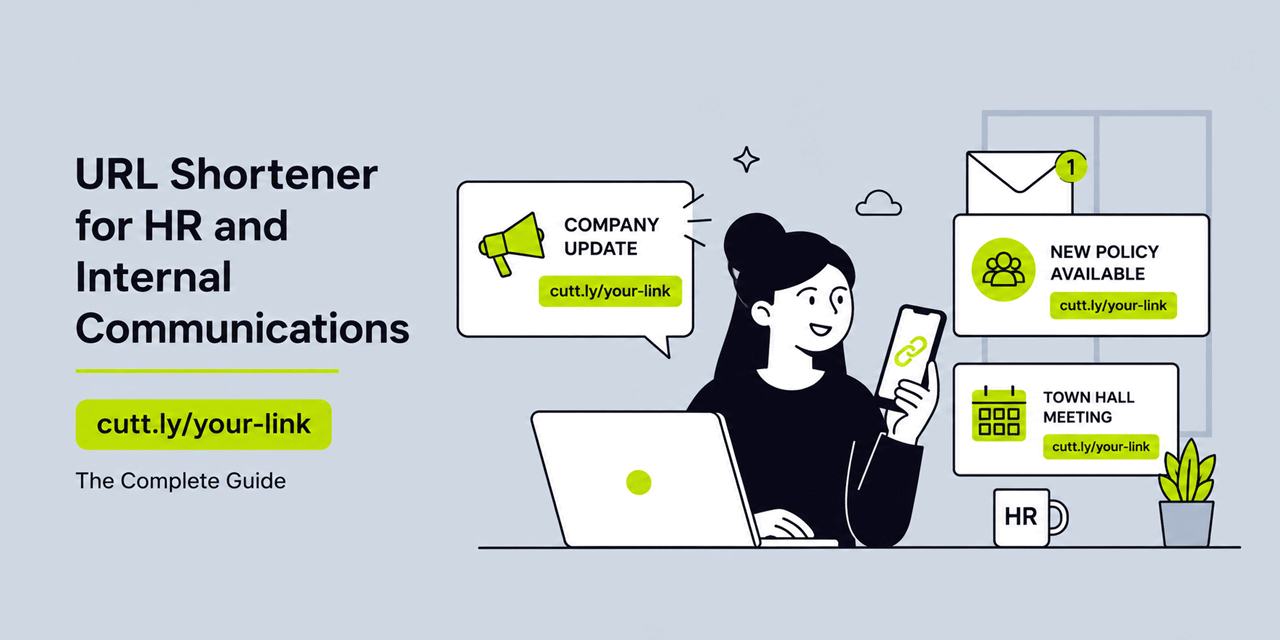
URL Shortener for HR and Internal Communications The Complete Guide
Internal communications is one of the most link-heavy disciplines in any organisation. HR teams send links to policy documents, benefits platforms, payroll systems, training modules, survey tools, job postings and onboarding materials every day. In most organisations these links are long, complex, forgettable and unmeasured. Short links and QR Codes solve these problems in internal communications exactly as they solve them in external marketing.
What This Guide Covers
- Why internal communications struggles with links
- Onboarding — the highest-value use case
- Policy distribution and compliance communications
- Benefits communications and open enrolment
- Learning and development communications
- Deskless and frontline worker communications
- Employee surveys and feedback mechanisms
- Internal job postings and mobility programmes
- Wellbeing and employee assistance programmes
- Setting up Cuttly for HR teams
- Measuring employee communications effectiveness
- Common mistakes in internal HR link management
Why internal communications struggles with links
Most organisations have accumulated dozens of different systems over time — an HRIS, a payroll platform, a learning management system, a benefits portal, an expense tool, a performance review system, a time and attendance platform, an intranet. Each of these systems has its own URL structure, and those URLs are typically long, complex and unmemorable.
When HR needs to communicate with employees about any of these systems — whether in a company-wide email, a manager briefing, a printed noticeboard posting or a new starter welcome pack — they are working with URLs that nobody types, nobody shares verbally and nobody remembers. And if the platform updates its URL structure, every piece of communication that contains it becomes wrong.
Short links solve the complexity problem. A branded short link like people.company.com/benefits or company.link/enrol is memorable, typeable, speakable and printable. It works in every channel — email, Slack, Teams, printed poster, noticeboard — and it can be updated when the destination changes without needing to reissue every communication.
The measurement problem is less discussed but equally important. Most HR teams have no way to know whether employees actually clicked the link in an all-staff email. Short link analytics provide the missing data layer: who clicked, when, from which device, in what volume.
Onboarding — the highest-value use case
A new employee's first days are information-dense and time-sensitive. They need to access multiple systems quickly, complete compliance training within deadlines and register for benefits within enrolment windows. Every additional click of friction, every broken link and every complex URL in the onboarding process is a small degradation of the new employee experience.
The practical approach is to create a small set of short links that cover everything a new employee needs in their first week:
- company.link/start — the main onboarding hub
- company.link/it — IT setup guide and account creation
- company.link/benefits — benefits portal enrolment
- company.link/payroll — payroll setup and direct deposit registration
- company.link/handbook — the current employee handbook
- company.link/training — mandatory compliance training modules
These six links replace what is typically a page of URLs in a welcome pack. They are easy to speak aloud in a first-day briefing, easy to type on a phone and easy to update when the underlying systems change.
Analytics on onboarding short links provide genuinely useful HR data. If the benefits enrolment link shows low click rates in the first week, it suggests that new starters are not receiving clear enough prompting to complete enrolment. If the IT setup link shows high click rates on mobile, it suggests that new starters are trying to complete setup on their phones before they have a laptop — which might indicate a gap in the IT provisioning process.
Policy distribution and compliance communications
Every organisation has policies that need to be communicated to all employees, acknowledged and periodically updated. Data protection policies, code of conduct, expense policies, health and safety policies, disciplinary procedures — these documents need to be accessible to every employee at any time.
Branded short links give each policy a permanent, memorable address. company.link/data-policy, company.link/expenses, company.link/safety. These links can be included in all policy communications, printed in employee handbooks, posted on noticeboards and included in onboarding materials. When the policy is updated, the link destination changes and all existing communications automatically point to the current version.
This dynamic updating capability is especially valuable for policies that change frequently — expense limits, holiday accrual rules, flexible working arrangements. Rather than re-issuing all communications every time a policy updates, the short link acts as a permanent reference that always points to the current version.
For compliance-sensitive communications — annual data protection refreshers, health and safety briefings, anti-bribery training — short links in reminder emails and manager briefing packs provide a direct path to completion that reduces friction and increases completion rates. The click data provides a preliminary indicator of engagement before formal completion is recorded in the compliance system.
Benefits communications and open enrolment
Benefits communication is one of the most complex challenges in HR communications. Most employees do not fully understand their benefits package. Annual enrolment periods generate a surge of questions and last-minute completions. New benefits launches require a communication push that competes with every other message employees receive.
Branded short links give each benefit a memorable entry point. company.link/pension, company.link/health, company.link/wellbeing. Use these links consistently across all benefits communications — emails, intranet articles, posters, manager talking points — and employees learn the addresses over time.
For annual enrolment periods, create campaign-specific short links that drive employees directly to the enrolment platform. A link like company.link/enrol2026 in all enrolment communications provides a direct path to action and generates click data that helps the HR team understand engagement in real time during the enrolment window.
Time-of-day analytics on benefits enrolment links reveal when employees engage with benefits communications. If the majority of clicks happen between 7pm and 9pm, employees are completing enrolment from home in the evening — which suggests that desktop-heavy enrolment platforms may be creating friction for a workforce completing this task on mobile.
Learning and development communications
Learning and development teams distribute more links than almost any other function in HR. Course enrolment links, module completion links, certification download links, webinar registration links, external learning resource links, coaching programme links — L&D is link-dense by nature.
For mandatory training campaigns — compliance training, data protection refreshers, fire safety, first aid — short links in campaign emails and manager briefing packs provide a direct path to the training module. A link like company.link/fire-training in an all-staff email takes employees directly to the module without navigating the LMS. Track clicks to identify non-completers before the deadline.
For optional development programmes — leadership development, mentoring schemes, skills workshops — a short link in the programme launch communication provides a low-friction expression of interest mechanism. An employee reading about a new leadership programme can click company.link/lead-apply immediately, while their interest is highest.
Deskless and frontline worker communications
Deskless and frontline workers represent the most significant link management challenge in internal communications. Warehouse operatives, retail staff, delivery drivers, healthcare workers, manufacturing employees — these workers do not sit at a computer all day. They do not have regular access to the company intranet. They may not have a company email address.
QR Codes are the most effective mechanism for connecting frontline workers with digital HR resources. A QR Code on a notice board in a staff break room is more accessible to a warehouse operative than an intranet URL in an email they check monthly. A QR Code on a physical payslip or a printed HR notice gives a worker with no desktop access a direct path to digital information.
The practical approach is to identify the five to ten things that frontline workers most frequently need to access — the holiday booking system, the payslip portal, the health and safety reporting tool, the shift swap platform, the pension portal — and create a QR Code for each, posted in every location where workers take breaks or check notices.
Analytics on QR Codes in frontline workplaces reveal engagement patterns that HR teams rarely have visibility of. Scan times tell you when frontline workers are accessing HR information — typically before shifts, during breaks and after shifts. Scan volumes tell you which QR Codes are generating the most interest and which systems need better mobile experiences.
Employee surveys and feedback mechanisms
Employee surveys are a critical HR tool — engagement surveys, onboarding surveys, exit interviews, pulse surveys. Response rates are a persistent challenge, and every mechanism that reduces friction between an employee and the survey form improves response rates.
Short links to survey platforms are more effective than full survey URLs in communications because they are shorter, more trustworthy in appearance and easier to click or type on mobile. A link like company.link/survey-q2 in an all-staff email is cleaner than the full SurveyMonkey or Qualtrics URL it replaces.
For multi-wave survey campaigns — where a survey is sent in a first wave, followed by reminders to non-completers — short link click data provides a complementary view of engagement to the survey platform's own response tracking. If a reminder generates high click volume but low additional completions, the problem is in the survey experience itself rather than in awareness.
Wellbeing and employee assistance programmes
Employee wellbeing communications require particular care with link presentation. An employee considering accessing mental health support, financial counselling or an employee assistance programme is in a sensitive moment. A complex, unfamiliar URL creates doubt about where the link goes.
Branded short links on the company's own domain reduce this friction. company.link/wellbeing or company.link/support is a more trustworthy and less stigmatising entry point than a specific EAP provider URL. The employee knows they are going somewhere the company has set up for their support.
For physical wellbeing programmes — gym discounts, cycle to work scheme, health checks — short links in communications and on office posters give employees a clean entry point into each programme. QR Codes in reception areas, lift lobbies and break rooms pointing to the wellbeing programme hub keep these resources top of mind in the physical workplace.
Setting up Cuttly for an HR or internal communications team
Choose a branded domain that fits the internal communications context. Options include a subdomain of the company domain (go.company.com or people.company.com), or a short version of the company domain. A subdomain of the main company domain typically provides the highest trust signal for employees.
Create a naming convention for internal short links that is intuitive and consistent. Group related links by function — people.company.com/benefits-health, people.company.com/benefits-pension, people.company.com/benefits-wellbeing — so that employees who learn one link can intuit related ones.
Use Cuttly's Campaign tagging to group links by communication campaign. Tag all links in the annual benefits enrolment campaign with one tag and you get aggregated click analytics for the entire campaign — total employee engagement across every channel and communication touchpoint.
Start improving your internal communications today — create a free Cuttly account, connect your branded domain and create your first HR communication link. Registration required; free plan available with no credit card needed.
Frequently Asked Questions
How can HR teams use short links for employee onboarding?
HR teams use short links in onboarding packs to give new employees clean, memorable access to key resources — the employee handbook, benefits portal, IT setup guides, payroll platform and first-week schedule. A branded short link like company.link/start replaces a list of long, complex URLs in a welcome pack. Click analytics show which resources new starters actually access, helping HR teams refine onboarding content over time.
Can short links help with internal policy distribution?
Yes. Branded short links pointing to the current version of each policy document replace long intranet URLs in all internal communications. When a policy is updated, the short link destination is changed to the new version. All existing communications, posters and QR Codes automatically point to the current document without needing to be reissued.
How do HR teams use QR Codes for deskless and frontline workers?
For deskless and frontline workers who do not have regular access to a company computer or intranet, QR Codes printed on notice boards, canteen posters and safety signage provide a direct connection between physical communications and digital HR resources. An employee can scan a QR Code on a noticeboard to access the holiday booking system, the benefits platform or the latest company update.
Can short links be used for training and learning management systems?
Short links work very well for distributing training links. A short link per course or per learning pathway is easier to communicate in emails and meeting invitations than a full LMS URL. Analytics show which training links are being clicked, when and by which devices — providing engagement data that supplements formal completion tracking in the LMS.
Are short links safe to use for internal HR communications?
Branded short links on your own company domain are as safe as any other internal link. Because you control the domain and the destination, there is no third-party routing risk. Cuttly does not store personally identifiable information in click analytics — it records aggregate data including click counts, device types and locations, not individual employee identities.
URL Shortener
Cuttly simplifies link management by offering a user-friendly URL shortener that includes branded short links. Boost your brand’s growth with short, memorable, and engaging links, while seamlessly managing and tracking your links using Cuttly's versatile platform. Generate branded short links, create customizable QR codes, build link-in-bio pages, and run interactive surveys—all in one place.
Cuttly - Consistently Rated
Among Top URL Shorteners
Cuttly isn’t just another URL shortener. Our platform is trusted and recognized by top industry players like G2 and SaaSworthy. We're proud to be consistently rated as a High Performer in URL Shortening and Link Management, ensuring that our users get reliable, innovative, and high-performing tools.


