URL Shortener for Electricians The Complete Guide
For most electricians, new work comes through three channels: Google search, word-of-mouth recommendation and visible local presence — the van parked outside a job, the neighbor who notices the name on the side and photographs it on their phone. These three channels all have a digital link component that most electricians leave unoptimized. A van wrap with a QR Code linking directly to a quote request form. A business card whose QR Code survives a platform change without reprinting. A job completion card that generates a Google Review from a satisfied customer before the electrician has driven away. A Google Business Profile with enough reviews to appear at the top of local search when someone in the area searches "electrician near me." None of these requires a marketing budget. All of them require a systematic approach to the links that connect the physical work to the digital presence.
This guide covers the complete link strategy for independent electricians and electrical contractors — from van wrap QR Codes and business cards through job completion cards, Google Reviews, quote request links, emergency call-out pages, referral systems and the per-channel attribution that shows where new work is actually coming from. For closely related trades contexts see also URL Shortener for Construction and Property Development and URL Shortener for Local Businesses.
What This Guide Covers
- How electricians acquire new work — the three channels
- Core standing links every electrician needs
- Choosing a branded domain
- Van wrap and vehicle QR Codes — passive lead generation
- Business cards with QR Codes
- Job completion cards — the highest-ROI printed asset
- Google Reviews — the primary trust signal in local trades
- Quote request links — removing friction from enquiries
- Emergency call-out links
- Post-job SMS follow-up with branded links
- Referral system for tradespeople
- Google Business Profile optimization
- Facebook and Nextdoor for local electricians
- Instagram for electrical contractors
- Certifications and compliance links
- Commercial and landlord client links
- Per-channel attribution — tracking where new jobs come from
- Multi-van and growing electrical businesses
- Cuttly plan guide for electricians
How Electricians Acquire New Work — The Three Channels
Understanding where electrical work comes from shapes every link decision. For most independent electricians, new work arrives through three distinct channels — and each has a specific link optimization opportunity.
Channel One: Google Search
When a homeowner needs an electrician — a tripping circuit breaker, a new EV charger installation, a full rewire, additional sockets — the first action for most people under 50 is a Google search: "electrician near me," "electrician [town name]," "emergency electrician [area]." The Google Maps results show local electricians with their star ratings, review counts and distances. The electrician with the highest review count at a strong rating wins this search — not necessarily the one closest or the cheapest. An independent electrician with 95 Google Reviews at 4.8 stars appears above a competitor with 6 reviews at 5.0 stars in virtually every local search result.
Channel Two: Word of Mouth
Neighbor-to-neighbor recommendation remains the highest-trust acquisition channel for trades. "Who did you use for your rewire?" is a question asked at fences, in WhatsApp groups and on Nextdoor every day. The electrician who gets recommended is the one whose work was excellent and whose name was memorable enough to recall weeks later. A business card or a completion card left at every job keeps the electrician's name and contact details in the home — giving the customer something specific to pass on rather than a vague "I used someone from Google."
Channel Three: Visible Local Presence
The van is the most powerful marketing asset most electricians own. Parked outside a job, it is visible to every resident on the street. A neighbor who sees an electrician's van regularly — on four different streets over several months — builds recognition that is worth more than any paid advertisement. A QR Code on that van converts passive recognition into an active quote request at the moment of decision.
Core Standing Links Every Electrician Needs
| Link | Destination | Primary deployments |
|---|---|---|
yourname.link/quote | Quote request form | Van wrap, business card, completion card, website |
yourname.link/review | Google Review form | Completion card, post-job SMS, van |
yourname.link/call | Click-to-call page or phone number | Van, emergency call-out contexts |
yourname.link/refer | Referral scheme page | Completion card, SMS to past customers |
yourname.link/certs | Certifications and accreditations page | Quote follow-up emails, LinkedIn, website |
All five links are dynamic. When the electrician rebuilds their website, changes their booking platform, or moves their quote form from one system to another, one destination update per link in Cuttly propagates across every van QR Code, every business card in circulation, every completion card left at previous jobs and every post-job SMS message already sent. For an electrician who prints business cards and completion cards in batches of 500, never needing to reprint because a URL changed is a straightforward operational advantage.
Choosing a Branded Domain
The branded domain for an electrician's short links should feel trustworthy, locally associated and memorable. A homeowner who photographs the van QR Code or reads the van's short URL while walking past needs to remember it or be confident scanning it. Patterns that work well:
- Solo electrician named Dave Hall →
davehallelectric.linkordaveelectric.link - "Spark & Son Electrical" →
sparkandsон.linkorsparkelectrical.link - "Meridian Electrical Services" →
meridianelec.link - "Fast Spark Electricians" →
fastspark.link quote.yourelectricalname.com— a subdomain of an existing website
The .link TLD is available for most electrical trade names and costs around $6–$12 per year. It reads naturally — sparkandsон.link/quote communicates its purpose clearly to anyone who sees it on a van. Connect to Cuttly via DNS in fifteen minutes — full guide at Cuttly Branded Domains.
Van Wrap and Vehicle QR Codes — Passive Lead Generation
A well-positioned QR Code on a van wrap is one of the most cost-effective passive lead generation assets available to any tradesperson. The van is already paid for. It is already visible to hundreds of people every day — parked outside jobs, on the road between jobs, parked overnight in a residential area. The QR Code adds a conversion mechanism to a passive brand impression at a cost of around $30–$80 for the QR Code sticker or its inclusion in a van wrap redesign.
Where to Position the Van QR Code
Position matters. The optimal van QR Code placement for maximum scan volume:
- Rear of the van. The most scanned position — the van stopped at traffic lights gives the driver behind a clear, close view of the QR Code for 30–60 seconds. This is the highest-dwell-time van marketing position available.
- Side of the van, lower half. Pedestrian-height placement for people walking past a parked van. The QR Code should be at a comfortable scanning height — roughly 3.5 to 4.5 feet from the ground — with a brief call to action above it: "Free quote in 60 seconds" or "Get a no-obligation quote."
- Magnetic door sign. For electricians who use a standard vehicle with a magnetic sign rather than a full wrap, a magnetic sign including the QR Code provides the same conversion mechanism at lower cost and with the flexibility to remove it when the vehicle is used privately.
Van QR Code Destination
The van QR Code destination — yourname.link/quote — should be a mobile-optimized quote request form that takes under two minutes to complete. Fields: name, phone number, address, brief description of the work required, preferred contact time. A form that requires more than five fields will lose a significant proportion of van-scan enquiries before completion. The confirmation after submission should be immediate and include a callback time commitment — "We will call you within two hours during working hours."
The Cuttly click analytics on the van QR Code — visible in the Cuttly dashboard as scans per day, peak scan times, device type — provide intelligence that most electricians never have: exactly how many people are scanning their van each week, which days generate the most scans (typically Monday and Friday), and whether scan volume changes by geographic area as the electrician moves between job sites.
Neighborhood Effect Analytics
For electricians who work in distinct neighborhoods or areas, creating a unique Cuttly link per area — yourname.link/quote-northside, yourname.link/quote-downtown — with each linked from the same van QR Code via a redirect test, or by using different QR Code stickers when working in different areas, provides geographic intelligence about which neighborhoods generate the most enquiries from van visibility. Over three months, this data shows which areas the electrician should prioritize for marketing activity and potentially for job scheduling to maximize van visibility in the highest-return neighborhoods.
Business Cards with QR Codes
An electrician's business card serves primarily as a referral tool — given to a satisfied customer to pass to someone they know who needs electrical work. The conversion of that referral from a card to a booked job depends on how easy the card makes it to contact the electrician or request a quote. A phone number alone requires the recipient to call during working hours. A QR Code linking to a quote request form — available 24 hours a day — captures the referral impulse at the moment it occurs, regardless of the time.
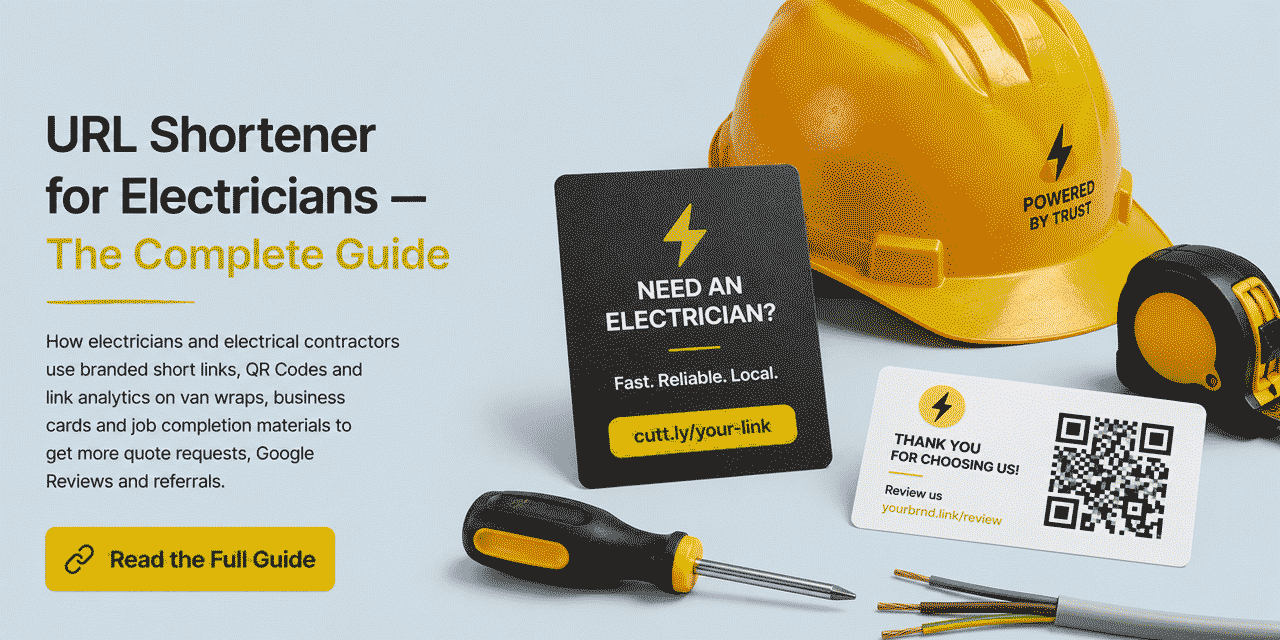
Optimal business card design for an electrician: front — name, NICEIC/NAPIT or equivalent certification mark, phone number, email, website and the short URL text (yourname.link/quote). Back — a large QR Code linking to yourname.link/quote with the brief text "Scan for a free no-obligation quote."
The certification mark deserves specific mention. For electricians in markets where certification is required — NICEIC Part P in England and Wales, NAPIT equivalent, NEC certification in the US — displaying the certification mark on the business card addresses the primary trust concern a homeowner has before inviting an unknown tradesperson into their home. A business card that carries both the quote QR Code and the certification mark removes the two biggest friction points — "is this legitimate?" and "how do I enquire?" — simultaneously.
Job Completion Cards — The Highest-ROI Printed Asset
The job completion card is the single most commercially valuable printed asset an electrician can produce, and almost no electricians use one. At the end of every job — after the consumer unit is installed, the sockets are tested, the EV charger is commissioned, the lighting circuit is sorted — the electrician leaves the property with the customer's payment and the customer is left with nothing except the work itself. Within a week, most customers cannot remember the electrician's name. Within a month, they cannot reliably describe the business to someone asking for a recommendation.
A job completion card, left with every customer at the end of every job, changes this dynamic permanently. The card stays in the kitchen drawer, on the kitchen counter or in a "useful contacts" file. When the neighbor asks who did the rewire, the customer picks up the card and hands it over. When an additional job comes up six months later, the customer scans the QR Code rather than trying to find the phone number from memory.
Job Completion Card Structure
Front of the card:
Electrician name and trading name
Phone number (large, prominent)
Certification mark (NICEIC, NAPIT or equivalent)
Date of job and brief description: "Electrical installation certificate issued [date]"
Back of the card — three QR Codes:
QR Code 1: "Leave us a Google review" → yourname.link/review
QR Code 2: "Book another job or get a quote" → yourname.link/quote
QR Code 3: "Refer a friend — you both save" → yourname.link/refer
All three QR Codes are Cuttly dynamic links. If the review link changes, the quote form moves to a new platform, or the referral scheme page updates — the completion cards already in homes across the service area continue redirecting correctly. A completion card printed today will still work accurately in three years.
Leaving completion cards costs approximately $0.10–$0.20 per card at typical small-batch print prices. Over a year of completing 300 jobs, the total print cost is $30–$60. The value of a single additional Google Review secured through a completion card QR Code, or a single additional job booked through a neighbor recommendation facilitated by a completion card, is worth many multiples of the total print cost.
Google Reviews — The Primary Trust Signal in Local Trades
In local trades, Google Reviews have a disproportionate effect on new work acquisition relative to almost any other marketing activity. A homeowner who needs an electrician and finds two options in Google Maps — one with 78 reviews at 4.9 stars, one with 4 reviews at 5.0 stars — overwhelmingly chooses the 78-review option. The reasoning is straightforward: 78 satisfied customers represents a verified track record of quality, reliability and professionalism across a range of job types. 4 reviews tells almost nothing about consistency.
Most electricians have dramatically fewer reviews than their job volume warrants. An electrician completing 10 jobs per week, 500 per year, should realistically have 75–150 Google Reviews from satisfied customers — yet most have under 20. The gap exists because no systematic request process is in place. The conversation at job completion ends with payment and pleasantries, not with a review request.
The Electrician Review System
- Completion card QR Code. The most durable placement — the card stays in the home indefinitely. The QR Code is there whenever the customer decides to leave the review, not only in the immediate post-job window.
- Verbal request at job completion. Delivered personally while handing over the completion card: "If you are happy with the work, a Google review at that QR Code really helps me get more work in the area — it only takes a minute." Personal, specific (pointing to the QR Code), and with a clear local benefit framing ("helps me get more work in the area") that resonates with customers who feel positively toward supporting a local business.
- Post-job SMS. Sent the day after the job is complete: "Thanks for having us today. If you were happy with the work, a Google review would really help: yourname.link/review — [Name]." Signed with the electrician's name to maintain the personal character of the communication.
- Invoice footer. A brief line at the bottom of the invoice — "If you were happy with our work, a Google review helps others find us: yourname.link/review" — catches customers who review the invoice carefully but were not verbally asked at the job.
Electricians who deploy all four touchpoints consistently and complete 8–10 jobs per week generate 5–15 new Google Reviews per month. Over 12 months, this transforms a profile with 12 reviews into one with 70–190 reviews — a fundamental change in Google Maps visibility and new job enquiry volume.
Quote Request Links — Removing Friction from Enquiries
A homeowner who wants to get a quote for electrical work has two options in most interactions with a traditional electrician: call during working hours (when the electrician is often on a job and cannot answer) or send an email that may take 24–48 hours to receive a response. Both options introduce friction and delay at the moment of highest decision intent. A quote request form available 24/7 via a QR Code or short URL captures this intent immediately.
yourname.link/quote should land on a form that takes under two minutes to complete on a mobile phone — because virtually all van QR Code scans happen on mobile. Fields should be limited to the absolute minimum needed to provide a useful quote callback: name, phone number, postcode, brief job description and preferred callback time. The form should confirm immediately on submission with a realistic callback commitment.
For electricians using platforms like Checkatrade, Rated People or TrustATrader that have their own enquiry forms, the platform's profile URL becomes yourname.link/quote — putting a clean branded entry point in front of a platform that handles the enquiry routing. When the platform changes or the electrician switches from one aggregator to another, one Cuttly destination update maintains continuity across all printed materials.
Emergency Call-Out Links
Emergency electrical call-outs — a total power failure, a burning smell from a socket, a tripped RCD that will not reset — are the highest-urgency and often highest-value jobs an electrician handles. The customer in an emergency is not browsing Google Maps; they are making a phone call or tapping the first available link. Being the first electrician they reach is what matters.
yourname.link/emergency links to a dedicated emergency page that shows: the electrician's phone number as a large tap-to-call button (the primary action in an emergency), a clear statement of availability ("24/7 emergency call-out available" or "Emergency response within 2 hours in [area]"), and a brief description of what constitutes a genuine electrical emergency versus a job that can wait.
This link belongs on the Google Business Profile as the primary action URL for electricians who offer emergency call-out, in the van QR Code secondary destination for evening and weekend scans, and on any local directory listings. Cuttly analytics on the emergency link show call-out enquiry volume by time of day — showing whether evening emergency enquiries justify staffing a late call-out service, or whether early morning enquiries represent the primary emergency demand profile.
Referral System for Tradespeople
A structured referral system — with a clear incentive and a frictionless mechanism — converts the occasional organic word-of-mouth recommendation into a consistent acquisition channel. For trades, the incentive that works best is a discount on future work rather than cash: a customer who refers a friend receives a $50 credit toward their next job. This keeps the incentive within the service relationship and motivates referrals from customers who plan to use the electrician again.
The referral system mechanics: a completion card QR Code linking to yourname.link/refer — a page that explains the incentive and provides a simple way to share the referral (a pre-written WhatsApp message with the electrician's quote link, a shareable URL, or a personal referral code that tracks attribution). When a referred customer submits a quote request using the referral code, both parties are credited automatically.
Cuttly analytics on the referral page show how many past customers are accessing the referral programme. If 40 customers visit the referral page per month but only 5 referral attributions are tracked in the booking system, either the referral mechanism has too much friction, or customers are referring informally without using the code. The first scenario is fixable; the second suggests the referral culture is healthy but the tracking could be improved.
Facebook and Nextdoor for Local Electricians
Facebook and Nextdoor are the two social platforms where local trade recommendations most actively occur. Both platforms have community recommendation dynamics — a homeowner asks "can anyone recommend a reliable electrician?" and receives replies from neighbors. Being one of the recommended electricians in these conversations is one of the most effective local marketing outcomes available.
Electricians who are active in local Facebook community groups — responding to recommendation requests promptly, posting occasional updates about the types of work they handle — build local visibility that compounds over time. A response to a recommendation request: "We cover [area] — fully NICEIC certified, get a free no-obligation quote at yourname.link/quote or call [number]." The branded short link makes the response immediately actionable; a potential customer who taps it lands directly on the quote form.
For tracking which Facebook groups or Nextdoor areas generate the most enquiries, create unique Cuttly links per community: yourname.link/quote-oakgrove for the Oak Grove Facebook group, yourname.link/quote-northpark for the Northpark Nextdoor area. After three months, the data shows which communities generate the most quote requests — allowing prioritized engagement in the highest-return local communities.
Instagram for Electrical Contractors
Instagram is increasingly used by tradespeople to showcase their work — and electrical work photographs better than most people expect. A neatly installed consumer unit with perfectly arranged cables, an EV charger installation on a clean garage wall, a professional outdoor socket installation, a loft conversion lighting scheme — these are genuinely satisfying images that demonstrate skill and attention to detail in a single glance. An electrician with an active Instagram account showing high-quality completed work builds the visual portfolio that helps a homeowner decide "yes, I want this person doing my rewire."
Content that performs well for electricians on Instagram: before-and-after shots of consumer unit upgrades (the most visually dramatic electrical transformation), EV charger installations (a growing, high-interest niche with significant search and social media traffic), neat wiring and cable management close-ups (appeals strongly to the detail-oriented homeowner), and educational content (how to identify an outdated fuse box, what an EICR is and why it matters for landlords, how to tell if a socket needs replacing).
The Instagram bio link is the same Cuttly Link in Bio page as any other channel — yourname.link — with buttons for quote request, Google Reviews, emergency call-out and certifications page. TikTok follows the same content approach with the same link infrastructure: the geographic algorithm gives strong local reach to trades content, and time-lapse installation videos perform particularly well in the trades category.
Certifications and Compliance Links
For homeowners, landlords and property managers choosing an electrician, the question of certification is the primary trust question — not price, not availability, but "is this person qualified and legally authorized to do this work?" In England and Wales, Part P of the Building Regulations requires certain electrical work to be carried out by a competent person registered with a government-approved scheme such as NICEIC or NAPIT. In the US, state licensing requirements vary but are often the first thing a homeowner checks. In Australia, electrical licensing is mandatory in every state.
A dedicated certifications page — yourname.link/certs — provides a clear, accessible answer to this trust question before it becomes a concern. The page should include: the certification scheme membership with current certificate number, a link to verify the certification on the scheme's own website, the types of work covered, the geographic area served, and any specialist qualifications (EV charger installation, solar PV, fire alarm systems). This link appears in quote follow-up emails, in the Google Business Profile description, on business cards and in any context where a potential client is evaluating credentials.
Cuttly analytics on the certifications link show how frequently potential clients check credentials before booking. If 30 people visit the certifications page per month, credentials are a meaningful decision factor — prominently featuring the certification mark on all marketing materials and linking to the verification page in every quote response is worth the emphasis. This data also reveals whether the certifications page is being accessed primarily from the Google Business Profile (pre-booking research) or from quote follow-up emails (post-quote due diligence) — informing where to feature the certification link most prominently.
Commercial and Landlord Client Links
Commercial electrical work — offices, retail units, hospitality venues, light industrial — and landlord maintenance contracts represent recurring, higher-value work streams for electricians who cultivate them. Commercial clients and landlords have different requirements from residential customers: they need PAT testing, periodic inspection and testing reports (PIRs or EICR certificates), emergency lighting compliance checks, and often have multiple properties requiring regular maintenance.
A dedicated commercial and landlord services page — yourname.link/commercial — covers: the types of commercial work handled, the certifications and compliance services offered, the turnaround time for EICR certificates and testing reports, and a contact form for commercial clients and property managers. This link is referenced in LinkedIn content targeting property managers and landlords, in direct email outreach to local letting agents, and in any commercial directories or trade association listings.
Landlords with multiple properties represent the highest-value long-term commercial relationship for most small electrical businesses. A landlord with 15 properties requiring annual EICR testing represents a guaranteed 15 days of EICR work per year plus all fault-finding and installation work across the portfolio. A dedicated landlord page — yourname.link/landlords — with specific information about EICR scheduling, certificate turnaround and multi-property discount structures, referenced in local letting agent outreach, is a targeted investment in the highest-value segment.
Per-Channel Attribution — Tracking Where New Jobs Come From
Most electricians have a general sense of where their work comes from — "mostly recommendation and Google" — but no precise channel attribution. The difference between knowing and having a data-driven answer matters when deciding whether to pay for a Checkatrade subscription, whether to invest in a new van wrap, or whether to prioritize Facebook group activity versus Google Business Profile optimization.
| Channel | Cuttly link | Measures |
|---|---|---|
| Van QR Code | yourname.link/quote-van | Van visibility to enquiry conversion |
| Business card | yourname.link/quote-card | Card distribution to enquiry conversion |
| Completion card | yourname.link/quote-completion | Past customer return and referral rate |
| Google Business Profile | yourname.link/quote-google | Search intent conversion |
| Facebook group | yourname.link/quote-fb | Facebook community conversion |
| Nextdoor | yourname.link/quote-nextdoor | Nextdoor community conversion |
| Checkatrade/Rated People | yourname.link/quote-checker | Platform subscription ROI |
After three months of tracking, the attribution data for a typical independent electrician reveals the true picture. A common finding: the completion card generates a surprising proportion of return and referral enquiries — past customers who come back for additional work, or who hand the card to a neighbor. The Google Business Profile drives the most high-intent new customer enquiries. The Checkatrade subscription generates fewer enquiries than expected at its monthly cost. The van QR Code generates steady, consistent enquiry volume that none of the digital channels replicate because it reaches people in the moment of geographic awareness — when they see the van on their own street.
This data does not make the marketing decisions — the electrician does. But it replaces the guesswork with evidence. The question "is the Checkatrade subscription worth renewing at $500 per year?" is answered by the data — not by the Checkatrade sales representative.
Cuttly Plan Guide for Electricians
The Free plan ($0) includes link shortening, QR Code generation and basic analytics on the cutt.ly domain. Useful for testing before committing. A cutt.ly link on a van wrap or business card carries no brand identity and looks unprofessional in a trade context where credibility is everything.
The Starter plan ($12/month) adds a branded custom domain, full analytics, dynamic link destinations, QR Codes at print resolution and a Link in Bio page. The right plan for most independent electricians and small electrical businesses. At $12/month — less than the revenue from an hour's work — it provides the complete link infrastructure for van wrap QR Codes, business cards, completion cards, Google Reviews and social media management. Less than a single tank of van diesel per month.
The Single plan ($25/month) adds five branded domains and retargeting pixels — useful for electricians running Facebook or Google paid ads alongside organic activity, or for electrical businesses operating under multiple trading names.
The Team plan ($99/month) suits growing electrical businesses with multiple engineers, multiple vans and a need for per-engineer link attribution — showing which engineer's van, completion cards and Google Reviews are generating the most new work.
Create a free Cuttly account and set up your first electrician quote request link today. Registration required; free plan available with no credit card needed.
Frequently Asked Questions
How do electricians use QR Codes on vans and vehicles?
A Cuttly QR Code on the van rear and side links to the quote request form — capturing neighbor enquiries when the van is parked outside a job. Optimal positions: rear of van (visible from traffic behind) and side at pedestrian height. Dynamic Cuttly links mean the destination stays current even if the website or booking platform changes, without reprinting the wrap.
How do electricians get more Google Reviews?
Completion card QR Code, verbal request at job end, post-job SMS the following day, and invoice footer link. All pointing to yourname.link/review — the direct Google Review form. Consistent deployment across 8–10 jobs per week generates 5–15 new reviews per month.
How do electricians use short links on business cards?
QR Code on the back of the card links to yourname.link/quote — a mobile-optimized quote request form. When the card is passed along as a recommendation, the recipient can submit a quote request before the impulse fades. Dynamic link means platform changes do not require a reprint.
What is a job completion card and how does an electrician use it?
A small branded card left with every customer at job end — containing contact details, the job date, the certification mark, and three QR Codes for Google Reviews, quote requests and referrals. The most commercially valuable printed asset an electrician can produce, at a cost of around $0.15 per card.
How do electricians compete with larger electrical contractors on marketing?
On local trust — Google Reviews, van visibility and neighbor recommendation. An independent with 80 Google Reviews at 4.9 stars wins local search against a large firm with no local review presence. Branded QR Codes on the van and completion cards make the independent's marketing as professional as any larger competitor at a fraction of the cost.
- Cuttly Tools
- URL Shortener Tool →
- QR Code Generator →
- Branded Domains →
- Link Analytics →
- Related Industries
- URL Shortener for Construction & Property
- URL Shortener for Local Businesses
- URL Shortener for Real Estate Agents
- Related Guides
- URL Shortener for SMS Marketing
- Short Links for Print & Offline
- Encyclopedia
- Dynamic QR Codes
- Branded Links
- All Industries →
- Start Here
- Create Free Account
- Plans & Pricing
URL Shortener
Cuttly simplifies link management by offering a user-friendly URL shortener that includes branded short links. Boost your brand’s growth with short, memorable, and engaging links, while seamlessly managing and tracking your links using Cuttly's versatile platform. Generate branded short links, create customizable QR codes, build link-in-bio pages, and run interactive surveys—all in one place.
Cuttly - Consistently Rated
Among Top URL Shorteners
Cuttly isn’t just another URL shortener. Our platform is trusted and recognized by top industry players like G2 and SaaSworthy. We're proud to be consistently rated as a High Performer in URL Shortening and Link Management, ensuring that our users get reliable, innovative, and high-performing tools.


