URL Shortener for Construction and Property Development The Complete Guide
Construction and property development operate across long timescales, complex stakeholder networks and a mix of physical and digital communications that most industries never have to manage simultaneously. A development site is both a physical place that thousands of passersby encounter every day and a digital product marketed to buyers months or years before a single unit is complete. Short links and QR Codes sit at the intersection of these two worlds.
What This Guide Covers
- Why construction and development needs better link management
- Site hoardings and construction signage
- Property developer marketing — off-plan sales and launches
- Tender and procurement documents
- Project communications and document management
- Show homes, sales suites and visitor experience
- Contractor and subcontractor management
- Planning and public consultation
- Property management and building handover
- Setting up Cuttly for a construction organisation
- Use cases by role in the sector
- Measuring the value of construction marketing
Why construction and development needs better link management
Construction and property development are document-intensive industries. A single major project generates thousands of documents — drawings, specifications, reports, contracts, programmes, risk registers, health and safety files, planning consents, warranties, handover packs. These documents need to be shared quickly with large numbers of people across the life of a project that may last three to five years.
The traditional approach is to send documents by email or share them via project management platforms with long, complex URLs that are impractical to communicate verbally, impossible to print legibly and break whenever folder structures change. Short links solve all three problems — they are communicable, printable and persistent regardless of where the underlying documents move.
At the marketing end, construction and development organisations invest in site hoardings, press advertising, direct mail and printed brochures but have limited ability to measure which of these investments is generating real interest. Short links and QR Codes make every physical marketing surface trackable — turning a site hoarding from a brand visibility exercise into a measurable marketing channel.
Trust and professionalism matter enormously in construction and property. Buyers spending hundreds of thousands of pounds on a new home pay close attention to every detail of how a developer presents themselves. A generic shortener link on a luxury development brochure undermines the brand signal the brochure is trying to create. Branded short links maintain the professional presentation at every touchpoint.
Site hoardings and construction signage
The construction site hoarding is one of the most distinctive physical advertising formats in existence. A hoarding around a city-centre development site is seen by thousands of pedestrians, drivers and commuters every day for months or years. It is an enormous, persistent, high-visibility advertising surface — and for most developers, it remains almost entirely unmeasured.
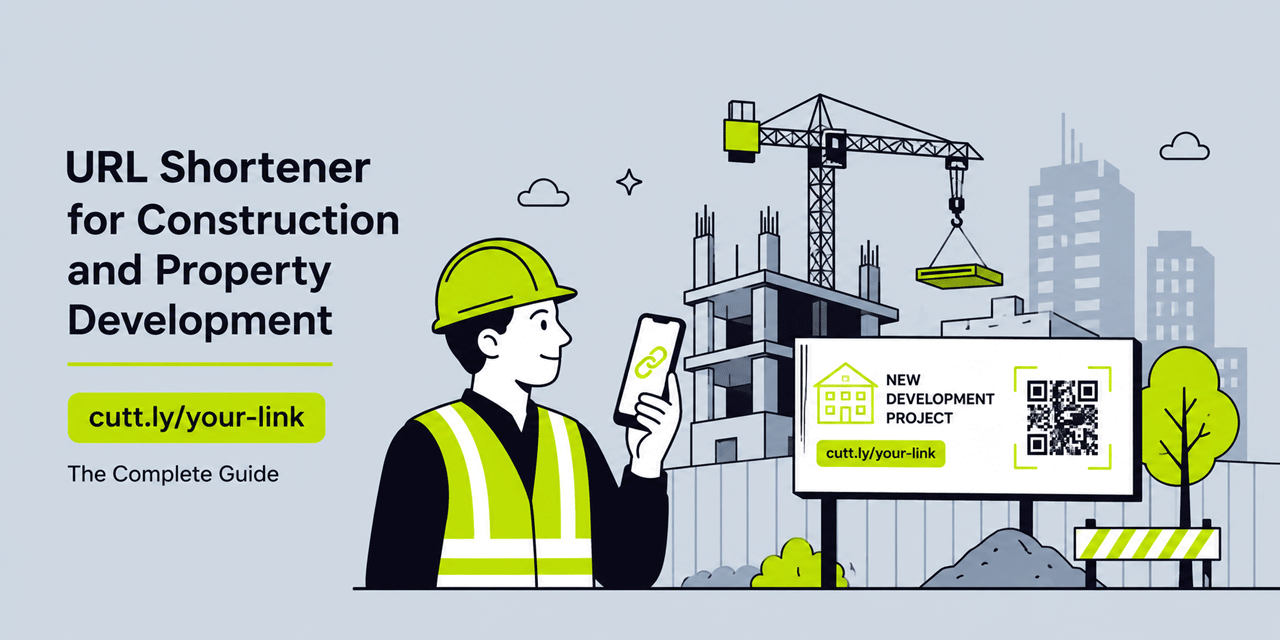
A QR Code on a site hoarding transforms this from a brand awareness exercise into a trackable marketing channel. Passersby who are curious about the development can scan immediately and access project information, CGI imagery, the sales registration page or planning consultation materials. Every scan is recorded. You know how many people the hoarding is generating, at what times of day, from which device types.
For a hoarding at pedestrian height, a QR Code of at least 15-20cm square works reliably at one to two metres scanning distance. Include the short link text alongside the QR Code for accessibility and for people who prefer to type. Use a separate short link for each hoarding location if the site has multiple panels — this lets you understand which sections are generating the most scans.
Because hoardings are in place for long periods, the ability to update the destination URL without replacing the hoarding is particularly valuable. A development in the pre-planning phase might link to a planning consultation page. Once planning is granted, the same hoarding link redirects to the sales launch page. Once units are selling, it redirects to the reservation platform. One hoarding, multiple campaign phases, no reprinting.
Property developer marketing — off-plan sales and new development launches
Off-plan property sales present a unique marketing challenge. You are selling something that does not yet exist to buyers who need to commit significant financial resources based on drawings, CGIs, specifications and the reputation of the developer. Every element of the marketing materials needs to be precise, professional and trustworthy — and every element needs to be measurable.
Short links sit throughout the off-plan sales journey. In the initial awareness phase, short links on press advertising, digital billboards and social media drive traffic to the development registration page. A separate short link per channel allows the sales team to understand which channels are generating the most qualified registrations.
For the sales brochure, short links replace the long, complex URLs that might point to a CGI tour, a floor plan download, a price list or a reservation form. A clean branded link in a printed brochure — developer.link/floorplans or brand.link/reserve — is more likely to be used than a thirty-character URL that a buyer has to type accurately from a printed page.
Link analytics for off-plan sales provide genuinely valuable commercial data. Understanding which floor plans are generating the most interest, which price brackets are attracting the most document views, which marketing channels are producing the most reservation-stage engagement — this data informs stock release sequencing, pricing strategy and channel investment decisions.
Tender and procurement documents
The procurement phase of a construction project generates enormous quantities of documentation. An employer's information requirements, a BIM execution plan, a specification pack, a suite of drawings, a programme, a risk register — all of these need to be made available to tenderers quickly, cleanly and in a way that ensures they always have access to the current version.
Short links in tender documents replace long file-sharing URLs that are ugly in print, break when folder structures change and give no information about whether tenderers have actually accessed the materials. A short link like company.link/tender-2026 in a cover letter gives tenderers one clean URL to access all tender materials. Track clicks and you know which firms have accessed the documents — useful context when evaluating the quality of submissions.
For addenda and clarifications issued during a tender period, short links allow you to communicate updated information clearly. Rather than re-issuing an entire document pack, a short link in the addenda notice points to the updated files. Tenderers access exactly what has changed. You track who has seen the update.
Project communications and document management
Once a project is underway, the volume of documents in circulation accelerates dramatically. Drawings are issued, revised and superseded. Specifications change. Health and safety documents are updated. Programme revisions are issued. Each of these document flows is an opportunity for miscommunication — and short links help manage all of them.
A project short link index — a single branded URL pointing to a project information portal — gives every project participant one address to access all current project information. Distribute this link at project start-up meetings, include it in every covering email and print it on site accommodation notice boards.
For health and safety documentation — construction phase plans, risk assessments, method statements, toolbox talk materials — short links pointing to current approved versions ensure that site operatives are always accessing the right documents. Print QR Codes pointing to safety documents in site welfare facilities. A site operative who needs to check a method statement can scan rather than search.
Show homes, sales suites and visitor experience
The show home and sales suite experience is the highest-value touchpoint in new home sales. A buyer visiting a show home is already significantly engaged — they have made an active effort to visit and are considering a major financial commitment.
QR Codes in a show home provide access to information without requiring sales staff involvement for every query. A buyer standing in the kitchen who wants to know the exact specification can scan a QR Code on the worktop and access the full kitchen specification immediately. A buyer in the garden who wants to understand the plot boundaries can scan and access the site plan. This self-service model respects the buyer's autonomy and allows sales staff to focus on high-value conversations.
For buyers who have visited but not yet reserved, short links in the follow-up email or printed follow-up pack provide easy access to the materials they need to continue their decision-making — updated price lists, available plot plans, mortgage calculator, reservation terms. Track clicks on these follow-up links to understand buyer engagement and prioritise active leads.
Contractor and subcontractor management
Main contractors managing complex supply chains face significant communications challenges. Site programmes change. Drawing revisions are issued. Health and safety briefings need to reach large numbers of operatives quickly. Short links provide a simple, reliable mechanism for distributing current information to a diverse supply chain.
A short link per work package — pointing to the current drawings, specification and programme for that package — gives each subcontractor a single reference point for everything they need. When documents are updated, the destination updates. The subcontractor uses the same link they have always used and automatically accesses the current information.
For plant and equipment inspections, QR Codes on plant can link to the maintenance log, the current test certificates, the operator manual and the emergency contact information for that specific item of plant. A site supervisor checking plant can scan the QR Code and immediately access all compliance documentation.
Planning and public consultation
Planning applications for major developments require public consultation and transparent communication with planning authorities, local residents and community groups. Short links and QR Codes make this engagement more accessible and more measurable.
For public consultation events, QR Codes on display boards allow attendees to access digital versions of the consultation materials, submit comments and access supporting technical documents. A short link on consultation leaflets distributed in the local area gives residents a clean, accessible way to participate without needing to attend a physical event.
For community liaison throughout the construction period — noise management updates, road closure notices, delivery management communications — a regularly updated short link in printed communications to local residents gives the local community a reliable reference point for current project information. Update the destination when new information is available without needing to reprint and redistribute leaflets.
Property management and building handover
The handover phase is when a project transitions from construction to occupation. For the developer or contractor, handover involves distributing large amounts of documentation — operating manuals, warranties, inspection records, as-built drawings, building safety case documentation — to building owners, facilities managers and residents.
A building handover short link — pointing to a digital handover pack or document management platform — gives the incoming building management team a single reference point for all building documentation. This link can be included in handover letters, printed in building management materials and shared with the building safety manager.
For residential developments, short links in the new home welcome pack give residents easy access to the resident information portal, the building management app, the defects reporting system and the concierge service. A QR Code on the welcome pack cover allows residents to access all of this from a phone scan on the day they move in.
Setting up Cuttly for a construction or development organisation
Connect a branded domain that reflects the organisation's brand. For a developer called Apex Developments, a domain like apexdev.link gives branded short links that match the company's professional presentation. Use the same domain across all projects and divisions for consistency.
Create a link naming convention that matches the project structure. For a project called City Quarter Phase 2, links might follow a pattern like apexdev.link/cq2-brochure, apexdev.link/cq2-floorplans, apexdev.link/cq2-reserve. This makes links easy to identify in analytics and easy to communicate to internal teams.
Use Cuttly Campaigns to group links by project. Tag all links for City Quarter Phase 2 with a campaign tag and you get aggregated analytics for the entire project — total clicks across all materials, all channels and all phases — in one view. Compare project campaigns to understand which developments are generating the most marketing engagement.
Start tracking your construction and development links today — create a free Cuttly account, connect your branded domain and create your first project link with a QR Code. Registration required; free plan available with no credit card needed.
Frequently Asked Questions
How do construction companies use QR Codes on site hoardings?
Construction companies place QR Codes on site hoardings to give passersby instant access to project information — planning details, developer contact information, sales registration pages, CGI imagery and development progress updates. The QR Code links to a dynamic short link so the destination can be updated as the project progresses without replacing the hoarding.
Can short links be used in construction tender documents?
Yes. Short links in tender documents and specification packs allow contractors and consultants to link to supporting documents, drawings, specification libraries and BIM files without cluttering the document with long URLs. You can track which recipients clicked which links, providing useful engagement data during the procurement process.
How do property developers use short links for off-plan sales?
Property developers use short links in off-plan sales to link brochures, CGI tours, floor plan PDFs, price lists and reservation forms to a single clean branded URL. They create separate links per development phase, per apartment type and per advertising channel to understand which sources are generating the most qualified interest.
What is the best way to share construction project documents with subcontractors?
A branded short link pointing to a shared document folder or project management platform is the cleanest way to distribute documents to subcontractors. It is easier to communicate in a briefing or on a phone call, it can be updated if the document location changes, and click analytics show who accessed the documents and when.
How can housebuilders track which marketing channels are generating site visits?
Create a unique short link for each marketing channel — one for the site hoarding, one for the press ad, one for the direct mail campaign, one for the show home flyer — and track clicks separately. By grouping these links into a Cuttly Campaign, you get a unified view of total traffic to the development while also seeing which individual channels are driving the most interest.
- Construction & Property
- URL Shortener Tool →
- QR Code Generator →
- Related Guides
- Short Links for Real Estate
- Short Links for Architecture
- Short Links for PDF Sharing
- Branded Short Links Guide
- QR Code Generator Guide
- Short Links in Offline Campaigns
- Short Links for B2B
- Start Here
- Create Free Account
- Plans & Pricing
URL Shortener
Cuttly simplifies link management by offering a user-friendly URL shortener that includes branded short links. Boost your brand’s growth with short, memorable, and engaging links, while seamlessly managing and tracking your links using Cuttly's versatile platform. Generate branded short links, create customizable QR codes, build link-in-bio pages, and run interactive surveys—all in one place.
Cuttly - Consistently Rated
Among Top URL Shorteners
Cuttly isn’t just another URL shortener. Our platform is trusted and recognized by top industry players like G2 and SaaSworthy. We're proud to be consistently rated as a High Performer in URL Shortening and Link Management, ensuring that our users get reliable, innovative, and high-performing tools.


