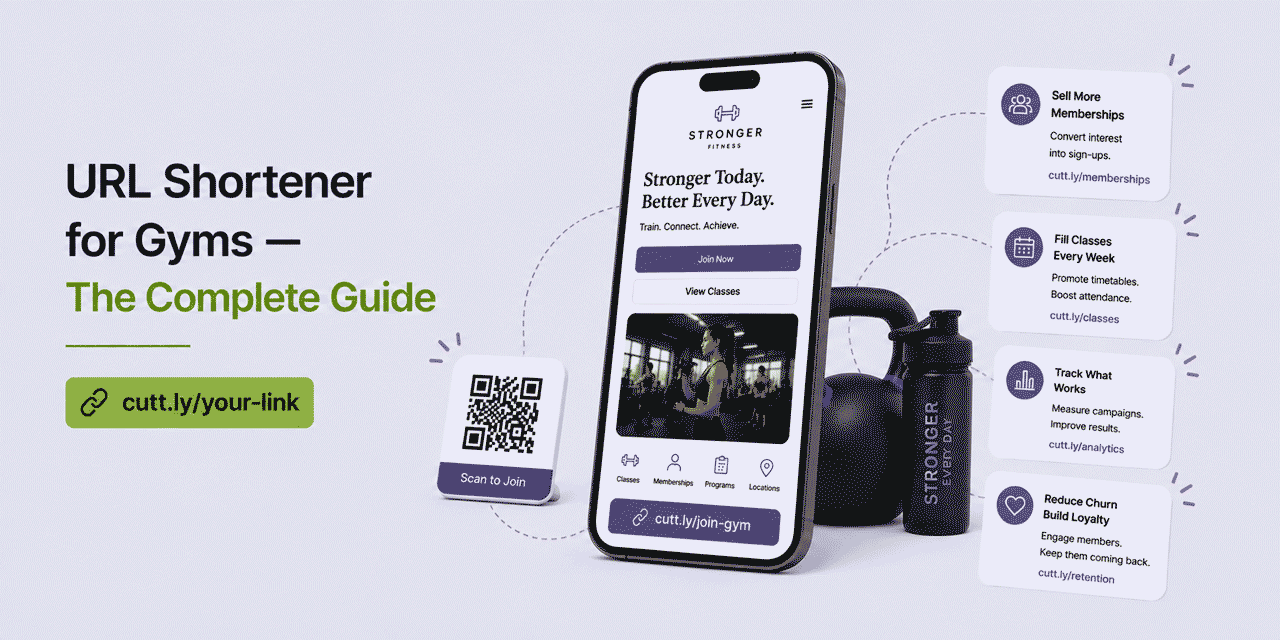
URL Shortener for Gyms The Complete Guide
Running a gym in a competitive local market means competing with PureGym's $25-per-month model, Anytime Fitness's 24/7 access offer, and the relentless convenience of Peloton and home workout apps — all while managing facility costs, staff, equipment maintenance and the inherent challenge of keeping members motivated enough to keep paying. Marketing is where independent gyms and fitness studios most consistently underperform relative to their actual product quality. The training environment, the community, the coaching and the personal relationships that an independent gym offers are genuinely superior to what a chain delivers — but the marketing that communicates this to potential members is often improvised, untracked and ineffective. A structured link strategy costs almost nothing and fixes this gap systematically.
This guide covers the complete link management approach for gyms, fitness studios, CrossFit boxes, functional training facilities and health clubs — from membership acquisition links through in-facility QR Code infrastructure, class booking, personal trainer booking, corporate wellness, retention campaigns and per-channel attribution. For related contexts see also URL Shortener for Personal Trainers and URL Shortener for Sports and Fitness.
What This Guide Covers
- The gym marketing problem that link strategy solves
- Core standing links every gym needs
- Choosing a branded domain for a gym
- Window and entrance QR Codes — the 24/7 membership funnel
- Free day pass and trial membership links
- In-facility QR Code placement strategy
- Equipment and workout station QR Codes
- Changing room and reception desk QR Codes
- Class timetable and booking links
- Personal trainer booking links
- Instagram and TikTok — content strategy and Link in Bio
- WhatsApp for gym member communications
- Email campaigns for gyms — January, September and retention
- SMS marketing for gyms
- Google Reviews for gyms
- Corporate wellness and employer links
- Referral programme links
- Guest pass and day pass links
- Retention campaigns — reducing member churn
- Per-channel attribution — knowing what drives new members
- Multi-site gym group management
- Cuttly plan guide for gyms
The Gym Marketing Problem That Link Strategy Solves
Most independent gyms and fitness studios spend marketing budget across multiple channels — Google Ads, Instagram posts and ads, local leaflets, window posters, referral incentives — and have no reliable way to know which of these activities actually signs up new members. They know their total new member count each month. They do not know whether those new members came from the Instagram ad they ran at $600, the leaflet drop to 2,000 local addresses at $350, or the window poster that cost $60 to print.
This attribution gap is not a minor inconvenience. Over 12 months, a gym spending $1,000 per month on marketing without knowing what works is potentially wasting $6,000–$8,000 per year on channels that produce no members while underfunding the channels that produce most of them. Per-channel Cuttly links — one unique branded link per marketing channel, all pointing to the free trial or membership page — close this gap completely for less than the cost of a single month's Instagram ad spend.
Beyond attribution, the second problem link strategy solves is friction. A potential member who sees the gym window at 9pm on a Sunday and wants to find out about a free trial has three options without a QR Code: remember to look it up tomorrow (most do not), type the gym's website URL from memory (most cannot), or pull out their phone and search Google (most find a chain instead). A window QR Code pointing to a free trial page converts that 9pm impulse into a registered trial before they reach their car.
Core Standing Links Every Gym Needs
Establish these permanent branded short links before building campaign-specific or per-channel tracking links. These deploy consistently across all materials and channels, with only destinations changing when underlying pages update:
| Link | Destination | Primary deployments |
|---|---|---|
yourbrnd.link/join | Membership sign-up or options page | Window, social bio, email, SMS, leaflets |
yourbrnd.link/free-pass | Free day pass or trial week registration | Window QR Code, social media, paid ads, referrals |
yourbrnd.link/classes | Class timetable and booking page | Studio QR Codes, Instagram bio, email, WhatsApp |
yourbrnd.link/pt | Personal trainer booking or profiles page | Gym floor QR Codes, email to members, social media |
yourbrnd.link/review | Google Review form | Changing room, reception desk, post-join SMS |
All five links are dynamic. When the gym switches from Mindbody to TeamUp, from a legacy booking system to a new app, or when the website is relaunched — one destination update per link in Cuttly propagates across every deployed QR Code, every printed leaflet and every social media post that references the link. For a gym with QR Codes on twenty pieces of equipment, six studio entrances, four changing room posters and two window stickers, this operational resilience is significant.
Choosing a Branded Domain for a Gym
The gym's branded domain for short links should feel energetic, associated with the facility name and memorable enough to be spoken in a class or mentioned in a social media video. Well-chosen domain patterns:
- "Iron & Grit Gym" →
ironandgrit.linkorirongrит.link - "Peak Performance Fitness" →
peakfit.linkorpeakperformance.link - "CrossFit Meridian" →
cfmeridian.link - "The Strength Lab" →
strengthlab.link gym.yourstudioname.com— a subdomain of the existing website, if it has a strong domain
The .link TLD is available for most fitness-related names and costs around $6–$12 per year. Connect to Cuttly via DNS in under fifteen minutes — full instructions at Cuttly Branded Domains. Once connected, every short link created in Cuttly can use the gym's branded domain.
Window and Entrance QR Codes — The 24/7 Membership Funnel
A gym window QR Code operates around the clock — capturing the person who jogs past at 6:30am and notices the facility for the first time, the person who drives past at 10pm and thinks "I really should join a gym," and the person who has been referred by a friend and walks to the address to see what it looks like before committing. None of these people are going to call the gym the next morning. Most will not remember to look it up online. A QR Code converts the impulse before it fades.
Primary Window Placement
The primary window QR Code links to the free pass or trial offer — the lowest-barrier, highest-conversion entry point for new members. The call to action should be specific and benefit-focused:
High-converting window QR Code copy:
"Your first week free — no contract, no credit card needed"
+ QR Code → yourbrnd.link/free-pass
+ Text beneath: "or visit yourbrnd.link/free-pass"
The free week or free day framing dramatically outperforms "Join now" or "Membership from $X/month" in window QR Code contexts, because it removes the financial commitment objection entirely. The gym's job is to get the potential member through the door once — the training environment, the atmosphere, the community and the coaching do the rest.
Secondary Window Placement
A second QR Code — smaller, positioned lower — with the text "Follow us on Instagram for training content" links to the gym's Instagram profile or the Cuttly Link in Bio page. This converts foot traffic into social media followers who continue to encounter the gym's content and are more likely to convert to members at a future decision point.
Both window QR Codes are Cuttly dynamic links. When the free trial offer changes — from a free week to a first-month discount, from a day pass to a group induction session — the destination updates in Cuttly without reprinting the window sticker. The printed call to action text can be kept generic enough ("your first session free" versus "your first week free") to accommodate destination changes without the sticker needing replacement.
Free Day Pass and Trial Membership Links
The free day pass or free trial week is the single most effective membership acquisition mechanism for most independent gyms. PureGym and other low-cost chains rely on low monthly price as their primary conversion lever. An independent gym's conversion lever is experience — getting a potential member into the facility to feel the quality of the coaching, the equipment, the community and the environment. A free pass removes the only barrier to that experience.
yourbrnd.link/free-pass is the acquisition link that belongs everywhere a potential member might encounter the gym:
- Window QR Code — primary placement, 24/7
- Instagram and TikTok Link in Bio — first button on the Link in Bio page
- Google Business Profile — set as the booking or call-to-action URL
- Local leaflets — "Bring this leaflet for a free day pass" with QR Code
- Paid social ads — the landing page destination for all new member campaigns
- Referral cards — "Give this to a friend for their free pass: yourbrnd.link/free-pass"
- Verbally in class: "If you know anyone who wants to try this, they can get a free pass at yourbrnd.link/free-pass"
The Post-Trial Conversion Sequence
The conversion window after a free trial is narrow. A person who completed a trial class or day pass is at their highest membership intent in the 24 to 48 hours after the visit — the physical experience is fresh, the motivation is high, and the friction of making a decision is at its lowest. After 72 hours, the motivation fades and competing priorities reassert themselves.
A WhatsApp or email message sent within 24 hours of the trial: "Great to have you in today — we hope you enjoyed the session. If you would like to continue, here are our membership options: yourbrnd.link/join. There is no joining fee for anyone who completes a trial this week."
The membership link in this message — yourbrnd.link/join — must land on a page that clearly shows membership options, pricing, contract terms (or no-contract terms) and an easy sign-up flow. A landing page that requires the potential member to navigate to find pricing will lose them. The link must land on the decision page, not the homepage.
In-Facility QR Code Placement Strategy
A gym is a physical environment where members spend meaningful time — 45 minutes to 90 minutes per visit, multiple times per week. This dwell time creates a dense network of link placement opportunities that most gyms leave entirely unused. A well-structured in-facility QR Code deployment turns every surface in the gym into a branded digital touchpoint.
The principle is simple: every QR Code in the facility links to content that is relevant to the specific location where the member encounters it. A cardio machine QR Code links to workout content for cardio. A weights area QR Code links to strength programming. A studio entrance QR Code links to class booking for that specific studio. A changing room QR Code links to the review form or membership upgrade. The relevance of the destination to the placement context is what makes in-facility QR Codes useful rather than ignored.
Equipment and Workout Station QR Codes
Equipment QR Codes serve members who are actively training — they are engaged, motivated and receptive to content that directly improves their current workout. The destinations should be immediately useful in the training context:
Cardio Equipment
A QR Code on each treadmill, rowing machine, assault bike and stationary bike — a small printed card attached to the equipment console — links to:
yourbrnd.link/cardio-workouts→ a page or document with structured cardio workouts: interval programmes, distance targets, heart rate zone training. A member who has been staring at a treadmill screen for 20 minutes with no plan is the target audience — the QR Code gives them a structured programme.yourbrnd.link/classes→ class timetable. A member finishing a treadmill session who thinks "I should try that HIIT class" can scan and book immediately rather than intending to check later and forgetting.
Weight and Strength Equipment
Weight station QR Codes — positioned on the weight rack, the cable machine station or the barbell rack — link to:
yourbrnd.link/programmes→ the gym's current training programmes (strength blocks, powerlifting cycles, functional fitness programming). This is particularly valuable for independent gyms that offer coached programming — it demonstrates the gym's intellectual value beyond equipment access.yourbrnd.link/pt→ personal trainer booking page. A member who has been working in the weights area and is unsure about their form or programming is at the optimal moment to consider PT sessions — the QR Code provides a frictionless path to booking an initial consultation.
Dynamic Equipment QR Code Advantage
Because all equipment QR Codes are Cuttly dynamic links, the destination can be changed at any time without replacing the physical card on the equipment. A seasonal challenge — a 30-day strength programme in January, a cardio challenge in March, a summer shred programme in May — is deployed by updating the destination behind the relevant QR Code. The existing printed cards on every piece of equipment automatically point to the new challenge. Programme changes that previously required reprinting and redistributing cards across every piece of equipment become a single Cuttly destination update.
Changing Room and Reception Desk QR Codes
The changing room and reception desk serve a different function from equipment QR Codes — they reach members in a reflective, unhurried state rather than mid-workout, and they target different commercial objectives.
Changing Room
Members in the changing room post-workout are at their peak satisfaction with the training session — the endorphins are present, the sense of physical accomplishment is fresh, and they are in a positive state toward the gym. This is the optimal moment for:
- Google Reviews: A card at mirror height — "How was your session today? Leave us a Google review" with
yourbrnd.link/reviewas QR Code and text. The direct link removes every navigation step. Members who are happy with their workout and see this at the right moment convert to reviewers at significantly higher rates than those who receive a verbal review request at the front desk. - Membership upgrade or add-on: For gyms with tiered memberships or add-on services (towel hire, locker rental, PT session packs, nutrition consultation), a card linking to
yourbrnd.link/upgradecatches members in the post-workout receptive state.
Reception Desk
The reception desk is the primary member-facing interface. Cards or small displays at reception link to:
yourbrnd.link/refer→ the referral programme page. "Know someone who would love this gym? Give them a free pass and earn a month free when they join" — the referral programme QR Code converts satisfied members into active recruiters at the moment they are most likely to recommend the gym.yourbrnd.link/classes→ class booking, for members who want to book their next session before leaving.
Class Timetable and Booking Links
For gyms that run group classes — HIIT, yoga, spin, boxing, functional fitness, CrossFit — the class booking link is one of the most commercially important links in the facility. A class that fills consistently generates predictable revenue and builds community. A class that runs half-empty erodes instructor morale, wastes coaching capacity and signals to observing members that the class is not worth attending.
yourbrnd.link/classes — the class timetable and booking page — belongs in every channel that reaches existing members:
- Studio entrance QR Code — inside or outside each dedicated class studio
- Instagram Link in Bio page — as a featured button
- WhatsApp broadcast messages to members — "This week's class schedule: yourbrnd.link/classes"
- Email newsletters — every newsletter footer
- Verbally in class: "You can book your next session at yourbrnd.link/classes"
Last-Minute Availability Campaigns
For classes that have not filled by 24 hours before the session, a targeted WhatsApp or SMS message to members who previously attended the same class type — "A few spots left in tomorrow's 6am HIIT class — book your spot: yourbrnd.link/classes" — consistently improves attendance rates. The message is personal (targeting previous attendees of the specific class type), urgent (24 hours) and actionable (direct link to booking). Gyms using this approach typically fill 70–80% of available spots versus 40–50% without targeted last-minute outreach.
Personal Trainer Booking Links
Personal training is the highest-margin product most gyms offer. A PT session priced at $50–$90 per hour generates 2–4x the revenue per hour of a group class and creates a deeply personal client relationship that dramatically reduces churn — PT clients typically have the longest membership retention of any member segment.
The PT booking link — yourbrnd.link/pt — is deployed at the moments when a member is most likely to consider personal training:
- Gym floor equipment QR Codes: Near the weights area, where technique uncertainty is most common and PT value is most obvious.
- New member onboarding email: "As part of your membership, you are entitled to a complimentary fitness assessment with one of our trainers: yourbrnd.link/pt"
- Post-trial follow-up: "If you would like more structured guidance, our personal trainers offer a free first consultation: yourbrnd.link/pt"
- Instagram content: PT transformation content and coaching clips with a bio link to the PT booking page.
For gyms with multiple PTs, each trainer gets their own booking link — yourbrnd.link/pt-sarah, yourbrnd.link/pt-mike — allowing individual PT performance tracking. A PT who has their own link on their own social media, their own business card and their own client communications drives independently trackable bookings. The gym owner sees aggregate and per-PT booking link analytics in the Cuttly dashboard.
Instagram and TikTok — Content Strategy and Link in Bio
Social media is the primary organic discovery channel for gyms targeting people who are not yet members. Instagram and TikTok together reach both the audience that is actively considering joining a gym (searching fitness content, following local gyms) and the audience that has not yet consciously considered joining but is receptive to the right content.
Content That Drives Gym Memberships
- Training session reels. Real, authentic footage of actual classes and gym floor training — not polished corporate video but genuine intensity, genuine community and genuine results. Potential members are evaluating whether they would fit in and whether the training is serious enough. Authentic content answers both questions more effectively than produced video.
- Member transformation and progress content. With explicit member consent and enthusiasm — members who are proud of their progress actively want to be featured. A 12-week transformation story, a first pull-up achieved, a powerlifting PB — these resonate deeply with the target audience because they are concrete evidence of what the gym delivers.
- Coaching content. Short technique demonstrations, common mistake corrections, programming explanations, nutritional guidance from in-house expertise. Educational content positions the gym's coaches as genuine experts and differentiates from chains where coaching quality is inconsistent or absent.
- Facility content. Equipment quality, cleanliness, atmosphere — morning light through the windows, the sound of the gym in action. Potential members form facility expectations from social media before they visit. High-quality facility content raises those expectations positively.
- Availability and challenge content. "We have 3 free day pass slots left this week — link in bio" as a direct conversion driver. Challenges — "30-day pull-up challenge, starts Monday — register at yourbrnd.link/challenge" — build anticipation and community.
Link in Bio Setup
Set the Instagram and TikTok bio link to the gym's branded Cuttly domain. The Link in Bio page provides multiple tracked buttons:
- Get your free day pass → free pass registration page (first button — lowest barrier, highest acquisition priority)
- Join as a member → membership options page
- View class timetable → current schedule
- Book a PT session → PT booking or consultation request
- Corporate memberships → corporate wellness enquiry page (if applicable)
- Find us → Google Maps location
Cuttly Link in Bio analytics show which button social media followers tap most. If "Get your free day pass" dominates, the audience is primarily new potential members — the content is successfully reaching discovery-stage prospects. If "View class timetable" dominates, the audience is primarily existing members — the social media is serving retention well but may need broader content to attract new prospects.
WhatsApp for Gym Member Communications
WhatsApp is increasingly the primary communication channel between gym staff and members — class reminders, schedule change notifications, challenge updates, PT session reminders and general member communications all flow through WhatsApp in gyms that have adopted it effectively. Managing this at scale without losing the personal character of gym communication requires the right automation approach.
WhatsApp Broadcast Lists for Class Communication
For gyms running regular group classes, WhatsApp broadcast lists — one per class type or per coach — allow targeted communication to relevant members. A 6am CrossFit group receives reminders and schedule changes specific to their class; a yoga class group receives information specific to their sessions. Each broadcast message includes branded Cuttly short links:
- Class reminder (evening before): "6am CrossFit tomorrow — see you there. If you need to cancel, update your booking at yourbrnd.link/classes"
- Last-minute availability: "One spot opened in tomorrow's 9am yoga — grab it at yourbrnd.link/classes"
- Challenge update: "Day 14 of the 30-day challenge — log your score at yourbrnd.link/challenge-log"
WhatsApp Business for New Enquiries
Automated WhatsApp Business responses for out-of-hours enquiries:
- Away message: "Thanks for getting in touch with [Gym Name]. We are currently closed but you can register for a free day pass at yourbrnd.link/free-pass and view membership options at yourbrnd.link/join. We will be in touch during opening hours."
- Quick replies: /free-pass sends the trial link; /join sends the membership page; /classes sends the timetable; /pt sends the personal trainer booking page.
Google Reviews for Gyms
Google Reviews are a primary factor in how potential members choose between local gyms. When someone searches "gym near me" or "CrossFit [city]", the star rating and review count appear immediately alongside the facility name and distance. A gym with 95 reviews at 4.9 stars is chosen over one with 12 reviews at 4.7 stars — not because one is demonstrably better, but because 95 reviews provides the social proof that 12 cannot.
Most gyms have dramatically fewer reviews than their member count warrants. A gym with 200 active members should realistically have 80–100 Google Reviews. Most have under 30. The gap exists because the review request system is inconsistent or non-existent.
The Gym Review System
- Changing room QR Code. The primary review placement — consistent, passive, and catches members in the post-workout positive state. "Loving the gym? Leave us a Google review" with
yourbrnd.link/reviewprominently displayed. - Post-join SMS or email. Sent after a member has been attending for 30 days — enough time to have a genuine experience to review: "You have been a member for a month — we hope you are loving it. If you have a moment, a Google review means a lot to us: yourbrnd.link/review"
- Post-class verbal request. Used sparingly — after particularly well-received classes, a brief mention: "If today's class was good, we would really appreciate a Google review — the link is in the changing room." Rarity makes the ask feel genuine rather than automated.
- Post-PT session. PT clients are typically the most satisfied and most loyal gym members — and the most likely to write detailed, useful reviews. A PT who asks a client for a review after a milestone session (first PB, first body composition recheck) generates high-quality reviews that carry specific credibility.
Corporate Wellness and Employer Links
Corporate wellness — where an employer pays for employee gym memberships as a workplace benefit — is a high-value, low-churn membership segment. Corporate members tend to commit for longer (the employer often pays annually), attend more regularly (the gym is presented as a workplace benefit rather than a personal expense), and refer their colleagues. One corporate account can bring five to fifteen new members simultaneously.
yourbrnd.link/corporate → a dedicated corporate wellness page covering: the benefits of employee gym membership for employers (productivity, sickness absence reduction, staff satisfaction), the gym's corporate pricing and package options, and a contact form for HR managers and business owners to enquire.
This link is referenced in LinkedIn content (where HR managers and business owners are most likely to see it), in direct email outreach to local businesses, and on any corporate partnership materials. Cuttly analytics on the corporate link show how many business enquiries originate from each channel — LinkedIn versus direct email versus local business networking events.
Referral Programme Links
Member referrals are the highest-quality, lowest-cost acquisition channel for most independent gyms. A referred member arrives pre-sold on the gym's quality (their referrer trained them), pre-integrated into the community (they know at least one existing member), and with a longer expected tenure than a cold-acquired member. Yet most gyms do not have a structured referral programme with a clear, easy mechanism for members to participate.
yourbrnd.link/refer → a referral landing page that explains the incentive (free month for the referring member when the referred person joins on a paid membership), provides a shareable referral link or code, and makes the process of referring as simple as sharing a link. This page is accessible from the reception desk QR Code, included in the new member welcome email, and mentioned in the monthly member newsletter.
For gyms using referral tracking software, the Cuttly short link provides an independent click count — showing how many members accessed the referral page versus how many actually submitted a referral. If the page gets 40 clicks per month but only 3 referrals are submitted, the referral page itself needs optimization. If the referral page gets only 5 clicks despite the programme being publicized, the awareness deployment needs improving.
Per-Channel Attribution — Knowing What Drives New Members
The attribution data that most independent gyms currently lack is precisely what drives confident marketing investment decisions. A gym spending $600 per month on Instagram ads, $350 on local leaflets, $250 on Google Business Profile management and $180 on window posters needs to know which of these activities is actually signing up new members.
| Channel | Cuttly free-pass link | Measures |
|---|---|---|
| Window QR Code | yourbrnd.link/free-pass-window | Foot traffic conversion rate |
| Instagram bio | yourbrnd.link/free-pass-ig | Instagram audience conversion |
| TikTok bio | yourbrnd.link/free-pass-tiktok | TikTok discovery conversion |
| Instagram paid ads | yourbrnd.link/free-pass-igads | Paid social ROI |
| Google Ads | yourbrnd.link/free-pass-google | Search ad ROI |
| Local leaflet drop | yourbrnd.link/free-pass-leaflet | Print distribution ROI |
| Referral card | yourbrnd.link/free-pass-refer | Referral programme conversion |
After three months of tracking, a typical independent gym's data shows something like this: the window QR Code drove 67 free pass registrations, the Instagram paid ads drove 44, the TikTok bio drove 38, the Google Ads drove 31, the leaflet drop drove 12, the referral cards drove 28. The leaflet drop at $350 generated 12 registrations — $29 per registration. The TikTok content at zero cost generated 38 registrations. The referral cards at virtually zero cost generated 28 registrations with the highest membership conversion rate of any channel.
This data makes the next marketing budget decision straightforward: reduce leaflet spend, increase referral programme promotion, continue TikTok content, optimize Instagram ads. The independent gym is now making marketing decisions with the same quality of attribution data that a chain's marketing department produces at ten times the cost.
Retention Campaigns — Reducing Member Churn
Member churn is the most commercially damaging challenge for most gyms — acquiring a new member typically costs 5–10 times more than retaining an existing one, yet most gym marketing investment focuses heavily on acquisition and lightly on retention. Branded short links support retention through targeted communication at the moments when churn risk is highest.
The highest churn-risk moments for gym members: the 30-day point (the initial motivation fades, the habit is not yet formed), the 90-day point (the "new year resolution" cohort reaches its natural endpoint), and the return from a holiday or illness (members who break their routine are significantly more likely not to return). Each of these moments benefits from a targeted, personal communication with a relevant Cuttly short link.
30-day retention message: "You have been a member for a month — well done for building the habit. There is a new challenge starting next week that might be worth trying: yourbrnd.link/challenge"
Post-absence re-engagement message: "We have not seen you in a while — hope everything is well. There are some great classes starting this week if you want to get back into your routine: yourbrnd.link/classes"
Each retention communication uses a different Cuttly link — yourbrnd.link/challenge, yourbrnd.link/classes — providing click data that shows which re-engagement messages actually prompt members to return to the facility. A click on the re-engagement link is a strong signal of retention intent; a lack of clicks is a signal that the member may need a different approach or is already disengaged beyond a link-based nudge.
Cuttly Plan Guide for Gyms
The Starter plan ($12/month) includes one branded domain, full analytics, dynamic link destinations, QR Codes at print resolution and a Link in Bio page. The right plan for most independent gyms and fitness studios — one branded domain covers all facility QR Codes, membership links, class booking links and social media bio management. At $12 per month, less than the revenue from a single guest day pass, it provides the complete link infrastructure for professional gym marketing.
The Single plan ($25/month) adds five branded domains, device targeting and retargeting pixels. The retargeting pixel is particularly valuable for gyms running paid social advertising — every click on a Cuttly free pass link fires a Meta or Google pixel, building a retargeting audience from people who showed interest but did not complete registration.
The Team plan ($99/month) suits multi-site gym groups and fitness studio chains — shared workspace with per-location branded domains, role-based access for site managers, aggregated campaign analytics and the Team API for CRM integration with membership management systems.
Create a free Cuttly account and set up your first gym membership link today. Registration required; free plan available with no credit card needed.
Frequently Asked Questions
How do gyms use QR Codes on equipment and in the facility?
Gyms place Cuttly QR Codes on cardio machines, weight stations, studio entrances, changing rooms and reception desks — each linking to content relevant to that specific location. Equipment QR Codes link to workout programming or class booking; changing room QR Codes link to Google Reviews; reception QR Codes link to referral programmes. All are dynamic — destinations update without replacing physical cards.
How do gyms use short links to sell more memberships?
A free day pass link — yourbrnd.link/free-pass — on the window, in the Instagram bio and on local leaflets drives trial visits. A follow-up message within 24 hours of the trial, with a direct membership link, achieves the highest conversion rates while motivation is fresh. Per-channel unique links track which marketing activity generates the most membership-converting trials.
How do gyms use URL shorteners for class booking?
yourbrnd.link/classes on studio QR Codes, in the Instagram bio, in WhatsApp notifications and in email newsletters creates a consistent class booking entry point across all channels. Last-minute availability messages with the direct booking link to waitlisted members fill classes that would otherwise run under capacity.
How do independent gyms compete with big chains using link analytics?
Per-channel unique Cuttly links measure exactly which marketing activity drives new member sign-ups — giving independent gym owners the same attribution intelligence chains produce at group level. After three months, the data shows which channels generate the most cost-effective member acquisitions, enabling confident reallocation of the marketing budget.
Should a gym use a branded domain for its short links?
Yes. A branded domain on window QR Codes, equipment cards, WhatsApp messages and social media bio carries the gym's identity before anyone clicks. A generic cutt.ly link carries no brand identity. The Cuttly Starter plan is $12/month — less than a single guest day pass at most gyms.
- Cuttly Tools
- URL Shortener Tool →
- Link in Bio Builder →
- QR Code Generator →
- Branded Domains →
- Campaigns →
- Related Industries
- URL Shortener for Personal Trainers
- URL Shortener for Yoga Studios
- URL Shortener for Pilates Studios
- URL Shortener for Sports & Fitness
- URL Shortener for Local Businesses
- Related Guides
- URL Shortener for SMS Marketing
- Short Links for Print & Offline
- Encyclopedia
- Dynamic QR Codes
- Branded Links
- All Industries →
- Start Here
- Create Free Account
- Plans & Pricing
URL Shortener
Cuttly simplifies link management by offering a user-friendly URL shortener that includes branded short links. Boost your brand’s growth with short, memorable, and engaging links, while seamlessly managing and tracking your links using Cuttly's versatile platform. Generate branded short links, create customizable QR codes, build link-in-bio pages, and run interactive surveys—all in one place.
Cuttly - Consistently Rated
Among Top URL Shorteners
Cuttly isn’t just another URL shortener. Our platform is trusted and recognized by top industry players like G2 and SaaSworthy. We're proud to be consistently rated as a High Performer in URL Shortening and Link Management, ensuring that our users get reliable, innovative, and high-performing tools.


