URL Shortener for Yoga Studios The Complete Guide
A yoga studio operates at the intersection of community, practice and commerce. The community is built through consistent, personal teaching and the relationships that form between regular practitioners. The practice — classes, workshops, retreats, teacher training — is both the product and the purpose. The commerce depends on making it as easy as possible for people who want to practice to find the studio, try a class, commit to a membership and keep coming back. The link between a potential student scrolling Instagram on a Tuesday evening, deciding to try yoga, and actually sitting on a mat in the studio on Wednesday morning is a short journey with a specific friction point: the booking link. How accessible that link is — how short, how branded, how direct, how present across every channel where the student might encounter the studio — determines whether the decision to try converts into an actual visit.
This guide covers the complete link management strategy for yoga studios and independent yoga teachers — from the five core standing links every studio needs, through Instagram and TikTok Link in Bio strategy, studio QR Code placements, online yoga infrastructure, retreats and teacher training, through to per-channel acquisition tracking and multi-teacher studio management. For closely related use cases see also URL Shortener for Sports and Fitness.
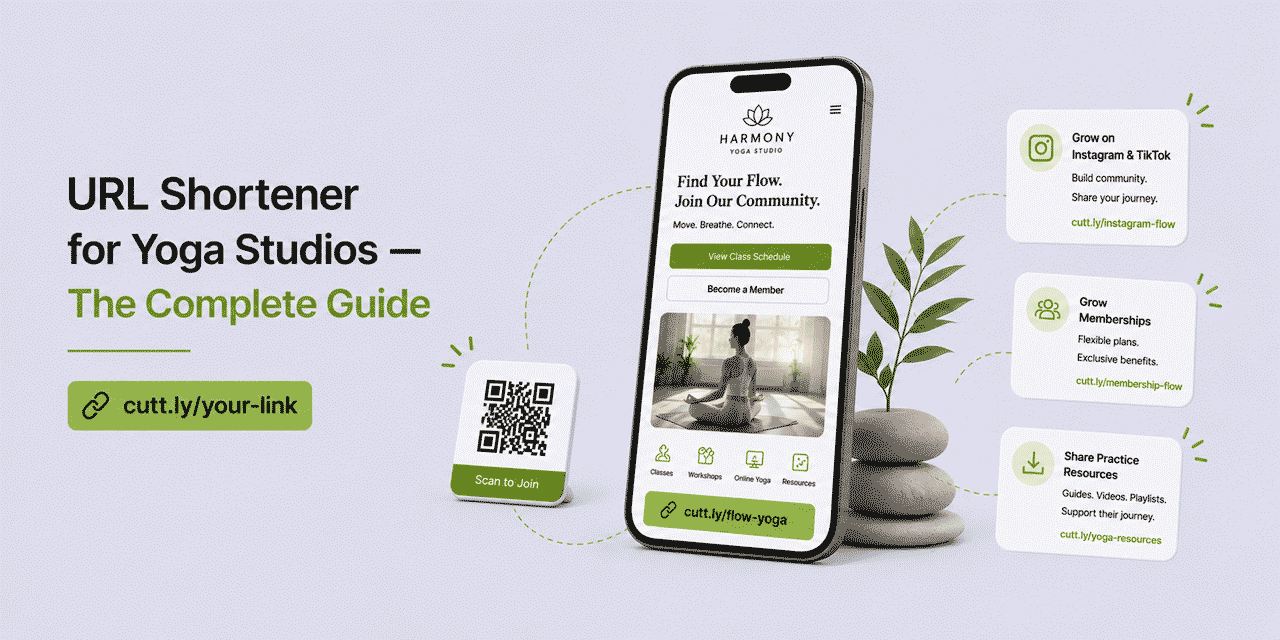
What This Guide Covers
- The five core standing links every yoga studio needs
- Choosing a branded domain for a yoga studio
- Window and entrance QR Codes
- Reception, changing room and studio space QR Codes
- Printed timetables and local distribution
- Instagram — content strategy and Link in Bio setup
- TikTok — local algorithmic reach for yoga studios
- WhatsApp for yoga student communications
- Free trial and new student acquisition links
- Membership and class pass links
- Online yoga — platform links, Zoom links and video libraries
- Workshop and retreat registration links
- Teacher training links
- Email newsletters for yoga studios
- Google Reviews for yoga studios
- Seasonal challenges and community campaigns
- Per-channel attribution — tracking what drives new students
- Multi-teacher and multi-location studios
- Cuttly plan guide for yoga studios
The Five Core Standing Links Every Yoga Studio Needs
Before building campaign links, per-channel tracking links or event-specific links, establish five permanent branded short links that are deployed consistently across all channels and materials. These links never change — only their destinations update when underlying pages change:
| Link | Destination | Deploy everywhere |
|---|---|---|
yourbrnd.link/book | Class booking page | Window, bio, WhatsApp, email, all materials |
yourbrnd.link/trial | Free or discounted trial class offer | Window, social media, printed timetables, referrals |
yourbrnd.link/schedule | Current class timetable | Printed timetables, community boards, email footer |
yourbrnd.link/join | Membership or class pass purchase | Post-class SMS, email, reception display |
yourbrnd.link/review | Google Review form | Changing room, post-class messages, window |
These five links cover the complete student lifecycle: discovery (trial), schedule exploration (schedule), booking (book), commitment (join) and advocacy (review). Every other link — workshop registration, teacher training, online platform, retreat booking — follows the same naming pattern and the same deployment logic.
The dynamic link advantage is especially important for yoga studios, which change booking platforms more frequently than most businesses as they grow. Starting with Mindbody, moving to Glofox, switching to a direct website booking system — every platform migration that would previously have required reprinting all materials, updating every social media post, and communicating new URLs to the student community becomes a single destination update in Cuttly. All deployed links continue working immediately.
Choosing a Branded Domain for a Yoga Studio
The branded domain for a yoga studio's short links should reflect the studio's identity — whether that is the studio name, a concept associated with the practice, or the teacher's personal brand. It should be short enough to appear on printed timetables and studio signage, and memorable enough to be spoken aloud in class.
Domain patterns that work well for yoga studios:
- "The Still Mind Studio" →
stillmind.link - "Flow Yoga" →
flowyoga.linkorflowwithus.link - Independent teacher named Anna →
yogawithanна.linkorannayoga.link - "Roots and Wings Yoga" →
rootsandwings.link yoga.yourstudioname.com— a subdomain of an existing website, for studios with strong main domain recognition
Check domain availability at any major registrar. The .link TLD is typically available and costs around £5-£10 per year. Connect to Cuttly via DNS configuration — full step-by-step guidance at Cuttly Branded Domains — in around fifteen minutes.
Window and Entrance QR Codes
A yoga studio window QR Code is the equivalent of a 24-hour reception desk. It captures the person who walks past the studio at 7am before a class starts, the person who passes at 10pm on a weekend and thinks "I've been meaning to try yoga", and the person who is referred by a friend and walks to the studio address to check it out before booking. None of these people are going to call during opening hours, search for the studio online later and then navigate to a booking page. A window QR Code that opens the trial class offer in two seconds captures this intent at the precise moment it exists.
Window QR Code Strategy
Two QR Codes on the studio window serve distinct purposes:
QR Code 1 — Trial class offer
Call to action: "Try your first class free" or "New to yoga? Your first class is on us"
Destination: yourbrnd.link/trial → trial offer page showing available first-class slots
QR Code 2 — Current timetable
Call to action: "See this week's classes" or "Classes starting from 7am — scan for the full schedule"
Destination: yourbrnd.link/schedule → current timetable page
The trial offer QR Code is the primary acquisition tool — lower barrier than a direct booking link, specifically designed to convert curious passers-by into first-time students. The timetable QR Code serves existing students who are outside the studio and want to check what is on.
Both QR Codes are dynamic. If the studio changes its trial offer structure, updates the timetable platform, or switches booking systems, the destination updates in Cuttly. The printed window stickers remain correct indefinitely.
Reception, Changing Room and Studio Space QR Codes
Inside the studio, QR Code placements serve the existing student community — encouraging rebooking, membership conversion, review generation and community deepening at the moments when students are most engaged.
Reception Desk
The reception desk is where students arrive and depart — both high-engagement moments. A reception desk card with two QR Codes: "Join our membership" (yourbrnd.link/join) and "Book your next class" (yourbrnd.link/book). Students who are arriving are in a positive, proactive state. Students who are leaving are satisfied from the class they just attended. Both moments are productive for membership conversion and rebooking.
Changing Rooms
The changing room is the optimal location for the Google Review request. A card at eye level — "Loved your class today? A Google review means the world to our studio: yourbrnd.link/review" — catches students in a reflective, satisfied state as they change. Because it is a private space, they are more likely to read and act on the card than in a public studio area.
A second changing room QR Code linking to the membership page works well here too — framed as "Come as often as you like with a membership: yourbrnd.link/join". Students who enjoyed the class and are changing to leave are in the highest possible state of motivation to commit to regular practice.
Studio Practice Space
A subtle, permanent QR Code in the studio practice space — perhaps on the wall near the props shelf — linking to yourbrnd.link/schedule allows students to check the timetable immediately while they are in the studio environment and most motivated to plan their next visit. It can also link to a practice resources page for students who want to continue their home practice between classes.
Printed Timetables and Local Distribution
Printed timetables distributed locally — in coffee shops, health food stores, community noticeboards, university campus boards, local gyms, libraries — are a cost-effective local marketing channel for yoga studios with a strong neighborhood presence. A well-designed A5 timetable with a QR Code and short URL generates bookings from people who would not otherwise have discovered the studio through social media or search.
The Cuttly link on printed timetables — yourbrnd.link/book printed as both text and QR Code at the bottom — is dynamic. If the timetable changes or the booking platform migrates, the destination updates without reprinting the timetable run. A timetable printed in January continues directing new students to current, accurate booking information throughout the year.
For tracking the commercial value of printed timetables, use a unique link — yourbrnd.link/book-print — on printed materials, distinct from the general booking link used online. After three months, the click data shows how many bookings the printed timetable distribution is actually driving versus online channels — data that informs whether the print distribution effort is worth continuing and at what scale.
Instagram — Content Strategy and Link in Bio Setup
Instagram is the primary social media platform for most yoga studios and independent teachers. The visual nature of yoga — the shapes, the light, the environment — is inherently well-suited to Instagram's image and video formats. And yoga's philosophical depth means there is an almost unlimited supply of quotable, shareable content that resonates beyond the practice itself.
Content Formats That Build Following for Yoga Studios
The content that consistently generates engagement and builds a local following for yoga studios on Instagram:
- Short practice clips (20–60 seconds). A flowing sequence, a challenging pose broken down into accessible stages, a breathwork technique, a meditation guide. These perform well because they are immediately useful — viewers can practice along, which creates a personal connection with the teacher.
- Pose breakdowns. Close-up instruction on alignment, modifications and common mistakes for a specific pose. Educational content that demonstrates expertise and builds trust with potential students who want to know the teacher understands both anatomy and accessibility.
- Studio environment. The morning light in the practice space, the props arranged for a workshop, the view from the studio window — atmospheric content that communicates the space and builds familiarity. Students who feel they know what to expect are more likely to book a first class.
- Behind-the-scenes teacher content. The teacher's own practice, their preparation for class, their reflections on teaching — personal content that builds the human connection at the heart of any yoga teacher-student relationship.
- "Spots available this week" posts. Direct availability and booking prompts — "A few spots left in Wednesday's Yin class — link in bio to book" — are among the highest-converting content types for filling last-minute class capacity.
Link in Bio Setup for Yoga Studios
Instagram allows one clickable link in the bio. Set this to the studio's branded Cuttly domain — yourbrnd.link. The Link in Bio page opens with multiple independently tracked buttons:
- Try your first class free → trial offer page (first button — lowest barrier, highest acquisition priority)
- Book a class → general booking page
- This week's schedule → current timetable (updated weekly; the dynamic destination can be refreshed without changing the button)
- Membership options → membership information and sign-up
- Upcoming workshops → workshop registration page (featured when a workshop is coming up, replaced by the next event when it sells out)
- Online classes → online platform or Zoom booking page (if applicable)
Cuttly analytics from the Link in Bio reveal the distribution of follower intent. If "Try your first class free" receives 65% of taps, the audience is primarily prospective students in the awareness phase — excellent for acquisition. If "This week's schedule" receives the most taps, the audience is primarily existing students checking upcoming availability — the content is retaining community rather than acquiring new students, which suggests leaning into more educational and inspirational content to broaden reach.
The Link in Bio page updates instantly when priorities change. A winter retreat gets a prominent featured button. A January new year offer gets the top position in January. A summer challenge links directly to the sign-up page. The bio URL never changes; the content behind it is always current.
TikTok — Local Algorithmic Reach for Yoga Studios
TikTok's recommendation algorithm gives significant weight to geographic proximity — a yoga studio posting consistently in a specific city or neighborhood reaches thousands of local potential students through the For You Page without paid promotion and without requiring an established following to begin with. For a local yoga studio, this organic local reach is unique among social platforms and represents one of the most cost-effective acquisition channels available.
The content that performs best on TikTok for yoga studios closely overlaps with Instagram — practice clips, pose breakdowns, teacher personality content — but with TikTok-specific conventions: trending audio overlaid on practice sequences, direct-to-camera conversational content, "storytime" formats where the teacher shares a perspective or story while demonstrating a pose, and highly practical "try this right now" micro-practices that viewers can follow in 60 seconds wherever they are.
TikTok Posting Frequency
For algorithmic growth on TikTok, posting frequency matters more than production quality. Three to five posts per week consistently outperforms one polished post per week. A 45-second flow filmed on a phone during a quiet moment before class, edited in TikTok's native editor and posted immediately, is the sustainable content model for a yoga teacher with a full teaching schedule. The content does not need to be perfect — it needs to be consistent and genuine.
The TikTok bio link is the same Cuttly Link in Bio page as Instagram. One page, both platforms, independent analytics showing which platform generates more trial class taps and booking clicks. Many yoga studios find TikTok drives a higher proportion of trial class sign-ups — consistent with TikTok's role as a discovery platform for users who have not yet encountered the studio.
WhatsApp for Yoga Student Communications
WhatsApp is the primary communication channel between yoga teachers and their student community in many markets — particularly for class updates, last-minute availability announcements, and direct booking enquiries. Managing WhatsApp communications efficiently while maintaining the personal warmth that characterizes yoga teacher-student relationships requires a balance between automation and authenticity.
WhatsApp Business Setup for Yoga Studios
WhatsApp Business (free) allows automated responses that handle routine enquiries while freeing the teacher to focus on class preparation and teaching. Three automations relevant to a yoga studio:
- Away message: "Thanks for getting in touch with [Studio Name]. I am teaching right now but you can check the current timetable and book at yourbrnd.link/schedule. I will be in touch soon." — acknowledges the message, provides an immediate useful action, sets a realistic response expectation.
- Greeting message: "Hi! Welcome to [Studio Name]. The best place to start is our free first class: yourbrnd.link/trial. I am also happy to answer any questions — what brings you here?" — the personal touch at the end maintains the relational character of yoga communication while providing a direct path to action.
- Quick replies: A /trial quick reply sends the trial class link; a /schedule quick reply sends the timetable link; a /book quick reply sends the booking page. Most routine enquiries ("Are you running classes this week?", "Do you do beginners' yoga?") are answered with two taps.
WhatsApp Community Groups
Yoga studios with an active student community often maintain a WhatsApp group for students — sharing class reminders, practice tips, community announcements and schedule changes. Branded Cuttly short links in WhatsApp group messages are immediately recognizable as from the studio: yourbrnd.link/schedule in a message announcing the week's timetable is instantly associated with the studio before anyone taps it. A raw booking platform URL in the same context looks like an external link and requires more cognitive trust to act on.
Free Trial and New Student Acquisition Links
The free or discounted trial class is the most powerful new student acquisition mechanism available to a yoga studio. It removes financial risk from the first-time decision — the biggest single barrier to trying a new studio is uncertainty about whether the experience will justify the cost. A free trial eliminates this barrier entirely.
yourbrnd.link/trial is the most important acquisition link in the studio's entire digital infrastructure. It belongs everywhere prospective students might discover the studio:
- First button on the Instagram and TikTok Link in Bio page
- Window QR Code — the primary acquisition placement
- Printed timetables distributed locally — framed as "First class free for new students"
- Google Business Profile — set as the primary action URL or booking URL
- Business cards handed to friends, colleagues and gym contacts
- Verbally: "Your first class is free — just go to [studioname].link/trial"
The new student journey after the trial link should be structured to convert the first-time visitor into a committed student: the trial page shows available first-class slots with clear descriptions (level, style, duration); the booking confirmation includes a warm welcome message and practical pre-class information; within 24 hours of attending, a WhatsApp or email follow-up invites the new student to book their second class and introduces the membership options.
For tracking which channels bring in new trial sign-ups, use per-channel unique links: yourbrnd.link/trial-ig, yourbrnd.link/trial-tiktok, yourbrnd.link/trial-window, yourbrnd.link/trial-print. After three months, the data shows precisely which channels are generating new students — informing where to allocate promotional effort.
Membership and Class Pass Links
Membership conversion is the most commercially significant progression in a yoga studio's student lifecycle. A member who attends three times a week generates more revenue, more consistently, with a longer relationship duration than a drop-in student attending once a month. The financial stability that memberships provide — predictable monthly revenue — is what allows a yoga studio to plan hiring, invest in the space and build long-term programming.
yourbrnd.link/join — the membership and class pass sign-up link — is deployed at the moments of highest membership conversion intent:
- After the trial class: The follow-up message to a first-time visitor who attended their free trial — "Loved it? Join us with a membership or class pass: yourbrnd.link/join"
- Reception desk display: A card visible to all students arriving and leaving, with the membership benefits summary alongside the QR Code
- Post-class email sequence: Week two and week four emails to recent class-pass purchasers introducing membership options
- New year / new season campaigns: January, September and post-summer are the highest membership conversion windows — feature the membership link prominently across all channels during these periods
- Verbally after class: "If you are thinking about coming regularly, our membership works out to about [price] per class — yourbrnd.link/join has all the options"
Online Yoga — Platform Links, Zoom Links and Video Libraries
Many yoga studios operate hybrid models — in-person classes combined with an online subscription, live-streamed classes or an on-demand video library. Online students have different link needs from in-person students, and the infrastructure should reflect this.
Standing Online Yoga Links
yourbrnd.link/online→ online platform sign-up or subscription pageyourbrnd.link/live→ live-streamed class link (Zoom, YouTube Live or platform-specific link) — updated weekly when the meeting ID changesyourbrnd.link/videos→ on-demand video library access pageyourbrnd.link/free-week→ free online trial week offer for prospective online students
The Zoom link — yourbrnd.link/live — is one of the most practically valuable dynamic links for online yoga. Zoom meeting IDs change when meetings are recreated, when security settings require a new meeting, or when platform plans change. Without a dynamic short link, every Zoom meeting ID change requires communicating the new link to every student in the community — via email, WhatsApp, social media and course platform. With yourbrnd.link/live, the destination updates in one click in Cuttly. Every student who uses the saved link, every mention of the link in archived emails and posts, continues working correctly with the new meeting ID.
Online-to-In-Person Conversion
For studios where online students also have the opportunity to attend in-person classes — either locally or at a studio they travel to — the in-person trial link (yourbrnd.link/trial) should be visible in online class communications. Online students who have built a relationship with a teacher through live-streamed classes represent a warm audience for in-person workshop attendance, residential retreats and teacher training programmes.
Workshop and Retreat Registration Links
Workshops and retreats are high-value offerings that represent a significant revenue opportunity for yoga studios and independent teachers. A sold-out weekend workshop generates more revenue from ten students than ten regular classes. A residential retreat generates more revenue in one week than months of regular teaching. Both require targeted promotion over several weeks and a clear, frictionless registration path.
Each workshop or retreat gets a dedicated Cuttly short link: yourbrnd.link/workshop-sept, yourbrnd.link/retreat-oct, yourbrnd.link/yin-intensive. This link is the single consistent entry point for all promotion — Instagram posts, TikTok content, email newsletters, WhatsApp announcements, printed flyers and word-of-mouth reference. Every student who hears about the event from any source reaches the same registration page via the same branded link.
The dynamic link is particularly valuable for retreat and workshop registrations. If the registration platform changes, the booking URL is updated, or the retreat page is restructured before the event — the Cuttly link destination updates in one click. If the event sells out and the destination needs to change to a waitlist page, the same link redirects appropriately. After the event, the link can be updated to a "photos and reflections" page or a "register interest for next time" form — converting a promotional link into a community engagement link post-event.
For tracking which promotional channels are most effective at driving workshop sign-ups, use per-channel variants: yourbrnd.link/workshop-sept-ig, yourbrnd.link/workshop-sept-email, yourbrnd.link/workshop-sept-wa. Post-event analytics show which channel drove the most registrations — directly informing promotional strategy for future events.
Teacher Training Links
Yoga teacher training (YTT) — typically 200-hour foundational programmes and 300-hour advanced training — is among the highest-value and most long-term-significant offerings a yoga studio or senior teacher provides. The students who complete teacher training become ambassadors for the studio and often go on to teach within the studio community. The link between a practitioner who is considering teacher training and the first enquiry or information request is the teacher training page link — which should be permanently accessible, clearly promoted and memorable.
yourbrnd.link/ytt or yourbrnd.link/teacher-training appears in:
- The Link in Bio page button (for studios that run regular YTT programmes)
- The studio's "about" or "programmes" email content
- Instagram and TikTok posts specifically addressing practitioners who are considering training
- In-studio information materials for regular students who attend multiple times per week
- Verbally when relevant: "If you have ever thought about teaching, our next YTT starts in September — yourbrnd.link/ytt has all the information"
Click data on the teacher training link — tracked over time — shows the organic interest level in teacher training from the existing student community. A sustained click rate indicates latent demand worth following up with a direct conversation. A spike in clicks after a specific social media post identifies which content resonates with students who are considering training.
Google Reviews for Yoga Studios
Google Reviews influence new student discovery at the search stage — when someone searches "yoga classes near me", studios with higher review counts and ratings appear more prominently. A studio with 80 reviews at 4.9 stars generates significantly more new-student enquiries from local search than a comparable studio with 12 reviews at 5.0 stars.
The most effective yoga studio review generation system:
- Changing room QR Code:
yourbrnd.link/reviewon a card at mirror height — the most consistently productive placement for yoga studios, because the private, reflective atmosphere of the changing room predisposes satisfied students to take a moment for the review. - Post-class WhatsApp or email to the community — occasional (not after every single class): "If the practice has been meaningful to you, a Google review helps others discover us: yourbrnd.link/review"
- Verbally, sparingly: At the end of particularly well-received classes, a brief mention: "If you would like to support the studio, a Google review means a great deal." The key is rarity — this message should be used occasionally, not after every class, so that it carries weight when it is said.
Per-Channel Attribution — Tracking What Drives New Students
A yoga studio typically invests time across multiple channels — Instagram content, TikTok content, printed timetable distribution, Google Business Profile, local community presence, email newsletters. Understanding which channels actually convert to trial class sign-ups is the data that makes every future marketing decision more effective.
| Channel | Cuttly trial link | What it measures |
|---|---|---|
| Instagram bio | yourbrnd.link/trial-ig | Instagram audience to trial conversion |
| TikTok bio | yourbrnd.link/trial-tiktok | TikTok discovery to trial conversion |
| Window QR Code | yourbrnd.link/trial-window | Forecourt walk-past conversion |
| Printed timetable | yourbrnd.link/trial-print | Local print distribution ROI |
| Google Business Profile | yourbrnd.link/trial-google | Search intent conversion |
| Email newsletter | yourbrnd.link/trial-email | Email list reactivation |
| WhatsApp referral | yourbrnd.link/trial-wa | Word-of-mouth digital conversion |
After three months of tracking, the data reveals the actual acquisition picture. Most yoga studios find that TikTok and Google Business Profile drive the highest proportion of genuinely new students — people who did not already know the studio. Instagram drives more engagement from the existing community. The window QR Code captures high-intent passers-by who are already in the geographic area. Printed timetable distribution varies dramatically by placement location — the coffee shop down the road might drive more trial sign-ups than five other distribution points combined.
This data does not just tell the studio where to focus marketing effort. It also shows which channels attract different types of students — age groups, practice levels, commitment levels — useful intelligence for tailoring communications and class offerings to match the actual composition of the incoming student community.
Multi-Teacher and Multi-Location Studios
For studios with multiple teachers, either employed or renting space, per-teacher link infrastructure adds visibility without requiring separate accounts or platforms.
Each teacher has their own booking link — studioname.link/book-anna, studioname.link/book-raj, studioname.link/book-claire — routing students directly to that teacher's class schedule. Each teacher promotes their personal link through their own Instagram and TikTok, on their personal business cards and in their own student communications. The studio owner sees all teacher link analytics aggregated in the Cuttly dashboard; each teacher optionally accesses their own analytics.
For multi-location studio groups — where the same brand operates in multiple cities — Cuttly's Team plan supports each location under its own branded domain with shared management from a central workspace. Group-wide campaigns (a New Year membership offer, a national workshop series) are created centrally and distributed to all locations simultaneously, with per-location click analytics available in the shared Campaigns dashboard.
Cuttly Plan Guide for Yoga Studios
The Free plan ($0) includes link shortening, QR Code generation and basic analytics on the cutt.ly domain. Suitable for testing Cuttly or for a solo teacher just beginning to build a digital presence. Not recommended as a permanent solution for any studio using links on printed materials or in messaging, where brand identity in the link domain matters.
The Starter plan ($12/month) adds a branded custom domain, full analytics, dynamic link destinations, QR Codes at print resolution and a Link in Bio page. The right plan for the vast majority of yoga studios and independent teachers. At $12 per month — less than the revenue from a single class drop-in — it provides the complete link infrastructure for a professional studio presence across all channels.
The Single plan ($25/month) adds five branded domains and device targeting. Relevant for teachers who maintain a personal brand alongside a studio brand, or for studios running paid social advertising that benefits from retargeting pixel support.
The Team plan ($99/month) suits multi-teacher studios and multi-location yoga organizations — shared workspace, role-based access for individual teachers, aggregated campaign analytics across all teachers and locations.
Create a free Cuttly account and build your first yoga studio booking link today. Registration required; free plan available with no credit card needed.
Frequently Asked Questions
How do yoga studios use URL shorteners?
Yoga studios use branded Cuttly short links for class booking, free trial offers, timetable pages, membership sign-ups and practice resources. These links appear on window QR Codes, Instagram and TikTok bios, printed timetables, WhatsApp messages and email newsletters — each tracked independently to show which channels drive the most class bookings.
How can a yoga teacher grow their class bookings?
Create yourbrnd.link/trial pointing to the free trial offer. Deploy on the window QR Code, Instagram and TikTok bio (as the first Link in Bio button), on business cards and in locally distributed timetables. The trial framing reduces the first-visit decision barrier significantly. Track which channel drives the most trial sign-ups with per-channel unique links.
What QR Code placements work best for yoga studios?
Window (trial offer, 24/7 conversion), reception desk (membership sign-up, arrival and departure), changing room (Google Review, post-class satisfaction moment), printed timetables (booking page QR Code for local distribution). Each placement uses a unique Cuttly link for independent tracking.
How do yoga studios use Instagram and TikTok effectively?
Consistent short-form video — practice clips, pose breakdowns, teacher personality content — builds local following. TikTok's geographic algorithm makes it especially valuable for local discovery. Both bio links point to the same Cuttly Link in Bio page with trial, booking, schedule and workshop buttons. Link in Bio analytics show whether the audience is in acquisition or retention mode — shaping content priorities.
How can an online yoga teacher use Cuttly?
Create branded links for the online platform sign-up (yourbrnd.link/online), Zoom class link (yourbrnd.link/live — dynamic, updates when the meeting ID changes), video library (yourbrnd.link/videos) and free trial week (yourbrnd.link/free-week). Track which channels drive the most online sign-ups via per-channel variants.
- Cuttly Tools
- URL Shortener Tool →
- Link in Bio Builder →
- QR Code Generator →
- Branded Domains →
- Surveys →
- Related Industries
- URL Shortener for Sports & Fitness
- URL Shortener for Personal Trainers
- URL Shortener for Spas
- URL Shortener for Healthcare & Wellness
- URL Shortener for Local Businesses
- Related Guides
- URL Shortener for Email Marketing
- Short Links for Print & Offline
- Encyclopedia
- Dynamic QR Codes
- Link in Bio
- All Industries →
- Start Here
- Create Free Account
- Plans & Pricing
URL Shortener
Cuttly simplifies link management by offering a user-friendly URL shortener that includes branded short links. Boost your brand’s growth with short, memorable, and engaging links, while seamlessly managing and tracking your links using Cuttly's versatile platform. Generate branded short links, create customizable QR codes, build link-in-bio pages, and run interactive surveys—all in one place.
Cuttly - Consistently Rated
Among Top URL Shorteners
Cuttly isn’t just another URL shortener. Our platform is trusted and recognized by top industry players like G2 and SaaSworthy. We're proud to be consistently rated as a High Performer in URL Shortening and Link Management, ensuring that our users get reliable, innovative, and high-performing tools.


