URL Shortener for Logistics Carriers The Complete Guide
A logistics carrier's operation runs on two parallel relationships that both depend heavily on reliable digital communication: the commercial relationship with B2B shipping clients who need accurate quotes, reliable tracking, and responsive account management, and the operational relationship with the driver workforce that physically moves every shipment. Both relationships generate continuous digital touchpoints — tracking notifications sent to thousands of recipients daily, freight quote enquiries that determine new contract wins, fleet vehicles that operate as moving brand exposure across entire regions every working day, and the ongoing driver recruitment challenge that affects almost every carrier in the industry. Every one of these touchpoints depends on links that work reliably at scale.
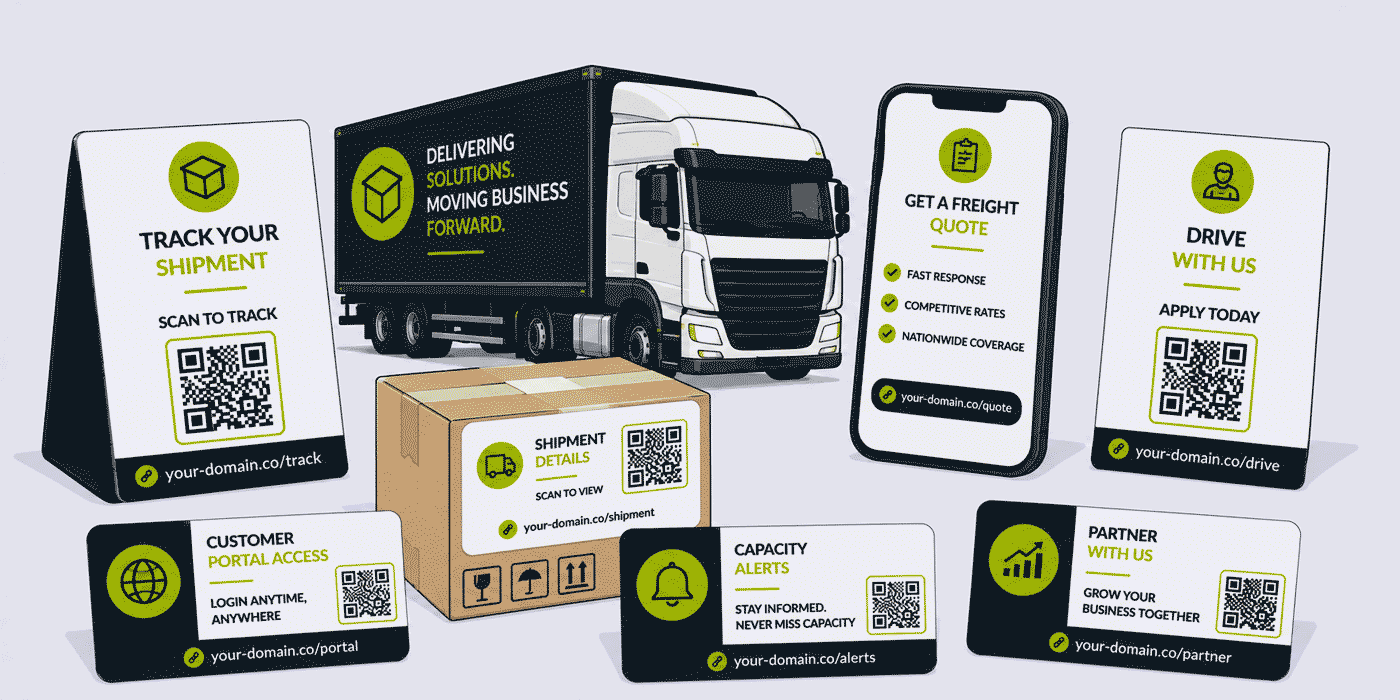
This guide covers how logistics carriers, freight forwarders, and last-mile delivery companies use a URL shortener, branded custom domain, dynamic QR Codes and click analytics across shipment tracking communications, B2B freight quote attribution, fleet vehicle QR Codes, driver recruitment, customer portal access, capacity and service alert communications, and the full range of link management needs for a business operating at high transactional volume across both commercial and operational relationships.
What This Guide Covers
- Shipment tracking communication links — reliability at high transactional volume
- B2B freight quote enquiry attribution
- Fleet vehicle QR Codes — passive brand exposure converted to measurable leads
- Driver recruitment links
- Customer portal and account management access
- Capacity alerts and service disruption communications
- Sustainability and carbon reporting links for commercial clients
- Depot and warehouse partnership links
- A worked example: a regional freight carrier's link infrastructure
- Common mistakes in logistics carrier link management
- A Cuttly plan guide for logistics carriers
- Frequently asked questions
Shipment Tracking Communication Links: Reliability at High Transactional Volume
The tracking notification — sent by text or email when a shipment is booked, dispatched, out for delivery, and delivered — is the single highest-volume customer communication most logistics carriers send. For a carrier processing thousands of shipments daily, this represents an enormous number of individual links being distributed continuously, each one needing to work reliably for a recipient who is often anxiously checking on a time-sensitive delivery.
Branded Tracking Links Versus Platform-Generated URLs
Most carrier tracking systems generate their own platform-specific tracking URLs automatically for each shipment, which is operationally necessary but creates two problems: the URL is typically long, unmemorable, and carries the underlying platform's branding rather than the carrier's own, and any future migration to a different tracking or delivery management system breaks every historical tracking link still being referenced by customers who saved it or are checking an older shipment.
A branded short link layer — your-carrier.com/track as a general entry point, or per-shipment short links generated automatically via API for each individual tracking number — gives customers a clean, trustworthy, carrier-branded link in every notification, while protecting against the platform migration risk that would otherwise affect every customer who has any historical tracking communication saved or bookmarked.
API-Generated Per-Shipment Tracking Links
For carriers processing high shipment volumes, generating a unique short link per shipment automatically through Cuttly's API — rather than manually creating individual links — allows the tracking notification system to embed a branded, trackable short link for every single shipment without any manual intervention. This also provides aggregate click analytics across the full notification volume: what proportion of recipients are clicking through to check their tracking status, and at which stage of the delivery process (booking confirmation, out-for-delivery, delivered) engagement is highest — useful operational intelligence about which notifications customers find most valuable.
B2B Freight Quote Enquiry Attribution
Winning new commercial shipping contracts — from businesses with regular, recurring freight needs — is a primary growth driver for most logistics carriers, and the freight quote enquiry is the commercial conversion point this growth depends on. Understanding which marketing and business development channels are generating the most qualified enquiries, and ultimately the most signed contracts, is essential for efficient commercial growth investment.
The Quote Enquiry Link
A permanent short link for the freight quote request page — your-carrier.com/get-a-quote — appears across:
- LinkedIn outreach and advertising targeting procurement and logistics managers
- Trade directory listings relevant to the carrier's specialism (parcel, pallet, full truckload, specialist freight)
- The carrier's Google My Business profile
- Any industry trade show or exhibition presence
Because freight quoting tools evolve — from basic enquiry forms to interactive rate calculators with route and volume-based instant pricing — a dynamic short link ensures every historical marketing reference continues to reach the current quoting system through any tool migration.
Per-Channel and Per-Sector Attribution
Per-channel attribution links — your-carrier.com/quote-linkedin, your-carrier.com/quote-directory — combined with the carrier's CRM data on which enquiries convert to signed contracts, give the commercial team a per-channel cost-per-contract metric. Given that B2B logistics contracts often represent significant ongoing recurring revenue, even modest differences in channel conversion efficiency represent substantial commercial impact across a carrier's annual new business pipeline.
For carriers serving multiple sectors with distinct needs — retail and e-commerce fulfilment, manufacturing and industrial freight, temperature-controlled food logistics, construction materials — sector-specific landing pages and short links, such as your-carrier.com/ecommerce-fulfilment or your-carrier.com/cold-chain, speak directly to each sector's specific requirements and typically convert significantly better than a single generic freight services page.
Fleet Vehicle QR Codes: Passive Brand Exposure Converted to Measurable Leads
A logistics carrier's fleet of delivery vehicles and trucks operates across wide geographic areas continuously throughout every working day, generating an enormous volume of passive brand exposure that most carriers do almost nothing to convert into measurable digital engagement. A QR Code on every vehicle is one of the lowest-cost, highest-reach marketing investments available to any carrier.
Vehicle QR Code Strategy
A QR Code on the rear doors or side panels of delivery vehicles, generated from a dynamic short link, can serve dual commercial purposes:
- Commercial enquiry. "Need reliable freight delivery? Scan to get a quote" —
your-carrier.com/quote-vehicle— captures business owners and logistics decision-makers who observe the vehicle operating in their area, whether at a delivery, in traffic, or parked at a depot. - Driver recruitment. "Join our driving team" —
your-carrier.com/driver-jobs— visible to anyone who might be considering a driving career, particularly relevant given the persistent driver shortage affecting most logistics operators.
Because fleet vehicles remain in service for many years, and because the carrier's website, recruitment system, and quoting tools will almost certainly change multiple times during that vehicle's operational life, dynamic QR Codes are the only sustainable approach: a single QR Code sticker, applied once, continues generating functional leads and applications throughout the vehicle's entire service life regardless of how many underlying system changes occur.
Driver Recruitment Links
Driver shortage is one of the most persistent and widely reported operational challenges across the logistics industry, making effective, continuous recruitment marketing a genuine commercial priority rather than an occasional activity. A logistics carrier that maintains a consistent, well-tracked recruitment presence across every available channel has a measurable advantage in addressing this ongoing challenge.
A short link for current driver vacancies — your-carrier.com/driver-jobs — used across fleet vehicle QR Codes, job board advertising, local radio and community advertising, and any driver referral programme communications, gives the recruitment team a consistent, trackable presence. Per-channel attribution — your-carrier.com/driver-jobs-indeed, your-carrier.com/driver-jobs-vehicle, your-carrier.com/driver-jobs-referral — shows which sources generate the most qualified applications, informing where to concentrate the recruitment marketing budget given how competitive driver recruitment has become across the wider industry.
Driver Referral Programme Links
Many carriers operate a driver referral programme, offering existing drivers a bonus for successfully referring a new driver who completes their probationary period. A short link for the referral programme — your-carrier.com/refer-a-driver — included in driver communications and payslip messaging, gives the carrier a trackable, low-cost recruitment channel that leverages the credibility of an existing driver's personal recommendation, often one of the most effective recruitment channels in an industry where word-of-mouth carries particular weight among professional drivers evaluating potential employers.
Customer Portal and Account Management Access
B2B shipping clients typically need ongoing access to a customer portal for booking new shipments, managing account billing, accessing historical shipment and invoice data, and managing their account preferences. The link through which clients access this portal needs to be stable across what may be a multi-year commercial relationship.
A permanent short link for the customer portal — your-carrier.com/my-account — used in every client onboarding communication, invoice email, and account notification, gives every commercial client a consistent, branded reference. Because logistics management and billing platforms change as carriers scale and upgrade their technology infrastructure, a dynamic short link ensures every client communication — including the very first onboarding email sent at the start of a contract that may run for years — continues to reach the current portal through any subsequent platform migration.
Capacity Alerts and Service Disruption Communications
Logistics operations are subject to disruption from weather, traffic incidents, depot issues, and seasonal capacity constraints (such as the pre-Christmas peak period most carriers experience). Communicating these disruptions clearly and quickly to affected commercial clients and individual customers is operationally important, and pre-established short links for disruption information pages allow this communication to happen rapidly without needing to create new links under time pressure during an active operational situation.
A permanent short link for service status and disruption information — your-carrier.com/service-status — maintained and ready to be activated immediately when needed, can be included in any urgent SMS or email communication to affected customers within minutes of an issue being identified, with the underlying page content updated in real time as the situation develops.
Sustainability and Carbon Reporting Links for Commercial Clients
Commercial shipping clients with corporate sustainability commitments increasingly require carbon emissions data and sustainability reporting from their logistics partners as part of their own Scope 3 emissions reporting obligations. A short link for the carrier's sustainability reporting portal or summary — your-carrier.com/sustainability or per-client variants — gives commercial clients accessible evidence of the carrier's environmental performance, an increasingly significant factor in B2B logistics procurement decisions and contract renewals.
Depot and Warehouse Partnership Links
Carriers operating through a network of depots, cross-dock facilities, or partner warehouses benefit from per-location short links for facility-specific information — operating hours, collection and drop-off procedures, and depot contact details — particularly useful for commercial clients or other carriers who need to interact with a specific facility within a wider network.
A Worked Example: A Regional Freight Carrier's Link Infrastructure
Consider a regional freight carrier operating a mixed fleet of vans and trucks serving both B2B contract clients and parcel delivery, using a branded domain such as your-carrier.com, connected through Cuttly's custom domain setup (an A record and a TXT record — see the custom domain setup guide).
Tracking notification migration: The carrier upgrades its delivery management system, changing the underlying tracking platform. Because all tracking notifications use the branded /track short link rather than the previous system's raw URL, the single destination update protects the customer experience for every shipment notification sent during the transition period, with zero customer-facing disruption despite a significant backend technology change.
Fleet QR Code programme: Across 60 delivery vehicles, dual-purpose QR Codes generate combined monthly analytics of 340 commercial quote enquiry scans and 95 driver recruitment scans. Of the recruitment scans, 22 result in completed job applications over six months — a meaningful contribution to driver recruitment from passive vehicle exposure during a period when the carrier, like much of the industry, is finding driver recruitment increasingly competitive through traditional job board channels alone.
Sector-specific quote pages: The carrier introduces /ecommerce-fulfilment as a dedicated landing page for online retail clients, distinct from its general freight quote page. LinkedIn advertising specifically targeting e-commerce operations managers, directed to this sector page rather than the generic quote form, generates a 2.3x higher enquiry-to-signed-contract conversion rate, attributed to the page's specific messaging about delivery speed and returns handling that resonates more directly with this client segment's priorities than generic freight messaging.
Common Mistakes in Logistics Carrier Link Management
Raw Platform Tracking URLs in Customer Notifications
A carrier that sends tracking notifications with the underlying delivery management platform's raw URL, rather than a branded short link, creates a customer-facing failure at every system migration and presents a less professional, less recognisable link to customers in every single tracking communication. Given the sheer volume of tracking notifications most carriers send, this represents a significant accumulated brand and reliability exposure.
No QR Code on Fleet Vehicles
A logistics carrier operating a substantial fleet without any QR Code on its vehicles is leaving one of its lowest-cost, highest-reach marketing opportunities entirely unexploited. Given the persistent industry-wide driver recruitment challenge and the ongoing need for B2B commercial growth, the negligible cost of adding a QR Code to existing vehicle livery makes this one of the most straightforward marketing improvements available to most carriers.
No Per-Sector Quote Page Differentiation
A carrier that routes every freight enquiry through a single generic quote form is missing the conversion rate improvement available from sector-specific landing pages that speak directly to the distinct priorities of different client types — e-commerce fulfilment, cold chain, construction materials, or manufacturing freight all have meaningfully different decision criteria that a single generic page cannot address effectively.
Cuttly Plan Guide for Logistics Carriers
- The Free plan ($0) provides 30 short links per month, one branded custom domain, full click analytics and dynamic QR Codes, with no credit card required. Suitable for a small carrier setting up core tracking, quote enquiry, and driver recruitment links.
- The Starter plan ($12/month) adds 300 short links per month and 30 custom aliases per month — practical for a growing carrier managing per-channel quote attribution, fleet vehicle QR Codes, sector-specific landing pages, and customer portal links.
- The Single plan ($25/month) adds up to 5 branded domains for carrier groups with multiple service brands, customizable QR Codes for professional fleet vehicle integration, 1,000 API-created links per month for automated per-shipment tracking link generation at scale, and a full year of analytics history.
- The Team plan ($99/month) suits larger logistics carriers with commercial, recruitment, operations, and customer service teams sharing link management, with Campaign tag analytics for aggregated channel and sector performance reporting.
Create a free Cuttly account to set up your carrier's tracking link, your freight quote enquiry link, and your fleet vehicle QR Codes. Registration is required for all plans, including free. No credit card is needed for the free plan.
Frequently Asked Questions
How do logistics carriers use short links for shipment tracking communications?
A logistics carrier uses a branded short link in every tracking notification rather than the platform's raw URL. Per-shipment links can be generated automatically via API at scale. Dynamic links ensure every tracking notification, including historical ones customers may have saved, continues to work through any delivery management platform migration.
How do logistics carriers use short links for B2B freight quote enquiries?
A logistics carrier creates a permanent quote enquiry short link with per-channel and per-sector attribution variants. Click analytics combined with contract conversion data reveal which channels and sector-specific pages generate the most commercially valuable new business, informing evidence-based commercial marketing investment decisions.
How do logistics carriers use QR Codes on fleet vehicles?
A logistics carrier places dynamic QR Codes on delivery vehicles linking to commercial enquiry and driver recruitment pages. Because vehicles generate continuous passive brand exposure across wide geographic areas, QR Codes convert this exposure into measurable leads and applications at near-zero incremental cost, remaining functional throughout the vehicle's full multi-year service life.
How do logistics carriers use short links for driver recruitment?
A logistics carrier maintains a consistent driver recruitment short link across vehicle QR Codes, job boards, and referral programmes. Per-channel attribution shows which sources generate the most qualified applications, important operational intelligence given the persistent, industry-wide driver shortage most carriers are navigating.
How do logistics carriers use short links for customer portal and account management?
A logistics carrier maintains a permanent customer portal short link used throughout the client relationship. Because logistics management platforms change as carriers scale, dynamic links ensure every client communication, including onboarding emails sent years earlier, continues reaching the current portal through any subsequent technology migration.
- Get Started
- Create Free Account
- Plans & Pricing
- Platform Tools
- URL Shortener
- Link Analytics
- QR Code Generator
- Related Guides
- URL Shortener for Airlines
- URL Shortener for Moving Companies
- URL Shortener for Distributors
- URL Shortener for Waste Management
- URL Shortener for Construction Companies
- Encyclopedia
- Dynamic QR Codes
- Branded Links
- Setup Guides
- Custom Domain Setup
- Track Link Clicks
- Industry Hub
- Travel, Logistics & Events
- All Industries →
URL Shortener
Cuttly simplifies link management by offering a user-friendly URL shortener that includes branded short links. Boost your brand’s growth with short, memorable, and engaging links, while seamlessly managing and tracking your links using Cuttly's versatile platform. Generate branded short links, create customizable QR codes, build link-in-bio pages, and run interactive surveys—all in one place.
Cuttly - Consistently Rated
Among Top URL Shorteners
Cuttly isn’t just another URL shortener. Our platform is trusted and recognized by top industry players like G2 and SaaSworthy. We're proud to be consistently rated as a High Performer in URL Shortening and Link Management, ensuring that our users get reliable, innovative, and high-performing tools.C


