URL Shortener for Construction Companies The Complete Guide
A construction company's commercial success depends on winning tenders against competitors, delivering projects safely and on schedule, and building a portfolio of completed work that wins the next contract. The communications supporting this cycle span an unusually wide range: formal tender submissions that may be evaluated by procurement panels over weeks, site hoardings seen by thousands of passersby over a project's duration, health and safety documentation that subcontractors and site visitors must access reliably, and the completed project case studies that demonstrate capability to the next prospective client. Every one of these communications depends on links that remain functional and current across project timelines that often span years.
This guide covers how construction companies, building contractors, and civil engineering firms use a URL shortener, branded custom domain, dynamic QR Codes and click analytics across tender submission support materials, site hoarding QR Codes, health and safety documentation access, subcontractor portal management, completed project case studies, recruitment and apprenticeship links, and the full range of link management needs for a business operating across long project cycles and high-stakes commercial relationships.
What This Guide Covers
- Tender submission support material links
- Site hoarding QR Codes — passive marketing at every active project
- Health and safety documentation and site induction links
- Subcontractor portal access
- Completed project case study links
- Recruitment and apprenticeship links
- Community liaison and considerate construction links
- Plant and equipment hire partner links
- A worked example: a regional contractor's link infrastructure
- Common mistakes in construction company link management
- A Cuttly plan guide for construction companies
- Frequently asked questions
Tender Submission Support Material Links
Winning construction contracts, particularly in the public sector and with large commercial clients, typically runs through a formal tender process: an Invitation to Tender or Request for Quotation, evaluated against criteria spanning price, capability, health and safety record, and demonstrated experience. Within this formal submission, links to supporting evidence — accreditations, completed project case studies, health and safety policy, and financial standing documentation — give evaluators a professional, accessible path to verification without bloating the submission document itself.
Supporting Evidence Links
A short link per evidence category, used consistently across tender submissions:
your-construction.com/credentials— accreditations including ISO certifications, CHAS, Constructionline statusyour-construction.com/case-studies— the completed project portfolioyour-construction.com/health-safety-policy— the company's health and safety policy and recordyour-construction.com/references— client reference contacts and testimonials
Because tender evaluation can take weeks or months from submission to award decision, and because accreditation status, recently completed projects, and policy documents are reviewed and updated during that period, a dynamic short link ensures evaluators always access current, accurate supporting evidence — including any accreditation renewals or new project completions that occurred after the original submission date but before evaluation concludes. Click analytics on these links, aggregated and anonymized, give the business development team a sense of which submissions are generating active evaluator engagement, a useful signal alongside the formal tender process itself.
Site Hoarding QR Codes: Passive Marketing at Every Active Project
A construction site hoarding is seen by an enormous number of people over the life of a project: residents, commuters, delivery drivers, and passersby who walk or drive past the same site repeatedly over months or years. This represents one of the most underexploited marketing surfaces available to most construction companies, which typically use hoardings only for statutory signage and basic branding without any digital engagement pathway.
Hoarding QR Code Destinations
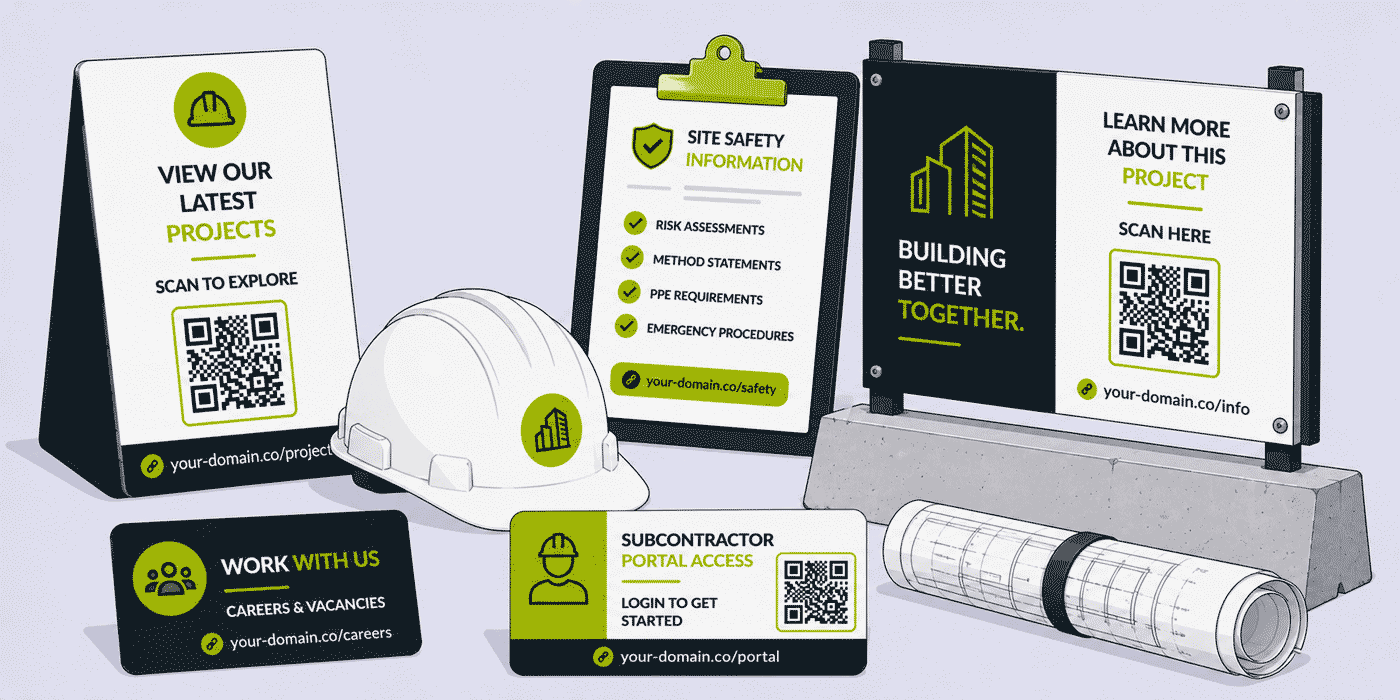
A QR Code on the site hoarding, generated from a dynamic short link, can serve several purposes depending on the project and audience:
- Project information. A page explaining what is being built, the expected completion date, and any public benefit (new housing, community facilities, infrastructure improvement) — particularly valuable for managing community relations around a disruptive or prominent local project. Short link:
your-construction.com/project-name. - Commercial enquiry. A link to the company's enquiry page for prospective clients who are impressed by what they observe of the site's organisation and progress —
your-construction.com/enquire. - Careers and apprenticeships. A link to current vacancies and apprenticeship opportunities —
your-construction.com/careers— visible to anyone passing the site who might be considering a construction career, including young people who may not otherwise encounter the company's recruitment marketing.
Because a single project's hoarding may remain in place for one to three years, and because the company's website, careers page, and enquiry systems will likely change during that period, dynamic QR Codes are essential. A QR Code applied to hoarding at groundbreaking, pointing to a destination that's accurate on day one, needs to remain functional and relevant throughout the entire build programme — something only achievable if the underlying short link destination can be updated without touching the physical signage.
Health and Safety Documentation and Site Induction Links
Health and safety compliance is a non-negotiable operational requirement in construction, and the documentation supporting it — site-specific risk assessments and method statements (RAMS), the company's overarching health and safety policy, and site induction materials — must be reliably accessible to everyone working on or visiting a site: direct employees, subcontractors, client representatives, and visiting inspectors.
Site Induction Links
A short link for the site induction materials — your-construction.com/site-induction-project-name — given to every subcontractor and visitor before they access a site, provides a consistent, trackable reference to the current induction requirements for that specific project. Because RAMS documents and site-specific safety requirements are updated as a project progresses through different construction phases, a dynamic short link ensures everyone accessing the induction materials always sees the current, approved version rather than an outdated document that no longer reflects the site's actual current risk profile.
Health and Safety Policy Links
A permanent short link for the company's overarching health and safety policy — your-construction.com/h-and-s-policy — referenced in tender submissions, subcontractor agreements, and client communications, gives every stakeholder a stable, professional reference. Because this policy is reviewed and updated periodically to reflect regulatory changes and lessons learned from incident reporting, a dynamic short link ensures the policy referenced in a contract signed years ago continues to point to the current, accurate version.
Subcontractor Portal Access
Most construction projects involve coordination across numerous subcontractors — groundworks, electrical, plumbing, roofing, and specialist trades — each needing access to current project drawings, schedules, payment application processes, and compliance document submission. Managing this coordination through a dedicated subcontractor portal, with a stable link reference, reduces the administrative friction of a multi-party project.
A short link for the subcontractor portal — your-construction.com/subcontractors — used in every subcontractor onboarding communication and ongoing project correspondence, gives every partner a single, consistent reference. Because construction project management platforms (such as Procore, Buildertrend, or sector-specific tools) change as companies adopt improved technology, a dynamic short link ensures every subcontractor relationship — including those spanning a multi-year project lifecycle — continues to reach the current system through any platform migration.
Completed Project Case Study Links
A construction company's portfolio of completed projects is its primary evidence of capability, used continuously in tender submissions, press features, award entries, and direct client business development conversations. The links through which this evidence is accessed need the same professional stability as any other significant marketing asset.
A short link per completed project — your-construction.com/project-name — used consistently across every context where the project is referenced, protects this evidence from the disruption of website redesigns that most companies undertake periodically. A project completed five years ago that's still being referenced in current tender submissions as evidence of relevant experience needs its link to work exactly as reliably as one completed last month; a dynamic short link, updated whenever the underlying portfolio page URL changes, guarantees this regardless of how many website migrations occur in the intervening years.
Recruitment and Apprenticeship Links
The construction industry faces persistent skills shortages, making effective recruitment marketing — for both experienced tradespeople and apprenticeship programmes bringing new talent into the industry — a significant ongoing commercial priority. A short link for current vacancies and apprenticeship opportunities — your-construction.com/careers — used in site hoarding QR Codes, local job board listings, school and college careers fair materials, and social media, gives the company a consistent, trackable recruitment marketing presence.
Click analytics per recruitment channel show which sources generate the most candidate interest — useful given that construction recruitment often spans quite different channels for experienced trade recruitment (industry-specific job boards, trade union connections) versus apprenticeship recruitment (school partnerships, careers fairs, local college relationships).
Community Liaison and Considerate Construction Links
For projects in residential or high-visibility locations, proactive community liaison — keeping local residents informed about construction timelines, noise and disruption management, and how to raise concerns — is increasingly an expected and sometimes contractually required element of responsible project delivery, often formalised through schemes like the Considerate Constructors Scheme.
A short link for community information and contact — your-construction.com/project-name-community — included on site hoardings, in letters distributed to neighbouring residents, and in any local press communication about the project, gives the community a clear, accessible path to project updates and a way to raise concerns. Because project timelines and community contact arrangements evolve as a build progresses, a dynamic short link ensures this resource remains accurate throughout the full project duration.
Plant and Equipment Hire Partner Links
Many construction companies maintain ongoing relationships with plant and equipment hire suppliers, sometimes formalised through preferred supplier arrangements that offer favourable rates in exchange for consistent business volume. Where these relationships extend to any joint marketing or referral arrangement, a short link tracking the relationship's commercial contribution — similar to any B2B referral partnership — helps quantify which supplier relationships are most commercially valuable.
A Worked Example: A Regional Contractor's Link Infrastructure
Consider a regional construction company delivering commercial and residential projects, with an annual turnover spanning a mix of public sector and private commercial contracts, using a branded domain such as your-construction.com, connected through Cuttly's custom domain setup (an A record and a TXT record — see the custom domain setup guide).
Tender submission evidence links: The company standardises every tender submission to reference /credentials, /case-studies, and /health-safety-policy. When the company achieves a new ISO accreditation mid-year, the credentials page is updated once; every tender submission already in evaluation, along with every future submission, immediately reflects the new accreditation without requiring any resubmission or amendment correspondence with procurement panels.
Site hoarding programme: Across four active sites, hoarding QR Codes link to project-specific information pages and a shared careers link. Over six months, the careers QR Code generates 84 scans across all four sites combined, leading to 6 genuine job applications — a meaningful contribution to recruitment pipeline from a channel that required no incremental marketing spend beyond the QR Code design and application to existing hoarding signage.
Subcontractor platform migration: The company migrates from email-based document sharing to a dedicated subcontractor portal platform partway through a major project with 14 active subcontractors. The /subcontractors short link destination updates once; every subcontractor who has been working from project documentation shared via the original onboarding email, sometimes eighteen months earlier, transitions to the new system without any need to redistribute updated links to every active party individually.
Common Mistakes in Construction Company Link Management
Static Document Links in Long-Running Tender Submissions
A construction company that references static document URLs in tender submissions risks evaluators encountering outdated information during a multi-week or multi-month evaluation period, particularly when accreditations or project portfolios are updated during that window. Dynamic short links ensure evaluators always see current, accurate supporting evidence regardless of when in the evaluation timeline they review the materials.
No QR Code on Site Hoardings
A construction company that erects hoarding at every project site without any digital engagement pathway is missing a meaningful, cost-free marketing opportunity. Given the volume of passersby most construction sites generate over their build duration, a QR Code linking to careers information or commercial enquiry represents one of the lowest-cost, highest-reach marketing investments available to most contractors.
Outdated Health and Safety Documentation Links
A construction company that distributes static links to health and safety policy and induction materials risks subcontractors and site visitors working from outdated risk information — a genuine safety concern, not merely an administrative inconvenience. Dynamic short links, paired with disciplined review processes for the underlying documentation, ensure everyone accessing safety-critical information always sees the current, approved version.
Cuttly Plan Guide for Construction Companies
- The Free plan ($0) provides 30 short links per month, one branded custom domain, full click analytics and dynamic QR Codes, with no credit card required. Suitable for a small contractor setting up core credentials, case study, and site hoarding QR Code links.
- The Starter plan ($12/month) adds 300 short links per month and 30 custom aliases per month — practical for a growing contractor managing per-project case study links, multiple active site hoarding QR Codes, subcontractor portal links, and recruitment attribution.
- The Single plan ($25/month) adds up to 5 branded domains for construction groups with multiple regional or specialist brands, customizable QR Codes for professional hoarding and site signage, and a full year of analytics history for project and channel performance comparison.
- The Team plan ($99/month) suits larger construction companies with business development, health and safety, commercial, and site teams sharing link management across multiple concurrent projects.
Create a free Cuttly account to set up your construction company's credentials link, your project case study links, and your site hoarding QR Codes. Registration is required for all plans, including free. No credit card is needed for the free plan.
Frequently Asked Questions
How do construction companies use short links for tender submissions?
A construction company uses dynamic short links for credentials, case studies, and health and safety policy referenced within tender submissions. Because evaluation periods can span weeks or months, dynamic links ensure evaluators always access current, accurate supporting evidence, including any accreditation renewals occurring after submission but before the award decision.
How do construction companies use QR Codes on site hoardings?
A construction company places dynamic QR Codes on site hoarding boards linking to project information, commercial enquiry, or careers pages. Because a single project's hoarding may remain in place for years, dynamic QR Codes ensure the link stays functional and relevant throughout the entire build programme regardless of website changes during that period.
How do construction companies use short links for health and safety documentation?
A construction company uses dynamic short links for site induction materials and health and safety policy, shared with subcontractors and visitors. Because this documentation is updated regularly to reflect current regulations and site-specific risks, dynamic links ensure everyone accessing the materials always sees the current, approved version.
How do construction companies use short links for subcontractor portal access?
A construction company uses a permanent subcontractor portal short link in onboarding and ongoing project communications. Because project management platforms change as companies adopt improved tools, dynamic links ensure every subcontractor relationship continues reaching the current system through any platform migration during a project's lifecycle.
How do construction companies use short links for completed project case studies?
A construction company creates a stable short link per completed project, used across tender submissions, press, and award entries for years after completion. Dynamic links protect this accumulated portfolio evidence from breaking during the periodic website redesigns most companies undertake, ensuring historical references continue supporting new business development indefinitely.
- Get Started
- Create Free Account
- Plans & Pricing
- Platform Tools
- URL Shortener
- Link Analytics
- QR Code Generator
- Related Guides
- URL Shortener for Housebuilders
- URL Shortener for Architecture Firms
- URL Shortener for Surveyors
- URL Shortener for Commercial Real Estate
- URL Shortener for Manufacturers
- Encyclopedia
- Dynamic QR Codes
- Branded Links
- Setup Guides
- Custom Domain Setup
- Track Link Clicks
- Industry Hub
- Real Estate & Construction
- All Industries →
URL Shortener
Cuttly simplifies link management by offering a user-friendly URL shortener that includes branded short links. Boost your brand’s growth with short, memorable, and engaging links, while seamlessly managing and tracking your links using Cuttly's versatile platform. Generate branded short links, create customizable QR codes, build link-in-bio pages, and run interactive surveys—all in one place.
Cuttly - Consistently Rated
Among Top URL Shorteners
Cuttly isn’t just another URL shortener. Our platform is trusted and recognized by top industry players like G2 and SaaSworthy. We're proud to be consistently rated as a High Performer in URL Shortening and Link Management, ensuring that our users get reliable, innovative, and high-performing tools.C


