URL Shortener for Food Bloggers The Complete Guide
Food blogging is one of the most competitive and most visually-driven niches in the creator economy. A food blogger competes simultaneously on Google search (where recipe SEO is fiercely contested), on Pinterest (where food content dominates the platform), on Instagram (where food photography and recipe Reels drive massive engagement), and on TikTok (where cooking content is one of the most-watched categories on the platform). Success requires exceptional content across all of these channels simultaneously, and the link infrastructure that connects that content — directing readers from a TikTok video to a recipe post, from a Pinterest pin to an equipment recommendation, from an email to a seasonal collection — determines how much of each channel's audience actually converts into engaged blog readers and paying customers.
This guide covers how food bloggers and recipe content creators use a URL shortener, branded custom domain, Link in Bio and click analytics across recipe card links, Amazon kitchen affiliate management, sponsored ingredient partnerships, cookbook launches, per-platform content attribution, newsletter building, and the full range of link management needs for a creator building a sustainable food content business.
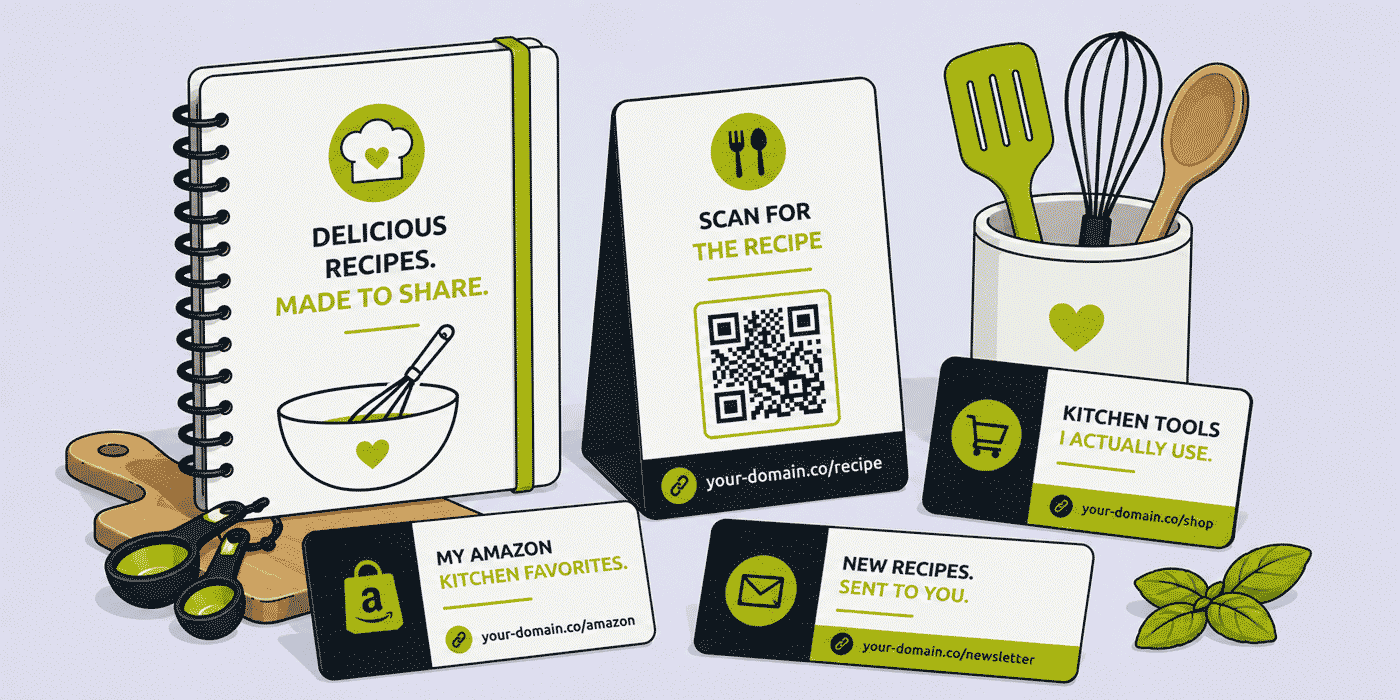
What This Guide Covers
- Recipe card and blog post short links — the migration-proof URL strategy
- Amazon Associates kitchen equipment affiliate links
- Food brand and ingredient sponsorship links
- Link in Bio for food creators — the recipe hub approach
- Pinterest strategy for food bloggers — long-tail recipe traffic
- TikTok and Instagram Reels — "recipe in bio" CTA links
- Cookbook and digital product launch links
- Newsletter building through short links
- Seasonal recipe collection links
- Per-platform content attribution for recipe posts
- A worked example: a food blogger's full link infrastructure
- Common mistakes in food blogger link management
- A Cuttly plan guide for food bloggers
- Frequently asked questions
Recipe Card and Blog Post Short Links
A food blogger publishes dozens or hundreds of recipe posts over the lifetime of their blog, and each of these posts is a permanent content asset that ideally drives traffic and affiliate income for years. The links to these posts appear in Pinterest pins, in email newsletters, in Instagram bio links, in TikTok video descriptions, and in any other channel where the blogger promotes their content. These links need to remain valid indefinitely, regardless of any changes to the blog's platform, URL structure, or domain.
The Food Blog Migration Problem
Food bloggers migrate blogging platforms more frequently than almost any other type of blogger. The technical demands of recipe blogging — structured data for recipe cards, optimized page speed for image-heavy content, ad network requirements for monetization, and evolving SEO best practices — mean that many bloggers have moved from Blogger to WordPress, from WordPress.com to self-hosted WordPress, from one theme framework to another, or from one hosting provider to another at least once in their blogging career. Most of these migrations involve URL structure changes that break every historical external link.
A food blogger with 300 published recipes and four years of Pinterest pins, email newsletters, and Instagram posts referencing those recipes has hundreds or thousands of external links pointing to their content. A blog migration that changes URL structures without proper redirects — which happens more often than it should — breaks all of these external references simultaneously.
A branded short link for each major recipe — your-blog.com/chocolate-layer-cake, your-blog.com/chicken-tikka-masala, your-blog.com/overnight-oats — provides a stable reference that survives every blog migration. When the URL changes, the short link destination is updated; every pin, every email, every historical social media post continues to send readers to the correct recipe. The migration is invisible to everyone except the blogger.
Permanent Recipe Index Links
Beyond individual recipe links, a food blogger benefits from permanent category-level links that serve as entry points to specific recipe types:
your-blog.com/quick-dinners— weeknight dinner recipesyour-blog.com/baking— baking and desserts categoryyour-blog.com/vegetarian— vegetarian and plant-based recipesyour-blog.com/meal-prep— meal prep and batch cooking contentyour-blog.com/five-ingredients— simple, minimal-ingredient recipes
These category links are particularly useful for Link in Bio pages, for seasonal social media promotions, and for email newsletters where the blogger is directing readers to a specific type of content rather than a single recipe. Because they are dynamic, they can be updated if the blog's category structure changes.
Amazon Associates Kitchen Equipment Affiliate Links
Amazon Associates affiliate links for kitchen equipment are one of the most consistent income sources for food bloggers. Every recipe that involves a specific piece of equipment — a stand mixer for cake batter, a cast iron pan for a skillet recipe, a specific brand of blender for smoothies, a Japanese chef's knife for knife skills content — is an opportunity for a relevant equipment recommendation that earns commission when a reader purchases.
The Problem With Raw Amazon Affiliate URLs
Raw Amazon Associates affiliate URLs are one of the most recognizable and most problematic link formats in content creation. They contain the product's ASIN, the affiliate tag, and multiple tracking parameters, combined in a URL that can easily exceed 200 characters. In a recipe post, these links are functional but visually intrusive and immediately recognizable as affiliate links to any reader who has been trained to notice them. In an email newsletter, long Amazon affiliate URLs can trigger spam filters. In a social media post, they are completely unsuitable as visible URLs.
A branded short link for each recommended product — your-blog.com/stand-mixer, your-blog.com/cast-iron, your-blog.com/best-blender — wrapping the Amazon affiliate URL replaces the unwieldy raw link with a clean, descriptive, and branded link that is suitable for every context: recipe posts, email newsletters, Instagram mentions, Pinterest pins, and YouTube video descriptions.
Equipment Link Lifecycle Management
Kitchen equipment recommendations have a longer update cycle than most affiliate recommendations because the same products remain relevant for years. A blogger who recommended a specific stand mixer in 2021 may still be recommending the same or an upgraded model in 2026. However, Amazon listing URLs change: products go out of stock, new versions replace old ones, Amazon restructures their catalog. A raw Amazon affiliate URL in a 2021 recipe post may point to an out-of-stock listing, a discontinued product, or a changed page in 2026.
A branded short link for each equipment recommendation, updated when the product or listing changes, means that every historical recipe post continues to link to the current, in-stock version of the recommended product. The blogger updates the link destination once; every recipe post that references that equipment recommendation — which may number in the dozens for popular categories like stand mixers or cast iron pans — automatically points to the current listing.
Equipment Short Link Strategy for Recipe Posts
A food blogger maintaining a core set of equipment short links uses them consistently across all relevant recipe content:
your-blog.com/stand-mixer— featured in every cake, cookie, and bread recipeyour-blog.com/cast-iron— featured in every skillet and stovetop-to-oven recipeyour-blog.com/instant-pot— featured in every pressure cooker and slow cooker recipeyour-blog.com/air-fryer— featured in every air fryer recipeyour-blog.com/knife-set— featured in any recipe with significant knife work
Click analytics per equipment link, aggregated and anonymized, show the blogger which equipment recommendations generate the most reader engagement across all content where they appear. A blogger who discovers that air fryer recipe posts generate significantly more equipment link clicks than baking posts might invest more in air fryer content production, knowing that the affiliate income per post is higher for that format.
Food Brand and Ingredient Sponsorship Links
Sponsored content partnerships with food brands — ingredient manufacturers, kitchen appliance brands, specialty food retailers, meal kit companies, and food delivery services — are one of the primary income streams for established food bloggers. These partnerships typically involve creating recipes that feature the brand's product, with promotion across the blogger's blog, Instagram, TikTok, and Pinterest channels.
Per-Sponsor Link Structure
For each brand partnership, a short link for the sponsor's product or purchase page:
your-blog.com/sponsor-brand-name— the brand's product page or websiteyour-blog.com/buy-product-name— where to purchase the specific featured product
These links appear in the sponsored recipe blog post, in the Instagram posts featuring the recipe, in the TikTok cooking video description and pinned comment, and in the Pinterest pins for the sponsored content. Click analytics for these links — aggregated and anonymized — show the brand how many of the blogger's readers engaged with the sponsor's product content across all channels simultaneously.
The commercial value of this reporting is substantial. A food brand paying a blogger for a campaign wants to know not just that the content was published but that readers engaged with it. A blogger who reports "our campaign generated 3,400 clicks to your product page across four weeks of content — 1,200 from the blog post, 1,100 from Pinterest, 760 from Instagram, 340 from TikTok" is providing a level of campaign transparency that most food brands have never received from a blogger partnership. This reporting positions the blogger as an unusually professional content partner and is a strong basis for long-term relationships and higher rates.
Link in Bio for Food Creators
Food bloggers face a specific challenge with their Link in Bio: they have hundreds of recipes and their audience's intent is highly varied. A reader who finds them through a pasta recipe TikTok has a different immediate need from one who follows them on Instagram for food photography inspiration, from one who subscribed to their newsletter for weekly meal planning ideas. A Link in Bio page at your-blog.com/links serves all of these audience types from a single entry point.
The Recipe Hub Link in Bio
A food blogger's Link in Bio page is organised as a micro recipe hub with clear sections:
- Now trending. The latest recipe post or the recipe that is performing best this week. Updated with each new post to keep the page fresh for returning visitors.
- Seasonal picks. A curated selection of recipes relevant to the current season or occasion: summer salads in July, warming soups in October, Christmas baking in December, Valentine's Day desserts in February. Updated monthly to reflect the current season.
- Recipe categories. Quick-click links to the core recipe categories the blog is known for: "30-minute dinners," "Vegan recipes," "Baking," "Meal prep." These let a new visitor immediately find the content category most relevant to their needs.
- My kitchen favourites. A curated set of Amazon equipment affiliate links presented as "the tools I use every day." These generate consistent affiliate income from any new visitor who explores the Link in Bio page.
- Free recipe collection. A link to a downloadable recipe collection or meal plan PDF in exchange for an email address. This is the primary email list building mechanism on the Link in Bio page.
- YouTube / Newsletter. Links to the YouTube channel for video recipe content and the newsletter sign-up for regular recipe delivery.
Pinterest Strategy for Food Bloggers
Pinterest and food content have an unusually strong relationship. Food is consistently the most popular content category on Pinterest, and recipe pins have a longer active lifespan than almost any other content type on the platform: a well-optimized recipe pin can drive traffic for two, three, or five years after it was created. For food bloggers, Pinterest is often the single largest traffic source, and the management of recipe pin links is therefore a commercially significant operational task.
Recipe Pin Links: The Stability Imperative
A food blogger with an active Pinterest presence might have 1,000 to 5,000 pins across their boards pointing to their recipe content. Each pin contains a link to a specific recipe post. If that link breaks — because the blog migrated platforms, because the URL structure changed, because the blogger moved from www to non-www — every affected pin generates a dead link experience for every user who clicks on it.
For a food blogger whose largest recipes generate 200 to 500 Pinterest-referred monthly page views, having even twenty or thirty pinned recipes pointing to dead links represents a significant and completely preventable traffic loss. Branded short links for every recipe that is actively being promoted on Pinterest is the only reliable solution: the pin link never changes, and the destination behind the short link is updated whenever the recipe URL changes.
TikTok and Instagram Reels: "Recipe in Bio" CTAs
TikTok and Instagram Reels have become transformatively important for food content discovery. A cooking video that goes viral on TikTok can generate millions of views from people who have never encountered the food blogger before, and many of those viewers will immediately want the full recipe. The challenge is that TikTok does not allow clickable links in video captions, and Instagram Reels do not generate direct link-outs from the content itself. The only path from "I want this recipe" to the recipe is via the bio link.
The Bio Link as Recipe Access Point
Every food blogger's TikTok and Instagram Reels content should include a verbal CTA: "full recipe is linked in my bio" or "recipe link in bio." The bio link should be the blogger's Link in Bio page, with the featured recipe prominently placed as the first item. When a new cooking video goes live, the blogger updates the Link in Bio page to put the featured recipe at the top.
Click analytics on the featured recipe link from the Link in Bio page, compared with the video's view count, give the blogger a video-to-recipe-read conversion rate. A cooking video with 50,000 views and 2,400 recipe page clicks (4.8% conversion) is a successful recipe content piece; a video with 80,000 views and 600 recipe page clicks (0.75% conversion) suggests the video content is engaging but the recipe itself may not be compelling enough to drive click-through, or the bio link placement is not effectively surfacing the recipe to viewers who watched the video.
Cookbook and Digital Product Launch Links
A cookbook launch is one of the highest-profile commercial moments in a food blogger's career, involving months of preparation, coordinated promotion across every channel, and a concentrated window of high sales activity around the publication date. The links associated with the launch need to be consistent, professional, and stable across the full launch timeline — from the cover reveal months before publication to post-launch gifting recommendations from readers years after the book is published.
Cookbook Launch Short Link
A single branded short link for the cookbook — your-blog.com/cookbook — is used as the permanent reference for the book across all channels and all stages of its commercial life:
- Pre-launch: destination is the pre-order page on Amazon, the publisher's website, or the blogger's chosen primary pre-order destination.
- Launch week: destination is the primary purchase page, potentially a "where to buy" page listing all retailers simultaneously.
- Post-launch: destination is the permanent purchase page, updated if the primary retailer changes or if the book goes into paperback edition.
- Long-term: the same short link in a blog post's "about the author" section, in years of social media posts recommending the book, and in any press coverage that includes the blogger's links continues to direct people to the current purchase option.
For digital products — meal planning guides, printable recipe collections, cooking technique courses — the same approach applies: a permanent branded short link for each digital product, stable across whatever platform migration the blogger uses to host and sell the product.
Newsletter Building Through Short Links
An email newsletter is the most resilient income and engagement channel available to a food blogger, and building it is one of the most commercially important long-term investments available. A food blogger with 15,000 email subscribers who sends a weekly recipe newsletter can drive consistent recipe page views, generate affiliate income from every featured recipe's equipment and ingredient links, and launch new products or books directly to a highly engaged audience, entirely independently of Google, Pinterest, or TikTok's algorithm decisions.
A short link for the email sign-up page — your-blog.com/weekly-recipes or your-blog.com/meal-plan — is used in the Link in Bio page, in YouTube CTA overlays, in blog post sidebar and footer CTAs, in Instagram stories, and in any social media post specifically promoting the newsletter. The most effective food blogger email sign-up incentives are practical: a free PDF recipe collection, a weekly meal plan template, a beginner's guide to a specific cuisine, or early access to a new recipe category the blogger is developing.
Seasonal Recipe Collection Links
Food blogging follows a predictable seasonal rhythm: Valentine's Day desserts in January and February, Easter baking in March and April, summer grilling and no-cook recipes in June through August, Halloween treats and pumpkin recipes in September and October, Thanksgiving and Christmas in November and December. Each seasonal period has its own content promotion priorities and deserves its own short link for coordinated cross-channel promotion.
A seasonal collection short link — your-blog.com/christmas-baking, your-blog.com/summer-salads, your-blog.com/thanksgiving — pointing to a curated collection page or a blog category filtered for the seasonal content gives the blogger a single, memorable link to promote consistently across every channel for the season's duration. When the season ends, the destination redirects to the general recipe index or to the next upcoming seasonal collection.
A Worked Example: A Food Blogger's Full Link Infrastructure
Consider a food blogger specialising in quick weeknight dinners and baking, with a blog receiving 120,000 monthly page views, 85,000 Pinterest monthly viewers, 62,000 Instagram followers, and a TikTok account with 180,000 followers, using a branded domain such as your-blog.com, connected through Cuttly's custom domain setup (an A record and a TXT record — see the custom domain setup guide).
Core recipe links: The blogger's 40 most-linked-to recipes each have a permanent short link. When the blog migrated from one WordPress theme framework to another in 2024, the URL structure changed for all posts. Updating 40 short link destinations took two hours; the alternative would have been broken Pinterest pins pointing to those recipes from three years of active pinning. The blogger estimates over 800 active Pinterest pins pointing to their top recipes; without short links, every one would have needed to be manually updated or would have generated dead links.
Amazon affiliate equipment links: Eight core equipment links: /stand-mixer, /cast-iron, /instant-pot, /air-fryer, /dutch-oven, /knife-set, /baking-sheets, /mixing-bowls. These appear in every relevant recipe post. When the blogger's preferred stand mixer was discontinued and a new model replaced it on Amazon, updating /stand-mixer took sixty seconds; every recipe post that referenced the stand mixer recommendation updated automatically. Per-link analytics show the /air-fryer link generating 2.8x more clicks than any other equipment link — a direct signal that air fryer content is their audience's highest-interest equipment category.
TikTok cooking content: A pasta recipe video achieves 340,000 views. The TikTok bio carries your-blog.com/links, with the pasta recipe featured at the top of the Link in Bio page. Over 48 hours: 4,200 clicks on the Link in Bio link from TikTok, 2,800 clicks on the featured pasta recipe link from the Link in Bio page (67% of bio visitors click the featured recipe — an unusually high conversion rate indicating strong recipe intent from TikTok traffic for this content).
Brand partnership: A food brand sponsors a recipe series featuring their pasta sauce. The blogger creates /sponsor-brand used across the blog post, three Instagram Reels, four TikTok videos, and fifteen Pinterest pins. Four-week campaign total: 5,400 clicks. The brand's marketing team, accustomed to receiving only reach and impression data from blogger partnerships, uses this engagement click data in their internal content ROI reporting and books the blogger for a six-month recipe ambassador programme.
Common Mistakes in Food Blogger Link Management
Raw Amazon Affiliate Links in Recipe Posts
A food blogger who embeds raw Amazon affiliate URLs in every recipe's equipment section creates a link management burden that grows with every product update, every Amazon catalog change, and every discontinued item. A single branded short link per product, updated centrally when the Amazon listing changes, replaces dozens of raw links across dozens of recipes with one link that serves every context professionally and requires only one update when the product or listing changes.
No Sponsored Content Click Reporting
A food blogger who completes brand partnership campaigns without per-sponsor link analytics is providing their brand partners with incomplete campaign reporting. Adding a single per-sponsor short link across all campaign content costs nothing and provides the engagement click data that transforms a basic deliverables report into a concrete commercial value story for the brand.
Pinning Raw Blog Post URLs
A food blogger who pins recipes with their raw blog post URLs creates a maintenance problem across their entire Pinterest archive at every blog migration. The cumulative value of years of food blogging is largely embedded in Pinterest pins; protecting that value through branded short links for all recipe pin destinations is one of the highest-return link management investments a food blogger can make.
Cuttly Plan Guide for Food Bloggers
- The Free plan ($0) provides 30 short links per month, a Link in Bio page, full click analytics and dynamic QR Codes, with no credit card required. Suitable for a new food blogger setting up core recipe links, a Link in Bio page, and core affiliate equipment links.
- The Starter plan ($12/month) adds 300 short links per month and a branded custom domain — practical for an established food blogger managing a large recipe catalogue, active Amazon affiliate equipment links, multiple brand partnerships, and per-platform content attribution links throughout the year.
- The Single plan ($25/month) adds up to 5 branded domains for bloggers with multiple food brands or a separate cookbook/product brand, customizable QR Codes for any printed materials, 1,000 API-created links per month for automated per-recipe link generation from CMS, and a full year of analytics history for affiliate programme and seasonal campaign comparison.
- The Team plan ($99/month) suits food media companies, recipe networks, or food blogger collectives where multiple creators share link management, with Campaign tag analytics for aggregated multi-creator campaign reporting and multiple branded domains for different food brands within the network.
Create a free Cuttly account to set up your recipe blog's Link in Bio page, your core Amazon affiliate equipment links, and your first recipe short links. Registration is required for all plans, including free. No credit card is needed for the free plan.
Frequently Asked Questions
How do food bloggers use short links for recipe cards?
A food blogger creates a branded short link for each major recipe post — your-blog.com/chocolate-cake — used in all social media posts, Pinterest pins, and email newsletters. Dynamic short links survive blog platform migrations and URL structure changes, ensuring every historical pin, email, and social post continues to direct readers to the correct recipe page regardless of blog infrastructure changes.
How do food bloggers use Amazon affiliate links for kitchen equipment?
A food blogger creates branded short links for their most-recommended kitchen equipment — your-blog.com/stand-mixer, your-blog.com/air-fryer — wrapping Amazon affiliate URLs. These clean links appear in recipe posts, emails, and social media. When a product or listing changes, updating the single short link destination updates every recipe that references that equipment recommendation automatically.
How do food bloggers use short links for sponsored ingredient campaigns?
A food blogger creates a per-sponsor short link — your-blog.com/sponsor-brand — used across all campaign content channels. Post-campaign click analytics show the brand exactly how many readers engaged with their product across blog, Instagram, TikTok, and Pinterest content. This concrete engagement reporting is a strong basis for long-term brand partnerships and higher rates.
How do food bloggers use Link in Bio pages?
A food blogger uses a branded Link in Bio page — your-blog.com/links — organized as a micro recipe hub with latest recipe, seasonal picks, recipe categories, equipment affiliate links, free recipe collection sign-up, and YouTube and newsletter links. Each destination is independently tracked, revealing which content types their social media audience is most interested in.
How do food bloggers use short links for cookbook launches?
A food blogger creates a permanent short link for the cookbook — your-blog.com/cookbook — used from the cover reveal through to years after publication. The destination updates from pre-order to launch to permanent purchase page as the book's commercial lifecycle progresses. Every historical social media reference and blog post that includes the cookbook link continues to point to the current purchase option.
- Get Started
- Create Free Account
- Plans & Pricing
- Platform Tools
- URL Shortener
- Link Analytics
- Link in Bio Builder
- Related Guides
- URL Shortener for Travel Bloggers
- URL Shortener for Influencers
- URL Shortener for Affiliate Links
- URL Shortener for Etsy Sellers
- URL Shortener for Restaurants
- Encyclopedia
- Link in Bio
- Branded Links
- Setup Guides
- Custom Domain Setup
- Track Link Clicks
- Industry Hub
- Creators & Social Media
- All Industries →
URL Shortener
Cuttly simplifies link management by offering a user-friendly URL shortener that includes branded short links. Boost your brand’s growth with short, memorable, and engaging links, while seamlessly managing and tracking your links using Cuttly's versatile platform. Generate branded short links, create customizable QR codes, build link-in-bio pages, and run interactive surveys—all in one place.
Cuttly - Consistently Rated
Among Top URL Shorteners
Cuttly isn’t just another URL shortener. Our platform is trusted and recognized by top industry players like G2 and SaaSworthy. We're proud to be consistently rated as a High Performer in URL Shortening and Link Management, ensuring that our users get reliable, innovative, and high-performing tools.C


