URL Shortener for Ecommerce The Complete Guide
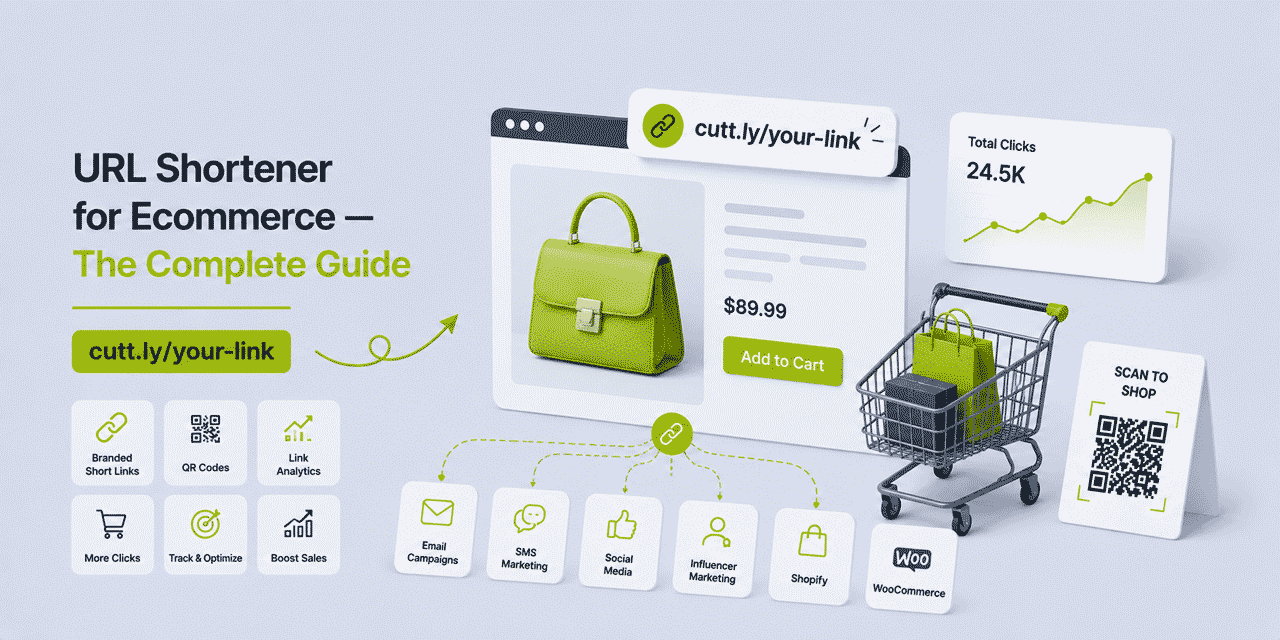
Every ecommerce store produces hundreds of URLs — product pages, category pages, promotional landing pages, flash sale URLs, affiliate links, influencer discount pages, cart abandon recovery links, post-purchase follow-up pages, review request pages. Most of these URLs are long, complex and filled with parameters that make them unwieldy in every channel where they appear. A URL shortener solves this at the infrastructure level: every URL your store produces becomes a short, branded, trackable link that works in email, SMS, social media, print, packaging and QR Codes — and tells you exactly what happened after the click.
This guide covers how ecommerce brands use Cuttly across their marketing stack — from Shopify and WooCommerce integrations to influencer campaign tracking, omnichannel attribution and seasonal promotion management. For the broader ecommerce context, see also URL Shortener for Retail.
What This Guide Covers
- Why ecommerce URLs need shortening
- Branded short links for product pages
- Email marketing — per-campaign link tracking
- SMS marketing — character count and link trust
- Social media — Instagram, TikTok, Facebook, Pinterest
- Influencer marketing — per-influencer link attribution
- Shopify — integration and automation
- WooCommerce — integration and automation
- Packaging and print — QR Codes on physical products
- In-store QR Codes for omnichannel retail
- Seasonal campaigns — link management at scale
- Affiliate and partner link management
- UTM parameters and GA4 attribution
- Dynamic links — update destinations without reprinting
- A/B testing product page variants
- Cuttly plan guide for ecommerce
Why Ecommerce URLs Need Shortening
A typical ecommerce product page URL looks like this:
https://www.yourecommercestore.com/products/wireless-noise-cancelling-headphones-premium-edition-black?variant=32145678&ref=homepage_featured&utm_source=email&utm_medium=newsletter&utm_campaign=spring2026
This URL is 177 characters. In an SMS message with a 160-character limit, this URL alone exceeds the entire message. In an Instagram caption, it cannot be clicked and is unusable even if transcribed. In a printed insert, it is impossible to type. In a TikTok video, it cannot be displayed meaningfully.
A Cuttly branded short link for the same destination:
yourbrnd.link/headphones
Twenty-four characters. Typeable from memory. Branded with the store's domain. Fully tracked. Dynamic — if the product page URL changes during a site migration, the short link destination can be updated in one API call without changing any of the distributed links, reprinting any materials or updating any social media bios.
This is the fundamental value of URL shortening for ecommerce: it decouples the link that recipients see and interact with from the underlying URL infrastructure. The visible link is always clean, branded and stable. The underlying URL can be as long and parameter-heavy as the platform requires.
Branded Short Links for Product Pages
Every product in your catalogue should have a canonical branded short link. Not a randomly generated slug — a descriptive, human-readable slug that communicates what the link leads to before it's clicked.
Examples of good product short link slugs:
yourbrnd.link/headphones— flagship product, easy to say aloudyourbrnd.link/summer-sale— seasonal promotionyourbrnd.link/new-arrivals— category page for new productsyourbrnd.link/vip-offer— loyalty segment landing pageyourbrnd.link/gift-guide— curated collection pageyourbrnd.link/app— mobile app download page
For category-level links: yourbrnd.link/shoes, yourbrnd.link/bags, yourbrnd.link/sale. For campaign-specific links: yourbrnd.link/black-friday, yourbrnd.link/easter, yourbrnd.link/back-to-school. These slugs are easy to include in packaging, print advertising, TV ads, radio spots and spoken video content.
Because Cuttly links are dynamic, the destination behind yourbrnd.link/sale can change from Black Friday to January clearance to Spring Sale without the link itself changing. Print a banner with yourbrnd.link/sale in November; update the destination in January; the banner continues working correctly.
Email Marketing — Per-Campaign Link Tracking
Email is typically the highest-ROI channel for ecommerce brands, which makes link tracking in email critical. Most email marketing platforms (Klaviyo, Mailchimp, Omnisend, Drip) wrap links in their own tracking URLs — but these wrapped URLs are long, platform-branded and may be flagged by email security tools. Cuttly branded short links provide a cleaner alternative.
For each email campaign, create a unique Cuttly link per CTA button. A typical promotional email might have three CTAs: "Shop now", "View all sale items" and "Get free shipping". Three unique Cuttly links — yourbrnd.link/email-shop, yourbrnd.link/email-sale, yourbrnd.link/email-shipping — each tracked independently. After the send, Cuttly click data shows which CTA drove the most engagement, informing the design of the next email.
Adding UTM parameters to each link passes source data to Google Analytics (GA4), allowing you to correlate Cuttly's click data (total clicks, device, country) with GA4's session data (time on site, pages visited, cart events, purchases). This two-layer attribution — Cuttly for click behavior, GA4 for session behavior — provides a more complete picture of email campaign performance than either platform alone.
Email Link Segmentation by Audience
For segmented email campaigns — VIP customers, first-time buyers, lapsed customers, geographic segments — create a unique short link per segment even if the destination is the same landing page. When the same page receives traffic from multiple segments via unique links, the Cuttly analytics show per-segment click behavior: which segment is most engaged, which is most likely to click on mobile, which is most likely to click at a specific time of day. This behavioral data informs future segmentation strategy.
SMS Marketing — Character Count and Link Trust
SMS is increasingly important for ecommerce — flash sale alerts, cart abandon recovery, order status updates, loyalty programme communications, back-in-stock notifications. Every ecommerce SMS use case involves a link. And every SMS link faces two constraints that make URL shortening mandatory: character count and trust.
Character Count
An SMS message is 160 characters per segment. Most ecommerce platforms generate product and promotional URLs that are 80–150 characters before any UTM parameters are added. A 120-character URL leaves 40 characters for the actual message — not enough to say anything meaningful. A 25-character branded Cuttly short link leaves 135 characters for message content, personalization and a clear call to action.
Link Trust in SMS
SMS phishing (smishing) has trained consumers to be suspicious of links from unfamiliar domains in text messages. A link from a recognized branded domain — yourbrnd.link/flash-sale — is immediately associated with the brand sending the SMS. A generic short link from an unfamiliar shortener domain raises suspicion and reduces click rates. For ecommerce brands with established customer bases, a branded SMS link is not optional — it is the baseline professional standard.
Cuttly integrates with SMS automation platforms including Whippy.ai and Mobile Message, allowing branded short links to be created automatically as part of SMS campaign workflows without manual link creation per message.
Social Media — Instagram, TikTok, Facebook, Pinterest
Social media platforms have different link constraints, and ecommerce brands operating across multiple platforms need a link strategy that accounts for each platform's specific requirements.
Instagram does not allow clickable links in post captions. The primary link placement is the bio link — one link per profile. Cuttly's Link in Bio feature lets you create a branded micro landing page at yourbrnd.link with multiple tracked buttons: "Shop new arrivals", "View sale", "Get the app", "Read the blog". Each button is tracked independently, showing which category drives the most engagement from your Instagram audience. In Stories and Reels, swipe-up links (for accounts with link stickers) use Cuttly branded links for consistent branding and tracking.
TikTok
TikTok's bio link and TikTok Shop links both benefit from branded short link infrastructure. For brands using TikTok Shop, creating Cuttly short links for product pages and using them in bio, Linktree-style pages and paid TikTok ads provides independent click tracking outside TikTok's native analytics. This matters because TikTok's attribution window and GA4's attribution window often disagree — having Cuttly as an independent click measurement layer helps reconcile the discrepancy.
Facebook and Meta Ads
For organic Facebook posts, Cuttly short links provide cleaner presentation and independent click tracking. For Meta paid ads, the primary value is retargeting pixel integration — Cuttly supports attaching retargeting pixels to short links, meaning every click on a Cuttly link can fire a Meta, Google, LinkedIn or other ad network pixel. This allows retargeting audiences built from link clicks rather than website visits, which is useful for capturing users who clicked but did not visit the full product page.
Pinterest pins can include URLs directly — branded Cuttly short links on Pinterest pins provide click tracking independent of Pinterest Analytics, which is useful for understanding which product categories perform best with Pinterest's predominantly mobile, visual-discovery audience. Product pins with descriptive branded slugs (yourbrnd.link/summer-dress) also perform better in Pinterest search than pins with raw long URLs.
Influencer Marketing — Per-Influencer Link Attribution
Influencer marketing attribution is one of the most common measurement problems in ecommerce. Without unique links per influencer, it is impossible to know which influencer drove clicks, conversions and revenue — you know the total from all influencers combined, but not the individual contribution.
The solution is straightforward: create a unique Cuttly branded short link for each influencer collaboration. All links point to the same product or landing page, but each slug identifies the specific influencer. Examples:
yourbrnd.link/emma— link for influencer Emma's contentyourbrnd.link/tomstyle— link for Tom's style contentyourbrnd.link/livefashion— link for Live Fashion's content
Each influencer receives their unique link to use in their bio, Stories, TikTok bio and any other placement. Cuttly tracks clicks per link — you see exactly how many clicks each influencer drove, on what devices, from what countries, at what times. This data informs: which influencer to re-engage, which content format drove the most clicks, which audience segment is most engaged, and how to negotiate future collaborations based on actual performance rather than follower count alone.
For influencers with discount codes, the Cuttly link and the discount code work together: the link tracks reach (clicks), the discount code tracks conversion (purchases). Together they provide a complete attribution picture — click-through rate and conversion rate per influencer.
Shopify — Integration and Automation
Shopify is the most widely used ecommerce platform globally. Cuttly integrates with Shopify workflows via multiple mechanisms:
Via Zapier
The Cuttly Zapier integration connects to Shopify's trigger events. Common automations: new product published → create Cuttly short link for product page → post link to Buffer for social scheduling. New collection created → create Cuttly short link for collection page → add to internal link library spreadsheet. Order fulfilled → create Cuttly short link for post-purchase survey → include in fulfilment email via Klaviyo.
Via Make (Integromat)
Make's visual scenario builder allows more complex Shopify + Cuttly workflows. A Make scenario can: monitor Shopify for new product additions, create a Cuttly short link for each new product with a structured slug based on the product handle, create a corresponding QR Code, and upload both the short link and QR Code image to a Google Drive folder organized by product category. The marketing team accesses a ready-to-use library of product links and QR Codes without any manual creation.
Via Cuttly API from Shopify
For Shopify Plus merchants with development resources, the Cuttly Regular API can be called directly from Shopify webhooks and custom Shopify apps. A webhook triggered on product creation calls the Cuttly API to create a branded short link using the product handle as the slug — for example, a product with handle wireless-headphones automatically gets the short link yourbrnd.link/wireless-headphones. The short link is stored in a metafield on the product record and available throughout the Shopify admin and frontend.
WooCommerce — Integration and Automation
WooCommerce runs on WordPress, which has a broad ecosystem of automation tools that connect to Cuttly:
Via OttoKit (formerly SureTriggers)
OttoKit is specifically popular with WordPress and WooCommerce users. It connects WooCommerce event triggers — new product published, order completed, review submitted — to Cuttly actions. A WooCommerce store can automatically create a Cuttly short link for every new product page as it is published, making the link available immediately for marketing distribution without a separate manual step.
Via Zapier or Make
Both Zapier and Make have WooCommerce connectors that work identically to the Shopify integration described above. The automation logic is the same — new product triggers Cuttly link creation; new collection triggers category page short link; order triggers post-purchase survey link.
Via Cuttly API from WordPress PHP
WooCommerce stores with a development team can call the Cuttly API directly from WordPress PHP — either via a custom plugin, a functions.php hook or a WooCommerce action hook. The Cuttly Laravel package (for PHP applications) can also be used in WordPress environments, simplifying the API integration to a few lines of idiomatic PHP.
Packaging and Print — QR Codes on Physical Products
Physical product packaging is one of the highest-value placements for QR Codes in ecommerce. A customer who has just purchased and opened your product is at peak brand engagement — they have physically handled the product, are forming their first impression and are receptive to follow-up actions. A QR Code on the packaging or inside the box captures this moment.
What Ecommerce Brands Put Behind Packaging QR Codes
- Review prompt page — "Enjoying the product? Leave us a review" with buttons for Google, Trustpilot, Amazon
- How-to video or setup guide — for products that benefit from a visual demonstration or assembly guide
- Warranty registration page — direct to a branded registration form
- Loyalty programme sign-up — "Join our rewards programme and earn points on your next purchase"
- Repurchase page — for consumable products, direct to the product page for reorder with a pre-filled cart or discount
- Brand content hub — a Link in Bio page with multiple buttons: review, social follow, next product, blog, support
The critical advantage of Cuttly QR Codes for packaging is their dynamic nature. Packaging is printed in large batches — changing the QR Code destination requires reprinting, which is costly and slow. A dynamic Cuttly QR Code allows the destination to be updated at any time without reprinting. A box printed in January can have its QR Code destination updated for a Valentine's Day promotion, then updated again for Spring, then for Summer — the physical box never changes, but the digital experience it delivers evolves with your marketing calendar.
In-Store QR Codes for Omnichannel Retail
For ecommerce brands that also operate physical retail — either their own stores or concessions in larger retailers — QR Codes bridge the physical and digital experience. In-store QR Code placements that drive ecommerce results:
- Shelf edge labels — QR Code next to a product links to extended specs, reviews, size guides or the online shop page
- Point-of-sale displays — "Scan to add to your wishlist" or "Scan to see more colors"
- Fitting room QR Codes — "Request a different size" or "Complete the look" with linked outfit suggestions
- Receipt QR Codes — printed on physical receipts, linking to a post-purchase review prompt or loyalty programme
- Window display QR Codes — active outside store hours, linking to the online store for after-hours purchases
Cuttly's analytics distinguish QR Code scans from direct link clicks, providing data on which in-store placements generate the most digital engagement — useful for optimizing store layout and display investment.
Seasonal Campaigns — Link Management at Scale
Ecommerce brands run multiple seasonal campaigns per year — Black Friday, Cyber Monday, Christmas, Valentine's Day, Easter, Summer Sale, Back to School, Singles Day for Asian markets. Each campaign requires a set of short links for multiple channels (email, SMS, social, influencer, paid ads). Managing this at scale without a structured link strategy creates operational chaos.
The Cuttly approach to seasonal campaign link management:
- Create campaign-level links early. Before the campaign launch, create all links for all channels. Use a consistent naming convention:
yourbrnd.link/bf-email,yourbrnd.link/bf-sms,yourbrnd.link/bf-instagram,yourbrnd.link/bf-emma(influencer). - Tag all links to the campaign. Use Cuttly's campaign tagging to group all Black Friday links under a single campaign tag. Cuttly's Campaigns dashboard shows aggregated click totals across all campaign links — one view for the entire campaign's click performance.
- Update destinations as the campaign evolves. If the landing page URL changes — a new sale page goes live, a product sells out and the destination needs updating — update the Cuttly link destination without changing the short link. All distributed links continue working.
- Review campaign analytics post-campaign. Per-channel click data informs budget allocation for the next campaign: which channel drove the most clicks, which drove the highest mobile engagement, which influencer drove the best performance.
Affiliate and Partner Link Management
Ecommerce brands with affiliate programmes face a specific link management challenge: affiliate links are often long, contain tracking identifiers that should not be modified, and are distributed across hundreds of publisher sites that cannot be easily updated. Cuttly addresses this with dynamic short links — the affiliate's distributed link stays constant, but the destination can be updated centrally.
For performance marketing teams managing partnerships: create a Cuttly short link per partner or affiliate, tag each link to the partner campaign, and use Cuttly's analytics to monitor partner performance independently of the affiliate network's own reporting. This provides an independent click count that can be compared with the affiliate network's reported clicks to identify discrepancies.
UTM Parameters and GA4 Attribution
Cuttly's built-in UTM builder generates UTM-tagged destination URLs without manual string construction. The short link stays clean — yourbrnd.link/summer-sale — while the destination URL carries the full UTM parameters invisibly through the redirect. GA4 receives source, medium, campaign, content and term parameters as session data.
For ecommerce attribution, the recommended UTM structure:
| Channel | utm_source | utm_medium | utm_campaign |
|---|---|---|---|
| Email newsletter | newsletter | summer-sale-2026 | |
| SMS campaign | sms | sms | summer-sale-2026 |
| Instagram organic | social-organic | summer-sale-2026 | |
| Instagram paid | cpc | summer-sale-2026 | |
| Influencer — Emma | influencer-emma | influencer | summer-sale-2026 |
| TikTok organic | tiktok | social-organic | summer-sale-2026 |
This UTM structure allows GA4 to show: which channel drove the most sessions, which drove the most purchases, what the revenue per session was by channel, and what the conversion rate was per channel. Combined with Cuttly's per-link click data, the result is a comprehensive multi-channel attribution picture for every campaign.
Dynamic Links — Update Destinations Without Reprinting
Dynamic links — where the destination URL can be changed without changing the short link — are particularly valuable in ecommerce contexts where the underlying URL infrastructure changes frequently: site migrations, replatforming from Shopify to another platform, URL structure changes, seasonal page swaps.
Every branded Cuttly short link is dynamic from the Starter plan upward. The destination can be updated from the dashboard or via the API. Changes take effect immediately — there is no propagation delay. All existing shares of the link (in email archives, SMS history, social media bios, printed materials, QR Codes) automatically redirect to the new destination.
For ecommerce brands planning a site migration or replatforming: create all marketing links in Cuttly before the migration. Distribute these links across all marketing channels. When the migration is complete and new URLs are live, update Cuttly link destinations in bulk via API. Zero link breakage across all marketing channels, regardless of how many URLs changed in the underlying platform.
A/B Testing Product Page Variants
Cuttly's A/B rotation feature splits link traffic between two or three destination URLs by percentage. For ecommerce conversion rate optimization, this allows traffic to be split between two product page variants — different layouts, different hero images, different call-to-action copy — without any changes to the distributed link.
Example: a flagship product page is being tested against a new design. Create one Cuttly short link; configure 50% traffic to the original page (A) and 50% to the new design (B). Distribute the single short link across all channels. After two weeks, compare Cuttly click data (which half received more total traffic, useful for detecting bot or quality issues) with GA4 conversion data (which variant produced more purchases). Update the Cuttly link to send 100% of traffic to the winning variant.
Cuttly Plan Guide for Ecommerce
The Free plan ($0) includes link shortening, basic analytics and QR Code generation. Suitable for testing and small-volume personal stores. The free plan uses the cutt.ly domain — branded domains require a paid plan.
The Starter plan ($12/month) adds a branded custom domain, full analytics and dynamic link destinations. The minimum recommended plan for any ecommerce store with professional marketing requirements. The branded domain alone — consistent across all channels — justifies the upgrade cost for any store spending money on marketing.
The Single plan ($25/month) adds device targeting (route mobile and desktop users to different destinations — useful for app-first ecommerce), retargeting pixels, A/B rotation testing, password protection and five branded domains. Suitable for ecommerce brands running cross-channel campaigns with conversion rate optimization requirements.
The Team plan ($99/month) suits ecommerce teams where multiple people manage links — marketing manager, email manager, social media manager, influencer manager — all operating under shared branded domains with individual access. Ten branded domains, team collaboration and the Team API for automated link creation workflows.
The Enterprise plan ($149/month) is for large ecommerce operations, multi-brand groups and enterprises running high-volume programmatic link creation — up to 99 branded domains and 50,000 links per month.
Create a free Cuttly account and create your first branded ecommerce link today. Registration required; free plan available with no credit card needed.
Frequently Asked Questions
How do ecommerce stores use URL shorteners?
Ecommerce stores use URL shorteners to create branded, trackable short links for product pages, category pages, promotional landing pages and email campaigns. Branded short links replace long URLs in email, SMS, social media and influencer content — making links visually clean, building trust before the click and providing per-channel analytics.
Can I use a URL shortener with Shopify?
Yes. Any Shopify URL can be shortened with Cuttly. Cuttly integrates with Shopify via Zapier and Make for automated link creation, and the Cuttly API can be called from Shopify webhooks and custom apps. Shopify Plus merchants can store short links in product metafields for use throughout their stack.
Can I use a URL shortener with WooCommerce?
Yes. WooCommerce URLs can be shortened with Cuttly. The OttoKit integration connects Cuttly directly to WordPress and WooCommerce workflows without code. Zapier and Make also have WooCommerce connectors. The Cuttly API can be called from WordPress PHP hooks and custom plugins.
How do I track which marketing channel drives the most ecommerce sales?
Create a unique Cuttly short link for each channel pointing to the same product or landing page. Add UTM parameters to each link. Cuttly analytics show per-link click data; GA4 shows per-source session and conversion data. Together they provide a complete multi-channel attribution picture.
Are QR Codes useful for ecommerce?
Yes — especially for packaging, printed inserts, in-store displays and direct mail. Cuttly generates a tracked, dynamic QR Code for every short link. Each scan is counted as a click with full analytics. The QR Code is dynamic — if the destination URL changes, the printed QR Code automatically redirects without reprinting.
- Cuttly Tools
- URL Shortener Tool →
- Link in Bio Builder →
- QR Code Generator →
- Branded Domains →
- Related Industries
- URL Shortener for Retail
- URL Shortener for Fashion & Beauty
- URL Shortener for Startups
- URL Shortener for Marketing Teams
- URL Shortener for Influencers
- Integrations
- All Integrations →
- Zapier →
- Make →
- OttoKit (WordPress) →
- Encyclopedia
- Branded Links
- Dynamic QR Codes
- All Industries →
- Start Here
- Create Free Account
- Plans & Pricing
URL Shortener
Cuttly simplifies link management by offering a user-friendly URL shortener that includes branded short links. Boost your brand’s growth with short, memorable, and engaging links, while seamlessly managing and tracking your links using Cuttly's versatile platform. Generate branded short links, create customizable QR codes, build link-in-bio pages, and run interactive surveys—all in one place.
Cuttly - Consistently Rated
Among Top URL Shorteners
Cuttly isn’t just another URL shortener. Our platform is trusted and recognized by top industry players like G2 and SaaSworthy. We're proud to be consistently rated as a High Performer in URL Shortening and Link Management, ensuring that our users get reliable, innovative, and high-performing tools.


