URL Shortener for Airlines The Complete Guide
An airline's digital communications span one of the broadest and most commercially sensitive ranges of any industry: flash fare sale campaigns sent to millions of loyalty members within minutes, pre-departure upsell emails to hundreds of thousands of confirmed passengers, in-airport QR Code experiences linking the physical travel environment to digital services, loyalty programme communications managing billions of miles and points across global member bases, travel agent and corporate partner portals, and crisis communications that need to reach passengers and staff reliably and immediately when the unexpected happens. Each of these communications involves links, and the quality, professionalism, and reliability of those links is a direct reflection of the airline's brand at some of its most commercially and operationally critical moments.
This guide covers how airlines and aviation brands use a URL shortener, branded custom domain, dynamic QR Codes and click analytics across fare sale campaigns, loyalty programme communications, airport and in-flight QR Code programmes, ancillary revenue upsell sequences, travel agent and partner communications, per-route campaign attribution, and crisis communications. This guide addresses link management mechanics; airlines should ensure all communications comply with applicable aviation regulatory requirements and their own legal and compliance frameworks.
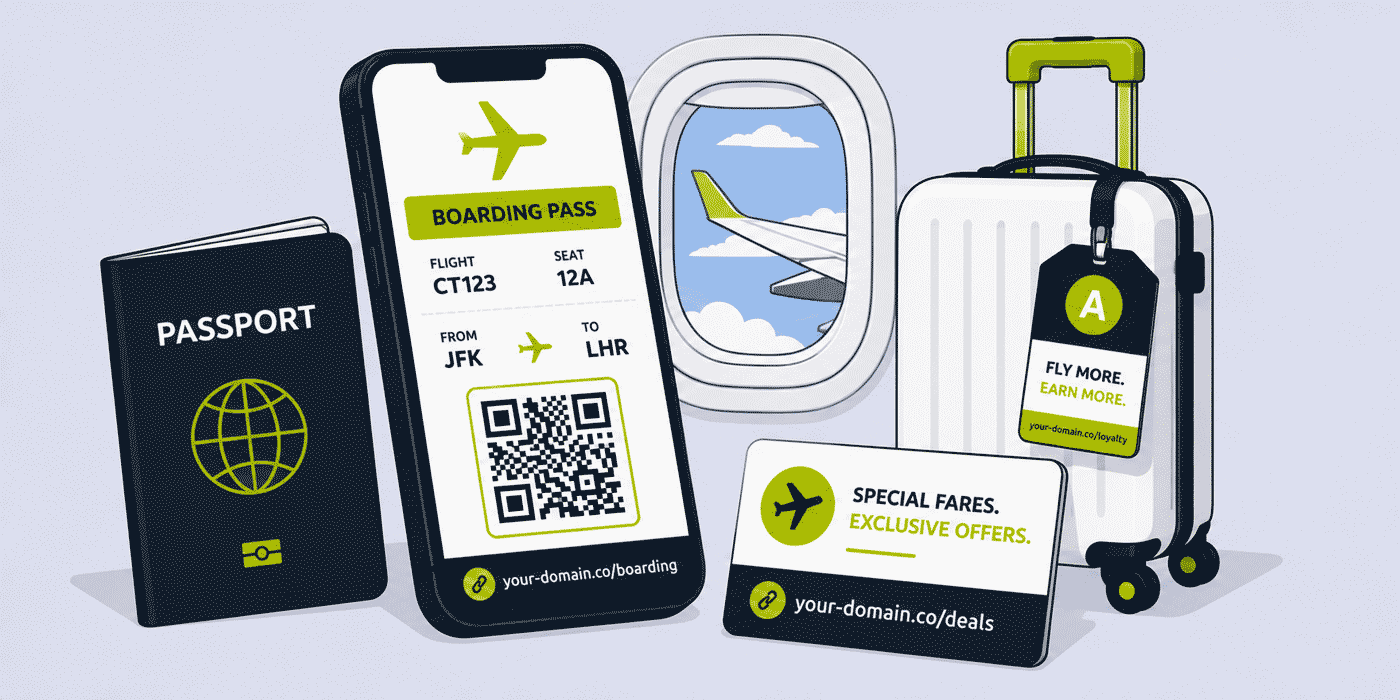
What This Guide Covers
- Fare sale and flash sale campaign links — speed, attribution, and lifecycle management
- Loyalty programme links — the most frequently referenced link in airline communications
- Airport and in-flight QR Code programmes
- Ancillary revenue upsell sequence links
- Per-route campaign attribution
- Travel agent and corporate partner links
- Co-branded credit card and financial partner links
- Destination content and inspiration links
- Crisis and operational disruption communications
- A worked example: a regional airline's link stack across a summer sale campaign
- Common mistakes in airline link management
- A Cuttly plan guide for airlines
- Frequently asked questions
Fare Sale and Flash Sale Campaign Links
Fare sale campaigns are among the most time-sensitive and highest-volume communications in airline marketing. A flash sale email to a loyalty member database of five million customers, deployed at 09:00 on a Tuesday morning, needs every link to be functional, correctly attributed, and pointing to the right fare search page from the moment the first email is opened. A broken link in a flash sale email to millions of customers during the sale window is a commercially significant failure: each click that should have reached the booking page but instead reached an error page is a potential booking lost.
Campaign Link Preparation and Testing
For any airline running fare sale campaigns, the short link for the campaign should be created, configured, and tested before the campaign email is deployed. A branded short link for the summer sale — your-airline.com/summer-sale — pointing to the correctly configured fare search results page for the promoted routes should be live and verified hours before the campaign send, not at the moment the email goes out. The short link also provides a fallback resilience: if the fare search page behind the link encounters a technical issue during the sale, the airline's digital team can update the short link destination to a holding page or an alternative booking path within seconds, without requiring any change to the already-sent email.
Per-Channel Sale Campaign Attribution
An airline running a sale campaign across email, social media, push notifications, the airline's own app, and partner distribution channels creates per-channel attribution links to compare channel efficiency during the sale window:
your-airline.com/sale-email— loyalty member email database sendyour-airline.com/sale-push— mobile app push notificationyour-airline.com/sale-social— social media posts across platformsyour-airline.com/sale-partner— distribution through travel agent and OTA partner channelsyour-airline.com/sale-affiliate— affiliate and cashback platform channels
Click analytics per channel, aggregated and anonymized, show the airline's marketing and revenue management team which distribution channel drives the most fare search page traffic during the sale window. Over multiple sale campaigns, the pattern builds into a clear picture of which channels generate the highest booking volumes relative to their reach, which channels' audiences are most price-responsive to sale fares versus standard fares, and how the click-to-booking conversion rates compare across channels. This per-channel intelligence is among the most commercially valuable data sets in airline marketing.
Sale Campaign Lifecycle Management
Fare sale campaigns have a defined lifecycle: pre-announcement (building anticipation), sale active (conversion focus), sale closing (urgency messaging as the sale end approaches), and post-sale (standard fare restoration). A dynamic short link for the campaign manages this lifecycle without any communication update: as the campaign moves through stages, the destination behind the link updates to reflect the current stage's relevant content and messaging. A passenger who bookmarked the sale link during the pre-announcement phase and returns to it during the sale active phase reaches the current, live booking page; one who returns after the sale has closed reaches a "sale has ended — view our latest fares" page rather than a dead link.
Loyalty Programme Links
An airline's loyalty programme is its most valuable customer relationship asset. Frequent flyers are more valuable per trip than infrequent travellers, are more likely to choose the airline over competitors when alternatives are available, and are more receptive to ancillary product purchases than non-members. The links through which loyalty members access their accounts, manage their miles, redeem for rewards, and engage with the programme's communications are therefore among the most commercially significant in the airline's entire digital ecosystem.
Loyalty Programme Portal Link
A permanent branded short link for the loyalty programme portal — your-airline.com/rewards or your-airline.com/miles — is used in every loyalty member communication: tier status updates, mileage balance statements, reward availability notifications, co-branded credit card offers, and partner earn alerts. Because airline loyalty systems undergo significant technical upgrades, platform migrations, and rebranding exercises over time, a dynamic short link ensures every existing member communication continues to direct members to the current programme portal regardless of what has happened to the underlying platform URL.
The stability of the loyalty portal link matters particularly in high-stakes member communications: a tier downgrade notification that includes a broken link to the tier status appeal process, or a mileage expiry notice that includes a broken link to the miles extension purchase page, creates a frustrated member experience at precisely the moment when the airline most needs to demonstrate operational competence and customer care.
Loyalty Campaign and Promotion Links
Loyalty programme promotions — bonus miles on specific routes, status challenge opportunities, partner earn promotions, mileage auction events — each deserve their own short link for independent campaign tracking:
your-airline.com/bonus-miles-summer— summer double miles promotionyour-airline.com/status-challenge— elite tier status challenge campaignyour-airline.com/partner-earn— hotel and retail partner earn promotionyour-airline.com/miles-auction— mileage auction for premium cabin upgrades
Click analytics per loyalty promotion link show the programme management team which promotional mechanics generate the most member engagement and which tier segments respond most actively to each promotion type. Elite members may respond strongly to status challenge campaigns; infrequent flyers may respond primarily to bonus miles offers on leisure routes. This segmented engagement intelligence informs both the design of future loyalty promotions and the communication targeting decisions that allocate each promotion to the most receptive audience segments.
Airport and In-Flight QR Code Programmes
The physical environment of air travel — the departure lounge, the gate, the aircraft cabin — is a concentrated dwell time opportunity that most airlines significantly underexploit for digital engagement. A passenger waiting 45 minutes at a gate before boarding has time and motivation to engage with digital content relevant to their journey if it is accessible and well-presented. A passenger in the aircraft cabin for four hours has an extended digital engagement opportunity if the airline's in-flight digital service is genuinely useful and easy to access.
Airport Lounge and Gate QR Codes
QR Codes at airport lounges and gates serve a captive, travel-focused audience at a moment of genuine digital receptivity. Strategic placements with relevant destinations:
- Loyalty enrolment. A QR Code at the gate or lounge entrance labelled "Not a member? Join our rewards programme and earn miles on today's flight" —
your-airline.com/join-rewards. This captures the highest-intent loyalty enrolment audience: a person who has chosen to fly with the airline and is about to accumulate miles they are not currently earning. - Destination guide. A QR Code in the departure lounge linking to a curated guide for the destination being served: local recommendations, transport information, weather, and cultural tips —
your-airline.com/destination-city-name. This is a high-engagement, brand-enhancing service that positions the airline as a travel companion rather than a transport commodity. - Duty-free pre-order. A QR Code at the gate linking to the duty-free pre-order portal —
your-airline.com/duty-free— captures passengers who are in the mindset of travel purchases and have time before boarding to browse and order items for collection at their destination. - Upgrade and ancillary offers. A QR Code offering last-minute upgrade availability —
your-airline.com/upgrade-now— at the gate, when premium cabin seats may still be available and a passenger may be more receptive to the offer than they were at the time of booking.
In-Flight QR Codes
In-flight QR Codes on seat-back tray tables, in the seat pocket materials, and on in-flight service cards serve the captive in-flight audience:
- In-flight entertainment and Wi-Fi. A QR Code linking to the in-flight entertainment portal or Wi-Fi connection page —
your-airline.com/inflight— simplifies access for passengers who are unfamiliar with the aircraft's system. - In-flight shopping. A QR Code linking to the in-flight duty-free catalogue for browsing and pre-ordering without requiring the paper catalogue —
your-airline.com/shop. - Post-flight survey. A QR Code on the arrival information card linking to a post-flight feedback survey —
your-airline.com/feedback. Because passengers are more likely to complete a survey in the final hour of a flight or immediately on landing than days later when the experience has faded, an in-flight QR Code survey invitation captures feedback at the optimal moment.
All in-flight and airport QR Codes are generated from dynamic short links, ensuring that when the in-flight entertainment platform is upgraded, the duty-free catalogue system changes, or the feedback survey tool migrates, every physical display material continues to work without replacement. For aircraft that are in service for 20 or more years, dynamic QR Codes in seat pocket materials are the only practical approach to digital integration.
Ancillary Revenue Upsell Sequence Links
Ancillary revenue — seat upgrades, extra baggage, priority boarding, seat selection, pre-ordered meals, lounge access, travel insurance, and car hire at the destination — represents a substantial and growing proportion of airline revenue for most carriers. The pre-departure period between booking confirmation and travel date is the primary window for ancillary upsell, and the email and push notification sequence in this window is the delivery mechanism through which ancillary revenue opportunity is converted into actual purchases.
Pre-Departure Upsell Sequence
A structured pre-departure upsell communication sequence with dedicated short links:
- Booking confirmation + 24 hours — seat selection:
your-airline.com/seat-select. The window immediately following booking is when the passenger is most engaged with the trip; seat selection is a natural extension of the booking completion experience and generates high conversion rates. - 6 weeks before departure — upgrade offer:
your-airline.com/upgrade. Cabin upgrade offers timed six to eight weeks before departure reach passengers when they are beginning to think concretely about their journey and may be more receptive to premium products than at the time of booking. - 4 weeks before departure — baggage:
your-airline.com/add-bags. Passengers who did not add hold baggage at booking are reminded at a point when their packing plans are becoming clearer. - 2 weeks before departure — experiences and transfers:
your-airline.com/experiences. Destination experiences, airport transfers, and car hire are promoted when the trip feels imminent and supplementary planning activity is highest. - 48 hours before departure — check-in and lounge:
your-airline.com/check-in. Online check-in invitation with a prominent upsell for lounge access, priority boarding, and any remaining unbooked ancillaries.
Click analytics per ancillary link in the upsell sequence, aggregated and anonymized across the passenger cohort, show the airline's ancillary revenue team at which timing point each product generates the most engagement. If upgrade offers generate significantly higher click rates at 6 weeks than at 2 weeks, the optimal upgrade offer window is established. If baggage upsells generate lower click rates but higher conversion rates than upgrade offers, the baggage message may be reaching a more intent-qualified audience. These timing and conversion insights are the most actionable inputs available for optimising the ancillary revenue sequence.
Per-Route Campaign Attribution
Airlines operate complex route networks where different routes have different load factors, different competitive dynamics, different demand profiles, and different marketing priorities at any given time. A route entering a peak demand period may need minimal promotional support; a route facing increased competition from a new entrant may need aggressive promotional investment; a newly launched route needs awareness-building campaign investment to reach its load factor target. Per-route campaign links provide the attribution data that connects marketing investment to specific route performance.
A per-route campaign short link structure — your-airline.com/route-lon-nyc, your-airline.com/route-man-dxb — used in route-specific advertising, in targeted email campaigns to members who have previously flown the route or who live near the origin airport, and in any partner distribution for that specific route, gives the revenue management and commercial teams a per-route marketing engagement signal that is distinct from the booking volumes the route generates organically. A route where marketing generates high click volumes but disappointing incremental bookings may have a price competitiveness problem; one where click volumes are modest but booking conversion is very high may be reaching a small but highly motivated audience that justifies the targeted investment.
Travel Agent and Corporate Partner Links
Travel agents, online travel agencies, global distribution systems, and corporate travel management companies represent a significant proportion of airline booking volumes. Managing these distribution partner relationships requires regular communication: fare updates, product training materials, booking tool access, incentive programme information, and promotional support for specific routes or cabin classes. The links through which this communication reaches distribution partners need to be professional, stable, and appropriate for the commercial relationship context.
Partner Portal and Trade Resource Links
A short link for the airline's trade portal — your-airline.com/trade — provides travel agents and corporate account managers with a stable, branded entry point to booking tools, commission structures, product training, and current promotional support materials. Because trade portal platforms change — airlines regularly upgrade their distribution technology, move between GDS configurations, and update their booking tool interfaces — a dynamic short link ensures every existing reference in agent communications continues to work through each technology change.
Per-partner attribution links — your-airline.com/trade-agency-name — used when the airline is directing specific information to individual agency partners, provide click analytics showing how actively each distribution partner is engaging with promotional and operational communications. An agency that consistently fails to access the airline's trade communications may not be promoting the airline effectively to its clients; a proactive engagement call from the airline's trade sales team, prompted by low engagement analytics, may identify and address barriers to the partnership's commercial productivity before they become visible in booking volume data.
Crisis and Operational Disruption Communications
Airlines face operational disruptions with a frequency and visibility that few other industries experience: weather diversions, technical delays, air traffic control restrictions, industrial action, and the occasional major incident all require rapid, accurate, and trustworthy communications to passengers and staff. The links in these communications are used at moments of high stress, high emotional load, and urgent information need — making their reliability and professionalism particularly important.
Pre-Established Disruption Communication Links
A well-prepared airline maintains pre-established short links for disruption-related information pages that can be activated immediately when an operational issue arises:
your-airline.com/disruption— the primary disruption information page, updated in real time during any operational issueyour-airline.com/rebooking— the self-service rebooking portal, critical during cancellations and major delaysyour-airline.com/compensation— the EU261 or equivalent compensation claim information and submission portalyour-airline.com/passenger-rights— the airline's passenger rights information page
These links exist as permanent, branded short links that can be included in any SMS, email, or social media communication within minutes of an issue being identified, without requiring any new link setup during a time-critical operational situation. Because disruption response systems and compensation portals change during airline digital transformations, the dynamic nature of these links ensures they continue to work correctly even after a platform migration that might otherwise require updating every template and every communication system simultaneously during an ongoing operational situation.
Destination Content and Inspiration Links
Airlines that invest in destination content — guides, travel inspiration, photography, video, and cultural information about the cities they fly to — build a brand relationship with travellers that extends beyond the transactional booking moment. A traveller who returns to an airline's website repeatedly for destination inspiration before booking, and who finds consistently excellent content there, is building a habit of starting the travel planning journey at that airline rather than a search engine or OTA. This habit is commercially valuable and is built through consistently excellent destination content linked from multiple promotional touchpoints.
Short links for destination content — your-airline.com/discover-cityname — used in social media posts, in email newsletters for frequent travellers, and in any advertising that targets travel inspiration seekers rather than flight bookers, provide click analytics showing which destinations generate the most traveller content engagement. High engagement with destination content for a specific city may be a leading indicator of growing booking demand for that route before it shows up in actual booking data, giving the commercial team an early signal to ensure adequate capacity allocation.
A Worked Example: A Regional Airline's Summer Sale Campaign
Consider a regional airline with 18 routes, a loyalty programme of 850,000 members, and a peak summer sale campaign targeting its four highest-demand leisure routes, using a branded domain such as your-airline.com, connected through Cuttly's custom domain setup (an A record and a TXT record — see the custom domain setup guide).
Campaign preparation (72 hours before launch): The primary sale link /summer-sale is created and destination-tested. Per-channel attribution variants are created: /sale-email, /sale-push, /sale-social, /sale-trade. Per-route links are created for the four featured routes: /route-lon-ibz, /route-lon-opo, /route-man-bcn, /route-brs-pmi. All six links are tested against the sale fare search pages 24 hours before launch.
Launch day: Email to 850,000 loyalty members at 07:00 using /sale-email. Push notification to 340,000 app users at 07:15 using /sale-push. Social media posts at 07:30 using /sale-social. By 09:00: /sale-email has generated 48,000 clicks (5.6% open-to-click rate), /sale-push has generated 34,000 clicks (10% push-to-click rate — highest engagement rate), /sale-social has generated 8,200 clicks. The revenue management team notes the push notification's significantly higher engagement rate and approves a second push notification at 16:00 to members who received but have not yet clicked the morning push.
Per-route analytics: The London-Ibiza route generates 3.8x the click volume of the Bristol-Palma route, confirming it as the strongest demand route in the sale. The airline's commercial team uses this ratio to inform the seat allocation between sale routes for the next promotional cycle.
Post-sale: The /summer-sale destination updates to "Summer sale has ended — view our latest fares" with a link to the standard fare search. All marketing materials, social posts, and partner communications that referenced the sale link continue to deliver an appropriate experience for any late-arriving visitor rather than a dead page or an error.
Common Mistakes in Airline Link Management
No Pre-Sale Link Testing Protocol
An airline that deploys a fare sale email to millions of loyalty members without testing every link in the email against a live staging environment is accepting a risk whose commercial cost can be significant. A broken sale link in an email to five million members during a 48-hour flash sale represents booking revenue that cannot be recovered after the sale closes. Pre-sale link testing, using dynamic short links that can be updated within seconds if a destination URL changes at the last minute, is the operational standard for any airline running time-critical sale campaigns.
Static QR Codes in Aircraft Cabin Materials
An airline that uses static QR Codes in seat pocket materials, on tray table inserts, or in any in-flight printed material creates a long-term digital maintenance problem. Aircraft are in service for decades; static QR Codes embedded in seat pocket materials printed in 2024 may still be there in 2034, by which time the URL they encoded is almost certainly broken. Dynamic QR Codes in all aircraft cabin materials are the only sustainable approach to in-flight digital integration across a long aircraft service life.
No Disruption Communication Link Infrastructure
An airline that does not maintain pre-established short links for its disruption communication pages is adding unnecessary operational complexity to an already stressful situation. When a major disruption occurs, the communications team should be sending pre-prepared messages containing pre-tested links, not creating new links under time pressure while managing the operational event simultaneously. Pre-established, permanently maintained disruption links are operational preparedness infrastructure, not a marketing convenience.
Cuttly Plan Guide for Airlines
- The Free plan ($0) provides 30 short links per month, one branded custom domain, full click analytics and dynamic QR Codes, with no credit card required. Suitable for a small regional airline or charter operator setting up core loyalty, booking, and disruption communication links.
- The Starter plan ($12/month) adds 300 short links per month and 30 custom aliases per month — practical for a growing regional airline managing multiple sale campaigns, per-route attribution, loyalty programme communications, and pre-departure upsell sequence links throughout the year.
- The Single plan ($25/month) adds up to 5 branded domains for airline groups with multiple brand entities, customizable QR Codes for professional airport and cabin displays, 1,000 API-created links per month for automated per-route or per-partner link generation, and a full year of analytics history for campaign and route performance comparison.
- The Team plan ($99/month) suits larger airlines with marketing, revenue management, loyalty, commercial, and operations teams sharing link management, Campaign tag analytics for aggregated route and campaign portfolio reporting, multiple branded domains for different airline brands within a group, and shared workspaces for distributed commercial teams.
Create a free Cuttly account to set up your airline's fare sale campaign links, loyalty programme portal link, and first airport or cabin QR Codes. Registration is required for all plans, including free. No credit card is needed for the free plan.
Frequently Asked Questions
How do airlines use short links for fare sale campaigns?
An airline creates a branded short link for each sale campaign with per-channel attribution variants for email, push, social, and partner channels. Because sale landing pages are rebuilt each campaign, dynamic links ensure every reference resolves correctly. Pre-sale link testing and a 72-hour preparation window are operational standards that prevent the broken-link risk that affects time-critical fare sale deployments.
How do airlines use short links for loyalty programme communications?
An airline maintains a permanent short link for its loyalty portal — your-airline.com/rewards — used in every member communication. Because airline loyalty systems undergo frequent technical migrations, a dynamic link survives every platform change without requiring updates to the templates of thousands of automated member communications. Per-promotion loyalty links track which promotional mechanics generate the most member engagement.
How do airlines use QR Codes at airports and in aircraft?
An airline places dynamic QR Codes at lounges, gates, and in aircraft cabins, linking to loyalty enrolment, destination guides, duty-free pre-order, and feedback surveys. Because physical airport and cabin materials remain in service for years, dynamic QR Codes are the only sustainable approach: destinations update when platforms change without any physical replacement of display materials.
How do airlines use short links for travel agent and partner communications?
An airline uses per-partner short links for trade portal access and promotional communications. Click analytics per partner show how actively each distribution partner is engaging with the airline's commercial materials, enabling the trade sales team to identify which partnerships need proactive development support before disengagement shows up in booking volume data.
How do airlines use short links for ancillary revenue upsell?
An airline uses dedicated short links per ancillary product in its pre-departure upsell sequence — seat selection, upgrade, baggage, experiences, check-in. Click analytics per link and per timing point reveal at which stage of the pre-departure window each ancillary product generates the most engagement, informing the optimal timing and product sequencing of the upsell communication programme.
- Get Started
- Create Free Account
- Plans & Pricing
- Platform Tools
- URL Shortener
- Link Analytics
- QR Code Generator
- Campaign Analytics
- Related Guides
- URL Shortener for Cruise Lines
- URL Shortener for Travel Bloggers
- URL Shortener for Hotels
- URL Shortener for Tour Operators
- Short Links for Offline Campaigns
- Encyclopedia
- Branded Links
- Dynamic QR Codes
- Setup Guides
- Custom Domain Setup
- Track Link Clicks
- Industry Hub
- Travel, Logistics & Events
- All Industries →
URL Shortener
Cuttly simplifies link management by offering a user-friendly URL shortener that includes branded short links. Boost your brand’s growth with short, memorable, and engaging links, while seamlessly managing and tracking your links using Cuttly's versatile platform. Generate branded short links, create customizable QR codes, build link-in-bio pages, and run interactive surveys—all in one place.
Cuttly - Consistently Rated
Among Top URL Shorteners
Cuttly isn’t just another URL shortener. Our platform is trusted and recognized by top industry players like G2 and SaaSworthy. We're proud to be consistently rated as a High Performer in URL Shortening and Link Management, ensuring that our users get reliable, innovative, and high-performing tools.C


