URL Shortener for Cruise Lines The Complete Guide
Cruising is one of the most considered, longest-lead, and highest-value travel purchases a consumer makes. The average booking window for a cruise voyage is twelve to eighteen months before sailing, and the purchase process involves extensive research, multiple website visits, price comparisons across itineraries and cabin categories, consultation with travel agents, and careful evaluation of the onboard experience promised by the cruise line's marketing. This long consideration period creates an extended marketing and communication window that most other travel categories do not have, and it means that the links distributed in cruise marketing communications may be clicked, saved, and revisited many times over a period of months before a booking decision is made.
This guide covers how cruise lines use a URL shortener, branded custom domain, dynamic QR Codes and click analytics across itinerary campaign management, the long booking cycle's multi-touch attribution challenge, pre-cruise upsell sequences, onboard QR Code programmes, shore excursion links, loyalty programme communications, travel agent and partner portals, and the specific link management challenges of an industry where decisions are made slowly, bookings are made far in advance, and the marketed experience is inherently high-expectation.
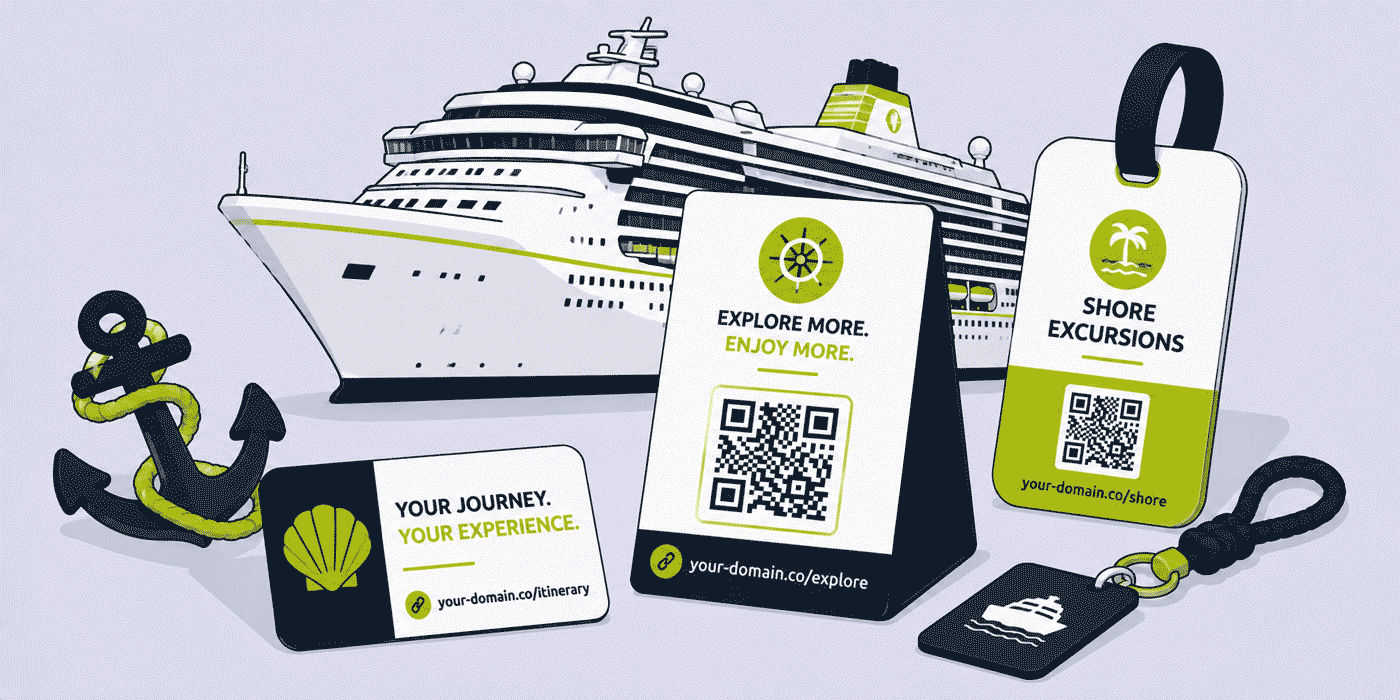
What This Guide Covers
- Itinerary campaign links — managing accuracy across a long booking window
- The long-cycle booking attribution challenge and how short links address it
- Pre-cruise upsell and ancillary revenue sequence links
- Shore excursion and port experience links
- Onboard QR Code programme — daily activities, dining, spa and entertainment
- Loyalty programme links — past guest communications
- Travel agent and cruise specialist partner links
- New ship and deployment announcement links
- Destination and itinerary content links
- A worked example: a cruise line's link stack across a new itinerary launch
- Common mistakes in cruise line link management
- A Cuttly plan guide for cruise lines
- Frequently asked questions
Itinerary Campaign Links: Managing Accuracy Across a Long Booking Window
A cruise itinerary campaign distributed eighteen months before the sailing date will be clicked, shared, saved, and revisited many times before a booking is made. During those eighteen months, the itinerary page it links to will be updated multiple times: as availability changes by cabin category, as promotional pricing is applied and withdrawn, as itinerary details are adjusted, and as new departure dates are added. The link that was correct on the day it was first distributed may point to a very different page three months later if the destination URL is static.
Dynamic Itinerary Links for Long-Cycle Management
A branded short link for each itinerary campaign — your-cruise.com/mediterranean-summer-2027 or your-cruise.com/caribbean-2027 — that is dynamically managed throughout the eighteen-month pre-sale period ensures that every distribution of that link, at whatever point in the booking cycle the recipient sees it, always leads to the current, accurate itinerary information. When pricing changes, the page behind the link is updated; the link itself does not change in any communication that contains it.
This is particularly important for cruise marketing because price discrepancy between a marketed fare and the fare shown on the booking page at the moment of clicking is one of the most commercially damaging trust failures in travel. A consumer who has been tracking a cruise for months, has seen a promotional fare advertised in an email they received three months ago, clicks the link expecting to see that fare, and instead sees a higher price, loses trust in the cruise line's pricing communications. A dynamic link that always points to the current, accurate pricing page eliminates the risk that a historical email creates a false pricing expectation.
Per-Channel Itinerary Attribution
Cruise marketing spans a uniquely diverse channel mix: direct email to past guests, travel agent partner channels, specialist cruise media publications, social media content targeting travel-interested audiences, paid search and display advertising, cruise comparison websites, and increasingly, video content on YouTube and TikTok where destination and onboard experience footage generates substantial travel inspiration engagement. Per-channel short links for itinerary campaigns:
your-cruise.com/med-email— email to past guest databaseyour-cruise.com/med-agents— travel agent distributionyour-cruise.com/med-social— social media organic and paidyour-cruise.com/med-cruise-mag— specialist cruise media featuresyour-cruise.com/med-comparison— cruise comparison platform listings
All pointing to the same itinerary page. Click analytics per channel, aggregated and anonymized, give the commercial team visibility of which distribution channels are generating the most itinerary research traffic throughout the booking window. In a category where the booking decision takes months, the click volume a channel generates in September for a voyage departing the following July may be a stronger predictor of booking conversion than any other available leading indicator.
The Long-Cycle Booking Attribution Challenge
Attribution is one of the most complex analytical challenges in cruise marketing precisely because of the long decision cycle. A consumer who first clicks a Mediterranean cruise link from a social media post in March, revisits the itinerary page via a Google search in June, opens a price drop email in September, consults with a travel agent in November, and books directly online in December has touched five or more marketing touchpoints across nine months before converting. Standard last-click or first-click attribution models are particularly misleading in this context: last-click attribution would credit the booking to the email, ignoring eight months of earlier engagement; first-click would credit social media, ignoring the final conversion trigger.
Short link click analytics do not solve multi-touch attribution in full — that requires integration with CRM and booking data across all channels — but they provide the most consistent and channel-agnostic top-of-funnel engagement data available. The click volume per channel over the full eighteen-month booking window, compared with the eventual booking volume that each channel generates, gives the most accurate picture of each channel's contribution to the full booking journey available from link analytics alone.
For a cruise line's commercial team, per-channel click data over the full pre-sailing booking window is a novel and genuinely useful input to campaign planning. Channels that generate early high click volumes but moderate booking conversions may be essential top-of-funnel awareness drivers that should not be cut despite their apparent low direct conversion rate; channels that generate lower but highly conversion-correlated late-cycle clicks may be bottom-of-funnel closers that should be maintained and strengthened.
Pre-Cruise Upsell and Ancillary Revenue Sequences
The period between a cruise booking confirmation and the sailing date — often nine to fifteen months for advance bookings — is a sustained commercial opportunity that well-managed cruise lines use systematically. Shore excursions, speciality dining reservations, beverage packages, spa treatments, stateroom upgrades, onboard credit packages, and pre-cruise hotel nights are all ancillary products that a confirmed passenger may be interested in adding to their cruise purchase during this extended pre-cruise period.
Pre-Cruise Communication Sequence
A structured pre-cruise upsell communication sequence — typically beginning twelve months before sailing and intensifying in the final three months — uses dedicated short links for each ancillary category:
- 12 months before — stateroom upgrade:
your-cruise.com/upgrade-cabin. Upgrade offers to confirmed passengers at a preferential rate, available while higher cabin categories still have availability. Early upgrade campaigns generate incremental revenue from passengers who would prefer a better cabin but did not book premium at the original purchase. - 9 months before — shore excursions:
your-cruise.com/excursions. Shore excursion bookings opened, with the cruise line's own curated excursion programme available before generic third-party tours. Passengers who book cruise line excursions are higher-margin and lower-risk (guaranteed ship-boarding compliance) than those who book independently. - 6 months before — dining and spa:
your-cruise.com/dining-reservationsandyour-cruise.com/spa. Speciality dining reservations and spa treatment bookings for the voyage, available at a pre-cruise discount compared with onboard booking prices. Pre-booked dining and spa revenue is confirmed revenue regardless of onboard spending decisions. - 3 months before — beverage packages:
your-cruise.com/drinks-package. Beverage package pre-purchase at a discount to the onboard price, targeted at passengers who have not yet added this to their booking. Click analytics at this stage reveal what proportion of confirmed passengers are engaging with the beverage package offer. - 6 weeks before — final extras:
your-cruise.com/pre-cruise-offers. A consolidated offer email covering any remaining unbooked ancillaries, presented as a "don't miss these extras" final opportunity before sailing. This email reaches passengers who have been engaged with previous upsell communications but have not yet purchased.
Click analytics per ancillary link across the full pre-cruise sequence give the revenue management team a detailed picture of ancillary purchase intent at each stage. A beverage package offer that generates 28% click engagement at three months before sailing but only 14% at the final-extras stage may be more effective at the three-month point, suggesting an optimal offer timing that the communications team should maintain for future sailings. An excursion offer that generates very high click engagement but moderate purchase conversion may indicate a pricing or presentation issue on the excursion booking page rather than a lack of passenger interest.
Shore Excursion and Port Experience Links
Shore excursions are among the most commercially significant ancillary categories in the cruise business and among the most competitively contested. Third-party tour operators, local guides, and independent booking platforms all compete with the cruise line's own curated excursion programme for the passenger's shore day spend. The cruise line's competitive advantage — guaranteed ship return times, pre-vetted quality, accessibility support, and seamless booking integration with the main cruise booking — needs to be communicated clearly and early to maximise cruise line excursion uptake over independent alternatives.
Per-Port Excursion Links
A per-port excursion link structure gives passengers direct access to the specific excursion options for each stop on their itinerary:
your-cruise.com/excursions-rome— Rome day excursion options (typically from Civitavecchia)your-cruise.com/excursions-dubrovnik— Dubrovnik port day optionsyour-cruise.com/excursions-mykonos— Mykonos island excursion programme
These per-port links are used in port preview emails sent as the sailing date approaches, in the onboard daily programme digital companion, and in any destination content that discusses specific ports of call. Click analytics per port excursion link reveal which ports are generating the most passenger excursion research interest, informing both the excursion programme's product development (which ports justify a broader and more varied excursion offering) and the communication timing for each port's excursion promotion.
Onboard QR Code Programme
A cruise ship is a contained physical environment where the cruise line has complete control over every surface, every display, and every digital touchpoint it places. This control creates an opportunity for a comprehensive onboard QR Code programme that connects every physical location and activity to a relevant digital service, from the moment a guest boards to the moment they disembark.
Cabin QR Codes
The cabin is where guests spend the most time outside of organised activities, and a QR Code in the cabin information materials — the daily programme card, the welcome letter, or the in-cabin desk display — is the most personal and most studied placement on the ship:
- Daily activities programme:
your-cruise.com/today— updated each morning with the current day's activities across the ship. A guest who wants to review the evening's entertainment options without carrying a paper programme can scan the cabin QR Code and see the digital version. The dynamic destination updates each morning to the current day's programme. - Dining reservations:
your-cruise.com/dining— direct access to the speciality dining reservation system for guests who want to book a restaurant for that evening or later in the voyage. - Loyalty enrolment:
your-cruise.com/join-club— for guests who are not yet members of the cruise line's loyalty programme. The cabin is a high-engagement moment for loyalty enrolment: a guest who has just arrived on their cruise ship for the first time is at peak positive sentiment toward the brand.
Public Space QR Codes
QR Codes in public spaces across the ship serve the full range of onboard commercial and service objectives:
- Shore excursions desk display:
your-cruise.com/excursions— for guests who have not yet booked their port day activities and are researching options the evening before arriving at each port. - Spa entrance:
your-cruise.com/spa-book— spa treatment booking for guests who spontaneously decide they want a treatment without approaching the reception desk. - Retail boutiques:
your-cruise.com/shop-online— for items that are sold out in the physical boutique or that the guest wants to purchase after disembarkation. Extending the shopping experience beyond the physical store is particularly valuable on the final day of the cruise when guests are constrained by luggage capacity. - Post-cruise feedback:
your-cruise.com/feedback— the guest satisfaction survey link, displayed prominently on the final day of the cruise and in the cabin departure materials. Capturing feedback while the cruise experience is still fresh, rather than days later when a post-cruise email arrives, generates significantly higher survey completion rates.
All onboard QR Codes are generated from dynamic short links. Because a cruise ship is in service for twenty or more years and the digital systems it connects to — the daily programme system, the dining reservation platform, the spa booking tool — change multiple times over that service life, dynamic QR Codes are the only approach that maintains a functional digital integration across the full vessel lifespan without requiring physical replacement of display materials.
Loyalty Programme Links
Cruise loyalty programmes are among the most sophisticated in travel, managing tiered benefits across fleets of ships, tracking onboard spending and past voyage history, and delivering personalised benefits that can include cabin upgrades, private shore excursion access, exclusive onboard events, and significant fare discounts on future sailings. The communications through which loyalty members engage with the programme are numerous and commercially significant.
A permanent short link for the loyalty portal — your-cruise.com/loyalty or your-cruise.com/club-name — in every past guest communication creates a stable, consistently branded access point that survives every platform migration the loyalty system undergoes. The commercial consequence of a broken loyalty portal link in a future cruise credit notification or a tier upgrade announcement is disproportionate to the technical simplicity of preventing it: a loyalty member who cannot access their account through a link in a communication from the cruise line loses trust in the programme's competence and may be less motivated to engage with the future booking incentive the communication was designed to drive.
Travel Agent and Cruise Specialist Partner Links
Travel agents — and particularly specialist cruise agents, who account for a substantial proportion of cruise bookings in most markets — are the most commercially important distribution channel for most cruise lines outside of direct online booking. A cruise specialist agent who is genuinely enthusiastic about a cruise line's product, who understands the ship's attributes in detail, and who actively recommends it to their clients is one of the most commercially effective sales resources available to the cruise line, and these agents' engagement with the cruise line's product and commercial materials is the foundation of that enthusiasm.
Agent Trade Portal Links
A short link for the cruise line's trade portal — your-cruise.com/trade — provides agents with a stable, professional entry point to booking tools, commission rates, training resources, and promotional support materials. Because cruise line trade portals undergo significant technology upgrades as the industry modernises its distribution infrastructure, a dynamic short link ensures the portal reference in every piece of agent communication remains valid through each platform change.
For the cruise line's trade sales team, per-agent portal engagement analytics — available through per-agent attribution links where the system generates them automatically — show which agents are actively engaging with the cruise line's materials versus which are superficially registered but not actively promoting the product. Agents who consistently engage with training and promotional materials tend to sell the cruise line more proactively; the trade sales team can use engagement analytics to prioritise face-to-face agent engagement investment toward the agents who are most actively researching the product.
New Ship and Deployment Announcement Links
A new ship launch or a major fleet deployment announcement is one of the highest-engagement content moments in a cruise line's annual calendar. The first images of a new ship, the first revealed itinerary for a flagship deployment, or the announcement of a new destination are events that generate genuine excitement among the cruise enthusiast community and significant media coverage in travel and consumer press. The links associated with these announcements deserve the same pre-launch preparation discipline as any major campaign.
A short link for the new ship reveal — your-cruise.com/new-ship-name — or for the new deployment announcement — your-cruise.com/new-itinerary — prepared and tested before the announcement goes out, provides a consistent, branded reference across every channel that covers the announcement: the press release, the social media posts, the email to past guests, the travel agent alert, and the media coverage that follows. Because new ship and deployment content evolves as more information becomes available (interior design reveals, amenity announcements, dining concept reveals), the dynamic short link means the announcement page always shows the most current available information, whether accessed at launch or three months later.
A Worked Example: A Cruise Line's New Itinerary Launch
Consider a premium cruise line announcing a new Japan and East Asia itinerary programme for the 2027–28 season, using a branded domain such as your-cruise.com, connected through Cuttly's custom domain setup (an A record and a TXT record — see the custom domain setup guide).
Launch day: The itinerary goes on sale 20 months before the first sailing. The primary itinerary link /japan-2027 goes live simultaneously with: an email to 340,000 past guests; a social media announcement across Instagram, Facebook, and X/Twitter; a travel agent alert with /japan-agents; and a specialist cruise media release with /japan-press. First 48 hours: email generates 42,000 clicks (12.4% open-to-click rate), travel agent alert generates 8,400 clicks (significant agent interest immediately), social media generates 11,200 clicks, specialist press generates 3,400 clicks from travel media coverage.
Three months later: A price drop promotion on early-booking Japan cabins. /japan-2027 destination is updated to the price-reduced itinerary page. The three-month-old email, the social media posts, and the media coverage all now lead to the promotional pricing. A new email goes to past guests who clicked the original announcement but have not yet booked, using /japan-promo-email. Click analytics show this segment generates a 19% click-to-booking conversion rate — significantly above the baseline 8% for the general past guest database — confirming that consumers who engaged with the announcement are highly pre-qualified for conversion at the price promotion stage.
Pre-cruise sequence: For early-booked passengers (fourteen months from booking to sailing), the pre-cruise upsell sequence begins at twelve months before sailing. Per-ancillary analytics after three months of upsell sequence: shore excursions generate 62% click engagement (highest — Japan port experiences are a primary motivation for booking), speciality dining generates 34%, beverages package generates 28%. The commercial team increases the excursion programme investment for Japan ports, adding three new curated experiences based on the high engagement data.
Common Mistakes in Cruise Line Link Management
Static Itinerary Links in Long-Lead Marketing Materials
A cruise line that uses static itinerary page URLs in marketing materials distributed eighteen months before sailing creates a pricing accuracy risk that compounds throughout the booking window. Every pricing and availability change during those eighteen months creates a potential discrepancy between the price seen in the historical marketing material and the price shown on the current itinerary page. Dynamic short links, whose destinations are updated whenever pricing changes, eliminate this discrepancy risk entirely.
Static QR Codes in Onboard Physical Displays
A cruise line that installs static QR Codes in its cabin materials or public space displays at the time of a ship's inaugural season creates a decades-long maintenance liability. Over a twenty-year ship service life, every digital system the QR Code connected to will be replaced multiple times. Dynamic QR Codes in all onboard materials are the only technically sound approach to onboard digital integration across a vessel's full service life.
No Per-Channel Attribution for Long-Cycle Campaigns
A cruise line that uses a single itinerary link across all distribution channels for a voyage that will be marketed for eighteen months cannot determine which channels drove enquiry momentum throughout the full booking window. Given that cruise marketing attribution is inherently multi-touch across a long cycle, the per-channel click data from short links provides the most consistent and channel-agnostic signal available, and is essential for understanding which channels are genuinely contributing to the booking journey versus which appear productive because of last-click bias.
Cuttly Plan Guide for Cruise Lines
- The Free plan ($0) provides 30 short links per month, one branded custom domain, full click analytics and dynamic QR Codes, with no credit card required. Suitable for a small or regional cruise operator setting up core itinerary, loyalty, and onboard QR Code links.
- The Starter plan ($12/month) adds 300 short links per month and 30 custom aliases per month — practical for a growing cruise line managing multiple itinerary campaign links, a full pre-cruise upsell sequence, per-channel attribution, trade partner links, and regular loyalty programme communications throughout the year.
- The Single plan ($25/month) adds up to 5 branded domains for cruise groups with multiple brand entities, customizable QR Codes for professional onboard cabin and public space displays, 1,000 API-created links per month for automated per-sailing or per-port excursion link generation, and a full year of analytics history for long-cycle campaign performance analysis.
- The Team plan ($99/month) suits larger cruise lines with commercial, marketing, loyalty, onboard, and trade teams sharing link management, Campaign tag analytics for aggregated itinerary and fleet portfolio reporting, multiple branded domains for different cruise brands within a group, and shared workspaces for globally distributed commercial teams.
Create a free Cuttly account to set up your cruise line's first itinerary campaign link, your loyalty programme portal link, and your onboard cabin and public space QR Codes. Registration is required for all plans, including free. No credit card is needed for the free plan.
Frequently Asked Questions
How do cruise lines use short links for itinerary campaigns?
A cruise line creates a dynamic short link per itinerary campaign — your-cruise.com/mediterranean-2027 — distributed eighteen months before sailing. Because pricing and availability change throughout the long booking window, a dynamic link ensures every historical marketing channel always leads to current, accurate pricing, eliminating the fare discrepancy problem that damages trust during a long consideration period. Per-channel variants track which distribution channels drive engagement throughout the full booking window.
How do cruise lines use short links for pre-cruise upsell?
A cruise line uses dedicated short links per ancillary product in a timed pre-cruise sequence — cabin upgrades at twelve months, excursions at nine months, dining and spa at six months, beverages at three months. Click analytics per link and per timing point reveal which products generate the most passenger engagement at which pre-cruise stage, informing the optimal timing and sequencing of the upsell programme for future sailings.
How do cruise lines use QR Codes onboard?
A cruise line places dynamic QR Codes throughout the ship linking to daily activities, dining reservations, excursion booking, spa, retail, loyalty enrolment, and post-cruise feedback. Because ships are in service for decades and digital systems change multiple times over that period, dynamic QR Codes are the only approach that maintains functional digital integration across a vessel's full service life without physical display replacement.
How do cruise lines use short links for loyalty programme communications?
A cruise line maintains a permanent short link — your-cruise.com/loyalty — in all past guest communications. Because cruise loyalty systems undergo frequent technology migrations, a dynamic link survives every platform change without updating the thousands of automated communications that include it. Per-promotion loyalty links track which promotional mechanics generate the most past guest re-booking engagement.
How do cruise lines use short links for travel agent and partner communications?
A cruise line uses a stable trade portal short link — your-cruise.com/trade — for all agent communications. Per-agent engagement analytics show which specialist cruise agents are actively engaging with training and promotional materials — a leading indicator of active product recommendation to clients — enabling the trade sales team to prioritise their development investment towards the most commercially engaged agency partners.
- Get Started
- Create Free Account
- Plans & Pricing
- Platform Tools
- URL Shortener
- Link Analytics
- QR Code Generator
- Campaign Analytics
- Related Guides
- URL Shortener for Airlines
- URL Shortener for Travel Bloggers
- URL Shortener for Hotels
- URL Shortener for Tour Operators
- URL Shortener for Luxury Brands
- Encyclopedia
- Branded Links
- Dynamic QR Codes
- Setup Guides
- Custom Domain Setup
- Track Link Clicks
- Industry Hub
- Travel, Logistics & Events
- All Industries →
URL Shortener
Cuttly simplifies link management by offering a user-friendly URL shortener that includes branded short links. Boost your brand’s growth with short, memorable, and engaging links, while seamlessly managing and tracking your links using Cuttly's versatile platform. Generate branded short links, create customizable QR codes, build link-in-bio pages, and run interactive surveys—all in one place.
Cuttly - Consistently Rated
Among Top URL Shorteners
Cuttly isn’t just another URL shortener. Our platform is trusted and recognized by top industry players like G2 and SaaSworthy. We're proud to be consistently rated as a High Performer in URL Shortening and Link Management, ensuring that our users get reliable, innovative, and high-performing tools.C


