URL Shortener for Luxury Brands The Complete Guide
A luxury brand communicates a proposition that is fundamentally about quality, exclusivity, and deliberate curation at every point of contact. The material of a dust bag, the weight of a gift box lid, the choice of typeface on a printed invitation, the texture of a retail environment — every sensory detail is a signal about the standard of care the brand invests in every aspect of its relationship with its clients. The digital links a luxury brand shares are no different: a generic short link from an unbranded third-party shortener domain is the digital equivalent of packaging a prestige purchase in a generic carrier bag. It is inconsistent, it is a brand decision, and it is the wrong one.
This guide covers how luxury brands — fashion houses, fine jewellery and watch brands, premium accessories, high-end homeware, prestige automotive, ultra-premium spirits, and lifestyle luxury — use a URL shortener with a branded custom domain, dynamic QR Codes and click analytics to maintain brand identity consistency across digital touchpoints, manage exclusive and invitation-only content access, support anti-counterfeiting programmes, communicate with VIP clients, and position every link as a coherent expression of the brand's positioning rather than a functional afterthought.
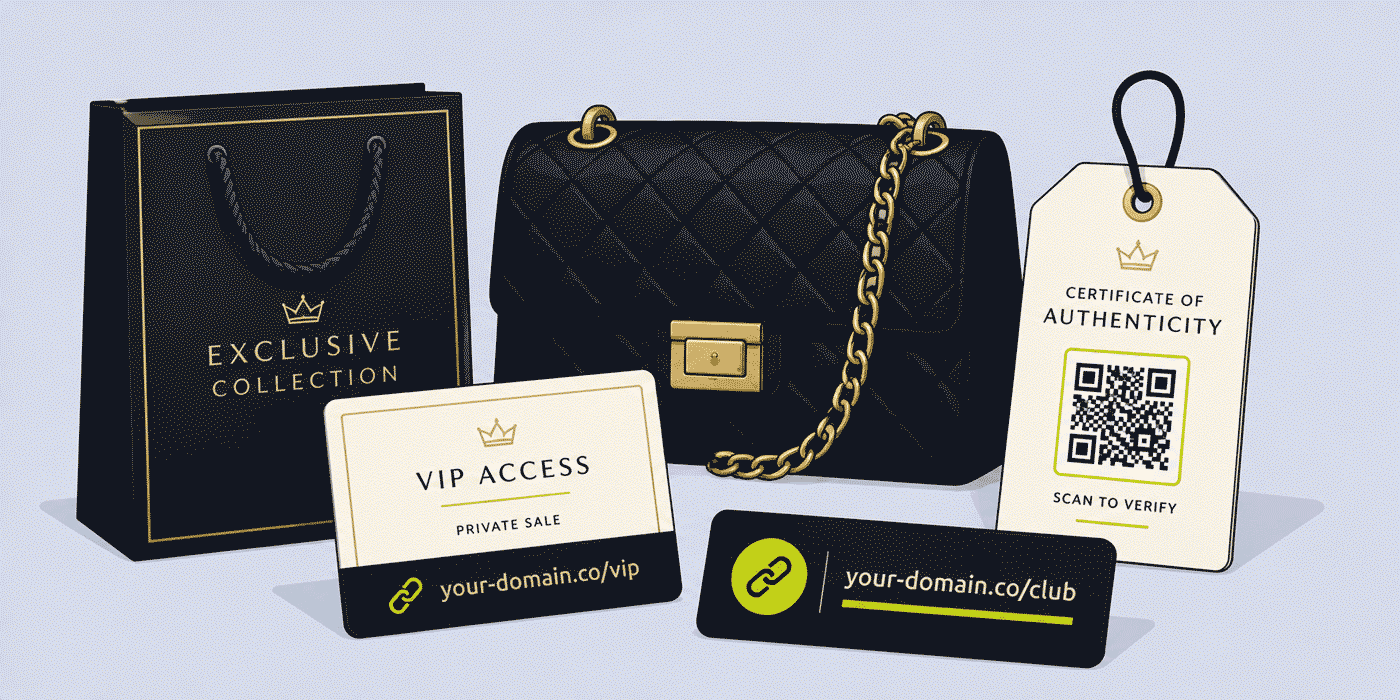
What This Guide Covers
- Why brand identity consistency in digital links is a luxury positioning requirement, not an aesthetic preference
- The luxury link design principles that distinguish prestige from mass-market digital communication
- QR Codes on product packaging, dust bags and certificates of authenticity
- Digital product passports and the living QR Code concept for luxury goods
- Anti-counterfeiting applications: per-item authentication QR Codes
- Private sale, trunk show and invitation-only event links
- VIP client and clienteling communication links
- Editorial content and press links for luxury creative
- Seasonal collection and campaign links
- Flagship store and boutique experience links
- Secondary market and resale provenance links
- A worked example: a luxury watch brand's link stack across a new collection launch
- Common mistakes in luxury brand digital link management
- A Cuttly plan guide for luxury brands
- Frequently asked questions
Why Brand Identity in Digital Links Is a Luxury Positioning Requirement
The luxury market is defined by a set of expectations that apply consistently across every dimension of the brand experience: the quality of materials, the precision of craft, the calibre of service, the consistency of presentation. A consumer who pays a significant premium for a luxury product is not only paying for the object itself but for the entire experience of the relationship with the brand — an experience that extends far beyond the moment of purchase into every subsequent interaction.
Digital communications are part of this relationship, and the standards that govern physical touchpoints apply equally to digital ones. An email sent to a VIP client about a private sale event is as much a brand touchpoint as the invitation card it may accompany. The link in that email — the domain visible to the client in the URL bar and in the email text — is part of the presentation. A link reading your-brand.com/private-preview communicates a deliberate, brand-controlled digital identity. A link reading cutt.ly/x7Qz3m communicates none of these things and introduces an unbranded third party into what should be a direct, exclusive relationship between the brand and its client.
This is not a marginal distinction. In a market where a consumer might spend tens of thousands on a single purchase and expects an experience commensurate with that investment, the quality of every detail matters. The brands that understand this — and extend the same attention to detail from their physical environments to their digital communications — are the brands that build the strongest long-term client relationships.
The Luxury Link Design Principles
Before examining specific applications, it is worth establishing the design principles that should govern every link a luxury brand creates. These principles are extensions of the same principles that govern luxury brand design in any medium.
- Brand domain always. Every externally shared link should carry the brand's own domain — or a domain that the brand clearly owns and has established as part of its identity. A luxury house with a fashion brand and a fragrance sub-brand might use separate branded domains for each, but never a generic shortener domain.
- Descriptive slugs that reflect brand language. A link slug is the first text a recipient reads about the destination.
your-brand.com/spring-collectionis consistent with a brand's editorial voice.your-brand.com/sc26is not. Slugs should use the same terminology and tone as the brand's editorial content. - Controlled scarcity in access. Some luxury brand links should feel exclusive by design: invitation-only access pages, private sale pages, and pre-release content pages communicate scarcity in the same way that limited edition product runs do. The link is the access point, and its design should reinforce the exclusivity of what it leads to.
- Permanence where appropriate. Luxury products are owned for decades. A QR Code on a certificate of authenticity or inside a watch case should remain functional for the lifetime of the product. Dynamic short links provide this permanence; static QR Codes encoding direct URLs do not.
- No visible technical infrastructure. A luxury brand's digital client communications should never expose the name of a third-party technology provider in a link. The client's experience should be of engaging with the brand itself, not with the brand's technology stack.
QR Codes on Product Packaging, Dust Bags and Certificates of Authenticity
Luxury product packaging is among the most carefully designed and expensively produced physical material in any commercial sector. The boxes, dust bags, ribbon, tissue paper, care cards and certificates of authenticity that accompany a luxury purchase are themselves brand statements, often kept by the purchaser for years or for the lifetime of the product. A QR Code introduced into this environment needs to be aesthetically coherent with the packaging design and functionally permanent.
Certificate of Authenticity QR Codes
A certificate of authenticity accompanying a luxury watch, a piece of fine jewellery, a limited edition handbag, or a collectible item is one of the most longevity-sensitive physical documents a brand produces. It may be referenced, stored, presented to insurance appraisers, and ultimately used to establish provenance for a secondary market sale decades after the original purchase. A QR Code on a certificate of authenticity needs to remain functional for this entire period.
A dynamic short link behind the certificate QR Code — such as your-brand.com/auth-serial-number or a unique per-item code in a consistent format — links initially to the brand's authentication page for that specific item, displaying the item's registered details, production information, and original purchase confirmation. As the item ages, the destination can be updated to include additional relevant content: care and maintenance guidance, service history records if the brand maintains a service relationship with the item, and eventually secondary market provenance documentation that the brand provides directly.
Packaging and Dust Bag QR Codes
Luxury handbag dust bags are often kept by the purchaser for the full lifetime of the bag. A QR Code subtly integrated into the care label or sewn label of a dust bag, linking to the brand's care guide and leather conditioning recommendations for that specific style, extends the brand relationship into every moment the item is stored, cleaned, or prepared for use.
For watches and jewellery, a QR Code on the inner lid of the presentation box — a surface that is seen every time the item is taken out or stored — links to a product-specific heritage page: the history of the design, the craftsmanship behind its manufacture, and the materials and techniques used. This is brand storytelling delivered at a contemplative moment, when the client is interacting most closely with the object and is most receptive to content that deepens their appreciation of what they own.
Because packaging QR Codes are among the most physically permanent of all luxury brand links — a presentation box may be kept for thirty years — dynamic short links are not merely advisable but essential. A brand that changes its website CMS, restructures its URL architecture, or updates its digital heritage content five years after a product is sold needs every previously distributed QR Code to continue working correctly. A dynamic link makes this possible; a static QR Code makes it impossible.
Digital Product Passports and the Living QR Code
The concept of the digital product passport — a standardized digital record of a product's materials, provenance, manufacturing process, and ownership history, accessible through a scannable identifier — is becoming a regulatory and commercial reality for luxury goods in particular. The EU's Digital Product Passport regulation, which is being progressively extended to luxury textiles and accessories, will require brands to make this information digitally accessible. The QR Code on product packaging or certification is the most practical mechanism for providing this access.
A luxury brand that has already established a per-product QR Code system using dynamic short links is in an excellent position to extend this system to meet digital product passport requirements as they come into force. The technical infrastructure is already in place; the brand needs only to ensure that the destination behind each product's QR Code contains the information categories required by the applicable regulation.
The Living QR Code Concept
The "living QR Code" is a way of thinking about what a per-product dynamic QR Code can accomplish across the full lifecycle of a luxury item. Rather than linking to a static page that is set at purchase and never updated, the living QR Code links to a destination that evolves with the item's journey:
- At purchase: authentication confirmation, care guide, brand heritage content, warranty registration, initial service booking
- During ownership: service reminders, limited edition complementary product invitations relevant to the item category, care and maintenance guides, brand event invitations linked to ownership history
- At resale consideration: secondary market valuation guidance, certified pre-owned programme information, resale authentication documentation directly from the brand
- At resale: transfer of ownership registration, new owner onboarding content, provenance documentation for the new owner
This living QR Code model turns a certificate of authenticity — or the QR Code inside a presentation box — from a static document into a lifelong channel through which the brand maintains a relationship with the item and with every person who owns it. For luxury brands that are seeking to build a direct relationship with the secondary market — an increasingly important part of the luxury consumption cycle, particularly for younger affluent consumers — this is a commercially significant capability.
Anti-Counterfeiting: Per-Item Authentication QR Codes
Luxury goods counterfeiting is an enormous global industry. The World Customs Organization estimates that luxury goods represent a disproportionate share of all counterfeit seizures globally, and the most valuable luxury categories — handbags, watches, jewellery, footwear, and eyewear — are among the most counterfeited product types in existence. A per-item QR Code system linked to the brand's own authentication database is one of the most direct and authoritative anti-counterfeiting tools available to a luxury brand.
Per-Item Authentication Architecture
A per-item authentication system assigns a unique short link to each individual product — your-brand.com/verify/item-id or a unique code that matches the item's serial number. This link, embedded in a QR Code on the certificate of authenticity and (for watches and jewellery) engraved or lasered onto the movement or inside the shank, leads to an authentication page on the brand's own website that confirms the item's authenticity, its production details, and its original purchase registration.
A buyer considering a secondary market purchase can scan the QR Code and receive confirmation directly from the brand, without intermediaries. A seller wishing to demonstrate provenance can provide the QR Code as evidence. A customs authority examining a suspected counterfeit can scan the QR Code and immediately determine whether the item is registered in the brand's database. Each of these is a use case that the per-item authentication QR Code system supports from the same underlying infrastructure.
The Brand's Authentication Advantage
Third-party authentication services — which have proliferated in the secondary market ecosystem — provide useful but imperfect authentication. They rely on physical inspection and comparative expertise, and their conclusions are subject to the limits of visual and tactile examination. A brand-issued QR Code that links to the brand's own registry is more authoritative than any third-party assessment, because only the brand knows exactly what it has produced and registered. This first-party authentication advantage is a commercially significant differentiator for luxury brands that establish robust per-item digital authentication infrastructure.
Private Sales, Trunk Shows and Invitation-Only Event Links
Exclusivity is not merely an aesthetic position for luxury brands; it is a commercial strategy. Private sales, trunk shows, pre-release viewings, and invitation-only launch events serve the dual purpose of rewarding the most loyal clients and creating demand through scarcity. The digital link to these events is part of the exclusivity apparatus, and it should be managed accordingly.
The Invitation Link as a Brand Object
A physical invitation to a private luxury event is a brand object in its own right: the weight of the paper, the quality of the print, the discretion of the envelope. A digital link to a private event page needs to carry the same associations. A link reading your-brand.com/spring-preview or your-brand.com/private-clients-2026 communicates exclusivity and brand ownership. It is sent to a named client, it points to content designed for them specifically, and it should feel like an access key rather than a generic URL.
Because private event pages are inherently time-limited — the preview takes place on specific dates, after which the products may or may not become publicly available — a dynamic short link allows the event page destination to transition through phases: from "preview only" to "now available for pre-order" to "collection now available" to "archive" after the event cycle is complete, all through the same link that was in the original invitation.
Click Analytics for Private Event Links
Click analytics for private event invitation links — aggregated and anonymized — give the clienteling team a picture of how many invited clients engaged with the digital invitation content before the event. While these analytics do not identify individual clients (click data is aggregated), patterns of click timing and frequency give the client relations team useful context: an invitation link with very low click engagement in the week before the event may benefit from a personal telephone follow-up from the client's dedicated sales associate, where a high-engagement invitation link suggests the client is already planning to attend.
VIP Client and Clienteling Communication Links
Clienteling — the practice of maintaining deep, personalized relationships with the most valuable clients, typically through dedicated sales associates — is central to the commercial model of most luxury retail. The digital dimension of clienteling involves sharing content with clients through email, messaging platforms, and increasingly through brand apps: new collection previews, editorial content relevant to the client's taste profile, personal styling recommendations, and early access to sought-after pieces.
Every piece of digital content shared in a clienteling context is a brand touchpoint, and the link through which it is shared should be consistent with the brand's identity. A sales associate sharing a link to a new collection piece with a client through a messaging platform should be sharing a link that reads your-brand.com/new-piece, not a platform-generated URL that the client cannot easily attribute to the brand.
Collection and Product Links for Clienteling
A consistent product and collection link structure allows sales associates to share branded links with clients reliably and professionally, without needing to create new links for each client interaction. A link library organized by collection season — your-brand.com/collection-aw26 for the autumn/winter collection, your-brand.com/new-arrivals for weekly new product updates — gives associates immediate access to share-ready links for the most common clienteling content categories.
Editorial Content and Press Links
A luxury brand's editorial content — campaign imagery, film, lookbook, creative director interviews, cultural partnership content, and archive material — is a significant investment and a defining part of the brand's cultural positioning. Sharing this content with press contacts, brand ambassadors, stylists, art directors, and high-value clients through branded links maintains the brand's aesthetic identity in every content interaction.
Campaign Asset Links for Press
A press asset link — your-brand.com/press-campaign-name — provided to fashion editors, stylists and journalists gives press contacts a branded, professional access point to campaign assets. This is significantly more aligned with luxury brand positioning than a Dropbox or WeTransfer link, and maintains the brand's visual and editorial identity at the point of content distribution to the individuals who will write about and reproduce that content.
Click analytics for press asset links — aggregated and anonymized — show the communications team which press contacts are actively accessing campaign materials, informing follow-up communication priorities and providing a measure of press engagement with each campaign before coverage is published.
Editorial Content for Client Newsletters
A luxury brand's client newsletter — typically a highly curated, low-frequency communication designed to feel like a private dispatch rather than a mass email — includes links to editorial content, new collection pieces, and brand events. Every link in this communication should carry the brand's domain. The combined effect of branded links, premium design, and curated content reinforces the newsletter's positioning as a private communication from the brand to its client, not a marketing email from a retailer to its database.
Seasonal Collection and Campaign Links
A luxury fashion or accessories brand typically operates on a biannual collection calendar, with additional capsule collections, collaborations, and special editions throughout the year. Each collection launch is a significant marketing event, and the link structure around each launch should be planned as carefully as the rest of the launch communication.
Collection Launch Link Structure
A structured collection launch link plan, established before the launch campaign begins:
your-brand.com/collection-name— the main collection landing page, used in all public communicationsyour-brand.com/collection-editorial— the editorial campaign film and imageryyour-brand.com/collection-preview— the VIP client preview page, used in invitation communications before public launchyour-brand.com/collection-press— press assets for media contactsyour-brand.com/collection-shop— the direct shop page, activated at the moment the collection becomes available for purchase
This five-link structure covers every audience and every phase of the collection launch, using branded links consistently throughout. After the collection has been available for a season, the links redirect to the relevant archive or "still available" pages rather than to dead ends.
Flagship Store and Boutique Experience Links
The flagship store or boutique is the most important physical expression of a luxury brand's identity, and an increasing number of luxury retail environments integrate digital touchpoints into the in-store experience: QR Codes providing product heritage content at display tables, links in fitting rooms to styling services booking, digital guestbook links for VIP client registration, and in-store event booking pages linked from table cards at client events.
All of these in-store digital touchpoints benefit from the same dynamic short link approach as physical packaging and print materials: a QR Code installed in a flagship store display table when a collection launches needs to serve every collection that follows, without requiring the physical installation to be changed each season. A dynamic link behind each in-store QR Code allows the content to evolve with the collection, the season, and the store's programming without any change to the physical environment.
In-Store Appointment and Styling Service Links
For luxury brands offering private shopping appointments, personal styling services, or bespoke consultation, a short link for the appointment booking page — your-brand.com/appointment — on in-store printed materials, on the brand website, and shared by sales associates provides a consistent, professional booking path. When the appointment system changes platforms — as most brands' booking systems do every few years — the short link destination is updated without needing to reprint store materials or update any previous communication that referenced the booking link.
Secondary Market and Resale Provenance Links
The secondary luxury market is growing significantly as younger affluent consumers embrace pre-owned luxury as both a sustainability choice and a financial value proposition. Luxury brands have complex relationships with the secondary market: they neither control nor directly profit from resale transactions, but the prices their products achieve on the secondary market are a signal of brand desirability, and the authenticity and provenance claims made in secondary market listings directly affect brand reputation.
A luxury brand that has established per-item QR Code authentication infrastructure is in a position to engage with the secondary market in a way that most brands currently cannot: by providing first-party provenance documentation that can be referenced in secondary market listings, and by using the moment of secondary market transaction as an opportunity to onboard the new owner into a direct relationship with the brand.
A QR Code-linked resale provenance page — which the original buyer can share with a potential secondary market buyer, and which can be accessed by the buyer to verify authenticity directly from the brand — is a first-party contribution to the secondary market ecosystem that positions the brand as an authoritative participant in its own provenance chain rather than a passive bystander.
A Worked Example: A Luxury Watch Brand's New Collection Launch
Consider a luxury watch brand launching a new reference in an established complications family, using a branded domain such as your-brand.com, connected through Cuttly's custom domain setup (an A record and a TXT record — see the custom domain setup guide).
Three months before the launch event: The per-reference authentication link convention is established: your-brand.com/auth/{reference-number}. Each new reference receives a unique link generated from its serial number range. The certificate of authenticity for the new reference is designed with a QR Code in the lower corner, unobtrusive but present. The QR Code prints with the permanent authentication link. No physical change to the certificate will ever be needed, regardless of what happens to the brand's website in the following decades.
Six weeks before launch: VIP client invitations go out for a private preview event at the Geneva headquarters. The invitation link — your-brand.com/collection-preview-2026 — points to a password-protected preview page with high-resolution imagery, a short film of the watchmaker demonstrating the complication, and an option to register interest in placing an order at the event. The communications team can see in aggregate that 78% of invited clients accessed the preview page within 48 hours of the invitation being sent.
At the launch event: a table display in the event space carries a QR Code using your-brand.com/collection-2026, linking to the collection's editorial page. The same link is used in the social media announcement, in the press release sent to watch media and collectors, and in the email sent to the broader client list after the VIP preview event.
Press assets — high-resolution photography, campaign film, technical specification documents — are accessible through your-brand.com/press-2026. Analytics on this link over the two weeks following the launch show 34 unique access events, corresponding to the brand's press distribution list, with 8 accessing the press pack more than once — a likely signal of journalists in active preparation of feature coverage.
One year later: a reference from the collection appears for sale on a major secondary market platform. The seller references the certificate of authenticity QR Code in the listing description. A prospective buyer scans it and receives direct confirmation from the brand that the reference number is registered, with the original purchase details and service history. The buyer purchases with confidence. The brand has participated in the secondary market transaction without any direct commercial involvement, and has strengthened the provenance confidence of its own authentication infrastructure.
Common Mistakes in Luxury Brand Digital Link Management
Using Generic Short Links in VIP Client Communications
A luxury brand that sends a VIP client an email with a cutt.ly/aBcDeF link has placed an unbranded third-party domain in what should be an exclusive, brand-controlled communication. The client sees an unknown shortener domain, not the brand's own identity. In any other context, this might be a minor aesthetic issue; in a luxury context, where every detail communicates the brand's standards, it is a meaningful inconsistency.
Printing Static QR Codes on Certificates of Authenticity
A certificate of authenticity that carries a QR Code encoding a direct URL to the brand's current website is accurate at the time of printing. It will not be accurate the first time the brand restructures its website, migrates to a new CMS, or changes its URL architecture — events that happen to virtually every brand within the lifespan of a typical luxury purchase. A dynamic short link behind every certificate QR Code is the only way to ensure permanence. There is no such thing as a "safe" static QR Code on a certificate that will be kept for decades.
No Link Strategy for Secondary Market Engagement
A luxury brand that has not considered how its per-item authentication QR Codes can be used to engage with secondary market buyers and sellers is missing a growing commercial and reputational opportunity. The secondary market for luxury goods is large, growing, and directly relevant to the brand's desirability signal. A first-party authentication link that works at the moment of secondary market transaction is a meaningful contribution to the integrity of the brand's provenance chain.
Feature Priority for Luxury Brands
| Feature | Primary Use Case | Priority for Luxury Brands |
|---|---|---|
| Branded custom domain | All external client communications, all packaging, all event links | Non-negotiable — this is a luxury brand positioning requirement |
| Dynamic QR Codes | Certificates of authenticity, packaging, dust bags, in-store displays | High — essential for permanent physical materials |
| Customized QR Codes | Branded QR Codes matching brand identity on packaging and certificates | High — QR Code aesthetic must be consistent with brand design standards |
| Click analytics | Press engagement, VIP invitation engagement, campaign performance | High — audience insight without identifiable personal data |
| Multiple branded domains | Separate domains for fashion, fragrance, accessories, home, hospitality arms | High for multi-category luxury houses |
| API access | Per-item authentication QR Code generation at production scale | High for brands implementing per-item authentication at volume |
| Campaign tag analytics | Aggregated collection launch campaign performance across all channels | Medium — useful for brands with formal campaign measurement processes |
Cuttly Plan Guide for Luxury Brands
For luxury brands, the relevant plan selection is driven primarily by the number of branded domains required (one domain per major brand or product category), whether customized on-brand QR Codes are needed for packaging and certificates, and whether per-item API-generated authentication QR Codes are part of the strategy.
- The Free plan ($0) provides 30 short links per month, one branded custom domain, full click analytics and dynamic QR Codes, with no credit card required. This is the starting point for a small luxury brand or independent designer establishing their first branded link infrastructure.
- The Starter plan ($12/month) adds 300 short links per month and 30 custom aliases per month — practical for an established independent luxury brand managing collection launches, press links, VIP client communications and boutique experience links throughout the year.
- The Single plan ($25/month) adds up to 5 branded domains, fully customizable QR Codes with brand-specific design elements for packaging and certification integration, 1,000 API-created links per month for per-item authentication QR Code generation at moderate volume, and a full year of analytics history — the most relevant tier for most established luxury brands with multiple product categories.
- The Team plan ($99/month) suits luxury houses with press, clienteling, digital, e-commerce and product teams sharing link management, multiple branded domains for different product categories or regional markets, Campaign tag analytics for collection launch campaign reporting, and shared workspaces across creative, communications and commercial departments.
- The Enterprise plan ($149/month) is for large luxury conglomerates or high-volume luxury producers implementing per-item authentication QR Code systems at full production scale through high-volume API access, multiple branded domains across a portfolio of luxury brands, and enterprise-level team management.
Create a free Cuttly account to set up your brand's first branded link domain, your collection campaign link and your first certificate of authenticity QR Code. Registration is required for all plans, including free. No credit card is needed for the free plan.
Frequently Asked Questions
Why do luxury brands need branded short links rather than generic URL shorteners?
A luxury brand's market position depends on quality and consistency at every touchpoint. A generic short link from an unbranded third-party domain introduces an unknown third party into what should be a direct, brand-controlled client relationship. Every link a luxury brand shares — in a VIP client email, on packaging, on a printed invitation — should carry the brand's own domain, because the domain itself is a brand element that signals the standard of care invested in every communication detail.
How do luxury brands use QR Codes on packaging and certificates of authenticity?
A luxury brand embeds QR Codes from dynamic short links on packaging, dust bags, care cards, and certificates of authenticity, linking to the product's digital passport, provenance documentation, and brand heritage content. Because the QR Code is dynamic, the destination evolves over the product's lifetime: authentication at purchase, care guidance during ownership, resale provenance documentation for the secondary market. This living QR Code turns a physical product into a lifelong digital relationship.
How do luxury brands manage private and invitation-only sale links?
A luxury brand creates a short link for private events — your-brand.com/private-sale — that appears in VIP invitation emails and printed invitations. The link points to a gated page reinforcing exclusivity. Because the link is dynamic, the destination transitions from "preview only" before the event to "now available for purchase" at the moment of release, without changing the link VIP clients already received.
How do luxury brands use short links for anti-counterfeiting?
A luxury brand assigns each individual product a unique QR Code linking to an authenticity verification page specific to that item's serial number. A secondary market buyer can scan the QR Code and receive first-party confirmation directly from the brand — more authoritative than any third-party authentication service, because only the brand knows exactly what it has produced and registered.
How do luxury brands use short links for editorial and press content?
A luxury brand shares editorial content with press, ambassadors, and VIP clients through branded short links — your-brand.com/campaign-name, your-brand.com/press-2026 — that reflect the brand's identity rather than generic file sharing URLs. Click analytics show which press contacts are actively accessing campaign materials, informing follow-up communication priorities.
What is the relationship between luxury brand digital strategy and link management?
A luxury brand's digital strategy is an exercise in controlled scarcity and curated access — the same principles that define luxury positioning in the physical world. Link management is the technical layer that enforces these principles digitally: a branded domain controls every access point; dynamic destinations control timing and content; click analytics provide audience insight. A link management approach that treats every digital touchpoint as a brand expression is one that takes luxury positioning seriously across the full digital customer journey.
- Get Started
- Create Free Account
- Plans & Pricing
- Platform Tools
- URL Shortener
- Link Analytics
- QR Code Generator
- Campaign Analytics
- Related Guides
- URL Shortener for Supermarkets
- URL Shortener for Fashion & Beauty
- URL Shortener for Ecommerce
- URL Shortener for Retail
- URL Shortener for Marketplace Sellers
- Short Links for Offline Campaigns
- Encyclopedia
- Branded Links
- Dynamic QR Codes
- Setup Guides
- Custom Domain Setup
- Track Link Clicks
- API Documentation
- Industry Hub
- Ecommerce & Retail
- All Industries →
URL Shortener
Cuttly simplifies link management by offering a user-friendly URL shortener that includes branded short links. Boost your brand’s growth with short, memorable, and engaging links, while seamlessly managing and tracking your links using Cuttly's versatile platform. Generate branded short links, create customizable QR codes, build link-in-bio pages, and run interactive surveys—all in one place.
Cuttly - Consistently Rated
Among Top URL Shorteners
Cuttly isn’t just another URL shortener. Our platform is trusted and recognized by top industry players like G2 and SaaSworthy. We're proud to be consistently rated as a High Performer in URL Shortening and Link Management, ensuring that our users get reliable, innovative, and high-performing tools.C


