URL Shortener for Marketplace Sellers The Complete Guide
Every marketplace seller faces the same fundamental business vulnerability: their entire revenue stream sits on infrastructure they do not own and cannot control. Amazon can change its algorithm and drop a listing from page one to page ten overnight. Etsy can update its search ranking factors and eliminate the organic visibility that took years to build. eBay can change its fee structure or its buyer protection policies in ways that fundamentally alter a seller's margins. A marketplace account can be suspended for a policy violation — sometimes even a disputed one — and every sale, every review, every customer relationship built through that account disappears with it. The most resilient marketplace sellers are the ones who understand this vulnerability and systematically build customer relationships and traffic sources that exist outside the marketplace.
This guide covers how sellers on Amazon, Etsy, eBay, Walmart Marketplace, OnBuy, Vinted, Depop, Folksy, and other marketplace platforms use a URL shortener, branded custom domain, Link in Bio, dynamic QR Codes and click analytics to drive off-marketplace traffic, build an owned customer list, run influencer campaigns, measure per-channel performance, and gradually reduce their dependence on the marketplace algorithm for their business's survival.
What This Guide Covers
- Why marketplace sellers need off-marketplace traffic sources and how short links enable them
- Amazon sellers — external traffic, listing links and Brand Analytics limitations
- Etsy sellers — social media promotion, Link in Bio and driving discovery outside the algorithm
- eBay and other marketplace sellers — listing link management and per-platform attribution
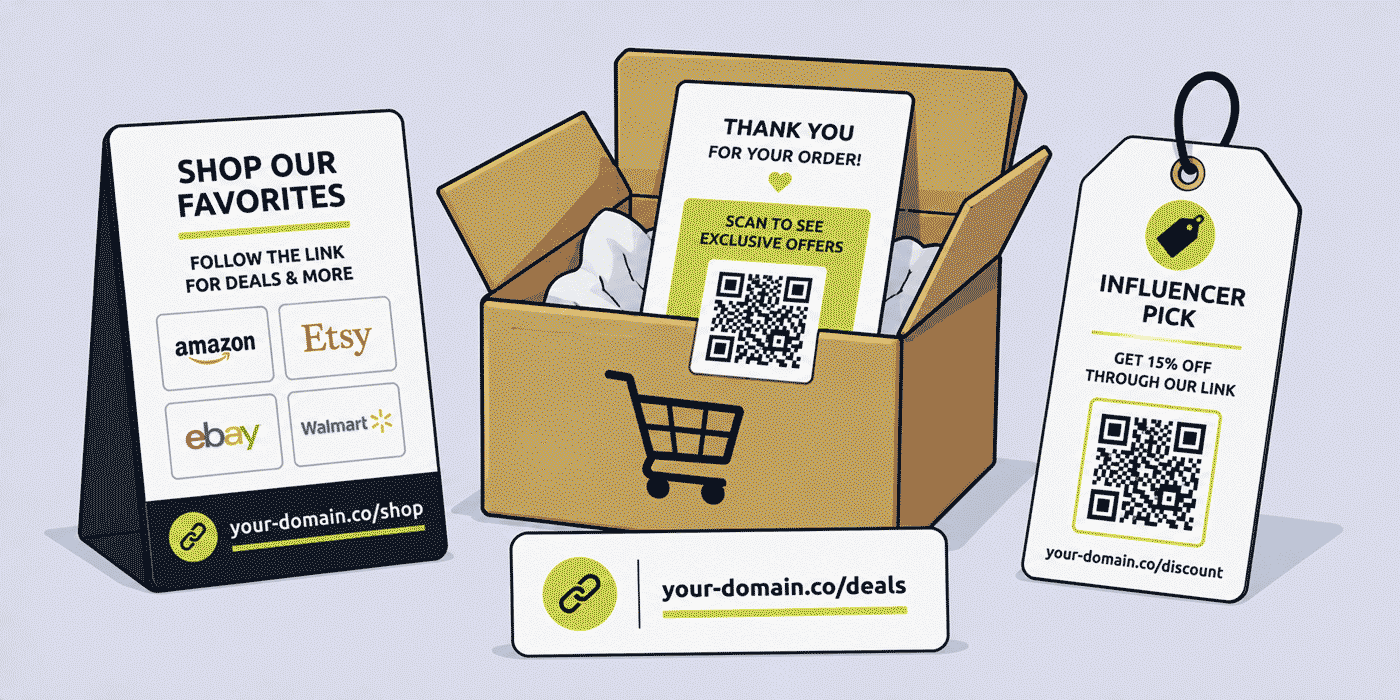
- Packaging insert QR Codes — the most underused link touchpoint in marketplace selling
- Building an owned email list through short links and QR Codes
- Influencer and creator campaign links for marketplace products
- Social media strategy for marketplace sellers
- Multi-platform selling — managing links across multiple marketplaces simultaneously
- Review management and post-purchase communication links
- A worked example: an Etsy and Amazon dual-platform seller's link stack
- Common mistakes in marketplace seller link management
- A Cuttly plan guide for marketplace sellers
- Frequently asked questions
Why Marketplace Sellers Need Off-Marketplace Traffic
The marketplace seller's growth dilemma is structural. On Amazon, Etsy, or eBay, a seller's visibility depends almost entirely on the marketplace's own algorithm — a system they cannot control, cannot fully understand, and that changes without notice. When the algorithm favours their products, sales are good. When it changes, or when a competitor outbids them on advertising, or when a large competitor enters their product category, their organic visibility can deteriorate rapidly.
Off-marketplace traffic is the remedy to this vulnerability. A seller who drives traffic to their marketplace listings from social media, email, influencer content, and content marketing has multiple channels of discovery that operate independently of the marketplace algorithm. Some of these external channels — particularly email — are channels the seller fully owns: an email list is not subject to algorithm changes, platform policy updates, or fee structure changes by any third party.
For Amazon sellers specifically, there is an additional commercial benefit beyond algorithm independence: external traffic sent to an Amazon listing is widely believed within the seller community to signal product relevance to the Amazon ranking algorithm, which can improve organic search position for that ASIN within the marketplace. This "external traffic boost" hypothesis — while not officially confirmed by Amazon and subject to ongoing debate — means that many Amazon sellers treat off-marketplace traffic generation as both a direct sales channel and an algorithm improvement strategy.
Short links are the enabling infrastructure for off-marketplace traffic generation. They make it possible to track which external channel is sending traffic to a marketplace listing, to manage links across multiple products and platforms without organizational chaos, and to present a professional, branded identity to social media audiences and email subscribers rather than an unwieldy marketplace URL.
Amazon Sellers: External Traffic and Listing Links
Amazon product listing URLs are among the least usable URLs in commercial e-commerce. A typical Amazon listing URL includes the product title in the URL (making it long), the ASIN (a proprietary Amazon product identifier), the source tracking parameters added by Amazon's own attribution system, and in many cases additional referral parameters that accumulate as the URL is copied and shared. A full Amazon listing URL can easily exceed 200 characters, and it is immediately recognizable as an Amazon link — which is useful when sharing within Amazon's own ecosystem but counterproductive when trying to build a brand identity in channels outside it.
The Clean Amazon Listing Short Link
A branded short link for each product listing — your-brand.com/product-name — pointing to the ASIN's listing page replaces the unwieldy Amazon URL with something that is clean, branded, and professional across every external channel. On Instagram, where a bio link and caption text compete for attention, a link reading your-brand.com/best-seller is more likely to be clicked than amazon.com/dp/B0XXXXXX/ref=....
For Amazon sellers with a catalogue of multiple products, a per-product link structure using a consistent naming convention — your-brand.com/product-1, your-brand.com/product-2, or your-brand.com/product-sku — keeps the link library organized and makes it straightforward for any team member to find and share the correct link for any product without navigating the seller's full Amazon catalogue.
Amazon Attribution and Short Links
Amazon provides Brand Registry sellers with an Amazon Attribution tool that allows them to create tracking links for external campaigns, showing how much traffic from each channel converts to sales within Amazon. These Amazon Attribution links are themselves lengthy and Amazon-branded. A short link can wrap an Amazon Attribution link — with the Attribution parameters intact — giving the seller both the Amazon Attribution data and the click analytics from the short link itself. This dual-tracking approach provides both the attribution data that Amazon's own system produces and an independent click measurement from the short link that exists outside Amazon's ecosystem.
Per-Channel External Traffic Links
For Amazon sellers running multi-channel external promotion, per-channel short links allow independent measurement of each source's contribution to listing traffic:
your-brand.com/product-ig— Instagram bio and postsyour-brand.com/product-pin— Pinterest contentyour-brand.com/product-email— email newsletteryour-brand.com/product-blog— blog content or guest postsyour-brand.com/product-youtube— YouTube video descriptions
All of these point to the same listing page (with Amazon Attribution parameters if the seller uses them). Click analytics per channel give the seller a picture of which external source drives the most listing traffic, completely independently of what Amazon Brand Analytics or Attribution reports internally.
Etsy Sellers: Social Media, Link in Bio and Off-Platform Discovery
Etsy's business model as a discovery platform for handmade, vintage, and unique products makes it naturally complementary to social media promotion. An Etsy seller's products are visually interesting, story-rich, and inherently suited to the content formats that perform well on Instagram, Pinterest, TikTok, and YouTube. The challenge is that Etsy listing URLs are long, opaque, and immediately attributable to Etsy rather than to the seller's own brand.
Link in Bio for Etsy Sellers
A Link in Bio page at your-shop.com/links or cutt.ly/shop-name is the foundation of an Etsy seller's social media strategy. It turns the single clickable link in a platform bio into a small hub of the seller's most important destinations: their Etsy shop home, their best-selling or featured listing, their email sign-up page (if they are building a list), their website if they have one, and any current promotion or new product launch. Each item on the Link in Bio page is independently tracked, so the seller can see which destination gets the most social media bio traffic — information that shapes what to feature prominently.
Per-Listing Etsy Short Links for Content
For Etsy sellers creating content around specific products — a behind-the-scenes TikTok showing the making of a piece of jewellery, a Pinterest pin featuring a styling image of a handmade ceramic, a YouTube tutorial that uses a craft supply the seller stocks — a per-listing short link in the video description or pin provides a clean, trackable path from the content to the listing. A link reading your-shop.com/ceramic-mug in a YouTube video description is more likely to be clicked than the raw Etsy listing URL, and provides the seller with click analytics that show how much traffic each piece of content is actually driving to the listing.
Etsy Shop Branded Domain Considerations
For Etsy sellers who are building a brand that extends beyond Etsy — perhaps with a presence on their own website or across multiple sales platforms alongside Etsy — a branded custom domain for all external links (your-brand.com/etsy pointing to the Etsy shop) maintains brand consistency across every channel. When and if the seller eventually moves their primary sales to their own website, the same short links can be updated to point to the new site while continuing to serve customers who have the old links saved or bookmarked.
eBay and Other Marketplace Sellers
eBay sellers, and sellers on platforms like Vinted, Depop, Folksy, and other specialist marketplaces, face the same basic external traffic and link management challenges as Amazon and Etsy sellers, with some platform-specific variations.
eBay listing URLs, like Amazon's, are long and platform-branded. A short link for an eBay listing, or for a seller's eBay store, makes it more shareable on social media and in direct messaging. For eBay sellers who run a lot of individual listings rather than a product catalogue, the link structure may be more focused on the store page or on category pages within the store rather than individual listing links.
Resale sellers on Vinted and Depop — who typically sell individual items rather than multiples of the same product — use short links differently from catalogue sellers: the most useful link for a resale seller is typically a Link in Bio page that aggregates their most recently listed or most interesting items, updated regularly as items sell and new listings are added, rather than a per-item link that becomes dead when the item sells.
Packaging Insert QR Codes: The Most Underused Marketplace Link Touchpoint
Of all the link opportunities available to a marketplace seller, the packaging insert QR Code is arguably the most powerful and the most underused. Every order a seller ships contains a package, and that package can contain a physical insert card — a small piece of printed collateral that the buyer handles at the moment of highest post-purchase satisfaction, when they have just received and are opening their order. This is the optimal moment to invite a review, to drive an email sign-up, to offer a discount on a second purchase, or to direct the buyer to the seller's social media.
What the Insert QR Code Should Link To
The insert QR Code destination choice depends on what the seller most needs at their current stage of business:
- Review request. For sellers whose primary conversion bottleneck is social proof — particularly new listings or new-to-marketplace sellers who need reviews to compete — a QR Code linking to the product's review page on the marketplace is the highest-priority insert destination. A buyer who has just opened a satisfying order and is holding an insert card is in the optimal mindset to leave a positive review.
- Email list sign-up. For sellers who are building a customer list that exists outside the marketplace, a QR Code linking to an email sign-up page is arguably the highest long-term commercial value per click. Each email subscriber is a customer the seller can contact regardless of what any marketplace does to their account or algorithm.
- Repeat purchase discount. A QR Code linking to a page showing a discount code for a second purchase on the marketplace — "Thank you for your order. Here's 10% off your next purchase" — drives repeat buying directly and is permitted by most marketplace policies when the discount code itself is used on the marketplace rather than on an external site.
- Social media follow. A QR Code linking to the seller's social media profile (via a Link in Bio page) converts a satisfied buyer into a social follower, creating an ongoing relationship outside the marketplace transaction system.
The optimal choice depends on the seller's specific growth priorities. Many sellers rotate the insert destination seasonally: prioritizing review generation for new products, shifting to email list building once a product has sufficient reviews, and periodically running repeat purchase discount campaigns. Because the QR Code is dynamic, the destination can be changed each time priorities shift without reprinting any insert cards.
Insert QR Code Analytics: Measuring What Most Sellers Cannot
One of the most valuable aspects of a packaging insert QR Code generated from a dynamic short link is that it provides click analytics that would otherwise be completely invisible to the seller. Currently, most marketplace sellers have no idea how many buyers actually interact with their packaging inserts. They print the cards, they pack them into boxes, they ship the orders, and they have no measurement of whether the insert is being seen, read, or acted upon.
A QR Code scan is the clearest possible signal that a buyer opened the box, saw the insert, and chose to engage with it. Click analytics on the insert QR Code — aggregated and anonymized — give the seller a scan rate (what percentage of orders result in a QR Code scan) that they can track over time and compare across product types, order sizes, and seasonal periods. A scan rate of 8% on a beauty product insert card and 2% on an electronics accessory insert card tells the seller something meaningful about which customer segment engages most with packaging inserts, which can inform the insert design and the investment in insert card production.
Building an Owned Email List Through Short Links
For any marketplace seller serious about building a sustainable business rather than a marketplace-dependent income stream, building an owned email list is the single most important off-marketplace activity. An email list is the seller's property: it cannot be taken away by an algorithm change, a marketplace policy update, or an account suspension. It provides a direct communication channel to customers that costs nothing per message beyond the email platform subscription. And it creates the foundation for a business that can exist independently of any marketplace, if and when the seller chooses to build or expand their own channel.
The Insert-to-List Conversion Funnel
The most effective email list building mechanism for marketplace sellers is the packaging insert QR Code combined with a value exchange: the buyer scans the QR Code, lands on an email sign-up page, and is offered something in return for their email address. This could be a discount code for a future purchase, access to exclusive content (recipes, tutorials, care guides depending on the product category), early access to new product releases, or simply membership of a community around the product type.
A short link for the email sign-up page — your-brand.com/join or your-brand.com/vip-list — behind the insert QR Code gives the seller a clean, branded entry point to the list-building flow. Because the link is dynamic, the destination can be updated when the email platform changes, when the sign-up incentive changes, or when the seller wants to test a different value proposition without reprinting insert cards. Click analytics on the email sign-up link show the conversion rate from QR Code scan to sign-up page visit, giving the seller data to compare with the email platform's actual sign-up completion rate.
Influencer and Creator Campaign Links
Creator-driven traffic is one of the most effective off-marketplace acquisition channels for many product categories — particularly beauty, home, craft, food, and lifestyle products where the visual demonstration of a product by a trusted creator carries significant purchase influence. A marketplace seller working with creators needs a per-creator link structure that gives both the seller and the creator visibility into the traffic being driven.
Per-Creator Listing Links
For each creator partnership, the seller creates a short link for the product listing that is specific to that creator: your-brand.com/creator-name or cutt.ly/product-creator. This link appears in the creator's video description, bio link, or pinned comment. Click analytics show how many viewers click through from the creator's content to the listing, independent of any marketplace affiliate data.
For creators who are also enrolled in the marketplace's affiliate programme (such as Amazon Associates for YouTube and blog creators), the creator's affiliate link and the seller's short link can serve different tracking purposes: the affiliate link tracks conversions for Amazon Attribution and the creator's commission; the seller's short link tracks the top-of-funnel click volume from the creator's specific content. Using both simultaneously gives the seller the most complete picture of the creator partnership's performance.
Social Media Strategy for Marketplace Sellers
Social media platforms are the primary off-marketplace discovery channel for most marketplace sellers, particularly those in visually-oriented categories. Instagram, Pinterest, TikTok, and YouTube are all platforms where product discovery happens organically, and where a marketplace seller can build an audience that is not dependent on any marketplace's search algorithm.
Platform-Specific Link Strategy
Each social platform has its own link conventions and constraints:
- Instagram. One clickable link in the bio; all other traffic through the bio link. A Link in Bio page is essential. For stories (swipe-up or link sticker), a per-product short link in the story gives click analytics specific to that story's traffic.
- TikTok. One bio link, accessed via the "link in bio" verbal or text CTA in videos. A Link in Bio page in the bio aggregates all current product listings. Per-video link attribution is more complex on TikTok as the link cannot be placed in the video itself, but a per-launch short link in the bio can be updated for each new product to track traffic from the most recent video content.
- Pinterest. Each pin can carry a direct link to a product listing. A per-product short link on Pinterest pins tracks how much traffic each pin drives to the marketplace listing, and can be updated if the listing URL changes (a common occurrence when relisting or when a marketplace changes its URL format).
- YouTube. Video description links are the primary channel for YouTube-driven marketplace traffic. A per-product, per-video short link in the description (updated for each video featuring that product) tracks which YouTube content drives the most listing traffic over time.
Multi-Platform Selling: Managing Links Across Multiple Marketplaces
Selling across multiple marketplaces simultaneously is an increasingly common strategy for ecommerce sellers who want to reduce dependency on any single platform. A seller listing the same product on Amazon, Etsy, and their own Shopify store has three separate product URLs for the same item, and needs to decide which URL to promote in any given channel and how to present the options to buyers who may have preferences about which platform they use.
The "Where to Buy" Page Model
A short link pointing to a "where to buy" page — your-brand.com/buy-product-name — that shows the product available on all platforms lets the buyer choose their preferred marketplace while keeping the seller's own link consistent across all marketing. The page lists: "Buy on Amazon | Buy on Etsy | Buy on our website | Buy on eBay" with direct links to each. Click analytics on the individual platform links from this page show the seller which platform buyers prefer for that specific product, which informs where to prioritize advertising spend and inventory management.
Platform Priority Routing
For some marketing contexts, a seller may want to route all traffic to a single preferred platform: Amazon for a product where reviews are strongest, their own website for a product where margin is highest, Etsy for a product where Etsy's audience is the best fit. A dynamic short link allows the seller to change the routing destination whenever priorities change, without updating any external promotions. A product that is best promoted to Amazon buyers in Q4 (when Amazon traffic is highest) can be re-routed to the seller's own website in Q1 (when the seller wants to reduce Amazon commission costs) through a single dashboard update.
Review Management and Post-Purchase Communication Links
Marketplace reviews are the social proof mechanism that most directly drives sales on Amazon, Etsy, and most other marketplaces. A product with more and better reviews typically ranks higher in marketplace search, is chosen more often when displayed alongside competing products, and achieves higher conversion rates at the same traffic volume. Managing the review acquisition process — including the post-purchase communication links that invite satisfied buyers to leave reviews — is a commercially critical seller activity.
Review Request Links
A short link for the product's review page — your-brand.com/review-product-name or, for Amazon specifically, the seller's product review page URL — used in packaging inserts, post-purchase follow-up emails (where permitted by marketplace policy), and social media posts asking satisfied customers to share their experience, provides a clean, professional path from the review request to the review submission page.
Note that marketplace policies regarding review solicitation vary and change regularly. Amazon's policies in particular are detailed and explicit about what sellers can and cannot do to request reviews. Sellers should ensure their review request approach is compliant with the current policies of each marketplace they sell on, and should not offer incentives for reviews where such practices are prohibited. A short link to the review page is a neutral facilitation tool; the compliance dimension is determined by how and when the seller uses it to invite reviews, not by the link technology itself.
A Worked Example: A Dual-Platform Etsy and Amazon Seller
Consider a handmade skincare brand selling on both Etsy and Amazon, using a branded domain such as your-brand.com, connected through Cuttly's custom domain setup (an A record and a TXT record — see the custom domain setup guide).
The seller's primary social media channel is Instagram. Their bio link points to your-brand.com/links, a Link in Bio page showing: their Etsy shop, their Amazon store, their top three products (with separate tracked links per product per platform), and an email sign-up link promising a "skincare routine guide" in return for sign-up.
Every product shipped from both Etsy and Amazon includes the same insert card with a single QR Code pointing to your-brand.com/join. The destination is the email sign-up page with the skincare guide offer. Click analytics on /join over three months show an average QR Code scan rate of 11% of all orders — meaning 1 in 9 buyers is engaging with the insert and visiting the sign-up page. Of those, 67% complete the email sign-up. The brand has grown its email list by 1,400 subscribers over three months entirely from packaging insert traffic, at no additional cost beyond the insert card printing.
For a new product launch on Amazon, the seller creates a launch campaign link: your-brand.com/new-serum pointing to the ASIN page. They work with three Instagram micro-creators: each gets their own link, your-brand.com/creator-ana, your-brand.com/creator-beth, your-brand.com/creator-cara. After two weeks, Creator Ana's link has generated 420 clicks and 34 Amazon purchases tracked through Amazon Attribution; Creator Beth's link has generated 180 clicks and 28 purchases; Creator Cara's link has generated 1,200 clicks but only 8 purchases. Creator Cara's audience is not converting despite high click volume, while Creator Beth's smaller audience converts at nearly twice the rate. The seller re-invests the influencer budget into Creator Ana and Creator Beth for the next launch.
Common Mistakes in Marketplace Seller Link Management
No Packaging Insert QR Code
A marketplace seller who ships thousands of orders per month and includes no insert card is leaving the highest-intent customer touchpoint in the fulfilment process completely unused. Every buyer who receives an order and opens the package is at peak satisfaction with the brand; a well-designed insert with a dynamic QR Code converts that moment into a review, an email subscription, or a social media follow. The cost of an insert card programme is modest relative to the commercial value of the customer relationships it builds.
Using Raw Marketplace URLs for Social Media Promotion
A marketplace seller who posts on Instagram with a caption that includes a full Amazon or Etsy listing URL is creating friction (the URL is too long to type, not clickable in caption text) and missing analytics (they cannot tell which social posts are driving marketplace traffic). A short branded link for each product, used consistently across all social promotion, eliminates both problems.
One Link for All Channels and All Products
A seller who uses their general shop homepage link for every piece of social media content, every email, every packaging insert, and every influencer campaign has no visibility into which channel or product is driving their external traffic. A link structure with at minimum a per-product level and ideally a per-channel level gives the seller the data to allocate their marketing time and budget to what is demonstrably working.
Cuttly Plan Guide for Marketplace Sellers
- The Free plan ($0) provides 30 short links per month, one branded custom domain, full click analytics, dynamic QR Codes and a Link in Bio page, with no credit card required. Suitable for a solo seller or small seller setting up their first per-product links, a packaging insert QR Code and a social media Link in Bio page.
- The Starter plan ($12/month) adds 300 short links per month and 30 custom aliases per month — practical for a growing marketplace seller with a catalogue of products, multiple influencer partnerships, per-channel attribution tracking, and regular new product launch links each month.
- The Single plan ($25/month) adds up to 5 branded domains, fully customizable QR Codes with the seller's brand identity for professional packaging inserts, 1,000 API-created links per month for automated per-product link generation across large catalogues, and a full year of analytics history for creator partnership ROI analysis — most relevant for established sellers with large catalogues or active influencer programmes across multiple platforms.
- The Team plan ($99/month) suits larger marketplace businesses with dedicated marketing, operations, and partnerships teams, multiple branded domains for different brand identities or regional markets, Campaign tag analytics for aggregated launch campaign performance reporting, and shared workspaces for cross-functional teams.
Create a free Cuttly account to set up your first product listing short link, your packaging insert QR Code and your social media Link in Bio page. Registration is required for all plans, including free. No credit card is needed for the free plan.
Frequently Asked Questions
Why do Amazon sellers need a URL shortener?
Amazon sellers use URL shorteners to drive off-Amazon traffic from social media, email, influencer content and content marketing — because external traffic to an Amazon listing can signal product relevance to the Amazon algorithm. A short link also enables per-channel tracking that Amazon's Brand Analytics cannot provide: separate short links per channel show which external source drives the most listing traffic, completely independently of what Amazon reports internally.
How do Etsy sellers use short links to drive traffic from social media?
An Etsy seller uses a branded short link in social media bios and posts — your-shop.com/shop-link — pointing to their Etsy shop or specific listing. A Link in Bio page aggregates links to their most important destinations. Click analytics show how much traffic each social platform drives to their Etsy shop, independently of Etsy's own traffic source reporting.
How do marketplace sellers use QR Codes on packaging inserts?
A marketplace seller places a QR Code on a packaging insert card linking to a review request page, email sign-up, discount for repeat purchase, or social media page. Because the QR Code is dynamic, the destination can be updated without reprinting insert cards. Click analytics show how many customers interact with the packaging insert — data that most sellers currently have no way of measuring.
Can marketplace sellers use short links to build an email list?
Yes, and it is one of the most commercially important uses of short links for marketplace sellers. A packaging insert QR Code pointing to an email sign-up page builds a customer list the marketplace cannot control or take away. A seller with thousands of email subscribers can communicate directly with customers regardless of what any marketplace algorithm does, creating resilience against ranking changes, policy updates, or account suspensions.
How do marketplace sellers use short links for influencer campaigns?
A marketplace seller assigns each creator their own short link — your-brand.com/creator-name — pointing to the product listing. Click analytics per creator link show how much traffic each creator is sending to the listing. Comparing click volume with purchase conversion gives a click-to-purchase rate per creator, one of the most useful metrics for evaluating the commercial efficiency of different creator partnerships.
How do multi-platform sellers manage links across Amazon, Etsy and eBay simultaneously?
A multi-platform seller uses a "where to buy" short link — your-brand.com/buy-product-name — pointing to a page listing the product across all platforms, letting buyers choose their preferred marketplace. Click analytics on each platform link from this page show which marketplace buyers prefer, informing advertising spend and inventory decisions.
- Get Started
- Create Free Account
- Plans & Pricing
- Platform Tools
- URL Shortener
- Link Analytics
- QR Code Generator
- Link in Bio Builder
- Survey Tool
- Related Guides
- URL Shortener for Subscription Boxes
- URL Shortener for Ecommerce
- URL Shortener for Etsy Sellers
- URL Shortener for Retail
- URL Shortener for Affiliate Links
- URL Shortener for Influencers
- Encyclopedia
- Branded Links
- Link in Bio
- Dynamic QR Codes
- Setup Guides
- Custom Domain Setup
- Track Link Clicks
- Industry Hub
- Ecommerce & Retail
- All Industries →
URL Shortener
Cuttly simplifies link management by offering a user-friendly URL shortener that includes branded short links. Boost your brand’s growth with short, memorable, and engaging links, while seamlessly managing and tracking your links using Cuttly's versatile platform. Generate branded short links, create customizable QR codes, build link-in-bio pages, and run interactive surveys—all in one place.
Cuttly - Consistently Rated
Among Top URL Shorteners
Cuttly isn’t just another URL shortener. Our platform is trusted and recognized by top industry players like G2 and SaaSworthy. We're proud to be consistently rated as a High Performer in URL Shortening and Link Management, ensuring that our users get reliable, innovative, and high-performing tools.C


