URL Shortener for Subscription Boxes The Complete Guide
A subscription box business has a link management challenge that is almost entirely unique to its business model: the physical product it ships every month contains a link. Not just on the outside, where a shipping label or outer packaging might carry a QR Code, but inside — on the insert card that sits between the products, on the product information sheet tucked under the tissue paper, on the welcome card for a new subscriber's first box. These links are inside a physical object that has already been printed, packed, and shipped before the month's box content has even been publicly revealed. They need to work not just on the day the box arrives but for weeks afterward, as subscribers open and re-explore their boxes at different times. And they need to link to content that is specific to that month's curation, even though the insert card format itself is identical from month to month.
This guide covers how subscription box companies — beauty and skincare boxes, food and drink discovery boxes, book and reading boxes, pet subscription boxes, wellness and health boxes, children's activity boxes, hobby and craft boxes, and any other curated monthly delivery model — use a URL shortener, branded custom domain, dynamic QR Codes and click analytics to power subscriber acquisition, in-box engagement, referral growth, churn prevention, and the commercial relationships with featured brands that underpin the curation model.
What This Guide Covers
- Why subscription boxes have a distinct in-box link management requirement that most other retailers do not face
- In-box QR Codes — the reusable insert card model and monthly content updating
- Subscriber acquisition links — per-channel and per-influencer tracking
- Referral programme links — converting subscribers into acquisition advocates
- Featured product links — purchase path for discovered products
- Brand partnership links — commercial attribution for featured brand relationships
- Churn prevention and retention links — pause, skip and win-back flows
- Renewal and upsell links — tier upgrades and annual plan conversion
- Unboxing content and community links
- A worked example: a beauty subscription box's link stack across a monthly cycle
- Common mistakes in subscription box link management
- A Cuttly plan guide for subscription box companies
- Frequently asked questions
The Subscription Box's Unique In-Box Link Challenge
Most retailers think about links in the context of digital communications: the link in an email campaign, the bio link on social media, the URL in a paid advertisement. Subscription box companies have all of these, plus a link category that no other retailer has: the link physically inside the product.
An insert card printed in the first week of the month and packed into thousands of boxes needs to carry links that will be scanned by subscribers over a period of weeks — from the earliest deliveries on the first of the month to the last deliveries sometimes ten to fourteen days later, and then potentially weeks or months afterward when a subscriber re-discovers a product they found in the box and returns to the insert card to find the product information. A static QR Code encoding a specific URL on this card must remain functional for the entirety of this window — and, for the content to remain relevant, should point to month-specific content throughout.
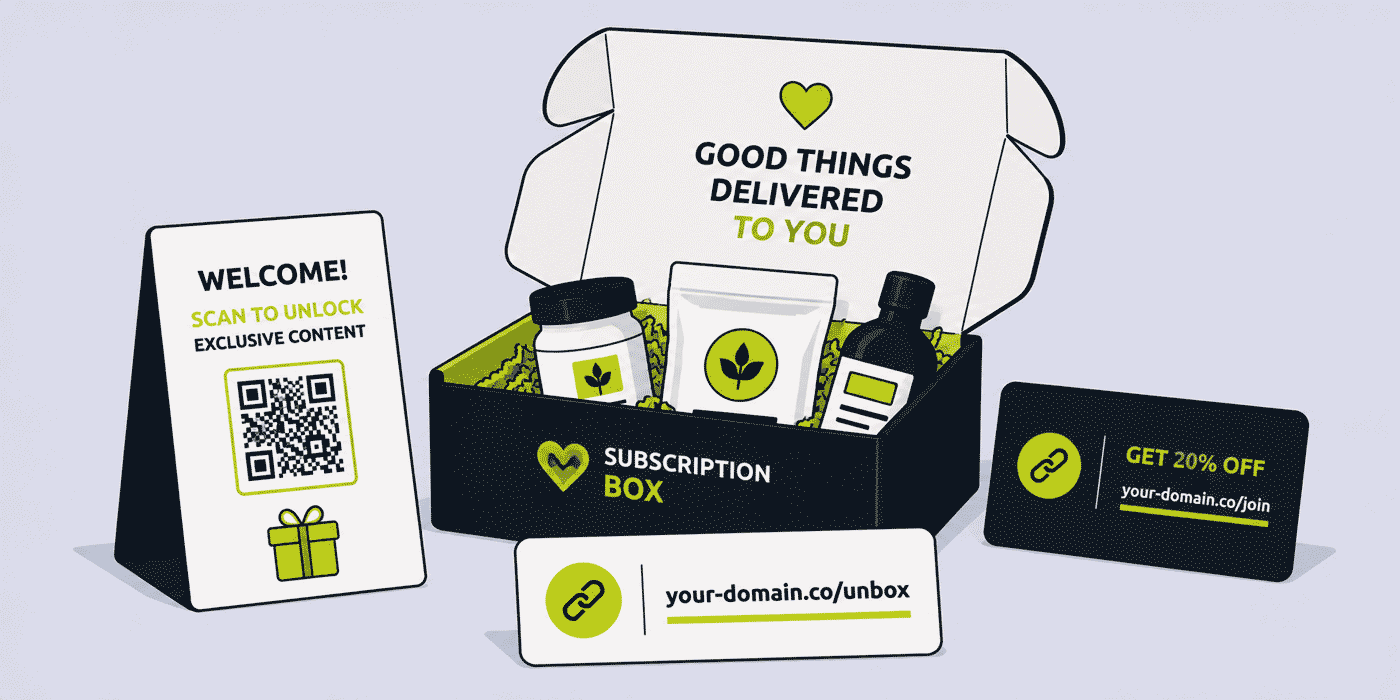
The solution is a reusable insert card format with dynamic QR Codes. The physical card — with its branding, typography, and design — is printed once, or reprinted in batches using the same template. The QR Code on the card, generated from a dynamic short link, points to this month's content hub. When next month arrives, the destination behind the QR Code is updated for the new month's content. The same physical card design serves every month; the digital content behind it is fresh each cycle.
This approach has operational and financial implications beyond the obvious printing cost saving. It means that any subscriber who keeps an old insert card and scans the QR Code months later will reach current content rather than a dead link or outdated page. It means the company has one link to manage per content category (welcome content, product information, referral link) rather than a new link every month per card type. And it means the insert card becomes a permanent channel between the physical box and the subscriber's digital engagement with the brand, rather than a one-time-use piece of print.
In-Box QR Codes: The Reusable Insert Card Model
The most practically transformative application of dynamic short links for a subscription box company is the reusable insert card QR Code system. Understanding how this works in detail reveals the operational and commercial value that most subscription box companies are currently leaving on the table by using static QR Codes or no QR Codes in their boxes at all.
The Four Core In-Box QR Codes
A subscription box insert card system typically needs four distinct QR Code destinations, each serving a different subscriber intent:
- This month's content hub.
your-box.com/this-month— links to a page dedicated to the current month's box: the product selection story, behind-the-scenes curation notes, how-to guides and usage tips for each product, and the featured brands' stories. This destination is updated each month before the first boxes ship. A subscriber opening the box in week one and a subscriber opening it in week two both reach the same current month content. - Featured product purchase links.
your-box.com/products-this-month— links to a page listing all this month's featured products with purchase links for subscribers who want to buy more of something they loved. This destination is updated each month to reflect the current box's selection. Product click-through from this link is one of the most commercially valuable data points for brand partnership conversations (see below). - Referral programme.
your-box.com/refer-a-friend— links to the referral programme page where subscribers can get their unique referral link or code to share with friends. This destination is stable (the referral programme does not change month to month) but benefits from a branded short link rather than the raw referral platform URL. - Feedback and community.
your-box.com/tell-us— links to a short feedback survey or the subscriber community page (Facebook group, Discord server, or branded community platform). Updated each month to include a specific feedback prompt relevant to that month's selection.
The New Subscriber Welcome QR Code
For new subscribers receiving their first box, a dedicated welcome QR Code — your-box.com/welcome — links to a welcome hub designed specifically for first-time box openers: a video from the founder, an explanation of how the curation process works, links to the subscriber community, and guidance on how to customize their preferences for future boxes. This welcome experience is separate from the general monthly content hub and can be kept stable from month to month, requiring only occasional updates when the welcome content is refreshed.
Placing this welcome QR Code on a separate welcome card that only goes into first-time subscriber boxes — a simple operational segmentation in the packing process — means the welcome experience is specifically served to the audience that needs it, while existing subscribers receive the standard monthly insert without a welcome card that is no longer relevant to them.
Subscriber Acquisition Links
Subscription box acquisition is a high-competition, high-cost activity. The cost of acquiring a new subscriber — whether through influencer partnerships, paid social, SEO, podcast advertising, or affiliate programmes — is one of the most important unit economics for any subscription box business. Understanding which acquisition channel actually brings in the subscribers who stay longest, spend most, and refer most friends is the data problem that per-channel short links are designed to solve.
Per-Channel Acquisition Link Structure
For any significant subscriber acquisition campaign, creating a separate short link per channel gives independent click analytics per source:
your-box.com/sub-instagram— Instagram bio and Story linksyour-box.com/sub-tiktok— TikTok bio linkyour-box.com/sub-email— email newsletter and lifecycle campaignsyour-box.com/sub-podcast— podcast ad mentionsyour-box.com/sub-affiliate— affiliate network trafficyour-box.com/sub-youtube— YouTube description links
All point to the same subscription sign-up page. Click analytics per channel, aggregated and anonymized, show which source drives the most sign-up page traffic. Combined with conversion data from the sign-up flow — which the subscription platform tracks — this gives the growth team a click-to-trial and ultimately a click-to-subscriber conversion rate per channel. A channel that drives high click volume but low subscription conversion may be bringing in browsers rather than buyers; a channel with lower click volume but high conversion is more efficiently targeted.
Seasonal and Campaign-Specific Acquisition Links
Subscription box businesses typically run significant acquisition campaigns around gifting seasons: Christmas, Valentine's Day, Mother's Day, Father's Day. Each gifting campaign benefits from a dedicated sign-up link — your-box.com/gift-xmas, your-box.com/gift-mothers-day — pointing to a landing page specific to the gifting occasion, with messaging and imagery tailored to the gift-giver audience rather than the self-subscriber audience. Comparing conversion rates between the gifting-specific landing page and the standard subscription page helps the marketing team understand whether occasion-specific landing pages justify the production investment.
Influencer Campaign Links
Influencer and creator partnerships are the primary acquisition channel for many subscription box businesses, particularly in beauty, lifestyle, food, and wellness categories. Unboxing videos on YouTube, TikTok hauls, and Instagram Reel reveals are a native format for the subscription box category — the product is visually interesting, the reveal moment is inherently satisfying to watch, and the "is it worth it?" judgment that creators make in their reviews directly drives subscriber decisions.
Per-Influencer Short Links
For each creator partnership, the company creates a short link pointing to the subscription sign-up page, typically paired with an exclusive discount code specific to that creator: your-box.com/creator-name leading to a landing page that auto-applies the creator's discount code at checkout. This structure gives the growth team two independent data points: the click volume from the creator's short link (how many viewers engaged with the promotion) and the redemption count of the discount code (how many of those who clicked actually subscribed). The gap between the two is a measure of the landing page conversion rate for that creator's specific audience.
Over multiple creator partnerships, comparing click-to-subscription conversion rates by creator type — beauty mega-influencer versus lifestyle micro-creator, foodie niche channel versus general lifestyle content creator — gives the partnerships team a picture of which creator categories bring in the most committed subscribers. A creator with 200,000 followers and a 12% conversion rate is commercially more valuable than one with 2,000,000 followers and a 0.8% conversion rate, and per-creator short link analytics make this comparison possible.
Creator Links for Unboxing Content
Some subscription box companies send free boxes to creators for unboxing content creation, without a formal paid partnership. For these organic partnerships, a creator-specific link still provides useful attribution: if a creator posts an unboxing video that generates significant traffic to the subscription page, a dedicated link for that creator's content — created after the video goes live and shared in any follow-up communication — captures the conversion attribution from that specific piece of content.
Referral Programme Links
Word-of-mouth referral is the highest-conversion acquisition channel for most subscription box businesses, because a recommendation from a trusted friend who already subscribes carries more credibility than any paid marketing. A well-designed referral programme turns every satisfied subscriber into a potential acquisition source, and the link through which referrals are shared is the primary mechanism through which referral growth operates.
In-Box Referral QR Codes
Placing a referral QR Code on the monthly insert card converts the box itself into a referral mechanism. A subscriber who has just opened an exciting box is at peak enthusiasm for the product, and a well-designed referral prompt at this moment — "Love your box? Share it: scan to get a free box for you and a friend" — captures this enthusiasm in the most high-intent moment of the subscriber's monthly experience with the brand.
The referral QR Code — your-box.com/refer-a-friend — links to the referral programme page, where the subscriber can access their unique referral link or code. Because the programme destination is stable from month to month, this QR Code is truly permanent: the same printed code on the same insert card format serves every box indefinitely, providing a consistent referral mechanism without any reprinting or link management overhead once it is initially configured.
Social Sharing Referral Links
The most effective referral links for subscription boxes are those shared on social media, particularly around unboxing moments. A subscriber who posts an unboxing photo or video and includes their referral link in the caption is generating referral traffic at a moment of peak content engagement. A referral link that reads your-box.com/try-with-name or the referral programme's generated unique URL, shortened to a clean branded format, is more likely to be clicked than a long, opaque referral system URL.
Featured Product Links and Brand Partnership Attribution
For subscription box companies that feature third-party branded products rather than (or alongside) their own products, the commercial relationship with featured brands often involves an agreement about the subscriber reach the box provides. Increasingly, these conversations extend to engagement data: not just how many subscribers received the product, but how many engaged with additional product content after receiving it.
Per-Product Purchase Links
A short link per featured product — your-box.com/buy-product-name — on the product insert card or on the monthly content hub page creates a trackable purchase path for subscribers who want to buy more of something they discovered through the box. Click analytics for each product link, aggregated and anonymized, show the subscription company how many subscribers were interested enough in each featured product to seek a purchase path.
This data has direct commercial value in brand partnership conversations. A beauty subscription box that can demonstrate to a featured skincare brand that 18% of subscribers clicked through to the brand's purchase page after receiving a sample has a concrete engagement metric that goes beyond the subscriber count the brand was told their product would reach. This kind of click-through data makes the case for a higher featured product placement fee, or for a longer-term featured product partnership.
Exclusive Discount Links for Featured Brands
Many subscription box companies negotiate exclusive subscriber discounts with featured brands: a code or link available only to box subscribers that gives them a discount on full-size purchases of the sampled product. A branded short link for this exclusive discount — your-box.com/discount-brand-name — on the product insert card is more elegant and more trustworthy than a raw promotional URL, and provides click analytics showing how many subscribers engaged with the exclusive offer. This click data is commercially valuable to both the subscription company (for brand partnership reporting) and the featured brand (as a measure of how effectively the box sample converts to full-size purchase interest).
Churn Prevention and Retention Links
Subscriber retention is the defining commercial challenge of any subscription box business. Customer lifetime value in subscription retail depends on how long subscribers stay, and the cost of acquiring a new subscriber to replace one who has cancelled is typically significantly higher than the cost of retaining the existing subscriber. Retention link strategy is therefore one of the highest-return applications of link management in the subscription box category.
At-Risk Subscriber Communication Links
A subscription box company identifies at-risk subscribers through behavioural signals: subscribers who have not opened any recent email communications, whose payment has recently failed or been declined, who have not clicked on any in-box QR Codes for several months, or who are approaching the end of a prepaid subscription period. Each of these signals triggers a different retention communication, each with its own specific call to action and its own short link:
your-box.com/pause— subscription pause option, for subscribers who want to stop temporarily without cancelling permanentlyyour-box.com/skip-month— single-month skip option, for subscribers who are not engaging but are not ready to pauseyour-box.com/customize— preference customization page, for subscribers who may be receiving boxes that do not match their preferencesyour-box.com/win-back— discounted renewal offer for subscribers who have already cancelled or are on the verge of cancelling
Separate short links for each retention action allow the retention team to see which intervention resonates most with at-risk subscribers. If the pause link generates significantly more engagement than the skip-month link, the team learns that at-risk subscribers prefer a more significant pause than a one-month delay; if the customization page generates high engagement but low follow-through on continued subscriptions, it suggests a product-fit issue that may require changes to the curation model rather than to the retention communication approach.
Cancellation Flow Rescue Links
Many subscription platforms include a cancellation flow that attempts to retain subscribers at the moment they initiate cancellation — offering a discount, a free gift-with-next-box, or a pause option. A branded short link for the retention offer in this flow, rather than the platform's auto-generated URL, maintains brand consistency at one of the most commercially critical moments in the subscriber lifecycle.
Renewal and Upsell Links
Subscription box companies typically offer multiple tiers: a standard monthly subscription, a deluxe or premium subscription with additional or higher-value products, and often an annual prepaid option that offers a discount in exchange for a commitment. Converting subscribers from monthly to annual plans and from standard to premium tiers are the two most impactful upsell opportunities in the subscription box model, and links are the primary mechanism through which these conversions are invited.
Annual Plan Conversion Links
An annual plan conversion email sent to monthly subscribers after they have received three or four boxes typically highlights the saving available on an annual commitment and includes a link to the annual plan sign-up page. A branded short link — your-box.com/annual-plan — in this email is more trustworthy and more clickable than a raw subscription platform URL, and provides click analytics showing how many monthly subscribers engage with the annual plan offer. Per-campaign comparison of annual conversion invitation emails sent at different points in the subscriber lifecycle (after month 3 versus after month 6) gives the subscription team data on the optimal timing for the annual conversion ask.
Tier Upgrade Links
For subscription boxes with multiple product tiers, an upgrade invitation — sent when a subscriber has demonstrated high engagement with their current tier through regular in-box QR Code scans, frequent email clicks, or active community participation — includes a short link to the upgrade page: your-box.com/upgrade. Click analytics on this link show the conversion team how many engaged subscribers consider the upgrade, informing the positioning and timing of the upgrade invitation.
Unboxing Content and Community Links
Unboxing content is both a marketing tool and a community building mechanism for subscription box companies. Encouraging subscribers to share their unboxing experience on social media extends the box's reach to the subscriber's own audience, generates authentic testimonial content, and builds the sense of a community of subscribers sharing an experience simultaneously each month.
Unboxing Community Hub Links
A short link to the subscription company's social media community — your-box.com/community — on the monthly insert card invites subscribers to join the conversation about this month's box. This link can point to a Facebook group, a Discord server, a branded community platform, or a hashtag landing page on the company's own website. Because the link is dynamic, it can be updated if the community platform changes, without any change to the printed insert card.
For months with a particularly shareable product or theme, the community link can be updated to point to a specific campaign page that encourages a particular type of content sharing: a photo challenge, a recipe competition using a food box ingredient, or a "how are you using it?" gallery for a wellness or craft product.
A Worked Example: A Beauty Subscription Box's Monthly Link Cycle
Consider a beauty subscription box company with approximately 8,000 active monthly subscribers, using a branded domain such as your-box.com, connected through Cuttly's custom domain setup (an A record and a TXT record — see the custom domain setup guide).
Day 1 of the month — content preparation: The team updates four dynamic short link destinations for this month's box: /this-month points to the August content hub (curation notes, product stories, how-to guides for each of the five featured products); /products-this-month points to the purchase hub with links to all five featured brands; /tell-us points to the August feedback survey with specific questions about the featured products. /refer-a-friend destination has not changed — it always points to the referral programme page.
Days 3-14 — box delivery window: Subscribers receive their boxes and scan QR Codes throughout the window. Click analytics on /this-month accumulate throughout the delivery window and for weeks afterward. By day 14, the team can see that the skincare serum's product story page is the most-clicked section of the content hub, while the lifestyle product's page has low engagement — data that feeds directly into the next month's curation decision about the balance between skincare and lifestyle products.
Mid-month — influencer campaign: A creator with 180,000 Instagram followers posts an unboxing Reel using the company's gifted box. Their specific link /creator-lauraamelia is tracked separately. Over 48 hours, 2,340 clicks are recorded, and 312 new subscribers sign up from the creator's unique landing page — a 13.3% click-to-subscription conversion rate, significantly above the company's email campaign average of 4.1%. The creator receives a paid campaign brief for the following three months.
Day 20 — at-risk subscriber retention: The retention team identifies 340 subscribers who have not scanned any in-box QR Codes in three consecutive months and whose last email click was over six weeks ago. A retention email with /pause and /customize options is sent to this segment. 87 subscribers click the pause option; 42 click the customization page and update their preferences. Without this intervention, many would likely have cancelled within the following billing cycle.
End of month — August reporting: The team presents monthly performance data including: in-box QR Code engagement by product (from /this-month analytics), influencer campaign ROI per creator (per-creator link analytics), referral programme activity (from /refer-a-friend clicks), and retention intervention effectiveness (from pause and customize link clicks). This data, drawn from a single link management dashboard, gives a comprehensive picture of subscriber engagement that the subscription platform alone cannot provide.
Common Mistakes in Subscription Box Link Management
Printing Static QR Codes on Insert Cards
A subscription box insert card with a static QR Code that encodes a specific URL must be reprinted every time the content it links to changes — which for a monthly subscription means every month. The reprinting cost alone justifies the switch to dynamic QR Codes, even before the operational savings of not managing a new URL for every card type every month. The reusable insert card model, enabled by dynamic short links, reduces both cost and operational complexity while improving the subscriber experience of in-box digital content.
No Per-Creator Attribution for Influencer Campaigns
A subscription box company running multiple simultaneous creator campaigns without per-creator short links cannot compare the commercial efficiency of different creator relationships. The discount code conversion data tells part of the story, but click-level data from the short link is necessary to understand where the discount code conversion rate comes from and which creators are driving high-intent clicks rather than casual engagement.
Treating Referral Links as Generic
A referral programme link printed on an insert card that reads as a raw, platform-generated URL rather than a clean branded link is a missed opportunity. The referral moment — the moment of highest subscriber enthusiasm, immediately after opening a box — is exactly when the referral ask should be most compelling and most frictionless. A clean branded referral link, consistent with the brand's aesthetic identity, is more likely to be shared than an opaque URL from an unfamiliar referral platform domain.
Cuttly Plan Guide for Subscription Box Companies
- The Free plan ($0) provides 30 short links per month, one branded custom domain, full click analytics, dynamic QR Codes and a survey tool, with no credit card required. Sufficient for a very early-stage subscription box with a small subscriber base setting up core in-box QR Codes and a single acquisition channel link.
- The Starter plan ($12/month) adds 300 short links per month and 30 custom aliases per month — the practical minimum for a growing subscription box running regular influencer campaigns, maintaining a full in-box QR Code set, and managing seasonal acquisition campaigns throughout the year.
- The Single plan ($25/month) adds up to 5 branded domains, fully customizable QR Codes with the subscription brand's design for professional insert card integration, 1,000 API-created links per month for automated creator and affiliate link generation, and a full year of analytics history for creator partnership ROI comparison — most relevant for established subscription box companies with active influencer programmes and multi-tier product offerings.
- The Team plan ($99/month) suits larger subscription box businesses with acquisition, retention, partnerships, and community teams sharing link management, Campaign tag analytics for aggregated campaign performance reporting across influencer and channel acquisition campaigns, and multiple branded domains for different box brands or regional operations.
Create a free Cuttly account to set up your first in-box content hub link, your subscriber acquisition channel links and your referral programme QR Code. Registration is required for all plans, including free. No credit card is needed for the free plan.
Frequently Asked Questions
How do subscription box companies track which influencer drives the most subscribers?
A subscription box company assigns each creator their own short link — your-box.com/creator-name — pointing to the sign-up page. Click analytics per creator link show how many viewers clicked through from that creator's content. Comparing click volumes and conversion rates per creator allows the growth team to distinguish between high-volume but low-converting traffic and smaller but more committed subscriber acquisition.
How do subscription boxes use QR Codes inside the box itself?
A subscription box places QR Codes on insert cards linking to this month's content hub, featured product purchase pages, the referral programme, and a feedback survey. Because the QR Codes are dynamic, the destination is updated each month without reprinting the physical insert cards. The same card format serves every month with fresh content behind each QR Code.
How do subscription box companies use short links for churn prevention?
A subscription company sends at-risk subscribers targeted emails with separate short links for each retention option: your-box.com/pause, your-box.com/skip-month, your-box.com/customize, your-box.com/win-back. Separate links per action show the retention team which intervention resonates most with at-risk subscribers, informing where to focus retention investment.
How do subscription box companies use short links for referral programmes?
A referral QR Code on the monthly insert card — your-box.com/refer-a-friend — converts the box itself into a referral mechanism at the moment of highest subscriber enthusiasm. The link points to the referral programme page and remains stable from month to month. Subscribers share their unique referral codes on social media in a format consistent with the brand identity.
How do subscription box companies track per-product page engagement?
A short link per featured product — your-box.com/buy-product-name — on the product insert card creates a trackable purchase path. Click analytics per product show which featured products generate the most subscriber click-through, providing data for brand partnership conversations and for future curation decisions about which product categories resonate most with the subscriber base.
What is the best URL shortener for a subscription box business?
The best URL shortener for a subscription box business provides a branded custom domain, dynamic QR Codes for in-box insert cards that update monthly without reprinting, per-influencer and per-channel subscriber acquisition tracking, and a clean referral programme link structure. Cuttly provides all of these, with the Starter plan at $12 per month covering most growing subscription box companies' link management needs.
- Get Started
- Create Free Account
- Plans & Pricing
- Platform Tools
- URL Shortener
- Link Analytics
- QR Code Generator
- Survey Tool
- Campaign Analytics
- Related Guides
- URL Shortener for Marketplace Sellers
- URL Shortener for Ecommerce
- URL Shortener for Retail
- URL Shortener for Fashion & Beauty
- URL Shortener for Influencers
- URL Shortener for Affiliate Links
- Encyclopedia
- Branded Links
- Dynamic QR Codes
- Setup Guides
- Custom Domain Setup
- Track Link Clicks
- Industry Hub
- Ecommerce & Retail
- All Industries →
URL Shortener
Cuttly simplifies link management by offering a user-friendly URL shortener that includes branded short links. Boost your brand’s growth with short, memorable, and engaging links, while seamlessly managing and tracking your links using Cuttly's versatile platform. Generate branded short links, create customizable QR codes, build link-in-bio pages, and run interactive surveys—all in one place.
Cuttly - Consistently Rated
Among Top URL Shorteners
Cuttly isn’t just another URL shortener. Our platform is trusted and recognized by top industry players like G2 and SaaSworthy. We're proud to be consistently rated as a High Performer in URL Shortening and Link Management, ensuring that our users get reliable, innovative, and high-performing tools.C


