URL Shortener for Supermarkets and Grocery Stores The Complete Guide
A grocery retailer occupies a unique position among all the categories in this guide: it is the business type that touches the largest number of consumers most frequently, in the most physically immediate context. A supermarket shopper stands in front of thousands of products, navigates dozens of promotional messages, and makes hundreds of micro-decisions in a single visit — and each of those products, promotions, and decisions is a potential link. Whether through a QR Code on a shelf label that connects a shopper to extended product information at the moment of purchase, a loyalty app notification that brings them back to a personalised offer, or a click and collect confirmation link in an SMS, the grocery retail environment generates more potential link touchpoints per customer interaction than almost any other sector.
This guide covers how supermarkets and grocery stores — national chains, regional grocery retailers, online-only grocery operators, farm shops, convenience store groups, and specialist food retailers — use a URL shortener, branded custom domain, dynamic QR Codes and click analytics across in-store digital engagement, loyalty programme communications, promotional campaigns, click and collect operations, online delivery, and food safety communications. The grocery sector's combination of extremely high transaction frequency, complex regulatory environment, and the need to communicate with shoppers simultaneously in physical and digital contexts makes it one of the richest application areas for link management in the entire retail category.
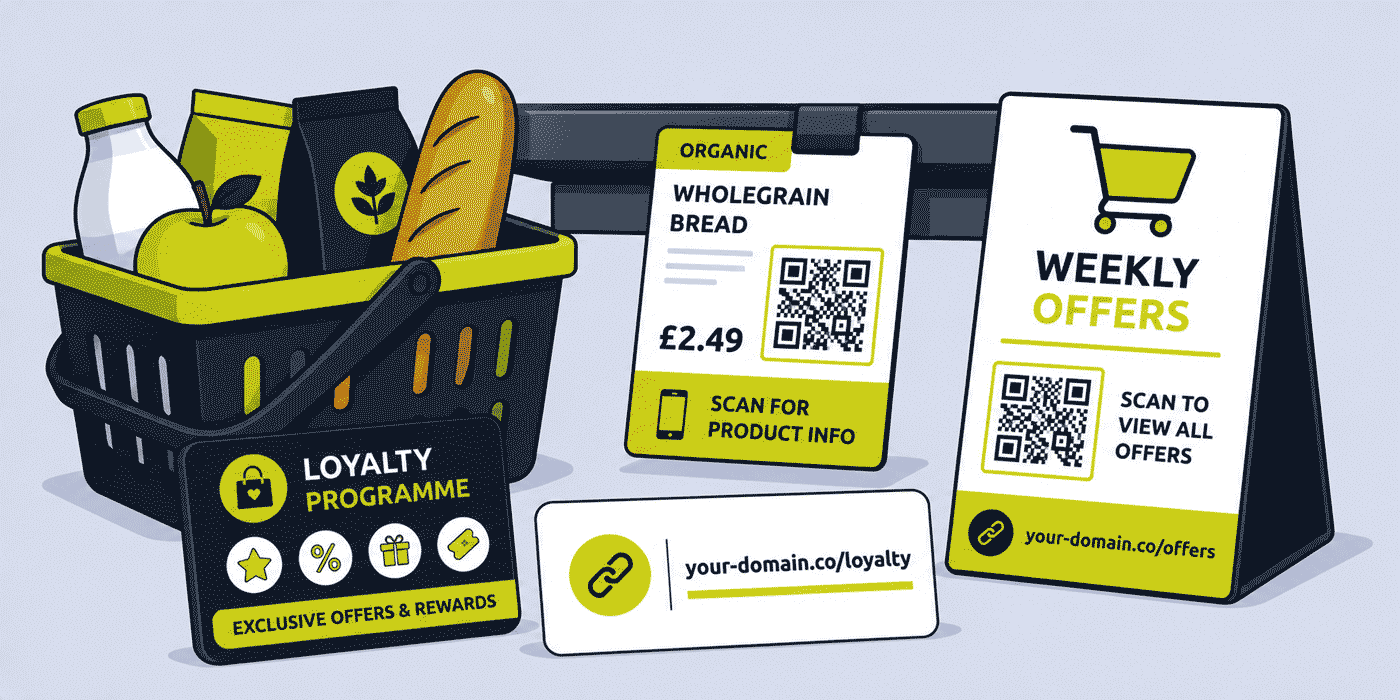
What This Guide Covers
- QR Codes on shelf labels and product displays — extended product information at the point of purchase
- QR Codes on product packaging — provenance, allergen, sustainability and usage information
- Loyalty programme communication links — personalised offers, points balances and tier notifications
- Promotional campaign links across in-store, email, app and social channels
- Click and collect and grocery delivery links
- Food safety, allergen and product recall communications
- Community and social responsibility links
- Staff communication and operational links for multi-site grocery operations
- App download and digital engagement links
- A worked example: a mid-size grocery chain's link stack across a seasonal promotion
- Common mistakes in supermarket link management
- A Cuttly plan guide for supermarkets and grocery stores
- Frequently asked questions
Why Grocery Retail Has a Distinctive Link Management Context
The grocery sector differs from most other retail categories in two fundamental ways that shape its link management approach. First, the purchase frequency is dramatically higher: a consumer shops for groceries multiple times per week, compared with monthly or less for most other product categories. This means that every link touchpoint in the grocery context — a loyalty notification, a promotional email, a click and collect confirmation — reaches the same consumer far more often than equivalent touchpoints in almost any other retail sector. The cumulative effect of link quality and consistency is therefore more pronounced in grocery than elsewhere.
Second, the regulatory complexity of the grocery sector is significantly higher than for non-food retail. Allergen labelling regulations require clear and accessible product information. Food safety regulations impose specific communication requirements for product recalls and safety alerts. Provenance and country-of-origin labelling requirements impose additional display and information obligations. The environmental and sustainability reporting obligations that now apply to most major food retailers require accessible disclosure of supply chain and environmental impact data. Each of these regulatory requirements creates an information communication need that links — on shelf labels, on packaging, in communications — are increasingly called upon to satisfy.
Third, the physical and digital integration challenge in grocery is more acute than in most other sectors. A supermarket operates simultaneously as a physical shopping environment, a digital ordering platform, a loyalty programme, an advertising medium, and a content publisher. Each of these dimensions generates links, and the consistency and quality of those links across every dimension shapes the shopper's experience of the brand. A shopper who scans a shelf QR Code and reaches a broken link in the store, then receives a poorly formatted loyalty email, then finds the click and collect app unresponsive, accumulates a series of minor friction experiences that collectively affect brand loyalty in a sector where switching costs are low and competitor proximity is high.
QR Codes on Shelf Labels and Product Displays
The shelf label QR Code is the most direct physical-to-digital link touchpoint in the grocery environment. A shopper who wants more information about a product at the moment of deciding whether to buy it cannot access a laptop or desktop; they have a smartphone in their hand or pocket, and a QR Code that takes two seconds to scan is the most immediate bridge between the physical product on the shelf and the digital information that might influence their purchasing decision.
Categories That Benefit Most From Shelf QR Codes
Not every product category benefits equally from shelf QR Codes, but several categories consistently generate high shopper information engagement:
- Fresh meat, fish and poultry. Provenance, farming method, welfare certification, country of origin and recommended cooking guidance. A QR Code on the meat counter label linking to the farm or supplier's provenance page, or to the retailer's own farming standards page, serves the growing consumer interest in food sourcing without requiring the retailer to print exhaustive information on space-limited counter cards.
- Wine, beer and spirits. Tasting notes, food pairing suggestions, origin information, alcohol content context, and responsible drinking guidance. A QR Code on a bottle shelf edge label linking to an extended product description and serving suggestion page has been shown to increase consideration and basket value in the wine category in particular.
- Organic, free-from and specialist ranges. Certification information, ingredient lists, manufacturing process details, and cross-contamination risk information for consumers with dietary requirements. For shoppers with allergies or intolerances, the ability to access detailed ingredient and production information at the shelf edge before purchase significantly reduces the risk of an incorrect purchase.
- Health and wellness products. Usage guidance, active ingredient information, interaction warnings, and when to consult a healthcare professional. For own-label health products that carry more limited packaging information than branded alternatives, a QR Code linking to a more detailed information page provides a practical compliance mechanism.
- Seasonal and premium ranges. Recipe ideas, serving suggestions, gift guide content, and premium product stories that reinforce the quality positioning and justify the price premium at the moment of purchase consideration.
Dynamic Shelf Label QR Codes: The Operational Imperative
Shelf labels in a supermarket are already operationally complex. They carry price information, promotional indicators, weight and unit pricing, and increasingly nutritional traffic light data. When a QR Code is added to a shelf label, the same operational reality that applies to every other element of that label applies to the QR Code: the label is printed in batches, installed in the store, and updated according to the store's label management schedule. The destination behind the QR Code, however, needs to be updated far more frequently than the label itself.
A new supplier for a fresh chicken product, a reformulation of an own-label sauce, a change in organic certification status for a range — each of these requires a product information update that the QR Code destination needs to reflect immediately. If the QR Code encodes the destination URL directly, the label must be reprinted every time the destination changes. If the QR Code encodes a dynamic short link, the destination is updated in the dashboard in seconds, and every existing label in every store automatically serves the current information.
For a national supermarket chain with hundreds of stores and thousands of shelf labels, the operational efficiency of dynamic QR Codes versus static ones is substantial. The cost of a single national shelf label reprint run to update a changed product information URL far exceeds the annual cost of a link management platform at the scale needed to manage the full label estate.
QR Codes on Product Packaging
For own-label grocery products — which now represent a significant proportion of the product range in most major grocery retailers — QR Codes on product packaging are an increasingly important communication channel. Own-label packaging typically has more limited space than branded products (which invest heavily in packaging design and brand communication) and needs to carry a high information density within that space. A QR Code on the back of pack that links to extended information is an efficient mechanism for extending the information capacity of the packaging format.
Regulatory Compliance Uses
The regulatory information requirements for packaged food products are extensive and expanding. Allergen declarations, nutritional information, country of origin, storage and preparation guidance, and waste management instructions are all mandatory. For products with complex supply chains or multiple production variants, additional information may need to be disclosed that cannot practically fit on the packaging. A QR Code linking to a product-specific online information page provides a compliant mechanism for making this information accessible.
The European digital product passport initiative, which is being progressively extended to food products, will increasingly require scannable product identifiers that provide access to supply chain information, environmental impact data, and product composition details. A QR Code generated from a dynamic short link is already technically compatible with this requirement and positions the retailer or producer to update the destination information as the digital product passport standards develop, without needing to reprint packaging.
Consumer Experience Uses
Beyond regulatory compliance, own-label packaging QR Codes serve consumer experience functions: recipe ideas for the product, preparation videos, serving suggestions, storage tips, and complementary product recommendations. A QR Code on a ready meal packaging that links to a "perfect wine pairing" page, or a QR Code on a baking kit that links to a preparation video, adds a layer of consumer value that cannot be provided within the packaging format itself.
For seasonal ranges — Christmas, Easter, summer barbecue, back-to-school — packaging QR Codes can link to seasonal content hubs that bring together recipes, entertaining ideas, and complementary product suggestions across the relevant range. Because the QR Code is dynamic, the same printed code can serve a seasonal content hub during the promotional window and redirect to a general recipe hub outside it, without any packaging change.
Loyalty Programme Communication Links
Grocery loyalty programmes are among the most sophisticated CRM systems in retail, generating enormous volumes of personalised communications triggered by purchase behaviour, life events, seasonal patterns, and promotional calendars. Every communication in this system involves links, and the quality of those links affects both the click-through rate of individual communications and the shopper's overall perception of the programme's digital experience.
Weekly Personalised Offer Communications
The personalised offer email or app notification — typically sent weekly to loyalty programme members — is one of the highest-open-rate communications in retail. A shopper who receives a personalised offer based on their purchase history is actively interested in the content. The link from that communication to the offer redemption page or the product detail page needs to be immediate, branded, and correctly directed.
A branded short link for the weekly offers destination — your-supermarket.com/my-offers — is more professional than a raw CRM platform URL, more memorable if the shopper wants to return to it directly, and more stable if the loyalty platform is updated or migrated. Click analytics for this link, available independently of the loyalty platform's own analytics, give the CRM team a secondary validation of engagement metrics and a channel-independent view of offer communication performance.
Points Balance and Tier Notifications
Points balance reminders, tier upgrade notifications, and reward expiry warnings are high-engagement loyalty communications that drive specific actions: visiting the store, making a qualifying purchase, or redeeming points before they expire. A short link for the points redemption destination — your-supermarket.com/redeem-points — in each of these communications provides a consistent, stable action link that guides the loyalty member to the correct next step in the redemption journey.
Loyalty App Download Links
For grocery retailers whose loyalty programme operates primarily through a smartphone app, driving app downloads from non-app loyalty members is a significant CRM priority. A smart redirect short link — your-supermarket.com/app — that sends iOS users to the App Store and Android users to Google Play from a single URL can be used consistently across every loyalty communication, receipt footer, in-store signage, and website page that promotes the app, with all traffic tracked in one place rather than managed as two separate store-specific links.
Promotional Campaign Links
Supermarket promotional campaigns are among the most operationally complex marketing programmes in any consumer sector. A major promotional event — a summer barbecue campaign, a back-to-school promotion, a Christmas food countdown — may involve hundreds of individual product offers, dozens of in-store promotional placements, email campaigns to millions of loyalty members, social media content, outdoor advertising, and in-app promotions, all running simultaneously for a defined promotional window.
Campaign Hub Links
A campaign hub link — your-supermarket.com/summer-bbq or your-supermarket.com/xmas-2026 — provides a single, branded entry point to all the content and offers associated with a major promotional event. This link appears in email campaign headers, in social media posts, on in-store aisle end displays, in paid advertising, and in any influencer content associated with the campaign. Because the link is dynamic, the destination can be updated as the campaign progresses: adding new offers as they launch, removing sold-out promotions, and eventually redirecting to the next campaign or to a general offers page once the promotional window closes.
Per-Channel Campaign Attribution
For a major promotional campaign running across email, in-store QR Codes, social media, and app push notifications simultaneously, per-channel short links provide the attribution data that most grocery retailers currently cannot access from a single source:
your-supermarket.com/summer-email— email campaignyour-supermarket.com/summer-instore— in-store aisle end and promotional QR Codesyour-supermarket.com/summer-social— social media postsyour-supermarket.com/summer-app— app push notification
Comparing click analytics across these channels over the campaign period gives the marketing team a picture of which promotional touchpoint is most effective at driving engagement with the campaign hub. For a grocery retailer making decisions about how to allocate the promotional display budget across email, in-store and digital channels, this per-channel data is more actionable than the aggregate campaign metrics that internal analytics platforms typically provide.
Click and Collect and Grocery Delivery Links
Online grocery — whether click and collect or home delivery — generates a high volume of transactional links: order confirmation emails, dispatch notifications, collection ready messages, delivery tracking links, and post-delivery feedback requests. Each of these is a link, and each one is an opportunity to reinforce the retailer's brand identity and provide a frictionless customer experience.
Order and Collection Links
A branded short link for each type of order communication — your-supermarket.com/track-order, your-supermarket.com/collect, your-supermarket.com/your-order — is more professional and more clickable in an SMS or email than a raw fulfilment platform URL. For click and collect specifically, the collection point QR Code experience discussed below creates an additional in-store link touchpoint that the online ordering journey can be designed around.
Click and Collect Point QR Codes
A supermarket click and collect collection point typically involves a customer arriving at a designated area, identifying themselves to a staff member or scanning a QR Code, and having their order brought from the picking area. A QR Code at the collection point, generated from a dynamic short link, can serve several functions:
- Check-in: scanning confirms the customer's arrival and triggers the picking team to bring the order to the collection point
- Order access: scanning gives the customer a direct link to their order details on the retailer's app or website
- Substitution queries: scanning connects the customer to a page where they can view and accept or decline substitutions before the order is handed over
- Feedback: scanning at the end of the collection experience links to a short post-collection survey
Because the QR Code is dynamic, the collection point QR Code can be configured for different functions at different times of day — check-in during peak hours, general information during off-peak periods — or updated to redirect to different stages of the collection flow as the technology evolves, without replacing any physical installation.
Delivery Tracking and Post-Delivery Links
A grocery delivery confirmation message that includes a branded tracking link — your-supermarket.com/track — rather than the raw URL of the logistics partner's tracking system maintains the retailer's brand identity throughout the fulfilment experience. Post-delivery, a feedback link — your-supermarket.com/delivery-feedback — in the post-delivery email captures satisfaction data in a format that the retailer controls, independent of whatever the delivery platform's own satisfaction tracking provides.
Food Safety, Allergen and Product Recall Communications
Food safety communications are among the most time-sensitive and highest-stakes link management situations in any business sector. A product recall requires immediate, clear communication across every channel available to the retailer, with a link that is easily accessible, correctly labelled, and stable throughout the duration of the recall period.
Product Recall Links
A dedicated short link for product safety and recall information — your-supermarket.com/product-safety or your-supermarket.com/recall — can be pre-configured as a permanent link that is activated whenever a recall situation arises. During normal operations, this link points to the retailer's general product safety information page. When a recall is initiated, the destination is updated to the specific recall notice; when the recall is closed, it is updated back to the general safety page or to a summary of past recall actions.
This permanent recall link approach means that the retailer already has a stable, brandedURL for product safety communications before any recall situation arises. In a live recall, when communications need to go out urgently, there is no time to create and test a new short link; the pre-configured link can be activated immediately and included in every recall communication channel simultaneously.
Allergen and Dietary Information Links
For own-label products, allergen information needs to be accurate, current, and accessible. A QR Code on own-label packaging linking to the product's specific allergen information page — through a dynamic short link that is updated whenever the formulation changes — is a meaningful contribution to allergen safety that printed packaging alone cannot provide when formulations change between print runs.
Regulatory developments in food allergen labelling in multiple markets are trending toward requiring more detailed and more accessible allergen disclosure than physical packaging can accommodate. A QR Code on packaging that links to a digital allergen information page is increasingly being recognized as a best-practice mechanism for meeting these requirements in markets where physical space constraints make comprehensive on-pack labelling impractical.
Community and Social Responsibility Links
Major grocery retailers are significant community stakeholders — one of the largest employers in most local areas, major contributors to local food bank networks, and often involved in community food programmes, sustainability initiatives, and local supplier development schemes. Communicating these activities to shoppers, staff, and stakeholders is an increasingly important part of grocery retail brand management.
A short link for community and CSR information — your-supermarket.com/community or your-supermarket.com/sustainability — provides a consistent, branded access point for this content across in-store communications, staff briefing materials, social media, and annual report references. Because corporate responsibility reports, community programme updates, and sustainability data are updated regularly, a dynamic short link behind this destination means the link in an old press release or in-store poster still reaches the most current information rather than an outdated report.
Staff Communication and Operational Links
A large supermarket store employs hundreds of staff across multiple departments, shifts, and roles. Internal communication with this workforce — about training, health and safety, scheduling, operational procedures, and company news — is a significant operational function. Short links for staff-facing resources make internal digital communication more accessible, particularly for staff who primarily work on the shop floor and may access company communications through personal mobile devices rather than desktop computers.
A staff communication short link — your-supermarket.com/staff or your-supermarket.com/colleague-hub — on staff briefing boards, locker room notices, and in team leader communications provides a consistent digital entry point to the company's staff portal or intranet. When the portal platform changes — as often happens in large retail organizations that regularly upgrade their internal systems — the short link destination is updated without requiring every staff communication reference to be reprinted.
A Worked Example: A Mid-Size Grocery Chain's Seasonal Promotion
Consider a regional grocery chain with 40 stores, running a major Christmas food promotion using a branded domain such as your-supermarket.com, connected through Cuttly's custom domain setup (an A record and a TXT record — see the custom domain setup guide).
Eight weeks before Christmas: the campaign hub link /xmas-2026 goes live pointing to the seasonal food landing page. Email to the loyalty database uses /xmas-email; social media posts use /xmas-social; in-store promotional displays carry QR Codes using /xmas-instore. The team adds a fourth variant /xmas-app for app push notifications.
Six weeks before Christmas: Christmas food range shelf labels are updated with QR Codes linking to the retailer's "Christmas inspiration" content hub through /xmas-recipes. The QR Code destination is set up before the labels are printed, so the content hub can be populated and tested before any physical labels go into stores.
Three weeks before Christmas: the campaign analytics show /xmas-email driving 58% of all campaign link clicks, /xmas-social 21%, /xmas-instore 16%, and /xmas-app 5%. The in-store QR Code performance is higher than the previous year's comparable campaign, attributed to improved placement on high-traffic aisle ends rather than low-traffic areas.
December 27: /xmas-2026 is redirected from the Christmas food landing page to a "New Year recipes and detox" page. All in-store shelf labels still carry QR Codes that now serve the new content without any label reprint. Staff briefing boards are updated with a notice using /colleague-hub to access January promotion briefing materials.
January 15: a product recall is required for an own-label product. /product-safety is updated in sixty seconds to point to the recall notice. All channels — email to loyalty members who purchased the product (if purchaser data allows for CRM targeting), in-store signage, app notification, social media — reference the same /product-safety link simultaneously. Post-recall, the link redirects back to the general food safety information page.
Common Mistakes in Supermarket Link Management
Printing Static QR Codes on Shelf Labels and Packaging
A grocery retailer that generates QR Codes from direct product information URLs and prints them on shelf labels or packaging creates a large-scale maintenance problem. Every time a product information page URL changes — which happens with website restructurings, CMS migrations, product relaunches, and supplier changes — every printed label or package carrying that QR Code becomes a dead link. At the scale of a national grocery chain, the reprint cost and the consumer experience damage from dead QR Codes across thousands of products is substantial. Dynamic short links eliminate this problem entirely.
No Per-Channel Promotional Attribution
A grocery retailer running a promotion across email, in-store QR Codes, social media and app push notifications simultaneously and using the same link for all channels cannot compare the relative effectiveness of each channel. The email platform reports email click rates; the app platform reports notification engagement; the social media platform reports post engagement — but none of these can be directly compared because they measure different things on different platforms. Per-channel short links give a single, consistent click metric across every promotional channel, measured on the same basis.
No Permanent Recall Link Infrastructure
A retailer that creates a product recall link from scratch each time a recall occurs is adding setup time to an already time-critical situation. A pre-configured permanent recall short link, activated by updating its destination, removes this bottleneck entirely and ensures the recall link can be deployed across all channels the moment a recall decision is made.
Cuttly Plan Guide for Supermarkets and Grocery Stores
- The Free plan ($0) provides 30 short links per month, one branded custom domain, full click analytics, dynamic QR Codes and a survey tool, with no credit card required. Suitable for an independent grocery store or farm shop setting up core loyalty, promotional and product information links.
- The Starter plan ($12/month) adds 300 short links per month and 30 custom aliases per month — practical for a small chain or multi-site independent grocery retailer managing promotional campaign links, loyalty communications and in-store QR Code programmes.
- The Single plan ($25/month) adds up to 5 branded domains, fully customizable QR Codes with the retailer's brand identity for professional shelf label and packaging integration, 1,000 API-created links per month for automated product-level QR Code generation, and a full year of analytics history — relevant for grocery retailers needing branded QR Codes across product ranges and wanting to automate link creation for large product catalogs.
- The Team plan ($99/month) suits regional grocery chains with marketing, category management, online and operations teams sharing link management, Campaign tag analytics for aggregated promotional campaign performance reporting across all channels and store locations, multiple branded domains for different trading fascias, and shared workspaces across departments.
- The Enterprise plan ($149/month) is for large national grocery retailers managing link infrastructure at scale across thousands of products, hundreds of stores, and enterprise-level API integration with product information management and loyalty systems.
Create a free Cuttly account to set up your first shelf label QR Code, your loyalty offer link and your seasonal promotion campaign hub. Registration is required for all plans, including free. No credit card is needed for the free plan.
Frequently Asked Questions
How do supermarkets use QR Codes on shelf labels?
A supermarket places QR Codes generated from dynamic short links on shelf labels in categories where extended information improves shopper confidence: fresh meat and fish, wine and spirits, organic ranges, free-from products, and health and wellness. Because the QR Code is dynamic, the product information destination can be updated when supplier or formulation information changes without reprinting the physical label. Click analytics from shelf QR Codes show which product categories generate the most shopper information engagement.
How do grocery retailers use short links in loyalty programme communications?
A supermarket uses short links in every loyalty communication — the weekly personalised offer email, points balance reminders, tier upgrade notifications — providing a branded, clickable link that is more professional than a raw loyalty platform URL. Click analytics show how many loyalty members engage with each communication type, helping the CRM team optimize message frequency and format.
How do supermarkets use QR Codes for click and collect orders?
A supermarket uses QR Codes at click and collect points so that customers can check in, view their order, and confirm collection without speaking to a staff member. The QR Code is generated from a dynamic short link that can redirect to different stages of the collection process as the operation evolves. Click analytics provide data on how many customers are using the digital collection flow.
How do supermarkets track which promotional campaigns drive the most online grocery orders?
A supermarket creates separate short links per channel for each major promotional campaign — email, in-store QR Codes, social media, app push. Click analytics per channel show which touchpoint drives the most engagement with the promotion, giving the marketing team per-channel attribution data for investment decisions across promotional budget.
Can independent grocery stores and farm shops benefit from URL shorteners?
Yes. A farm shop can use dynamic QR Codes on product labels linking to provenance information and recipes. A local grocery store can use short links in WhatsApp order reminders to drive customers to the online ordering page. The free plan typically covers the core QR Code, loyalty notification and promotional link needs of a small independent operation.
How do supermarkets use short links for product recall and regulatory communications?
A supermarket maintains a permanent recall short link — your-supermarket.com/product-safety — that is activated by updating its destination when a recall is required. All channels use this same link simultaneously. Post-recall, it redirects back to a general food safety page. Click analytics provide evidence of how many customers engaged with the recall communication, relevant for regulatory reporting.
- Get Started
- Create Free Account
- Plans & Pricing
- Platform Tools
- URL Shortener
- Link Analytics
- QR Code Generator
- Survey Tool
- Campaign Analytics
- Related Guides
- URL Shortener for Luxury Brands
- URL Shortener for Ecommerce
- URL Shortener for Retail
- URL Shortener for Subscription Boxes
- URL Shortener for the Pet Industry
- Short Links for Offline Campaigns
- Encyclopedia
- Branded Links
- Dynamic QR Codes
- Setup Guides
- Custom Domain Setup
- Track Link Clicks
- Industry Hub
- Ecommerce & Retail
- All Industries →
URL Shortener
Cuttly simplifies link management by offering a user-friendly URL shortener that includes branded short links. Boost your brand’s growth with short, memorable, and engaging links, while seamlessly managing and tracking your links using Cuttly's versatile platform. Generate branded short links, create customizable QR codes, build link-in-bio pages, and run interactive surveys—all in one place.
Cuttly - Consistently Rated
Among Top URL Shorteners
Cuttly isn’t just another URL shortener. Our platform is trusted and recognized by top industry players like G2 and SaaSworthy. We're proud to be consistently rated as a High Performer in URL Shortening and Link Management, ensuring that our users get reliable, innovative, and high-performing tools.C


