URL Shortener for Architecture Firms The Complete Guide
An architecture practice presents itself to the world through the quality of its buildings, through the clarity of its ideas, and through the precision and intelligence of its communications. A practice that produces extraordinary architecture but presents its work through broken links, unwieldy URLs, and untracked portfolio references is communicating a gap between its design intelligence and its operational competence that discerning clients will notice. Every link through which a practice's work is discovered, shared, submitted for awards, presented to clients, and referenced in planning consultations is a small but real element of the practice's professional presentation — and it is also the mechanism through which new commissions and professional recognition actually arrive.
This guide covers how architecture firms — from solo practices and small studios to large multidisciplinary design practices — use a URL shortener, branded custom domain, dynamic QR Codes and click analytics across portfolio presentation, new commission enquiry attribution, planning consultation links, construction site QR Codes, award and press submission links, client collaboration portal access, CPD and education programme links, and the full range of professional communications needs for a design practice operating across every stage of a building's lifecycle.
What This Guide Covers
- Portfolio project links — precision, stability and professional presentation
- New commission enquiry links and per-channel attribution
- Construction site and building QR Codes
- Planning consultation and public engagement links
- Award submission and press coverage links
- Client collaboration portal and project communication links
- CPD, lecture and education programme links
- Practice recruitment and graduate links
- Research and publication links
- A worked example: a mid-size architecture practice's full link infrastructure
- Common mistakes in architecture firm link management
- A Cuttly plan guide for architecture firms
- Frequently asked questions
Portfolio Project Links: Precision, Stability, and Professional Presentation
An architecture practice's portfolio is its primary commercial evidence: the accumulated record of what it has built, what clients have trusted it to design, and what standard of work it consistently delivers. The links through which this portfolio is accessed — in a proposal document sent to a prospective client, in an award submission entry, in a social media post, in an editorial feature in Dezeen or the Architectural Review — need to reflect the same quality as the work they lead to.
Per-Project Short Links
A short link per significant project — your-practice.com/project-name — provides a clean, memorable, professional reference to each project's portfolio page that can be used in any context where the project is being shared or promoted:
- Proposals and tender submissions. A new commission proposal that includes specific portfolio project links — "see our completed housing project at your-practice.com/project-name" — gives a prospective client an immediate, one-click path to the detailed project information without requiring them to navigate the practice's portfolio. A proposal that references projects through clean short links on the practice's own domain conveys professional precision; one with raw CMS URLs conveys the opposite.
- Award submissions. Architecture award entries — RIBA Awards, Stirling Prize nominations, AJ Architecture Awards, WAF entries — typically require links to project photography, drawings, and descriptive content. A short link per submitted project, stable and correctly formatted, is the professional standard for award submissions in a design field where presentation quality matters at every level.
- Social media and editorial. An Instagram post showing completed photography of a project references it at
your-practice.com/project-namein the caption — a link that is short enough to type from memory, clearly branded as the practice's own, and stable regardless of any subsequent CMS migration. - Press and editorial features. Architectural publications that feature the practice's work may reference project links in online articles, in print captions, or in their own social media posts. A short link for the project that is stable across years of potential republication is significantly more professionally managed than a raw portfolio URL.
The CMS Migration Problem in Architecture
Architecture practices rebuild and migrate their websites more often than most professional service businesses, partly because the website itself is an expression of the practice's design sensibility and may be refreshed with each significant evolution of the practice's brand and approach. When an architecture practice migrates from WordPress to Cargo to a custom-built portfolio platform, or when it restructures its portfolio categories and URL naming convention, every historical link to specific projects breaks.
A practice that has received editorial coverage in the Architectural Review, been featured on Dezeen, been listed in the RIBA Client Guide, and been referenced in award citations over a ten-year period has an enormous accumulated archive of links to its work across dozens of publications and platforms. A website migration that breaks all of those links simultaneously is not merely an operational inconvenience — it is a permanent loss of referral traffic and professional credibility from the industry's most trusted publications.
Dynamic short links for every portfolio project, updated when the underlying project page URL changes at migration, protect the entire accumulated external reference investment. Every editorial mention, every award citation, every social media post ever made about the practice's work continues to reach the correct, current project page regardless of how many website migrations the practice has undertaken since the reference was first published.
New Commission Enquiry Links and Attribution
A new commission is the commercial event that sustains an architecture practice. The journey from a prospective client's first encounter with a practice's work to a signed appointment agreement typically involves multiple touchpoints: discovering the work in a publication, visiting the practice's website, seeing a building in person, receiving a recommendation from another client or a contractor, attending a lecture by one of the practice's principals. Understanding which of these touchpoints generates the most commission enquiries — not merely the most website visits — is the most commercially important analytics question in an architecture practice's business development activity.
The Commission Enquiry Page Link
A permanent short link for the practice's new commission enquiry page — your-practice.com/new-project or your-practice.com/enquiry — is the single consistent reference used across every business development touchpoint:
- The RIBA Architecture directory and Find an Architect service
- The practice's LinkedIn company page and principal architects' personal profiles
- The practice's Instagram profile bio
- Any editorial features in architectural or design publications
- Award programme participant directories
- Any lecture or CPD session where the practice is presenting
- The email footer of all practice correspondence
Per-channel attribution variants — your-practice.com/new-project-riba, your-practice.com/new-project-instagram, your-practice.com/new-project-linkedin — all pointing to the same enquiry form, give the practice leadership independent click analytics per source. Over a year of commission enquiries, the pattern reveals which discovery contexts generate the most interested prospective clients. If RIBA directory referrals generate high click volumes and moderate conversion while editorial features generate lower volume but significantly higher commission conversion, the practice should invest more in editorial presence than in directory listings — a strategic insight that most practices currently make on instinct rather than data.
Construction Site and Building QR Codes
The construction site hoarding is one of the most visible and most underexploited marketing surfaces available to an architecture practice. A distinctive building under construction in a city centre, on a residential street, or in a prominent institutional setting generates genuine public and professional curiosity: what is being built, who designed it, what will it look like when complete? The site hoarding typically carries planning information, contractor details, and sometimes a brief project description — but rarely a link that allows a curious passerby to learn more about the architect and the project in depth.
Site Hoarding QR Code Strategy
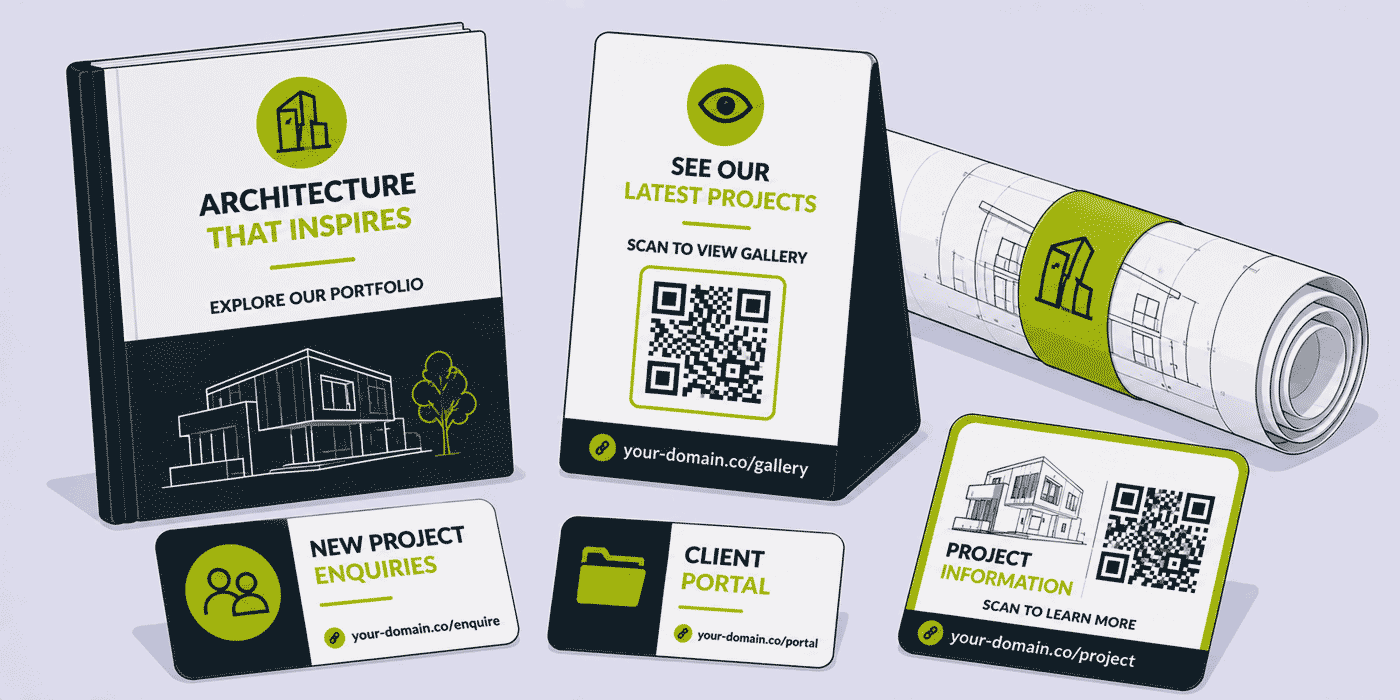
A QR Code on the site hoarding — on the architect's site board or on a dedicated design information panel — links to the practice's project page for the building under construction: your-practice.com/project-name. This page shows the design concept, the planning drawings, the design evolution, any publicly available visualisations, and information about the practice. A prospective client, a journalist, an award programme researcher, a planning committee member, or simply a member of the public who is curious about the building they are watching be built can scan the QR Code and discover the practice's work in an active, live project context.
Because construction projects run for months or years, and because a practice's website will be updated, migrated, or restructured during that period, dynamic QR Codes on site hoardings are essential. A site board QR Code that was applied at groundbreaking, pointing to a project page that was correct at the time of application, may be pointing to a restructured or migrated URL six months into the build if the practice has updated its website. A dynamic QR Code whose destination is updated when the project page URL changes remains functional throughout the entire construction period.
Permanent Building QR Codes
Some architecture practices, with the agreement of their clients, install a permanent building information plaque or QR Code at a completed building, linked to the practice's project page and to any publicly available documentation about the building's design, construction, and awards. This is more common for cultural, civic, and public buildings than for private residential work, but for any completed building that is a significant piece of the practice's portfolio, a permanent physical-digital link between the building and its design story is a lasting professional asset.
A building completed today may be standing for a hundred years. A dynamic QR Code on that building's information plaque, managed through a permanent short link on the practice's domain, can be updated as the practice migrates its website, changes its portfolio platform, and evolves its documentation — remaining functional and relevant throughout the building's entire lifetime of public and professional interest.
Planning Consultation and Public Engagement Links
Most significant architecture projects require planning permission, and increasingly, planning authorities require meaningful pre-application and post-application community engagement as part of the planning process. Public exhibitions, online consultation portals, community information sessions, and press communications about planning applications all involve links that need to reach the relevant information accurately and remain functional throughout the planning process, which may extend over months or years.
Public Consultation Short Links
A short link for the project's public consultation page — your-practice.com/project-consultation — used in local press coverage of the planning application, in community newsletter communications, in letters to neighbouring residents (where the local authority requires notification), and in any public engagement materials for the consultation event, provides a consistent, findable reference to the consultation information that remains functional throughout the planning process.
Because planning applications are sometimes subject to revisions, resubmissions, and appeals that extend the process over years, and because the consultation platform or the document repository where consultation materials are stored may change during this period, a dynamic short link for consultation materials ensures the reference in any community communication always reaches current, accurate information. The practice should ensure all publicly distributed consultation materials comply with the relevant local authority's requirements and any conditions attached to the planning application's consultation process.
Planning Application Document Links
Architecture practices that want to make planning application documents — design and access statements, heritage impact assessments, environmental impact assessment summaries, and planning statements — accessible to the public, to statutory consultees, and to interested third parties benefit from short links for each document category that are clear, stable, and easily shareable:
your-practice.com/project-design-statement— the design and access statementyour-practice.com/project-heritage-assessment— heritage impact assessmentyour-practice.com/project-visualisations— publicly available visualisations and renders
These document links, included in press materials about the planning application, in community newsletter features, and in any stakeholder communications, give interested parties direct access to the planning documentation without requiring them to navigate the local authority's planning portal. Click analytics on document links show the practice's planning team which documents are generating the most public engagement, informing future public engagement strategy for similar planning applications.
Award Submission and Press Coverage Links
Architecture awards are a primary mechanism through which practices build professional reputation, generate press coverage, attract new clients, and recruit talented staff. A practice that is regularly shortlisted for and wins industry recognition demonstrates a consistent level of design quality that is immediately legible to sophisticated clients, to the architectural press, and to the graduates and established architects who are considering where to work. Managing award-related links well — so that every shortlisting announcement, every press feature about a winning project, and every industry database entry for an award-winning project leads to the correct, current project page — is part of how a practice maximises the commercial value of its award investment.
Award Submission Links
When submitting to the RIBA Awards, the Stirling Prize, the AJ Architecture Awards, the Dezeen Awards, or any sector-specific design award, the submission entry typically requires links to project photography, construction drawings, and descriptive supporting content. A short link per submitted project — used consistently in the submission form and in any social media communication about the shortlisting — provides a professional, stable reference that the award programme jury can access cleanly and that remains functional if the shortlisting is publicly announced months after the submission date.
A practice that is shortlisted for a major award and promotes the news immediately on LinkedIn and Instagram — "We're delighted to be shortlisted for the RIBA Awards for [Project Name]. See the project at your-practice.com/project-name" — is creating a social media post that may be reshared, liked, and commented on for days. The project link in that post needs to remain functional not just on announcement day but for the entire period the award process remains active and for all subsequent references to the award recognition.
Client Collaboration Portal and Project Communication Links
Architecture projects involve extensive client collaboration across every RIBA work stage: briefing and feasibility (Stage 1), concept design (Stage 2), developed design (Stage 3), technical design (Stage 4), construction (Stage 5 and 6), and handover and in-use (Stage 7). Each stage involves shared document repositories, drawing issue registers, design review presentations, and client approvals. The links through which clients access these shared resources — in regular project meeting minute emails, in design review invitations, and in any communication that asks the client to review and respond to specific documents — need to be reliable, current, and easy to use.
A per-project client portal short link — your-practice.com/project-name-client or a general collaboration platform link — your-practice.com/project-hub — in all project communications gives each client a consistent, branded reference to their project's shared resource space. Because collaboration platforms change as the practice upgrades its project management infrastructure — moving between email-based document sharing, Dropbox, Asite, Procore, or a practice management software portal — a dynamic short link ensures every communication continues to reach the current collaboration environment through every platform migration.
CPD, Lecture and Education Programme Links
Many architecture principals and associates deliver lectures, CPD sessions, university guest crits, and professional development presentations as part of their professional practice and public intellectual contribution. These education activities are both a professional obligation (RIBA members have CPD obligations) and a business development mechanism: a principal who delivers a compelling lecture at a university or a professional institute is simultaneously building the practice's reputation and reaching an audience that may include prospective clients, future employees, and professional collaborators.
A short link for the practice's CPD and education activities page — your-practice.com/talks or your-practice.com/education — used in any communications about upcoming lectures, CPD sessions, or education programme contributions, gives interested professionals a consistent reference to the practice's intellectual and pedagogical work. A per-lecture link — your-practice.com/lecture-institution-date — used in the host institution's communications about the lecture gives the practice a tracked reference for each speaking engagement, with click analytics showing how much interest each lecture engagement generates in the practice's portfolio and commission enquiry pages.
Practice Recruitment and Graduate Links
Architecture practices recruit from a competitive pool of talented graduates, Part II students, and experienced architects. The practice's reputation as an employer — its design culture, its project portfolio, its approach to professional development, its studio environment — is as important to a talented architect considering joining as its commercial offer. A practice that communicates its employment proposition clearly, with well-managed links to its current vacancies, its studio culture content, and its graduate recruitment pages, is more competitive in the talent market than one that relies on a generic "careers" link.
A short link for the practice's recruitment and vacancies page — your-practice.com/join or your-practice.com/careers — used in any social media posts about studio culture or current vacancies, in the RIBA Jobs or ArchitectJobs listings, and in the practice's RIBA member profile, gives prospective candidates a consistent reference to current opportunities. Because practices change their recruitment management tools — from email applications to dedicated ATS platforms to RIBA Jobs-integrated application systems — a dynamic short link ensures every recruitment reference remains functional through every system change.
Research and Publication Links
Many architecture practices contribute to architectural discourse through research publications, design guides, position papers, and written contributions to professional debate. These publications build intellectual reputation, contribute to policy discussion, and establish the practice's expertise in specific building types or design approaches. The links through which these publications are accessed — in academic citations, in policy documents, in press features about the research — need to be stable across the long timescales of professional and academic reference.
A short link per publication — your-practice.com/publication-title — used in all communications about the research, in any citation materials distributed to journalists or policy contacts, and in the practice's own social media and newsletter promotion of the publication, provides a permanent, professional reference that survives the website migrations that would otherwise break academic and policy citations to the practice's research work.
A Worked Example: A Mid-Size Architecture Practice's Link Infrastructure
Consider a 24-person architecture practice with a mixed portfolio of residential, cultural, and public sector projects, an active award programme participation record, and a reputation for housing design that generates regular editorial coverage in architecture publications, using a branded domain such as your-practice.com, connected through Cuttly's custom domain setup (an A record and a TXT record — see the custom domain setup guide).
Website migration: The practice migrates its portfolio from a legacy WordPress installation to a new custom-built platform with significantly improved project photography presentation and a cleaner URL structure. The new platform uses a different URL format for every project page. Previously, the practice had published 34 project links across Instagram posts, editorial features in the Architectural Review and Dezeen, RIBA award submissions, and LinkedIn posts over six years. With dynamic short links for all 34 projects, the migration requires 34 destination updates in the link management dashboard, taking the practice manager approximately 90 minutes. All 34 historical references continue to work correctly from the moment the new site is live. The practice estimates this prevents the loss of referral traffic from approximately 240 external links to its work across publications and award programmes.
RIBA Award shortlisting: The practice is shortlisted for the RIBA National Award for a housing project. The shortlisting announcement generates coverage in the Architectural Review, Building Design, and several architecture Instagram accounts with large followings. All external references use /housing-project-name. Over the three months between shortlisting announcement and award ceremony, the project short link generates 4,200 clicks — the highest single-month traffic any of the practice's portfolio links has ever received. New commission enquiry form submissions increase by 34% in the two months following the shortlisting announcement. The practice's business development director attributes a significant portion of this enquiry increase to the award coverage's referral traffic arriving cleanly through the stable project short link.
Site hoarding QR programme: Three active construction projects across the city each have a site board with a QR Code from a project-specific short link. After six months: the most prominently located site — a mixed-use development on a busy street — generates 840 QR Code scans. Of these, 38 proceed to the practice's commission enquiry page (4.5% of QR scanners actively exploring the commission opportunity). The practice receives 4 new commission enquiries that are traceable to the site hoarding QR Code through click analytics — representing a lead generation mechanism that costs the practice nothing beyond the initial QR Code sticker design and application.
Common Mistakes in Architecture Firm Link Management
Raw Portfolio URLs in Award Submissions and Editorial Features
An architecture practice that uses raw portfolio page URLs in its RIBA Award submissions, in editorial features, and in social media posts is creating a link liability that breaks at every website migration. Given that award submissions may be publicly archived for years, and that editorial features in architectural publications are permanent web content, breaking these links through a website migration is a permanent loss of professional credibility and referral traffic. Dynamic short links for all portfolio projects protect this accumulated investment indefinitely.
No Site Hoarding QR Code
An architecture practice that manages active construction projects without a site hoarding QR Code is missing the most visible and contextually relevant marketing surface available to it. A construction site attracts public and professional curiosity by its very nature; a QR Code on the site board converts this curiosity into portfolio engagement and potentially into commission enquiries at essentially zero recurring cost. For a practice working on landmark or prominent projects, the site hoarding QR Code is one of the highest-potential-reach marketing investments it can make.
No Commission Enquiry Attribution Across Channels
An architecture practice that uses a single enquiry page link across the RIBA directory, editorial features, social media, award listings, and lectures cannot measure which professional contexts are generating commission-quality leads. Most practices invest in a mix of professional memberships, editorial relationships, award submissions, and social media without knowing which generates the most qualified new commission enquiries. Per-channel attribution short links provide this intelligence with minimal operational overhead and maximum commercial relevance.
Cuttly Plan Guide for Architecture Firms
- The Free plan ($0) provides 30 short links per month, one branded custom domain, full click analytics and dynamic QR Codes, with no credit card required. Suitable for a small practice or sole principal setting up core portfolio project links, a commission enquiry link, and a first site hoarding QR Code.
- The Starter plan ($12/month) adds 300 short links per month and 30 custom aliases per month — practical for a mid-size practice managing per-project portfolio links, commission enquiry attribution across multiple channels, site hoarding QR Codes, planning consultation links, award submission links, and recruitment references throughout the year.
- The Single plan ($25/month) adds up to 5 branded domains for practice groups with multiple studio identities, fully customizable QR Codes for professional site hoarding and building information displays, 1,000 API-created links per month for automated per-project link generation across a large portfolio, and a full year of analytics history for year-on-year commission enquiry channel comparison.
- The Team plan ($99/month) suits larger architecture practices with business development, marketing, project, and studio management teams sharing link management, Campaign tag analytics for aggregated commission pipeline and portfolio reporting, and multiple branded domains for different studio brands within a larger design group.
Create a free Cuttly account to set up your architecture practice's portfolio project links, your commission enquiry link, and your first site hoarding QR Codes. Registration is required for all plans, including free. No credit card is needed for the free plan.
Frequently Asked Questions
How do architecture firms use short links for portfolio presentation?
An architecture practice creates a branded short link per major project — your-practice.com/project-name — used in proposals, award submissions, editorial features, and social media. Dynamic links survive every website migration and CMS restructuring, ensuring every historical reference to the practice's work remains accessible. A practice with ten years of editorial coverage and award citations protects this entire accumulated reference investment through dynamic portfolio links.
How do architecture practices use short links for new commission enquiries?
An architecture firm uses a permanent commission enquiry short link with per-channel attribution variants for the RIBA directory, Instagram, LinkedIn, editorial, and lectures. Click analytics combined with enquiry quality data reveal which professional contexts generate the most commission-ready prospective clients, enabling evidence-based business development investment decisions rather than intuition-based ones.
How do architecture practices use QR Codes at completed buildings and construction sites?
An architecture practice places dynamic QR Codes on site hoardings during construction and on building information plaques at completed projects. Because buildings stand for decades and construction projects run for months, dynamic QR Codes ensure every physical-digital link remains functional through every website migration the practice undertakes. Site hoarding QR Codes generate portfolio engagement and commission enquiries from the practice's most contextually motivated audience.
How do architecture firms use short links for planning application references?
An architecture practice creates short links for planning consultation pages, design statements, and public exhibition materials, distributed in community communications and press coverage. Because planning processes run for months or years and consultation platforms change, dynamic links ensure every community reference reaches current, accurate consultation information throughout the process. All public consultation content must comply with relevant planning policy requirements.
How do architecture practices use short links for award submissions and press?
An architecture practice uses stable project short links in all RIBA, AJ, and Dezeen award submission entries and in social media promotion of shortlistings and wins. Because award recognition generates press coverage and professional references over years, dynamic project links ensure every historical award citation remains functional regardless of subsequent website migrations. Award-driven editorial coverage is one of the most commercially valuable long-tail referral traffic sources for architecture practices.
- Get Started
- Create Free Account
- Plans & Pricing
- Platform Tools
- URL Shortener
- Link Analytics
- QR Code Generator
- Related Guides
- URL Shortener for Surveyors
- URL Shortener for Housebuilders
- URL Shortener for Commercial Real Estate
- URL Shortener for Property Management
- URL Shortener for Home Improvement
- Encyclopedia
- Dynamic QR Codes
- Branded Links
- Setup Guides
- Custom Domain Setup
- Track Link Clicks
- Industry Hub
- Real Estate & Construction
- All Industries →
URL Shortener
Cuttly simplifies link management by offering a user-friendly URL shortener that includes branded short links. Boost your brand’s growth with short, memorable, and engaging links, while seamlessly managing and tracking your links using Cuttly's versatile platform. Generate branded short links, create customizable QR codes, build link-in-bio pages, and run interactive surveys—all in one place.
Cuttly - Consistently Rated
Among Top URL Shorteners
Cuttly isn’t just another URL shortener. Our platform is trusted and recognized by top industry players like G2 and SaaSworthy. We're proud to be consistently rated as a High Performer in URL Shortening and Link Management, ensuring that our users get reliable, innovative, and high-performing tools.C


