URL Shortener for Commercial Real Estate The Complete Guide
Commercial real estate transactions move at a different speed and through different channels than almost any other property transaction. A single office lease negotiation may take nine to eighteen months from first contact to exchange of lease; an investment transaction involving a standing commercial asset or a pre-let development may take two to four years from initial marketing to financial close. Throughout this period, the links that brokers, agents, developers and investment managers share with their professional counterparties — to property brochures, virtual tours, investment information memoranda, data rooms, availability schedules and specification documents — are the primary vehicles through which a deal is discovered, evaluated, and progressed.
This guide covers how commercial real estate professionals — occupier brokers, investment brokers, leasing agents, commercial property developers, asset managers, REITs, property investment managers, and commercial building owners — use a URL shortener, branded custom domain, dynamic QR Codes and click analytics across the full lifecycle of a commercial property transaction and marketing programme. The specific character of commercial real estate — long transaction timescales, sophisticated professional audiences, high information quality expectations, and complex multi-party deal structures — creates a set of link management requirements that differ meaningfully from those of residential property or any other category in this hub.
What This Guide Covers
- Why commercial real estate creates distinct link management requirements compared with residential and other property sectors
- Property brochure and particulars links — professional distribution to occupier and investor audiences
- Virtual tour and floor plan links for remote evaluation by dispersed decision-makers
- Investment information memorandum (IIM) and data room links for investor transactions
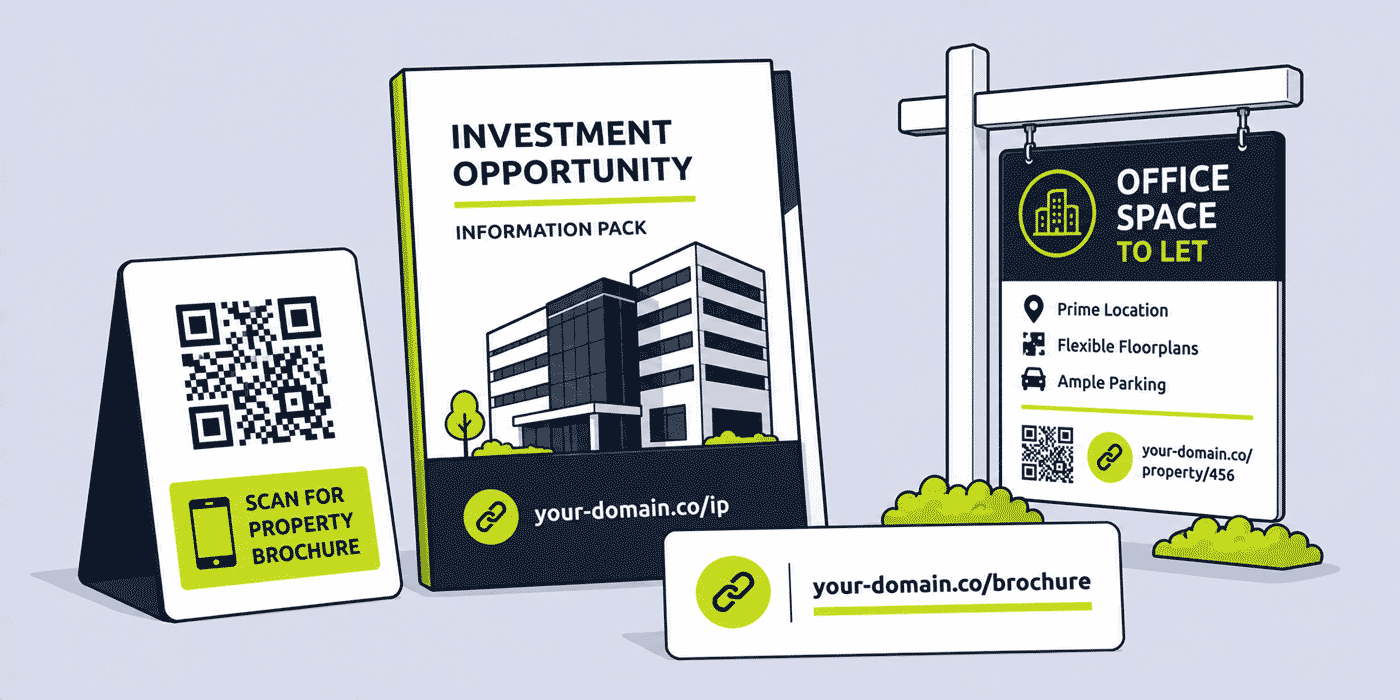
- On-site hoarding and signage QR Codes for commercial developments and vacancy marketing
- Per-broker and per-joint-agent attribution across multi-agent instructions
- Occupier prospect and tenant outreach links
- Asset management and building owner reporting links
- Lease documentation and legal transaction links
- Portfolio marketing and multi-asset investment links
- A worked example: a commercial agency's link management across a major office letting campaign
- Common mistakes in commercial real estate link management
- A Cuttly plan guide for CRE professionals
- Frequently asked questions
Why Commercial Real Estate Has Distinct Link Management Requirements
Commercial real estate operates in a professional-to-professional context where the quality of every information exchange — including the format and presentation of links — is a signal about the quality of the broker or developer sharing them. A long, auto-generated URL from a property marketing platform or a document sharing service is not merely aesthetic, it is a professionalism indicator in a market where clients are choosing to work with advisors partly based on impressions of their operational quality.
The transaction timescales in commercial real estate compound this. A property marketed for occupancy may be available for six to twenty-four months before being let; an investment asset may be marketed for six to twelve months before sale or refinancing; a development property may be in active marketing for years across planning, construction and leasing phases. The links shared with occupiers, investors and advisors during these periods need to remain stable, current, and correctly directed for the full duration of the marketing programme, not just for the first few weeks after a brochure is created.
The audience sophistication in commercial real estate also raises the bar. The recipients of a commercial property brochure link are typically property professionals, corporate real estate directors, investment fund managers, or institutional investors with decades of transaction experience. They are evaluating the quality of the information provided and the professional presentation of the broker or developer sending it, not just the property itself. A broken link, an unbranded redirect, or a raw document platform URL in a deal correspondence email is more noticeable to this audience than to a first-time buyer receiving a residential listing link.
Finally, the multi-party nature of commercial transactions — where a single property may be jointly marketed by two or three agents, evaluated by multiple prospective occupiers simultaneously, and reviewed by institutional investors through a parallel process — creates a need for link structures that can serve different audiences with different information while maintaining consistent brand presentation from the marketing party.
Property Brochure and Particulars Links
The commercial property brochure or particulars document is the primary information vehicle in any occupier or investment marketing campaign. Whether presented as a PDF, an interactive online document, or a dedicated property microsite, the brochure link is the most frequently shared link in any active commercial property campaign — sent in response to every enquiry, distributed to every qualified prospect, and included in every piece of outreach by the marketing agent.
Per-Property Brochure Links
A branded short link for each property's brochure — your-agency.com/property-ref-brochure or your-agency.com/building-name — is more professional than a raw document platform URL (Dropbox, SharePoint, Google Drive, OneDrive all generate long, platform-branded links that communicate nothing about the property or the agency) and more stable across the document revisions that are inevitable in a long marketing campaign.
Commercial property brochures are updated regularly throughout a marketing campaign. Floor plate revisions as a tenant negotiates a partial floor; pricing changes as market conditions evolve; availability changes as some space is let and the remaining quantum is re-marketed; new photography after a fit-out is completed — each of these is a reason to issue an updated brochure. A dynamic short link means that the same link sent in month one of the campaign points to the current version of the brochure in month eight, automatically, without requiring the agency to resend the brochure link to every contact who received the original version.
Click Analytics for Brochure Engagement Tracking
Click analytics for a brochure link give the marketing agent a picture of which contacts are actively engaging with the campaign documentation. A prospect who received a brochure link eight weeks ago and has accessed it three times in the last two weeks is more likely to be progressing towards a viewing instruction than one who has not accessed it since the initial response. While these analytics are aggregated and anonymized (they show totals and trends, not individual user activity), patterns of increased engagement can be a useful signal for the agency's deal progression conversations with the instructing client.
Virtual Tour and Floor Plan Links for Remote Evaluation
Commercial property evaluation frequently involves decision-makers who are based in different cities or countries from the property being considered. An international occupier considering a regional office consolidation, a pan-European fund evaluating an investment in a market they do not regularly visit, or a corporate real estate team assessing options across multiple cities in parallel — all of these scenarios involve prospective tenants or buyers who need to form a credible view of a property without immediate physical access.
Virtual tours, drone footage, measured floor plans, and 3D space planning visualizations serve this need. Each of these resources has its own link, and each benefits from being presented through a branded short link that is clean, professional, and correctly labelled for what it contains.
Tour and Floor Plan Link Structure
A clear, function-labelled link structure for each property's digital resources makes it straightforward for a prospective tenant or investor to navigate the information package:
your-agency.com/property-ref-tour— virtual walkthrough or videoyour-agency.com/property-ref-plans— measured floor plansyour-agency.com/property-ref-drone— drone footage or aerial photographyyour-agency.com/property-ref-cgi— CGI or 3D visualizations for developments
Each resource has its own tracked link. Click analytics per resource type show the marketing agent which materials prospective tenants and investors engage with most, informing decisions about what to include in future marketing packages and what to prioritize in enquiry response emails.
International Audience Considerations
For commercial properties marketed to international occupier or investor audiences, virtual tour and digital information links are often the primary mode of initial engagement. A fund manager in Singapore evaluating a UK office investment for the first time may access a virtual tour, a floor plan download, and an investment brochure through three separate short links before deciding whether to instruct their UK advisors to arrange a physical inspection. The professionalism and accessibility of these digital resources — and the branded links through which they are accessed — shape the initial impression of both the property and the marketing agent.
Investment Information Memorandum and Data Room Links
For commercial investment transactions — the sale of an income-producing asset, a forward-funding arrangement, a portfolio disposal, or a property company transaction — the information flow is more formal, more confidential, and more structured than in an occupier leasing campaign. An Investment Information Memorandum (IIM) or Confidential Information Memorandum (CIM) is the primary marketing document for the investment, and access to it is typically controlled through a formal bid process.
IIM Distribution Links
A branded short link for the IIM — your-agency.com/property-ref-iim — included in the initial marketing letter or email to qualified investors is professional, descriptive, and stable. If the IIM is revised after initial distribution — as commonly happens when yield assumptions are updated, when additional financial information becomes available, or when a vendor's solicitors require amendments to the disclosed documents — the short link destination is updated and all recipients who access the link after the update receive the current version automatically, without a bulk resend.
For formal bid processes where the investment agent wants to monitor which bidders are actively engaging with the marketing documentation before the bid deadline, click analytics for the IIM link provide an aggregated picture of access activity over the marketing period. While aggregated click data cannot identify which specific investor accessed the document at any given time, total access patterns — spikes in click activity in the week before the bid deadline, for example — give the investment team a sense of active engagement levels that complements the formal expressions of interest received through the bid process.
Data Room Links for Due Diligence
Following a bid process and selection of a preferred bidder or shortlist, commercial property transactions typically proceed to a formal due diligence phase in which extensive property information is shared through a secure data room platform (Intralinks, Donnelley Financial, Ansarada, and similar platforms are commonly used). The data room access link — a per-user or per-organization link issued by the data room platform — is typically long, platform-branded, and looks like a security credential URL rather than a professional property information link.
A branded short link wrapping the data room access URL — your-agency.com/property-ref-dataroom — gives the investment team a professional communication at this critical stage of the transaction, and maintains the agency's brand identity in a process that is otherwise visually dominated by the data room platform's own interface. If the data room platform is changed during the due diligence period — sometimes necessary if technical issues arise or if a change of platform is required by the vendor's advisors — the short link destination is updated without requiring all counterparty contacts to receive a new access link.
On-Site Hoarding and Signage QR Codes for Commercial Developments
Commercial development sites — office buildings under construction, retail schemes in development, industrial and logistics units being built to a pre-let or speculative programme — use site hoarding QR Codes for a professional audience that is different from the residential buyer demographic but equally important. Occupiers considering relocating their offices, developers evaluating potential site acquisitions, and investment managers assessing a market for future acquisition opportunities all pass development sites as part of their professional activities, and a well-executed QR Code on a commercial development hoarding can capture interest from this audience at the moment they encounter the site.
Commercial Development Hoarding Content
The content that a commercial development hoarding QR Code points to should serve the professional audience who will scan it: not a general website homepage but a specific development page containing the development specification, the floor plate configuration, the site plan, the availability quantum, the practical completion programme, the leasing agent contact, and an enquiry form for occupier or investor interest. A professional who scans a hoarding QR Code wants to be able to assess the development's basic parameters in seconds; a generic homepage visit sends them to a landing experience designed for a general audience, not for their specific professional evaluation need.
The Commercial Development Site Lifecycle
Like residential development hoardings, commercial development hoardings remain in place for multi-year periods. A speculative office development from planning consent to practical completion may take three to four years; a large logistics or industrial scheme may have an even longer programme. The QR Code installed on the hoarding at site start needs to serve the following lifecycle phases:
- Planning and pre-construction: development scheme information, planning application reference, developer contact, agent contact
- Construction commencement: development specification page, availability quantum, pre-let enquiry form
- Construction progress: updated programme, specification page with any revisions, virtual CGI tour if available
- Practical completion and letting phase: available-to-let details, floor plan downloads, virtual tour, leasing agent contact and viewing enquiry form
- Fully let: redirect to developer's other active schemes or a case study page for the completed scheme
All of these transitions are managed through a single dynamic short link behind the hoarding QR Code. The physical QR Code panel on the hoarding never changes; the digital content it serves evolves with the development programme.
Per-Broker and Per-Joint-Agent Attribution
Commercial property in major markets is frequently marketed by more than one agency simultaneously. An office building might be jointly marketed by two or three agencies with different specialisms or different market relationships; a national retail portfolio might be marketed by a specialist retail agent alongside a generalist commercial agent. In these multi-agent instructions, understanding which agent is generating the most active occupier or investor interest is commercially important for the landlord or vendor instructing the agents, and for the agencies themselves in evaluating the effectiveness of their respective marketing efforts.
Per-Agent Tracking Links
Each agent in a joint instruction can use a distinct version of the property's key links — your-property-link.com/agent-a-brochure, your-property-link.com/agent-b-brochure — each pointing to the same brochure document. The click volume each link generates over the marketing period gives all parties visibility into which agent is more actively distributing the property to their professional network, independently of which enquiries or viewings are subsequently credited to each agent.
This per-agent tracking approach is most practically implemented in markets where the landlord or developer manages the link infrastructure and provides each instructed agent with their specific links, rather than leaving each agent to create and manage their own links independently. A developer or institutional investor with a well-structured commercial marketing link infrastructure is in a position to measure joint-agent performance across a portfolio of properties in a consistent, comparable way.
Occupier Prospect and Tenant Outreach Links
Commercial letting agents carry out significant proactive outreach to prospective tenants whose lease expiry dates, space requirements, or public announcements suggest they may be active in the market for new space. This outreach involves sharing property information with a qualified prospect list, often across multiple conversations over months as the prospect's real estate requirements become more defined.
Outreach Campaign Link Management
An occupier broker conducting a targeted outreach campaign for a specific property to a list of fifty qualified prospective tenants uses short links to ensure that every outreach email contains a consistent, professional link to the property brochure and virtual tour. A per-campaign outreach link — your-agency.com/property-ref-outreach-q3 — pointing to the brochure or the enquiry form gives the marketing agent click analytics showing how many of the fifty outreach contacts engaged with the campaign materials within a specified period, without needing to chase every contact individually for a response.
For active prospecting across a portfolio of properties — where an occupier broker is simultaneously promoting several available spaces to the same qualified prospects — a consistent per-property link structure means the broker can reference any property's key links from memory or a simple reference sheet rather than searching through a disorganized link library during a client call.
Asset Management and Building Owner Reporting Links
Asset managers and property managers acting for institutional investors and property companies share regular reporting and documentation with their clients: monthly management reports, quarterly valuation updates, sustainability and ESG reporting, capex schedule updates, lease event summaries, and regulatory compliance documentation. These reports are typically shared as PDFs or through client portal access, and the links through which they are accessed need to be professional, branded, and stable across the full duration of the asset management mandate.
A branded short link for each reporting category — your-manager.com/client-name-report, your-manager.com/asset-ref-esg — gives institutional clients a consistent, professional access point for their reporting documentation that reflects the asset manager's brand identity rather than the document platform's. When reporting is migrated to a new platform — a common occurrence as asset management businesses upgrade their client reporting infrastructure — the short link destination is updated without requiring any change to client-facing communications or previously distributed links.
Lease Documentation and Legal Transaction Links
Once a commercial letting or investment transaction progresses to the legal phase, solicitors and property lawyers take the primary role in managing documentation flow. However, the commercial property professional — the broker, the developer, or the asset manager — continues to be involved in coordination and communication throughout this phase, and the links shared with legal and professional counterparties during this period benefit from the same professionalism standards as those used in the marketing phase.
Heads of terms documents, draft lease summaries, building survey access arrangements, and property information questionnaire (PIQ) documentation are all shared through links during the legal phase. A branded short link for each of these — consistent with the link structure used throughout the transaction — maintains brand consistency from first marketing contact through to lease signature and maintains a complete, organized transaction link record for the broker's file.
Portfolio Marketing and Multi-Asset Investment Links
Commercial investment transactions increasingly involve portfolios of multiple assets sold together: a national retail portfolio, a regional office portfolio, a pan-European logistics portfolio, or a mixed-use urban regeneration scheme with multiple commercial buildings. Marketing a portfolio to institutional investors requires presenting information about multiple assets consistently and in an organized way, while giving investors the ability to dig into individual asset detail as their due diligence progresses.
Portfolio-Level Link Structure
A portfolio transaction benefits from a two-level link structure: a portfolio overview link pointing to the IIM for the overall portfolio (your-agency.com/portfolio-name-overview) and individual asset links for each property in the portfolio (your-agency.com/portfolio-name-asset-ref). This structure allows investors to start with the portfolio overview and then access individual asset data as they progress their evaluation, without the marketing agent needing to manage a separate information environment for each stage of the evaluation.
Click analytics at both the portfolio and individual asset levels — aggregated and anonymized — show the investment team which assets within the portfolio are attracting the most investor attention. If one asset in a ten-property portfolio is generating 40% of all individual asset link clicks, it may indicate that investors are most interested in that asset type or location, which can inform how the portfolio is positioned and discussed in investor meetings.
A Worked Example: A Major Office Letting Campaign
Consider a commercial agency marketing a 50,000 sq ft office building available for a whole-building letting, using a branded domain such as your-agency.com, connected through Cuttly's custom domain setup (an A record and a TXT record — see the custom domain setup guide).
The agency creates five core links at the start of the campaign: /building-brochure (the main particulars PDF), /building-tour (the 3D virtual tour), /building-plans (the measured floor plans), /building-epc (the Energy Performance Certificate and sustainability data), and /building-enquire (the viewing enquiry form). These five links cover every document a prospective occupier needs at the initial evaluation stage.
The agency is instructed jointly with a second agent. The first agency uses the standard five links; the second agency is provided with parallel links suffixed with their identifier: /building-brochure-b, /building-tour-b. After three months, the first agency's brochure link has generated 340 clicks and the second agency's equivalent has generated 78. The landlord uses this data in a review conversation with both agents about their respective market coverage.
Eight months into the campaign, the floor plates are reconfigured to allow a two-floor partial letting after a potential whole-building deal falls through. The brochure is updated. The destination behind /building-brochure and /building-brochure-b is updated in the dashboard. All previous brochure link recipients automatically access the updated document without a bulk resend.
Fourteen months into the campaign, a deal is agreed on a two-floor element of the building. The agency updates /building-enquire to reflect that two floors are under offer and one floor is still available. The on-site hoarding QR Code — which has been in place since the campaign launched and uses /building-hoarding — is updated to emphasize the remaining availability with urgency messaging. A professional driving past the site eleven months into the campaign and scanning the QR Code sees a "one floor remaining" message rather than the original "50,000 sq ft available" message, without any change to the physical hoarding.
Common Mistakes in Commercial Real Estate Link Management
Sharing Unbranded Document Platform Links in Deal Correspondence
A Dropbox, SharePoint or Google Drive link in a deal correspondence email from a commercial agency is a professionalism signal to a sophisticated recipient that the agency has not invested in its own branded digital infrastructure. In a sector where the selection of advisors is partly based on impressions of capability and quality, an unbranded raw document link is a needlessly negative signal. A branded short link for every externally shared document is a one-time setup investment that improves every subsequent piece of client and counterparty correspondence.
No Per-Agent Attribution on Joint Instructions
A landlord instructing two or three agents on the same building and using the same property information links for all of them cannot measure which agent is generating more active market coverage. Per-agent tracking links are cheap to set up and give all parties in a multi-agent instruction a shared, objective measure of marketing activity that supplements the subjectivity of agent reporting.
Static QR Codes on Commercial Development Hoardings
A commercial development hoarding that carries a QR Code encoding a specific URL directly creates the same lifecycle problem as a residential development hoarding: the first time the URL changes, the QR Code breaks, and the only remedy is a physical replacement of the QR Code panel. On a commercial development site where the hoarding may be in place for three to five years, this is a near-certain operational issue. Dynamic short links behind all commercial development QR Codes prevent it entirely.
Using Different Link Conventions Across a Transaction Team
On a large commercial transaction or portfolio marketing exercise involving multiple surveyors, marketing teams and administrative staff, it is common for different team members to create and share different links to the same property documents — sometimes using different platforms, different naming conventions, and different shortened URL services. The result is multiple overlapping links for the same documents, with click analytics fragmented across different tools. Establishing a single link naming convention for a transaction at the outset, agreed by all team members, prevents this fragmentation.
Feature Priority for Commercial Real Estate Professionals
| Feature | Primary Use Case in CRE | Priority |
|---|---|---|
| Branded custom domain | All deal correspondence and marketing materials | High — professional standard in a sophisticated market |
| Dynamic QR Codes | Development hoardings, signage, printed marketing materials | High — essential for multi-year physical installations |
| Click analytics | Brochure engagement, per-agent attribution, IIM access monitoring | High — deal intelligence and agent performance measurement |
| Multiple custom aliases | Per-property, per-document, per-agent link structure | High — organized link library for complex transactions |
| Customized QR Codes | Branded QR Codes matching development or agency brand identity | Medium-high — professional presentation in high-visibility placements |
| Multiple branded domains | Different agency brands, development company brands, portfolio brands | Medium — relevant for multi-brand CRE businesses |
| Campaign tag analytics | Aggregated portfolio marketing campaign performance reporting | Medium — useful for large portfolio transactions |
| API access | Automated link generation for large portfolio transactions | Low to medium — relevant for technology-forward CRE firms |
Cuttly Plan Guide for Commercial Real Estate Professionals
The right plan for a commercial real estate professional depends primarily on the volume of active instructions and transactions requiring link management, whether customized branded QR Codes are needed for development signage, and whether the firm operates multiple brands or regional identities requiring separate branded domains.
- The Free plan ($0) provides 30 short links per month, one branded custom domain, full click analytics and dynamic QR Codes, with no credit card required. Suitable for a sole practitioner or small commercial agency setting up core brochure and enquiry links for a handful of active instructions.
- The Starter plan ($12/month) adds 300 short links per month and 30 custom aliases per month — practical for a mid-size commercial agency managing multiple simultaneous instructions each requiring their own set of brochure, tour, floor plan, enquiry and attribution links.
- The Single plan ($25/month) adds up to 5 branded domains, fully customizable QR Codes with agency or developer branding for professional development signage and marketing materials, 1,000 API-created links per month, and a full year of analytics history — the most relevant tier for most mid-size commercial agencies, property companies and developers needing complete link management across an active portfolio of instructions.
- The Team plan ($99/month) suits larger commercial agencies, property investment managers and commercial developers with surveying, marketing and transaction management teams sharing link management across a substantial portfolio of instructions, multiple branded domains for different office locations or specialisms, and Campaign tag analytics for aggregated portfolio marketing campaign reporting.
- The Enterprise plan ($149/month) is for large institutional asset managers, REITs and national commercial agency networks managing link infrastructure at scale across a large portfolio of assets, transactions and marketing campaigns, with enterprise-level API access and multi-team workspace management.
Create a free Cuttly account to set up your first property brochure link, your development hoarding QR Code and your enquiry form link. Registration is required for all plans, including free. No credit card is needed for the free plan.
Frequently Asked Questions
How do commercial real estate brokers use short links for property brochures?
A CRE broker creates a branded short link for each property's brochure — your-agency.com/property-ref-brochure — included in email responses to enquiries and outreach emails to qualified prospects. Because the link is dynamic, the brochure destination is updated when property details change without needing to resend the link to every previous contact.
How do CRE agencies track which broker generates the most qualified enquiries?
A CRE agency with multiple brokers creates a separate short link per broker on a joint instruction — your-agency.com/property-ref-broker-a, your-agency.com/property-ref-broker-b — each pointing to the property brochure or enquiry form. Click analytics per link show how much traffic each broker is driving to the property documentation, giving all parties an objective measure of marketing activity.
How do commercial property developers use QR Codes on-site?
A commercial property developer installs QR Codes on development hoardings generated from dynamic short links. The QR Code destination updates through the development lifecycle — from planning information to pre-let campaign to available-to-let details — without any physical change to the signage. On-site QR Codes provide click analytics showing how many professionals engage with the development through the physical site presence.
How do CRE professionals share investment information packs with institutional investors?
A CRE investment team shares IIMs and data room access links through branded short links — your-agency.com/property-ref-iim, your-agency.com/property-ref-dataroom. These links are professional access points that remain stable if the information memorandum is revised or the data room platform changes. Click analytics show how many investors have actively accessed the documentation.
How do commercial real estate agents use short links for virtual tours?
A CRE agency creates a branded short link for each property's virtual tour — your-agency.com/property-ref-tour — shared with qualified occupier prospects and investor clients for initial evaluation before in-person inspection. The branded link is more professional than a raw tour platform URL and remains valid if the tour platform changes.
What makes commercial real estate link management different from residential property?
CRE link management differs from residential in transaction timescale (months to years, not weeks), audience sophistication (professional counterparties with high information quality expectations), multi-party deal structures requiring per-agent attribution, and the commercial confidentiality requirements of investment transactions. Branded, stable, professionally presented links are more important in CRE than in almost any other property sector because the professional audience evaluates link quality as part of evaluating the professionalism of the broker or developer sharing it.
- Get Started
- Create Free Account
- Plans & Pricing
- Platform Tools
- URL Shortener
- Link Analytics
- QR Code Generator
- Campaign Analytics
- Related Guides
- URL Shortener for Housebuilders
- URL Shortener for Real Estate
- URL Shortener for Real Estate Agents
- URL Shortener for Construction & Property Development
- URL Shortener for Mortgage Brokers
- URL Shortener for PDF Sharing
- Encyclopedia
- Branded Links
- Dynamic QR Codes
- Setup Guides
- Custom Domain Setup
- Track Link Clicks
- Industry Hub
- Real Estate, Architecture & Construction
- All Industries →
URL Shortener
Cuttly simplifies link management by offering a user-friendly URL shortener that includes branded short links. Boost your brand’s growth with short, memorable, and engaging links, while seamlessly managing and tracking your links using Cuttly's versatile platform. Generate branded short links, create customizable QR codes, build link-in-bio pages, and run interactive surveys—all in one place.
Cuttly - Consistently Rated
Among Top URL Shorteners
Cuttly isn’t just another URL shortener. Our platform is trusted and recognized by top industry players like G2 and SaaSworthy. We're proud to be consistently rated as a High Performer in URL Shortening and Link Management, ensuring that our users get reliable, innovative, and high-performing tools.C


