URL Shortener for Housebuilders and Residential Developers The Complete Guide
A residential development is one of the longest-running marketing campaigns in any industry. From the moment a planning application is submitted to the day the final plot completes — a period that may span three, five, or in larger developments, eight or more years — a housebuilder is continuously managing the digital and physical touchpoints through which prospective buyers discover, engage with, and ultimately reserve a home. Every link in that process, from the QR Code on a site hoarding board to the reservation portal link in a sales consultant's email, needs to remain functional, professional, and correctly directed throughout a timeline that outlasts most digital marketing campaigns by years.
This guide covers how housebuilders and residential property developers — national volume builders, regional SME developers, self-build plotfinders, housing associations building for sale, and mixed-tenure residential schemes — use a URL shortener, branded custom domain, dynamic QR Codes and click analytics across every stage of the development sales and marketing programme. The specific challenges of new-build residential development — multi-year timelines, physical installations that cannot be easily updated, plot-by-plot sales progression, government scheme complexity, and multi-channel buyer registration campaigns — make link management more operationally important here than in almost any other sector in the construction and property category.
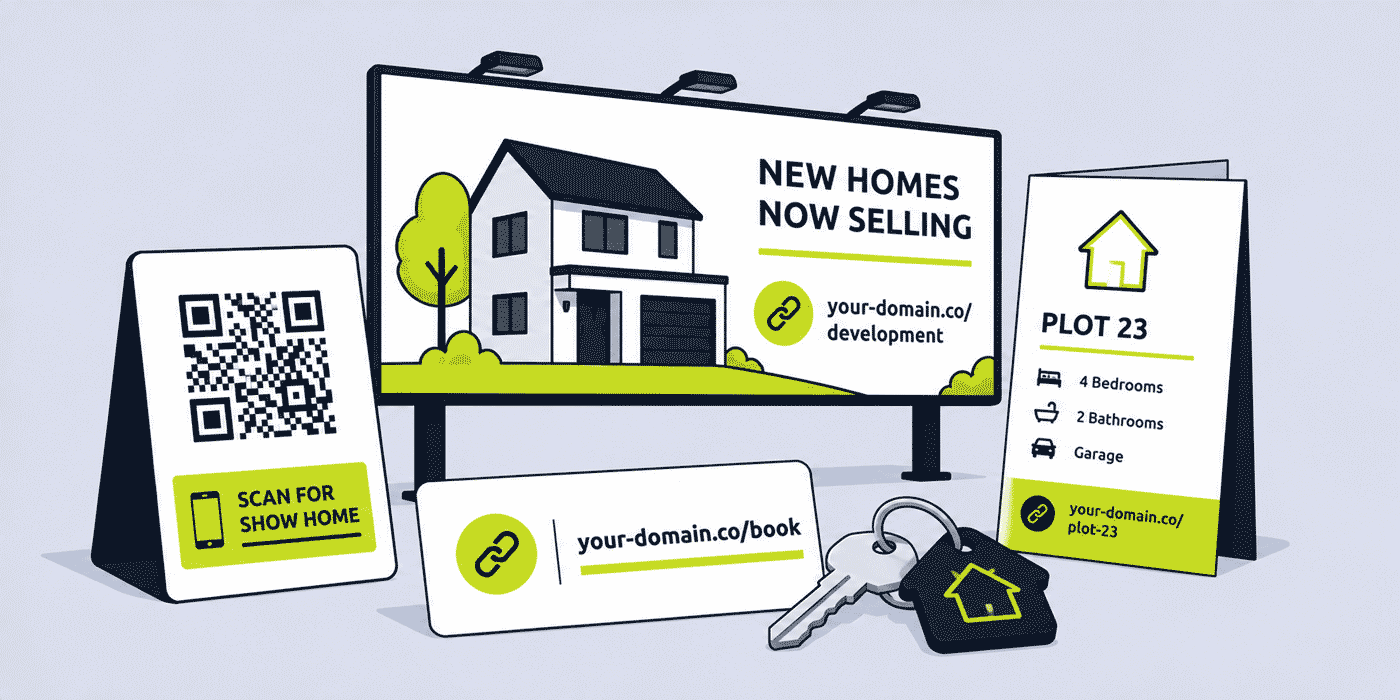
What This Guide Covers
- Why residential development creates link management challenges that differ from almost every other property sector
- Site hoarding QR Codes — the definitive case for dynamic links in physical site marketing
- Plot-specific links and the development lifecycle link model
- Show home environments — room specification QR Codes and buyer information displays
- Buyer registration and reservation portal links
- Help to Buy, shared ownership and government scheme links
- Per-channel buyer registration attribution — understanding where registrations actually come from
- Estate agent and IFA referral links
- Investor and buy-to-let buyer communications
- Multi-development portfolio link organization
- Post-completion handover and aftercare links
- A worked example: a regional developer's link stack across a 120-plot scheme
- Common mistakes with housebuilder site marketing links
- A Cuttly plan guide for housebuilders and residential developers
- Frequently asked questions
Why Residential Development Has Unique Link Management Challenges
New-build residential development sits at the intersection of three domains — construction, property marketing, and consumer sales — each of which has its own timeline and its own relationship to digital content. Construction timelines are measured in years. Property marketing cycles last months to years per development. Consumer purchase decisions, particularly for first-time buyers, involve research periods of six to eighteen months before reservation. The result is a sales and marketing programme that runs for significantly longer than the typical campaign lifecycle of any digital marketing tool, and that involves physical marketing installations — site hoardings, show home displays, site signage — that are installed once and then need to serve the development for its entire duration.
The practical consequence is that a housebuilder who installs a site hoarding without considering the full lifecycle of the QR Code or URL on that hoarding is creating a future problem at the moment of installation. A hoarding installed at site start, when planning permission has just been granted and the development's website page is at its most basic, will still be standing when the last few plots are selling two or three years later. The URL on that hoarding needs to serve all of these moments appropriately.
The second specific challenge is the complexity of the buyer journey. A new-build buyer typically goes through: initial discovery of the development (often through a portal listing, a hoarding, or a social media campaign), registration to receive updates, attendance at a show home launch event or private appointment, reservation of a specific plot, exchange of contracts, and legal completion. Each stage of this journey has different digital content requirements, and the links that a buyer accesses at each stage need to reflect where they are in the process.
The third challenge is the policy and scheme complexity that surrounds new-build sales. Help to Buy, shared ownership, First Homes, deposit contribution schemes, part exchange programmes and developer-specific financial incentives all have their own information pages, eligibility criteria, application processes and government portal links. These scheme structures change with policy updates, often with minimal notice to developers, and any printed or digital material referencing a specific scheme URL may need updating at short notice.
Dynamic short links address all three of these challenges simultaneously: they provide stability for physical installations, lifecycle flexibility for changing content, and update resilience for scheme and policy links. The investment in setting up a well-structured link management approach at the start of a development programme pays dividends across the full duration of the scheme.
Site Hoarding QR Codes: The Definitive Case for Dynamic Links
If there is one single piece of link management advice that every housebuilder should act on before any other, it is this: never install a site hoarding QR Code that encodes a destination URL directly. Always generate the QR Code from a dynamic short link.
The reason is straightforward. A site hoarding for a residential development is physically installed at or shortly after ground-breaking, and it typically remains in place until the development is substantially complete and the last occupier has moved in — a period of two to five years for most medium-scale schemes. During this period, the development's website, its planning status, its available plots, its pricing, and its sales programme will change substantially, probably multiple times. The digital content that a hoarding QR Code should point to changes at every major milestone: from planning consent to groundworks, from groundworks to show home launch, from show home launch to first completions, from first completions to final few remaining plots.
The Site Hoarding Link Lifecycle
A well-managed site hoarding link is updated at each of the following milestones, using the same short link and QR Code throughout:
- Planning and pre-launch: points to a "coming soon" or "register your interest" page capturing early buyer registrations before any plot details are public. Prospective buyers who pass the site can register to receive launch updates months before the development formally goes on sale.
- Phase one launch: points to the development's main sales page showing available plots, plot types, prices and the show home appointment booking form.
- Active sales programme: continues to point to the main sales page, which is updated by the sales team as plots sell and become reserved. The QR Code destination does not need to change; the destination page itself is kept current.
- Later phases or re-releases: if a development is phased, the short link destination can be updated to emphasize available plots in the current phase rather than the full development overview.
- Final plots: the destination is updated to emphasize the remaining plot urgency, or to a "final opportunities" campaign page if the developer is running one.
- Sold out: the destination redirects to a "this development is now fully reserved" page with links to the developer's other nearby or future schemes.
All of these updates require nothing more than changing the destination URL in the link management dashboard. The physical QR Code on the hoarding never changes. The print and installation cost is incurred once. The developer's ability to serve appropriate digital content at each stage of the development is preserved for the full duration.
Per-Panel QR Code Tracking
For larger development sites where hoardings run along multiple road frontages, or where a developer is considering the relative effectiveness of different hoarding panel locations, separate short links per panel location — your-developer.com/dev-name-north-panel, your-developer.com/dev-name-main-road — provide per-location click analytics. Comparing QR Code scans per panel over time gives the developer's marketing team a sense of which site frontage generates the most pedestrian and driver interest, which can inform decisions about where to invest in more prominent hoarding graphics at future schemes.
Plot-Specific Links and the Development Lifecycle Link Model
For developments with a significant number of plots, a plot-level link structure gives both the sales team and prospective buyers a direct link to a specific home's details page. A buyer who has viewed the show home and is deciding between plot 14 (a corner plot with a larger garden) and plot 22 (a mid-terrace with a south-facing rear garden) should be able to access each plot's specific details, floor plan, dimensions, and availability status through a clear, shareable link.
Plot-Level Link Structure
A consistent plot-level link convention for a 120-plot development might look like: your-developer.com/dev-name-plot-14, your-developer.com/dev-name-plot-22. These links are shared by sales consultants in email correspondence with interested buyers, included in printed plot-specific information sheets given at show home visits, and linked from the development's plot availability page.
Because each plot's status changes as the sales programme progresses — from available, to reserved, to exchanged, to completed — a dynamic plot link allows the destination page to be updated to reflect current status. A prospective buyer who received a link to plot 14 six months ago and returns to it finds the current status, not the status as it was when the link was shared.
For developments where plot links are created and managed at scale as part of a CRM or sales management workflow, the Cuttly API allows plot links to be generated automatically when plots are created in the sales system, eliminating the manual step of creating a short link per plot for large-scale schemes.
Show Home Environments: QR Codes and Buyer Information Displays
The show home is the highest-investment, highest-stakes marketing environment in new-build residential development. A developer who has invested in furnishing, dressing and staffing a show home wants every visitor to leave with the most complete and accurate picture possible of what they would be buying. QR Codes and short links throughout the show home environment significantly improve this information delivery without increasing the staffing burden on the sales team.
Room Specification QR Codes
Every room in a show home has a specification: the kitchen units are from a specific manufacturer and range, the worktops are a specific material, the flooring is a named product, the bathroom sanitary ware is a specific brand and model. A buyer who wants to know exactly what they are getting needs this specification, but a sales consultant cannot memorise and recite the full specification for every room simultaneously during a busy show home launch weekend.
A QR Code on a small, branded information card in each room — generated from a dynamic short link pointing to the room specification PDF or page — gives every visitor access to the complete specification at the moment they are standing in that space. A buyer standing in the kitchen, considering whether the standard specification meets their requirements or whether they want to upgrade, can scan the QR Code and access the full kitchen specification, the upgrade options available, and the price differences, without waiting for a sales consultant to be free.
When specifications change — as often happens during a development programme when a specified product becomes discontinued and a substituted product is used instead — the short link destination is updated and all existing room information cards point to the current specification automatically. This is particularly important for specification changes that occur after the show home has opened and information cards have been printed and placed.
Development and Development-Wide Information QR Codes
Beyond room-specific information, the show home environment typically needs to provide buyers with development-wide information: the site plan showing all plots and their positions, the development timeline and current build programme, transport links and amenities, school catchment information, planning conditions and S106 contributions, and any development-specific covenants or restrictions.
A QR Code at the entrance or in the sales office area of the show home — linked through your-developer.com/dev-name-info — giving access to a development information hub is more effective than a printed folder that gets out of date as the build programme progresses, and more reliable than relying on a sales consultant to answer every question from memory. Buyers who visit the show home multiple times before reserving — as many do — can re-access the same information hub between visits without contacting the sales team, which reduces the burden on the sales office while keeping the buyer engaged with the development between appointments.
Buyer Registration and Reservation Portal Links
The buyer registration form and reservation portal are the two most commercially critical links in any new-build development's digital presence. Registration captures early buyer interest before plots are on sale; reservation converts registered interest into a committed purchase. Both need to be accessible, professional, and stable across the full duration of the sales programme.
Interest Registration Links
A branded registration link — your-developer.com/dev-name-register — is the CTA used in every piece of development marketing before launch: site hoarding, press advertising, social media posts, portal listings, and email campaigns. This link appears months before any plot details are available, capturing prospective buyers who want to be first in the queue when the development launches.
Because the registration link may be in active use for six to twelve months before the development formally launches, it needs to remain stable and consistently directed to the current registration form throughout this period. If the developer changes their CRM platform or restructures their website during the pre-launch period — both common occurrences in a multi-year development programme — only the short link destination needs to be updated. Every piece of previously distributed marketing material continues to work.
Reservation Portal Links
Once a buyer has decided to reserve a specific plot, the reservation process — paying a reservation fee, completing a reservation form, receiving the reservation agreement — typically moves to a dedicated reservation portal or involves specific documentation. A short link for the reservation process — your-developer.com/reserve — included in the sales consultant's follow-up email after a show home visit is more professional than a raw portal URL, and allows the developer to guide buyers through the current reservation process even if the underlying portal changes during the development programme.
Help to Buy, Shared Ownership and Government Scheme Links
Government-backed purchase assistance schemes are a critical part of the new-build market. Help to Buy, shared ownership, First Homes, deposit unlock, and other schemes each have their own eligibility criteria, application processes and information resources, and many have their own government or housing association portals that buyers need to access as part of their purchase.
These schemes present a particular link management challenge because government policy changes — scheme closures, eligibility changes, portal restructurings, and the introduction of new schemes — frequently invalidate the specific URLs that developers have used in their marketing materials. A brochure printed with a specific government Help to Buy portal URL is accurate on the day it is printed and may be inaccurate within six months if the portal is restructured.
Per-Scheme Short Links
A short link for each scheme the developer offers — your-developer.com/help-to-buy, your-developer.com/shared-ownership, your-developer.com/first-homes — pointing to the developer's own scheme information page (rather than directly to a government portal) gives the developer control over both the information buyers receive and the link stability. When a government portal URL changes, or when a scheme's terms are updated, the developer's own information page is updated and the short link continues to point to accurate, current information.
For developments that offer multiple schemes, scheme-specific information pages accessible through short links also give the sales and marketing team click analytics showing which schemes prospective buyers are most interested in researching. If a significant proportion of clicks are going to the shared ownership information page rather than the Help to Buy page, the sales team can ensure they prioritize shared ownership scheme knowledge and ensure the show home launch event includes appropriate shared ownership materials.
Per-Channel Buyer Registration Attribution
New-build developers typically run simultaneous multi-channel marketing campaigns across property portals, social media, paid search, email marketing, local press, outdoor advertising and site-level marketing. Understanding which of these channels actually drives buyer registrations — rather than which drives impressions or portal views — is one of the most commercially significant data questions in residential development marketing.
Portal analytics (Rightmove, Zoopla, OnTheMarket) report views and enquiries per listing on their own platforms. Social media analytics report reach, engagement and link clicks within their platforms. Email analytics report opens and clicks within the email. None of these platforms can report how much of the total traffic to the developer's registration page or reservation portal actually comes from their specific channel, because that traffic often enters the developer's own site through a different path after a multi-touch buyer journey.
Per-Channel Registration Link Structure
Creating a separate short link per channel for the registration or reservation page — each pointing to the same destination — gives the development marketing team independent click analytics per channel:
your-developer.com/dev-name-register-rm— Rightmove listingyour-developer.com/dev-name-register-z— Zoopla listingyour-developer.com/dev-name-register-ig— Instagram campaign postsyour-developer.com/dev-name-register-fb— Facebook campaign postsyour-developer.com/dev-name-register-email— email campaignyour-developer.com/dev-name-register-press— local press advertisingyour-developer.com/dev-name-register-hoarding— site hoarding QR Code
Click analytics per channel, aggregated and anonymized, show which channel drives the most traffic to the registration page. Comparing these totals over the pre-launch and launch period gives the marketing team a channel attribution picture that informs budget allocation for subsequent phases or future developments.
For a developer who has been spending equal amounts on Rightmove and Zoopla for several years without any visibility into which portal generates more qualified buyer interest, this per-portal click data is directly actionable. A consistent finding that Zoopla drives 30% more registration page traffic per pound of portal advertising spend than Rightmove, across three consecutive development launches, is a strong evidence base for rebalancing portal advertising spend.
Estate Agent and IFA Referral Links
Many housebuilders work with estate agency referral networks and independent financial advisors (IFAs) or mortgage brokers who refer buyers to their developments as part of a buyer's new-build property search. Managing these relationships through a per-partner referral link structure allows the developer to see which referral partners are actively sending buyers to their developments, independent of how many referrals ultimately convert to reservations.
A short link per referral partner — your-developer.com/dev-name-ref-agentname — pointing to the development registration or sales page gives the developer click analytics per referral partner. Partners who are actively promoting the development to their buyer clients will generate regular clicks on their referral link; partners who have agreed to refer buyers but are not actively doing so will show minimal click activity. This data gives the developer's land and partnerships team a performance picture of each referral relationship, independent of conversion data, which helps prioritize which partners to invest more time in cultivating.
Investor and Buy-to-Let Buyer Communications
Many residential developments, particularly apartments and city-centre schemes, attract a significant proportion of investor buyers rather than owner-occupiers. These buyers have different information needs — rental yield projections, comparable rental market data, property management options, investor pack details — and typically access the development through different channels from owner-occupier buyers, often through property investment platforms, IFA contacts, or dedicated investor events.
A dedicated investor information link — your-developer.com/dev-name-investor — pointing to an investor-specific information page or pack, separate from the general buyer registration page, serves this audience more effectively than a generic development page that emphasizes features more relevant to an owner-occupier. Click analytics for the investor link versus the owner-occupier registration link give the sales team a picture of the buyer mix for each development, which has implications for pricing strategy, payment schedule options, and the balance of investor versus owner-occupier marketing investment.
Multi-Development Portfolio Link Organization
A regional or national housebuilder running multiple developments simultaneously faces a link management challenge at portfolio scale. With five, ten, or fifty active development schemes each requiring their own registration links, plot links, scheme links, referral links and show home links, an unstructured approach to link management rapidly becomes unmanageable.
The solution is a consistent development-code or development-name based naming convention applied uniformly across all schemes from the moment each development is set up in the link management dashboard:
your-developer.com/{dev-name}— main development pageyour-developer.com/{dev-name}-register— buyer registrationyour-developer.com/{dev-name}-plots— available plotsyour-developer.com/{dev-name}-show— show home bookingyour-developer.com/{dev-name}-info— development information hubyour-developer.com/{dev-name}-hoarding— site hoarding QR Code
This pattern, applied consistently across every scheme, means that any team member can construct or find the right link for any development without needing to search through a disordered link library. It also makes it straightforward to compare how different developments are performing in terms of digital buyer engagement — by comparing registration link click volumes per development over equivalent periods of their respective sales programmes.
Post-Completion Handover and Aftercare Links
The relationship between a housebuilder and a buyer does not end at legal completion. Post-completion — the period during which the buyer moves in, discovers any snagging issues, and begins the process of raising warranty claims if defects emerge — is a critical phase for buyer satisfaction and for the developer's reputation for aftercare. Links to the snagging and defect reporting portal, the NHBC or equivalent warranty information, the aftercare team contact page, and the homeowner manual are all part of the post-completion communication package that every buyer receives.
A short link for each post-completion resource — your-developer.com/my-home-aftercare, your-developer.com/report-snag, your-developer.com/warranty-info — included in the completion documentation pack gives new homeowners a stable, branded digital access point for these resources. Because homeowners may access aftercare resources at any point in the two-year builder's warranty period, these links need to remain functional and correctly directed for at least two years after the last completion on the scheme. A dynamic short link ensures this stability regardless of any changes to the developer's aftercare management systems during this period.
A Worked Example: A Regional Developer's 120-Plot Scheme
Consider a regional housebuilder launching a 120-plot mixed-tenure residential scheme, using a branded domain such as your-developer.com, connected through Cuttly's custom domain setup (an A record and a TXT record — see the custom domain setup guide).
Month 0 — Planning consent granted: Site hoarding goes up on the main road frontage. The QR Code panel on the hoarding uses /dev-name-hoarding, pointing to a "register your interest" page. The developer knows this code will be on the hoarding for the next 24 months. A second entrance hoarding panel uses /dev-name-hoarding-side to track that entrance separately.
Month 6 — Pre-launch marketing begins: Rightmove and Zoopla listings go live. Portal enquiry links use /dev-name-register-rm and /dev-name-register-z separately. Email campaign to a regional buyer database uses /dev-name-register-email. Social media posts use /dev-name-register-social. Within the first month, click analytics show Rightmove driving 3.4x more registration page traffic than Zoopla per £1,000 of portal spend for this scheme — the opposite of the previous scheme's pattern, which the team investigates and attributes to a higher proportion of first-time buyers in this catchment who use Rightmove more actively.
Month 9 — Show home opens: QR Codes are installed in the kitchen, bathroom, living room and master bedroom, each linked to the relevant room specification document. The show home entrance carry panel links to the development information hub at /dev-name-info. Help to Buy and shared ownership information cards link through /dev-name-htb and /dev-name-so. Six weeks after opening, the kitchen specification QR Code shows 340 scans, while the bathroom QR Code shows 180 — data the sales team uses to inform which specification upgrade options to present first in buyer consultations.
Month 14 — Phase one sold out, phase two launches: The hoarding QR Code destination is updated to emphasize phase two available plots. The Rightmove listing is updated to show phase two only; the portal link still uses the same /dev-name-register-rm short link. No physical changes needed anywhere.
Month 22 — Help to Buy scheme terms change: The government updates the scheme portal URL. The developer's own /dev-name-htb page is updated to reflect the new terms; the short link destination is verified. All existing printed materials referring to /dev-name-htb continue to direct buyers to accurate current information without any reprint.
Month 26 — Final 12 plots remaining: Hoarding QR Code destination updated to a "final homes remaining" campaign page. Post-completion aftercare links go live in the completion documentation pack for early buyers. Aftercare portal link /dev-name-aftercare is set up and remains active for the two-year warranty period.
Choosing Between Generic Short Links and a Branded Developer Domain
For a housebuilder or residential developer, a branded custom domain for all development links is not a preference but a professional standard. A link reading your-developer.com/dev-name communicates the developer's brand identity at every touchpoint: on a site hoarding visible to thousands of commuters daily, in an email to a prospective buyer who is making one of the largest purchase decisions of their life, and in a show home information card that will be read by every person who visits. The alternative — a generic short link from an unbranded shortener domain — communicates nothing about the developer's identity and adds no value to what is already one of the most trust-sensitive marketing environments in any consumer sector.
Setting up a branded custom domain requires an A record and a TXT record configured at the domain registrar — a one-time technical step that takes between fifteen minutes and one hour depending on the registrar and the developer's internal IT or website management arrangements. Once configured, the same branded domain serves every development in the portfolio indefinitely.
Common Mistakes With Housebuilder Site Marketing Links
Encoding Destination URLs Directly in Site Hoarding QR Codes
This is the most common and most costly mistake in new-build development digital marketing. A site hoarding contractor who generates a QR Code from a URL using a free static QR Code tool is creating a permanent liability for the developer: the moment that URL changes, the QR Code on the hoarding fails, and the only way to fix it is to physically replace the QR Code panel. On a development where the hoarding runs for two or three years and the website is restructured at least once in that period, this is not a theoretical risk but a near-certain operational problem. The cost of a dynamic short link is negligible compared with the cost of a QR Code panel replacement, let alone the reputational cost of a broken hoarding QR Code on a busy road frontage.
No Per-Channel Attribution for Launch Campaigns
A developer who uses the same registration link in their Rightmove listing, their email campaign, their social media posts, and their site hoarding cannot tell which channel drove the pre-launch registrations that determined how strong their launch day demand was. This is not a minor gap: understanding which channels are building buyer registrations months before a development launches is one of the most actionable insights a developer's marketing team can have, because it directly informs where to invest the marketing budget in the critical pre-launch period of subsequent phases or future schemes.
Government Scheme URLs Hardcoded in Printed Brochures
A development brochure that includes the URL of a government Help to Buy portal directly in the printed text is accurate when printed and potentially inaccurate within a policy cycle. Brochures are expensive to produce and are not reprinted at every policy update. A short link for the scheme information page, controlled by the developer, means the destination can be updated when government portals change without invalidating any printed brochures still in circulation.
No Post-Completion Link Strategy
Many housebuilders invest heavily in pre-launch and launch marketing links and then give little thought to post-completion aftercare links. A homeowner who cannot find their warranty information, cannot remember how to report a snagging issue, or cannot access the developer's aftercare team six months after moving in has a negative experience that generates a negative review. A well-structured aftercare link set, provided in the completion documentation pack and stable for at least the duration of the warranty period, is one of the simplest ways to improve the post-completion buyer experience.
Seasonal and Programme Patterns in Residential Development Marketing
New-build residential marketing follows a predictable annual pattern alongside its development-specific lifecycle. Spring — from February to June — is consistently the highest-traffic period for new-build buyer registrations, driven by buyers who want to move before the summer or before the new school year. Autumn — September and October — is a secondary peak. December and January are typically lower-activity periods for buyer-facing marketing, though they are often used for development programme planning and pre-launch preparation for the following spring.
A developer who sets up their development's registration links and per-channel attribution structure well before the spring window — ideally by January at the latest — ensures that when buyer activity peaks in February and March, every piece of marketing activity is fully trackable from day one. The registration data accumulated in the early weeks of a spring campaign is often the strongest predictor of launch-day demand, and per-channel attribution data from the pre-launch period is the most useful input to the channel budget allocation decisions that determine how much is spent on portal advertising, social media, local press and site marketing for the launch itself.
Feature Priority for Housebuilders and Residential Developers
| Feature | Primary Use Case | Priority for Housebuilders |
|---|---|---|
| Dynamic QR Codes | Site hoardings, show home displays, brochures, site signage | High — critical for physical installations |
| Branded custom domain | All external buyer and partner communications | High — trust and professionalism in high-value purchase context |
| Click analytics | Per-channel buyer registration attribution, portal performance comparison | High — informs multi-channel marketing budget allocation |
| Multiple custom aliases | Per-development, per-channel, per-plot, per-scheme link structure | High — link library organization at portfolio scale |
| Customized QR Codes | Branded QR Codes matching development branding on hoardings and brochures | Medium-high — professional presentation in high-visibility placements |
| API access | Automated plot-level link generation for large schemes | Medium — relevant for volume builders and large schemes |
| Multiple branded domains | Different development brands, regional operations, affordable housing arm | Medium — relevant for multi-brand developers |
| Campaign tag analytics | Aggregated launch campaign reporting across all channels | Medium — useful for marketing teams with formal campaign reporting |
Cuttly Plan Guide for Housebuilders and Residential Developers
The right plan for a residential developer depends primarily on the number of active developments, whether customized branded QR Codes are needed for professional hoarding and show home displays, and whether the developer needs API access for automated plot-level link generation at scale.
- The Free plan ($0) provides 30 short links per month, one branded custom domain, full click analytics and dynamic QR Codes, with no credit card required. Suitable for a small developer with one or two active schemes setting up core hoarding, registration and scheme links.
- The Starter plan ($12/month) adds 300 short links per month and 30 custom aliases per month — practical for a regional developer running two or three active schemes simultaneously with per-development, per-channel and per-plot link structures.
- The Single plan ($25/month) adds up to 5 branded domains, fully customizable QR Codes with developer logo and development-specific branding for professional hoarding and show home displays, 1,000 API-created links per month for automated plot link generation, and a full year of analytics history for launch campaign attribution analysis — the most relevant tier for most mid-size regional housebuilders.
- The Team plan ($99/month) suits larger regional and national developers with sales, marketing, land and aftercare teams sharing link management, multiple branded domains for different development brands or regional operations, Campaign tag analytics for aggregated multi-scheme launch campaign reporting, and shared workspaces for teams across different office locations or development regions.
- The Enterprise plan ($149/month) is for large volume housebuilders managing high-volume API-generated plot links across a large portfolio of simultaneously active schemes, multiple branded domains for different trading names, and enterprise-level link management across distributed sales and marketing teams.
Create a free Cuttly account to set up your first development's hoarding link, registration link and show home information QR Code. Registration is required for all plans, including free. No credit card is needed for the free plan.
Frequently Asked Questions
How do housebuilders use QR Codes on site hoardings?
A housebuilder installs QR Codes on site hoarding panels generated from dynamic short links rather than encoding destination URLs directly. The QR Code destination progresses through the development's lifecycle: from a registration page before launch, to the main sales page at launch, to available plot information as sales progress, and eventually to a sold-out or nearby schemes page. The physical hoarding remains unchanged while the digital content behind it stays current throughout the entire build and sales programme, which typically runs for two to five years.
How do residential developers track which marketing channels generate the most buyer registrations?
A residential developer creates a separate short link per marketing channel pointing to the registration page — your-developer.com/dev-name-register-rm for Rightmove, your-developer.com/dev-name-register-email for email campaigns, your-developer.com/dev-name-register-hoarding for the site hoarding QR Code. Click analytics per channel show which source drives the most traffic to the registration page, giving the marketing team channel attribution data independent of what each portal or platform reports internally.
How do housebuilders use short links for Help to Buy and shared ownership schemes?
A housebuilder creates dedicated short links for each scheme's information page — your-developer.com/help-to-buy, your-developer.com/shared-ownership. When government portal URLs change with policy updates, the developer's own information page is updated and the short link continues to direct buyers to accurate current information, without invalidating any printed brochures or marketing materials that reference the scheme.
Can housebuilders use QR Codes in show home environments?
Yes. QR Codes on room specification boards in show homes give visitors access to complete room specifications at the moment they are standing in that space. Because the QR Code is dynamic, the specification destination can be updated when specifications change during the development programme without replacing any printed room cards or information boards.
How do residential developers manage links across multiple developments simultaneously?
A developer running multiple schemes uses a consistent naming convention organized by development name — your-developer.com/dev-name, your-developer.com/dev-name-register, your-developer.com/dev-name-plots — applied uniformly across every development from the start of each scheme. This keeps the link library navigable at portfolio scale and allows direct comparison of how different developments are performing in terms of digital buyer engagement.
How long do housebuilder site hoarding QR Codes remain in use?
A site hoarding for a medium-scale residential development is typically in place for between two and five years. A QR Code on a site hoarding installed at the start of this period needs to remain functional and relevant throughout — pointing to different content at different stages of the development programme. Dynamic short links make this possible: the physical installation is unchanged but the digital content behind it can be updated in seconds at any point during the development's lifecycle.
What is the best URL shortener for a housebuilder or residential developer?
The best URL shortener for a housebuilder or residential developer combines a branded custom domain reflecting the developer's identity, dynamic QR Codes for site hoardings and show home environments, per-development and per-channel link tracking for buyer registration attribution, and a link library organized around the development portfolio. Cuttly provides all of these, with the Single plan at $25 per month covering most mid-size developer requirements including customized QR Codes and up to five branded domains.
- Get Started
- Create Free Account
- Plans & Pricing
- Platform Tools
- URL Shortener
- Link Analytics
- QR Code Generator
- Campaign Analytics
- Related Guides
- URL Shortener for Commercial Real Estate
- URL Shortener for Real Estate
- URL Shortener for Real Estate Agents
- URL Shortener for Construction & Property Development
- Short Links for Offline Campaigns
- URL Shortener for PDF Sharing
- Encyclopedia
- Branded Links
- Dynamic QR Codes
- Setup Guides
- Custom Domain Setup
- Track Link Clicks
- API Documentation
- Industry Hub
- Real Estate, Architecture & Construction
- All Industries →
URL Shortener
Cuttly simplifies link management by offering a user-friendly URL shortener that includes branded short links. Boost your brand’s growth with short, memorable, and engaging links, while seamlessly managing and tracking your links using Cuttly's versatile platform. Generate branded short links, create customizable QR codes, build link-in-bio pages, and run interactive surveys—all in one place.
Cuttly - Consistently Rated
Among Top URL Shorteners
Cuttly isn’t just another URL shortener. Our platform is trusted and recognized by top industry players like G2 and SaaSworthy. We're proud to be consistently rated as a High Performer in URL Shortening and Link Management, ensuring that our users get reliable, innovative, and high-performing tools.C


