URL Shortener for Chiropractors The Complete Guide
Chiropractic practices grow through three primary channels: Google search and Google Reviews, patient referrals, and local community presence. All three depend on digital touchpoints that most practices manage inconsistently — a Google Business Profile that hasn't been updated in months, a referral card with the practice's website URL that takes four clicks to find the booking page, a social media profile with a homepage link instead of a direct appointment booking path. The patients are there — back pain affects over 80% of adults at some point, and chiropractic care is increasingly the first choice over medication for many musculoskeletal conditions. The gap is not in demand; it is in the quality of the digital path from "I need a chiropractor" to "I have booked an appointment."
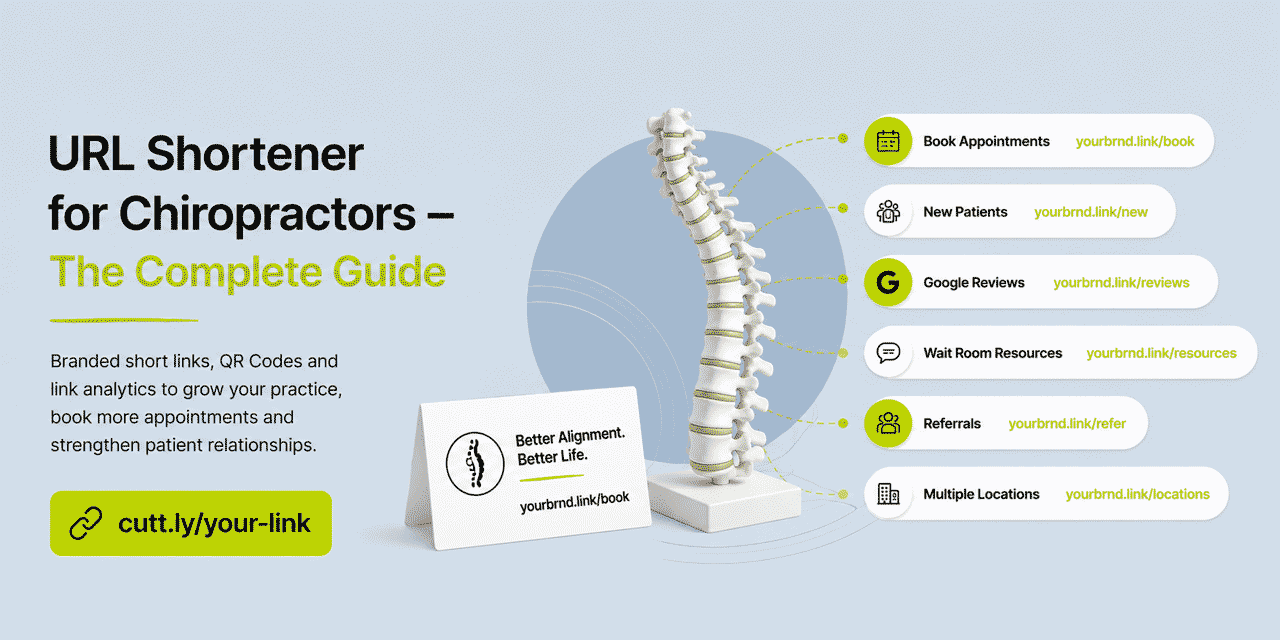
This guide covers the complete link strategy for chiropractic practices — from new patient booking links through Google Review generation, waiting room QR Code infrastructure, appointment reminder SMS, referral programme management, social media strategy and per-channel attribution. For closely related contexts see also URL Shortener for Healthcare and Wellness and URL Shortener for Dental Practices.
What This Guide Covers
- Why link quality matters in chiropractic patient acquisition
- Core standing links every chiropractic practice needs
- Choosing a branded domain for a chiropractic practice
- New patient booking links — removing acquisition friction
- Google Reviews — the most commercially important link in chiropractic
- Waiting room QR Codes — educational resources and intake forms
- Treatment room and post-adjustment QR Codes
- Appointment reminder SMS with branded links
- Referral programme links
- Business cards with QR Codes
- Instagram and Facebook for chiropractors
- Educational content links — condition guides and resources
- Corporate wellness and employer links
- Community outreach and local event links
- Email newsletters for chiropractic patients
- Per-channel attribution — tracking what drives new patients
- Multi-location chiropractic group management
- GDPR and data considerations for healthcare link analytics
- Cuttly plan guide for chiropractors
Why Link Quality Matters in Chiropractic Patient Acquisition
Chiropractic patient acquisition has a specific conversion dynamic that differs from most service businesses. A person with back pain or a musculoskeletal complaint typically reaches the point of deciding to book a chiropractor after weeks or months of considering it. When that decision point arrives, they want to book quickly — while the motivation is at its peak — before life gets in the way and the appointment gets deferred again.
If the path from "I'm going to book a chiropractor" to a confirmed appointment involves more than three steps — finding the practice's website, navigating to the booking page, selecting a time — a meaningful proportion of motivated potential patients abandon the process. Research in healthcare conversion contexts consistently shows that friction in the booking journey is one of the primary causes of appointment abandonment even among patients who are genuinely ready to proceed.
A branded short link — yourpractice.link/book on a business card, in a Google Business Profile, in a SMS from a friend recommending the practice, or on a referral card given by an existing patient — creates a one-step path from intent to booking. The patient sees the link, taps it, and lands directly on the appointment booking page. That reduction in friction, replicated across every channel where a potential patient might encounter the practice, produces a measurable improvement in new patient conversion rates without any additional marketing spend.
Core Standing Links Every Chiropractic Practice Needs
Establish these permanent branded short links before building campaign-specific or per-channel tracking links:
| Link | Destination | Primary deployments |
|---|---|---|
yourpractice.link/book | Appointment booking page | All channels — window, bio, business card, SMS |
yourpractice.link/new-patient | New patient consultation booking or intake form | Referral cards, social media, Google profile |
yourpractice.link/review | Google Review form | Waiting room, treatment room, post-visit SMS, email |
yourpractice.link/refer | Referral programme page | Referral cards, waiting room display, email |
yourpractice.link/resources | Patient educational resource library | Waiting room QR Codes, post-visit email, social media |
All five links are dynamic. When the practice changes booking platforms — from Jane App to Cliniko, from a manual phone-only system to an online booking tool, from one CRM to another — one destination update per link in Cuttly propagates across every window sticker, business card, referral card, waiting room QR Code and social media post that references the link. For a chiropractic practice that distributes business cards in batches and maintains waiting room materials for months at a time, this platform-agnostic resilience is operationally significant.
Choosing a Branded Domain for a Chiropractic Practice
The branded domain for a chiropractic practice's short links should feel professional, health-associated and clearly linked to the practice name. It appears on business cards, in SMS messages to patients and in any printed materials — it needs to pass the immediate trust threshold of a healthcare context.
- "Align Chiropractic" →
alignchiro.linkoralignchiropractic.link - "Riverside Spine & Wellness" →
riversinespine.link - Dr. Sarah Chen's practice →
drchen.linkorchenchiro.link - "Peak Performance Chiropractic" →
peakchiro.link book.yourpracticename.com— a subdomain of the practice's existing website
The .link TLD is available for most chiropractic practice names and costs around $6–$12 per year. A subdomain of the practice's existing website domain is an equally strong option — it carries the existing domain's authority and recognition. Connect to Cuttly via DNS configuration in under fifteen minutes — full guide at Cuttly Branded Domains.
New Patient Booking Links — Removing Acquisition Friction
The new patient booking link is the most commercially important link a chiropractic practice creates. It is the bridge between a potential patient's decision to seek chiropractic care and a confirmed first appointment — and every obstacle on that bridge reduces the conversion rate.
yourpractice.link/new-patient should land on a page that makes a first-time booking as simple as possible: a clear explanation of what the first consultation includes (examination, history, any imaging required), a real-time availability selector, minimal required information (name, phone number, insurance information if applicable), and immediate confirmation. For practices that require a new patient intake form before the appointment, the intake form should be accessible immediately from the booking confirmation — not sent as a separate email days later when motivation may have faded.
Where to deploy the new patient booking link:
- Practice window: "New patient appointments available — book here: yourpractice.link/new-patient" with QR Code and text
- Google Business Profile: Set as the primary booking URL in the profile — this is where most new patients who search for "chiropractor near me" will be directed
- Instagram and Facebook bio: First button on the Link in Bio page
- Business card back: QR Code linking directly to new patient booking
- Referral cards: Given to existing patients to share with friends and family
- Any SMS or email from the practice referencing new patient booking
- Corporate wellness materials: If the practice offers corporate accounts, the new patient link is the entry point for employees
The dynamic link advantage: if the practice migrates from one booking platform to another, the link destination updates once in Cuttly. All business cards distributed over the past two years, all referral cards in circulation, all social media posts that reference the link, all SMS messages ever sent containing the link continue redirecting to the new booking platform immediately. No reprint, no re-communication to referring patients.
Google Reviews — The Most Commercially Important Link in Chiropractic
Google Reviews are the single most commercially significant digital asset for most chiropractic practices. When a person with back pain or a musculoskeletal complaint searches "chiropractor near me," the Google Maps results show practice name, distance, star rating and review count — all before the person visits a single website. The practice with 120 reviews at 4.9 stars is chosen over the competitor with 18 reviews at 5.0 stars in virtually every case, because 120 reviews provides a track record that 18 cannot, regardless of the marginally higher average rating.
Healthcare Google Reviews have particular significance. Patients choosing a healthcare provider are making a trust decision more significant than choosing a restaurant or a coffee shop. A chiropractic practice with many detailed, positive reviews — describing specific conditions that were helped, specific chiropractors by name, specific treatment approaches — provides the social proof that a new patient needs to make a high-trust healthcare decision with confidence.
The Chiropractic Practice Review System
Create yourpractice.link/review pointing directly to the Google Review form (found in Google Business Profile under "Get more reviews"). Deploy consistently across five touchpoints:
- Waiting room display. A framed card or small display with the review QR Code and a warm, personal message — "If your treatment has made a difference, sharing your experience helps others find the care they need: yourpractice.link/review." Positioned at eye level in the waiting room where patients spend 5–15 minutes before their appointment.
- Treatment room post-adjustment. After an adjustment, while the patient is resting on the table or in the recovery position, a card visible from the treatment table — "How are you feeling? If today's adjustment was helpful, a Google review means a great deal to our practice." The immediate post-adjustment moment is peak patient satisfaction — the relief or improvement is fresh and the positive feeling toward the chiropractor is at its highest.
- Post-appointment SMS (sent the morning after the appointment): "We hope you are feeling the benefit of yesterday's adjustment. If you would be willing to share your experience, a Google review helps other patients find us: yourpractice.link/review"
- Post-appointment email (for practices with email in the patient communication workflow): includes the review link alongside the next appointment reminder and any post-adjustment care advice.
- Referral card. When a satisfied patient takes a referral card to share with someone they are recommending the practice to, the referral card should also include the review link — "While you are here, a Google review would mean a lot to us."
Chiropractic practices deploying all five touchpoints consistently generate 10–20 new Google Reviews per month from a typical patient volume. At that rate, a practice with 30 reviews at the start of a 12-month programme has 150–270 reviews by year end — a transformation in its local search visibility and new patient acquisition from Google.
Review Content and Healthcare Trust
Chiropractic reviews that mention specific conditions ("my chronic lower back pain has significantly improved"), specific practitioners ("Dr. Chen took the time to explain exactly what she found and why she recommended the treatment plan"), specific treatment approaches ("the spinal decompression has been life-changing") and specific outcomes ("I can now sit through a full workday without pain for the first time in years") are dramatically more persuasive to new patients than generic positive reviews. The review request, when made verbally alongside the QR Code, can be personalized: "If you are comfortable, mentioning what brought you in and how you are feeling now is genuinely the most helpful thing for other patients who are considering treatment."
Waiting Room QR Codes — Educational Resources and Intake Forms
The waiting room is a uniquely valuable link placement context in a chiropractic practice. Patients in a chiropractic waiting room have a specific and immediate reason for being there — a musculoskeletal complaint, back pain, neck pain, a sports injury, a postural concern — and they are in a receptive state for information that is directly relevant to their situation. A waiting room that serves this receptivity with educational content linked via QR Code converts idle waiting time into patient engagement that builds trust, reduces appointment anxiety and improves treatment outcomes.
Waiting Room QR Code Placement Strategy
Create unique Cuttly links for each type of waiting room content, deployed on framed cards or wall-mounted displays:
- "New patient? Complete your intake form before your appointment" →
yourpractice.link/intake— the digital intake form. A patient who completes the intake form in the waiting room before their first appointment frees appointment time for examination rather than paperwork, and arrives in the treatment room with a more thorough history already recorded. The QR Code intake form link is particularly valuable for new patients who may have arrived early and are waiting. - "Learn about your spine — educational resources" →
yourpractice.link/resources— a library of short, accessible articles and videos about spinal health, common chiropractic conditions, what to expect from treatment and how chiropractic differs from other approaches. Content that addresses the questions patients have but may not think to ask in the appointment itself. Well-written educational content also demonstrates the practice's expertise before the patient has met the chiropractor — building trust before the door opens. - "Back pain? Neck pain? Take our health questionnaire" →
yourpractice.link/questionnaire— a simple self-assessment tool for common conditions. This is particularly effective for patients who are visiting for general wellness rather than a specific acute complaint and who may not have a clear sense of their primary concerns before the appointment. - "See what our patients say" →
yourpractice.link/testimonials— a curated testimonials page separate from Google Reviews. For new patients who are in the waiting room for their first appointment and still forming their confidence in the practice, reading specific patient stories directly relevant to their condition can significantly increase their receptiveness to the treatment plan that follows.
All waiting room QR Code links are Cuttly dynamic links. When the intake form platform changes, the educational content is updated, or the testimonials page moves to a new URL, the destination updates without replacing a single physical waiting room display.
Treatment Room and Post-Adjustment QR Codes
The treatment room is where the patient's relationship with the practice reaches its most personal and most impactful moment. Immediately after an adjustment — when the patient is resting, feeling the effects and processing the experience — there is a brief window of peak satisfaction and peak openness to re-engagement. A well-placed QR Code card in the treatment room captures this moment.
- Post-adjustment exercise and stretching guide:
yourpractice.link/exercises— a page of gentle exercises and stretches that complement the adjustment and extend its effects. Providing this at the point of maximum relevance — immediately after the adjustment, while the patient is resting — is more effective than emailing it later. Patients who receive post-adjustment guidance feel better cared for and have better outcomes, which translates directly to higher retention rates and more positive reviews. - Google Review request:
yourpractice.link/review— as described in the review section above. The treatment room card is the second-highest converting review placement after the post-appointment SMS, because the patient is at peak satisfaction immediately following a successful adjustment. - Rebooking:
yourpractice.link/book— "Ready to book your next appointment?" A patient who has just had a positive adjustment experience and is in a motivated, health-positive state is the ideal candidate for scheduling their next appointment before leaving. Practices with a strong rebooking system — offering specific next-appointment slots in the treatment room immediately after the session — have significantly higher patient retention rates than those that leave rebooking to the front desk interaction.
Appointment Reminder SMS with Branded Links
Appointment reminders are a standard feature of most practice management systems, but the quality of those reminders — the message content, the trust signal carried by the link, the call-to-action beyond the reminder itself — varies enormously between practices that think about this and those that do not.
A generic appointment reminder: "Reminder: You have an appointment at [Practice] tomorrow at 2:30pm. Reply STOP to cancel."
A well-structured branded reminder: "Hi Sarah — your chiropractic appointment is tomorrow at 2:30pm with Dr. Chen. To reschedule: yourpractice.link/schedule. Pre-appointment: yourpractice.link/resources. See you tomorrow."
The difference is substantive: the branded link passes the trust threshold immediately (patients are rightly cautious about unfamiliar links in SMS messages in a healthcare context), the pre-appointment resource link provides value beyond the reminder itself, and the reschedule link reduces no-shows by making rescheduling as easy as the original booking. The message stays within 160 characters — both links fit because they are Cuttly branded short links rather than raw practice management system URLs.
Cuttly click analytics on the reminder SMS links provide insight into appointment no-show risk: a patient who clicks the reschedule link 30 minutes after receiving a reminder is signaling imminent cancellation — the practice can call proactively to address the concern. A patient who clicks the pre-appointment resource link is engaged and preparing — likely to arrive on time and in a receptive state.
Referral Programme Links
Patient referrals are the highest-quality, lowest-cost acquisition channel for most chiropractic practices. A referred patient arrives with a warm trust transfer from the referring patient — they have already received an endorsement from someone they know and trust — and they are significantly more likely to complete a full treatment course than a patient who found the practice through Google search or a social media ad. Referred patients also refer others at higher rates than cold-acquired patients.
Despite this, most chiropractic practices do not have a structured referral programme with a clear incentive and a frictionless mechanism for patients to participate. The conversation typically ends with "feel free to recommend us to anyone who might benefit" — which produces some referrals from enthusiastic patients but nothing systematic.
Building the Referral System
yourpractice.link/refer links to a referral programme page that explains: the incentive for the referring patient (a complimentary adjustment after their referred friend completes their first paid appointment), the incentive for the referred new patient (a discounted or complimentary new patient consultation fee), and the simple mechanics of how referrals are tracked.
Physical referral cards — business card sized, printed with the practice's branding — are given to satisfied patients at the end of appointments: "If you know anyone who is dealing with similar concerns, this card gets them a discounted first appointment — and when they join, you get a complimentary session as our thank you." The card includes yourpractice.link/new-patient as the booking link and yourpractice.link/refer for patients who want to learn more about the programme before referring.
Cuttly analytics on both links show: how many patients are accessing the referral page (referral programme awareness), and how many referred new patients are reaching the booking page (referral programme conversion). If 30 patients access the referral page per month but only 4 new patient bookings arrive via referral cards, either the incentive structure needs reviewing or the referral card distribution is inconsistent.
Business Cards with QR Codes
For chiropractors, the business card serves a different function from many other businesses. It is not primarily given to potential patients at networking events (though this happens); it is most often given to existing patients to pass on to someone they know who needs chiropractic care. This referral function makes the QR Code on the business card the most important element — not the design, not the credentials listed, but the immediate path from the card to a booking.
Optimal chiropractic business card layout: front — practice name, chiropractor's name and credentials, address, phone, and any professional association membership marks (CCPA, ACA, BCA or equivalent for the market). Back — a prominent QR Code linking to yourpractice.link/new-patient with the brief instruction "Scan to book a new patient consultation" and the short URL in text beneath for those who prefer to type.
Because the QR Code is a Cuttly dynamic link, if the booking platform changes or the new patient page URL updates, all existing distributed business cards continue redirecting correctly. The practice does not need to reorder business cards when it migrates from one booking system to another.
Instagram and Facebook for Chiropractors
Social media plays a specific role in chiropractic marketing: less direct booking conversion and more trust-building, education and community positioning. A chiropractor who is visible on Instagram and Facebook as a knowledgeable, approachable healthcare professional builds the name recognition that tips the decision in their favor when a potential patient is choosing between two local practices.
Content That Works for Chiropractic Practices
- Educational posts and short videos. "What causes lower back pain," "3 desk posture mistakes you are probably making," "Is chiropractic care right for my sciatica?" — educational content that is directly relevant to the conditions the target patient is experiencing. This content positions the chiropractor as a trustworthy expert before any patient has made contact, and it generates shares from patients who recognize the content as useful for someone they know.
- Condition-specific content. Posts specifically addressing the most common presenting conditions — lower back pain, neck pain, headaches, sports injuries, posture concerns — reach people who are experiencing those conditions and searching for information. Each post can reference the practice's educational resource page via the bio link.
- Patient testimonial content. With explicit written consent — patient experience stories, including the condition, the treatment journey and the outcome. These posts carry the most persuasive weight for potential new patients who are on the fence about trying chiropractic care for the first time.
- Practice and team content. Introducing the chiropractor(s) by name and personality, showing the practice environment, the equipment and the care process — building the familiarity that makes a first appointment feel less intimidating.
Link in Bio Setup
Set the Instagram and Facebook bio link to the practice's branded Cuttly domain. The Link in Bio page provides tracked buttons:
- Book a new patient appointment → new patient booking page (first button)
- Book a follow-up appointment → general booking page for existing patients
- Patient resources → educational resource library
- Read our patient reviews → Google Business Profile
- Find us → Google Maps location
Cuttly Link in Bio analytics show whether the practice's social media audience is primarily new potential patients (new patient booking dominates) or existing patients (follow-up booking and resources dominate). This shapes content priorities: if new patients dominate, lean into educational and trust-building content; if existing patients dominate, lean into condition management and lifestyle content.
Corporate Wellness and Employer Links
Corporate wellness accounts — where an employer covers chiropractic treatment as a workplace benefit — are a high-value, predictable segment for chiropractic practices that actively pursue them. A corporate account with 25 employees who each attend six sessions per year generates 150 sessions of predictable revenue from a single commercial relationship.
yourpractice.link/corporate → a dedicated corporate wellness page covering: the documented workplace benefits of chiropractic care (reduced sickness absence related to musculoskeletal complaints, improved employee comfort for desk workers, prevention of repetitive strain injuries), the practice's corporate programme pricing and booking logistics, and a contact form for HR managers and business owners to discuss arrangements.
This link is referenced in LinkedIn content (where HR managers and business owners are active), in direct email outreach to local businesses with large desk-worker populations, and in any corporate partnership materials. Cuttly analytics on the corporate link show how much website traffic the corporate wellness page generates from each outreach channel.
Per-Channel Attribution — Tracking What Drives New Patients
A chiropractic practice that invests in Google Business Profile management, social media content, local leaflet drops, referral card distribution, and community events — without knowing which of these drives new patient bookings — is allocating marketing effort by intuition rather than evidence. Per-channel Cuttly links for the new patient booking page convert intuition into data.
| Channel | Cuttly new patient link | Measures |
|---|---|---|
| Practice window | yourpractice.link/new-patient-window | Walk-past to booking conversion |
| Instagram bio | yourpractice.link/new-patient-ig | Social audience booking intent |
| Facebook bio | yourpractice.link/new-patient-fb | Facebook audience booking intent |
| Google Business Profile | yourpractice.link/new-patient-google | Search intent conversion (highest intent) |
| Referral card | yourpractice.link/new-patient-refer | Referral programme conversion |
| Business card | yourpractice.link/new-patient-card | Business card distribution ROI |
| Local leaflet | yourpractice.link/new-patient-leaflet | Print distribution ROI |
After three months of tracking, the picture for a typical chiropractic practice emerges clearly. Google Business Profile almost always drives the highest-volume, highest-intent new patient traffic — because patients searching "chiropractor near me" are ready to book. Referral cards typically drive a lower volume but the highest quality new patients (pre-sold by the referring relationship). Social media drives brand awareness and educational engagement but lower direct booking conversion. Local leaflets typically show the highest cost-per-click of any channel.
This data informs clear priorities: maintain excellent Google Business Profile management and review generation as the highest-ROI activity, invest in the referral card programme as the highest quality per-patient channel, use social media for trust and education rather than expecting direct booking conversion, and carefully evaluate the ROI of print distribution with per-campaign unique links before continuing.
Community Outreach and Local Event Links
Chiropractic practices that are visible in their local community — at health fairs, corporate wellness days, sports events, school outreach programmes, charity runs and community markets — build name recognition and trust that no amount of digital advertising can replicate. A chiropractor who gives a free posture assessment at a local 5K race, hands out a business card and says "scan the back for a discounted first consultation" creates a trust relationship in three minutes that a Facebook ad would take weeks to build.
Each community outreach context gets its own Cuttly short link for tracking: yourpractice.link/new-patient-healthfair, yourpractice.link/new-patient-corporate-day, yourpractice.link/new-patient-sportsclub. After each event, the click data from the event-specific link shows how many people followed through on the initial contact — the actual conversion rate from community presence to new patient booking. Over multiple events, this data shows which types of community presence generate the most new patients, enabling smarter allocation of the time that community outreach requires.
For practices that offer free spinal screening sessions — either in the practice or at community events — a dedicated screening link (yourpractice.link/screening) provides a consistent entry point across all promotional materials. A free screening generates the same outcome as a free trial class for a gym: the potential patient experiences the quality of the practice and the expertise of the chiropractor before any financial commitment, dramatically increasing the probability of booking a full consultation.
GDPR and Data Considerations for Healthcare Link Analytics
Cuttly link analytics collect aggregate data — total clicks, device breakdown, geographic distribution, timing — without collecting personally identifiable patient data. The analytics show that 47 people clicked the new patient booking link this month from Instagram; they do not show which specific patients those were or link that data to patient records. This aggregate, anonymized analytics approach is consistent with healthcare data privacy requirements in most markets.
Cuttly operates with servers in the EU and is GDPR-compliant by design. For chiropractic practices operating in GDPR jurisdictions, the aggregate link analytics data does not constitute personal data processing and does not require specific patient consent. The link analytics show population-level behavioral patterns, not individual patient data.
For markets outside GDPR — the US, Canada, Australia — the same principle applies: Cuttly click analytics are aggregate and anonymized by default, without any individual patient identification. The specific privacy regulations in each market should be reviewed with the practice's own legal or compliance advisor for any marketing activities beyond standard link analytics.
Cuttly Plan Guide for Chiropractors
The Starter plan ($12/month) includes one branded domain, full analytics, dynamic link destinations, QR Codes at print resolution and a Link in Bio page. The right plan for most single-location chiropractic practices. At $12 per month — less than the revenue from a single adjustment at most price points — it provides the complete link infrastructure for new patient acquisition, Google Review generation, waiting room QR Codes, appointment reminder SMS links and social media bio management.
The Single plan ($25/month) adds five branded domains and device targeting — relevant for chiropractors who maintain a personal brand domain alongside the practice domain, or for practices running paid social advertising alongside organic content.
The Team plan ($99/month) suits multi-location chiropractic groups — shared workspace with per-location branded domains, role-based access for practice managers at each location, and aggregated campaign analytics showing new patient acquisition performance across all locations simultaneously.
Create a free Cuttly account and build your first chiropractic practice booking link today. Registration required; free plan available with no credit card needed.
Frequently Asked Questions
How do chiropractors use URL shorteners for new patient acquisition?
Create yourpractice.link/new-patient pointing directly to the new patient booking page. Deploy on the practice window, Google Business Profile, Instagram and Facebook bios, business card backs and referral cards. The direct path from link to booking page removes the friction that causes motivated potential patients to abandon the booking process.
How do chiropractors get more Google Reviews?
Create yourpractice.link/review pointing to the Google Review form. Deploy across waiting room display, treatment room post-adjustment card, post-appointment SMS and post-appointment email. Consistent deployment generates 10–20 new reviews per month — transforming local search visibility over 6–12 months.
How do chiropractors use QR Codes in the waiting room?
Waiting room QR Codes link to: new patient intake forms (so patients complete paperwork before appointments), educational resources about common conditions, self-assessment questionnaires and patient testimonials. All are dynamic Cuttly links — content updates without replacing any physical waiting room materials.
How should a chiropractic practice structure its referral programme links?
Create yourpractice.link/refer linking to the referral programme page with clear incentives. Give physical referral cards to satisfied patients at appointment end. The card links to yourpractice.link/new-patient for the referred friend and yourpractice.link/refer for programme details. Cuttly analytics show referral programme awareness and conversion rates.
Can a chiropractor use a URL shortener for appointment reminders?
Yes. Branded Cuttly links in reminder SMS messages keep messages within 160 characters and use the practice's own domain for immediate trust — critical in a healthcare context where patients are appropriately cautious about unfamiliar links. The reschedule link and pre-appointment resource link add value beyond the reminder itself.
- Cuttly Tools
- URL Shortener Tool →
- Link in Bio Builder →
- QR Code Generator →
- Branded Domains →
- Surveys →
- Related Industries
- URL Shortener for Healthcare & Wellness
- URL Shortener for Dental Practices
- URL Shortener for Personal Trainers
- URL Shortener for Local Businesses
- Related Guides
- URL Shortener for SMS Marketing
- URL Shortener for Email Marketing
- Short Links for Print & Offline
- Encyclopedia
- Dynamic QR Codes
- Branded Links
- All Industries →
- Start Here
- Create Free Account
- Plans & Pricing
URL Shortener
Cuttly simplifies link management by offering a user-friendly URL shortener that includes branded short links. Boost your brand’s growth with short, memorable, and engaging links, while seamlessly managing and tracking your links using Cuttly's versatile platform. Generate branded short links, create customizable QR codes, build link-in-bio pages, and run interactive surveys—all in one place.
Cuttly - Consistently Rated
Among Top URL Shorteners
Cuttly isn’t just another URL shortener. Our platform is trusted and recognized by top industry players like G2 and SaaSworthy. We're proud to be consistently rated as a High Performer in URL Shortening and Link Management, ensuring that our users get reliable, innovative, and high-performing tools.


