URL Shortener for Coworking Spaces The Complete Guide
A coworking space competes for members in a market that has become genuinely competitive in most cities: there are WeWork and IWG locations, local independent spaces, corporate flex office operators, and the permanent gravitational pull of working from home. The factors that differentiate one space from another — community, location, design, amenities, price, and the quality of the networking and events programme — are communicated primarily through digital channels. Every potential member who discovers the space through Google, through a LinkedIn post, through a friend's recommendation, or through a local business directory eventually clicks a link to learn more or to book a tour. How well those links are managed determines how much of that interest actually converts into memberships.
This guide covers how coworking spaces and flexible office providers use a URL shortener, branded custom domain, dynamic QR Codes and click analytics across membership sign-up journeys, tour booking attribution, in-space QR Code programmes, community events, corporate team enquiries, member referral schemes, and the multi-location link management challenges that arise as a coworking operator expands.
What This Guide Covers
- Membership sign-up links — per-tier, per-location and per-channel
- Tour booking links — attribution across Google, LinkedIn and referral
- Day pass and trial visit links
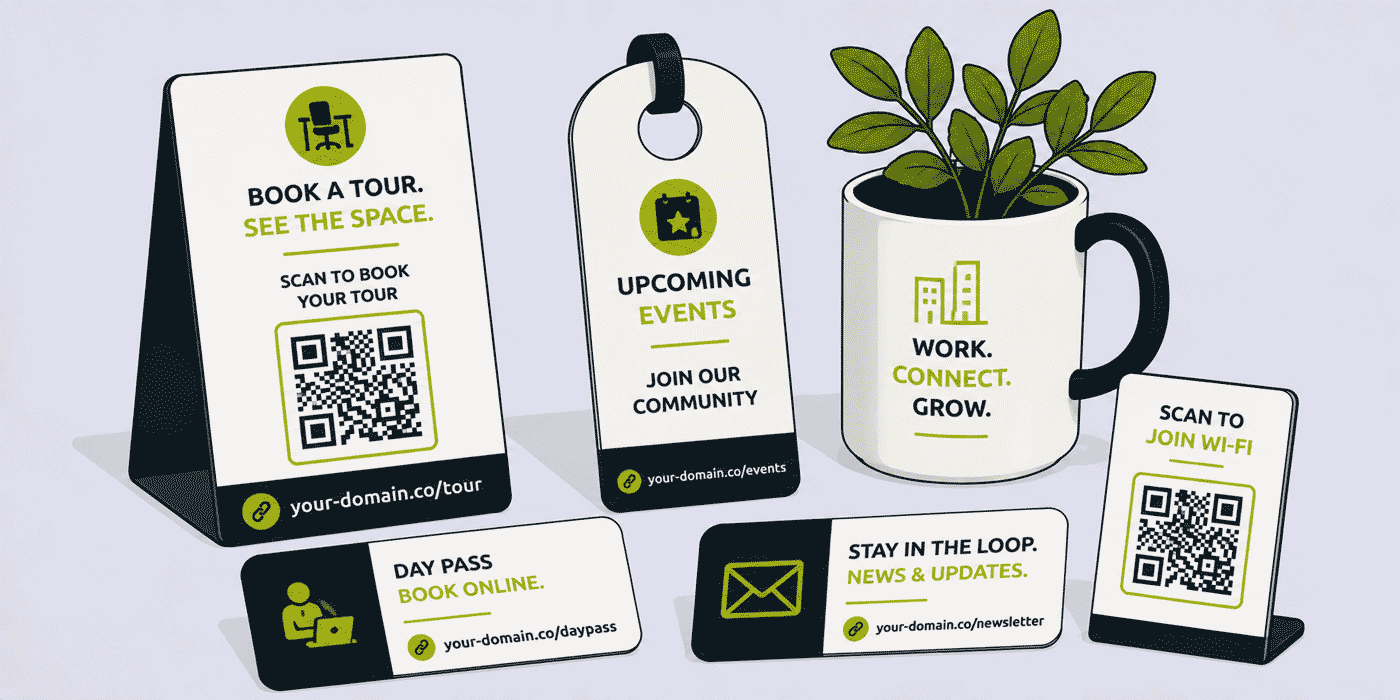
- In-space QR Codes — room booking, event calendar and member resources
- Community events promotion links
- Corporate team and enterprise workspace links
- Member referral programme links
- Multi-location operator link management
- Partnerships with local businesses, hotels and transport hubs
- A worked example: a three-location coworking operator's link stack
- Common mistakes in coworking space link management
- A Cuttly plan guide for coworking spaces
- Frequently asked questions
Membership Sign-Up Links
The membership sign-up journey for a coworking space typically moves through several digital touchpoints before a prospect commits: discovering the space through search or social media, visiting the website to compare plans, booking a tour to see the space in person, and finally signing up for a membership. Short links at each stage of this journey provide both a professional presentation and the analytics that reveal where in the funnel the space is converting well and where it is losing prospective members.
Per-Tier Membership Links
A coworking space with multiple membership tiers — hot desk, dedicated desk, private office, virtual membership — benefits from a short link per tier that takes a prospect directly to the relevant sign-up or information page without requiring navigation through the full pricing page:
your-space.com/hot-desk— the hot desk plan information and sign-upyour-space.com/dedicated-desk— the dedicated desk planyour-space.com/private-office— the private office optionsyour-space.com/virtual— the virtual address and mail handling planyour-space.com/day-pass— the day pass or pay-as-you-go option
These per-tier links are used in any content that discusses a specific membership type: a LinkedIn post about the benefits of a dedicated desk has a clear CTA to /dedicated-desk rather than the general pricing page. A Google Ad targeting "private office coworking near me" sends clicks directly to /private-office. Click analytics per tier show which membership type generates the most prospective member interest from digital channels, informing how the space positions each tier in its marketing content and advertising spend.
Membership Platform Migration Resilience
Coworking spaces change their membership management platforms more frequently than many operators anticipate. A space that starts on a simple booking system may move to Nexudus for its community features, then to OfficeRnd for its enterprise client management, then to a custom-built solution as the business scales. Each migration changes the membership sign-up URL. A dynamic short link for each membership tier means every existing marketing reference — Google My Business, social media posts, printed materials, local directory listings — continues to point to the correct current sign-up page through every platform change.
Tour Booking Links and Per-Channel Attribution
The space tour is the single most important conversion event in a coworking space's sales process. A prospective member who tours the space and experiences the community, the amenities, and the atmosphere is significantly more likely to sign up than one who only views the website. Everything that drives tour bookings is therefore directly commercially valuable, and understanding which channels are most effective at driving tour bookings is the most actionable analytics question in the space's marketing operation.
Per-Channel Tour Booking Attribution
A coworking space running marketing across multiple channels creates per-channel short links for its tour booking page:
your-space.com/tour-google— Google Search Ads and Google My Businessyour-space.com/tour-linkedin— LinkedIn posts and advertisingyour-space.com/tour-email— email campaigns to prospect listsyour-space.com/tour-referral— member referral programmeyour-space.com/tour-walk-in— QR Codes on the space's exterior or local displays
All pointing to the same tour booking form. Click analytics per channel, combined with the space's CRM data on which tours convert to memberships, give the marketing manager a per-channel cost-per-member-acquired metric. If Google Ads generates 180 tour booking link clicks per month with a 28% tour-to-membership conversion, while LinkedIn generates 80 clicks with a 42% conversion, the LinkedIn audience is more intent-qualified despite lower volume. This distinction informs how to balance and grow the channel mix rather than simply chasing the highest-volume channel.
Day Pass and Trial Visit Links
A day pass or free trial visit is one of the most effective conversion tools for a coworking space, because it allows a prospective member to experience the community and the environment before committing to a membership fee. Managing the day pass link well — ensuring it is prominently accessible, clearly labelled, and available through every channel where a prospective member might be considering whether to try the space — directly affects the space's ability to convert curious visitors into trial attendees and, subsequently, paying members.
A short link for the day pass or free trial — your-space.com/try or your-space.com/free-day — is used in social media posts specifically targeting people who may be hesitant to commit to a monthly membership, in LinkedIn advertising to remote workers and freelancers, in local business Facebook groups, and on any outdoor or partner display where a low-commitment entry point is the right CTA for a passing audience. Because the day pass offer itself may change — pricing, availability, included features — a dynamic short link allows the offer to evolve without requiring updates to every place the link appears.
In-Space QR Codes
A coworking space's physical environment is a marketing surface that most operators underexploit. Members who are sitting at their desks, in meeting rooms, at the coffee bar, or in communal areas are a captive audience for the space's own community events, services, and resources. QR Codes placed thoughtfully throughout the space — on notice boards, in meeting rooms, at the reception desk, in kitchen and breakout areas — give members and visitors instant access to digital resources without requiring them to search for the space's app or navigate a website.
Core In-Space QR Code Destinations
- Meeting room booking. A QR Code on each meeting room door or wall, linking to the room booking system for that specific room: "Book this room" →
your-space.com/book-room-name. A member who wants to book the room they are currently standing outside can scan and book in seconds, without navigating the space's full booking portal. Because room booking systems change, a dynamic short link ensures the QR Code continues to work through every system migration. - Events calendar. A QR Code on the notice board or community bulletin board, linking to the upcoming events calendar:
your-space.com/events. Members who see an event mentioned on a display can immediately add themselves to the guest list or view the full programme. - Community newsletter sign-up. A QR Code at the reception desk or coffee bar, inviting visitors and day pass users who are not yet members to join the community newsletter:
your-space.com/community-news. This captures the contact details of prospective members who have visited but not yet committed to a membership. - Member referral programme. A QR Code in communal areas with the message "Love working here? Refer a friend and both get a month free" →
your-space.com/refer. Placing the referral CTA where members are most relaxed and most positively disposed toward the space (after a good working day, in the communal area) is the optimal moment for a referral invitation. - Space access and house rules. A QR Code linking to the space's access guide, house rules, and member handbook:
your-space.com/member-guide. Useful for new members who are in the space for the first time and want to understand the facilities, printer access, kitchen facilities, and meeting room etiquette.
Community Events Promotion Links
A coworking space's events programme — networking breakfasts, workshop sessions, speaker evenings, wellbeing sessions, industry meetups — is one of its most powerful member retention and community acquisition tools. Events that bring members together build the community that is the space's most defensible competitive advantage over home working and generic office space. Promoting these events effectively through well-managed short links is as important as the events themselves.
A per-event short link — your-space.com/event-name-date — used in the community newsletter, in social media posts, in the in-space notice board QR Code, and in any local business partnership communications gives the events team independent click analytics for each event type. Over a programme of twelve to eighteen events per year, comparing click engagement by event format — networking, workshop, speaker, social — reveals which formats generate the most interest from both members and non-members, informing which events to invest in repeating and which to test for non-member audience building.
Corporate Team and Enterprise Workspace Links
Many coworking spaces generate a significant share of their revenue from corporate team memberships: companies that want flexible office space for a remote team, a satellite office for a distributed workforce, or project-based space for a short-term team engagement. This B2B market segment is commercially very attractive because corporate memberships represent higher revenue per member and longer commitment periods than individual memberships.
A short link for the enterprise or team workspace enquiry page — your-space.com/for-teams or your-space.com/enterprise — is used in LinkedIn outreach to HR directors, operations managers, and office managers at companies in the space's target market, in any content marketing addressing flexible working for teams, and in presentations at business networking events. Click analytics on the enterprise link show how many corporate prospects are engaging with the team workspace offer, giving the sales team a pipeline engagement signal that indicates who is actively considering the space for their team.
Member Referral Programme Links
Member referrals are the highest-converting and most cost-effective acquisition channel for most coworking spaces. A member who refers a friend or colleague to the space is providing a personal endorsement that no advertising can replicate, to a prospect who already has some reason to trust the referring member's judgement. A well-managed referral programme with a clear short link turns satisfied members into an active acquisition channel.
A short link for the referral programme — your-space.com/refer — featured in the member newsletter, on in-space QR Codes, and in any member communication that prompts referral activity, gives the space a clear, trackable entry point for the programme. Because referral platform providers change, and because the referral incentive itself may evolve (from a discount month to a cash reward to a free guest day), a dynamic short link allows the referral programme destination to be updated without any member communication needing to be reissued.
Local Business and Hotel Partnership Links
Many coworking spaces build their member acquisition through partnerships with complementary local businesses: hotels that accommodate business travellers who need a professional working environment for a day or a week, coffee shops and restaurants that want to serve the lunchtime coworking crowd, local business improvement districts that promote flexible working as part of a wider commercial area strategy, and transport hubs where commuters might benefit from a coworking option between connections. Each partnership involves a link that the partner shares with their customers or members.
A per-partner short link — your-space.com/hotel-partner-name, your-space.com/biz-district-name — gives the coworking space a trackable entry point for each partnership's referrals. Click analytics per partner show which relationships are generating the most inbound interest, informing where to invest in deepening partnership activities and which partnerships are generating so little referral traffic that the relationship may not be commercially worthwhile to maintain.
Hotel partnerships in particular are a significant source of day pass and short-term membership revenue for coworking spaces near business hotels. A hotel that includes the coworking space in its concierge recommendation or provides a card with a QR Code linking to the day pass booking page is directing a highly qualified audience — business travellers with a legitimate professional working need — to an immediately relevant solution. A QR Code on a hotel room desk or in the hotel's business facilities linking to your-space.com/hotel-partner-name provides trackable attribution for every day pass booking that the hotel partnership generates.
Newsletter and Community Communication Links
A coworking space's community newsletter is one of its most important member retention and community building tools. A well-produced newsletter that keeps members informed about upcoming events, new amenities, member spotlights, and local business news reinforces the sense of belonging to a community that is the space's primary competitive advantage over home working. Managing the links in the newsletter well — ensuring every CTA is trackable, every event registration link works, and every resource link remains functional through platform changes — is as important as the newsletter content itself.
Newsletter Link Structure
A coworking space newsletter typically includes links to:
your-space.com/events— the upcoming events calendar (permanent link, always current)your-space.com/event-name-date— per-event registration links for featured events in the newsletteryour-space.com/refer— the member referral programme (featured in every newsletter)your-space.com/book-meeting-room— meeting room booking (for members who have not yet used the digital booking system)your-space.com/member-offer-name— any member-exclusive offers or partnerships featured in that issue
Click analytics on newsletter links show the community manager which content in each newsletter generates the most member engagement. If the event registration link consistently generates the most clicks, the events programme is the most valued community feature; if the member offer link outperforms event links, the member benefits and discount programme is generating more community engagement than the events. This data directly informs how to structure future newsletter content to maximise member engagement and retention.
Survey and Feedback Links
Member satisfaction and community health surveys are important tools for coworking spaces that take member retention seriously. A space that asks its members how they feel about the community, the amenities, the events, and the pricing is gathering the intelligence it needs to improve before members leave rather than after. A survey link — your-space.com/member-survey — distributed in the member newsletter, displayed as an in-space QR Code, and included in any member satisfaction check-in communication, gives the community team a consistent, professional entry point for feedback collection.
Click analytics on the survey link show how many members are engaging with the feedback invitation, which is itself a signal of community health: a community where 40% of members engage with the satisfaction survey request is one where members feel invested enough in the space to spend three minutes providing feedback; a community where fewer than 10% engage may have either a disengaged membership or a survey design that is too long or too infrequent to maintain habitual participation.
A Worked Example: A Three-Location Coworking Operator's Link Stack
Consider a coworking operator with three locations in a mid-size city — a city centre location, a creative quarter location, and a tech district location — using a branded domain such as your-space.com, connected through Cuttly's custom domain setup (an A record and a TXT record — see the custom domain setup guide).
Per-location tour links: /city-centre-tour, /creative-quarter-tour, /tech-district-tour. Google Ads campaigns for each location use the location-specific tour link. After three months, city centre generates 340 tour booking page clicks at 31% conversion to actual tour; the creative quarter generates 180 clicks at 48% conversion; the tech district generates 220 clicks at 22% conversion. The tech district's lower conversion rate despite reasonable click volume suggests a mismatch between what the ad is promising and what the tour booking page is delivering; the marketing manager reviews the landing page copy and testing begins.
In-space QR programme: All three locations carry in-space QR Codes. Meeting room booking QR Codes generate an average of 8.4 scans per room per week — suggesting strong member adoption of the QR booking pathway, reducing pressure on the reception desk for room booking enquiries. The events calendar QR Code at the creative quarter generates 3.2x more scans than the equivalent at the city centre location, suggesting a more events-engaged community at that location. The operator increases event frequency at the creative quarter and tests a new format specifically for the city centre's more professionally-focused membership.
Corporate team enquiries: /for-teams is used in a LinkedIn outreach campaign to 340 HR and operations contacts at mid-size companies in the city. After one month, 28 have clicked the enterprise page (8.2% engagement rate). The sales team prioritises follow-up calls to these 28 contacts and converts 4 into corporate team memberships — the highest-value individual acquisition event in the quarter.
Common Mistakes in Coworking Space Link Management
Single Tour Booking Link Across All Channels
A coworking space that uses one tour booking link across Google, LinkedIn, email, and referrals cannot compare which channel is sending the most genuinely interested prospects versus curious browsers. The tour-to-membership conversion rate per channel is the most commercially actionable analytics metric in a coworking space's marketing operation, and it requires per-channel short links to calculate.
No In-Space QR Code Programme
A coworking space that does not use QR Codes in its physical environment is missing its most captive and highest-affinity audience — the members who are already there every day. In-space QR Codes that link to the events calendar, the referral programme, the room booking system, and the community newsletter turn the space itself into a continuous marketing and engagement surface for both retention and referral.
No Per-Location Link Separation in Multi-Location Operations
A multi-location operator that uses the same tour booking and membership link across all locations cannot compare marketing effectiveness per location. Locations with different community profiles, different competitive environments, and different target member types may need entirely different marketing approaches; without per-location attribution analytics, the operator is flying blind on which locations are performing and which need intervention.
Cuttly Plan Guide for Coworking Spaces
- The Free plan ($0) provides 30 short links per month, one branded custom domain, full click analytics, dynamic QR Codes and a survey tool, with no credit card required. Suitable for a single-location coworking space setting up core tour booking, day pass, membership tier and in-space QR Code links.
- The Starter plan ($12/month) adds 300 short links per month and 30 custom aliases per month — practical for an active coworking space running per-channel tour attribution, regular events promotion, a member referral programme, and corporate team enquiry links.
- The Single plan ($25/month) adds up to 5 branded domains for multi-location operators, fully customizable QR Codes with the space's brand identity for professional in-space and external displays, 1,000 API-created links per month for automated per-event or per-location link generation, and a full year of analytics history for location and channel performance comparison.
- The Team plan ($99/month) suits larger coworking groups with marketing, community, and sales teams sharing link management across multiple locations, Campaign tag analytics for aggregated multi-location reporting, and multiple branded domains for different coworking brands within the group.
Create a free Cuttly account to set up your coworking space's tour booking link, your membership tier links, and your first in-space QR Codes. Registration is required for all plans, including free. No credit card is needed for the free plan.
Frequently Asked Questions
How do coworking spaces use short links for membership sign-up?
A coworking space creates per-tier short links — your-space.com/hot-desk, your-space.com/private-office — used in channel-specific content so prospects land directly on the relevant plan rather than the general pricing page. Because membership platforms change as spaces scale, dynamic short links survive every system migration without updating any existing marketing material.
How do coworking spaces use QR Codes in the physical space?
A coworking space places dynamic QR Codes on notice boards, meeting room doors, reception desks and communal areas, linking to meeting room booking, the events calendar, community newsletter sign-up, the member referral programme and the member handbook. Click analytics show how many members are using each QR Code pathway, informing which resources are most actively used by the community.
How do coworking spaces track which marketing channel drives the most tour bookings?
A coworking space creates per-channel tour booking links — Google, LinkedIn, email, referral — all pointing to the same booking form. Combined with CRM tour-to-membership conversion data, the per-channel click analytics give a cost-per-member-acquired metric per channel, revealing which sources send the most commercially motivated prospects.
How do multi-location coworking operators manage links across several spaces?
A multi-location coworking operator creates per-location short links for tour booking and membership sign-up, all managed from a single dashboard. Per-location click analytics enable direct comparison of marketing effectiveness across locations, identifying which need increased investment, which have conversion rate problems on their landing pages, and how the member community profile differs by location.
How do coworking spaces use short links for corporate team and enterprise clients?
A coworking space uses a dedicated enterprise short link — your-space.com/for-teams — in LinkedIn outreach to HR and operations decision-makers. Click analytics show which corporate prospects are engaging with the team workspace offer, giving the sales team a pipeline engagement signal for prioritising follow-up calls before a formal enquiry is made.
- Get Started
- Create Free Account
- Plans & Pricing
- Platform Tools
- URL Shortener
- Link Analytics
- QR Code Generator
- Survey Tool
- Related Guides
- URL Shortener for Moving Companies
- URL Shortener for Local Services
- URL Shortener for Property Management
- URL Shortener for Trade Shows
- Short Links for Offline Campaigns
- Encyclopedia
- Dynamic QR Codes
- Branded Links
- Setup Guides
- Custom Domain Setup
- Track Link Clicks
- Industry Hub
- Local Services
- All Industries →
URL Shortener
Cuttly simplifies link management by offering a user-friendly URL shortener that includes branded short links. Boost your brand’s growth with short, memorable, and engaging links, while seamlessly managing and tracking your links using Cuttly's versatile platform. Generate branded short links, create customizable QR codes, build link-in-bio pages, and run interactive surveys—all in one place.
Cuttly - Consistently Rated
Among Top URL Shorteners
Cuttly isn’t just another URL shortener. Our platform is trusted and recognized by top industry players like G2 and SaaSworthy. We're proud to be consistently rated as a High Performer in URL Shortening and Link Management, ensuring that our users get reliable, innovative, and high-performing tools.C


