URL Shortener for Trade Shows and Industry Events The Complete Guide
A trade show stand costs thousands in space hire, stand build, staff time, and logistics before a single visitor has walked past. A conference speaking slot represents months of preparation, abstract submission, and the professional credibility that comes with being selected from a competitive field. Industry events are among the highest-cost, highest-visibility marketing investments in the B2B marketing mix — and they are also among the least measurable, because most of the interactions at a physical event generate no digital record that connects the visitor's interest to any subsequent business activity.
This guide covers how trade show exhibitors, conference speakers, B2B event organisers, and industry association event teams use a URL shortener, branded custom domain, dynamic QR Codes and click analytics to bring digital measurement to physical event presence, manage the full lifecycle of event-related links from pre-show promotion to post-show follow-up, and connect the significant investment in trade show and conference participation to measurable pipeline and engagement outcomes.
What This Guide Covers
- The trade show measurement problem and how QR Codes and short links address it
- Stand QR Codes — product information, brochures and demo booking
- Lead capture QR Codes — digital alternative to badge scanning
- Per-event ROI measurement using short link analytics
- Speaker session links — converting conference audience attention into pipeline
- Pre-show marketing links — driving stand visitor intention before the show opens
- Event organiser links — exhibitor directories, floor plans and session schedules
- Post-show follow-up attribution
- Multi-show annual event programme management
- A worked example: a B2B technology company's link stack across a major industry event
- Common mistakes in trade show link management
- A Cuttly plan guide for trade show exhibitors and event organisers
- Frequently asked questions
The Trade Show Measurement Problem
The fundamental measurement challenge of trade show participation is that the primary currency of the event — a conversation between a company representative and a prospective customer at a stand — generates almost no digital record unless both parties actively exchange contact details. Badge scanning solves part of this problem for exhibitors who have badge scanning equipment, but badge scanning measures attendance at the stand, not the quality of the conversation, the visitor's specific product interest, or their likelihood of becoming a customer.
QR Codes and short links do not replace conversation — they supplement it. A visitor who scans a QR Code during a stand conversation is doing so because they want the specific information the QR Code links to: a product brochure, a technical specification, a demo booking form, a pricing enquiry form. This scan is a much higher-quality engagement signal than a badge scan, because it indicates specific intent rather than just physical proximity to the stand. It is also the beginning of a digital trail: the click is recorded, the destination page may have further tracking, and the lead generated from a QR Code scan is connected to the specific product or piece of content that generated the interest.
Over an entire trade show programme — multiple shows per year, each with different audiences and different product emphases — the accumulation of per-show QR Code analytics builds into a picture of event ROI that most B2B marketing teams currently construct only approximately and retrospectively. The framework below applies to any exhibitor or event team that wants to make trade show investment measurable in real time.
Stand QR Codes: Product Information, Brochures and Demo Booking
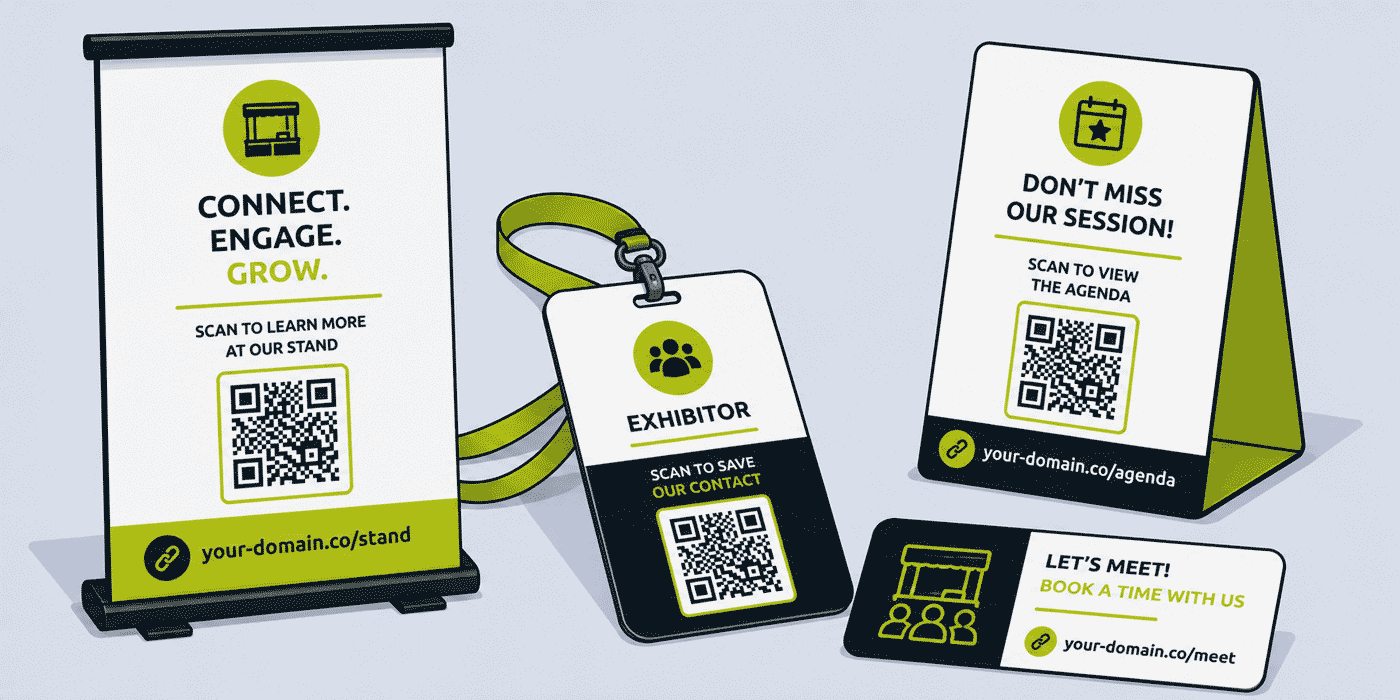
The trade show stand is the physical anchor of an exhibitor's event presence, and the QR Codes placed on stand displays, product demonstration units, and printed stand materials are the digital extension of that presence. A stand that carries well-placed, clearly labelled QR Codes gives every visitor a self-service path to the information they want at the moment they want it, without requiring a stand team member to be available to answer every query simultaneously.
Core Stand QR Code Types
A well-equipped trade show stand carries different QR Codes for different visitor intentions:
- Product brochure or data sheet. A QR Code labelled "Scan for the full product specification" on or next to a product display links to a downloadable PDF or online product page. A visitor who is technically evaluating the product can access the detailed specification in the moment they are looking at the product, without asking for a printed brochure (which they may lose) or waiting for a follow-up email (which they may forget to open). The short link:
your-company.com/product-name-spec. - Demo booking. A QR Code labelled "Book a full product demo" links to a demonstration scheduling page where the visitor can book a post-show demo with the appropriate product specialist. This converts stand interest into a specific post-show commitment at the moment of peak engagement. The short link:
your-company.com/show-demooryour-company.com/show-name-demofor event-specific attribution. - Video demonstration. A QR Code on or beside a live product that is not running during the show, or for a product whose live demonstration is complex to convey in a stand environment, links to a video demonstration that the visitor can watch on their phone. The short link:
your-company.com/product-video. - General company information. A QR Code labelled "Find out more about us" on the stand's general information panel links to the company website or a show-specific landing page. The short link:
your-company.com/show-name-2026.
The Dynamic Advantage for Reusable Stand Materials
Trade show display hardware — pop-up banners, modular wall systems, literature stands, and demonstration unit surrounds — represents significant capital investment that is reused across multiple events. A company that exhibits at six to twelve trade shows per year uses the same physical stand elements at most of them, with different graphics or product configurations for different audiences.
A QR Code printed or applied to reusable stand hardware needs to serve every event where that hardware is used, which may be events with completely different audience profiles, different product emphases, and different call-to-action priorities. A dynamic short link behind each stand QR Code allows the company's event marketing team to update the destination for each event: at an infrastructure-focused show, the product specification QR Code links to technical documentation; at a decision-maker-focused show, it links to a business case and ROI calculator. The same physical stand, with the same QR Codes, serves a different audience effectively at each event through destination management alone.
Lead Capture QR Codes: Digital Alternative to Badge Scanning
Badge scanning systems — provided by the event organiser for a fee or integrated into event apps — are the traditional digital lead capture mechanism at trade shows. They work by scanning the barcode or NFC chip in a visitor's event badge, capturing their registration data (name, company, job title, email) and logging it against the exhibitor's account. The limitation is that badge scanning captures attendance, not intent: a visitor who pauses at the stand to look at a display is badge-scannable, but they have expressed no more intent than physical proximity.
A QR Code lead capture form captures a different type of engagement: a visitor who voluntarily scans a QR Code and completes a brief contact form is expressing active interest in whatever the QR Code was labelled to deliver. This is a more qualified lead than a badge scan, because the visitor has self-identified their intent.
Lead Capture Form QR Code Setup
A lead capture QR Code on a stand display — labelled "Scan to request a follow-up from our team" or "Scan to receive our latest research report" — links through a dynamic short link to a brief digital contact form: name, company, email, and optionally a free-text field for their specific question or interest area. The short link: your-company.com/show-name-contact.
This form can be hosted on the company's own website, on a form platform, or as a landing page specific to the event. Because the QR Code is dynamic, the form destination can be updated for each show — different forms for different events, with event-specific hidden fields that tag each lead with the event source — without any change to the physical QR Code on the stand.
Click analytics for the lead capture QR Code show total scans; form completion data from the landing page shows actual lead submissions. The ratio between scans and completions is a measure of form conversion rate, which gives the event team insight into whether the QR Code label is setting accurate expectations (a scan that leads to a form the visitor did not expect to find will have a low completion rate) and whether the form itself is appropriately brief for the trade show context.
Per-Event ROI Measurement
Measuring the return on trade show investment is one of the most persistent challenges in B2B marketing. The conventional approach — counting badge scans, collecting business cards, counting conversations, and then attributing any subsequent sales to the event — is slow, imprecise, and dependent on CRM data quality that is rarely as good as the attribution methodology requires.
Per-event short links provide an additional measurement layer that is faster and more reliable than post-event CRM attribution. By creating a specific short link for each event — your-company.com/show-name-year — used only for that event's materials, the company generates a clean digital engagement count per event that is independent of CRM data quality and available within hours of the event opening rather than weeks after it closes.
Building the Per-Event Measurement Framework
A comprehensive per-event measurement framework for a B2B exhibitor uses short links at each stage of the event cycle:
- Pre-show:
your-company.com/show-name-prebookfor pre-event meeting booking,your-company.com/show-name-registerfor free ticket registration where the exhibitor provides tickets to clients. - During the show:
your-company.com/show-name-productfor the featured product,your-company.com/show-name-demofor demo booking,your-company.com/show-name-contactfor lead capture. - Post-show:
your-company.com/show-name-followupfor the post-show follow-up email's primary CTA,your-company.com/show-name-contentfor content promised to leads at the show.
Click analytics across all of these links give the event marketing manager a complete digital engagement picture per event: how many prospects engaged pre-show, how many interacted with the stand digitally during the show, and how many engaged with the post-show follow-up. Comparing this engagement data with the actual pipeline generated from each event gives the most complete event ROI picture available from non-complex analytics infrastructure.
Speaker Session Links
Speaking at a trade show conference session is one of the highest-visibility marketing opportunities at any event. A speaker in a conference theatre has an audience of potential buyers for thirty to sixty minutes in a context of active professional engagement: they have chosen to attend the session because the topic is relevant to their work, which means they are self-selected as the most qualified audience in the event hall. Converting this attention into measurable post-session engagement is the primary commercial objective of any conference speaking slot.
The Speaker's Short Link Set
A speaker at a trade show conference session uses a small set of short links displayed on the opening and closing slide and mentioned verbally during the presentation:
your-company.com/talk-show-2026— the session-specific resource page (slides, references, contact)your-company.com/show-demo— demo booking for the product or service the talk was aboutyour-company.com/report-title— any specific report or research referenced in the talk
The session resource page — accessed through the session-specific short link displayed on slides — is the primary post-session engagement destination. It combines the slides, any referenced data or reports, and a clear invitation to take the next step with the company. Click analytics on this link, measured in the 24 to 48 hours following the session, show the speaker and the event marketing team how many audience members engaged with the session content after leaving the conference theatre.
Because trade show session talks are increasingly recorded and made available to registered attendees after the event, the session-specific short link has a longer engagement tail than the in-session audience alone. Attendees who missed the live session, or who want to revisit a reference from a talk they attended, access the same short link through the event's recording platform weeks after the event. A dynamic short link means this destination can be updated from a "live session resource" to an "archived talk resource" as the post-event content strategy evolves.
Pre-Show Marketing Links
The period before a trade show opens is one of the most effective times to drive qualified stand visitor intention. Attendees who know they want to visit a specific stand are more likely to seek it out proactively on the show floor, to engage more deeply when they arrive, and to book pre-arranged meetings that use stand time more efficiently than waiting for passing traffic.
Pre-Show Meeting Booking Links
A pre-show email campaign to the company's existing client contacts and target accounts, inviting them to book a specific meeting time at the stand, uses a short link for the meeting booking page: your-company.com/show-name-meet. This link is also included in LinkedIn posts announcing the company's presence at the show, in the event's official exhibitor directory entry, and in any sponsored communications through the event organiser's pre-show email programme.
Click analytics on the pre-show meeting booking link show the event marketing team how much pre-show engagement the company's stand presence is generating, and the ratio of clicks to actual meeting bookings reveals whether the booking experience itself is creating friction (high click, low booking) or whether the offer is compelling but visibility is the constraint (low click, high conversion of those who click).
Event Organiser Links: Exhibitor Directory, Floor Plan and Sessions
From the event organiser's perspective, short links and QR Codes serve a different purpose than for exhibitors: they manage the attendee experience across the full event lifecycle. An event organiser who provides attendees with a clean, consistent set of short links for every element of the event experience — registration, floor plan, session schedule, exhibitor directory, networking app, and post-event survey — is presenting a professional digital event infrastructure that reflects the quality of the event itself.
Organiser Core Event Links
A trade show organiser's core short link set, used consistently across all attendee communications:
show.com/register— attendee registrationshow.com/exhibitors— exhibitor directoryshow.com/floorplan— interactive floor planshow.com/sessions— conference session schedule and bookingshow.com/app— event app download (smart redirect by device)show.com/speakers— speaker profiles and session linksshow.com/feedback— post-event attendee survey
These links are used in every attendee communication: the pre-event registration confirmation, the pre-show reminder emails, the on-site signage QR Codes, the printed visitor guide, and the post-event follow-up. Because all are dynamic, any change to the event's digital infrastructure — a new app version, a restructured session schedule, an updated floor plan as exhibitor bookings change — is reflected in every existing reference to these links without any printed material needing to be updated.
Post-Show Follow-Up Attribution
The post-show period — the two to three weeks after a trade show during which follow-up emails are sent, meetings are booked, and pipeline is formally registered — is where most of the commercial value of a trade show participation is actually captured. The quality of post-show follow-up is one of the strongest determinants of trade show ROI, and the links in post-show communications are the primary mechanism for reconnecting leads with the content and context of their stand interaction.
Post-Show Follow-Up Link Strategy
A post-show follow-up email to a lead captured at the stand typically includes:
- A reminder link to the product information or brochure they accessed at the stand:
your-company.com/product-name-spec - A link to any content promised during the conversation:
your-company.com/show-name-content - A demo booking link:
your-company.com/book-demo - A contact link for any follow-up questions:
your-company.com/contact-show-name
Click analytics on post-show follow-up links show the event marketing team how many leads from each event engage with the follow-up content. A show that generates high stand engagement (many QR Code scans) but low post-show follow-up link engagement may have a mismatch between the quality of leads collected and the relevance of the follow-up content; a show with lower stand engagement but higher follow-up engagement may be generating more committed prospects despite smaller numbers.
A Worked Example: A B2B Technology Company's Event Link Stack
Consider a B2B technology company exhibiting at three major industry events per year, using a branded domain such as your-company.com, connected through Cuttly's custom domain setup (an A record and a TXT record — see the custom domain setup guide).
Six weeks before Event A: Pre-show campaign links created: /event-a-meet (meeting booking), /event-a-register (free ticket offer to target accounts). Email to 600 target accounts generates 89 meeting bookings. LinkedIn posts generate 340 clicks on the event registration link.
During Event A: The stand carries four QR Codes: /event-a-product (product page), /event-a-demo (demo booking), /event-a-report (downloadable research report), /event-a-contact (lead capture form). Two-day analytics: product page 247 scans, demo booking 84 scans (34% of product page scanners progressed to demo booking — strong intent conversion), report download 312 scans, lead capture 178 form completions.
Post-show: Follow-up emails to 178 lead capture contacts use /event-a-followup as the primary CTA. After one week, 91 have clicked (51% engagement), 34 have booked demo appointments, 8 have entered formal sales conversations. The event marketing manager presents these figures to the marketing director as the most complete single-event digital attribution data the company has ever produced from a trade show.
Event B comparison: Event B (two months later, different industry vertical) generates fewer stand QR Code scans but a higher demo booking conversion rate from those scans. Event A had broader audience reach; Event B had a more specific audience with higher purchase intent. The company increases its investment in Event B for the following year and reduces spend on a less targeted sector event that generated high footfall but minimal QR Code engagement.
Common Mistakes in Trade Show Link Management
Static QR Codes on Reusable Stand Hardware
A company that applies static QR Codes to its reusable display hardware creates a permanent mismatch between the QR Code destination and the appropriate content for each event. A QR Code on a banner that encoded the product page URL from the first event it was used at will still be encoding that URL at Event 12 two years later, regardless of how many product updates, website restructurings, and content strategy changes have occurred. Dynamic short links behind all stand QR Codes allow the content to evolve while the hardware stays constant.
No Per-Event Digital Engagement Measurement
A company that exhibits at multiple events per year without per-event short links has no way of comparing the digital engagement quality of different shows. Badge scan counts, lead form submissions, and post-show CRM entries are all captured post-hoc and with varying data quality. Per-event short link analytics provide a real-time, consistent digital engagement count per event that enables direct comparison across the annual event programme.
No Post-Show Follow-Up Link Attribution
A company that sends post-show follow-up emails with generic website links cannot measure whether those emails are driving engagement. Per-show follow-up links that are specific to each event's follow-up campaign measure exactly how many leads from each show are engaging with the follow-up content, which is a leading indicator of pipeline quality per event that most B2B marketing teams currently have no access to.
Cuttly Plan Guide for Trade Show Exhibitors and Event Organisers
- The Free plan ($0) provides 30 short links per month, one branded custom domain, full click analytics, dynamic QR Codes and a survey tool, with no credit card required. Suitable for a small company attending one or two events per year and setting up core stand QR Code and post-show follow-up links.
- The Starter plan ($12/month) adds 300 short links per month and 30 custom aliases per month — practical for a company with an active trade show programme, multiple events per year, per-event attribution link sets, and pre-show and post-show campaign links for each event.
- The Single plan ($25/month) adds up to 5 branded domains, fully customizable QR Codes with company branding for professional stand displays, 1,000 API-created links per month for automated per-exhibitor or per-session link generation at scale, and a full year of analytics history for annual event programme ROI comparison.
- The Team plan ($99/month) suits large B2B companies with dedicated event marketing teams, event organiser organisations managing multiple events per year, or industry associations with complex annual event programmes. Includes Campaign tag analytics for aggregated event ROI reporting, multiple branded domains, and shared workspaces for event and marketing teams.
Create a free Cuttly account to set up your stand QR Codes, your pre-show meeting booking link, and your post-show follow-up attribution links. Registration is required for all plans, including free. No credit card is needed for the free plan.
Frequently Asked Questions
How do trade show exhibitors use QR Codes on their stands?
A trade show exhibitor places QR Codes from dynamic short links on display panels and printed materials, linking to product specifications, demo booking forms, video demonstrations, and lead capture forms. Because the QR Code is dynamic, the same physical stand hardware serves multiple events with different content destinations for different audiences. Click analytics provide direct digital measurement of stand visitor engagement.
How do B2B companies measure trade show ROI using short links?
A B2B company uses per-show short links for lead capture, product pages, and demo booking — all attributed to the specific event. Click analytics per event, combined with lead quality and pipeline data, give the marketing team a more complete ROI picture than badge scan counts alone. Comparing digital engagement across multiple events identifies which shows generate the most qualified interest per exhibiting investment.
How do trade show organisers use short links for exhibitor directories and event apps?
A trade show organiser creates branded short links for the exhibitor directory, floor plan, session schedule, app download, and post-event survey — used in all attendee communications, printed visitor guides, and on-site signage. Because all links are dynamic, destinations update as the event programme evolves without requiring reissue of any printed materials.
How do speakers at trade shows use short links during their presentations?
A conference speaker displays a session-specific short link — your-company.com/talk-show-2026 — on opening and closing slides, pointing to a resource page with slides, referenced data, and a demo booking invitation. Because the QR Code is dynamic, the destination evolves from a live session resource to an archived talk resource without any change to what was displayed on stage.
How do event organisers use QR Codes for lead capture at trade shows?
A trade show organiser provides exhibitors with lead capture QR Codes pointing to brief digital contact forms. Visitors who scan voluntarily are expressing specific intent rather than just physical proximity. Click analytics show total scans; form completion shows actual leads. The conversion rate between the two measures form design effectiveness and QR Code label clarity.
- Get Started
- Create Free Account
- Plans & Pricing
- Platform Tools
- URL Shortener
- Link Analytics
- QR Code Generator
- Survey Tool
- Campaign Analytics
- Related Guides
- URL Shortener for Events
- URL Shortener for Stadiums & Arenas
- URL Shortener for Sports Events
- URL Shortener for Management Consultancies
- Short Links for Offline Campaigns
- Encyclopedia
- Dynamic QR Codes
- Branded Links
- Setup Guides
- Custom Domain Setup
- Track Link Clicks
- Industry Hub
- Travel, Logistics & Events
- All Industries →
URL Shortener
Cuttly simplifies link management by offering a user-friendly URL shortener that includes branded short links. Boost your brand’s growth with short, memorable, and engaging links, while seamlessly managing and tracking your links using Cuttly's versatile platform. Generate branded short links, create customizable QR codes, build link-in-bio pages, and run interactive surveys—all in one place.
Cuttly - Consistently Rated
Among Top URL Shorteners
Cuttly isn’t just another URL shortener. Our platform is trusted and recognized by top industry players like G2 and SaaSworthy. We're proud to be consistently rated as a High Performer in URL Shortening and Link Management, ensuring that our users get reliable, innovative, and high-performing tools.C


