URL Shortener for Sports Events and Marathons The Complete Guide
A mass participation sports event has a longer life than almost any other type of event. Registration opens months or years in advance. Training resources are distributed weeks or months before race day. Race day itself spans hours. Results stay live for years. Finisher medals and trophies are kept for decades. Every link associated with a sports event — from the first registration announcement to the QR Code on a medal sitting on a shelf twenty years from now — exists somewhere in the physical or digital world for far longer than most event organizers plan for when they create it.
This guide covers how sports event organizers — city marathons, half marathons, cycling sportives, triathlons, obstacle courses, open water swims, mass participation fun runs and professional road races — use a URL shortener, branded custom domain, dynamic QR Codes and click analytics across the full lifecycle of an event: from the first registration link through to the finisher medal QR Code that still needs to point somewhere useful years after the race is run.
What This Guide Covers
- The sports event link lifecycle — from registration to memorial medal
- Registration and early-bird campaign links
- Training resource and participant communication links
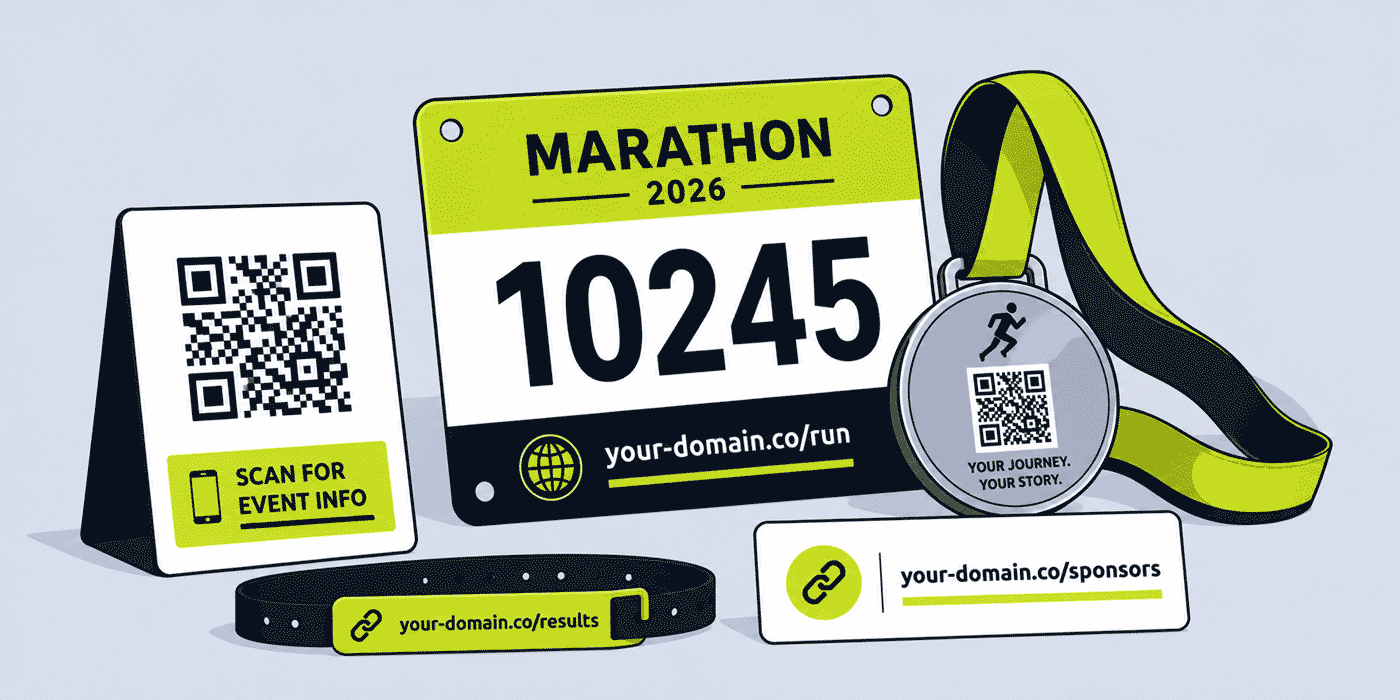
- QR Codes on race bibs — tracking, information and spectator links
- Sponsor and charity partner links
- Race day links — live tracking, start lists and logistics
- Results and post-event links
- QR Codes on medals, trophies and finisher merchandise
- Post-event survey and next-year registration links
- Social media and participant community links
- A worked example: a city marathon's link stack across its full lifecycle
- Common mistakes with sports event links and race day QR Codes
- A Cuttly plan guide for sports event organizers
- Frequently asked questions
The Sports Event Link Lifecycle
Most businesses think about links in the context of active campaigns: a link is created, shared, clicked, and eventually becomes irrelevant as the campaign ends. Sports events are different because a single event generates links that need to remain functional and relevant across a timeline of months or years, through phases that have completely different content requirements.
A city marathon might open early-bird registration fourteen months before the event, send training plans twelve weeks before race day, issue race bib QR Codes three days before the start, publish live tracking links on race morning, release results within six hours of the final finisher crossing the line, and then open registration for the following year's event within twenty-four hours. Each of these phases requires specific digital content at its specific time, and any link that appears on a physical object — a bib, a medal, a poster, a t-shirt — needs to remain useful through every subsequent phase even when its original destination is no longer current.
Dynamic short links make this lifecycle manageable because the same link can serve every phase. A QR Code on a race bib generated from your-event.com/bib-12345 points to the participant's live tracking page on race day morning, is updated to their results page within hours of finishing, and redirects to the results archive page once the race database is migrated to its permanent location. The same physical bib, the same printed QR Code, serves every phase automatically.
Registration and Early-Bird Campaign Links
The registration link is the most commercially important link for any mass participation event organizer, and it is typically the first link the public encounters. Managing it well sets the tone for the entire event's digital communications.
Primary Registration Link
A branded registration link — your-event.com/register or your-event.com/enter — is the permanent entry point for all registration traffic across the full pre-event period. This link appears in every press release, every social media announcement, every email to a previous participant database, every partnership communication, and every piece of out-of-home or print advertising associated with the event.
Because this link is dynamic, the destination behind it can be updated as registration status changes: from an early-bird entry page to standard entry, from standard entry to a late entry page, from late entry to a waiting list when places sell out. The link shared in every communication ever sent about the event continues to work and send interested parties to the most current registration option, without requiring any update to past social media posts, press coverage, or email newsletters.
Early-Bird and Campaign-Specific Links
For registration campaigns targeted at specific audiences — running club members, previous participants, corporate team entry promotions, charity places, international participants — separate short links per campaign allow the event team to see which audiences convert at the highest rate from registration link click to completed entry. A link such as your-event.com/register-clubs shared with affiliated running clubs alongside a club discount code gives the team independent analytics on how that specific audience segment responds to the campaign, separate from the general public registration flow.
Training Resource and Participant Communication Links
The weeks between registration closing and race day involve intensive participant communication: training plans, nutrition guidance, kit checklists, course maps, travel information, start time allocations, and race village information. Each of these is a link, and each can be tracked to understand which resources participants actually access versus which are sent but ignored.
Training Plan and Resource Links
A short link for each major training or preparation resource — your-event.com/training-plan, your-event.com/course-map, your-event.com/start-info — gives the event team click analytics showing which resources are most accessed and when. Click spikes on the course map link in the week before the event confirm that participants are actively preparing; low engagement with a nutrition guide might prompt the team to resend it with a more compelling subject line in the next reminder email.
These resource links have a secondary value: they can be updated as information changes. A start time allocation that changes due to route modifications, a kit drop-off location that moves, a bag drop procedure that is updated after a previous year's operational challenge — the short link remains consistent in all participant communications while the destination reflects the most current information.
QR Codes on Race Bibs
The race bib is the most physically prominent printed material in any mass participation sports event, and a QR Code on a race bib is one of the highest-potential link placements available to an event organizer. Every spectator along the course, every finisher photo, every social media post of a runner at the start line, and every media photograph taken during the event shows the bib — and therefore the QR Code on it.
What the Bib QR Code Should Link To
The bib QR Code's destination needs to be useful to multiple audiences at multiple times. On the morning of the race, a spectator who scans a runner's bib wants to see that runner's live tracking information. A runner who has forgotten their start time wants to see their start wave allocation. A charity sponsor representative at the finish line wants to see the finisher's fundraising page.
For large events where individual participant pages are technically feasible, a per-participant QR Code — each generated from a unique short link pointing to that participant's specific page — is the most useful approach. For smaller events, a general event information QR Code that links to a live results page, a start list, and general race day information serves most use cases. In both cases, the QR Code destination can be updated as the day progresses: from start list in the morning, to live tracking during the race, to results once the race is complete.
Generating Per-Participant Bib QR Codes at Scale
For large events generating thousands of unique bib QR Codes, the Cuttly API supports automated link creation at scale. An event with 15,000 participants can generate 15,000 unique short links — one per participant — programmatically, each pointing to that participant's unique page in the event's timing system. The QR Code for each link is generated automatically and passed to the bib printing workflow. After the event, all 15,000 links can be batch-redirected to the results archive in a single API call.
Sponsor and Charity Partner Links
Sponsorship revenue is a primary income stream for most professional sports event organizers, and the ability to demonstrate sponsor engagement to partners — beyond participant numbers and race day attendance — is a significant commercial advantage. A per-sponsor short link is the simplest mechanism for generating this data.
Per-Sponsor Link Structure
For each commercial sponsor, the event creates a short link pointing to the sponsor's designated landing page: your-event.com/title-sponsor, your-event.com/nutrition-partner, your-event.com/kit-sponsor. These links appear in participant registration confirmation emails, pre-race participant packs, the event website, social media posts featuring each sponsor, and any physical materials printed with a QR Code linking to sponsor content.
Click analytics per sponsor link — aggregated and anonymized — show total engagement with each partner across all touchpoints. Comparing these figures at the end-of-event sponsor reporting stage gives the commercial team a concrete engagement metric alongside finisher counts and social media reach figures, strengthening the case for sponsor renewal and informing conversations about which activation touchpoints (registration email, race bib, social media) generate the most participant click-through.
Charity Fundraising Links
Many mass participation events have a significant charitable dimension, with participants raising money for event charity partners or their own chosen charities through JustGiving, GoFundMe or similar platforms. A short link for the event's primary charity partner — your-event.com/charity — included in registration confirmation, training communications, bib information packs and post-event thank-you emails gives the event team a measure of how many participants engaged with the charity fundraising call to action, supplementing the charity's own fundraising platform data.
Race Day Links
Race day is the highest-traffic day for every link associated with a sports event. Participants are actively seeking information in real time; spectators are trying to track specific runners; media are accessing start lists, course maps and results; charity representatives are monitoring fundraising totals; sponsors are activating at event villages and along the course. Every link needs to be functional, fast-loading and pointing to current content from the moment the first participant arrives at the venue.
Core Race Day Links
your-event.com/track— live tracking platform (updated from start list to live tracking when the race begins)your-event.com/results— results page (goes live as finishers cross the line)your-event.com/map— course and spectator mapyour-event.com/start— start time allocations and wave informationyour-event.com/photos— official race photography (live or post-event)
These links are shared with participants in the final pre-race communication, displayed at the race village on signage QR Codes, and linked from every race day social media post. Because each is a dynamic short link, the team can update destinations in real time during the event if any technical issue causes a platform URL to change unexpectedly — a live tracking platform that switches to a backup URL mid-race, for example, can have its short link updated in seconds without any change to what participants have been told to visit.
Results and Post-Event Links
Results are among the longest-lived pages any sports event creates. A participant who ran a marathon in 2019 may still share their result, look up their time, or reference their position years later. A results link that breaks when the event migrates its timing platform is a permanent gap in a participant's race history and a source of frustration that creates unnecessary support burden for the event team.
A permanent results short link — your-event.com/results for the current year or your-event.com/results-2026 for a year-specific archive — maintained through every platform migration gives participants a stable reference that can be shared on social media, included in race reports, and referenced in conversation indefinitely. The event team updates the destination once when results migrate to a permanent archive; every existing reference continues to work.
QR Codes on Medals, Trophies and Finisher Merchandise
Finisher medals are among the most cherished physical objects in a distance runner's life. A well-designed medal is displayed, photographed, kept for decades. A QR Code on a finisher medal that links to something useful — the participant's personal results, the event's results archive, the photo gallery — is a digital extension of the medal's physical significance. A QR Code on a medal that leads to a dead link is a minor but persistent disappointment every time the participant notices it.
A dynamic short link on a finisher medal allows the event to evolve the destination over the medal's lifetime:
- Race day: live results page
- Week after the event: full results archive with photo gallery
- Six months later: early registration page for next year's event
- Ongoing: event history page showing all previous years' results and the current year's registration
This lifecycle approach turns a finisher medal into a permanent connection between the participant and the event brand — every time they look at it and scan the QR Code, they land on something relevant to where the event is in its current cycle.
Post-Event Survey and Next-Year Registration Links
The post-event period — the forty-eight hours after a race when participants are still riding the emotional high of finishing — is the highest-intent window for two critical event management tasks: collecting participant feedback and capturing registration interest for the following year. A short survey link in the post-event thank-you email, combined with an early registration link for the next edition, converts immediate post-event goodwill into actionable data and revenue.
your-event.com/feedback in the post-event email, combined with a medal QR Code that redirects to a "register for next year" page once the feedback window closes, creates a continuous engagement loop between the participant and the event brand across the full annual cycle.
A Worked Example: A City Marathon's Link Stack
Consider a city marathon using a branded domain such as your-event.com, connected through Cuttly's custom domain setup (an A record and a TXT record — see the custom domain setup guide).
Fourteen months before race day: /register goes live pointing to the early-bird entry form. Every press release, every social post, every email to last year's finisher database uses this single link. When early-bird closes and standard entry opens, only the destination behind /register changes.
Eight weeks before: the team distributes training resources using /training-plan, /course-map, /start-info. Click analytics show the course map link gets 73% more clicks than the training plan in the final two weeks, prompting the team to make the course map more prominent in the final pre-race email.
Bib printing: 18,000 unique short links are generated via the API, one per participant, each encoding that participant's results page. QR Codes are printed on bibs. Title sponsor gets /title-sponsor included in the pre-race participant pack email, bib delivery notification, and race village signage.
Race day: /track and /results are the two most-clicked links of the year. At 3pm (when the final cutoff passes), /results is redirected from the live timing page to the permanent results database. Medal QR Codes redirect from live results to the full results and photo gallery at 6pm.
Post-event: /feedback in the thank-you email generates a 31% survey completion rate (up from 22% in previous years when a generic third-party survey URL was used). Six months later, /register is updated to point to next year's early-bird entry, and medal QR Codes are redirected to the new registration page. The cycle begins again.
Common Mistakes With Sports Event Links
Printing Static QR Codes on Race Bibs
A QR Code printed on a race bib that encodes a direct URL cannot be updated after printing. If the live tracking platform changes its URL structure at any point — including on race morning — every bib QR Code becomes a dead link simultaneously. Dynamic short links prevent this entirely.
Not Planning the Link Lifecycle Before Printing
Many event teams create QR Codes for medals and bibs without planning what those QR Codes should point to at each stage of the event's lifecycle. A QR Code that was never intended to be updated is effectively a static QR Code even if it was created from a dynamic short link. Planning the lifecycle — race day, results day, next-year registration — before any physical material is printed ensures the dynamic link is actively used rather than a static link in dynamic packaging.
One Registration Link for All Audiences
Using the same registration link for all audiences means the event team cannot see which audience segments are converting at which rates. Running club members, charity place holders, corporate team entrants and returning participants all have different motivations and conversion behaviours. Per-audience registration links provide the data needed to optimize outreach to each group separately.
Cuttly Plan Guide for Sports Event Organizers
- The Free plan ($0) provides 30 short links per month, one branded custom domain, full click analytics, dynamic QR Codes and a survey tool, with no credit card required. Suitable for a small local running event or first-year organizer setting up core registration and race day links.
- The Starter plan ($12/month) adds 300 short links per month and 30 custom aliases per month — practical for a mid-size event managing multiple sponsor links, per-audience registration campaigns and a full participant resource library throughout the event cycle.
- The Single plan ($25/month) adds up to 5 branded domains, customizable QR Codes with event logo and brand colors for professional medal and bib QR Codes, 1,000 API-created links per month for per-participant bib QR Code generation, and a full year of analytics history — the most relevant tier for events with up to 1,000 participants needing individual bib QR Codes.
- The Team plan ($99/month) and Enterprise plan ($149/month) suit large-scale events with thousands of participants requiring high-volume API-generated per-participant links, multiple branded domains across a series of events, Campaign tag analytics for aggregated sponsor reporting, and shared workspaces for the event operations, commercial and communications teams.
Create a free Cuttly account to set up your event's registration link, your first sponsor activation link and your race day resource links. Registration is required for all plans, including free. No credit card is needed for the free plan.
Frequently Asked Questions
How do marathon organizers use QR Codes on race bibs?
A QR Code printed on a race bib and generated from a dynamic short link can link to a participant's personal results page, live tracking URL, information pack, or charity fundraising page. Because the QR Code is dynamic, the destination can be updated after the event — redirecting from live tracking to final results — without reprinting any bibs. Spectators and family members scanning the bib always land on the most current information.
How do sports event organizers track sponsor link engagement?
An event organizer creates a separate short link for each sponsor — event.com/sponsor-name — included in registration confirmations, participant packs, event websites, social media and race-day communications. Click analytics per sponsor link show how many participants engaged with each sponsor's call to action, giving the commercial team concrete engagement data for sponsor reporting.
Can QR Codes on medals and finisher merchandise remain useful after an event?
Yes. A QR Code on a finisher medal links through a dynamic short link, so the destination can be updated from a live results page on race day to a permanent results archive, then to a registration page for next year's event. The physical medal continues to carry a functional, relevant link throughout its life.
How do event organizers use short links for charity fundraising?
A short link for the event's charity fundraising page — event.com/charity — included in all participant communications, on race bibs and on the event website gives the team a measure of how many participants engaged with the fundraising call to action, supplementing the charity's own fundraising platform data.
What is the best URL shortener for running events and marathons?
The best URL shortener for running events and marathons provides a branded custom domain, dynamic QR Codes for race bibs and medals, per-sponsor link tracking, post-event survey links, and API access for per-participant bib QR Code generation at scale. Cuttly provides all of these from its paid plans, with a free plan suitable for smaller events getting started.
- Get Started
- Create Free Account
- Plans & Pricing
- Platform Tools
- URL Shortener
- Link Analytics
- QR Code Generator
- Survey Tool
- Related Guides
- URL Shortener for Professional Sports Teams
- URL Shortener for Stadiums & Arenas
- URL Shortener for Events
- URL Shortener for Nonprofits
- Short Links for Offline Campaigns
- Setup Guides
- Custom Domain Setup
- API Documentation
- Industry Hub
- Sports & Stadiums
- All Industries →
URL Shortener
Cuttly simplifies link management by offering a user-friendly URL shortener that includes branded short links. Boost your brand’s growth with short, memorable, and engaging links, while seamlessly managing and tracking your links using Cuttly's versatile platform. Generate branded short links, create customizable QR codes, build link-in-bio pages, and run interactive surveys—all in one place.
Cuttly - Consistently Rated
Among Top URL Shorteners
Cuttly isn’t just another URL shortener. Our platform is trusted and recognized by top industry players like G2 and SaaSworthy. We're proud to be consistently rated as a High Performer in URL Shortening and Link Management, ensuring that our users get reliable, innovative, and high-performing tools.C


