URL Shortener for Nonprofits: The Complete Guide
Nonprofits operate at the intersection of limited resources and ambitious impact goals. Every hour of staff time, every pound of communications budget, and every digital touchpoint with supporters, donors, and beneficiaries needs to work as hard as possible. A URL shortener with a charity's own branded domain is not a marketing luxury for organisations in this position — it is a tool that directly solves several operational problems simultaneously: it makes donation links more trustworthy (reducing the friction between a donor's intention and a completed gift), it measures which communications channels are generating donor and volunteer engagement (essential data for both strategy and funder reporting), it makes limited print budgets go further (one dynamic QR Code on a brochure that can be updated without reprinting), and it provides the digital reach evidence that grant funders increasingly require as part of impact reporting. This guide covers the complete nonprofit use case for branded short links, QR Codes, and link analytics — from individual fundraising campaigns to multi-programme grant reporting, from volunteer management to beneficiary communications.
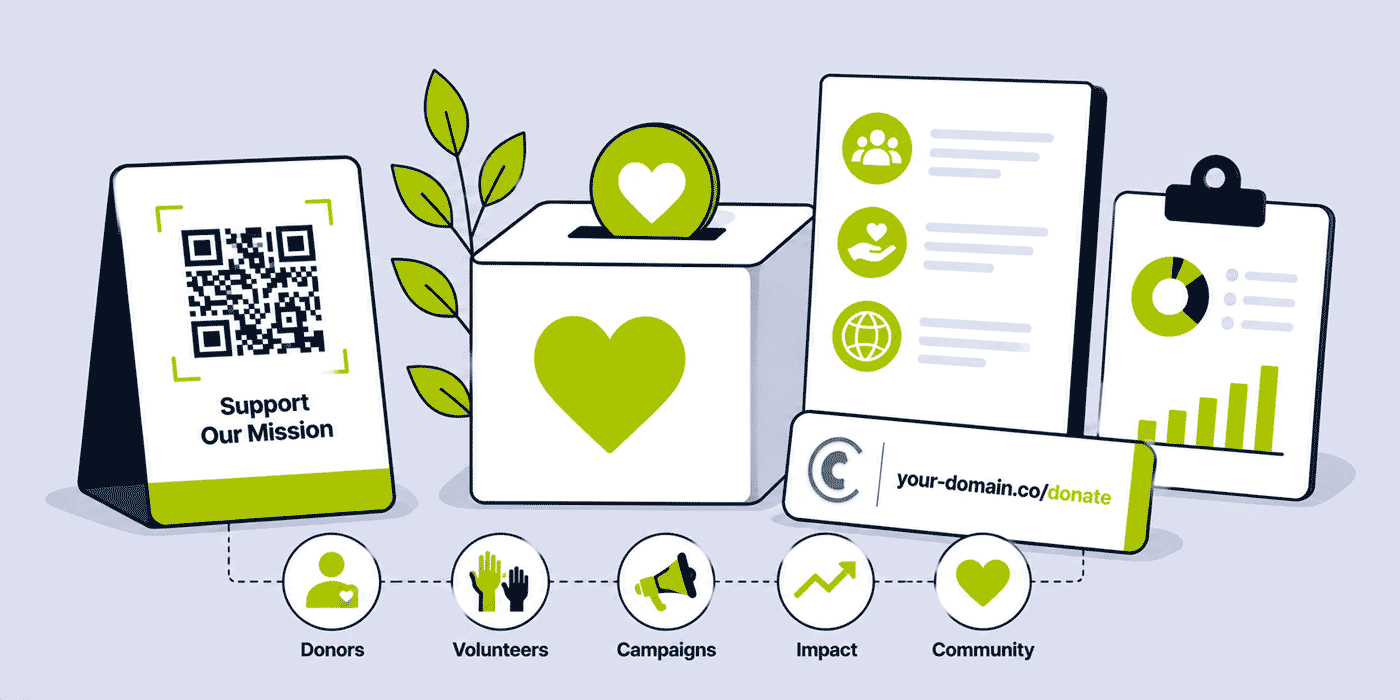
What This Guide Covers
- Why donor trust requires branded links — the fraud context in fundraising
- Donation links: the highest-value short link for any nonprofit
- Donor attribution: understanding which channels drive donations
- Direct mail and print fundraising: dynamic QR Codes for limited budgets
- Crowdfunding and peer-to-peer fundraising campaigns
- Event fundraising: sponsored events, galas, and community events
- Volunteer recruitment and management
- Beneficiary communications and service access
- Multi-programme analytics for programme management
- Grant reporting: digital reach evidence from link analytics
- Social media fundraising across platforms
- Email and newsletter fundraising
- Corporate partnership and major donor communications
- Advocacy and campaigning links
- Annual report and impact communication
- Which Cuttly plan nonprofits should use (including free)
Why Donor Trust Requires Branded Links
Charity fraud is a documented and significant problem. In the UK, Action Fraud and the Charity Commission regularly warn donors about fraudulent donation collection campaigns that impersonate legitimate charities — using fake social media accounts, fraudulent crowdfunding pages, and, critically, short links in email and SMS appeals that appear to be from genuine charities but route to criminal payment collection pages.
This fraud context means that every donation link a genuine charity distributes in an email appeal, a social media post, or an SMS campaign carries an inherent trust burden. The donor receiving the link has no way to verify, without examining it carefully, whether the link is from the real charity or from a fraudster impersonating it. A generic short link on a shared platform domain provides no verification mechanism — it looks identical to a fraudulent link. A branded short link on the charity's own official domain is a domain the donor can verify.
A donor who has received multiple communications from a charity with links on give.charityname.org or links.charityname.org.uk learns to recognise that domain as the charity's official link identity. A fraudulent email claiming to be from the charity but using a different domain is immediately distinguishable — the domain is wrong. This is the anti-fraud value of branded short links for nonprofits, and it is the argument for making them a communications standard rather than an optional upgrade.
The trust value is reinforced by the analytics value: branded short links with per-channel tracking show which communications channels are driving donor engagement. Without this data, a fundraising team cannot make evidence-based decisions about where to invest increasingly scarce communications resources.
Donation Links: The Highest-Value Short Link
For any nonprofit that accepts online donations, the link to the donation page is the most commercially important link the organisation manages. Every print material, email, social media post, SMS appeal, and event communication that includes a donation prompt should use a clean, branded, professionally presented donation link.
Create a stable, memorable donation short link: give.charityname.org/donate or links.charityname.org.uk/give. This link appears on: the charity's website in the most prominent position, the email newsletter footer, every appeal letter and direct mail piece, every social media bio (via Link in Bio), printed collection materials, event programmes, annual reports, and every staff email signature.
Create separate short links per campaign — all routing to the same donation page, differentiated by campaign parameter. A Christmas appeal donation link (give.charityname.org/christmas-2026), a spring campaign link (give.charityname.org/spring-2026), and an emergency appeal link (give.charityname.org/emergency-flood) each generate independent link analytics. Comparing per-campaign donation link click volumes shows which appeal type generates the most donor engagement. Over multiple years of data (1 year of analytics history on the Single plan, 2 years on Team), seasonal patterns in donation link engagement are visible — informing the annual fundraising calendar.
UTM parameters on donation links (Cuttly's built-in UTM builder, all plans including free) pass campaign attribution through to the charity's website analytics or donation platform. When a donor clicks the email appeal link and completes a donation, the donation platform's analytics shows the donation attributed to the email campaign. This two-layer attribution (Cuttly for click-level data, donation platform for gift completion) provides the full fundraising funnel picture: from which channel the donor came, through how many clicked the donation link, to how many completed a gift.
Donor Attribution: Understanding Which Channels Drive Donations
Donor attribution — understanding which communications activities lead to donations — is one of the most important and most poorly answered questions in nonprofit fundraising. Most charities cannot reliably attribute a specific donation to a specific communication because they have no per-channel tracking mechanism. They know how many donations they received in a period, but not which of their many simultaneous activities (email appeals, social media, direct mail, SMS, events) generated them.
Per-channel tracked short links answer this question. A winter appeal campaign that simultaneously distributes links via email newsletter, Instagram posts and stories, direct mail QR Codes, SMS to lapsed donors, and a corporate partner email — each with a different tracked short link routing to the same donation page — generates per-channel click data throughout the appeal window. After the campaign, comparing clicks per channel (adjusted for the size of each channel's audience where known) reveals relative channel productivity.
Combined with the donation platform's UTM attribution data (showing completed gifts per source), the charity can see: email generated 340 donation link clicks and 28 completed donations (8.2% click-to-gift conversion); direct mail QR Codes generated 85 clicks and 12 donations (14.1% conversion); SMS generated 210 clicks and 8 donations (3.8% conversion). The direct mail QR Code has the highest click-to-gift conversion rate — suggesting that donors who engage with the physical appeal are more committed to giving than those who engage digitally. This insight informs the next campaign's direct mail investment.
This kind of evidence-based fundraising optimisation is accessible to nonprofits of any size — the only requirement is the discipline of creating separate tracked short links per channel per campaign and reviewing the analytics systematically after each appeal.
Direct Mail and Print Fundraising: Dynamic QR Codes on Limited Budgets
Direct mail — appeal letters, impact reports, donation envelopes, collection point cards — remains one of the most effective fundraising channels for many established charities, particularly for engaging older donor demographics. The challenge: print runs are expensive, print lead times are long, and the digital call to action in a printed piece (the donation URL or QR Code) must remain functional for the entire distribution period, which may be months.
Dynamic QR Codes from Cuttly branded short links solve the print campaign URL problem: a QR Code printed on 50,000 appeal letters routes to the current campaign donation page, not a static URL that might change if the fundraising platform migrates. When the campaign closes and the donation page is replaced by a "thank you" page, the short link destination is updated — all 50,000 printed QR Codes automatically route to the updated destination. The same QR Code template can be used across multiple appeal cycles, with only the Cuttly short link destination updated between campaigns.
For charities with very limited print budgets, the dynamic QR Code benefit is particularly valuable: a printed annual report that cost £5,000 to produce and distribute does not need a reprint if the donation platform URL changes during the 12 months the report is in circulation. The QR Code destination is updated in Cuttly; the report remains current.
QR Code design for charity print materials: download in SVG format from Cuttly for professional print production. Use the charity's brand colours (meeting WCAG contrast requirements for accessibility). Error correction level H for print resilience. Include a brief text call to action near the QR Code: "Scan to donate" or "Scan for more information." Testing the QR Code scan before the print run goes to press is mandatory — a QR Code that does not scan in the final printed format has rendered the call to action in thousands of appeal letters completely ineffective.
Crowdfunding and Peer-to-Peer Fundraising
Crowdfunding campaigns — on platforms like JustGiving, GoFundMe Charity, Enthuse, Crowdfunder, and others — and peer-to-peer fundraising (supporters who create their own fundraising pages for a sponsored event, birthday fundraising, or personal challenge) generate long, platform-specific URLs that are difficult to share effectively in social media, WhatsApp messages, and physical materials.
A branded short link to a crowdfunding campaign page — give.charityname.org/london-marathon-2026 — is shareable in a tweet, an Instagram caption, a WhatsApp message to friends and family, and on a race number back-banner, in a way that www.justgiving.com/campaign/london-marathon-2026-charityname-long-slug is not. The short link makes the campaign accessible from every channel the charity promotes it in.
For peer-to-peer fundraising pages (individual supporter pages), each supporter's page gets its own unique short link for tracking: give.charityname.org/team-sarah. Analytics show which peer fundraisers are generating the most campaign traffic — useful for identifying the charity's most effective peer ambassadors and investing additional support and recognition in cultivating those relationships.
A Cuttly Action Page (Single plan+) serves well as a campaign hub for a major fundraising appeal: the event name and date, how much the charity aims to raise, what the funds will achieve (specific programme impact), a progress tracker towards the goal (manually updated as the campaign progresses), featured supporter fundraising pages, and a primary "Donate Now" CTA button. Accessible via a branded short link, the Action Page is a campaign landing page created without website development resource.
Event Fundraising: Sponsored Events, Galas, and Community Events
Fundraising events — charity balls and galas, sponsored runs and walks, community fetes, quiz nights, auction evenings — are high-effort, high-revenue activities for many nonprofits. The link infrastructure for an event spans the full event cycle: pre-event promotion and registration, on-the-day experience and giving, and post-event follow-up and stewardship.
Pre-event: a branded short link to the event registration or ticket purchase page (give.charityname.org/gala-2026), promoted across email, social media, direct mail, and through corporate partners and major donors. Per-channel tracked links show which promotional channel is driving event registrations. A corporate partner email that generates 40 registration link clicks from 200 employee recipients (20% engagement rate) is an extremely productive channel — worth replicating for future events.
On-the-day: a QR Code displayed on tables at a gala dinner linking to a mobile donation page for those who have not yet made a gift, or a mobile auction bidding platform. A cashless collection QR Code for street collections, community events, and public fundraising stands — in markets where contactless giving has overtaken cash giving, a QR Code on a collection bucket linking to a mobile donation page is the functional replacement for the coin.
Post-event: a short link to the post-event survey (Cuttly Surveys, all plans including free) gathering attendee feedback on the event experience. The survey results inform future event planning and provide evidence of attendee satisfaction for reporting to event sponsors and corporate partners. A branded short link to the thank you page and impact update, sent in the follow-up email to all attendees, keeps the relationship warm and demonstrates stewardship.
Volunteer Recruitment and Management
Volunteers are the operational backbone of most nonprofits. Recruiting volunteers, onboarding them into specific programmes, communicating updates and schedules, and maintaining their engagement between active volunteering periods are all activities that involve links — to the volunteer application form, the role descriptions, the training resources, the scheduling platform, and the community communications.
A dedicated volunteer recruitment short link — links.charityname.org/volunteer — should be prominently placed on every channel reaching potential volunteers: the charity's website, its social media profiles, staff email signatures, event materials, and any corporate partnership communications (many companies actively support employee volunteering programmes and need a clear link to share with staff).
Per-source volunteer recruitment link tracking shows which channels reach people who are motivated to volunteer. Corporate employee volunteering campaigns often use a dedicated link per employer — links.charityname.org/volunteer-companyname — tracking how many employees from each corporate partner actually engage with the volunteer application. This data supports the corporate partnership relationship and provides evidence of programme uptake for the corporate's own CSR reporting.
Volunteer management communications — schedule updates, role changes, training resource links, community platform invitations — should use branded short links consistently. For charities that manage hundreds of active volunteers across multiple programmes, consistent branded links in all volunteer communications build the same trust dynamic as in donor communications: volunteers recognise the official domain and trust communications from it.
Multi-Programme Analytics for Programme Management
Nonprofits that run multiple distinct programmes simultaneously — a food bank, a youth mentoring programme, a housing advice service, and a community wellbeing project, for example — often struggle to measure and compare their programmes' digital reach and engagement because all programme communications generate undifferentiated data in a shared website analytics system.
Per-programme tagged short links solve this. Every communication for the food bank programme uses links tagged programme-foodbank; every communication for the youth mentoring programme uses links tagged programme-youth. Cuttly Campaigns (Team plan+) aggregates all links per programme tag, showing each programme's total digital engagement across all its communications channels — independently from the other programmes. Programme managers can view their programme's specific link analytics without seeing other programmes' data.
This programme-level analytics separation is valuable for: programme-specific performance reporting to programme commissioners, evidence of digital engagement for programme-specific grant applications, resource allocation decisions (which programme is generating the highest volunteer or beneficiary enquiry link engagement?), and programme team reporting to boards and trustees.
Grant Reporting: Digital Reach Evidence
Grant funders increasingly require evidence of reach and engagement alongside evidence of programme outcomes. A grant that funded a public awareness campaign, an event series, or a communications infrastructure investment will typically require the grantee to demonstrate that the funded activities reached the intended audience. Link analytics from tracked short links provide exactly this evidence.
A grant report narrative supported by link analytics might look like: "The campaign funded under this grant generated 4,200 website visits from social media channels (47% of total visits), 2,800 visits from our email newsletter (32%), and 1,100 visits via the direct mail QR Code (12%). The campaign's primary call-to-action link was clicked 8,100 times total across all channels, with 73% of clicks from mobile devices, indicating successful reach to our target demographic of 18 to 35-year-olds. The Cuttly Analytics export is included as Appendix D."
This kind of specific, quantified, channel-attributed digital reach evidence is significantly more compelling to grant funders than general statements about "extensive social media and email campaign activity." It demonstrates that the charity has the measurement infrastructure to know whether its communications activities are working — and that it is using that knowledge to manage its programmes responsibly.
The 1-year analytics history on Cuttly's Single plan covers most grant reporting periods (most grants fund activities over 6 to 24 months). For grants with 2 to 3-year programme durations, the Team plan's 2-year analytics history provides coverage without requiring manual data export and archival.
Advocacy and Campaigning Links
Nonprofits engaged in policy advocacy, public campaigns, and community organising have distinct link management needs alongside their fundraising and service delivery activities. Petition links, consultation response portals, campaign information pages, parliamentary correspondence tools, and event mobilisation links all benefit from branded short links with per-channel tracking.
An advocacy campaign asking supporters to write to their MP, sign a petition, or respond to a public consultation uses tracked short links to measure mobilisation: how many supporters clicked through to the action page, from which communication channels, and when during the campaign window. A campaign that deploys the same action link via email, social media, and a coalition partner network — with different tracked links per channel — can see how each mobilisation channel contributes to total action completions.
For coalition campaigns — where multiple charities campaign together on a shared issue — the lead organisation can provide each coalition partner with a unique short link to the shared campaign action page. Analytics per partner link show each organisation's mobilisation contribution to the overall coalition campaign. This data supports fair attribution of campaign outcomes across coalition members and provides evidence for each member's own reporting to their supporters and funders.
Password-protected short links (Single plan+) are useful for campaign coordination materials that are not intended for public distribution: coalition briefing documents, embargoed campaign announcements, strategic planning resources for campaign steering groups. A password-protected link to a campaign planning document, shared within the coalition's steering group and protected from broader public access, maintains operational security for the campaign's strategy while making the document easily accessible to authorised participants.
Annual Report and Impact Communication
A charity's annual report and impact summary — printed and digital — is its most comprehensive communication to donors, funders, corporate partners, and the public about what it has achieved and why continued support matters. Every call to action in the annual report (donate, volunteer, partner with us, follow us, subscribe to our newsletter) benefits from a branded short link and QR Code.
Annual reports often have long print lives — distributed at events, stocked in reception areas, posted to major donors — and the URLs within them must remain current throughout that period. Dynamic QR Codes from Cuttly short links ensure that a QR Code printed in the annual report continues to route correctly even if the charity's website undergoes a restructure during the year after printing.
Analytics on annual report links — the "donate now" QR Code, the "volunteer with us" link, the "follow us on social media" links — show how the printed report is generating digital engagement over time. A donation QR Code in the annual report that generates 15 to 20 scans per week in the month after distribution, declining to 2 to 3 scans per week three months later, shows the report's engagement lifecycle: high initial engagement among active supporters, declining to low-frequency engagement from materials left in circulation.
Which Cuttly Plan Nonprofits Should Use
The Free plan ($0, no credit card required) is the right starting point for every nonprofit, regardless of size. 30 links/month, 1 branded domain, basic QR Code generation, Cuttly Surveys for beneficiary and supporter feedback, UTM builder, and 30 days of analytics. For small nonprofits with limited active campaigns and basic link needs, the free plan provides all the core functionality needed to establish branded donation links, generate printed material QR Codes, and create feedback surveys. Registration required; free plan available immediately.
The Single plan ($25/month) is appropriate for active nonprofits with multi-channel fundraising programmes. 5,000 links/month covers all campaign activity. 1 year of analytics history covers standard grant reporting periods and enables year-over-year donor engagement comparison. Full QR customization with SVG export for professional printed appeal materials. Action Pages for campaign hubs. Password-protected links for restricted campaign and corporate partner materials. Link expiration for time-limited campaign windows.
The Team plan ($99/month) is appropriate for larger nonprofits with multiple programmes, multiple team members creating and managing links, or organisations that need Cuttly Campaigns for multi-programme analytics aggregation and grant reporting evidence. 2 years of analytics history covers longer grant periods. Shared workspace with role-based access allows programme managers to access their programme analytics independently. Team API for integration with CRM or fundraising database systems.
Start with Cuttly's free plan — no credit card required, 1 branded domain included. Create your organisation's donation short link, generate a QR Code for your printed appeal materials, and set up your first supporter feedback survey in under 20 minutes. Registration required; free plan available immediately.
Social Media Fundraising Across Platforms
Social media has become one of the most productive fundraising channels for many nonprofits — particularly for organic, mission-driven content that resonates with audiences already aligned with the cause. Instagram, Facebook, TikTok, LinkedIn, and Twitter/X each have distinct audience profiles and content formats; the link management approach needs to accommodate each platform's specific mechanism.
Instagram's single bio link constraint makes the Link in Bio page essential for nonprofits. A Cuttly Link in Bio page at cutt.bio/charityname or on the charity's branded domain (Single plan) aggregates all current high-priority destinations: the donation page (first and most prominent button), the current campaign action, the volunteer application, the upcoming events, the newsletter signup, and the latest impact report. The page is updated as campaigns and priorities change, without requiring a profile link change.
Analytics on the Link in Bio page show which destinations Instagram followers engage with most. If the donation button generates 3× the clicks of all other buttons combined, the Instagram audience is high donation intent — the content strategy should lean into donation conversion. If the volunteer application generates more clicks than the donation page, the Instagram audience is more action-oriented than financially oriented — volunteer recruitment content should be prioritised over donation appeals.
Facebook remains the most important social platform for many established charities, particularly those with older donor demographics. Facebook fundraisers (native to the platform) and linked donation pages both benefit from tracked short links. A Facebook post promoting a donation page with a tracked short link allows the charity to see how many post viewers clicked through — Facebook's native analytics shows post reach, but Cuttly analytics adds the donation link click data that Facebook's native tools do not always provide clearly.
TikTok is increasingly relevant for nonprofits reaching younger audiences — particularly for awareness campaigns and mission storytelling. A TikTok video that goes modestly viral (50,000 views is modest on TikTok) can generate substantial donation link clicks from an audience that might not be reachable through any other channel. A tracked short link in the TikTok bio, separate from the Instagram bio link, shows whether TikTok-driven traffic is converting to donation intent differently from other social platforms.
LinkedIn is relevant for corporate fundraising, major donor cultivation, and professional audience campaigns. A nonprofit's LinkedIn presence — thought leadership content from the CEO, impact reports, programme updates — reaches the corporate and professional audience from whom major gifts, corporate partnerships, and pro bono support are most likely to come. Tracked short links in LinkedIn posts, with analytics showing which content type drives the most profile and donation link engagement from the LinkedIn audience, inform the professional communications strategy.
Corporate Partnership and Major Donor Communications
Corporate partnerships and major donor relationships are the highest-value development activities for most nonprofits. They are built on personal relationships, regular communication, meaningful impact updates, and clear evidence of how the partnership investment is being used. The digital communications supporting these relationships — impact reports, project updates, stewardship briefings, invitation links to events — benefit from the same professional branded short link standards as all other nonprofit communications.
For corporate partners who have specific reporting requirements (CSR reporting, ESG evidence for annual reports, matching gift documentation), a password-protected short link to a dedicated partner impact page — links.charityname.org/partner-companyname-2026, password-protected for the specific partner — provides a professional, exclusive digital reporting experience. The partner accesses their tailored impact report through a branded, protected link; the analytics on that link show how many times the report was accessed and by whom in the corporate's network.
Major donor stewardship benefits from personalised digital touchpoints: a short link to a dedicated story about the impact of the donor's specific gift, a behind-the-scenes video from the programme funded by their donation, or a personalised thank you page with their name and impact summary. Analytics on these personalised links (from the Single plan's analytics history) show whether major donors are engaging with stewardship content — a high click rate on stewardship links correlates with renewed or upgraded giving in subsequent appeals.
Beneficiary Communications and Service Access
Nonprofits that provide direct services to beneficiaries — housing support, food provision, legal advice, mental health services, education programmes, employment support — communicate regularly with people in often challenging life circumstances. The digital access points to these services must be as clear, trustworthy, and easy to use as possible.
Short, branded links to service access pages — appointment booking systems, service information pages, self-referral forms, eligibility checkers — reduce the friction of accessing services for beneficiaries who may be navigating the charity's digital presence for the first time. A housing advice charity that uses help.charityname.org/housing in all its beneficiary communications creates a simple, memorable access point to its primary service.
QR Codes at service locations — food bank collection points, advice centre reception areas, community space notice boards — give beneficiaries a direct digital path to supplementary services, upcoming events, or the online components of a programme without requiring them to navigate to the charity's website from scratch.
For Cuttly Surveys distributed via a branded short link to programme participants: structured feedback from beneficiaries about their service experience is both operationally valuable (informing service improvement) and evidentially important for programme evaluation and grant reporting. A short, accessible survey (3 to 5 questions) with a QR Code at the service point generates far higher completion rates than a long survey sent by post or email. The survey data, exportable to PDF and XLS, becomes part of the programme's impact evidence framework.
Email and Newsletter Fundraising
Email remains the highest return-on-investment fundraising channel for most established nonprofits. A warm, engaged supporter email list — people who have previously donated, volunteered, attended events, or signed petitions — is the most commercially productive digital audience a charity manages. Every fundraising email, campaign update, and impact report delivered to this list contains links whose click performance reveals the audience's engagement with the charity's mission and specific asks.
The deliverability dimension is directly relevant to nonprofit fundraising: an email that lands in a supporter's spam folder generates zero donation clicks. Branded short links on the charity's own domain reduce the risk of the email being flagged by spam filters based on link domain reputation — the charity's email domain and its short link domain share a trust signal, rather than the email using a generic platform-domain link that carries shared reputation risk. See the email deliverability guide for the full technical detail.
Per-email tracked links show not just how many supporters clicked the donation link in a specific appeal, but when during the day and week they clicked (informing optimal send time for future appeals), from what device (mobile-dominant email click data confirms the need for mobile-optimised donation pages), and from which specific links within a multi-link email (which CTA — the header image link, the main body text link, or the footer link — generates the most clicks). This granular link-level data, available in Cuttly's analytics, complements the campaign-level click rate that the email platform provides.
Building a Culture of Measurement in Nonprofit Communications
The most valuable long-term benefit of implementing a structured branded short link and analytics infrastructure is not any single campaign's data — it is the culture of evidence-based decision-making that the infrastructure enables. A nonprofit communications team that reviews link analytics after every appeal, compares this year's channel performance to last year's, and uses that comparison to adjust the next campaign's channel mix is a team that gets better over time. Not through guesswork, not through copying what larger charities do, but through learning from their own specific audience with their own specific communications in their own specific cause context.
This is a significant capability advantage. Most charities do not have this measurement discipline — their communications are informed by tradition, instinct, and what worked last time in a general sense. The charity that tracks specific channel performance per campaign, manages per-programme analytics separately, and uses donor attribution data to allocate communications budgets is making every pound of its communications investment work harder than its less-measured peers.
The infrastructure required is not expensive. Cuttly's free plan is genuinely sufficient for many smaller nonprofits. The Single plan at $25/month is less than the cost of printing 200 additional appeal letters — and the analytics it provides are worth far more than 200 unattributed letters to any charity trying to understand and grow its supporter base. The return is not in the cost of the tool. It is in the quality of the decisions it enables.
Frequently Asked Questions
Why do nonprofits need a URL shortener?
To create trustworthy branded donation links (donors verify the charity's official domain), to track which channels drive donations and volunteer sign-ups for reporting, to make long fundraising platform URLs shareable in print, social and SMS, to use dynamic QR Codes on limited print budgets, and to build digital reach evidence for grant reporting.
Is Cuttly free for nonprofits?
Yes. The free plan ($0, no credit card) provides 30 links/month, 1 branded domain, QR Codes, surveys, and 30 days of analytics — sufficient for many smaller nonprofits. Single plan ($25/month) adds 1 year of analytics history for grant reporting, full QR customization, and Action Pages for campaign hubs.
How can nonprofits use QR Codes for fundraising?
On direct mail donation appeals (linking to online donation form), collection tins and buckets (cashless giving), annual reports and impact communications, exhibition displays, corporate partner materials, and event programmes. All dynamic — destinations updatable without reprinting materials.
How do nonprofits use link analytics for grant reporting?
Per-channel tracked links generate specific digital reach evidence: "the campaign generated X website visits from social media (Y%), Z from email (W%), N QR Code scans from direct mail." Cuttly CSV export is includable as an appendix to grant reports, providing concrete attribution data for funded communications activities.
- Tools
- URL Shortener →
- Link in Bio Builder →
- QR Code Generator →
- Link Analytics →
- Related Industry Guides
- URL Shortener for Nonprofits 2026 →
- URL Shortener for Government →
- URL Shortener for Healthcare →
- URL Shortener for Events →
- Related Guides
- What Is a Branded Short Link? →
- QR Code Best Practices 2026 →
- Link Tracking 101 →
- Password-Protected Short Links →
- URL Shortener Security →
- Verticals Hub
- URL Shortener for Every Industry →
- Start Here
- Create Free Account
- Plans & Pricing
URL Shortener
Cuttly simplifies link management by offering a user-friendly URL shortener that includes branded short links. Boost your brand’s growth with short, memorable, and engaging links, while seamlessly managing and tracking your links using Cuttly's versatile platform. Generate branded short links, create customizable QR codes, build link-in-bio pages, and run interactive surveys—all in one place.
Cuttly - Consistently Rated
Among Top URL Shorteners
Cuttly isn’t just another URL shortener. Our platform is trusted and recognized by top industry players like G2 and SaaSworthy. We're proud to be consistently rated as a High Performer in URL Shortening and Link Management, ensuring that our users get reliable, innovative, and high-performing tools.


