URL Shortener Security: How to Protect Your Brand from Link Hijacking
The same mechanism that makes URL shorteners useful — hiding a long destination URL behind a short, shareable link — also creates security surface area. Short links are used in phishing attacks to disguise malicious destinations. They are used in smishing campaigns that impersonate trusted brands. They create brand impersonation risks when generic platform domains are used instead of branded ones. And they introduce account security dependencies: if the account that controls a short link is compromised, every link in that account is a potential weapon. This guide covers the full security and brand protection landscape of URL shorteners: the specific threat vectors, how each one works technically, the real-world consequences for brands, and the concrete defences available. The most important defence — consistent use of branded short links on a domain you own — is also the one that improves CTR and trust. Security and marketing alignment is not always this convenient.
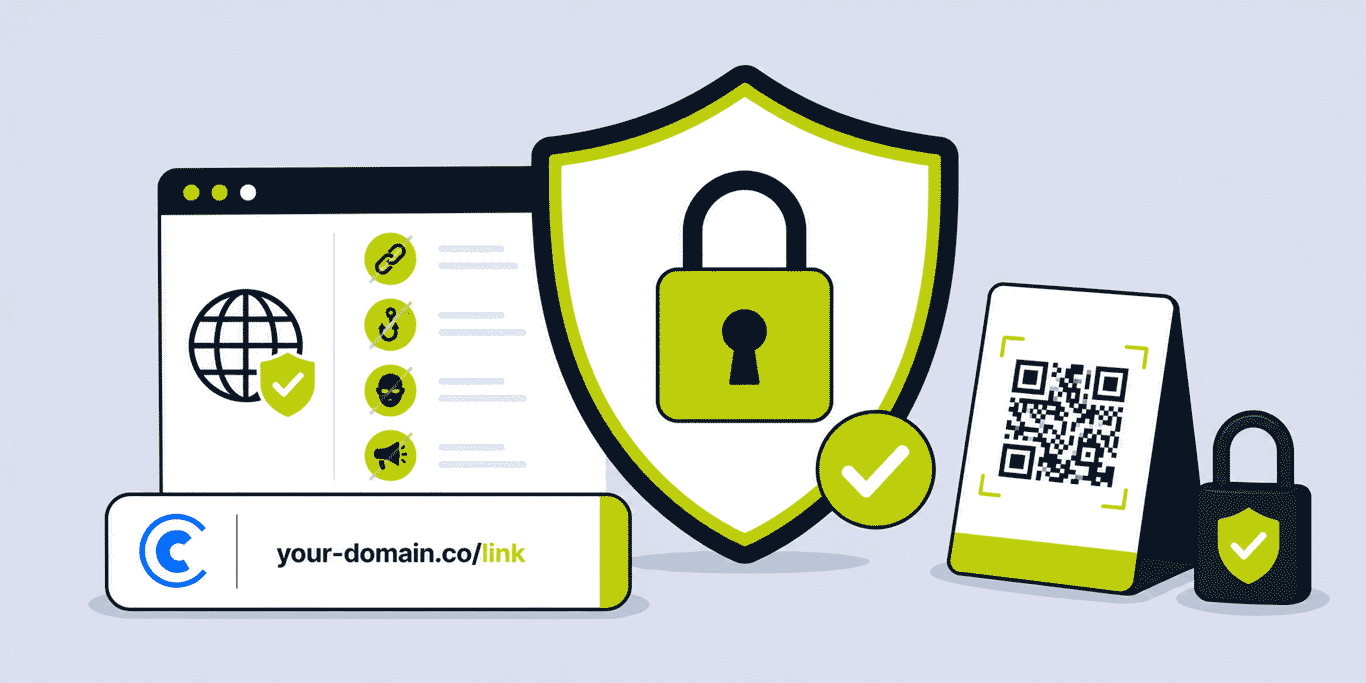
What This Guide Covers
- The URL shortener threat landscape — six distinct attack vectors
- Phishing via shared-domain short links: how it works and why it's effective
- Smishing: why branded domains in SMS are a security necessity, not a preference
- Domain impersonation: typosquatting and confusable domain attacks
- Account takeover: protecting short link accounts from compromise
- Domain expiry exploitation: the sleeper threat in branded link programmes
- Open redirect exploitation: how legitimate domains become phishing vectors
- Destination URL manipulation: what happens when link destinations change
- How branded short domains structurally reduce the attack surface
- Cuttly's security infrastructure: Safe Redirecting, abuse detection, blocked links
- Team and organisational security: access control for link management
- Reporting and incident response for compromised short links
- The broader brand protection framework for link management
The URL Shortener Threat Landscape
URL shorteners exist at the intersection of three security-relevant properties: they obscure the destination from recipients before they click, they are easily created by anyone, and they leverage trusted-looking domains that may pass through security filters. These properties make them an attractive tool for attackers — and they make the security posture of a brand's link infrastructure a meaningful security concern, not just a marketing one.
The six primary attack vectors in the URL shortener security landscape:
- Phishing via shared-domain short links — creating links on generic shortener platforms that redirect to malicious pages, distributed as if from a legitimate brand
- Smishing (SMS phishing) — using short links in SMS campaigns that impersonate trusted organisations
- Domain impersonation — registering domains that look like a brand's short domain to create lookalike links
- Account takeover — compromising a brand's URL shortener account to modify link destinations
- Domain expiry exploitation — registering an expired branded short domain to intercept existing traffic
- Open redirect exploitation — using a vulnerable redirect endpoint on a legitimate domain to construct phishing URLs that appear to originate from that domain
Not all of these vectors are equally relevant to every organisation. A small independent business faces different exposure than a financial institution or a healthcare provider. But the structural defences — primarily the consistent use of branded short domains with strong account security — address multiple vectors simultaneously and are accessible to organisations of every size.
Phishing via Shared-Domain Short Links
The most widespread URL shortener security threat is phishing that leverages shared shortener platforms. The attack pattern is straightforward: an attacker creates a free account on a well-known URL shortener, creates a short link pointing to a malicious page (a credential harvesting login form, a malware download, a fake payment page), and distributes the short link via email, social media, or SMS claiming to be from a trusted brand.
The attack exploits two specific vulnerabilities. First, the recipient cannot see the destination URL before clicking — the short link conceals it. Second, the short link's domain is the shortener platform's domain (a widely recognised name that may have established email filter and browser reputation), not a suspicious unknown domain that security filters would flag.
From the attacker's perspective, this approach has historically been cost-effective: creating a free short link on a generic platform takes 30 seconds and requires no domain registration or hosting. The platform's domain reputation provides cover. And because the link is on a shared platform used by millions of legitimate users, blanket blocking of the entire platform domain is not viable for email or SMS filters — they cannot block all links from that domain without disrupting legitimate communication.
Reputable URL shortener platforms actively combat this. Cuttly maintains an internal system — Cuttly Safe Redirecting — that analyses links for suspicious content and blocks those that violate platform regulations. Phishing and spam links are actively identified and blocked. Users can report suspicious links at cutt.ly/report. When Cuttly's Safe Redirecting system flags a link, users who click it see a warning screen rather than being redirected to the malicious destination.
The brand protection implication: if your organisation uses a generic shared-domain shortener for communications, your recipients cannot distinguish your legitimate links from attacker-created links on the same platform domain. A phishing email claiming to be from your organisation with a link on a shared shortener domain looks identical in structure to your legitimate communications. The structural defence is the branded short domain: go.yourorganisation.com/link requires the attacker to compromise your domain specifically, rather than just creating a free account on a shared platform.
Smishing: Why Branded Domains in SMS Are a Security Necessity
Smishing — SMS-based phishing — has grown substantially in documented incident rates across multiple markets. The UK's National Cyber Security Centre, the US FTC, and equivalent agencies in Australia, Canada, and major European markets have all issued public guidance about smishing attacks. The common pattern: an SMS message appearing to come from a bank, delivery company, government agency, or other trusted organisation, containing a short link to a malicious page designed to harvest credentials, install malware, or steal payment information.
SMS is a particularly effective smishing vector for several reasons: SMS is opened and read by nearly 100% of recipients, the channel has limited metadata for security analysis (unlike email, which carries extensive headers and authentication signals), and mobile browsers may not display the full URL clearly before a tap commits to navigation.
For organisations that use SMS for legitimate customer communications — delivery notifications, appointment reminders, service alerts, authentication codes — the smishing threat directly affects how recipients respond to legitimate messages. A customer who has been warned about parcel delivery smishing attacks is suspicious of any SMS with a short link claiming to be about their parcel. If the legitimate carrier's SMS uses a generic short link domain, that suspicion is not resolved by looking at the link — the link looks exactly like a smishing attack.
Branded short links in SMS resolve this suspicion immediately and structurally. A recipient who receives an SMS from "Royal Mail" (or their bank, or their insurer) and sees a link on go.royalmail.com (or links.theirbank.com) can recognise that domain as belonging to the organisation the SMS claims to be from. An attacker would need to compromise that specific domain — a substantially higher bar than creating a free account on a shared shortener.
This is not a theoretical advantage. Consumer awareness campaigns specifically instruct people to check the domain in a link before clicking — not just whether it looks "right" in the surrounding text, but what domain the URL is on. A link on the organisation's own branded domain passes this check; a generic short link does not.
For Indian market SMS specifically: TRAI's DLT regulatory framework (described in Cuttly's TRAI SMS compliance guide) requires SMS links to use registered headers and approved sender identities. This regulatory requirement aligns with the security rationale: traceable, registered sender identity in SMS links reduces the viability of impersonation.
Domain Impersonation: Typosquatting and Lookalike Attacks
Domain impersonation attacks use domains that closely resemble a target brand's domain — differing by a single character, using homoglyphs (visually similar Unicode characters), adding hyphens, or using different TLDs — to create links that appear to be from the brand to inattentive recipients.
In the URL shortener context, the specific risk is that an attacker registers a domain that looks like the brand's branded short domain, creates links on that domain, and distributes them in communications claiming to be from the brand. Recipients who check the domain but not carefully enough may not notice the difference between go.yourbrand.com (legitimate) and go.yourbrand-secure.com, go-yourbrand.com, go.y0urbrand.com (zero instead of 'o'), or go.yourbrand.co (different TLD).
Defensive registrations: brands that use branded short domains should consider registering the most confusable variants of their short domain — typosquatted versions, hyphen variants, common TLD alternatives (.link, .io, .co alongside your primary TLD). Redirect these defensive registrations to your legitimate domain with 301 redirects. This converts domains an attacker might use into harmless redirects. The cost is typically $10 to $20 per domain per year — a low absolute cost for eliminating obvious impersonation vectors.
Domain monitoring: services that monitor for newly registered domains that are confusable with your brand's domains (brand monitoring tools, domain watch services) alert you when an impersonation domain is registered, enabling rapid response (legal action, hosting provider reporting, Google Safe Browsing reporting) before the attack reaches significant scale.
Homoglyph attacks: Unicode characters that are visually indistinguishable from ASCII characters — the Cyrillic 'а' versus the Latin 'a', for example — can be used to register domains that appear identical to a brand's domain in most rendering contexts. Defences: register IDN (Internationalized Domain Name) versions of your branded domains, and use monitoring services that include Unicode lookalike detection.
Account Takeover: Protecting Link Management Accounts
If an attacker gains access to your URL shortener account, they can modify the destination of every short link in the account — silently routing your existing traffic, from every channel where your links appear, to malicious destinations. This is a high-consequence attack: your legitimate communications become the delivery mechanism for phishing, malware, or reputation damage, with no indication to recipients that anything is wrong (the links remain branded with your domain).
The attack vector for account takeover is typically: password reuse from another breached service, credential phishing targeting your team, or a weak password that can be brute-forced or guessed. The organisational risk is amplified if a personal API key (tied to one individual's account) rather than a workspace-level Team API key is used for production link generation — a compromised individual's account gives the attacker access to that person's entire link portfolio, including production links.
Defences against account takeover:
Two-factor authentication (2FA): Cuttly supports both OTP (email code) and authenticator app 2FA (Two-Factor Authentication using any compatible authenticator app). Enable 2FA on every account that manages production short links. 2FA is available on all Cuttly plans. An attacker who has a compromised password cannot access the account without the second factor.
Strong, unique passwords: use a password manager to generate and store a unique, strong password for the Cuttly account. Never reuse the password from another service. A password that has been leaked in another service's data breach is immediately usable for credential stuffing attacks against accounts that share it.
Team API keys over personal API keys for production: as described in the Team API vs Personal API architectural guide, a workspace-level Team API key is not tied to any individual. A compromised individual's personal account does not give an attacker access to the team workspace's production links. Team API keys are available from the Team plan.
Principle of least privilege for team access: Cuttly's Team plan role system (Owner, Admin, Moderator, User, Viewer) allows assigning team members the minimum access level needed for their function. A social media manager who needs to create short links but does not need to manage team settings or generate API keys should have User role, not Owner role. Limiting the number of accounts with Owner or Admin access reduces the attack surface for account takeover with high-privilege consequences.
Regular link destination auditing: periodically review active short link destinations to confirm they still route to the correct pages. Any unexpected destination change is a potential indicator of account compromise or inadvertent modification. This is particularly important for evergreen links that have been active for months or years and appear in permanent materials (printed brochures, packaging, book content).
Domain Expiry Exploitation
Domain expiry exploitation is a particularly insidious threat because it can compromise links that appeared completely secure — on the brand's own verified domain — without any account compromise. The mechanism: a branded short domain is allowed to expire (accidentally or through administrative oversight), the domain drops back into the open registration pool, and an attacker registers it.
The attacker now owns the domain that all existing short link materials route through. Any QR Code printed on packaging, any business card distributed, any link shared in a social media post or email that contains the now-attacker-controlled domain will route to wherever the attacker points it. The original links are now attack infrastructure.
This is not a hypothetical scenario. High-profile domain expiry incidents involving legacy domains with significant organic traffic have been documented in security research. The value of an expired domain with existing inbound links and traffic is well understood by domain speculators and malicious actors — valuable domains are registered within minutes of becoming available.
Defences:
Enable auto-renewal on every branded short domain without exception. At your domain registrar, turn on automatic renewal for your branded short domain and every defensive registration you hold. Set the payment method to a credit card with a sufficient credit limit and no near-term expiry. Register for domain expiry notification emails and ensure they go to a monitored inbox — not a personal email account of someone who might leave the organisation.
Register domains for multi-year periods. Renewing for 5 to 10 years at once reduces the number of renewal events and the associated risk of administrative oversight. It also signals domain ownership stability to search engines and provides advance warning of expiry well before the critical window.
Document domain ownership in an asset register. Every branded short domain used in marketing materials — including legacy domains from previous brand versions or campaigns — should be documented in an organisational asset register alongside its renewal date, the registrar account, and the payment method on file. Domain management should not depend on any single person's institutional memory.
Audit printed materials for old domains. When a domain is intentionally retired (after a rebrand, for example), identify all printed materials that contain the old domain — packaging, brochures, signage, books, product manuals — and plan either maintaining the redirect infrastructure for those materials' expected lifespan or destroying/replacing the materials. Retiring a domain without accounting for its presence in long-life printed materials is the most common path to inadvertent domain expiry exploitation risk.
Open Redirect Exploitation
An open redirect vulnerability occurs when a legitimate website or application accepts a destination URL as a parameter and redirects visitors to it without validating whether the destination is safe or within an expected domain. If an attacker discovers such a vulnerability, they can construct a URL on the legitimate domain that redirects to their malicious destination — legitimatedomain.com/redirect?url=malicious-page.com/phishing.
The threat in the URL shortener context: if a URL shortener platform has an open redirect vulnerability, or if a brand's website has an open redirect that can be combined with a short link to create a seemingly legitimate multi-hop link, attackers can create URLs that appear to originate from trusted domains but route to malicious destinations.
More practically for brands using short links: the open redirect risk is on the brand's own website, not just on the shortener platform. A login authentication endpoint, a social sharing redirect, or a referral tracking parameter that accepts arbitrary destination URLs without validation can be exploited to construct phishing URLs that display your domain in the browser address bar long enough for the victim to see it before the redirect completes.
Defence: ensure your web development team audits all redirect endpoints for open redirect vulnerabilities. Any endpoint that accepts a destination URL as a parameter must validate that the destination is within an allowed domain list before executing the redirect. OWASP's guidance on open redirect prevention is the appropriate technical reference. Periodic penetration testing should include open redirect testing for any redirect-accepting endpoints on your domain.
Destination URL Manipulation and the Kill Switch
In addition to external attacks, brands face an internal security scenario: the unintended or malicious modification of a short link's destination URL — whether through account compromise, inadvertent editing, or deliberate insider action. A high-traffic short link that is redirected to a competitor's website, a harmful page, or a wrong internal destination represents both a security incident and a marketing incident.
The primary defence is operational: regular destination URL auditing (reviewing that active links route to the correct destinations) and access control (limiting who can edit link destinations). But when an incident is discovered — a modified destination routing users to unintended content — speed of response is critical.
Cuttly provides the ability to disable a short link immediately from the dashboard, redirecting it to a neutral destination or stopping it from routing entirely. This is the "kill switch" capability described in the Cuttly article on kill switch architecture. The time from incident discovery to link disablement can be under one minute if the account holder is alerted and able to act. For production links in high-traffic contexts, ensuring that the person responsible for link management can be reached quickly in an incident is part of the brand protection posture.
For the Team plan, any Team Owner or Admin can disable or modify links — not just the original creator. This shared administrative access is specifically valuable for incident response: if the original link creator is unavailable, another authorised team member can act immediately.
Cuttly's Security Infrastructure
Cuttly operates several security mechanisms that protect users and their audiences from link-based threats:
Cuttly Safe Redirecting: an internal system that analyses shortened links for suspicious content and blocks those that violate Cuttly's platform regulations. When this system blocks a link, users who click it see a warning screen rather than being redirected to the potentially harmful destination. This system actively monitors for phishing, malware distribution, and spam links across the platform.
Abuse reporting: any suspicious Cuttly link can be reported at cutt.ly/report. Reported links are reviewed; confirmed violations result in the link being blocked and the account reviewed.
Domain rejection: Cuttly reserves the right to reject custom domain additions that violate its Terms of Service — including domains associated with spam, phishing, or unethical content. Domains on recognised cybersecurity blacklists (Google Safe Browsing, Spamhaus, SURBL) are rejected. This protects the platform from being used with malicious domain infrastructure.
Chained redirect prohibition: links that contain more than one redirect (excluding affiliate tracking links) are prohibited under Cuttly's Terms of Service. This prevents the creation of multi-hop chains designed to obscure malicious destinations behind multiple layers of trusted domains.
GDPR compliance: Cuttly is GDPR compliant. Analytics data is aggregated and anonymised — no personally identifiable information about link clickers is collected or shared. This is relevant to the security posture: user privacy in analytics is a security consideration as well as a compliance one.
Team and Organisational Security: Access Control for Link Management
For organisations managing links at scale — marketing teams, agencies, multi-location businesses, SaaS companies with API-based link creation — the internal access control model is as important as external threat defences. Inappropriate internal access creates risk: a departing employee with Owner-level access to a production link account, a shared account password known to many team members, or an API key hardcoded in application code all represent controllable risk.
Role assignment: assign team roles according to the principle of least privilege. Most team members need User or Moderator access — sufficient to create and manage links, but not to generate API keys, add domains, or change team settings. Only technical leads and account owners who genuinely need full access should have Admin or Owner roles.
Offboarding process: when a team member leaves, their access should be removed from all shared accounts and team memberships as part of the standard offboarding process. If their departure is sudden or for adverse reasons, this access removal should happen the same day. The Team plan's role system enables targeted access removal without disrupting other team members' access.
API key management: document every API key, its intended use, and who is responsible for it. Rotate keys when the responsible person leaves. If an API key may have been compromised, generate a new key immediately — the previous key is invalidated instantly on generation of the new one. Ensure the new key is updated in all integrations before announcing the rotation, to minimise downtime.
Registry and audit: Cuttly's Team plan includes a Registry feature — a log of recent actions within the team. Regular review of the Registry shows which links were created, modified, or deleted and by whom. Unexpected modifications to high-value links are detectable through this log before they affect significant traffic.
The Broader Brand Protection Framework
URL shortener security sits within a broader brand protection framework that includes: trademark monitoring (watching for domain and social media registrations that impersonate your brand), dark web monitoring (checking whether credentials associated with your organisation appear in breached data repositories), phishing simulation training (educating employees to recognise phishing attempts, including those that may target your organisation's customers through your brand identity), and incident response planning (having a documented process for responding to a link compromise, domain impersonation incident, or account takeover before the incident occurs).
The link management layer of brand protection — using branded short domains, enabling 2FA, practising domain auto-renewal, maintaining access control, and regularly auditing link destinations — is one of the most accessible and cost-effective components of this framework. It does not require specialist security expertise. It does not require significant budget. And unlike many security measures that exist in opposition to usability, these practices actively improve the marketing performance of the link infrastructure at the same time as they improve its security posture.
A brand that uses branded short links on its own domain, secures its Cuttly account with 2FA and strong credentials, auto-renews its short domains, limits access to appropriate team roles, and periodically audits link destinations has addressed the primary URL shortener security surface area without specialist intervention. The URL shortener becomes a defended asset rather than a vulnerability.
Recipient Education: Training Your Audience to Recognise Your Links
Technical defences protect the infrastructure. Recipient education protects the human layer. Even with perfect branded short link implementation and strong account security, there is a remaining risk: recipients who have not been specifically trained to recognise your branded domain may not notice a lookalike domain in a phishing attack. And recipients who have been trained — explicitly or implicitly through consistent exposure to your branded domain — have a meaningful additional layer of protection.
Implicit training through consistency: when every communication from your organisation uses the same branded short domain — go.yourorganisation.com — over months and years, your audience becomes familiar with it. They recognise it as "ours." Any deviation becomes suspicious by contrast. This is exactly the trust dynamic that makes branded short links valuable for CTR, and it is simultaneously a security training mechanism. Consistent use of your branded domain trains your audience to expect it — and to be suspicious when they do not see it.
Explicit education: for organisations with high phishing risk — financial institutions, healthcare providers, government agencies, large employers — explicit communication to customers and employees about what your legitimate links look like is appropriate and demonstrably effective. A bank that communicates "our links always appear on go.ourbank.com — never click a link claiming to be from us that appears on any other domain" is providing specific, actionable protection to its customer base.
This education is most effective when the brand has already committed to consistent branded short links. A bank that sends links on three different shortener domains cannot give customers a clear, consistent signal to look for. A bank that exclusively uses go.ourbank.com on every email, SMS, and push notification can communicate that domain name as the one definitive trust signal with genuine clarity.
Security Checklist for URL Shortener Brand Protection
Infrastructure
- ☐ Branded short domain registered and connected to Cuttly — not using generic platform domain
- ☐ Auto-renewal enabled on all branded short domains at domain registrar
- ☐ Defensive domain registrations in place for confusable variants
- ☐ Domain asset register documents all short domains, expiry dates, and responsible owners
Account Security
- ☐ 2FA enabled on all Cuttly accounts with access to production links
- ☐ Unique strong passwords — not reused from any other service
- ☐ Team API key used for organisational integrations (not personal API keys)
- ☐ Team roles assigned at minimum privilege level for each team member
- ☐ Offboarding process includes removal of Cuttly access on day of departure
Ongoing Operations
- ☐ Periodic link destination audit — verify high-value links route to correct destinations
- ☐ Registry review — periodic check of team link creation and modification log
- ☐ Incident response plan documented — who is notified, who acts, what is done first
- ☐ Kill switch access — confirm team members who can disable links in an emergency are reachable 24/7
- ☐ Domain monitoring — alert system for confusable domain registrations
The security of your link infrastructure is directly proportional to the consistency with which your organisation treats it as an asset worth protecting. Branded short domains, strong account security, auto-renewal, access control, and regular auditing are not sophisticated interventions — they are standard operational hygiene for any organisation whose communications and marketing depend on links working correctly, and reaching the right destination, every time.
Why Security and Marketing Alignment Matters Here
The most important observation about URL shortener security is that the primary technical defence — branded short links on your own domain — is also the practice with the strongest positive marketing ROI. It improves click-through rates, improves email deliverability, builds brand recognition, and reduces friction from recipients suspicious of generic domains. The same investment that protects your audience from impersonation attacks also makes every link you send more effective.
This alignment between security and marketing performance is unusual. Security measures often trade convenience or performance for protection. Here, the tradeoff is reversed: the insecure option (generic platform-domain short links) is also the lower-performing option on every commercial metric. The secure option (branded short links) is also the higher-performing option. The security case reinforces the marketing case. For any organisation evaluating its link infrastructure, this alignment should eliminate any remaining hesitation about the investment in a branded short domain and proper account security.
Protecting your brand from link hijacking is not a separate security project — it is part of building the professional, trusted link infrastructure that your marketing and communications already need.
Frequently Asked Questions
Can someone hijack a short link and redirect it somewhere else?
On reputable platforms with proper access controls, third parties cannot modify your short links without access to your account. The realistic risks are account compromise (weak credentials, no 2FA), domain expiry (expired branded domain can be re-registered by attackers), and alias squatting on shared-domain platforms. Defence: 2FA, strong unique password, domain auto-renewal, branded short domain.
How do fraudsters use URL shorteners for phishing?
Attackers create free accounts on generic shortener platforms, create links to malicious destinations, and distribute them appearing to be from trusted brands. The generic domain provides cover because it is widely used by legitimate users. Branded short links on your own domain require attackers to compromise your specific domain — a much higher bar.
What is link hijacking in the context of URL shorteners?
Four forms: (1) account takeover — modifying link destinations after gaining account access; (2) domain impersonation — lookalike domains mimicking your branded short domain; (3) domain expiry exploitation — registering your expired branded domain; (4) open redirect exploitation — using a vulnerable redirect on a legitimate domain. Each has specific defences: 2FA, defensive domain registration, auto-renewal, application security auditing.
How does a branded short domain protect against phishing impersonation?
Attackers cannot create links on your branded domain without compromising your specific account — unlike generic platform domains where anyone can create a free account. Your recipients learn to recognise your specific domain and are suspicious of any variation. The domain's reputation reflects your organisation's practices, not a shared platform pool.
- Tools
- URL Shortener →
- Branded Domains →
- Related Guides
- Zero-Trust Links 2026 →
- Domain Reputation Management →
- Kill Switch Architecture →
- Short Links Going to Spam →
- Team API vs Personal API →
- Branded Short Links Guide →
- What Is a Branded Short Link? →
- How to Create a Branded Short Link →
- Support
- Report a Suspicious Link →
- Start Here
- Create Free Account
- Plans & Pricing
URL Shortener
Cuttly simplifies link management by offering a user-friendly URL shortener that includes branded short links. Boost your brand’s growth with short, memorable, and engaging links, while seamlessly managing and tracking your links using Cuttly's versatile platform. Generate branded short links, create customizable QR codes, build link-in-bio pages, and run interactive surveys—all in one place.
Cuttly - Consistently Rated
Among Top URL Shorteners
Cuttly isn’t just another URL shortener. Our platform is trusted and recognized by top industry players like G2 and SaaSworthy. We're proud to be consistently rated as a High Performer in URL Shortening and Link Management, ensuring that our users get reliable, innovative, and high-performing tools.


