URL Shortener for Government and Public Sector: The Complete Guide
Government and public sector organisations communicate at a scale and with a trust requirement that few private sector organisations match. A national health service sending vaccination appointment reminders to millions of citizens, a local council distributing recycling schedule updates to every household in its area, a public transport authority managing real-time service disruption communications, a benefits agency directing claimants to the correct online forms — each of these communications carries the weight of official authority and the expectation of unambiguous trustworthiness. In an environment where government-impersonating fraud via SMS and email is widely documented and widely publicised, the link in every official citizen communication is a direct trust signal. A URL shortener with a government's own branded domain is not a marketing preference in this context — it is a public safety measure. This guide covers the complete landscape of how public sector organisations use branded short links, QR Codes, and link analytics: from citizen-facing communications at scale to internal multi-department governance, from printed public materials to emergency communications, from campaign measurement to accessibility compliance.
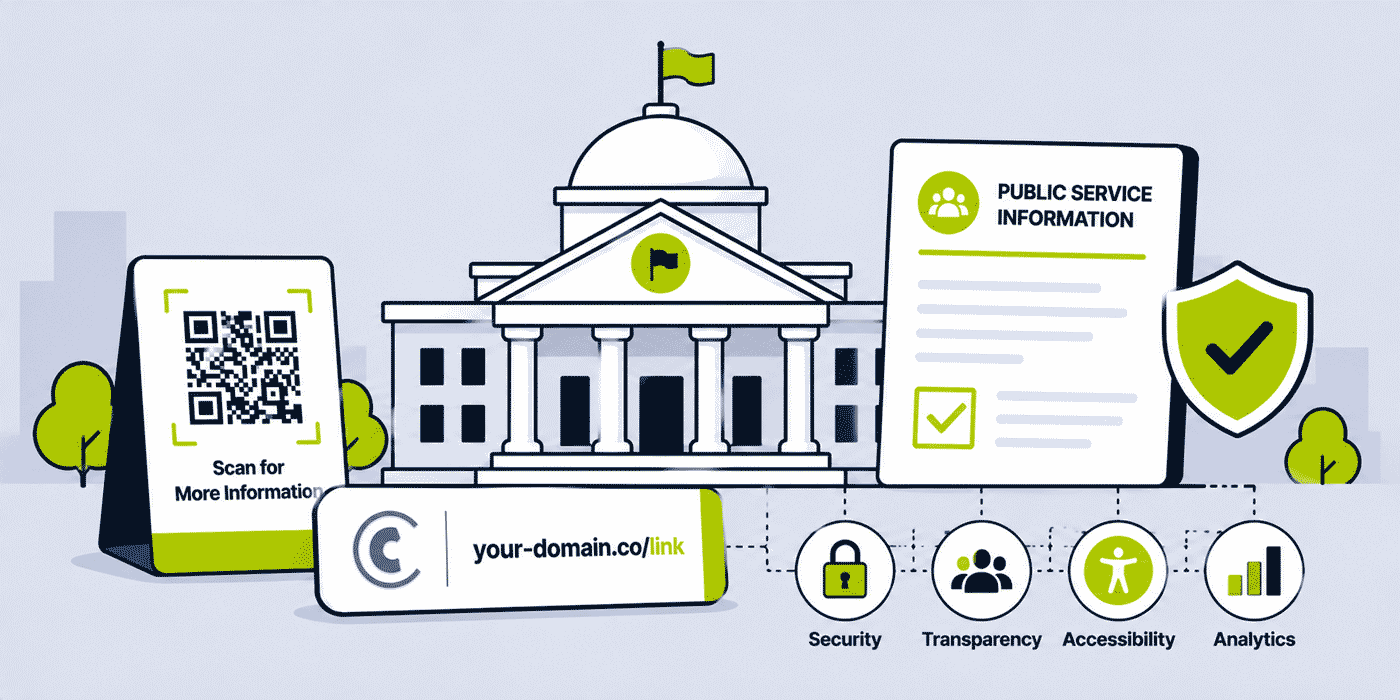
What This Guide Covers
- Why branded domains are a public trust requirement in government communications
- Citizen SMS and email alerts: the trust case for official-domain short links
- Printed public materials: leaflets, posters, signage, and official correspondence
- QR Codes on public infrastructure and government premises
- Public health campaigns: multi-channel, multi-agency coordination
- Emergency and crisis communications: speed, clarity, and trust
- Multi-department link governance: managing links across a large organisation
- Local government: councils, planning, waste management, and community services
- Education authorities: school communications and student resource management
- Transport authorities: service information, disruption alerts, and accessibility
- Benefits and services: directing citizens to the correct digital services
- Accessibility considerations for public sector link management
- GDPR and data protection considerations
- Campaign analytics and public communications measurement
- Which Cuttly plan suits public sector organisations
Why Branded Domains Are a Public Trust Requirement
The fraud context that government communications operate in makes branded domains for short links a functional requirement, not a preference. In the UK, the National Cyber Security Centre (NCSC) has documented government-impersonating phishing attacks via SMS and email as among the most prevalent fraud vectors targeting citizens. These attacks typically involve SMS messages claiming to be from HMRC, the NHS, DWP, or other government bodies, containing short links — often on generic shortener platforms — that lead to credential harvesting pages.
Public awareness campaigns advising citizens to be wary of links in unexpected messages from government bodies have been successful — but they have also conditioned citizens to be suspicious of all short links in official-looking messages, including legitimate ones. A government agency that sends citizens a genuine tax credit notification via SMS with a generic shortener domain link is providing citizens with no mechanism to distinguish it from the fraud pattern they have been warned about.
A branded short link on an official government domain — go.hmrc.gov.uk/tax-notice or links.yourcouncil.gov.uk/recycling-schedule — is a domain citizens can verify. It is part of the government's own domain infrastructure. It cannot be replicated by fraudsters without compromising the official domain itself — a substantially higher attack barrier than creating a free account on a generic shortener platform. When the NCSC advises citizens to "check the link domain," official-domain branded short links pass that check; generic shortener domains do not.
This trust argument is reinforced by the analytics argument: branded short links with per-channel tracking show government communications teams which channels are reaching citizens, which messages are generating the intended action, and where communications investments should be concentrated. Without per-channel tracked links, all citizen communications generate invisible engagement — activity happens but measurement is impossible.
Citizen SMS and Email Alerts: The Trust Case at Scale
Mass citizen communications — appointment reminders, service updates, policy notifications, emergency alerts, benefit change notifications — are the highest-volume and highest-stakes communication activity many government agencies undertake. The link in these communications is typically to a specific service page, a personalised appointment confirmation, a form to complete, or a guidance document.
SMS is the dominant channel for urgent citizen communications because of its near-100% open rate and its accessibility to citizens without smartphones or reliable internet access. But SMS is also the channel most exploited by government-impersonating fraudsters. The branded domain in a government SMS is the primary trust signal available to the citizen before they decide whether to click.
A national health service using go.nhs.example.gov/appointment in vaccination appointment reminder texts, and consistently using this domain across all official communications, creates a domain that citizens learn to recognise and trust. Citizens who have seen go.nhs.example.gov in multiple previous legitimate communications recognise it as official. A fraudulent SMS using a different domain is distinguishable — the citizen checks the domain and finds it is not the official one.
For high-volume SMS communications, the branded short link also solves a practical problem: official government service URLs are often very long — including department identifiers, service category paths, session parameters, and unique citizen identifiers — making them impossible to include directly in a 160-character SMS without consuming the entire message. A short branded link leaves character space for the message content itself.
Analytics on citizen SMS campaigns reveal: open rates (if tracked via link click proxy), which service links generate the most citizen action, and time patterns (when citizens respond to government messages — morning weekday hours are typical). This data informs send time optimisation and message priority sequencing for subsequent campaigns.
Printed Public Materials: Leaflets, Posters, Signage, Official Correspondence
Government and public sector organisations produce substantial volumes of printed materials: council leaflets distributed to every household, NHS public health posters in GP surgeries and pharmacies, planning application notices, library services information cards, environmental enforcement notices, benefit claim guidance booklets. Each of these printed materials potentially contains URLs that citizens need to access online.
Raw government service URLs in printed materials have two problems: they are long and unwieldy (making accurate typing difficult from a leaflet or poster), and they are static — if the service URL changes (website restructure, new portal platform, updated form URL), all previously printed materials become broken. Both problems are solved by dynamic QR Codes and branded short links.
A council environmental services leaflet with a QR Code linking to the waste collection schedule page can remain in circulation for a year or more. When the waste management portal moves to a new URL (an annual occurrence for many local councils as digital transformation programmes update legacy systems), the short link destination is updated in Cuttly. Every QR Code in every leaflet still in circulation routes to the correct page. No reprint required, no broken links, no citizen complaints about dead QR Codes.
For official correspondence — letters from benefits agencies, planning decision notices, tax notifications — a short link or QR Code printed in the letter gives the citizen a direct digital path to the relevant service without requiring them to navigate the main government website. A planning decision notice with a QR Code linking directly to the relevant planning portal entry is more accessible than one with a long URL that requires typing and navigation.
All QR Codes on government printed materials should be downloaded in SVG format from Cuttly for professional print production — vector format ensuring quality at any print size from a small leaflet to a large public display. QR Code visual styling should use high-contrast official colours that are accessible for citizens with low vision, consistent with the agency's accessibility standards.
QR Codes on Public Infrastructure and Government Premises
QR Codes on fixed public infrastructure — bus stop timetable boards, library information kiosks, planning notice boards, council office reception displays, health centre waiting room materials, museum and gallery information plaques — have become a standard public information mechanism. For government and public sector applications, the dynamic nature of Cuttly QR Codes is operationally critical.
A bus stop timetable board with a static QR Code encoding a raw URL is broken the moment the transport authority updates its website structure — which transport authorities do regularly as digital services evolve. A dynamic QR Code from a branded Cuttly short link allows the destination to be updated whenever the transport authority migrates its timetable platform, without any physical update to the bus stop board.
Analytics on public infrastructure QR Codes reveal usage patterns that are genuinely useful for service planning. A library information kiosk QR Code showing 200 scans per month on the "renew your books online" link and 5 scans per month on the "events calendar" link tells the library service which digital services its physical visitors are primarily seeking — intelligence that informs both the kiosk display priorities and the service website's information architecture.
For council planning notice boards — temporary notices placed at the site of a planning application requiring public consultation — a QR Code linking directly to the planning application's online consultation page converts the physical notice from a passive announcement into an active participation mechanism. Citizens who see the notice at the site can immediately access the consultation without navigating to the council website and searching for the reference number. The analytics show how many members of the public engaged with the planning notice digitally — evidence of community engagement with the planning process.
Public Health Campaigns: Multi-Channel, Multi-Agency Coordination
Public health campaigns — vaccination programmes, health screening campaigns, mental health awareness, sexual health services, substance misuse programmes, chronic disease management — frequently involve multiple agencies communicating simultaneously: the national health authority, regional health boards, local primary care networks, third-sector health charities, and local councils. Each agency has its own communication channels, audiences, and messaging context. Coordinating consistent, trackable links across all participating organisations is a link governance challenge of significant complexity.
The recommended architecture: the lead agency creates and manages the campaign's primary short link set, with per-channel and per-agency tracked links all routing to the same campaign page. Each participating agency receives its own unique short link for distribution through its own channels. Analytics per agency link show which organisations are generating the most citizen reach and engagement with the campaign.
Example: a national vaccination catch-up campaign uses a central campaign page. The national health authority's social media link, the GP surgery reminder letter QR Code, the local council's doorstep leaflet QR Code, the pharmacy poster QR Code, and the third-sector health charity's email newsletter link each get different short links — all routing to the same vaccination booking page. Cuttly Campaigns (Team plan+) aggregates all these per-channel links under a single campaign tag, showing total campaign reach across all participating organisations. Individual agency links show each organisation's channel contribution to the overall campaign.
This multi-agency analytics architecture provides the campaign leads with evidence for reporting to ministers or commissioners: "the vaccination campaign generated X total booking page visits across all participating organisations, with Y% from primary care letters, Z% from community pharmacies, and W% from council doorstep leaflets." Without per-agency tracked links, this attribution is impossible — all sources look the same in the booking page's analytics.
Emergency and Crisis Communications: Speed, Clarity, and Trust
Emergency communications — flood alerts, public safety incidents, disease outbreak notifications, extreme weather warnings, public transport emergencies — demand the fastest possible communication with the highest possible trust. In an emergency, a citizen who receives an alert message must be able to act on it immediately without deliberating about whether the message is genuine or fraudulent.
Branded short links on official government domains are particularly important in emergency communications precisely because citizens are most vigilant about fraud when receiving unexpected urgent messages. A flood warning SMS with a generic shortener domain link creates doubt in the moment when decisive action is needed. The same message with a link on the Environment Agency's official domain — or the local council's official domain — is unambiguously legitimate.
For emergency communications, link infrastructure readiness matters. Links to standard emergency resources — flood advice pages, emergency shelter information, public safety guidance — should be created and tested in advance, not set up during the emergency. A library of ready-to-use official branded short links for common emergency scenarios means communications teams can act within minutes of an incident rather than spending time creating and testing links while the emergency is already unfolding.
Cuttly's ability to update short link destinations immediately — within seconds of logging in and editing the link — means that if the official guidance page URL changes during a fast-moving situation, the short link destination is updated and all previously distributed communications route to the updated page. For SMS alerts already delivered to thousands of citizens, this is the only mechanism for updating the digital resource they route to.
Multi-Department Link Governance
A government department or local authority with multiple operational divisions — housing, planning, environmental services, benefits, health and wellbeing, libraries, transport, community safety — each generating their own citizen communications and public materials, faces a link governance challenge similar to that of a large agency managing many clients. Without governance, each division creates links independently, using inconsistent naming, different domains, untagged campaigns, and no shared analytics visibility.
The Cuttly Team plan workspace architecture maps well to government departmental structures. A local council, for example, might structure its Cuttly workspace as follows: one team workspace for each operational division, each connected to a divisional branded subdomain (links.housing.council.gov.uk, links.planning.council.gov.uk, links.environment.council.gov.uk). Staff within each division create links within their workspace, on their divisional domain. The central communications team has Owner-level access across all workspaces and can see aggregate performance across all divisions.
Alternatively: a single workspace for the entire organisation with a single official short domain, and rigorous tagging by department and campaign. This is simpler to administer but provides less data isolation between departments. The choice depends on the organisation's size and its governance requirements for inter-departmental data visibility.
Link naming conventions in government contexts should align with the organisation's existing content governance standards. Many public sector bodies follow structured content naming frameworks — the same principles apply to short link aliases. A consistent naming convention ensures that any staff member can identify a link's purpose from its alias without opening it, and that the link portfolio remains searchable and auditable as it grows.
Local Government: Councils, Planning, Waste, and Community Services
Local councils are among the most link-intensive public sector organisations, managing communications across dozens of service areas simultaneously: housing benefit, council tax, waste collection, recycling, planning applications, public consultations, highways, parks and green spaces, community events, libraries, and social care. Each service area generates its own citizen-facing digital communications, each with links to the relevant portal pages, forms, and guidance documents.
The highest-value link use cases for local councils: waste and recycling schedule QR Codes on household calendars distributed annually (dynamic — survives bin collection route changes without reprinting), planning notice board QR Codes (linking to online consultation systems — a major driver of public participation in planning decisions), council tax payment reminders with short links to the online payment portal (with per-channel tracking showing which reminder channel drives the most payments), and community events promotion with per-channel tracked links showing which local communications channels reach residents most effectively.
Quarterly consultation surveys — Cuttly's native survey builder (all plans including free) distributed via a branded short link in the council's digital channels and printed materials — provide structured resident feedback data that is exportable to PDF, XLS, and CSV for inclusion in committee reports and service planning evidence. A resident satisfaction survey with a QR Code in the annual council tax statement, the waste management calendar, and the council newsletter reaches the broadest possible resident audience through multiple simultaneous channels.
Education Authorities: School Communications and Student Resources
Local education authorities, multi-academy trusts, and individual maintained schools communicate with parents, students, and the community across a complex set of channels. School communication platforms (ParentMail, SchoolComms, Arbor), direct email newsletters, school websites, social media channels for community engagement, and physical communications distributed through students' bags — all carry links to forms, policy documents, event registrations, and educational resources.
A local authority education service managing communications for 40 schools benefits from the same team workspace architecture as other multi-department government bodies — one workspace per school, each with a school-specific branded subdomain. Links created in each school's workspace carry that school's domain, keeping branding and analytics appropriately isolated.
Parent communication links — term dates, school trip permission forms, parent consultation booking, Ofsted report links, safeguarding policy updates — should use branded short links on the school's official domain. The safeguarding dimension (as discussed in the childcare and nurseries guide) is relevant here: parents receiving links in school communications are sensitive to unfamiliar domains in messages about their children's education and welfare.
Student resource QR Codes — on classroom displays, on printed learning materials, on assessment feedback sheets — linking to digital resources, video explanations, additional practice exercises, or the school's virtual learning environment create a blended learning infrastructure that extends the value of physical classroom materials into digital learning contexts.
Transport Authorities: Service Information and Disruption Alerts
Public transport authorities — national rail operators, bus networks, tram and metro systems, ferry services — manage real-time communications with passengers across multiple channels. Service disruption alerts (the highest-urgency communication type), timetable change notifications, fares and ticketing updates, route information, and accessibility service bookings all involve links that need to reach passengers quickly and reliably.
Disruption alert SMS messages — sent to registered passengers when a service is cancelled or delayed — should use branded short links on the transport operator's official domain. The trust argument is identical to the government health alert argument: passengers who have been warned about fake disruption alerts (a fraud vector in some markets) need a domain they can verify. An operator that consistently uses go.transportoperator.example/alerts in all passenger communications creates a recognisable official link format.
QR Codes at stations, on vehicles, and in printed timetable materials link to real-time service information, journey planning tools, and accessibility information. Dynamic QR Codes ensure these links survive platform migrations and website updates without physical replacement of station displays or printed materials.
Accessibility Considerations for Public Sector Link Management
Public sector digital communications are subject to accessibility requirements — in the UK, the Public Sector Bodies (Websites and Mobile Applications) Accessibility Regulations 2018 (implementing EU Directive 2016/2102); equivalent regulations apply in other jurisdictions. While these regulations primarily govern website content, the links in public sector communications contribute to the accessible citizen experience.
Accessible link practices for public sector use: use descriptive short link aliases rather than opaque random strings wherever the link alias is visible to the citizen — go.council.gov.uk/recycling-calendar is more accessible than go.council.gov.uk/x7Qm9p; ensure QR Codes have sufficient contrast for citizens with low vision (dark code on white background, meeting WCAG contrast requirements); include both QR Code and printed short URL in printed materials so citizens who cannot scan QR Codes (due to device limitations, visual impairment, or unfamiliarity with QR technology) have a typeable alternative; and ensure the password-entry screen for any password-protected link meets accessibility standards for screen reader compatibility.
The Link in Bio format — used for official social media profiles — should include text descriptions for all button destinations in accessible language, consistent with plain English communication standards that UK public sector bodies are required to follow under the GDS content design guidelines and equivalent frameworks.
GDPR and Data Protection in Government Link Analytics
Government organisations using Cuttly's link analytics must ensure their use is consistent with their data protection obligations under GDPR (in the UK and EU), PECR (for electronic communications in the UK), and any sector-specific data protection requirements that apply to their organisation.
Cuttly's analytics are aggregated and anonymised — they do not collect or store personally identifiable information about individual link clickers. The data Cuttly analytics provides: click volume, device type, approximate geographic location (country or regional level), OS and browser, referrer source, and time patterns. This is not personal data in the GDPR sense — it is aggregate usage data that does not identify any individual.
Government organisations should nonetheless document their use of Cuttly in their Records of Processing Activities (ROPA) as a data processor used for link management analytics. The processing purpose (measuring citizen communications engagement), the data categories (aggregated anonymous usage data), and the retention period (analytics history available for the plan's retention period) should all be documented. Cuttly's privacy policy and GDPR compliance documentation are available at cutt.ly for inclusion in internal data protection assessments.
For public sector organisations with specific procurement requirements — framework compliance, supplier due diligence questionnaires, data processing agreements — Cuttly can be assessed against those requirements using publicly available policy documentation. Contact Cuttly directly for any enterprise or public sector procurement enquiries.
Campaign Analytics and Public Communications Measurement
Public sector communications teams increasingly operate in an evidence-based commissioning environment — communications investments must be justified through measurable outcomes, not just activity volumes. "We sent 200,000 SMS messages and distributed 500,000 leaflets" is an activity measure; "our vaccination campaign generated 45,000 booking page visits from SMS (32%), printed materials QR Codes (28%), and social media (40%)" is an outcome-attributed measure. The latter is only possible with per-channel tracked links.
For government communications teams making the case for communications budget, the analytics framework this creates is valuable: each communications channel's contribution to campaign outcomes is measurable and comparable. Channels that consistently underperform can be deprioritised; channels that drive disproportionate citizen action can be invested in. Over time, the accumulated per-campaign analytics build an evidence base for communications strategy that is specific to the organisation's citizen audience and communication context — not generic advice but data from their own campaigns with their own citizens.
Which Cuttly Plan Suits Public Sector Organisations
The Free plan ($0) suits very small public bodies — a single-building community library, a small parish council, a neighbourhood community committee — with minimal active communications and link management needs. 30 links/month, 1 branded domain, 30 days of analytics. Functional for basic needs with no budget commitment.
The Single plan ($25/month) is appropriate for individual government departments, local councils, schools, health centres, or public service units running active multi-channel citizen communications. 5,000 links/month, up to 5 branded domains, 1 year of analytics history (enabling year-over-year comparison of campaign performance), full QR customization with SVG export for public print production, surveys for citizen feedback, and Link in Bio for official social media profiles.
The Team plan ($99/month) is appropriate for larger public sector bodies managing multiple departments or service areas with shared infrastructure needs: multi-department team workspace architecture, Cuttly Campaigns for cross-department campaign analytics, Team API for integration with government digital service platforms, and 2 years of analytics history for longer-term communications performance measurement.
Start with Cuttly's free plan — no credit card required, 1 branded domain included. Create your official citizen communications short link, generate your first public information QR Code, and verify the setup before upgrading to the plan that matches your organisation's scale. Registration required; free plan available immediately.
Benefits and Services: Directing Citizens to the Correct Digital Services
Benefits agencies, welfare services, and citizen advice bodies manage some of the most sensitive and high-stakes citizen communications in the public sector. A person receiving a Universal Credit reassessment notice, a pension credit eligibility letter, or a housing benefit decision letter is often in a vulnerable position — they need to understand their options clearly and access the relevant digital services without confusion or delay. The link in these communications to the relevant form, the appeals process, the guidance document, or the specialist advice service is a critical access point.
Long, complex government service URLs — which may include department codes, session parameters, unique reference numbers, or deeply nested navigation paths — are poorly suited to printed correspondence. A person who receives a letter and must type a 60-character URL including various forward slashes, underscores, and encoded characters is at significant risk of entering the URL incorrectly and landing on an error page. A short, branded link — go.dwp.gov.uk/uc-reassessment — is typeable without error and includes a QR Code for those who prefer to scan.
Analytics on benefit communication links provide the benefits agency with evidence of citizen engagement with digital services versus traditional contact channels. If a reassessment notice generates low link click rates compared to call volume on the associated helpline, the digital self-service provision may need improving — the link analytics provide the signal that citizens are choosing the phone over the digital route, prompting investigation into why.
For agencies that send reminder communications (appointment confirmations, deadline reminders, document submission prompts), per-communication tracked links show which reminder type generates the highest citizen action rate. An appointment reminder SMS with a QR Code and short link generating 45% link click-through means nearly half of recipients are engaging digitally with the appointment process — a measurable indicator of digital uptake that can be reported to commissioners and used to justify continued investment in digital communications infrastructure.
Public Consultation and Democratic Engagement
Democratic participation — planning consultations, budget consultations, policy reviews, local plan reviews, licensing applications — requires broad public reach and accessible engagement mechanisms. Traditional consultation approaches rely on physical comment forms and in-person public meetings that systematically underrepresent residents who are less likely to attend evening meetings or submit paper responses. Digital participation tools, distributed via effective link infrastructure, expand the reach of consultation to residents who would not otherwise engage.
A local plan consultation promoted via: a branded short link in the council's email newsletter to 50,000 subscribers, a QR Code on a street-level notice board in the affected area, a short link in the council's Twitter/X and Facebook posts, a printed leaflet with QR Code delivered door-to-door in the consultation area, and a link in the council's paper-based council tax statement reaching every household — with each channel tracked independently — provides granular evidence of which engagement mechanisms reached which resident populations.
Post-consultation analytics showing that the door-to-door leaflet QR Code generated 2,400 consultation responses while the social media link generated 380 tells the council's engagement team that physical door-to-door distribution is, for their specific community, dramatically more effective at driving consultation participation than social media. This finding shapes investment in subsequent consultations — and provides evidence for the council's democratic engagement reports to elected members.
Cuttly's native survey builder (all plans including free) creates structured consultation questionnaires accessible via branded short link or QR Code. Survey responses are encrypted, exportable to PDF and XLS, and can be cited in consultation outcome reports as the quantitative foundation of the public response. For small-scale consultations (service feedback, community needs assessments, local plan preference surveys), the survey builder provides a ready-made tool without requiring procurement of a separate consultation platform.
Benefits of Government Adopting a Consistent Link Identity
There is a broader civic benefit — beyond the operational and security arguments — to government organisations adopting a consistent branded link identity across all their citizen communications. When every official link that a citizen receives from any channel of the same authority uses the same recognisable official domain, the authority establishes a digital identity that citizens can learn, recognise, and trust over time.
This is the link equivalent of a consistent official letterhead — citizens recognise the visual identity of official correspondence and trust it accordingly. A government agency whose links are always on go.agency.gov across SMS, email, printed letters, website, and social media creates a consistent digital identity that is distinguishable from fraud and reassuring to citizens navigating complex service interactions.
For government bodies that span multiple service areas — a local council covering housing, planning, environment, libraries, and community safety — a consistent link identity does not require a single domain for all services. It requires that each service's domain is clearly official, consistently used, and visually aligned with the organisation's broader digital identity standards. Citizens who receive a recycling reminder with go.environment.yourcouncil.gov.uk/recycling and a planning notice with go.planning.yourcouncil.gov.uk/application-1234 recognise both as official council communications — different service subdomains but a consistent official pattern.
This consistency, built and maintained through a disciplined link governance framework, is how government organisations build the digital trust that makes their online services more effective, their communications more compelling, and their democratic processes more participatory. It is not a technology project — it is a communications standards commitment, supported by the right infrastructure.
Frequently Asked Questions
Why do government agencies use URL shorteners?
Three reasons: official government URLs are too long for SMS, print, and signage; branded short links on official government domains allow citizens to verify link legitimacy (critical for anti-phishing trust); and per-channel analytics show which communications channels are reaching citizens and driving the intended action.
Can government agencies use a GDPR-compliant URL shortener?
Cuttly is GDPR compliant. Link analytics are aggregated and anonymised — no personally identifiable information about individual link clickers is collected. Public sector organisations should document Cuttly in their ROPA as a data processor for link management analytics. Consult your DPO for organisation-specific guidance.
What is the risk of using a generic URL shortener domain in government communications?
Citizens cannot distinguish legitimate government links from government-impersonating fraud links when both use the same generic shortener domain. In a context where government-impersonating phishing via SMS and email is widely documented, using a generic domain undermines citizen trust and erodes the value of public awareness campaigns warning citizens to check link domains before clicking.
- Tools
- URL Shortener →
- QR Code Generator →
- Link Analytics →
- Branded Domains →
- Related Industry Guides
- URL Shortener for Government 2026 →
- URL Shortener for Nonprofits →
- URL Shortener for Healthcare →
- URL Shortener for Schools →
- URL Shortener for Museums →
- Related Guides
- URL Shortener Security →
- What Is a Branded Short Link? →
- QR Code Best Practices 2026 →
- Link Tracking 101 →
- Verticals Hub
- URL Shortener for Every Industry →
- Start Here
- Create Free Account
- Plans & Pricing
URL Shortener
Cuttly simplifies link management by offering a user-friendly URL shortener that includes branded short links. Boost your brand’s growth with short, memorable, and engaging links, while seamlessly managing and tracking your links using Cuttly's versatile platform. Generate branded short links, create customizable QR codes, build link-in-bio pages, and run interactive surveys—all in one place.
Cuttly - Consistently Rated
Among Top URL Shorteners
Cuttly isn’t just another URL shortener. Our platform is trusted and recognized by top industry players like G2 and SaaSworthy. We're proud to be consistently rated as a High Performer in URL Shortening and Link Management, ensuring that our users get reliable, innovative, and high-performing tools.


