URL Shortener for Professional Sports Teams The Complete Guide
A professional sports club communicates with its fan base more frequently, more emotionally, and across more channels than almost any other type of organization. Matchday programmes, social media posts, email newsletters, stadium announcements, kit launches, player signing announcements, sponsor activations, ticket sales campaigns, academy news, community programmes and fan engagement competitions — each one involves links, and each link represents an opportunity to measure fan response in a way that informs future commercial and marketing decisions.
This guide covers how professional sports teams — football clubs, basketball franchises, rugby unions, cricket boards, ice hockey teams and every other type of professional sporting organization — use a URL shortener, branded custom domain, dynamic QR Codes and click analytics across every touchpoint in their fan communications, commercial operations and community engagement.
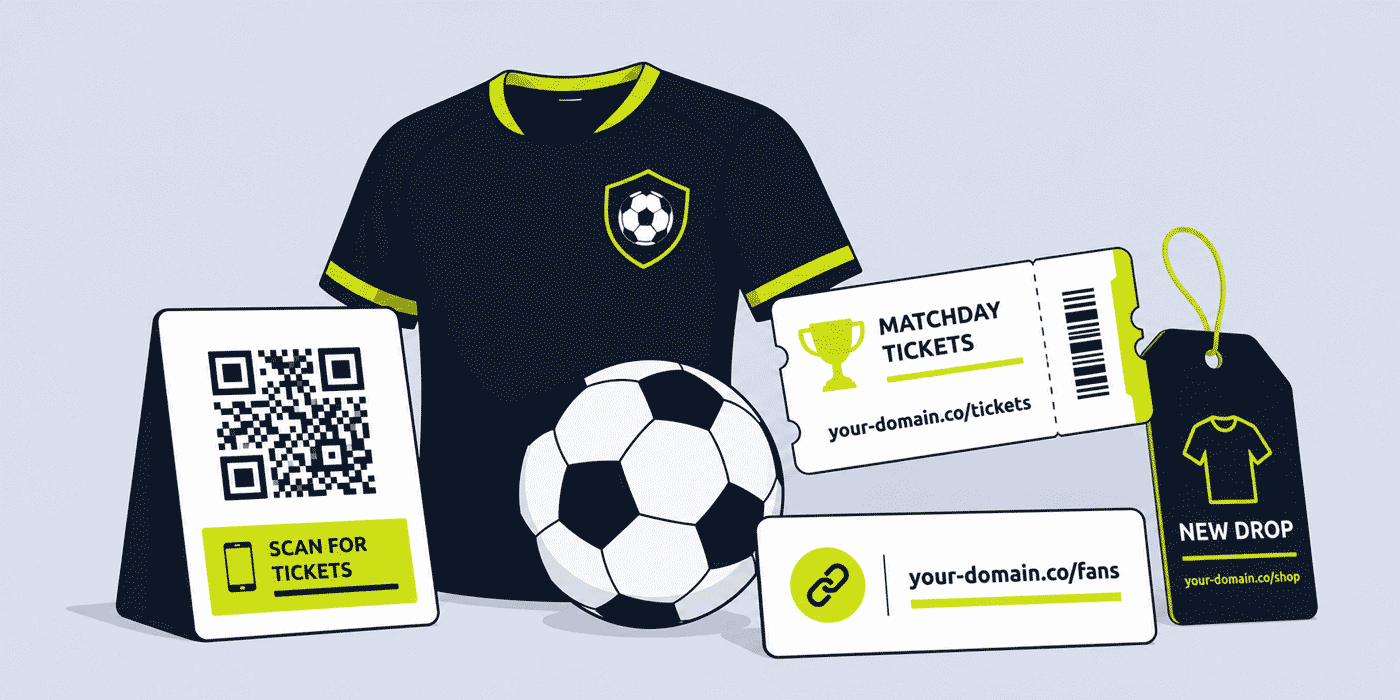
What This Guide Covers
- Ticket sales links — matchday, season tickets and hospitality
- Sponsor activation links and per-partner engagement reporting
- Merchandise and kit launch link strategy
- Matchday communications — programmes, announcements and digital matchday experience
- Social media and fan engagement links
- Academy, community and foundation programme links
- Transfer and player announcement links
- Pre-season, cup and competition campaign links
- QR Codes on physical and printed club materials
- A worked example: a professional football club's link stack across a season
- Common mistakes in sports team link management
- A Cuttly plan guide for professional sports teams
- Frequently asked questions
Why Professional Sports Teams Need Link Management
A professional sports club is one of the most emotionally engaging brands in any market. Fans follow the club through wins and losses, through transfer windows and pre-season tours, through cup campaigns and relegation battles, across social media platforms, matchday programmes, email newsletters and club apps. Every piece of communication a club sends is consumed by an audience that is genuinely interested — which makes the click-through behaviour of that audience a particularly reliable signal about what content and campaigns are actually resonating.
At the same time, professional sports clubs operate an unusually complex commercial structure. Ticket revenue, merchandise revenue, broadcast revenue, and commercial partnership revenue each come with their own reporting requirements, their own KPIs, and their own stakeholders who want data demonstrating the value of their investment. Sponsor partners want engagement evidence. The commercial team wants to know which kit launch channel drove the most sales. The marketing team wants to know which email campaign drove the most ticket registrations. Link management is the layer that makes all of this measurable without requiring a separate analytics tool for each function.
Ticket Sales Links
Ticket revenue is the financial foundation of most professional sports clubs, and ticket sales links are among the most commercially important links a club manages. A well-structured ticket link strategy keeps the fan journey from awareness to purchase as short as possible while giving the commercial team the attribution data they need to optimize spending across channels.
Core Permanent Ticket Links
Every club should maintain a small set of permanent, stable ticket links that appear consistently across all communications throughout the season:
your-club.com/tickets— the main ticketing hub, linking to matchday, season and hospitality optionsyour-club.com/season-tickets— the season ticket renewal or new purchase pageyour-club.com/hospitality— the corporate and hospitality packages pageyour-club.com/memberships— fan membership and loyalty programme
These permanent links are mentioned across social media, in email footers, on stadium signage, in matchday programmes and in any media appearance where a presenter or spokesperson mentions how to buy tickets. Because they are dynamic, the destination can be updated — for example, redirecting /season-tickets from the renewal page to a waitlist page when season tickets sell out — without any change to the link itself.
Per-Fixture and Per-Campaign Ticket Links
For individual fixtures, particularly high-profile matches where dedicated campaigns are run — derbies, cup matches, rivalry fixtures, season openers — a per-fixture short link allows the club to track which campaign drives ticket sales for that specific match. your-club.com/tickets-derby-oct used in the specific campaign for an October derby gives the marketing team a clean read on how much of that match's ticket traffic was driven by the dedicated campaign versus general seasonal awareness.
Sponsor Activation Links and Partner Reporting
Commercial partnerships are the largest revenue driver for most top-division professional clubs, and the ability to demonstrate engagement value to sponsors — beyond reach and impressions — is an increasingly important part of the commercial team's sales and retention toolkit. A per-sponsor short link is the simplest mechanism for providing concrete click-through data alongside traditional sponsorship metrics.
Per-Partner Link Structure
For each commercial partner, the club creates a short link pointing to the partner's designated landing page: your-club.com/partner-brand or your-club.com/kit-sponsor. This link is used across every piece of club communication where that partner is activated: social media posts, matchday programme mentions, email newsletters, stadium PA announcements, digital perimeter board CTAs, and post-match content features.
Click analytics for this link — aggregated and anonymized — show total fan engagement with the partner's link across all activation touchpoints. Comparing click volumes per partner shows the commercial team which partners' campaigns generate the most fan action, and sharing this data with partners as part of mid-season and end-of-season reporting gives sponsors a concrete engagement metric that broadcast reach numbers alone cannot provide.
Per-Channel Sponsor Tracking
For the club's key commercial partners, per-channel link tracking adds another layer of insight. Creating separate short links for a sponsor's activation across social media, email and matchday programme — each pointing to the same landing page — allows the club to show the sponsor exactly which of the club's channels drives the most engagement with their brand. This data strengthens the case for specific channel investments in future partnership discussions.
Merchandise and Kit Launch Link Strategy
Kit launches are among the highest-profile commercial events in any football club's calendar, and the link strategy around a kit launch shapes both the fan experience and the club's ability to measure campaign performance. A well-planned kit launch link structure provides a single, clean entry point for fans across every channel, with independent analytics showing which channel drove the most pre-orders or day-one sales.
Launch Link Setup
For a major kit launch, the club creates a primary launch link — your-club.com/new-kit or your-club.com/kit-2026 — pointing initially to a teaser or reveal page, then updated on launch day to point to the shop page where the kit is available for purchase. This single link is used consistently across every channel: the announcement post on every social platform, the email to season ticket holders, the press release, and any out-of-home advertising associated with the launch.
For per-channel analytics, the club also creates channel-specific variants pointing to the same page: your-club.com/kit-email for the email send, your-club.com/kit-instagram for the Instagram post, your-club.com/kit-twitter for the Twitter announcement. Comparing clicks across these variants after the launch shows which channel drove the most immediate traffic to the shop page — data that informs channel weighting for future launches.
Ongoing Merchandise Links
Beyond kit launches, clubs run ongoing merchandise campaigns throughout the season: Christmas gift guides, player-specific merchandise around signing announcements, limited edition commemorative items for milestone fixtures, and clearance sales at the end of the season. Each of these deserves its own short link so its performance can be tracked independently. A link such as your-club.com/xmas-shop or your-club.com/player-shirt — updated each time it is used for a new campaign — gives the merchandising team a consistent view of campaign performance across the season.
Matchday Communications
Matchday is the single highest-engagement day in any club's calendar. Fans are emotionally invested, attention is high, and the window for driving fan action — from purchasing matchday extras to entering competitions to sharing club content — is concentrated. Matchday communication links should be planned in advance and cover every touchpoint in the matchday journey.
Digital Matchday Programme Links
Clubs producing digital matchday programmes can include multiple QR Codes and short links within the programme: links to player profiles on the club website, links to sponsor landing pages, links to ticket pages for upcoming fixtures, and links to post-match content that goes live after the final whistle. A QR Code generated from a dynamic short link inside a digital programme can be updated after the match to redirect to post-match analysis or highlight content rather than the now-redundant pre-match preview page the programme originally pointed to.
Printed Matchday Programme QR Codes
For clubs that still produce printed matchday programmes — a significant tradition in many sports, particularly in English football — QR Codes generated from dynamic short links are particularly valuable because printed programmes can be collected and re-read long after the match. A QR Code inside a printed programme that points to a dynamic short link can be redirected to an archive match report, a post-season review, or a general club content hub once the match has passed, so that any fan who picks up an old programme and scans a QR Code lands somewhere interesting rather than a dead page.
Social Media and Fan Engagement Links
Professional sports clubs are among the most followed organizations on social media globally. The fan engagement on a major football club's social posts regularly exceeds what most media brands achieve, which makes the Link in Bio link and per-post link strategy for a sports club more commercially significant than for most other organizations. A Link in Bio page at your-club.com/links aggregates the most important current fan destinations: tickets, shop, fan membership, current campaign, academy news. Updated weekly or around major club events, this page serves as the club's primary social media digital hub without requiring any change to the bio link itself.
Fan Competition and Survey Links
Fan competitions, voting polls (player of the month, goal of the season) and supporter surveys are a central part of fan engagement for most professional clubs. A short link for each competition or survey — your-club.com/vote-pom for the player of the month vote — gives the club independent analytics on fan participation rates, separate from the voting platform's own data. A survey tool integrated with short link analytics gives the community team a combined view of fan engagement and opinion data in one dashboard.
Academy, Community and Foundation Links
Most professional sports clubs operate significant community and academy programmes alongside their first team. These programmes reach a different audience from the matchday and commercial fan base — school-age players, families, local community organizations, educational partners — and their link needs reflect this: registration forms for trials and coaching sessions, school visit booking links, volunteer sign-up pages, charitable donation links, and educational resource downloads.
Short links for community programmes serve the same function as for any other part of the club's communications: they remain stable regardless of changes to the club's website structure, they provide click analytics that help the community team measure engagement with programme communications, and they can be included on physical materials — school letters, community centre posters, bus shelter advertising for local community events — as QR Codes that remain valid even if the underlying programme pages change.
Transfer and Player Announcement Links
Player signings are the highest-traffic moments for most club social media accounts. An announcement post on a major signing can generate millions of impressions within hours, and the links included in that announcement — to a welcome article, to the player's shirt for sale, to a new signing interview — receive a proportionally high volume of clicks in a very short window.
Having short links prepared before an announcement is public — with destinations set up to go live at the same moment as the announcement — means the club's commercial team can capitalize on the announcement traffic peak rather than scrambling to create links after the announcement has already driven its peak engagement. A player kit link (your-club.com/player-name-shirt) ready to go live at announcement time, appearing in the announcement post and the welcome article, gives the merchandising team a clean read on how much signing announcement traffic converts to shop visits.
Pre-Season, Cup and Competition Campaign Links
A professional sports team's calendar is structured around distinct competition phases: pre-season tours, league season opening, cup campaigns, international breaks and end-of-season run-ins. Each phase has its own marketing character and its own link requirements. Pre-season tour links — for fan events abroad, for tour merchandise, for match ticket information in host cities — are distinctly different from mid-season cup campaign links or end-of-season survival or title run-in links.
A link structure that uses campaign-level slugs — your-club.com/preseason-2026, your-club.com/cup-campaign, your-club.com/final-day — keeps the link library organized around the club's actual communications calendar and makes it straightforward to compare fan engagement across different competition phases year over year.
A Worked Example: A Professional Football Club's Link Stack Across a Season
Consider a professional football club playing in a top national division, using a branded domain such as your-club.com, connected through Cuttly's custom domain setup (an A record and a TXT record — see the custom domain setup guide).
Pre-season: the club runs a pre-season tour with matches in two overseas cities. The marketing team creates /preseason-tour pointing to the tour information hub, /tour-tickets-cityA and /tour-tickets-cityB for match-specific ticket pages. Social media posts about the tour use the primary link; email to the overseas fan community uses the city-specific links. Post-tour analytics show which city's fan base drove more ticket traffic from email versus social, informing the following year's overseas engagement strategy.
August: the new home kit is announced. /new-kit is created pointing to the reveal page, updated at 9am on launch day to the shop page. Kit-specific channel links (/kit-email, /kit-instagram, /kit-tiktok) track per-platform launch traffic. TikTok drives 38% of day-one link clicks despite having a smaller follower count than Instagram, leading the social team to allocate more resource to short-form video content for the away kit launch in December.
Throughout the season, each commercial partner has their own link used consistently across all activations. Mid-season sponsor review meeting: the commercial team presents click analytics showing Partner A's link averaging 1,200 clicks per matchday communication, Partner B averaging 340. Partner B extends their deal but requests a change in how they are activated. Partner A requests additional digital touchpoints to capitalize on their engagement performance.
May: the club reaches a domestic cup final. /cup-final is created as the campaign hub. The link appears in every piece of final-related content for three weeks, accumulating click analytics that give the commercial team a picture of final-campaign engagement that the board uses in post-season reporting to league sponsors and broadcast partners.
Common Mistakes in Sports Team Link Management
No Sponsor Link Attribution
Many clubs share sponsors across their communications with no per-sponsor link structure, meaning every sponsor activation is invisible in terms of measurable fan engagement. Creating a separate link per sponsor at the start of the commercial season — before any activation begins — takes less than ten minutes and gives the commercial team a full season of per-partner engagement data to use in renewal discussions.
Using Ticketing Platform URLs Directly
Ticketing platform URLs are typically long, platform-branded, and unmemorable. A fan who hears "go to ticketmaster dot com slash sports slash your-club slash fixtures slash home slash category slash adult" on a stadium PA announcement is not going to act on it. A link that reads your-club.com/tickets is. Every ticketing CTA in every channel should use a branded short link in front of the platform URL.
No Link Transition Strategy Between Competition Phases
A cup campaign link that points to an entry page after the club has been eliminated, or a season ticket link that still points to the purchase page after season tickets have sold out, creates a poor fan experience. Maintaining links actively — updating destinations as competitions end, as products sell out, as campaigns close — keeps the club's entire digital presence accurate without requiring any change to the links themselves in existing content.
Cuttly Plan Guide for Professional Sports Teams
- The Free plan ($0) provides 30 short links per month, one branded custom domain, full click analytics, dynamic QR Codes and a Link in Bio page, with no credit card required. Suitable for a smaller professional club or semi-professional team setting up core ticket and social links.
- The Starter plan ($12/month) adds 300 short links per month and 30 custom aliases per month — practical for a professional club running regular fixture-by-fixture campaigns, sponsor activation links and multiple merchandise launches throughout a season.
- The Single plan ($25/month) adds up to 5 branded domains, customizable QR Codes with club logo and colors for branded matchday and merchandise materials, 1,000 API-created links per month and a full year of analytics history — relevant for clubs running high-volume campaign links, producing branded QR Codes for printed programmes and stadium signage, or wanting historical analytics for end-of-season sponsor reporting.
- The Team plan ($99/month) suits larger professional clubs and multi-sport organizations with shared link management across commercial, marketing, digital and community teams, multiple branded domains (for example, separate domains for the main club, the foundation and the academy), Campaign tag analytics for aggregated reporting across seasons, and team workspaces with appropriate access controls per department.
Create a free Cuttly account to set up your club's core ticket link, sponsor activation links and social media Link in Bio page. Registration is required for all plans, including free. No credit card is needed for the free plan.
Frequently Asked Questions
How do sports teams use short links for ticket sales?
A sports team creates a branded short link for each ticket product — your-club.com/tickets, your-club.com/season-tickets — appearing in matchday communications, email newsletters, social media, and stadium signage. A separate short link per campaign or fixture allows the team to see which promotions drive the most ticket traffic, independent of the ticketing platform's own reporting.
How do professional teams track sponsor activation link performance?
A team creates a separate short link for each commercial partner's activation — your-club.com/sponsor-name — pointing to that partner's landing page. Click analytics, aggregated and anonymized, show how many fans followed up on a sponsor mention across all channels. This gives the commercial team concrete engagement figures to share with sponsors as part of sponsorship performance reporting.
Can a sports team use QR Codes on matchday programmes and merchandise?
Yes. QR Codes generated from short links can be printed on matchday programmes, season ticket cards, replica kits, scarves, mugs and other merchandise, linking to a fan portal, digital programme, content hub or campaign page. Because the QR Code is dynamic, the destination can be updated after the match without reprinting the physical item.
How do sports teams use short links for merchandise launches?
For a merchandise launch, the team creates a short link such as your-club.com/new-kit pointing to the launch page or shop section, used across all promotional channels simultaneously. Per-channel tracking using separate links for each promotion surface allows the commercial team to see which channel drives the most merchandise traffic during a launch window.
Is a URL shortener useful for fan engagement and community building?
Yes. Beyond ticket and merchandise links, sports teams use short links for fan surveys, competition entry pages, content hubs, academy news, community programme registration and supporter group information. A Link in Bio page on social media aggregates all current fan-facing destinations in one place, updated to reflect current priorities without changing the bio link itself.
- Get Started
- Create Free Account
- Plans & Pricing
- Platform Tools
- URL Shortener
- Link Analytics
- QR Code Generator
- Link in Bio Builder
- Survey Tool
- Campaign Analytics
- Related Guides
- URL Shortener for Stadiums & Arenas
- URL Shortener for Sports Events & Marathons
- URL Shortener for Sports & Fitness
- URL Shortener for Gaming & Esports
- Short Links for Offline Campaigns
- Encyclopedia
- Branded Links
- Dynamic QR Codes
- Setup Guides
- Custom Domain Setup
- Track Link Clicks
- Industry Hub
- Sports & Stadiums
- All Industries →
URL Shortener
Cuttly simplifies link management by offering a user-friendly URL shortener that includes branded short links. Boost your brand’s growth with short, memorable, and engaging links, while seamlessly managing and tracking your links using Cuttly's versatile platform. Generate branded short links, create customizable QR codes, build link-in-bio pages, and run interactive surveys—all in one place.
Cuttly - Consistently Rated
Among Top URL Shorteners
Cuttly isn’t just another URL shortener. Our platform is trusted and recognized by top industry players like G2 and SaaSworthy. We're proud to be consistently rated as a High Performer in URL Shortening and Link Management, ensuring that our users get reliable, innovative, and high-performing tools.C


