URL Shortener for E-Learning Platforms The Complete Guide
E-learning platforms operate in one of the most competitive digital markets: millions of courses, thousands of platforms, and a learner audience whose attention is competed for by social media, professional obligations, and the ordinary demands of life alongside their desire to learn. A platform's ability to reach potential learners with the right course at the right moment, through the right channel, and to convert that reach into an enrollment, is the fundamental commercial challenge — and the links through which course discovery, promotion, and enrollment happen are the infrastructure that makes this possible or impedes it at every stage.
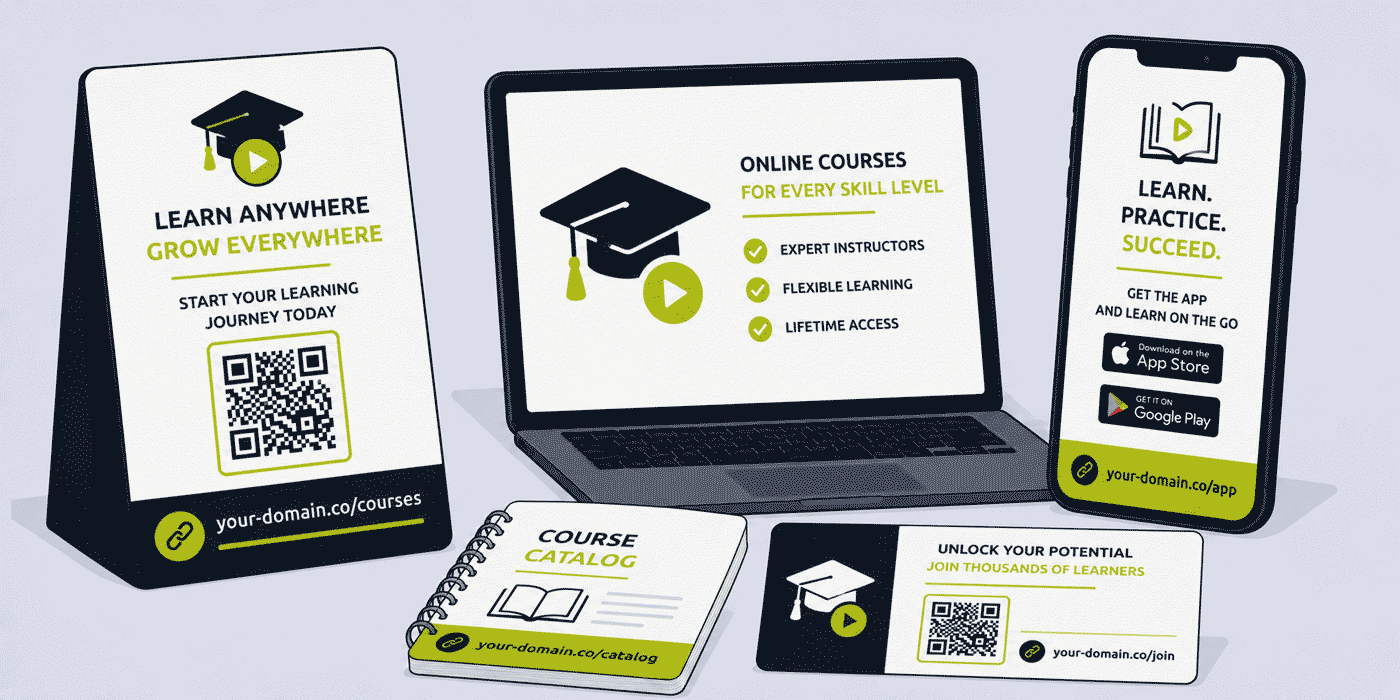
This guide covers how e-learning platforms, online course marketplaces, professional certification platforms, language learning apps, and coding education platforms use a URL shortener, branded custom domain, Link in Bio and click analytics across course promotion, affiliate management, per-channel enrollment attribution, learner onboarding, app download, conference presence, and content creator partnerships.
What This Guide Covers
- Course promotion links — per-course, per-category, and per-campaign
- Per-channel enrollment attribution across paid, organic, and partner channels
- Affiliate and content creator partner links
- Instructor and course creator links for independent promotion
- Learner onboarding and engagement links
- Free trial and freemium conversion links
- App download and mobile learning links
- Conference, career fair and offline event QR Codes
- B2B and corporate learning team links
- Social media Link in Bio for e-learning platforms
- A worked example: a professional certification platform's link stack
- Common mistakes in e-learning platform link management
- A Cuttly plan guide for e-learning platforms
- Frequently asked questions
Course Promotion Links
The course page URL is the primary conversion point for an e-learning platform: the page where a prospective learner decides whether to enroll. The link to that page, shared across every promotional channel, determines how many learners reach it and from which sources. Managing these links well — ensuring they are branded, trackable, and stable across platform migrations and course catalog restructurings — is the foundational link management task for any e-learning business.
Per-Course Short Links
A branded short link per course — your-platform.com/course-name or your-platform.com/learn-skill-name — is cleaner and more shareable than the long, parameter-heavy URLs that most learning management systems generate for course pages. A course URL that includes a platform's internal course ID, a series of tracking parameters, and a category path is unmemorable and visually opaque; a short link that reads your-platform.com/python-for-beginners is immediately informative, shareable in a podcast mention, and clickable in a social media caption.
Because e-learning platforms regularly reorganize their course catalogs, rename courses, or migrate to new technical platforms, the underlying URL of a specific course page changes more often than in most other content types. A dynamic short link that sits in front of the course URL means that any historical promotion, any instructor's social media content, any affiliate partner's review article, and any email archive that references the course link continues to direct learners to the current, correct course page regardless of what has happened to the underlying URL.
Category and Learning Path Links
Beyond individual course links, e-learning platforms benefit from short links at the category and learning path level: your-platform.com/data-science for the data science course category, your-platform.com/path-fullstack for the full-stack developer learning path. These category-level links are used in campaigns that promote a subject area rather than a specific course — brand awareness campaigns, seasonal "learn something new" promotions, and subject-area advertising campaigns that let learners self-select the specific course most relevant to their level.
Promotional and Campaign Links
E-learning platforms run regular promotions: Black Friday course sales, New Year's learning resolution campaigns, pre-exam season study support promotions, and seasonal professional development offers. Each promotion benefits from a campaign-specific short link — your-platform.com/black-friday, your-platform.com/new-year-learning — pointing to the promotional landing page. When the promotion ends, the link redirects to a current offers page rather than a dead campaign page.
Per-Channel Enrollment Attribution
E-learning platforms typically run multi-channel acquisition campaigns simultaneously: email newsletters, social media organic and paid, podcast sponsorships, YouTube advertising, affiliate partnerships, and content marketing. Each of these channels attracts a different audience with different learning motivations and different conversion behaviours. Understanding which channel drives the most enrollment completions — not just the most clicks — requires per-channel attribution data that most platform analytics systems cannot provide in a unified format.
Per-Channel Course Link Structure
For any significant course promotion, a per-channel short link structure provides the click-level attribution data that complements the platform's own enrollment analytics:
your-platform.com/course-email— email newsletter and campaign sendsyour-platform.com/course-social— organic social media postsyour-platform.com/course-paid— paid social and display advertisingyour-platform.com/course-podcast— podcast sponsorship mentionsyour-platform.com/course-affiliate— affiliate partner trafficyour-platform.com/course-youtube— YouTube video descriptions
All six links point to the same course enrollment page. Click analytics per channel give the growth team a unified click measurement that can be directly compared across channels, independent of each channel's own analytics system. A podcast sponsorship that generates 420 clicks with a 28% enrollment conversion rate is commercially different from a social media campaign that generates 2,100 clicks with a 4% conversion rate, even though the social campaign drives five times more total traffic. Per-channel click data, combined with the platform's enrollment data, enables this comparison.
Affiliate and Content Creator Partner Links
Affiliate marketing and content creator partnerships are significant acquisition channels for most e-learning platforms. Course review websites, YouTube educators who recommend learning resources, newsletter writers in professional development niches, and LinkedIn thought leaders who discuss skill development all represent potential affiliate partners who drive enrollment through their own audiences.
Per-Affiliate Short Links
For each affiliate partner, the platform creates a short link that directs to the platform with the affiliate's tracking parameter embedded: your-platform.com/affiliate-name pointing to the platform home or a specific landing page with the affiliate's identifier passed through. Click analytics for each affiliate's short link — aggregated and anonymized — show how much traffic each partner is sending to the platform independently of the affiliate tracking system's conversion data.
This dual measurement approach — short link clicks plus affiliate system conversions — gives the partnerships team a click-to-enrollment conversion rate per affiliate that reveals which partners are sending high-quality, high-intent traffic versus which are sending high-volume but low-converting traffic. A course review website with 50,000 monthly readers that generates 200 affiliate clicks and 45 enrollments is a more commercially efficient partner than a large platform with 1,000,000 readers that generates 800 clicks but only 40 enrollments, even though the second partner's traffic volume is four times higher.
Instructor Self-Promotion Links
On marketplace-model e-learning platforms where independent instructors create and sell courses, the instructor's own promotion of their course through their existing professional network, social media, and newsletter is a significant source of enrollment. Providing each instructor with a short link for their course — your-platform.com/instructor-name-course or allowing instructors to create their own custom alias — gives instructors a professional, branded link to share in their own promotional channels.
Click analytics on instructor-promoted course links, shared with the instructor as part of their course performance dashboard, give instructors visibility into how their own promotional efforts are contributing to their course's enrollment numbers. Instructors who can see the direct relationship between their LinkedIn posts and their course link click volume are more motivated to invest in their own promotion, which benefits both the instructor and the platform.
Learner Onboarding and Engagement Links
E-learning platforms suffer from a completion rate problem: a significant proportion of learners who enroll in a course do not complete it. The reasons are well-documented — competing priorities, insufficient motivation, poor initial engagement — and the onboarding sequence in the days immediately following enrollment is the critical window for establishing the habits and motivations that lead to course completion. Short links in onboarding communications help the platform guide learners through this critical period and provide funnel analytics that reveal exactly where learners are dropping off.
Onboarding Email Link Structure
A structured onboarding link set for the post-enrollment email sequence:
- Welcome email (day 0):
your-platform.com/start— the recommended first lesson or module - Day 3 nudge:
your-platform.com/continue— their current progress point in the course - Week 1 check-in:
your-platform.com/milestone— the week-one learning milestone content - Completion encouragement:
your-platform.com/finish— the final lessons and certificate claim page
Click analytics on each onboarding email's link — aggregated and anonymized — show the product team the engagement rate at each stage of the onboarding sequence. If 65% of learners click the welcome email link but only 30% click the day-3 nudge link, the drop-off between day 0 and day 3 is the most critical retention problem. If the completion link has a very low click rate but the platform's internal data shows learners are actually completing the course, the completion email timing or subject line may be the issue rather than learner engagement. Per-email link analytics enable these distinctions.
Free Trial and Freemium Conversion Links
Many e-learning platforms use a free trial or freemium model where a limited selection of course content is available without payment, with a conversion prompt to unlock full access. The links in this conversion journey — from free content access to paid enrollment or subscription — are among the most commercially important links the platform manages.
Trial-to-Paid Conversion Links
A short link for the trial conversion offer — your-platform.com/upgrade or your-platform.com/get-full-access — used in in-platform CTAs, in trial end email sequences, and in retargeting advertising pointing to free trial users gives the growth team a unified click signal for how many trial users engage with conversion offers across every touchpoint. Per-channel variants of this link show which touchpoint in the trial experience is most effective at prompting conversion consideration.
App Download and Mobile Learning Links
Mobile learning is the dominant format for many learner demographics, and driving app downloads from web-enrolled learners who have not yet installed the mobile app is a significant engagement and retention challenge for most e-learning platforms. A learner who uses the mobile app consistently completes more courses than one who only accesses the platform through a web browser.
A smart redirect short link — your-platform.com/app — that sends iOS users to the App Store and Android users to Google Play provides a single, consistent app promotion CTA across every channel: onboarding emails, the platform's web interface, social media profiles, and any offline materials at conferences or events. Per-channel variants — your-platform.com/app-email, your-platform.com/app-inapp — show which touchpoints are most effective at driving app download from enrolled learners.
Conference, Career Fair and Offline Event QR Codes
E-learning platforms attend industry conferences, professional association events, career fairs, and education technology exhibitions as part of their business development and brand awareness strategy. At these events, QR Codes on booth displays, handout cards, and promotional materials provide a trackable digital bridge from physical event presence to course enrollment or platform registration.
A conference-specific short link — your-platform.com/conference-name-2026 — pointing to a conference promotional landing page (with a conference-specific discount code or free trial offer) allows the marketing team to measure how much enrollment or trial activity each conference attendance generates. Over multiple conferences and events, comparing per-event enrollment attribution data informs the events team's decisions about which events justify attendance investment.
B2B and Corporate Learning Team Links
Many e-learning platforms have a B2B business line alongside their consumer business: corporate learning teams, HR departments, and L&D managers who purchase platform access for employee development. The links in B2B sales and onboarding communications serve a different audience from consumer learner links — the decision-maker is the HR or L&D professional, not the individual learner — and they need to be appropriate for professional procurement communication contexts.
A short link for the enterprise or team pricing page — your-platform.com/for-teams or your-platform.com/enterprise — used consistently in B2B marketing channels, in LinkedIn outreach to L&D decision-makers, and in any trade event materials targeting corporate buyers, gives the B2B team a trackable entry point to the enterprise sales funnel. Per-channel variants show which B2B marketing activity drives the most enterprise page visits.
A Worked Example: A Professional Certification Platform's Link Stack
Consider a professional certification platform offering accredited courses in project management, data analysis, and digital marketing, using a branded domain such as your-platform.com, connected through Cuttly's custom domain setup (an A record and a TXT record — see the custom domain setup guide).
The platform's three core certification programs each have a permanent course link: /pmp-cert, /data-analyst-cert, /digital-marketing-cert. These links appear in all long-term marketing assets: the YouTube channel description, the LinkedIn company page, the podcast sponsorship mentions, and the affiliate partner review articles. When the platform migrates to a new LMS and all course URLs change, only the three short link destinations need updating; every existing marketing asset continues to work.
For the Q1 "New Year, New Career" campaign, the platform creates per-channel promotion links for the project management certification: /pmp-email, /pmp-social, /pmp-podcast. After four weeks, the podcast channel generates the highest click-to-enrollment conversion rate at 19% (podcast listeners are actively seeking professional development and self-direct well to certification); the social media channel generates the most total clicks but a 6% conversion rate (brand awareness audience with lower purchase intent). The marketing team shifts the Q2 campaign budget weighting toward podcast sponsorships.
For the platform's affiliate programme, 12 career development bloggers each have their own link. Monthly analytics reveal that one career coaching blogger's link consistently generates a 24% conversion rate, significantly above the programme average of 9%. The partnerships team approaches this blogger for a deeper commercial relationship — a co-created course or an exclusive discount for their audience — that the link analytics data made apparent as a priority.
Common Mistakes in E-Learning Platform Link Management
Platform-Generated Course URLs in All Promotions
An e-learning platform that promotes courses using the LMS's own auto-generated URLs creates a link stability problem at every platform migration and catalog restructuring, and a sharability problem in every context where a clean, memorable link would help. A branded short link per course costs nothing beyond the initial setup and provides stability and professional presentation for the full lifecycle of the course.
One Course Link for All Channels
An e-learning platform that promotes the same course across six channels with a single link cannot compare channel performance in a unified metric. The email platform reports its own click data; the social media platform reports its own engagement; the affiliate system reports its own conversions — none of these are directly comparable. Per-channel short links provide a single, consistent click metric that can be compared across every channel simultaneously.
No Onboarding Funnel Step Analytics
A platform that measures learner engagement only at the course completion stage misses the step-by-step onboarding data that reveals where learners are dropping out before they reach completion. Per-email, per-step short links in the onboarding sequence are the simplest way to get this funnel visibility without additional analytics infrastructure.
Cuttly Plan Guide for E-Learning Platforms
- The Free plan ($0) provides 30 short links per month, one branded custom domain, full click analytics, dynamic QR Codes and a survey tool, with no credit card required. Suitable for a new e-learning platform or independent course creator setting up core course and enrollment links.
- The Starter plan ($12/month) adds 300 short links per month and 30 custom aliases per month — practical for a growing platform managing per-course links, per-channel campaign attribution, affiliate partner links, and regular promotional campaign links throughout the year.
- The Single plan ($25/month) adds up to 5 branded domains, customizable QR Codes for conference and event materials, 1,000 API-created links per month for automated per-instructor or per-course link generation, and a full year of analytics history for affiliate program optimization.
- The Team plan ($99/month) suits larger e-learning platforms with growth, partnerships, product, and B2B sales teams sharing link management, Campaign tag analytics for aggregated multi-course campaign reporting, multiple branded domains for different platform brands or regional markets, and shared workspaces for cross-functional teams.
Create a free Cuttly account to set up your platform's first course promotion link, your affiliate program link, and your learner onboarding email links. Registration is required for all plans, including free. No credit card is needed for the free plan.
Frequently Asked Questions
How do e-learning platforms use short links for course promotion?
An e-learning platform creates a branded short link per course — your-platform.com/course-name — used consistently across every promotion channel. Because the link is dynamic, the destination updates when a course is revised or when the platform migrates LMS, without invalidating any existing promotional materials or affiliate partner content.
How do online learning platforms manage affiliate partner links?
An e-learning platform creates a per-affiliate short link for each partner, combining short link click analytics with the affiliate system's conversion data to calculate a click-to-enrollment conversion rate per affiliate — revealing which partners send high-quality, high-intent traffic versus high-volume but low-converting traffic.
How do e-learning companies track which marketing channel drives the most enrollments?
An e-learning platform creates a separate short link per channel for each course promotion — email, social, podcast, affiliate. Click analytics per channel give a unified, comparable click metric across all channels simultaneously, which combined with enrollment data provides a per-channel click-to-enrollment conversion rate.
How do e-learning platforms use QR Codes at conferences and offline events?
An e-learning platform places QR Codes from dynamic short links on booth displays and handout cards, linking to a conference-specific promotional page. After the event, the destination updates to a post-conference follow-up page without replacing any physical materials. Per-event analytics measure how much enrollment activity each event generates.
How do e-learning platforms use short links for learner onboarding?
An e-learning platform uses short links in the post-enrollment onboarding email sequence — welcome, day-3 nudge, week-1 check-in, completion encouragement — each with its own tracked link. Click analytics at each onboarding step show where learners are engaging and where they are dropping off, giving the product team specific data for retention optimization.
- Get Started
- Create Free Account
- Plans & Pricing
- Platform Tools
- URL Shortener
- Link Analytics
- QR Code Generator
- Link in Bio Builder
- Related Guides
- URL Shortener for Corporate Training & L&D
- URL Shortener for Education
- URL Shortener for Online Courses
- URL Shortener for Coding Bootcamps
- URL Shortener for Affiliate Links
- Setup Guides
- Custom Domain Setup
- Track Link Clicks
- Industry Hub
- Education
- All Industries →
URL Shortener
Cuttly simplifies link management by offering a user-friendly URL shortener that includes branded short links. Boost your brand’s growth with short, memorable, and engaging links, while seamlessly managing and tracking your links using Cuttly's versatile platform. Generate branded short links, create customizable QR codes, build link-in-bio pages, and run interactive surveys—all in one place.
Cuttly - Consistently Rated
Among Top URL Shorteners
Cuttly isn’t just another URL shortener. Our platform is trusted and recognized by top industry players like G2 and SaaSworthy. We're proud to be consistently rated as a High Performer in URL Shortening and Link Management, ensuring that our users get reliable, innovative, and high-performing tools.C


