URL Shortener for Headhunters and Recruitment Agencies The Complete Guide
Recruitment is a relationship business that happens through links. A LinkedIn InMail to a passive candidate includes a job description link. A candidate email campaign includes a link to the employer's careers page. A job board listing carries the application link. A career fair display carries a QR Code. A business development email to a prospective employer client carries a link to the agency's service proposition or market salary report. The quality, professional presentation, and trackability of every link in this chain affects both the candidate experience and the agency's ability to measure its own effectiveness at every stage of the recruitment process.
This guide covers how recruitment agencies, executive search firms, independent headhunters, RPO providers, and in-house talent acquisition teams use a URL shortener, branded custom domain, dynamic QR Codes and click analytics across vacancy distribution, candidate outreach, job board attribution, career fair presence, employer business development, consultant performance measurement, and the full range of operational and commercial link management needs in modern recruitment.
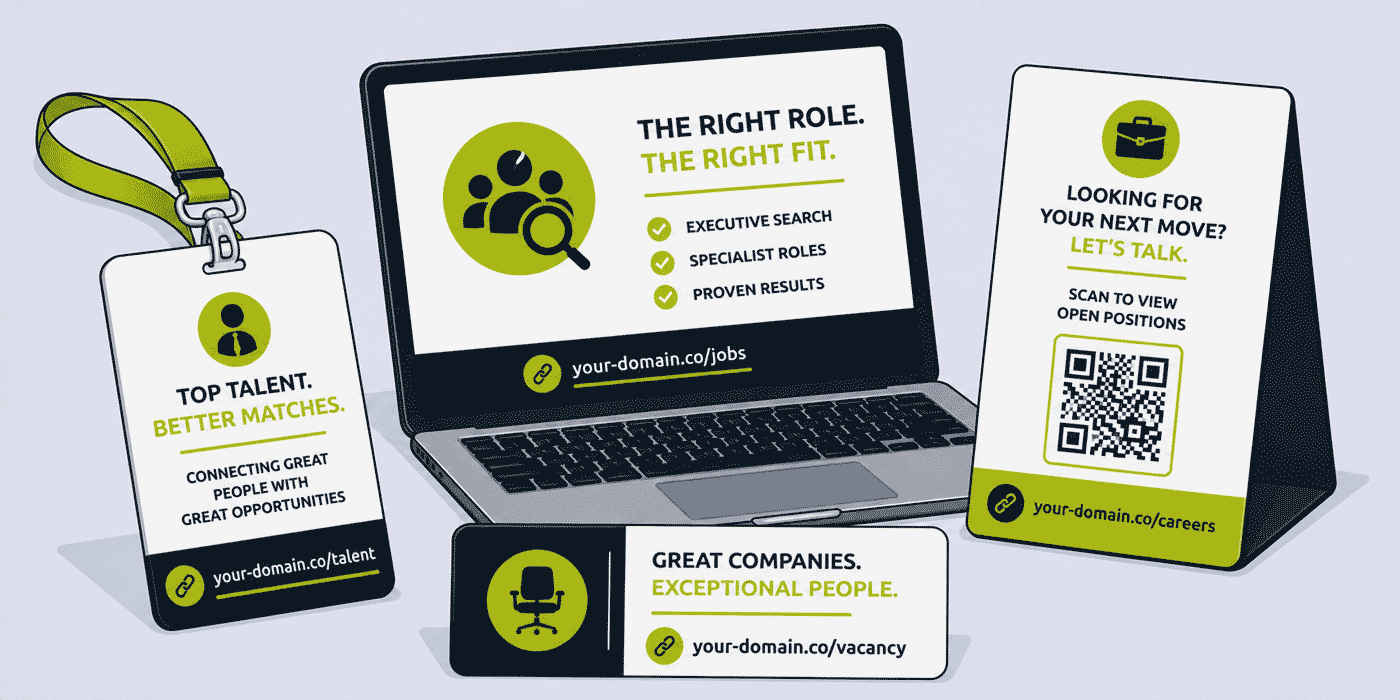
What This Guide Covers
- Vacancy and job posting links — per-role, per-board and per-channel attribution
- Candidate outreach links — InMail, email and SMS professionalism
- Job board attribution — understanding which boards drive the most qualified candidates
- Career fair and event QR Codes
- Employer branding and client attraction links
- Market salary report and thought leadership distribution links
- Consultant-level performance tracking through link analytics
- Executive search and headhunting link strategy
- Candidate referral programme links
- In-house talent acquisition team link management
- A worked example: a multi-discipline agency's link stack across a major vacancy campaign
- Common mistakes in recruitment agency link management
- A Cuttly plan guide for recruitment agencies and headhunters
- Frequently asked questions
Why Recruitment Agencies Need Branded Link Management
The recruitment industry faces two distinct link audiences with different quality expectations. Candidates — particularly passive candidates who are not actively job-seeking and who a headhunter is approaching speculatively — are making micro-judgements about the agency's professionalism in every interaction. A LinkedIn InMail that includes a generic, unbranded shortener link to a job description looks like the kind of bulk outreach that passive candidates immediately file under "automated recruitment spam." A message that includes a branded, clearly labelled link on the agency's own domain looks like something that was prepared by a professional who has thought about the candidate's experience.
Employer clients — the companies that pay the agency's fees — are equally sensitive to professional presentation. A business development email that includes a raw ATS URL or a generic shortener link to a case study is sending a subtle signal about the agency's operational standards. The same content distributed through a clean, branded link communicates a more organised and professional operation.
Beyond presentation, the link management infrastructure that a recruitment agency builds determines how much it can measure about its own performance. A consultant who sends 500 candidate outreach messages per month and receives 80 replies currently has no way of knowing whether 400 of those candidates clicked the job description link and decided not to reply, or whether only 90 clicked it at all. This distinction matters enormously for understanding whether the outreach messaging or the role itself is the limiting factor in candidate engagement. Link analytics answer this question.
Vacancy and Job Posting Links
The vacancy link is the primary operational link in any recruitment agency's day-to-day activity. It appears in candidate outreach messages, in job board listings, in social media posts, in email campaigns, and on career event materials. It is the link that takes a candidate from awareness of a role to consideration of it. Managing these links well — making them professional, trackable, and resilient to the vacancy filling or the ATS changing — is the most impactful single link management investment a recruitment agency can make.
Per-Vacancy Short Link Conventions
A consistent naming convention for vacancy short links makes the link library navigable for a team of consultants and makes the links themselves informative to candidates who see them:
your-agency.com/head-of-product-london— role and location in the slug, immediately informativeyour-agency.com/job-2026-147— job reference number, consistent with internal job reference systemyour-agency.com/cto-fintech-remote— role, sector, and working arrangement
The first convention is most appropriate for agency-branded roles where the specific position is the primary identifier; the second suits agencies with a large volume of active vacancies where internal reference numbers are the practical navigation tool; the third works well for senior or executive roles where sector and flexibility are important candidate decision factors visible before the click.
Managing the Vacancy Lifecycle Through Dynamic Links
A vacancy has a lifecycle that affects the appropriate link destination at each stage:
- Active: links to the full job description and application portal or CTA. All candidate outreach and job board listings use this destination.
- Under offer / reserved: the destination can be updated to indicate the role is under offer and invite candidates to register for similar future roles. This is more professional than a dead link or a "position closed" error, and captures candidates for the pipeline rather than losing them.
- Filled: the link redirects to similar active vacancies in the same sector and seniority level, or to a general candidate registration page. Any candidate who engaged with the role after it was filled — through a historical LinkedIn post, a saved email, or an old job board listing — lands somewhere useful.
This lifecycle management approach requires nothing more than updating the link destination at each stage transition. The consultant updates the destination in the dashboard when the role status changes; every existing outreach email, every saved job board listing, and every historical social media post that referenced the role link automatically serves the appropriate current-stage content.
Job Board Attribution: Understanding Which Boards Drive Quality Candidates
Most recruitment agencies advertise the same role on multiple job boards simultaneously and then measure success by how many applications arrive in the ATS, without any visibility into which job board generated which applications. This makes job board spend allocation a matter of habit and industry assumption rather than evidence-based decision-making.
The practical reason for this measurement gap is that most ATS platforms do not reliably track application source from job board to application in a way that is consistent and comparable across boards. Source tracking in ATS systems depends on candidate self-reporting ("how did you hear about this role?") or on UTM parameters that many job boards do not reliably pass through their application flows. Per-job-board short links provide an alternative top-of-funnel measurement that is completely independent of ATS source tracking.
Per-Board Vacancy Link Structure
For a vacancy listed on five platforms, a per-board link structure gives the agency independent click data per source:
your-agency.com/job-ref-linkedin— LinkedIn job listingyour-agency.com/job-ref-indeed— Indeed listingyour-agency.com/job-ref-reed— Reed listing (UK)your-agency.com/job-ref-totaljobs— Totaljobs listing (UK)your-agency.com/job-ref-agency— agency's own website
All five point to the same job description and application page. Click analytics per board link, aggregated and anonymized, show how much traffic each board sends to the application page. Over multiple vacancies in the same discipline and seniority level, the pattern builds into per-sector, per-seniority guidance on which boards are most effective. An agency that discovers LinkedIn consistently generates 3x the application page click volume of Indeed for senior technology roles, but Indeed generates 2x the volume for volume hiring of junior administrative roles, has the evidence base to allocate its job board advertising spend more rationally than the industry's general assumptions would suggest.
This is one of the most commercially valuable data sets a recruitment agency can develop, and it requires only one additional short link per job board per vacancy to generate. The measurement cost is negligible; the strategic value over twelve to eighteen months of consistent attribution is substantial.
Candidate Outreach Links
Candidate outreach — the LinkedIn InMail, the email, the WhatsApp message — is where the recruiter's professional presentation most directly affects outcomes. A passive candidate who receives outreach for a role that is genuinely right for them is making an immediate judgment call about whether to engage: is this a professional recruiter with a real opportunity, or is this a generic bulk outreach from a database trawl? The quality of the message, and the quality of the link in the message, both contribute to this judgment.
Branded Links in LinkedIn InMail
A LinkedIn InMail from a recruitment consultant that includes a raw ATS URL — typically a long, portal-branded link with internal job reference codes visible in the URL — looks automated and impersonal. A message that includes your-agency.com/cto-fintech-remote looks like a specific, purposeful communication about a specific, targeted role. The link itself signals that the recruiter has invested in a professional presentation rather than copy-pasting from a vacancy management system.
For executive search consultants working at the senior end of the market — where candidates being approached are C-suite executives, partner-level professionals, or senior specialists who receive dozens of recruitment approaches per month — the professional differentiation between a generic link and a branded, role-specific link is even more significant. These candidates are highly sensitive to the quality of approach and will form immediate impressions about the quality of the search firm from the first message they receive.
Click Analytics on Candidate Outreach
Click analytics on candidate outreach links — aggregated and anonymized at the campaign level — give the consultant and their manager a picture of outreach effectiveness that message response rates alone cannot provide. Three distinct outreach performance patterns are visible through link analytics:
- High click, low response: candidates are engaging with the role description but choosing not to reply. The role itself, the salary, the company, or the job description content may be the limiting factor, not the outreach message quality.
- Low click, proportional response: few candidates are clicking but a consistent proportion of those who do are responding. The outreach message may be poorly communicating the role's appeal before the click, reducing the number of candidates motivated to read the full description.
- High click, high response: the outreach is working well at every stage. The targeting is appropriate, the message is compelling, and the role content is relevant to the candidate audience.
These three patterns point to different intervention priorities, and without link click data the agency can only see the response rate, which does not distinguish between the first two patterns.
Career Fair and Event QR Codes
Career fairs and recruitment events — university graduate fairs, professional networking events, sector-specific job expos, and employer brand events — represent a significant investment of consultant time and sometimes event sponsorship cost. Measuring the return on this investment is difficult for most agencies because there is no reliable way to track which candidates who spoke to the agency at an event subsequently applied for a role. QR Codes on event materials provide the only practical direct digital measurement of career fair engagement.
Event-Specific QR Codes
An agency's career fair presence typically includes a display stand, branded handout cards, and in some cases branded merchandise. Each of these can carry a QR Code linked through a dynamic short link:
- Display stand QR Code:
your-agency.com/event-name-2026pointing to the agency's current vacancies page filtered by the discipline or sector most relevant to the event audience. At a technology careers fair, this destination shows technology roles; at a graduate fair, it shows graduate and entry-level positions. Because the QR Code is dynamic, the same physical display can be used at multiple events with the destination updated for each audience without reprinting. - Handout card QR Code:
your-agency.com/register-candidateoryour-agency.com/cv-uploadpointing to the candidate registration form. A handout card with a QR Code that takes the candidate directly to the registration form is more effective than one that requires them to navigate the agency website to find the form. - Business card QR Code: An individual consultant's business card QR Code pointing to their LinkedIn profile or to the agency's candidate team contact page gives a candidate a direct, memorable way to connect with the specific consultant they spoke to at the event.
Click analytics per event QR Code give the agency a direct engagement count per event that is independent of how many leads the consultant subjectively felt they generated. An event where the display QR Code is scanned 180 times but only 12 candidates subsequently register is a funnel conversion problem; an event where the QR Code is scanned only 40 times despite high footfall is a display placement or event audience alignment problem. These are different problems with different solutions, and link analytics make the distinction visible.
Employer Branding and Client Attraction Links
Beyond the candidate-facing function, recruitment agencies also have a client acquisition challenge: winning new employer clients who will use the agency's services rather than a competitor's. Business development in recruitment typically involves relationship-led outreach, with thought leadership content, sector salary reports, and case studies as the primary marketing assets.
Salary Report and Market Insight Links
Salary reports, hiring market trend reports, and sector-specific talent insight documents are among the most effective lead generation tools for recruitment agencies, because they provide immediate tangible value to an HR director or hiring manager who downloads them, before any commercial conversation takes place. A branded short link for each report — your-agency.com/salary-report-tech-2026 or your-agency.com/hiring-trends-2026 — is shared in LinkedIn posts targeting HR professionals, in email outreach to hiring manager contacts, and in any business development communication.
Click analytics on salary report links give the business development team a picture of how much interest each report generates from the employer market, which is a direct measure of the business value of content marketing investment. If the technology salary report generates significantly more employer engagement than the marketing salary report, this informs both the content production calendar and the sector focus for business development outreach.
Case Study and Client Reference Links
Client case studies — "how we placed a Head of Engineering at Company X in 18 days, saving the client eight weeks of internal recruiter time" — are compelling business development assets when shared with the right prospective client at the right moment. A branded short link for each case study — your-agency.com/case-study-tech-startup — is used in business development emails and LinkedIn outreach to prospective employer clients in the same sector or of the same company stage as the case study subject.
Click analytics for case study links give the business development team a signal about which prospective clients are engaging with materials before responding, which is an early indicator of genuine interest. A prospective client who has clicked the case study link twice in the week before a first meeting is more likely to be in an active hiring conversation than one who has not yet engaged.
Consultant-Level Performance Tracking
Recruitment agencies measure consultant performance through a combination of KPIs: number of jobs submitted, number of interviews arranged, number of placements made, and fee revenue generated. These metrics are all outcome-focused — they measure what happened at the end of the funnel — and provide limited insight into where in the process a consultant's activity is stronger or weaker.
Link analytics add a process-level measurement layer. If each consultant uses their own vacancy link convention or their own candidate outreach link tracking, the agency's management team can compare:
- Outreach effectiveness. Which consultant's candidate outreach messages generate the highest click-through rate on job description links? High click rate suggests compelling messaging and accurate targeting; low click rate suggests the messaging or targeting needs improvement.
- Job board utilisation. Which consultants are generating the most traffic from each job board? If one consultant's listings on a specific board consistently outperform others in the same discipline, their listing quality or their approach to paid featured listings may be contributing.
- Business development engagement. Which BD activities are generating the most employer client engagement? Which consultants' market reports are attracting more employer reads per distribution?
These analytics, available at the campaign or link level rather than the individual user level, give the agency's management team a richer picture of activity effectiveness than KPI dashboards alone provide. They inform coaching conversations, training investment, and the sharing of best practice between consultants within the team.
Executive Search and Headhunting Link Strategy
Executive search — the retained search for C-suite, board, and senior leadership positions — involves a different link management context from contingency recruitment. The search process is typically confidential: the role may not be publicly advertised, the client company's identity may not be disclosed in early candidate conversations, and the candidate audience is small, senior, and highly sensitised to the quality and discretion of every communication.
Confidential Role Links
For executive search assignments where the role is confidential or where the client's identity cannot be disclosed, a short link can be configured to point to a protected or minimally-identifying role description: your-agency.com/retained-search-cfo-2026 pointing to a page that describes the role's scope and context without identifying the client. Because the link is dynamic, it can be updated when the candidate progresses to a stage where fuller information can be shared, transitioning from the confidential brief to a detailed specification as the search narrows.
The professional presentation of executive search links is particularly important because the audience — sitting C-suite executives, chairpersons, senior partners — has high expectations of discretion and quality. A search firm that sends a text message to a CEO with a generic shortener link to a role brief is communicating something negative about its professionalism and attention to detail. A branded link on the search firm's own domain, clean and descriptive, communicates professional care at the most senior level of communication.
Candidate Referral Programme Links
Candidate referrals — where a placed candidate refers a contact from their network to the agency for consideration — are one of the highest-quality lead sources in recruitment. Referred candidates have already been pre-screened by someone who knows them professionally, which significantly reduces early-stage screening time and improves placement rates. Managing referral links well converts informal "my friend might be looking" conversations into structured, trackable pipeline entries.
A short link for the candidate referral form or programme — your-agency.com/refer-a-contact or your-agency.com/referral-programme — included in post-placement follow-up emails, in the onboarding communication to newly placed candidates, and in any periodic check-in with the agency's placed candidate network, makes the referral action as friction-free as possible. Click analytics show how many placed candidates engage with the referral invitation.
A Worked Example: A Multi-Discipline Agency's Vacancy Campaign
Consider a multi-discipline recruitment agency with specialist technology, finance, and marketing desks, using a branded domain such as your-agency.com, connected through Cuttly's custom domain setup (an A record and a TXT record — see the custom domain setup guide).
New vacancy: Head of Product, London, Series B SaaS: The technology desk creates /head-of-product-lon as the primary vacancy link. Per-board variants: /hop-linkedin, /hop-indeed, /hop-agency-site. The consulting team sends 120 LinkedIn InMails to targeted candidates using /head-of-product-lon in the message body. After 72 hours: 68 candidates have clicked the link (57% click rate), 31 have responded to the message (26% response rate). Of the 31 respondents, 18 had clicked before responding and 13 responded without clicking first. The consultant notes the 13 non-clickers replied positively without reading the JD — a strong signal of motivated passive candidates worth prioritizing.
Job board performance: After one week, per-board analytics show LinkedIn driving 140 application page visits, the agency website driving 78, and Indeed driving 34. The marketing team uses this to justify reducing the Indeed featured listing budget for senior technology roles while maintaining full coverage on LinkedIn for this level.
Role filled: After three weeks, the role is filled. /head-of-product-lon destination is updated from the job description to a page showing similar active product and technology leadership roles. The LinkedIn listing, three social media posts, and 120 InMail messages that referenced the link now all redirect any late-arriving candidate interest to live opportunities rather than dead pages.
Business development parallel activity: The agency's finance desk has published a Q2 2026 Salary Survey for Finance Leaders. The BD link /salary-finance-2026 is distributed in email outreach to 340 CFOs and Finance Directors. After one week, 89 have clicked the link (26% engagement rate), generating 12 new BD conversation requests. This 12:89 click-to-BD-enquiry conversion rate is the agency's most measurable content marketing result to date and directly informs the production of the following quarter's technology salary survey.
Common Mistakes in Recruitment Agency Link Management
Dead Vacancy Links in Historical Content
A recruitment agency that does not update vacancy link destinations when roles are filled leaves a trail of dead links across its social media history, its email campaigns, and its job board listings. Every dead link is a missed opportunity to capture a candidate who found the role through historical content and redirect them to current opportunities. Lifecycle management of vacancy links — updating destinations at each stage — converts historical marketing investment into ongoing candidate pipeline value.
No Per-Board Attribution for Job Advertising Spend
A recruitment agency spending significant budget on job board advertising without per-board attribution data is making renewal and allocation decisions based on job board sales team assurances and general industry assumptions rather than its own data. Per-board short links for each vacancy provide the evidence base for every job board spend decision at the cost of creating one additional link per board per vacancy.
Generic or Unbranded Links in Candidate Outreach
The most visible link quality issue in recruitment is the raw ATS URL or generic shortener link in candidate outreach messages. For passive candidates evaluating whether to engage with an approach, every element of the message contributes to their assessment of the recruiter's quality. A branded, role-descriptive link signals a professional, targeted approach; a generic link signals automated bulk outreach. In competitive talent markets where passive candidates receive multiple approaches per week, this distinction affects response rates.
Cuttly Plan Guide for Recruitment Agencies and Headhunters
- The Free plan ($0) provides 30 short links per month, one branded custom domain, full click analytics, dynamic QR Codes and a survey tool, with no credit card required. Suitable for an independent headhunter or small agency setting up core vacancy, outreach, and career event links for a focused specialism.
- The Starter plan ($12/month) adds 300 short links per month and 30 custom aliases per month — practical for a growing agency with multiple active vacancies per month, per-board attribution links, regular candidate outreach campaigns, and career event QR Code materials.
- The Single plan ($25/month) adds up to 5 branded domains for multi-discipline agencies with separate specialist brands for different sectors (technology, finance, marketing), customizable QR Codes for professional career fair materials, 1,000 API-created links per month for automated per-vacancy link generation from the ATS, and a full year of analytics history for job board ROI analysis.
- The Team plan ($99/month) suits larger recruitment groups with multiple consultant teams, business development, and marketing functions sharing link management, Campaign tag analytics for aggregated sector-level vacancy and BD campaign reporting, multiple branded domains for different recruitment brands or regional operations, and shared workspaces for consultant teams with appropriate access controls.
Create a free Cuttly account to set up your agency's first vacancy link, your career fair QR Code, and your salary report download link. Registration is required for all plans, including free. No credit card is needed for the free plan.
Frequently Asked Questions
How do recruitment agencies use short links for job posting distribution?
A recruitment agency creates a branded short link for each active vacancy — your-agency.com/head-of-product-london — used in candidate outreach, LinkedIn posts, job board listings, and career event materials. When the role fills, the link destination updates to redirect candidates to similar live vacancies rather than a dead posting. Click analytics show which roles generate the most candidate engagement across all promotion channels.
How do headhunters track which job board generates the most qualified candidates?
A recruitment agency creates per-board short links for each vacancy — your-agency.com/job-ref-linkedin, your-agency.com/job-ref-indeed — all pointing to the same application page. Click analytics per board build over multiple vacancies into per-sector, per-seniority-level guidance on which job boards are most effective, providing the evidence base for advertising spend allocation decisions.
How do recruitment consultants use short links in candidate outreach?
A consultant includes a branded short link — your-agency.com/cto-fintech-remote — in LinkedIn InMails, emails, and WhatsApp messages. A branded link on the agency's domain is more professional than a raw ATS URL and more likely to be clicked by a passive candidate. Click analytics reveal whether candidates are engaging with the role description before responding, distinguishing between messaging problems and role attraction problems.
How do recruitment agencies use QR Codes at career fairs?
A recruitment agency places QR Codes from dynamic short links on display stands, handout cards, and business cards at career events. Because the QR Code is dynamic, the same materials serve different events with destinations updated per audience. Per-event analytics measure direct digital engagement independently of subjective assessments of how many leads were generated.
How do recruitment agencies use short links for employer client attraction?
A recruitment agency uses branded short links for client-facing assets: salary reports, case studies, and service information pages. Click analytics on BD content links show which assets generate the most employer engagement, providing data to inform content investment decisions and to identify which prospective clients are actively evaluating agency services before a formal conversation.
- Get Started
- Create Free Account
- Plans & Pricing
- Platform Tools
- URL Shortener
- Link Analytics
- QR Code Generator
- Campaign Analytics
- Related Guides
- URL Shortener for Consultancies
- URL Shortener for Staffing Agencies
- URL Shortener for B2B Marketing
- URL Shortener for Agencies
- URL Shortener for PDF Sharing
- Setup Guides
- Custom Domain Setup
- Track Link Clicks
- Industry Hub
- Marketing, Sales & SaaS Teams
- All Industries →
URL Shortener
Cuttly simplifies link management by offering a user-friendly URL shortener that includes branded short links. Boost your brand’s growth with short, memorable, and engaging links, while seamlessly managing and tracking your links using Cuttly's versatile platform. Generate branded short links, create customizable QR codes, build link-in-bio pages, and run interactive surveys—all in one place.
Cuttly - Consistently Rated
Among Top URL Shorteners
Cuttly isn’t just another URL shortener. Our platform is trusted and recognized by top industry players like G2 and SaaSworthy. We're proud to be consistently rated as a High Performer in URL Shortening and Link Management, ensuring that our users get reliable, innovative, and high-performing tools.C


