URL Shortener for Pharmacies: The Complete Guide
Pharmacies are among the most trusted health institutions in their communities. Patients visit more frequently than any other healthcare setting, often for routine needs, and the relationship between a pharmacist and a regular patient is one of the most consistent health relationships many people have. That trust is built through every interaction — the quality of the advice given over the counter, the reliability of the service, the clarity of information provided, and increasingly, the quality of every digital touchpoint where the pharmacy communicates with patients. Links are part of that picture. A pharmacy that sends patients a branded, recognizable short link to a repeat prescription service, a vaccination booking, or a medication information page is reinforcing the same professional trust it builds in person. This guide covers how independent pharmacies, pharmacy chains, and community chemists use branded short links, QR Codes, and link analytics to improve patient communications, promote seasonal health services, drive online prescription and click-and-collect services, and build the digital presence that complements their community health role.
What This Guide Covers
- Why patient trust makes branded links a professional standard in pharmacy
- Prescription services and repeat prescription requests
- Click and collect: trackable links for online pharmacy orders
- QR Codes on prescription bag inserts and counter materials
- Seasonal health campaigns: flu vaccination, travel health, stop smoking, weight management
- OTC product information and extended labelling QR Codes
- Patient waiting area engagement
- NHS and clinical services promotion
- Google Reviews and patient feedback
- Social media and community health content
- Multi-branch pharmacy chains: team link management
- Link in Bio for pharmacy social profiles
- Which Cuttly plan is right for a pharmacy
Why Patient Trust Makes Branded Links a Professional Standard in Pharmacy
Healthcare communications carry an inherent trust requirement that most other business sectors do not. A patient who receives a text message with a link to a repeat prescription service, a vaccination booking form, or a medication information page is in a context where link safety matters — phishing attacks targeting healthcare patients are documented and patients are increasingly aware of the risks. A generic short link in a healthcare communication is a trust friction point that a pharmacy's other professional signals have to overcome.
A branded short link on the pharmacy's own domain — go.cooperpharmacy.com/repeat-rx or links.highstreet-chemist.co.uk/flu-jab — creates no such friction. The patient recognizes the domain, trusts the source, and clicks. This is not a marginal improvement in click-through rate statistics. It is the difference between a patient engaging with a service and a patient not engaging, in a context where non-engagement has health implications.
The branded link also reinforces the pharmacy's independent identity in an environment where multiple online prescription and pharmacy comparison services compete for patient attention. Every communication that carries the pharmacy's branded domain is an assertion of the pharmacy's own brand rather than a generic shortener platform's. For independent pharmacies competing with large chains and online pharmacy aggregators, this brand consistency matters.
Prescription Services and Repeat Prescription Requests
Prescription management — helping patients request, process, and collect their prescriptions efficiently — is central to the pharmacy's core service. The digital extension of this service through online prescription management portals, NHS-integrated systems, and pharmacy app platforms creates significant link management opportunities.
Repeat Prescription Request Link
A branded short link to the repeat prescription request form or portal — go.pharmacyname.com/repeat-rx — should be the most consistently distributed link in every patient communication context: printed on prescription bag inserts (the most valuable placement), displayed in the waiting area, included in any patient newsletter or SMS communication, and printed on the pharmacy's loyalty card or patient information card.
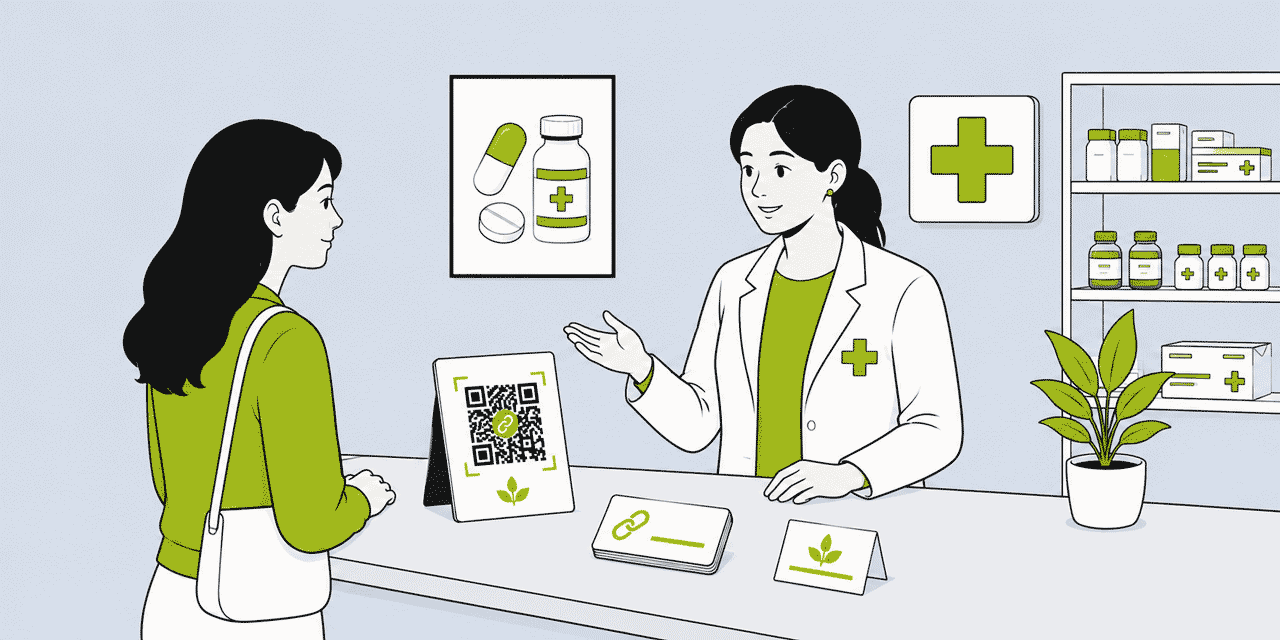
The prescription bag insert is a particularly high-value placement. Every patient collecting a prescription receives the bag. Including a card insert or a sticker with a QR Code and the short URL printed below — "Request your next prescription online: [QR Code] or [branded short URL]" — reaches 100% of the pharmacy's existing patient base at the moment of their highest engagement with the pharmacy's services. The QR Code must be dynamic (Cuttly-generated) so that if the prescription system changes or the portal URL changes, the insert QR Code continues to work without reprinting the entire stock of inserts.
Prescription Ready Notifications
Pharmacies that send SMS or email notifications when a prescription is ready for collection benefit from branded short links in those communications. A text message that says "Your prescription at [Pharmacy Name] is ready for collection. Visit [branded short link] to confirm your collection time or request delivery" uses a trusted, recognizable link that the patient is comfortable clicking. The same message with a generic short link introduces uncertainty in a healthcare context where trust is paramount.
Click and Collect: Trackable Links for Online Pharmacy Orders
Pharmacy click and collect — ordering OTC products, health and beauty items, or prescription accessories online for in-store collection — has grown significantly as a service offering. Promoting this service effectively requires links that are both trustworthy enough for patients to use and measurable enough for the pharmacy to understand where engagement is coming from.
A branded short link to the click and collect service — promoted via SMS, in-store display QR Codes, printed marketing materials, and the pharmacy's social media — should have a clean alias: go.pharmacyname.com/click-collect or links.pharmacyname.com/order-online. Create separate short links per promotion channel to track where click and collect engagement is being driven from. SMS promotions, in-store counter displays, window posters, and social media posts each get their own tracked link to the same click and collect page.
Monthly analytics review shows which channels are generating click and collect engagement. A well-placed counter display QR Code that generates consistent scans shows that patients are actively using the service. A window poster campaign that generates few scans despite high pedestrian traffic may indicate the poster placement is not at the right height for scanning, or the call to action is unclear.
QR Codes on Prescription Bag Inserts and Counter Materials
The prescription bag is a uniquely valuable marketing surface for pharmacies: it is a physical touchpoint with every dispensing patient, at the moment of collection, which is a moment of active engagement with the pharmacy's services. A QR Code on the bag insert, the bag itself, or an accompanying card creates an immediate digital bridge from that physical interaction.
Bag Insert QR Code
A small card insert — professionally printed, pharmacy-branded — included in every prescription bag with one or two QR Codes covering the highest-value digital actions: repeat prescription request and Google Review. Two QR Codes on one small card. Each is tracked separately in Cuttly. Analytics reveal what percentage of patients receiving prescription bags scan either code, and which service generates the most interaction.
The insert QR Codes must be dynamic. Prescription bag insert stock may last 6 to 12 months. Any change to the prescription portal URL, the review platform, or the call to action destination during that period is handled by updating the short link destination in Cuttly — not by reprinting the entire insert stock.
Counter Display and Waiting Area QR Codes
Framed QR Codes on the counter and in the waiting area provide passive engagement opportunities for patients waiting for their prescription. Destinations for counter display QR Codes: the pharmacy's NHS services page (listing all provided services — vaccination, blood pressure check, weight management advice, emergency contraception), the online prescription request form, the pharmacy's Google Business Profile, or a health information resource relevant to the current season.
Waiting area QR Codes are particularly effective for service promotion because patients in a pharmacy waiting area are already in a healthcare mindset. A QR Code display promoting the pharmacy's blood pressure monitoring service, sleep consultation service, or travel health vaccination service reaches an audience that is actively thinking about health — a receptive moment for service awareness.
Use a separate short link per counter display or waiting area placement. Analytics show which in-store placements generate the most engagement. A display near the blood pressure monitor that consistently generates scans confirms the proximity-to-service placement is working. A display that generates no scans may need a more prominent call to action or a different location.
Seasonal Health Campaigns
Seasonal health campaigns — flu vaccination, travel health, hay fever management, sun protection, stop smoking, weight management — are among the pharmacy's highest-engagement patient communications and some of its most profitable clinical service lines. Each campaign benefits from professional, tracked link management that makes the service accessible and measures the campaign's effectiveness.
Flu Vaccination Campaign
The flu vaccination campaign is typically the highest-volume seasonal campaign for most pharmacies. Promotion happens via window posters, prescription bag inserts, SMS reminders to eligible patients, social media posts, and GP surgery partnerships. A branded short link and QR Code for flu vaccination booking — go.pharmacyname.com/flu-jab — should appear in every promotional context.
Create a separate short link per channel: one for the SMS campaign, one for the window poster QR Code, one for the bag insert, one for the social media post, one for the GP surgery partnership leaflet. Each generates its own analytics. At the end of the campaign, the per-channel attribution shows which promotional activity drove the most vaccination bookings — data that directly informs next year's campaign budget allocation.
Cuttly's Action Page (Single plan+) serves well as the flu vaccination campaign landing page — a dedicated page with service description, eligibility information, what to expect, and a "Book Your Flu Vaccination" CTA button. Accessible via the campaign short link, shareable in all channels, analytics tracking both page visits and booking button click-through rate.
Travel Health
Travel vaccination and travel health consultations are an increasingly important pharmacy service. Promotion happens seasonally (pre-summer, pre-winter sun travel), via waiting area displays, and through GP referrals when patients are identified as planning international travel. A branded short link to the travel health booking page — go.pharmacyname.com/travel-health — with a QR Code displayed in the waiting area and included in relevant patient communications connects the service awareness to the booking action.
Stop Smoking Services
Pharmacy stop smoking services — providing NRT, counselling support, and structured quit programmes — are promoted through in-store materials, GP referrals, and community health networks. A QR Code in the waiting area and a branded short link in any related patient communications should route to the stop smoking service page or booking form, not to the pharmacy's homepage. A direct, purpose-specific destination removes friction for patients who have decided to seek support.
Seasonal OTC Campaigns
Hay fever season, cold and flu season, sun protection awareness, and similar seasonal OTC product campaigns benefit from branded short links in window and shelf displays. A QR Code on a seasonal display pointing to a campaign-specific page — "This season's hay fever solutions" or "Your guide to cold and flu remedies" — extends the in-store physical display with a digital content experience that can include more information than shelf space allows.
OTC Product Information and Extended Labelling QR Codes
Many OTC products carry basic information on packaging that cannot include the full details patients need — full ingredient lists, contraindications for specific conditions, drug interaction information, usage guidance for specific patient groups, or multi-language patient information leaflets. A QR Code on shelf labels or product cards linking to extended product information serves both the patient experience and the pharmacy's advisory role.
For pharmacies that stock own-label products or curate a specific range with personalised advice content, QR Codes on shelf labels linking to the pharmacy's own extended product information page — not the manufacturer's generic page — reinforce the pharmacy's advisory expertise and keep patients engaged with the pharmacy's digital environment rather than an external brand's.
Shelf label QR Codes must be dynamic. Pharmacies rotate products, change ranges, and update information regularly. A static QR Code on a shelf label that links to a product page which has since been restructured creates a poor experience. Dynamic QR Codes allow the destination to be updated without reprinting shelf labels.
Patient Waiting Area Engagement
The pharmacy waiting area is a captive attention context — patients who are waiting for their prescription have time and a healthcare mindset. This makes it one of the most receptive environments for health service promotion and digital engagement that exists in community health.
A waiting area display strategy using QR Codes might include: a rotating set of three to four framed cards on the counter or wall, each promoting a different pharmacy service (blood pressure monitoring, medication review, NHS walk-in consultation, pharmacy first scheme), each with a QR Code and short URL linking to that service's booking or information page. Each card is a separate short link in Cuttly — tracked independently.
Seasonal rotation: change one or two of the displayed cards seasonally to reflect the current health priorities — flu vaccination in autumn, travel health in spring, sun safety in summer, cold and flu in winter. Since the QR Codes are dynamic, the cards themselves can be reprinted with new content while the QR Code simply points to a new destination — or the same cards can have their QR Code destinations updated without reprinting if only the destination URL is changing.
A health information screen or digital display in the waiting area can include QR Codes alongside public health messaging. Many pharmacies run digital screens in their waiting areas — including a QR Code alongside each displayed service message provides an immediate action path from awareness (the screen message) to engagement (the scan).
NHS and Clinical Services Promotion
Community pharmacies in the UK, and equivalent primary care pharmacy services in other markets, offer an expanding range of NHS-commissioned and locally commissioned clinical services: Pharmacy First (minor illness consultations), blood pressure monitoring and hypertension case-finding, type 2 diabetes risk assessment, smoking cessation support, emergency hormonal contraception, needle exchange, and others.
These services are often poorly promoted relative to their availability and value. Patients frequently do not know that their pharmacy offers the full range of services available. QR Codes and branded short links are an effective mechanism for communicating service availability to the patients who are already in the pharmacy.
A "Services" landing page on the pharmacy's website — listing every available NHS and private service with booking options — linked via a clean branded short link and displayed via a QR Code in the waiting area and on prescription bag inserts, communicates the full scope of the pharmacy's clinical offering to every patient. Analytics on this link reveal how many patients are actively exploring the pharmacy's service range beyond their immediate prescription need.
Cuttly's survey builder (available on all plans including free) provides a mechanism for a brief waiting room patient experience survey — 3 to 5 questions on service satisfaction, awareness of available services, and whether patients know the pharmacy offers medication review or blood pressure monitoring. Distributed via a QR Code in the waiting area, an anonymous survey can be completed during the prescription wait without any staff involvement. The data informs both service communication strategy and patient experience improvement.
Google Reviews and Patient Feedback
Google Reviews are critical for pharmacy visibility in local search. A patient searching "pharmacy near me" or "chemist [location]" sees Google Business Profile listings with review counts and ratings before any website content. A pharmacy with 150 reviews and a 4.8 rating is dramatically more visible and more trusted by new patients than one with 12 reviews, regardless of the underlying service quality.
The most effective mechanism for generating reviews is a direct, frictionless link to the Google Review submission page — no searching, no navigating, just a scan and a tap. A branded short link to the Google Review page — go.pharmacyname.com/review — should be: printed on prescription bag inserts alongside the repeat prescription QR Code, displayed in the waiting area as a framed "Your feedback helps us serve the community" card, included in any SMS sent to patients after a clinical service appointment (flu vaccination, travel health consultation), and in any thank-you communication.
Analytics on the review link show how many patients are clicking through to the review page. Click-through rate versus actual review submission rate (tracked in the Google Business Profile) reveals the friction in the review submission process — if click-through is high but review completion is low, the review page itself may need to be simplified or the ask may need more specific framing.
Social Media and Community Health Content
Independent pharmacies with active social media presences — Facebook for local community engagement, Instagram for health and wellness content, occasional LinkedIn for professional and corporate audience engagement — benefit from tracked short links in every post that includes a call to action.
A Facebook post promoting the flu vaccination service includes a branded short link to the vaccination booking page. The analytics show how many people clicked through from the Facebook post versus from the in-store QR Code versus from the SMS campaign. Over time, this shows which channel drives the most engagement with seasonal service promotions — data that informs how to allocate effort across digital and physical channels.
Community health content — posts about medication adherence, seasonal health tips, understanding your prescriptions, what pharmacists can help with — serves the pharmacy's community health role and builds organic social media reach. Including a branded short link to a relevant health resource or service page in these posts extends the educational value of the content while tracking which health topics generate the most patient engagement online.
Link in Bio
A pharmacy's social media profiles — particularly Instagram and Facebook — benefit from a Link in Bio page aggregating the pharmacy's most important digital destinations: prescription request, click and collect, service booking, Google Reviews, and the pharmacy website. A single Link in Bio URL in the profile bio points to all of these rather than requiring the pharmacy to change the single profile link every time a different campaign is the priority.
From the Single plan, the Link in Bio page can be on the pharmacy's branded domain — go.pharmacyname.com/links — rather than on a Cuttly-owned URL. This keeps the entire digital patient journey within the pharmacy's professional brand identity.
Multi-Branch Pharmacy Chains: Team Link Management
Pharmacy groups with multiple branches face specific link management challenges: maintaining brand consistency across all branches while allowing each branch to manage its location-specific campaigns, combining analytics from a national flu vaccination campaign across all branches, and integrating short link creation with pharmacy management systems.
Cuttly's Team plan ($99/month) provides a shared workspace where all branches create links under the group's branded domain and QR Code style presets. Each branch's links are tagged with the branch identifier — analytics per branch are available in the dashboard. Group marketing management can see total campaign performance across all branches and compare branch-level engagement.
Cuttly Campaigns (Team plan+) aggregates analytics across all tagged links in a campaign. A national flu vaccination campaign running across 15 branches, each with its own SMS, poster, and bag insert links, shows total campaign click volume, geographic distribution of engagement, and per-branch comparison in a single campaign analytics view — without requiring each branch to manually export and sum their individual analytics.
The Team API enables integration with pharmacy management and patient communication systems — automatic generation of short links for patient-specific communications, programmatic creation of campaign QR Codes across branches, and analytics retrieval for integration with the group's reporting dashboards.
Which Cuttly Plan Is Right for a Pharmacy
The Free plan ($0) provides 30 links/month, 1 branded domain, basic QR Code generation, UTM builder, and 30 days of analytics. No credit card required. A starting point for a pharmacy owner who wants to test branded links and the platform before upgrading. 30 links/month is limiting for active use across all the service areas covered in this guide but adequate for a minimal initial setup.
The Single plan ($25/month) is the right plan for most independent pharmacies. 5,000 links/month covers extensive use across all service promotions, patient communications, and seasonal campaigns. Up to 5 branded domains allows a pharmacy to use separate branded domains for different service lines or community identities if appropriate. 1 year of analytics history supports year-over-year comparison of seasonal campaign performance. Full QR customization with SVG export for professional counter displays, bag inserts, and window posters. Action Pages for seasonal campaign promotion. Link expiration for time-limited campaign offers. Surveys for patient waiting area feedback collection.
The Team plan ($99/month) is the appropriate plan for pharmacy groups with two or more branches, any pharmacy running coordinated multi-channel campaigns with campaign-level analytics requirements, and pharmacies integrating short link creation with practice management systems via the Team API. Shared workspace, 10 branded domains, 20,000 links/month, 2 years of analytics history, Cuttly Campaigns for aggregated branch analytics, and unlimited surveys with custom domain support.
Start with Cuttly's free plan — no credit card required, 1 branded domain included. Create your prescription request short link, set up your bag insert QR Code, and build a waiting area display card in under 30 minutes. Registration required; free plan available immediately.
Frequently Asked Questions
Why do pharmacies need a URL shortener?
Pharmacies use URL shorteners to build patient trust with branded links on their own domain (essential in healthcare communications where link safety concerns are real), to track which campaigns and channels generate the most service bookings, and to make long prescription portal or booking URLs shareable in prescription bags, counter displays, and patient communications.
How can a pharmacy use QR Codes?
High-value uses: prescription bag inserts (repeat Rx request and Google Review), counter displays and waiting area cards (service booking and NHS services), window posters for seasonal campaigns (flu vaccination, travel health), OTC product shelf labels (extended product information), and social media Link in Bio. All dynamic — destination updatable without reprinting, every scan tracked.
Which Cuttly plan is right for a pharmacy?
Most independent pharmacies start with the Single plan ($25/month): 5,000 links/month, 5 branded domains, 1 year analytics history, full QR customization with SVG export, Action Pages, link expiration, and surveys. Pharmacy chains with multiple branches need the Team plan ($99/month) for shared workspace and Cuttly Campaigns for aggregated branch analytics.
How can pharmacies track which marketing activities generate the most footfall?
By creating a separate branded short link per channel — seasonal campaign leaflets, window poster QR Codes, prescription bag inserts, SMS reminders, social media posts — pharmacies can see which touchpoints generate the most digital engagement. Cuttly analytics shows clicks, location, device, and time patterns per link. Per-channel attribution for seasonal campaigns informs next year's budget allocation.
- Tools
- URL Shortener Tool →
- QR Code Generator →
- Link Analytics →
- Related Industry Guides
- URL Shortener for Healthcare →
- URL Shortener for Dental Practices →
- URL Shortener for Physiotherapists →
- URL Shortener for Opticians →
- URL Shortener for Veterinarians →
- URL Shortener for Small Business →
- Related Guides
- Branded Short Links Guide →
- QR Codes on Product Packaging →
- UTM Parameters Guide →
- Verticals Hub
- URL Shortener for Every Industry →
- Start Here
- Create Free Account
- Plans & Pricing
URL Shortener
Cuttly simplifies link management by offering a user-friendly URL shortener that includes branded short links. Boost your brand’s growth with short, memorable, and engaging links, while seamlessly managing and tracking your links using Cuttly's versatile platform. Generate branded short links, create customizable QR codes, build link-in-bio pages, and run interactive surveys—all in one place.
Cuttly - Consistently Rated
Among Top URL Shorteners
Cuttly isn’t just another URL shortener. Our platform is trusted and recognized by top industry players like G2 and SaaSworthy. We're proud to be consistently rated as a High Performer in URL Shortening and Link Management, ensuring that our users get reliable, innovative, and high-performing tools.


