URL Shortener for PR Agencies The Complete Guide
A PR agency's professional currency is the quality of its relationships with journalists, editors, influencers, and media decision-makers. Every email pitch, every press release, every media kit, every product send, and every event invitation is an interaction in an ongoing relationship, and the quality of that interaction — including how professional and reliable every link in the communication is — contributes to the agency's reputation as a professional partner. An agency that sends a journalist a broken press release link, a media kit link that goes to an error page, or an invitation to an event whose RSVP link has expired, has created a minor but memorable negative impression in a relationship that is built on reliability and professionalism.
This guide covers how PR agencies — full-service agencies, specialist consumer PR firms, B2B communications consultancies, corporate communications agencies, digital PR practices, and boutique PR agencies of all sizes — use a URL shortener, branded custom domain, click analytics and link management across press release distribution, media kit sharing, per-publication campaign attribution, influencer outreach, client reporting, event press management, and multi-client link organization. For PR agencies, link management is not merely an operational efficiency tool but a professional standards tool: the quality of links in PR communications reflects directly on the agency's reputation with the journalists and influencers on whom its entire value proposition depends.
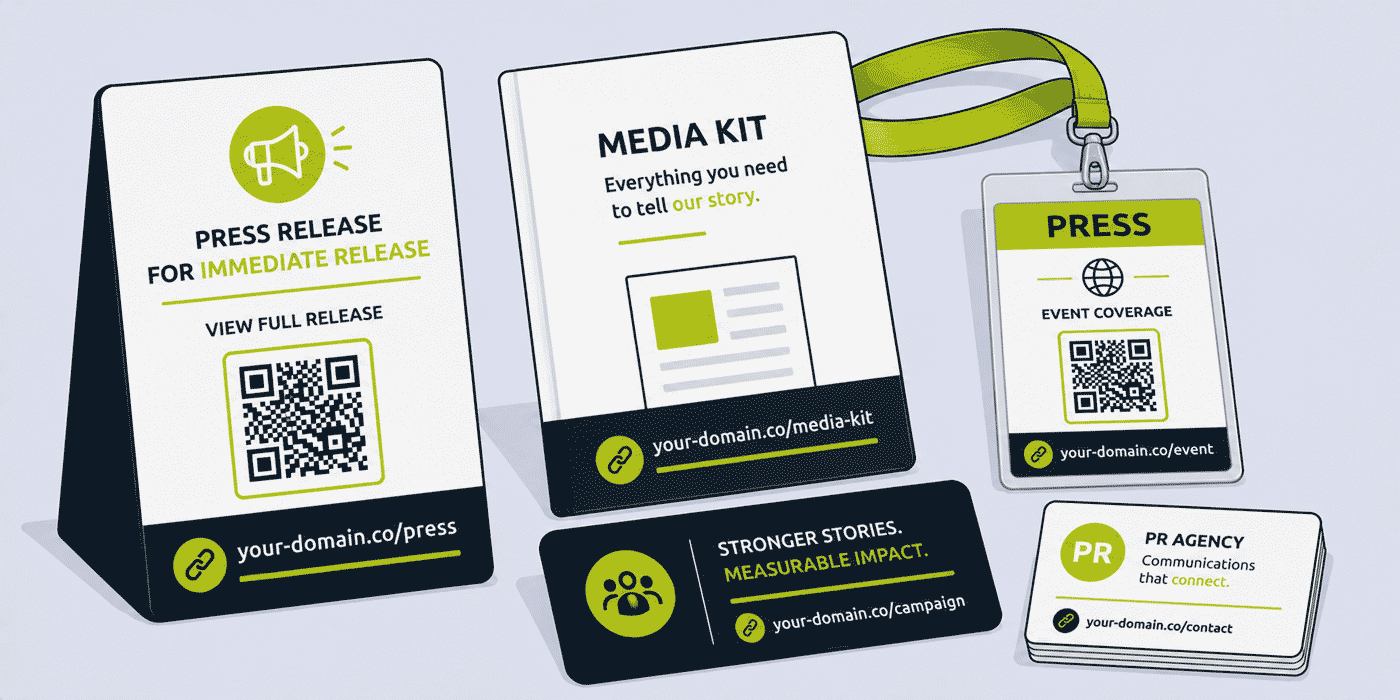
What This Guide Covers
- Press release distribution links — professional, trackable, updatable
- Media kit and asset links for journalists and editors
- Per-publication pitch attribution — understanding which publications engage before they cover
- Influencer outreach and campaign brief links
- Event press management links — invitations, press office, embargo tracking
- Client reporting links — making PR measurement more concrete
- Multi-client link organization in a shared agency account
- New business and agency marketing links
- Crisis communications links — the link management challenge of fast-moving situations
- A worked example: a PR agency's link stack across a product launch campaign
- Common mistakes in PR agency link management
- A Cuttly plan guide for PR agencies
- Frequently asked questions
Press Release Distribution Links
The press release is the foundational document of most PR campaigns, and the link through which journalists access it in response to a pitch is the most frequently sent link in any PR agency's day-to-day operations. Managing press release links well — ensuring they are professional, functional, and trackable — is the baseline link management standard for any PR professional.
Client-Branded Press Release Links
The most professional approach for a PR agency is to use the client's own domain for all press and media links: client-brand.com/press-release-title. This approach keeps the client's brand identity front and centre in every journalist communication and ensures that the link a journalist clicks in a pitch email is immediately recognizable as belonging to the brand being pitched, not to an unfamiliar agency or generic shortener domain.
For agencies that manage multiple clients and find it impractical to set up a separate domain for each, an agency-branded domain with per-client organization — agency.com/client-name-release-title — is a workable alternative that maintains the professionalism of a branded link while using the agency's own domain infrastructure. Either approach is significantly more professional than a generic shortener domain, which communicates nothing about the client or the agency and looks visually indistinguishable from a link in a spam email.
Dynamic Press Release Links for Post-Distribution Updates
Press releases are updated after initial distribution more often than most PR professionals would prefer: a factual error in a quote is identified after the pitch emails have already gone out, a client requests a change to the announcement before the embargo lifts, a supplementary statistic needs to be corrected, or an image is found to be low resolution and needs replacing. With a dynamic short link, the PR team updates the press release page and the destination behind the short link simultaneously; every journalist who clicks the link after the update accesses the corrected version, without any need to send a "please disregard my previous email" correction email to the full media list.
Press Release Link Analytics
Click analytics on a press release link — aggregated and anonymized — provide the PR team with a top-of-funnel signal that most PR agencies currently lack: how many journalists actually clicked on the press release link before the campaign generates any coverage. Most PR teams measure success at the coverage stage — how many articles were published — and have no visibility into the pre-coverage engagement stage. A press release that was opened and read by 40% of the pitching list but generated only 3% coverage take-up has a different problem (weak news value or wrong angle) than one read by only 5% of the list (weak subject line or wrong publication list). Click analytics reveal which problem the campaign has.
Media Kit and Asset Links
A well-organised media kit is one of the most valuable assets in a PR campaign. A journalist or editor who needs photography, logos, biographical notes, and supplementary information to complete a feature or news article should be able to access everything they need from a single, well-labelled link. A media kit link that is broken, that leads to a folder with poorly named files, or that contains outdated photography from a previous product generation creates unnecessary friction in the journalist relationship and risks the article being delayed or deprioritized.
Per-Campaign Media Kit Links
A short link per campaign media kit — client-brand.com/press-kit-campaign-name or client-brand.com/media-2026 — pointing to a well-organized media resource page or folder gives journalists a consistent, professional access point for all campaign assets. When assets are updated — new product photography replaces original shots, a higher-resolution logo is added, biographical notes are updated to reflect a new appointment — the media kit page is updated and the short link continues to point to the current version.
For ongoing client relationships where new assets are added regularly throughout the year, a permanent media kit link — client-brand.com/press — pointing to the client's general press resource hub gives any journalist who needs assets at any point in the year a consistent, remembered link to go to, rather than requiring them to search through old pitch emails to find the relevant asset folder.
Per-Publication Pitch Attribution
One of the most practically useful but least commonly used link management techniques in PR is per-publication press release or media kit links. When a PR team pitches 40 publications simultaneously, most teams send the same link to all 40. The result is a click total that shows how many journalists overall accessed the materials, but no indication of which specific publications are actively engaging with the pitch.
Creating a separate short link per publication — all pointing to the same press release page — gives the PR team per-publication engagement data. A publication link that generates three clicks in the 24 hours after a pitch suggests a journalist, section editor, and picture editor have all accessed the materials — a strong signal that coverage is being actively considered. A publication link with zero clicks three days after pitching suggests the email may not have been opened or the subject line was not compelling enough. These per-publication signals allow the PR team to prioritize follow-up calls intelligently, rather than calling publications at random or in alphabetical order.
The practical trade-off is that creating 40 separate short links for a 40-publication pitch takes more time than creating one. For major campaign launches where the publication list is carefully curated and follow-up call priority matters significantly, this investment is worthwhile. For high-volume routine press release distribution to a large general media list, a simpler per-tier approach — one link for tier-one national media, one for trade press, one for regional media — provides useful attribution without the per-publication overhead.
Influencer Outreach and Campaign Brief Links
Influencer relations have become a central component of most consumer PR campaigns, and the communications patterns with influencer contacts parallel those with journalists: initial outreach with campaign brief and product information, follow-up for response, agreement on deliverables, brief fulfilment, and post-campaign reporting. Each phase of this process involves links.
Campaign Brief Distribution Links
A short link for the campaign brief — client-brand.com/influencer-brief-campaign-name — gives each influencer contact a professional, branded entry point to the campaign information. When the brief is updated after initial distribution — if deliverable timing changes, if the product information is supplemented, or if new creative direction guidance is added — the dynamic short link destination is updated and all outreach emails reference the current brief without requiring a correction resend.
Per-Influencer Attribution Links
For campaigns where influencer contacts are being assessed for potential paid collaboration, a per-influencer link to the campaign brief or product information page — client-brand.com/brief-influencer-name — gives the PR team click analytics showing which influencer contacts actually read the brief before responding. An influencer who responds enthusiastically to a campaign proposal without having accessed the brief may be responding to the general proposition rather than the specific brief; an influencer whose response references specific brief details is demonstrably engaged with the content. Per-influencer link analytics add this signal to the PR team's influencer assessment process.
Event Press Management Links
Press events — product launches, brand announcements, press conferences, fashion shows, film premieres, book launches, and any other event to which journalists are invited — generate a specific set of link management requirements: the invitation and RSVP link, the pre-event background information link, the event day press accreditation link, the post-event press release and assets link, and any embargo-lifted content link that goes live at a specific time.
Press Event Invitation and RSVP Links
A short link for the press event RSVP — client-brand.com/rsvp-event-name — in the press invitation gives journalists a clean, professional entry point to the registration form. When the event details change — which they do for many events, as venues change, timings shift, or the event format is adjusted — the RSVP page destination can be updated without reissuing invitations. Journalists who have already saved the RSVP link still reach the current, accurate event information when they return to it.
Embargo Management Links
Embargo management is one of the most operationally demanding link management tasks in PR. A press release under embargo must be accessible to journalists (so they can write their coverage in advance) but must not be public until the embargo lifts. A short link for the embargoed press release — client-brand.com/embargo-release-name — that points to an access-controlled or password-protected page before the embargo lifts and is updated to the public press release page at the exact embargo lift moment is cleaner than any alternative approach. No link reissue is needed at embargo lift; the same link the journalist received when the pre-embargo brief was sent now leads to the public page automatically.
Client Reporting Links
PR reporting has historically been one of the weaker areas of PR agency practice, because the primary measurement metric — published coverage — is difficult to attribute to specific agency activities and impossible to compare directly with the digital marketing metrics (click-through rates, conversion rates, cost per acquisition) that clients use to evaluate other marketing investments. Short link click analytics provide PR agencies with a pre-coverage engagement metric that supplements the traditional coverage count: how many journalists engaged with the pitch materials, and when.
What Click Analytics Add to PR Reporting
Click analytics for press release and media kit links, included in client campaign reports, add three things that most PR reporting currently lacks:
- Pre-coverage engagement evidence. A campaign where 45% of pitched journalists accessed the press release within 48 hours, but only 12% published coverage, shows the client that the pitch generated significant interest even where coverage was not secured. The gap between engagement and coverage may indicate that the news value was competitive with other strong news that week, rather than that the pitch was ineffective.
- Media kit usage data. Click analytics on the media kit link show how many journalists actively prepared content using the provided assets, which is a better proxy for active coverage preparation than a simple pitch open rate.
- Campaign timing evidence. The timeline of press release link clicks relative to the pitch distribution, any follow-up activity, and eventual coverage publication gives the client a visible picture of how the PR campaign unfolded digitally, making the PR timeline more concrete and explicable than it typically is in most client reporting formats.
Multi-Client Link Organization
A PR agency managing multiple clients simultaneously faces the organizational challenge of keeping each client's links clearly separate and individually trackable without creating either a complex link library structure that is difficult to maintain or a fragmented analytics picture where client data bleeds into other clients' reporting.
Per-Client Link Structure Options
The cleanest approach for a PR agency with multiple clients is a per-client branded domain: each client has their own short domain, and all press and media links for that client use their own domain. The agency's link management account manages all client domains from a single dashboard, with per-client link libraries and per-client analytics visible separately.
For agencies where per-client domain setup is not practical for every client, a naming convention-based organization within a single agency domain provides a workable alternative: agency.com/client-a-release-name, agency.com/client-b-media-kit. A consistent naming convention that always leads with the client identifier makes the link library navigable and keeps each client's analytics separable in a single dashboard view.
Crisis Communications Links
Crisis communications is one of the most demanding and time-sensitive PR contexts, and link management in a crisis has specific requirements that differ from routine campaign link management. In a crisis, the PR team needs to distribute accurate, up-to-date information to journalists, stakeholders, and the public simultaneously, in a rapidly evolving situation where the information itself may change multiple times within hours.
A pre-established crisis communications short link — client-brand.com/statement or client-brand.com/press — that the agency can activate immediately when a crisis situation arises is one of the most valuable crisis preparedness tools available. The link is already established and known to the client's PR contact list; when a crisis breaks, the statement page destination is updated to the initial crisis statement within minutes, and every media contact, stakeholder, and company spokesperson who already has the link immediately has access to the current official position. As the situation evolves and subsequent statements are issued, the destination is updated each time; the link itself never changes.
New Business and Agency Marketing Links
A PR agency's own marketing — its credentials presentations, its awards submissions, its LinkedIn content, and its new business pitches — benefits from the same professional link standards that the agency applies to its clients. An agency that sends a credentials document link on a generic shortener domain in a new business pitch is not demonstrating its own digital communications standards.
Short links on the agency's own branded domain — agency.com/credentials, agency.com/case-studies, agency.com/awards — in new business communications present the agency as a digital communications professional that practices what it preaches. Click analytics on new business presentation links give the agency business development team a signal of which prospects are actively engaging with credentials materials before a pitch meeting, informing preparation and follow-up strategy.
A Worked Example: A PR Agency's Product Launch Campaign
Consider a mid-size consumer PR agency managing the UK product launch of a new sustainable lifestyle brand, using branded domains for the client such as client-brand.com, connected through Cuttly's custom domain setup (an A record and a TXT record — see the custom domain setup guide).
Two weeks before launch embargo lift: The agency creates /launch-release (pointing to the embargoed press release on a password-protected page), /media-kit (the full launch media kit including imagery, CEO bio, brand story, and product facts), and /launch-event (the press event RSVP page for the embargo lift event). The embargoed press release link is sent to the pre-brief list of 22 national and lifestyle journalists with password access.
Embargo lift day: At 00:01, /launch-release destination is updated from the password-protected page to the public press release page. All 22 journalists' links now lead to the live, public press release. The agency's wider media list of 85 journalists is pitched simultaneously. For the top 15 tier-one publications, the agency creates per-publication links: /lr-guardian, /lr-times, /lr-vogue, etc. — all pointing to the same release page.
48 hours post-launch: Click analytics show that 8 of the 15 tier-one publications have accessed the press release link, with The Guardian and Vogue each showing 3 clicks (suggesting multiple team members accessing the materials). Stylist magazine shows 0 clicks despite an apparent positive email response from the features editor. The account director calls the Stylist features editor and discovers the pitch email went to their junk folder; the materials are re-sent directly, and the magazine runs a feature two weeks later that would not have happened without the click-gap follow-up.
Client reporting: The monthly report includes: total press release link clicks (340 across all distribution), media kit click count (127 unique access events), tier-one per-publication engagement rates, coverage secured to date (23 pieces), and the correlation between link engagement and eventual coverage conversion. The client notes this is the most detailed pre-coverage visibility they have ever received from a PR agency, and renews the contract for the following season's campaign.
Common Mistakes in PR Agency Link Management
Generic Shortener Domains in Journalist Pitches
A PR agency that sends journalists pitch emails containing generic shortener domain links is presenting links that look like spam to any spam filter and like suspicious links to any security-aware journalist who has been trained to check link domains before clicking. The professional standard for PR agency communications is a client-branded or agency-branded short domain on every externally shared link, without exception.
No Click Analytics in Campaign Reporting
A PR agency that does not include pre-coverage engagement data in client campaign reports is missing the most concrete and independently verifiable measurement data available in the PR process. Coverage counts tell clients what coverage resulted from the campaign; click analytics tell clients how many journalists engaged with the pitch materials before any coverage decisions were made. Both data points together give a far more complete picture of campaign performance than coverage alone.
Same Link for All Publications in a Pitch
A PR team that uses the same press release link for all 80 publications in a pitch list gets a total click count but no per-publication engagement data. For major campaigns where follow-up call prioritization matters, per-publication or per-tier links provide the intelligence needed to allocate follow-up time efficiently. The incremental cost is one additional short link per publication or per tier, which is negligible relative to the follow-up time saved by knowing which publications are actively engaging with the pitch.
Cuttly Plan Guide for PR Agencies
- The Free plan ($0) provides 30 short links per month, one branded custom domain, full click analytics and dynamic QR Codes, with no credit card required. Suitable for a sole practitioner or very small PR agency setting up core press release, media kit, and event RSVP links for a single client.
- The Starter plan ($12/month) adds 300 short links per month and 30 custom aliases per month — practical for a growing PR agency managing multiple concurrent client campaigns, each with press release, media kit, event, and influencer outreach links, and wanting per-publication attribution for key campaign pitches.
- The Single plan ($25/month) adds up to 5 branded domains for different client accounts, fully customizable QR Codes for event and press materials, 1,000 API-created links per month, and a full year of analytics history for multi-campaign client reporting — most relevant for established agencies managing five or more active clients simultaneously with their own branded domains.
- The Team plan ($99/month) suits larger PR agencies with account teams, digital PR specialists, and media relations teams sharing link management across a full client roster, multiple branded domains per client, Campaign tag analytics for aggregated multi-client campaign reporting, and shared workspaces for account-level link management with appropriate client data separation.
Create a free Cuttly account to set up your agency's first client press release link, your media kit link and your first event RSVP short link. Registration is required for all plans, including free. No credit card is needed for the free plan.
Frequently Asked Questions
How do PR agencies use short links for press release distribution?
A PR agency creates a branded short link for each press release — client-brand.com/press-release-title — included in every pitch email. Because the link is dynamic, the press release page can be updated after distribution without resending to the media list. Click analytics show how many journalists accessed the press release, providing a pre-coverage engagement signal that most PR reporting currently lacks.
How do PR agencies use short links for media kit distribution?
A PR agency creates a short link for each client's media kit — client-brand.com/media-kit — pointing to a resource page with press release, imagery, logos, and biographical notes. When assets are updated, the destination updates automatically. Click analytics show how many journalists actively accessed the full asset package, indicating active coverage preparation.
How do PR agencies track per-publication campaign attribution?
A PR agency creates a separate short link per publication for major campaign pitches — all pointing to the same press release page. Click analytics per publication link show which publications engaged with pitch materials before responding, allowing intelligent prioritization of follow-up calls based on actual engagement signals rather than guesswork.
How do PR agencies manage links across multiple clients?
A PR agency uses per-client branded domains where possible — each client has their own short domain managed from a single agency dashboard. For clients without dedicated domains, a consistent naming convention within the agency's own domain — agency.com/client-name-release — keeps each client's links organized and analytics separately trackable.
How do PR agencies use short links for influencer outreach campaigns?
A PR agency assigns per-influencer links to campaign brief or product information pages. Click analytics per influencer link show which contacts actually read the brief before responding, helping the agency distinguish between engaged influencer prospects and those who responded without reviewing the campaign details. For time-sensitive briefs, these signals help prioritize follow-up within the response window.
- Get Started
- Create Free Account
- Plans & Pricing
- Platform Tools
- URL Shortener
- Link Analytics
- Campaign Analytics
- Related Guides
- URL Shortener for Agencies
- URL Shortener for Marketing Teams
- URL Shortener for Influencers
- URL Shortener for Publishers & Media
- URL Shortener for PDF Sharing
- Setup Guides
- Custom Domain Setup
- Track Link Clicks
- Industry Hub
- Marketing, Sales & SaaS Teams
- All Industries →
URL Shortener
Cuttly simplifies link management by offering a user-friendly URL shortener that includes branded short links. Boost your brand’s growth with short, memorable, and engaging links, while seamlessly managing and tracking your links using Cuttly's versatile platform. Generate branded short links, create customizable QR codes, build link-in-bio pages, and run interactive surveys—all in one place.
Cuttly - Consistently Rated
Among Top URL Shorteners
Cuttly isn’t just another URL shortener. Our platform is trusted and recognized by top industry players like G2 and SaaSworthy. We're proud to be consistently rated as a High Performer in URL Shortening and Link Management, ensuring that our users get reliable, innovative, and high-performing tools.C


