URL Shortener for Restaurants The Complete Guide
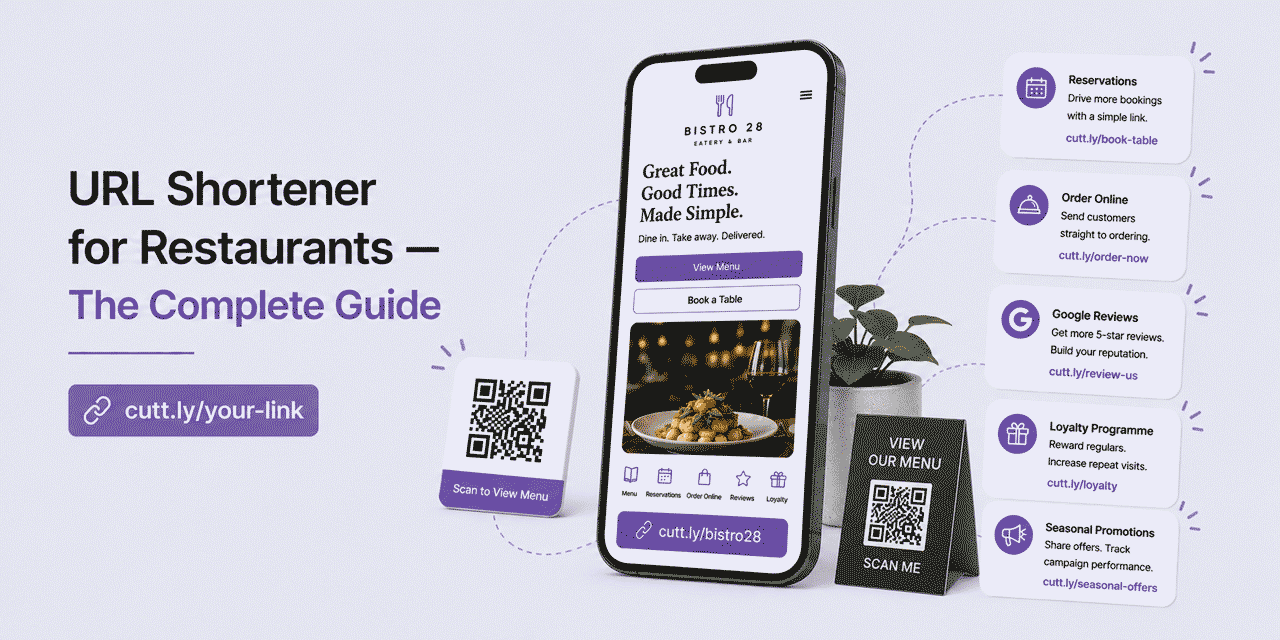
Restaurants operate in one of the most competitive local markets in existence. Every town has more dining options than most people can try in a year, and the decision of where to eat on any given evening is increasingly made through digital discovery — Google searches, Instagram posts, TripAdvisor listings, delivery app browsing, word-of-mouth recommendations that arrive via WhatsApp. At every stage of this journey, a link is involved. The restaurant with a branded short link on its table QR Code, a direct Google Review link on every receipt, a well-structured Instagram Link in Bio and a pre-visit SMS reservation link is extracting significantly more value from its marketing touchpoints than one that relies on a printed menu URL or a homepage link in the Instagram bio.
This guide covers the complete link strategy for restaurants, cafés, bars, casual dining, fine dining, takeaways and hospitality businesses — from digital menu QR Codes through Google Review generation, reservation management, delivery platform attribution, seasonal promotions, loyalty programmes and per-channel analytics. For closely related contexts see also URL Shortener for QR Code Menus and URL Shortener for Local Businesses.
What This Guide Covers
- Core standing links every restaurant needs
- Choosing a branded domain for a restaurant
- Dynamic QR Code menus — the right way to do table QR Codes
- Table card QR Code strategy — menu, WiFi, reviews and loyalty
- Window and entrance QR Codes
- Till receipt and takeaway packaging links
- Google Reviews — the system that generates consistent volume
- Reservation and booking links
- Delivery platform attribution — Deliveroo, Uber Eats, Just Eat
- Own website ordering links
- Instagram — content strategy and Link in Bio setup
- TikTok for restaurants — food content and local discovery
- SMS marketing for restaurants
- WhatsApp Business for reservations and communications
- Loyalty programme links
- Seasonal promotions — Valentine's Day, Christmas, Mother's Day
- Events — private dining, themed nights, chef's table links
- Per-channel attribution — tracking what fills tables
- Multi-location restaurant group management
- Cuttly plan guide for restaurants
Core Standing Links Every Restaurant Needs
Before building seasonal campaign links, per-platform delivery tracking or event-specific links, establish a set of permanent branded short links that are deployed consistently and updated only when underlying pages change:
| Link | Destination | Primary deployments |
|---|---|---|
yourbrnd.link/menu | Current digital menu | Table QR Codes, window, receipt, social bio |
yourbrnd.link/reserve | Reservation / booking page | Table cards, social bio, SMS campaigns, Google profile |
yourbrnd.link/order | Online ordering or delivery page | Window, receipt, takeaway packaging, social bio |
yourbrnd.link/review | Google Review form | Table cards, receipt, window, post-visit SMS |
yourbrnd.link/loyalty | Loyalty programme sign-up | Table cards, receipt, social media |
Each link is dynamic. When the digital menu platform changes — from a PDF on the website to a dedicated menu app, from one provider to another — yourbrnd.link/menu updates in Cuttly and all printed table QR Codes, window stickers, receipt codes and social media references redirect correctly. For a restaurant printing table cards in batches of 200, the value of never needing to reprint because a platform URL changed is immediate and concrete.
Choosing a Branded Domain for a Restaurant
The restaurant's branded domain for short links should feel natural to the brand — for a neighbourhood café, something warm and local; for a fine dining establishment, something clean and refined; for a casual dining group, something accessible and energetic. Well-chosen domain patterns:
- "The Corner Table" →
cornertable.linkorthecornertable.link - "Ember & Salt" →
emberandsalt.link - "Café Botanica" →
cafebotanica.link - "The Anchor" (pub) →
theanchor.link dine.yourrestaurant.com— a subdomain of an existing website, for restaurants with strong main domain recognition
The .link TLD has wide availability for restaurant and food business names. Register at any domain registrar (typically $6–$12 per year) and connect to Cuttly via DNS in under fifteen minutes — full guide at Cuttly Branded Domains.
Dynamic QR Code Menus — The Right Way to Do Table QR Codes
QR Code menus became standard practice during the pandemic years and have remained in widespread use — but most restaurants are using them suboptimally. The most common implementation is a static QR Code generated directly from the menu PDF URL, printed on table cards. This approach has a fundamental operational problem: every time the menu changes — a dish sells out, a price updates, a new section launches, a seasonal menu replaces the previous one — the static QR Code points to an outdated page or a broken URL.
The correct implementation is a Cuttly dynamic QR Code pointing to a branded short link (yourbrnd.link/menu), with the destination updateable at any time from the Cuttly dashboard. The printed table card never changes. The menu behind the QR Code updates instantly whenever the restaurant makes changes. A Monday morning menu update after a weekend of sold-out dishes is live on every table before the first lunch service, without touching a single printed card.
Menu QR Code Analytics
Every scan of the menu QR Code is tracked in Cuttly — total scans per day, peak scan times (showing exactly when tables are occupied and guests are browsing the menu), device type (virtually 100% mobile, but iOS vs Android breakdown is useful for menu formatting decisions), and geographic distribution (showing whether menu scans come from local guests or tourists, which may affect menu language or description style decisions).
For restaurants with multiple table types — bar seating, standard tables, private dining area — creating a unique Cuttly link per area (all pointing to the same menu destination) shows which seating areas generate the most menu engagement. A private dining area that has very few menu scans relative to its cover count may indicate guests in that area are receiving physical menus — useful operational intelligence.
Table Card QR Code Strategy — Menu, WiFi, Reviews and Loyalty
The table card is one of the most consistently viewed pieces of communication in a restaurant — every guest who sits down at a table with a card will see it, typically multiple times during their visit. Most restaurants use table cards for a single purpose (the menu QR Code). A well-designed multi-purpose table card with two or three QR Codes converts the same physical space into multiple commercial touchpoints.
Four QR Code Table Card Setup
QR Code 1 — Menu
"View our menu" → yourbrnd.link/menu
QR Code 2 — WiFi
"Connect to our WiFi" → yourbrnd.link/wifi — links to a page showing the current WiFi password and network name. When the password changes (as it periodically should for security), the Cuttly destination updates — no reprinting required. Every table card continues directing guests to the current password.
QR Code 3 — Reviews
"Enjoyed your meal? Leave us a Google review" → yourbrnd.link/review
QR Code 4 — Loyalty (optional, if programme exists)
"Join our loyalty programme" → yourbrnd.link/loyalty
The four-QR-Code table card serves the guest throughout their visit: menu at arrival, WiFi when they settle in, review prompt toward the end of the meal (ideally timed with dessert menus or the bill), and loyalty sign-up at departure. All four are Cuttly dynamic links — any destination can update without reprinting. All four are tracked independently, showing which table card interactions generate the most engagement at different points of the dining experience.
Window and Entrance QR Codes
A restaurant window is a marketing asset that most restaurants underutilize beyond displaying opening hours and a few photographs. A window QR Code — or two — converts passive passers-by into active enquirers before they have entered the restaurant.
Two effective window QR Code placements for restaurants:
- Reservation link: "Book a table tonight" or "Reserve your table — scan here" →
yourbrnd.link/reserve. Captures the person who passes at 11am and decides they would like to book for dinner that evening, or the couple who pass on Saturday morning planning their anniversary dinner. - Menu preview: "Explore our menu" →
yourbrnd.link/menu. A potential guest who is undecided between two nearby restaurants and wants to see the menu before choosing can scan, browse and decide — converting indecision into a booking at the restaurant that made decision-making easiest.
During promotional periods — Valentine's Day, Christmas, a special event — the window QR Code destinations update to the relevant seasonal page. The physical sticker remains the same; the digital content it delivers is always current.
Till Receipt and Takeaway Packaging Links
The till receipt is the last piece of branded communication a diner receives from the restaurant. Most receipts contain the restaurant's name, address and VAT number — functional but commercially inert. A QR Code and a short URL on the receipt converts the checkout moment into a review opportunity, a loyalty sign-up or a rebooking prompt.
Effective receipt QR Code deployments:
- Google Review prompt: "Enjoyed your visit? Leave us a Google review" →
yourbrnd.link/review. The most commercially valuable receipt QR Code deployment — catching diners at the moment of maximum satisfaction (they have just finished a meal they enjoyed enough to pay for) before they leave and forget. - Rebooking: "Book your next visit" →
yourbrnd.link/reserve. Particularly effective for restaurants with longer booking lead times or limited availability, where a diner who enjoyed their visit should be prompted to rebook before they leave.
For takeaway and delivery restaurants, packaging QR Codes serve the same function. A QR Code sticker on the takeaway bag or box — linking to the Google Review form or the reorder page (yourbrnd.link/order) — reaches the customer at home in the equivalent of the post-dining satisfaction moment. A sticker costs under 1p per bag; the review or reorder it generates is worth many times that.
Google Reviews — The System That Generates Consistent Volume
Google Reviews are the single most commercially significant online asset for most restaurants. They determine position in local search results, they appear prominently in Google Maps alongside every restaurant listing, and they provide the social proof that converts a potential diner who is choosing between two nearby options. A restaurant with 180 Google Reviews at 4.7 stars generates more new customers from local search than one with 25 reviews at 4.9 stars — because the higher volume provides a more convincing signal of consistent quality across a range of guests and occasions.
Most restaurants have dramatically fewer reviews than their cover count warrants. A restaurant serving 300 covers per week — 1,200 per month, 15,000 per year — with only 45 Google Reviews is leaving an enormous amount of social proof on the table. The conversion rate from satisfied diner to Google reviewer is low not because guests are unwilling but because the path from "I enjoyed that" to "I left a review" has too many steps.
Creating the Review Link
In Google Business Profile, navigate to "Get more reviews" and copy the direct review link. This URL opens the review form immediately — no Google Maps navigation, no search for the restaurant listing, no clicking through tabs. Set this as the destination for yourbrnd.link/review in Cuttly.
The Five-Touchpoint Restaurant Review System
- Table card QR Code. The primary placement — visible to every diner throughout their visit. The review prompt should appear on the card but be positioned below the menu QR Code so as not to feel transactional before the meal begins. The ideal timing for a verbal mention: "If you enjoyed your evening, there is a QR Code on the table that goes straight to our Google reviews — it means a lot to us."
- Till receipt QR Code. Catches diners at the checkout moment. Immediate, habitual, zero additional cost per cover.
- Window QR Code. Catches guests who leave without scanning the table card — the review prompt is visible as they exit.
- Post-visit SMS or email (for guests who booked online): sent the following day — "Thank you for dining with us last night. If you enjoyed your visit, a Google review would mean a great deal: yourbrnd.link/review"
- Staff verbal request. Used selectively — after a table has been visibly happy, a warm personal request from the server is significantly more effective than a generic printed prompt. "If you have had a good evening, we would really appreciate a Google review — the link on the table card goes straight there."
Restaurants deploying all five touchpoints consistently report generating 15–30 new Google Reviews per month from a typical cover count. At that rate, a restaurant with 40 reviews at the start of the year has 220–400 reviews by year end — a transformation in its local search presence and new customer acquisition.
Reservation and Booking Links
The reservation link is the primary conversion point for restaurant marketing — the moment when a potential diner's interest converts into a committed booking. Every channel that generates diner awareness should point to a frictionless reservation path.
yourbrnd.link/reserve — deployed consistently across all channels — should land on a reservation page that requires minimal steps: date, time, party size, name and contact information. A reservation page that requires account creation, a phone verification step or excessive form fields will lose a significant proportion of motivated potential diners at the final step.
Reservation Platform Transitions
Restaurants change reservation systems regularly — from OpenTable to Resy, from a phone-only approach to a dedicated booking app, from one integration to another. Every platform change previously required updating the restaurant's Google Business Profile, website, Instagram bio, printed materials and any existing email or SMS references to the old booking URL. With yourbrnd.link/reserve as the consistent branded short link, the only change required is updating the Cuttly destination. All deployed references continue working immediately.
Private Dining and Event Booking
For restaurants that offer private dining rooms, corporate events, birthday packages or celebration menus, a dedicated short link — yourbrnd.link/private-dining — provides a clean entry point to the private event enquiry form. This link is referenced in the Instagram Link in Bio page, in corporate outreach emails and in any editorial or press features that mention private dining options. Cuttly analytics on this link show how much traffic the private dining offering generates from different discovery sources — useful for allocating promotional effort between corporate sales and consumer marketing.
Delivery Platform Attribution
Restaurants operating on multiple delivery platforms — Deliveroo, Uber Eats, Just Eat, and their own direct ordering system — face the same attribution challenge as any multi-channel business: which platform actually drives the most profitable orders, and is the commission paid to third-party platforms justified relative to the direct ordering alternative?
Most delivery platforms provide their own analytics — total orders, average order value, customer ratings. What they do not provide is a comparison between platforms, or a comparison between platform orders and direct orders through the restaurant's own system. Cuttly provides this independent comparison layer.
Create a unique Cuttly short link per delivery channel, all pointing to the relevant ordering page:
| Channel | Cuttly link | utm_source |
|---|---|---|
| Deliveroo | yourbrnd.link/order-deliveroo | deliveroo |
| Uber Eats | yourbrnd.link/order-ubereats | uber-eats |
| Just Eat | yourbrnd.link/order-justeat | just-eat |
| Own website ordering | yourbrnd.link/order-direct | direct |
| Takeaway packaging | yourbrnd.link/order | packaging |
These links are referenced in social media posts, in the Instagram Link in Bio page, on the restaurant's website and in any marketing materials that reference delivery. When a customer clicks through from the restaurant's own Instagram to Deliveroo via the Cuttly link, that click is tracked — giving the restaurant independent data on how much of its social media traffic it is sending to a third-party platform with a 25-35% commission versus how much it is retaining for its direct ordering system.
Over three to six months, this data builds a meaningful picture of which platforms the restaurant's own marketing is feeding — and enables a deliberate decision about whether to promote direct ordering more actively. Many restaurants find that a significant proportion of their delivery orders come from customers who discovered the restaurant through their own social media and then ordered via a platform rather than directly — a 25-35% commission cost on orders that the restaurant's own marketing generated.
Instagram — Content Strategy and Link in Bio
Instagram is the primary social media discovery platform for restaurants. Food content — beautifully photographed dishes, satisfying cooking videos, atmospheric restaurant imagery — performs naturally on a visual platform, and the restaurant audience on Instagram is actively seeking dining inspiration. A restaurant with a strong Instagram presence reaches potential diners in a state of receptive food-oriented browsing.
Content That Fills Tables
- Dish photography. The most consistent high-performing content for restaurants — close-up, well-lit images of the most photogenic dishes. The photography directly represents the product: a potential diner who sees a beautifully photographed dish and thinks "I want to eat that" is a conversion opportunity the next time they are choosing where to eat.
- Kitchen process and chef content. Behind-the-scenes cooking videos, chef profiles, preparation processes — content that communicates the skill and care behind the food. This type of content builds restaurant identity beyond the dishes themselves and creates the sense of authenticity that distinguishes independent restaurants from chains.
- Atmosphere and dining experience content. Full table shots, ambient room photography, the dining room during service — content that communicates the experience of dining at the restaurant, not just the food. Diners choose restaurants for the complete experience; showing that experience attracts bookings from people who are specifically seeking the atmosphere the restaurant provides.
- Seasonal and special menu announcements. New menu launches, seasonal specials, limited-time dishes — content that creates urgency and gives followers a reason to book now rather than "sometime."
- Availability posts. "Tables still available this Saturday evening — link in bio to book" as a direct conversion driver. Particularly effective when posted on Wednesday or Thursday mornings when weekend dining plans are being made.
Link in Bio Setup for Restaurants
Set the Instagram bio link to the restaurant's branded Cuttly domain. The Link in Bio page provides multiple tracked buttons:
- Book a table → reservation page (first button for dine-in focused restaurants)
- View our menu → digital menu
- Order delivery → delivery ordering page or platform selector
- This week's specials → current specials page or seasonal menu (updated weekly; the dynamic destination refreshes without changing the button)
- Private dining → private event enquiry form
- Find us → Google Maps
Analytics from the Link in Bio show the primary intent of the restaurant's Instagram audience. If "Book a table" dominates, the audience is ready to reserve — lean into availability posts and special occasion content. If "View our menu" gets the most taps, followers are in the research phase — lean into dish photography and menu highlight content to accelerate the decision. If "Order delivery" dominates, the Instagram audience is primarily local delivery customers — content that showcases the delivery experience (packaging, presentation, portion size) performs better than reservation-focused content.
TikTok for Restaurants
TikTok has transformed restaurant discovery — videos of specific dishes, restaurant experiences and food preparation regularly generate hundreds of thousands of views and create genuine queues and waiting lists for the restaurants featured. For local restaurants, TikTok's geographic algorithm provides organic local reach that Instagram's follow-based model cannot replicate at the same scale.
Content formats that perform well for restaurants on TikTok: dish preparation videos (satisfying cooking process content), "what I ordered at [restaurant]" style videos featuring the restaurant's most photogenic dishes, restaurant experience content showing the atmosphere and service, response videos to trending food formats adapted to the restaurant's menu, and "come eat with us" front-of-house content showing real dining moments with the energy of a full service.
The restaurant that invests in consistent TikTok content — three to five posts per week — typically sees meaningful local reach growth within four to six weeks, with a corresponding increase in reservation enquiries from people who discovered the restaurant through TikTok rather than Google search or word of mouth. Tracking this attribution with a TikTok-specific Cuttly reservation link (yourbrnd.link/reserve-tiktok) quantifies the TikTok contribution to actual booking volume.
SMS Marketing for Restaurants
SMS marketing for restaurants is most effective in two specific contexts: filling quiet periods and driving seasonal bookings. Both leverage the high open rates and immediacy of SMS against the restaurant's most commercially relevant timing challenges.
Quiet Night Fill Campaigns
A quiet Tuesday or Sunday service that is running at 40% capacity by Monday evening can be substantially improved with a targeted SMS to the restaurant's subscriber list. The message needs to be immediate, personal and with a clear call to action:
"Hi — we have some last-minute tables for this Tuesday evening and we are running a free dessert with every main course tonight. Book here: yourbrnd.link/reserve-tuesday"
The branded short link is essential for trust. A restaurant's regular customers who recognize the restaurant's branded domain in a WhatsApp or SMS message act on it at significantly higher rates than they would for a generic shortener or raw URL. The unique link for the Tuesday offer — yourbrnd.link/reserve-tuesday — also tracks exactly how many bookings the SMS campaign generated, providing concrete ROI data for this marketing approach.
Seasonal Booking Campaigns
Valentine's Day, Mother's Day, Christmas and New Year's Eve are the four highest-demand booking days for most restaurants. Most of these bookings are made weeks in advance by organized customers — but a significant proportion of potential bookings are lost to procrastination. An SMS sent three weeks before Valentine's Day to the restaurant's customer list — "Valentine's Day tables are filling fast — book now: yourbrnd.link/valentines" — captures this procrastinating segment before they end up at a competitor or settling for a less preferred option.
WhatsApp Business for Reservation Communications
WhatsApp is increasingly the channel through which restaurant reservations and enquiries arrive — particularly for independent restaurants where the personal relationship between guest and restaurant is part of the appeal. Managing these efficiently without losing the personal character of the interaction requires the right combination of automation and genuine responsiveness.
- Away message: "Thanks for getting in touch with [Restaurant Name]. We are currently in service but you can check availability and book at yourbrnd.link/reserve. We will confirm your booking shortly."
- Greeting message: "Hi — welcome to [Restaurant Name]. You can check our menu at yourbrnd.link/menu and book a table at yourbrnd.link/reserve. What can we help you with?"
- Reservation confirmation template: After confirming a WhatsApp reservation, send the confirmation with a link to the menu and a gentle note about the review link: "Your table for [date] is confirmed. Looking forward to seeing you. Our menu is at yourbrnd.link/menu — and if you enjoy your visit, a Google review would mean a lot to us: yourbrnd.link/review"
Loyalty Programme Links
Restaurant loyalty programmes — stamp cards, points systems, app-based rewards — increase visit frequency from the existing customer base, which is the most cost-effective revenue growth lever available to any restaurant. A customer who visits monthly becomes a customer who visits every two to three weeks with the right loyalty incentive. Over a year, the revenue difference is meaningful.
yourbrnd.link/loyalty — the loyalty programme sign-up link — is deployed at the moments of highest sign-up intent:
- Table card QR Code: Visible throughout the meal. "Join our loyalty programme" alongside the menu and review QR Codes.
- Till receipt: "Join our loyalty programme and earn a free dessert on your next visit" with the QR Code at the bottom of the receipt.
- Post-first-visit SMS: "Thank you for visiting us — we hope to see you again soon. If you join our loyalty programme, you will earn points toward a free meal: yourbrnd.link/loyalty"
Because the loyalty link is a dynamic Cuttly link, switching loyalty platforms — from a stamp card app to a points system, from one provider to another — requires one destination update. All printed table cards, receipt codes and previously sent SMS messages continue redirecting to the current loyalty programme sign-up.
Seasonal Promotions and Events
Valentine's Day, Mother's Day, Christmas and New Year's Eve — these four dates together generate a disproportionate share of annual bookings for restaurants that serve them well. Each deserves a dedicated Cuttly campaign structure:
- Create a seasonal booking link —
yourbrnd.link/valentines,yourbrnd.link/christmas— pointing to the seasonal special menu or event booking page - Create per-channel variants for attribution tracking — email, SMS, Instagram, window QR Code
- Set up a Cuttly campaign tag — "Valentine's Day 2027", "Christmas 2026"
- Deploy from 4-6 weeks before the date across all channels simultaneously
- Post-event review: Cuttly Campaigns analytics show total link clicks per channel, peak engagement times and per-channel conversion — informing promotion intensity and timing for the following year
For ongoing events — a monthly chef's table, a weekly quiz night, a regular live music evening — each event type gets its own dedicated short link: yourbrnd.link/chefs-table, yourbrnd.link/quiz-night, yourbrnd.link/live-music. These links are referenced consistently in the Instagram bio, in weekly social posts and in email newsletters. Cuttly analytics show which event type generates the most booking interest over time — informing the event programming calendar.
Per-Channel Attribution — Tracking What Fills Tables
Most restaurants have no reliable way to know whether a new diner found them through Google, Instagram, TikTok, a friend's recommendation, a delivery app or the window. Per-channel Cuttly reservation links provide this attribution with precision.
| Channel | Cuttly reservation link | Measures |
|---|---|---|
| Window QR Code | yourbrnd.link/reserve-window | Foot traffic to booking conversion |
| Instagram bio | yourbrnd.link/reserve-ig | Instagram audience booking intent |
| TikTok bio | yourbrnd.link/reserve-tiktok | TikTok discovery to booking conversion |
| Google Business Profile | yourbrnd.link/reserve-google | Search intent conversion |
| Email newsletter | yourbrnd.link/reserve-email | Email campaign booking conversion |
| SMS campaign | yourbrnd.link/reserve-sms | SMS campaign booking conversion |
| Table card QR | yourbrnd.link/reserve-table | In-restaurant rebooking rate |
After three months of tracking, the reservation attribution picture emerges with specificity. Most independent restaurants find that Google Business Profile drives the highest-intent traffic (people who were actively searching for a restaurant like this), Instagram drives a high volume of discovery clicks but a lower direct booking rate, the window QR Code captures high-intent local passers-by, and the in-restaurant table card rebooking link has the highest conversion rate of any channel because the guest is making the booking decision at the moment of peak dining satisfaction.
Multi-Location Restaurant Group Management
For restaurant groups operating multiple locations — whether under the same brand or as a portfolio of distinct concepts — Cuttly's Team plan provides shared link management with per-location analytics. Each location operates under its own branded domain or subdomain, managed from a single shared workspace. The group marketing team sees all locations' link performance and aggregated campaign analytics; individual location managers see only their own site's data.
Group-wide seasonal campaigns — a Valentine's Day promotion running across all locations — are created centrally with per-location Cuttly links providing location-specific attribution. The group can compare which location's marketing generates the most per-channel reservation traffic, identifying both the best-performing locations and the channels that work most effectively in different demographic or geographic markets.
Cuttly Plan Guide for Restaurants
The Starter plan ($12/month) includes one branded domain, full analytics, dynamic link destinations, QR Codes at print resolution, Link in Bio page and Cuttly Campaigns. The right plan for most independent restaurants and cafés. At $12 per month — less than the margin on two desserts — it provides the complete link infrastructure for professional digital menu management, Google Review generation, reservation tracking and social media bio management.
The Single plan ($25/month) adds five branded domains, link expiration (useful for time-limited seasonal booking offers — a Valentine's Day link that expires automatically on February 15), retargeting pixels and device targeting. Relevant for restaurants running paid social advertising alongside organic content, or for operators managing multiple distinct dining concepts.
The Team plan ($99/month) suits restaurant groups with multiple locations — shared workspace, up to ten branded domains, role-based access for location managers, aggregated campaign analytics and the Team API for integration with reservation management systems.
Create a free Cuttly account and set up your first restaurant menu QR Code today. Registration required; free plan available with no credit card needed.
Frequently Asked Questions
How do restaurants use QR Code menus with URL shorteners?
Create yourbrnd.link/menu in Cuttly pointing to the digital menu. The QR Code generated automatically by Cuttly goes on table cards. When the menu changes — dishes, prices, seasonal sections — the Cuttly destination updates instantly without reprinting any table cards. Every printed QR Code always serves the current menu.
How do restaurants get more Google Reviews?
Create yourbrnd.link/review pointing to the Google Review form. Deploy on table cards, till receipts, window sticker and in post-visit SMS to guests who booked online. Verbal mention toward the end of the meal. Consistent deployment across all five touchpoints generates 15–30 new reviews per month.
How do restaurants track which delivery platform drives the most orders?
Create a unique Cuttly link per platform — Deliveroo, Uber Eats, Just Eat, direct ordering. All point to the relevant order page. Cuttly analytics show per-platform click data independently, enabling data-driven decisions about platform spend and the balance between third-party delivery commissions and direct ordering.
How do restaurants use SMS marketing with short links?
SMS with a branded Cuttly short link fills quiet nights ("Tables available tonight: yourbrnd.link/reserve-tuesday") and drives seasonal bookings ("Valentine's tables filling fast: yourbrnd.link/valentines"). The branded domain builds immediate trust. Per-campaign unique links track how many bookings each SMS campaign generates.
What is the best way for a restaurant to use their Instagram bio link?
Set the bio link to the branded Cuttly domain. The Link in Bio page provides tracked buttons for reservation, menu, delivery ordering, specials and private dining. Analytics show whether the Instagram audience primarily wants to book, browse the menu or order delivery — directly shaping content strategy.
- Cuttly Tools
- URL Shortener Tool →
- Link in Bio Builder →
- QR Code Generator →
- Branded Domains →
- Surveys →
- Related Industries
- URL Shortener for QR Code Menus
- URL Shortener for Local Businesses
- URL Shortener for Delivery & Food Services
- URL Shortener for Hotels & Hospitality
- Related Guides
- URL Shortener for SMS Marketing
- URL Shortener for Email Marketing
- Short Links for Print & Offline
- Encyclopedia
- Dynamic QR Codes
- Branded Links
- All Industries →
- Start Here
- Create Free Account
- Plans & Pricing
URL Shortener
Cuttly simplifies link management by offering a user-friendly URL shortener that includes branded short links. Boost your brand’s growth with short, memorable, and engaging links, while seamlessly managing and tracking your links using Cuttly's versatile platform. Generate branded short links, create customizable QR codes, build link-in-bio pages, and run interactive surveys—all in one place.
Cuttly - Consistently Rated
Among Top URL Shorteners
Cuttly isn’t just another URL shortener. Our platform is trusted and recognized by top industry players like G2 and SaaSworthy. We're proud to be consistently rated as a High Performer in URL Shortening and Link Management, ensuring that our users get reliable, innovative, and high-performing tools.


