URL Shortener for Solar Energy Companies The Complete Guide
Solar energy is a considered, high-value purchase with a long sales cycle and a complex information environment. A homeowner or business considering solar installation needs to understand the technology, the financial case, the available incentives, the installation process, and the company's credentials before committing to a contract that may run to five figures. The marketing and sales process that takes a prospect from initial curiosity to signed installation agreement involves multiple digital touchpoints — each of which depends on a link that works reliably, looks professional, and contributes to the attribution data that tells the company's sales leadership which channels are generating its revenue.
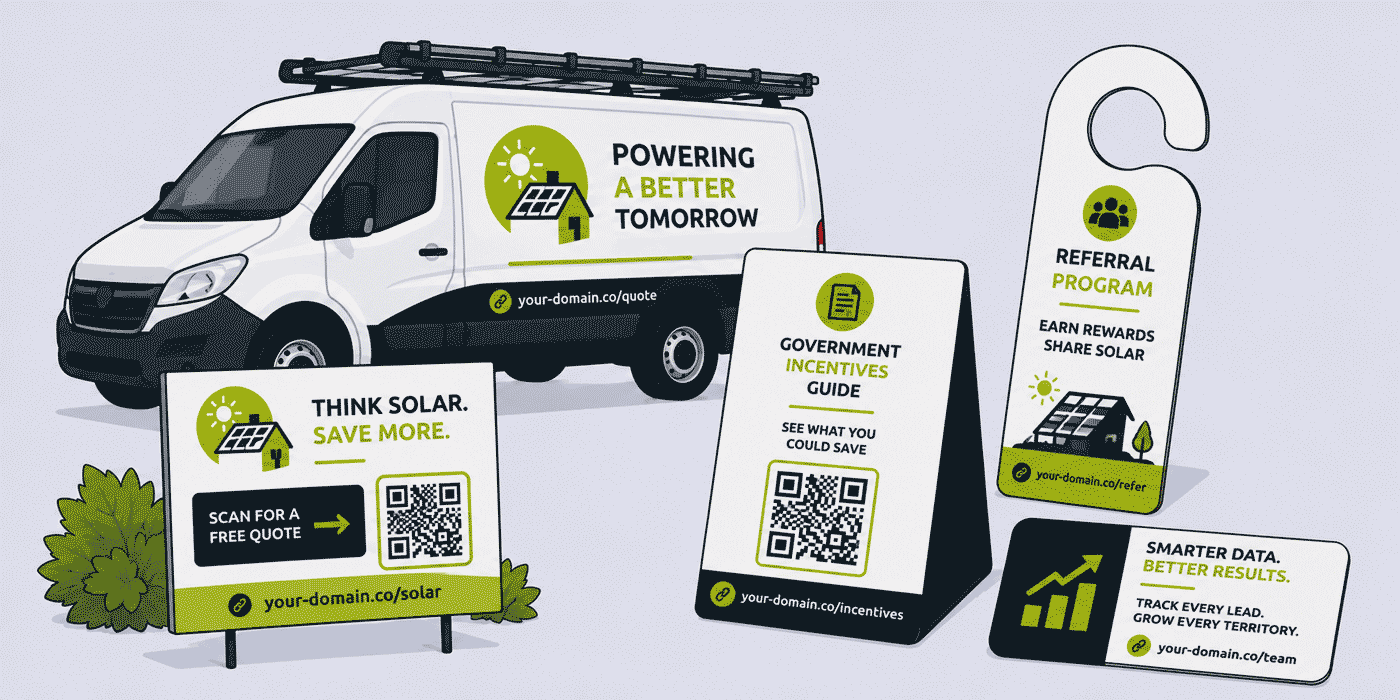
This guide covers how solar panel installers, renewable energy companies, battery storage providers, and heat pump installers use a URL shortener, branded custom domain, dynamic QR Codes and click analytics across quote request attribution, yard sign and vehicle QR Codes, government incentive communications, per-territory sales team performance, customer referral programmes, and the content marketing that educates prospects through a complex purchase decision.
What This Guide Covers
- Quote request links — the primary conversion point in the solar sales funnel
- Per-channel acquisition attribution across Google, social, yard signs and referrals
- Yard sign and installation site QR Codes — neighbourhood social proof converted to leads
- Installation vehicle QR Codes
- Government incentive and grant information links
- Savings calculator links — the highest-engagement content in solar marketing
- Customer referral programme links
- Per-territory sales team attribution
- Post-installation customer communication links
- Trade and B2B solar installation links
- A worked example: a regional solar installer's full link infrastructure
- Common mistakes in solar company link management
- A Cuttly plan guide for solar energy companies
- Frequently asked questions
Quote Request Links: The Solar Sales Funnel's Primary Conversion Point
The solar installation sales funnel typically moves from awareness (seeing an ad, a neighbour's installation, or a news article about energy costs) through consideration (researching solar technology, costs, and installers) to the quote request (submitting contact details and property information for a tailored quote). The quote request is the moment at which a prospect converts from anonymous audience member to identified sales lead, and the link through which this conversion happens is the most commercially important link the solar company manages.
The Solar Quote Tool Migration Problem
Solar quoting tools have evolved significantly over the past decade and continue to evolve as technology improves. Companies have moved from basic contact forms to detailed survey-based quote calculators, from calculators to satellite roof assessment tools that estimate generation capacity from aerial imagery, and from static assessment tools to real-time energy tariff integration that shows live payback period calculations. Each technology upgrade typically changes the quote tool URL.
For a solar company that has been marketing for several years, the quote tool URL appears across its Google My Business profile, its comparison site listings, its Facebook ad account's landing pages, its Google Ads destination URLs, its printed door-drop materials, its yard sign text, and its vehicle signage. A tool migration that changes the URL without a dynamic short link in place breaks every one of these references simultaneously — precisely at the moment the company is investing in upgrading to a better tool.
A permanent branded short link for the quote request — your-solar.com/quote — provides a stable reference that survives every tool migration. When the new tool goes live, the short link destination updates; every existing marketing reference continues to send prospects to the current tool. The upgrade is invisible to every prospect who uses any of those references.
Per-Channel Quote Attribution
A solar company running simultaneous marketing across Google Ads, Facebook and Instagram, door-to-door canvassing, yard signs at completed installations, trade show presence, and customer referrals cannot determine which channel is generating its most valuable leads without per-channel attribution data. The solar sales cycle is typically eight to sixteen weeks from first enquiry to signed installation agreement; by the time a contract is signed, the sales team may have forgotten which channel generated the original quote request.
Per-channel short links for the quote request form:
your-solar.com/quote-google— Google Ads and organic search CTAsyour-solar.com/quote-fb— Facebook and Instagram advertisingyour-solar.com/quote-yard— yard signs at completed installationsyour-solar.com/quote-door— door-to-door canvassing handoutsyour-solar.com/quote-referral— general customer referral channelyour-solar.com/quote-event— trade show or home improvement exhibition
All six link to the same quote request page. Click analytics per channel, combined with the company's CRM data tagging each lead with its source, give the sales director a per-channel cost-per-installation metric across the full sales cycle. Because solar installations are high-value contracts — typically £6,000 to £15,000 for a domestic system in the UK, or equivalent in other markets — even a modest difference in conversion rate between channels, multiplied across the installation volume, represents substantial revenue impact.
Yard Sign and Installation Site QR Codes
The yard sign is one of the most effective and most underdigitised marketing tools available to a solar installer. When a crew is installing panels on a residential roof, the property is a live demonstration of the company's work — visible to every neighbour, every passing driver, and every pedestrian in the street. The neighbours of a newly installed solar system are, statistically, some of the most interested solar prospects the company will ever have the opportunity to reach: they have seen a local installation, they know the property (perhaps they have discussed energy costs with the homeowner), and the installation has made solar a conversational topic in their community.
The Yard Sign QR Code
A yard sign placed at an installation site during and after the work — with the company's name, a compelling headline ("We installed this solar system — find out what it could save you"), and a QR Code linking to a savings calculator or quote request page — converts neighbourhood curiosity into trackable digital engagement. The QR Code is generated from a dynamic short link — your-solar.com/yard — that:
- Provides click analytics showing exactly how many neighbourhood scans each installation site generates
- Can be updated to point to different destinations — quote form, savings calculator, case study gallery — based on testing which drives the most conversion
- Remains functional if the company's website is restructured or the quote tool is migrated
- Provides a dedicated attribution channel for neighbourhood discovery that is completely independent of any other marketing source
Over time, comparing yard sign click rates across different neighbourhoods, different installation types, and different seasons reveals patterns in neighbourhood solar interest that inform the company's territory prioritisation and canvassing strategy. A neighbourhood where yard signs generate high QR Code scan rates is one where solar is actively on residents' minds; a neighbourhood with low scan rates despite high installation volume may have a different resident demographic or energy cost profile.
Installation Vehicle QR Codes
A solar installation crew's vehicles — vans, flatbed trucks carrying panel delivery, and equipment trailers — are visible across the company's operating territory throughout every working day. Unlike a typical service vehicle, a solar installation van parked at a residential property during an installation generates genuine neighbourhood curiosity: people can see the crew working, they can see panels being installed, and the visible activity is inherently informative about the company's product.
A QR Code on a solar installation vehicle — your-solar.com/van — alongside the company's branding and headline message gives curious passersby and neighbours a direct digital path to learn more. Click analytics on the vehicle QR Code, tracked separately from all other channels, show the company how much organic neighbourhood interest its installation activity generates on a weekly basis. For a company operating four vehicles completing two installations per week each, this passive advertising exposure represents a significant and measurable lead source that costs nothing beyond the initial QR Code sticker and the link setup.
Government Incentive and Grant Information Links
Government incentives are one of the most significant factors in a homeowner's solar installation decision. Feed-in tariffs, the Smart Export Guarantee in the UK, the Investment Tax Credit in the US, the Energy Savings Opportunity Scheme for commercial installations, and equivalent programmes in other markets can substantially reduce the effective cost of a solar installation and shorten the payback period. Prospects who do not understand these incentives frequently underestimate the financial case for solar; those who do understand them convert at significantly higher rates.
A branded short link for the company's government incentives guide — your-solar.com/incentives or your-solar.com/grants — is one of the most commercially important content links a solar company manages. It appears in Google Ads targeting people searching for solar grants and subsidies, in email campaigns to prospects in the consideration phase, in blog content about the financial case for solar, and in any social media post discussing the current incentive environment.
Because government incentive programmes change frequently — the UK's Feed-in Tariff was replaced by the Smart Export Guarantee; US ITC rates have been revised multiple times; European national incentive schemes are regularly updated — the dynamic nature of a short link behind the incentives guide is not merely convenient but operationally important. A prospect who clicks the incentives guide link from a social media post made eighteen months ago needs to reach the company's current, accurate incentives information, not an outdated guide referencing a scheme that has since been replaced or revised. Incorrect incentive information that leads a prospect to have false expectations about their project economics is a significant trust and commercial risk; a dynamic link that always serves current information is part of managing that risk.
Savings Calculator Links
The solar savings calculator is consistently the highest-engagement content asset in a solar company's digital marketing arsenal. A prospect who enters their location, their current energy bill, and their roof size receives a personalised estimate of how much solar could save them annually and over the life of the system. This interactive, personalised experience is far more persuasive than any static content, and a prospect who has spent five minutes with a savings calculator is significantly more likely to request a full quote than one who has only read a general overview of solar panel costs.
A branded short link for the savings calculator — your-solar.com/savings or your-solar.com/calculator — is used in every channel where the company is targeting prospects in the consideration phase: in email nurture campaigns to prospects who have expressed interest but not yet requested a quote, in social media content targeting homeowners researching energy costs, in Google Ads targeting energy bill-related search terms, and in any content that makes the financial case for solar. Click analytics on the calculator link show how many prospects are engaging with the personalised savings experience and provide a top-of-funnel signal for the company's quote pipeline.
Customer Referral Programme Links
Solar installation customers are among the most motivated brand advocates available to any company in the home improvement sector. A homeowner who has just installed solar panels and is watching their energy bills fall, receiving payments from their energy company for exported generation, and enjoying the satisfaction of contributing to renewable energy has strong personal motivation to share their positive experience with friends, neighbours, and family. A well-managed referral programme captures this advocacy systematically.
Post-Installation Referral Link
A short link for the referral programme — your-solar.com/refer — is provided to every customer at the post-installation follow-up: in the completion congratulations email, in the first-month performance report email, and in any anniversary communication. The incentive for sharing — typically a cash reward, a monitoring system upgrade, or a battery storage discount for both referrer and referee — should be clear and immediately compelling.
For companies that want to track which individual customers are the most active advocates, per-customer unique referral links — generated at scale using Cuttly's API — attribute each referred lead to the specific customer who generated it. This per-customer referral tracking enables a tiered advocacy programme where the most active referrers receive enhanced rewards, and enables the company to identify its natural brand ambassadors for deeper advocacy programmes.
Per-Territory Sales Team Attribution
A solar company with geographically distributed sales teams or franchise territories needs per-territory attribution data to compare sales team performance across regions and to allocate marketing support appropriately. A territory generating high quote request volumes but low conversion rates may need different sales support from one generating low volumes but very high conversion; per-territory link analytics provide the visibility that makes this distinction actionable.
A per-territory quote link structure — your-solar.com/quote-north, your-solar.com/quote-south, your-solar.com/quote-midlands — used in each territory's local marketing gives the national sales director per-territory digital engagement data alongside each territory's installation revenue data. The relationship between marketing engagement and installation revenue per territory is the most actionable performance management data set available for a multi-territory solar operation.
Post-Installation Customer Communication Links
The post-installation customer relationship is commercially significant for a solar company for three reasons: review generation (online reviews drive future solar lead generation more strongly than almost any other factor in local search), referral generation (a satisfied customer who refers two neighbours is generating installations worth multiples of the original contract), and upsell potential (battery storage, EV charging, and energy monitoring system upsells to an existing customer base are lower-cost conversions than new customer acquisition).
Post-Installation Link Set
A structured post-installation communication sequence uses short links at each stage:
- Completion day — system performance guide.
your-solar.com/system-guide: the guide to understanding the monitoring app, reading generation data, and understanding the Smart Export Guarantee payment process. A customer who understands their system is more satisfied and more likely to generate a positive review. - One month post-installation — review request.
your-solar.com/review: a direct Google review request with context ("After a month with your new solar system, we'd love to hear how it's going"). The one-month mark captures the customer after they have seen their first month's generation data and energy bill comparison. - Three months post-installation — referral invitation.
your-solar.com/refer: "Your neighbours have probably noticed your new solar panels — share the link and earn [reward] for every successful installation." At three months, the customer has had enough experience to speak confidently about the system's performance. - Annual anniversary — battery storage upsell.
your-solar.com/battery-storage: an invitation to enhance their system with battery storage, timed to when the customer has a full year of generation data to inform the conversation about storage capacity sizing.
A Worked Example: A Regional Solar Installer's Link Infrastructure
Consider a regional solar installer completing 80 to 120 domestic installations per year across a three-county territory in England, with a dedicated sales team of four and two installation crews, using a branded domain such as your-solar.com, connected through Cuttly's custom domain setup (an A record and a TXT record — see the custom domain setup guide).
Quote attribution: After twelve months of per-channel tracking: Google generates 48% of quote link clicks (highest volume), yard signs generate 19% (highest click-to-installation conversion rate at 34%, versus Google's 18%), referrals generate 14% (second highest conversion at 29%), Facebook generates 12% (lowest conversion at 11%), door-drop canvassing generates 7%. The sales director shifts 15% of the Facebook budget to yard sign programme expansion (more signs, more sites, longer leave periods), increasing the share of the highest-converting channel.
Incentives guide: /incentives is updated three times in the year as government guidance changes. Because all existing marketing references use the short link, the updates are invisible to every prospect who clicks the link from an older social post, a previous email campaign, or an archived comparison site listing. The sales team estimates at least 40 quote requests in the year arrived through the incentives guide link from marketing materials produced 6 to 18 months earlier — leads that would have hit a dead or outdated page without the dynamic link infrastructure.
Referral programme: 34 of 96 installation customers in the year click the referral link from the three-month post-installation email (35% engagement). Of these, 8 generate referred installations (24% referral-to-installation rate). These 8 referred installations represent approximately £72,000 in contracted revenue generated entirely from a post-installation email containing a short link, with no other marketing cost.
Common Mistakes in Solar Company Link Management
Embedding the Quote Tool URL Directly in Google Ads
A solar company that uses its quote tool's native URL as the Google Ads destination URL will break its entire paid search campaign at every tool migration, because the destination URL is embedded in the ad. A dynamic short link as the Google Ads destination means the tool can migrate without touching the ad account; the short link destination updates and the campaign continues to function correctly.
No Yard Sign QR Code Programme
A solar installer that puts yard signs at completed installations without a QR Code is generating neighbourhood awareness without converting it into measurable enquiries. Given that yard sign leads consistently show among the highest quote-to-installation conversion rates in the solar category, the incremental investment in adding a QR Code to an existing yard sign programme is negligible relative to the additional tracked lead volume it generates.
Static Incentives Guide Links in Long-Term Marketing
A solar company that publishes its government incentives guide URL directly in email campaigns, comparison site profiles, and printed materials creates an accuracy liability at every policy change. Incorrect incentive information reaching a prospect who uses it to inform their financial decision creates a significant trust problem when the discrepancy is discovered. A dynamic short link for the incentives guide, updated whenever the underlying content changes, is both a link management tool and an accuracy assurance mechanism.
Cuttly Plan Guide for Solar Energy Companies
- The Free plan ($0) provides 30 short links per month, one branded custom domain, full click analytics and dynamic QR Codes, with no credit card required. Suitable for a small solar installer setting up core quote, savings calculator, incentives guide and yard sign QR Code links.
- The Starter plan ($12/month) adds 300 short links per month and 30 custom aliases per month — practical for a growing solar company managing per-channel quote attribution, a yard sign QR programme across multiple sites, a customer referral programme, post-installation communication links, and regular incentives guide updates throughout the year.
- The Single plan ($25/month) adds up to 5 branded domains for solar groups operating multiple regional brands, customizable QR Codes with the company's branding for professional yard signs and vehicle displays, 1,000 API-created links per month for automated per-customer referral link generation, and a full year of analytics history for seasonal demand pattern analysis.
- The Team plan ($99/month) suits larger solar installation groups with multiple regional sales teams, multiple territories, and marketing teams sharing link management, with Campaign tag analytics for aggregated territory and campaign reporting and multiple branded domains for different regional brands.
Create a free Cuttly account to set up your solar company's quote attribution links, your yard sign QR Codes, and your government incentives guide link. Registration is required for all plans, including free. No credit card is needed for the free plan.
Frequently Asked Questions
How do solar energy companies use short links for quote requests?
A solar installer creates a permanent short link — your-solar.com/quote — for its quote tool, with per-channel attribution variants for Google, social, yard signs, and referrals. Because solar quoting tools evolve frequently, a dynamic link ensures every existing marketing reference continues to work through each tool upgrade. Per-channel conversion data identifies which sources generate the most commercially valuable leads.
How do solar companies use QR Codes on yard signs and installation sites?
A solar installer places QR Codes from dynamic short links on yard signs at completed installations, linking to a savings calculator or quote request page. Neighbours are among the highest-converting solar leads; the yard sign QR Code converts their curiosity into trackable enquiries. Analytics on your-solar.com/yard track neighbourhood engagement separately from all other acquisition channels.
How do solar installers track which marketing channel produces the most installations?
A solar company creates per-channel quote links — Google, Facebook, yard signs, door-drops, referrals. Click analytics per channel combined with CRM installation data give a per-channel cost-per-installation metric across the full sales cycle. Because solar is a high-value contract with a long cycle, even small conversion rate differences between channels represent significant revenue impact.
How do solar companies use short links for government incentive information?
A solar installer uses a dynamic short link — your-solar.com/incentives — for its government incentives guide. Because incentive programmes change frequently, the dynamic destination ensures every existing reference always serves current, accurate information. Incorrect incentive information creates significant trust risk with prospects using it for financial planning; a dynamic link is part of managing that risk.
How do solar energy companies use short links for referral programmes?
A solar installer provides every customer with a referral programme short link at the three-month post-installation point. Per-customer unique referral links, generated via API, track exactly which customers generate the most referred leads. Click analytics on the referral link show how many customers engage with the advocacy invitation and at which post-installation timing engagement is highest.
- Get Started
- Create Free Account
- Plans & Pricing
- Platform Tools
- URL Shortener
- Link Analytics
- QR Code Generator
- Related Guides
- URL Shortener for Manufacturers
- URL Shortener for Housebuilders
- URL Shortener for Home Improvement
- URL Shortener for Moving Companies
- Short Links for Offline Campaigns
- Encyclopedia
- Dynamic QR Codes
- Branded Links
- Setup Guides
- Custom Domain Setup
- Track Link Clicks
- Industry Hub
- Manufacturing & Industrial
- All Industries →
URL Shortener
Cuttly simplifies link management by offering a user-friendly URL shortener that includes branded short links. Boost your brand’s growth with short, memorable, and engaging links, while seamlessly managing and tracking your links using Cuttly's versatile platform. Generate branded short links, create customizable QR codes, build link-in-bio pages, and run interactive surveys—all in one place.
Cuttly - Consistently Rated
Among Top URL Shorteners
Cuttly isn’t just another URL shortener. Our platform is trusted and recognized by top industry players like G2 and SaaSworthy. We're proud to be consistently rated as a High Performer in URL Shortening and Link Management, ensuring that our users get reliable, innovative, and high-performing tools.C


