URL Shortener for Churches and Religious Organisations The Complete Guide
A church communicates with its congregation and community across a remarkably diverse range of channels and contexts: a printed weekly bulletin handed to every person entering the service, a verbal announcement from the pulpit, a text message to the congregation's mobile numbers, a weekly email newsletter, social media posts across Facebook and Instagram, a livestream of the Sunday service watched by housebound or distant members, printed posters in the church porch and local community spaces, and the pastoral conversations in which a minister mentions a support resource or an upcoming event. Every one of these communication contexts involves a link — to a giving page, a livestream, an event registration, a sermon archive, a small group sign-up, or a community support resource — and the accessibility and reliability of those links is part of how a church demonstrates care for its congregation.
This guide covers how churches, faith communities, religious organisations, and places of worship of all traditions use a URL shortener, branded custom domain, dynamic QR Codes and click analytics across online giving, livestream access, printed bulletin QR Codes, event and service registration, small group sign-ups, community outreach, pastoral communications, and the full range of congregational and community link management needs for a faith community that communicates across both digital and physical channels simultaneously.
What This Guide Covers
- Online giving links — the most commercially important link a church manages
- Bulletin and printed material QR Codes — bridging the physical service and digital engagement
- Service and sermon livestream links
- Event and special service registration links
- Small group and ministry sign-up links
- Sermon archive and resource library links
- Community outreach and support service links
- Pastoral and congregational communication links
- A worked example: a growing church's full link infrastructure
- Common mistakes in church link management
- A Cuttly plan guide for churches and religious organisations
- Frequently asked questions
Online Giving Links
For most churches and faith communities, online giving has become the most significant financial management challenge of the digital age. A congregation that previously gave almost entirely through cash in an offering bag or envelope has been transformed, over the past decade, into one where digital giving — through giving platforms, bank transfers, standing orders, and contactless giving points — now represents a large and growing proportion of total giving. The link to the giving platform is the primary mechanism through which a church invites this digital giving, and managing it well has direct financial consequences for the community.
The Giving Platform Migration Problem
Churches change their online giving platforms more frequently than most organisations, partly because the church giving technology market is active and evolving — with platforms like Tithe.ly, Pushpay, Donorbox, Give.net, and numerous others competing for the church market — and partly because giving platforms are often selected by church administrators or treasurers who may change their preferences or find a better-value option as contracts expire. Each platform change creates a new giving URL.
A church that has printed its giving URL in 52 weekly bulletins over the past year, included it in a year's worth of weekly email newsletters, displayed it on a QR Code stand in the church entrance, referenced it in every stewardship campaign communication, and had it mentioned verbally from the pulpit more times than anyone can count, has distributed that URL very widely across both digital and physical contexts. When the platform changes, updating every one of these references is either impossible (physical bulletins that have already been distributed) or extremely time-consuming (email newsletter archives, website pages, social media posts).
A permanent branded short link for the giving page — your-church.com/give or simply give.your-church.com — updated when the platform changes, means every existing reference continues to direct donors to the current giving page. The church's communications minister updates one short link destination; every bulletin that mentioned it, every email that contained it, and every QR Code that encoded it continues to work correctly.
The Bulletin Giving Link
The weekly bulletin is the most universally distributed printed material in most churches: every person attending the service receives one. A giving link in the bulletin — whether as a printed URL or as a QR Code — reaches the entire Sunday congregation simultaneously. For many attendees, particularly older members who are less digitally active, the bulletin's printed or QR-coded giving link is their primary path to online giving beyond cash or cheque.
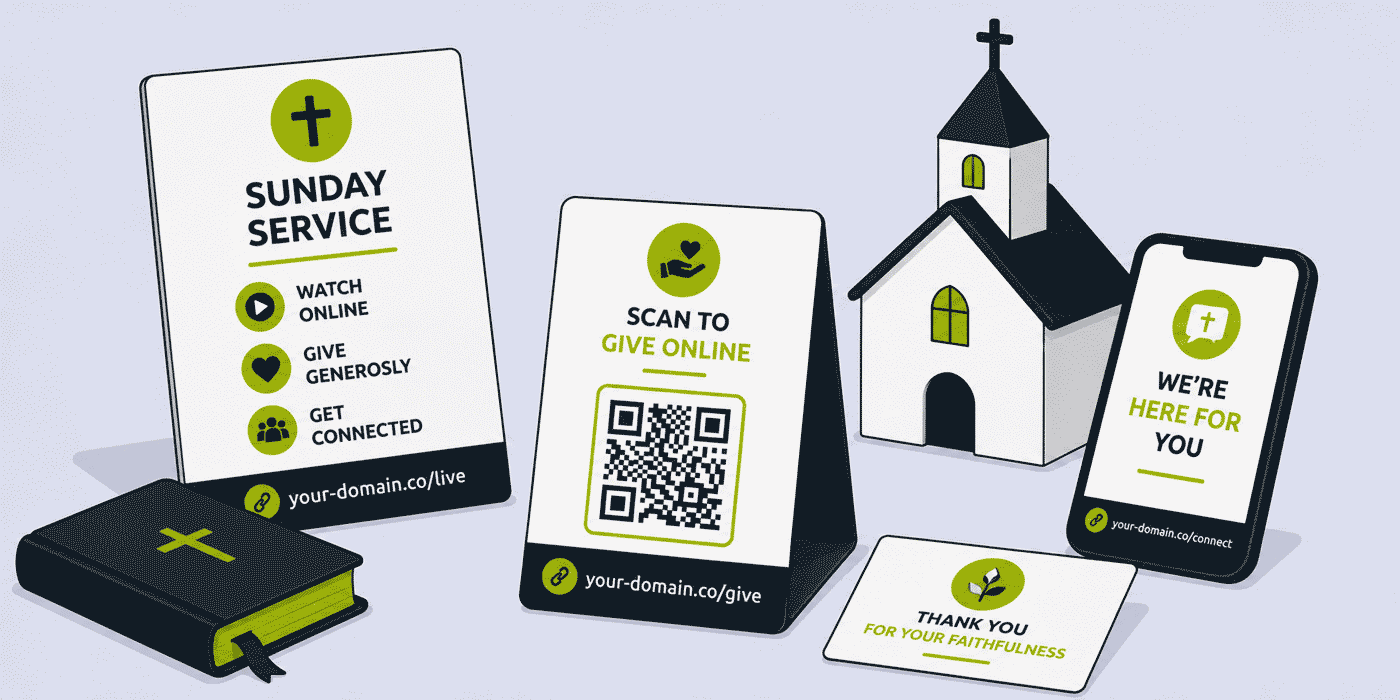
A QR Code in the bulletin, generated from the giving short link, provides an instant-scan path to the giving platform. A congregant who sees the QR Code during the offertory moment and scans it immediately reaches the giving page in seconds, in the context of maximum generosity motivation. Click analytics on the giving link, aggregated and anonymized, show the church's stewardship team when the most giving page access occurs — during the service, in the hours immediately after, or in the days following — informing when verbal giving encouragements have the most impact and when reminder communications are most effective.
Campaign and Appeal Giving Links
Beyond general weekly giving, most churches run specific giving campaigns: building fund appeals, mission support campaigns, emergency community relief fundraising, and end-of-financial-year gift day campaigns. Each campaign benefits from its own short link pointing to a campaign-specific giving page:
your-church.com/building-fund— the capital project giving campaignyour-church.com/mission-giving— the overseas or community mission support fundyour-church.com/gift-day— the annual gift day campaignyour-church.com/community-appeal— an emergency community relief fund
Campaign-specific giving links allow the stewardship team to track which campaigns generate the most congregational giving engagement, and to update each link to a "campaign completed — thank you" page once the campaign target is reached, rather than leaving donors to arrive at an active giving page after the need has been met.
Bulletin and Printed Material QR Codes
The printed bulletin — the service order, the notices sheet, or whatever form the weekly printed congregational communication takes — is simultaneously one of the most universally distributed materials in any church and one of the most under-digitally-integrated. A bulletin that carries only printed text and no QR Codes is missing the opportunity to be the physical bridge between the Sunday service experience and every digital resource, community, and service the church offers.
Core Bulletin QR Codes
A well-designed church bulletin carries a small set of QR Codes that serve the congregation's most common digital needs:
- Giving.
your-church.com/give— as discussed above, the most commercially important QR Code in any bulletin. Placed adjacent to the offertory section of the service order or in a clear "Give Online" panel. - Sermon notes and study guide.
your-church.com/sermon-notesor a per-sermon link —your-church.com/sermon-date. A congregant who wants to follow the sermon on their phone, take notes digitally, or download the week's Bible study guide has a single scan path to do so. A visitor who missed the service and wants to access the notes can scan a bulletin they kept. - Event registration. For any event promoted in that week's bulletin, a per-event QR Code —
your-church.com/event-name— provides a direct registration path from the bulletin rather than requiring the congregant to search the church website for a registration form. - Community and newcomer welcome.
your-church.com/new-here— a welcome page for visitors who are attending for the first time, linking to information about the church community, small groups, and how to get more involved. A first-time visitor who scans this QR Code during the service or after can explore the community at their own pace.
All bulletin QR Codes are generated from dynamic short links. Because the bulletin's physical format and QR Code positions are set by the design template, which is typically unchanged for months at a time, dynamic QR Codes ensure that every week's bulletin design continues to serve accurate, current content for its digital destinations without requiring the bulletin designer to regenerate QR Codes whenever a platform or URL changes.
Service and Sermon Livestream Links
The COVID-19 pandemic permanently changed the relationship between churches and livestreaming: many congregations that had never considered broadcasting their services now have significant online communities of regular livestream viewers — housebound members, people who have moved away but want to stay connected with their home church, family members of congregants who live in other cities, and people who are exploring faith but are not yet ready to attend in person. Managing the livestream link well — ensuring it is always accessible, always current, and consistently featured across all congregational communications — is part of how a church serves this growing online community.
Permanent Livestream Short Link
A permanent short link for the church's service livestream — your-church.com/live — is used in every weekly communication that promotes Sunday attendance: the Friday email to the congregation, the Saturday reminder to registered online attendees, the Sunday morning bulletin QR Code, the church's social media posts, and the website's homepage. This link points to the active livestream during the service and to the most recent sermon recording in the hours and days after the service.
Because churches change their livestreaming platform with some regularity — moving from Zoom to YouTube Live to Facebook Live to dedicated church platforms as technology and preference evolves — a dynamic short link means that the livestream link a congregant saved on their phone from a bulletin two years ago continues to reach the current active stream, wherever it is hosted. A church that has a loyal community of online attendees who have saved the livestream link should not lose them every time it changes streaming platform.
Event and Special Service Registration Links
Churches organise a calendar of significant events throughout the year: Christmas carol services, Easter celebrations, baptism Sundays, harvest festivals, confirmation services, church anniversary weekends, community fairs, guest speaker events, and seasonal programmes for children and young people. Each of these events benefits from a dedicated short link for registration or attendance information that is used consistently across all the channels through which the event is promoted.
Per-Event Short Link Strategy
A short link per major event — your-church.com/christmas-2026, your-church.com/easter-sunrise, your-church.com/family-fun-day — gives each event a consistent, shareable, trackable reference used in:
- The bulletin QR Code in the weeks leading up to the event
- The weekly email newsletter
- Social media posts about the event
- Printed posters in the church porch and local community spaces
- Verbal announcements from the pulpit that mention "you can register at..."
- Any community outreach leaflets promoting the event to the wider neighbourhood
A short, memorable URL — your-church.com/christmas — mentioned verbally in a Sunday announcement is far more likely to be remembered and visited later than a long event platform URL. Click analytics per event link show the events team how much advance engagement each event is generating, and comparing engagement rates across event types over multiple years builds a picture of which events the congregation and community find most compelling.
After the event has passed, the short link redirects from the registration page to a thank-you or highlights page — or to the next upcoming event — rather than to a dead page. Anyone who finds the event QR Code on a poster that wasn't taken down lands somewhere helpful rather than an error page.
Small Group and Ministry Sign-Up Links
Small groups — Bible study groups, prayer groups, ministry teams, pastoral care teams, youth and children's groups — are the relational backbone of most church communities. The process of inviting someone into a small group typically begins with a pastoral conversation, but it is completed through a digital action: visiting a sign-up page, completing a registration form, or accessing a group's communication channel. Short links for small group sign-ups remove the friction between the pastoral conversation and the digital action.
A per-small-group or per-ministry short link set:
your-church.com/small-groups— the small groups overview and sign-up hubyour-church.com/youth— the youth group information and registrationyour-church.com/prayer-team— the prayer ministry team invitationyour-church.com/serving— the volunteer and ministry serving teams overview
These links are used in bulletin QR Codes during a small groups promotion period, in the church's newcomer welcome page (your-church.com/new-here), and in any pastoral communication that specifically invites someone to explore a particular ministry or community. A pastoral team member who texts a congregant "I thought you might enjoy our prayer group — sign up at your-church.com/prayer-team" is providing a direct, actionable path to the next step in their community journey.
Sermon Archive and Resource Library Links
Most churches produce a significant volume of resources each year: weekly sermons, Bible study notes, seasonal devotional materials, children's ministry resources, and pastoral guidance documents. These resources represent years of theological and pastoral labour, and making them accessible and discoverable to both current congregation members and people outside the church who encounter them online, is part of the church's ongoing ministry. Short links for the sermon archive and resource library give these resources a stable, accessible reference across every context where they might be shared.
A short link for the sermon archive — your-church.com/sermons — and for specific sermon series — your-church.com/series-name — is used in pastoral referrals ("I thought this sermon series might be helpful for what you're working through"), in social media posts sharing recent sermons, in any external coverage of the church's ministry, and in email newsletters that feature recent sermon content. Because sermon archives are hosted on platforms (Sermon Audio, Buzzsprout, the church's own website) that may change, a dynamic short link ensures the archive reference remains valid through any hosting migration.
Community Outreach and Support Service Links
Many churches run significant community outreach programmes: food banks, debt counselling services, community cafes, parent-and-toddler groups, bereavement support groups, mental health and pastoral counselling, and emergency community relief services. These programmes serve not just church members but the wider community, including people who may have no connection to the church's faith community but who need the practical support the church provides. The links through which these programmes are accessed by the community need to be trusted, clearly identifiable, and stable.
A branded link on the church's own domain — your-church.com/foodbank, your-church.com/support, your-church.com/counselling — is more trustworthy to a community member accessing a support service than a generic shortener URL. It communicates that the resource is from the church they may know from the neighbourhood, and it provides the kind of visual assurance that is important when someone is in a vulnerable situation and is evaluating whether to trust a resource they have found on a poster or been given in a leaflet.
Community outreach links should be treated with the same permanent maintenance priority as any crisis resource link: they may be accessed by people in genuine need, and a broken link in an outreach context creates a barrier to help at exactly the moment when that help is most needed. Dynamic short links for all community support service entry points, regularly monitored and maintained, are part of the church's duty of care to the community it serves.
Pastoral and Congregational Communication Links
Churches communicate with their congregations through a variety of pastoral channels beyond the formal service and bulletin: weekly email newsletters, pastoral letters, prayer request systems, congregational survey and feedback tools, and the church management system through which members update their details, track attendance, and access community resources. Short links for each of these communication systems give the pastoral team a professional, stable, and consistent reference across the diverse communication contexts of congregational life.
A survey tool link — your-church.com/survey — for congregational feedback, visitor welcome surveys, and ministry planning input gives the pastoral team a consistent, tracked entry point for gathering community input. Click analytics on survey links show how many congregation members are engaging with each survey invitation, and comparing engagement across different survey topics informs both the content of future surveys and the communication channels most effective at prompting congregational feedback participation.
A Worked Example: A Growing Church's Full Link Infrastructure
Consider a growing evangelical church in a medium-size English city, with a Sunday morning congregation of 380 people, an online audience of approximately 120 regular livestream viewers, and an active community programme including a weekly food bank and a monthly community cafe, using a branded domain such as your-church.com, connected through Cuttly's custom domain setup (an A record and a TXT record — see the custom domain setup guide).
Core permanent links: /give (giving platform), /live (Sunday livestream), /sermons (sermon archive), /small-groups (community group sign-up), /new-here (visitor welcome), /foodbank (community food bank information), /support (pastoral support services). These seven links appear in the bulletin, in the weekly email, and across the church's digital presence. When the church migrates its giving platform from PayPal to Tithe.ly, only the /give destination needs updating; every printed bulletin, every past email, and every QR Code display in the building continues to work.
Christmas carol service: In late November, the church promotes its Christmas carol service — historically the event that most non-churchgoing community members attend. The event link /christmas-2026 goes into the bulletin QR Code from November 15th, into the weekly email, into Facebook and Instagram posts, and onto printed A5 cards distributed by congregation members to neighbours. After three weeks: 340 QR Code scans from the bulletin, 280 email link clicks, 190 social media clicks. Advance registration: 420 people (including the 380 regular congregation), suggesting significant community interest from non-regular attendees. The church prepares for 150 non-regular attendees and sets up a welcome team with /new-here cards specifically for the Christmas service.
Livestream community: The church's /live link is mentioned in every Sunday service verbal announcement. Over six months, analytics show a consistent 80 to 140 weekly livestream link clicks, of which approximately 65% occur within 30 minutes of the service starting (live viewers) and 35% in the following 48 hours (on-demand viewers). The pastoral team learns from this data that the on-demand audience is significant and begins producing improved post-service resources — sermon notes, discussion questions — specifically for the on-demand viewing context.
Common Mistakes in Church Link Management
Giving Platform URL Directly in Printed Bulletins
A church that prints its giving platform's native URL in its weekly bulletin creates a link maintenance problem at every platform change. When the church moves from one giving provider to another — which most do at some point — every historically printed bulletin with the old URL becomes a dead giving reference. A permanent branded short link for the giving page, updated when the platform changes, protects the church's entire historical print investment in the giving reference.
No QR Codes in the Weekly Bulletin
A church whose bulletin contains only printed text with no QR Codes is leaving the digital bridge between the Sunday service and the congregation's online engagement entirely to chance. Congregants who hear about online giving, small groups, or the livestream in the service have no immediate action path unless a QR Code provides one. Adding two or three well-chosen QR Codes to the bulletin design is one of the most impactful digital changes any church can make to its congregational engagement.
Unstable Livestream Links
A church that changes its streaming platform without updating a permanent short link loses its online community at the transition. Loyal online attendees who have the livestream link saved or bookmarked find a dead page the next Sunday; without a prominent announcement of the change across all channels, some will never find the new stream and will simply stop attending online. A permanent dynamic short link for the livestream protects the online congregation through every platform change.
Cuttly Plan Guide for Churches and Religious Organisations
- The Free plan ($0) provides 30 short links per month, one branded custom domain, full click analytics, dynamic QR Codes and a survey tool, with no credit card required. Sufficient for most churches establishing core giving, livestream, bulletin QR Code, and event registration links. The free plan covers the needs of the majority of faith communities without any financial commitment.
- The Starter plan ($12/month) adds 300 short links per month and 30 custom aliases per month — practical for a church with an active events calendar, multiple ministries with individual sign-up links, regular sermon series links, and outreach programme links throughout the year.
- The Single plan ($25/month) adds up to 5 branded domains for multi-site churches, church networks, or denominational bodies managing links for several congregations from a single account, fully customizable QR Codes for professional bulletin and display integration, and a full year of analytics history for giving campaign and event engagement comparison.
- The Team plan ($99/month) suits larger multi-site churches, diocese-level or denominational communications teams, or para-church organisations with multiple departments sharing link management, Campaign tag analytics for aggregated ministry programme reporting, and multiple branded domains for different congregational identities within a larger faith community.
Create a free Cuttly account to set up your church's giving link, your livestream link, and your first bulletin QR Codes. Registration is required for all plans, including free. No credit card is needed for the free plan.
Frequently Asked Questions
How do churches use short links for online giving?
A church creates a permanent short link — your-church.com/give — for its giving platform, featured in bulletins, email, livestreams, and verbal announcements. Because churches regularly change giving platforms, a dynamic link ensures every historical bulletin, email, and QR Code display continues to reach the current platform. Campaign-specific giving links track which appeals generate the most congregational engagement.
How do churches use QR Codes in printed bulletins and service materials?
A church places QR Codes from dynamic short links in its weekly bulletin, linking to the giving page, sermon notes, event registration, small group sign-up, and newcomer welcome. Dynamic QR Codes survive every platform change without requiring a new bulletin design. Click analytics show which bulletin QR Codes are generating the most congregational digital engagement each week.
How do churches use short links for sermon and service livestreams?
A church uses a permanent short link — your-church.com/live — in every service communication. When the streaming platform changes, only the link destination updates; the online congregation does not lose access. Analytics reveal the split between live-stream viewers during the service and on-demand viewers in the days following, informing how to serve both communities most effectively.
How do churches use short links for event and service registration?
A church creates per-event short links — your-church.com/christmas-2026 — used in the bulletin, email, social media, posters, and verbal announcements. A short, memorable URL mentioned from the pulpit is more likely to be remembered and visited than a long event platform URL. Click analytics show advance engagement per event, helping the events team prepare appropriate capacity and welcome resources.
How do faith communities use short links for community outreach?
A faith community uses branded short links — your-church.com/foodbank, your-church.com/support — on outreach materials, community notice boards, and partnership communications. A link on the church's own domain is more trustworthy in a support-seeking context than a generic shortener URL. These links are maintained permanently and monitored regularly as part of the community's duty of care to those who may need them.
- Get Started
- Create Free Account
- Plans & Pricing
- Platform Tools
- URL Shortener
- Link Analytics
- QR Code Generator
- Survey Tool
- Related Guides
- URL Shortener for Charity Events
- URL Shortener for Non-Profits
- URL Shortener for University Alumni
- URL Shortener for Education
- Short Links for Offline Campaigns
- Encyclopedia
- Dynamic QR Codes
- Branded Links
- Setup Guides
- Custom Domain Setup
- Track Link Clicks
- Industry Hub
- Non-Profit & Government
- All Industries →
URL Shortener
Cuttly simplifies link management by offering a user-friendly URL shortener that includes branded short links. Boost your brand’s growth with short, memorable, and engaging links, while seamlessly managing and tracking your links using Cuttly's versatile platform. Generate branded short links, create customizable QR codes, build link-in-bio pages, and run interactive surveys—all in one place.
Cuttly - Consistently Rated
Among Top URL Shorteners
Cuttly isn’t just another URL shortener. Our platform is trusted and recognized by top industry players like G2 and SaaSworthy. We're proud to be consistently rated as a High Performer in URL Shortening and Link Management, ensuring that our users get reliable, innovative, and high-performing tools.C


