URL Shortener for Charity Events The Complete Guide
A charity event is a concentrated act of collective generosity. Whether it is a sponsored marathon where a hundred runners ask their networks to donate, a gala dinner where a table of guests makes live pledges during an auction, a virtual challenge where thousands of people complete a shared activity for a shared cause, or a community fundraising fair where physical collection boxes and digital giving QR Codes sit side by side — every moment in the event's lifecycle involves a link that connects the motivation to give with the act of giving. The quality of those links determines how much of the goodwill and motivation that the event generates is converted into actual donations.
This guide covers how charities and fundraising event organisers use a URL shortener, branded custom domain, dynamic QR Codes and click analytics across peer-to-peer fundraising, event registration, printed material QR Codes, donation page attribution, match funding campaigns, corporate sponsor communications, fundraiser support and training, and every stage of the charity event lifecycle from pre-event recruitment through to post-event donor stewardship.
What This Guide Covers
- The charity event's link management challenge — converting motivation into measurable donations
- Peer-to-peer fundraising page links — per-fundraiser attribution at scale
- Event registration links — per-channel participant recruitment attribution
- QR Codes on printed event materials — T-shirts, race bibs, sponsorship forms, programmes
- Donation page attribution across email, social, direct mail and event channels
- Match funding campaign links
- Corporate sponsor and partner links
- Fundraiser support and training links
- Post-event donor stewardship links
- A worked example: a charity's marathon event link stack
- Common mistakes in charity event link management
- A Cuttly plan guide for charity events
- Frequently asked questions
The Charity Event Link Management Challenge
Charity events create a uniquely complex link management situation because they simultaneously involve the charity itself (managing the event, the donation platform, and the communications), individual fundraisers (who are creating and sharing their own personal fundraising pages), donors (who are clicking links shared by people they personally know and trust), and corporate sponsors and partners (who may be promoting the event to their own audiences through their own channels). Managing links consistently across all of these stakeholders, in a way that reflects the charity's identity and maintains the trust that motivates giving, requires a deliberate approach.
The primary link management challenges for charity events are:
- Platform instability. Charities change their donation and event registration platforms regularly. A charity that has printed sponsorship forms with a URL for its JustGiving campaign page, then moves to Enthuse, then to its own payment integration, has created broken links in every historically printed material. Dynamic short links eliminate this problem entirely.
- Attribution complexity. A charity running an event promoted simultaneously through email, social media, direct mail, corporate partner channels, and individual fundraiser networks cannot measure which channels are generating donation traffic without per-channel attribution links. Without this data, the charity cannot make evidence-based decisions about where to concentrate its marketing investment for the next event.
- Fundraiser link quality. Individual fundraisers who share raw fundraising platform URLs in their social media posts and emails are sharing links that may be long, unattractive, and that lack the charity's brand identity. A branded short link on the charity's own domain that each fundraiser shares reinforces the charity's identity in every communication.
Peer-to-Peer Fundraising Page Links
Peer-to-peer fundraising — where individuals sign up to complete a challenge or participate in an event on behalf of a charity and raise money by asking their own networks to sponsor them — is one of the most effective and most scalable fundraising models available to charities. A marathon event with 500 runners, each with a personal fundraising page, creates 500 individual fundraising stories being shared across 500 distinct social networks simultaneously. The collective reach of peer-to-peer fundraising dwarfs what the charity could achieve through its own direct communications alone.
Branded Fundraiser Page Links
The standard peer-to-peer fundraising experience gives each fundraiser a long, platform-specific URL for their personal page: a JustGiving URL, a Enthuse URL, or a platform-specific format that includes the fundraiser's name in a way that is not consistently formatted across participants. A charity that upgrades this to a branded short link for each fundraiser — your-charity.com/run-fundraiser-name or your-charity.com/john-smith-marathon — gives each fundraiser a link that reflects the charity's identity, not the platform's.
When a fundraiser posts on LinkedIn "I'm running the London Marathon for [Charity Name] — please sponsor me at your-charity.com/john-marathon," every person who sees that post understands immediately which charity the fundraiser is supporting, because the link itself carries the charity's brand. A long JustGiving URL carries JustGiving's brand, not the charity's.
For charities running large peer-to-peer events, per-fundraiser branded short links can be generated at scale through Cuttly's API, creating a unique link for each of the event's 500 or 5,000 participants automatically rather than manually. Click analytics for each fundraiser link, aggregated and anonymized at the event level, give the fundraising team a picture of which participants are generating the most online traffic to their fundraising pages, who may benefit from additional communications support or motivation, and which fundraising approaches are generating the most donor engagement in the participant community.
Event Registration Links
The event registration link is the primary conversion point for participant recruitment to a fundraising event. A potential fundraiser who is considering participating in a sponsored marathon, a charity swim, or a fundraising gala dinner needs a clear, compelling, frictionless path to registration. The link to the registration form is the final step of that journey, and managing it well — ensuring it is branded, current, and attributable per recruitment channel — directly affects participation numbers and therefore total funds raised.
Per-Channel Registration Attribution
A charity recruiting participants for a fundraising event across multiple channels creates per-channel registration links to compare recruitment channel effectiveness:
your-charity.com/event-email— email to the charity's supporter databaseyour-charity.com/event-social— social media posts across platformsyour-charity.com/event-corporate— corporate partner employee communicationsyour-charity.com/event-pr— press and media coverageyour-charity.com/event-past-participant— re-engagement email to past event participants
All pointing to the same registration page. Click analytics per channel show which recruitment sources generate the most registration page visits. Combined with the registration completion rate (which the registration platform tracks independently), the per-channel data reveals which channels send the most motivated participants — those who click and complete registration — versus those who click out of curiosity but do not register.
A past participant re-engagement channel — targeting people who completed a previous year's event and encouraging them to return — consistently generates among the highest registration completion rates of any channel, because past participants have demonstrated commitment by completing the event before. Identifying this channel's superior conversion rate through per-channel attribution links justifies investing in better data management of past participant contact details for future recruitment campaigns.
QR Codes on Printed Event Materials
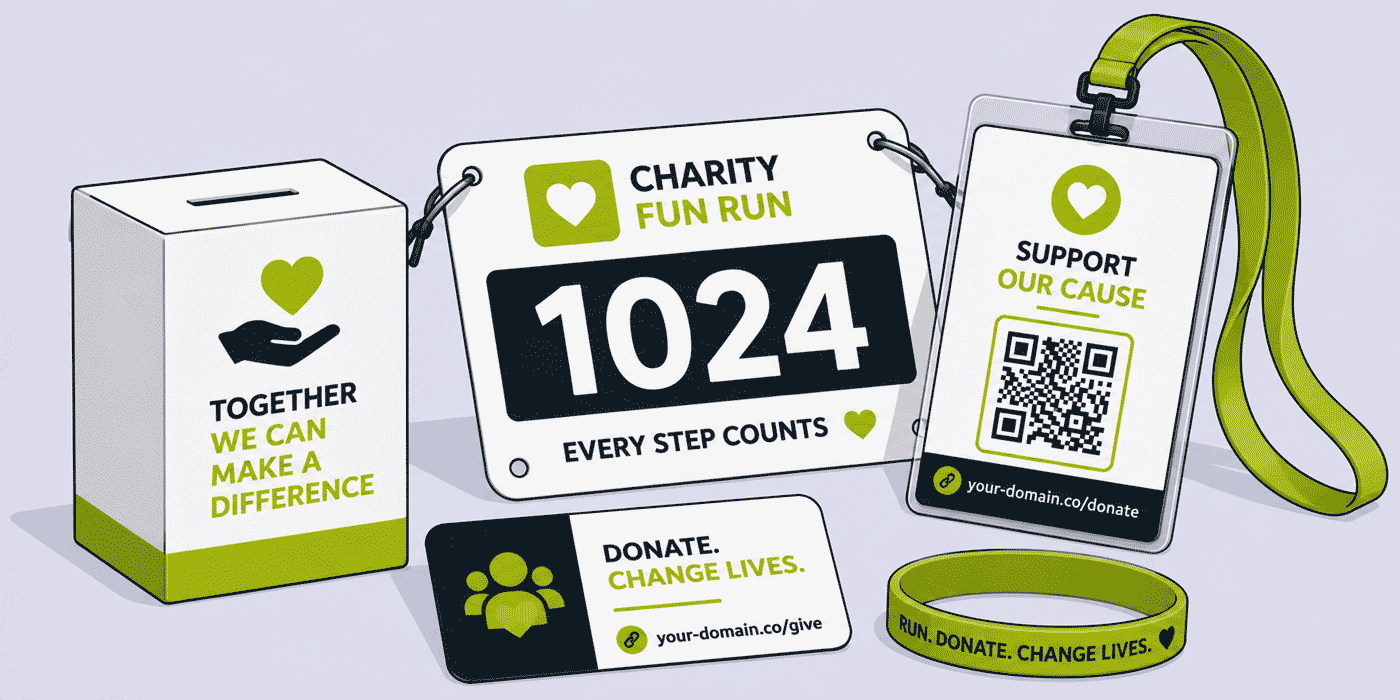
Charity events produce a significant volume of physical materials — event T-shirts, race bibs, sponsorship forms, gala dinner programmes, auction bid sheets, event day handbooks, and finish line photographs. Each of these physical materials is an opportunity to carry a QR Code that extends the giving moment beyond the event day itself. A T-shirt worn for months after a charity race carries the story of the runner's achievement; a QR Code on that T-shirt carries a live link to the charity's ongoing work.
T-Shirt and Race Bib QR Codes
A QR Code on a charity event T-shirt — on the back or on the sleeve label — with a brief message such as "Find out more about our work" or "Support [Charity Name]" — your-charity.com/about or your-charity.com/give — converts the wearable item into a passive fundraising tool throughout its wearing life. A person who sees a stranger wearing a charity marathon T-shirt, is curious about the cause, and scans the QR Code has initiated a relationship with the charity from a physical item that could be years old.
Because T-shirts are worn for years after the event, the dynamic QR Code is essential: if the charity changes its website, restructures its giving page, or rebrands, the QR Code destination updates without any change to the T-shirt. A T-shirt printed in 2024 with a static QR Code may be pointing to a dead URL by the time someone scans it in 2027.
Sponsorship Form QR Codes
Printed sponsorship forms — still widely used for community and workplace fundraising where participants collect pledges from colleagues, friends, and family in person — are made significantly more actionable by a QR Code that allows sponsors to make their pledge digitally rather than writing their name, address, and donation amount on paper. A QR Code on the sponsorship form — your-charity.com/sponsor-name-event pointing to the fundraiser's personal giving page — converts a physical pledge into a digital transaction that the fundraiser does not have to manually process.
For charity events operating Gift Aid in the UK, digital giving through a QR Code also enables automatic Gift Aid declaration at the point of donation, significantly simplifying the Gift Aid claim process for the charity compared with paper sponsorship form Gift Aid declarations. This administrative benefit alone justifies the investment in QR Code-enabled sponsorship forms for any UK charity that is eligible for Gift Aid.
Donation Page Attribution Across All Channels
A charity's general donation page — distinct from event-specific fundraising pages — is the primary destination for all donation-motivated traffic that the charity generates through its communications and campaigns. Understanding which channels drive the most donation page traffic, and which channels send donors who actually complete a donation, is the most commercially important analytics question in charity digital marketing.
Per-Channel Donation Attribution Links
A charity with a permanent giving page uses per-channel short links to track donation page traffic from each source:
your-charity.com/give-email— email campaigns and supporter newslettersyour-charity.com/give-social— social media posts and paid advertisingyour-charity.com/give-event— event-day QR Codes and printed materialsyour-charity.com/give-direct-mail— postal appeal lettersyour-charity.com/give-pr— press coverage and editorial mentions
All pointing to the same giving page. Over a year of consistent per-channel attribution, the charity builds a data set showing which channels generate the most giving page visits and which generate the highest donation completion rates. This data is directly applicable to annual fundraising strategy decisions: where to concentrate communication investment, which channels justify increased spending, and which are generating reaches that feel impressive but convert to donations poorly.
Match Funding Campaign Links
Match funding campaigns — where every pound donated during a defined period is matched by a corporate sponsor, a major donor, or a grant-making foundation — are among the most effective mechanisms for driving a concentrated burst of donation activity. The psychological power of "your donation is worth twice as much right now" is well-documented in fundraising research. Managing the match fund campaign link well — ensuring it communicates the match opportunity clearly, reaches donors at the moment the matching is active, and updates appropriately when the match window closes — is critical to maximising the campaign's commercial impact.
Match Fund Campaign Link Lifecycle
A match fund campaign short link — your-charity.com/match-fund or your-charity.com/double-gift — transitions through the following stages:
- Pre-match announcement (1–2 weeks before): Destination is a "match fund opens soon — sign up to be notified" page, building anticipation and capturing donor email addresses for the campaign launch communication.
- Match fund active: Destination is the giving page with prominent match fund messaging, showing the current matched total and the remaining match fund pot if applicable. Every donation made during this period is highlighted as doubled.
- Match fund closing (final 24 hours): Destination updates to include urgency messaging — "Match fund closes tonight — donate before midnight." Click analytics typically show a spike in donation page visits during the urgency window.
- Match fund closed: Destination updates to a "Thank you — match fund complete" page showing the total raised. Any supporter who clicks the link after the campaign sees the impact result rather than a dead page or an expired offer.
Click analytics during the active match fund window, compared with standard giving campaign analytics, provide the fundraising team with a quantified measure of the match fund's donor engagement uplift. If the match fund generates 3.4x the normal donation page click volume for the same communications reach, the match fund multiplier effect on donor motivation is directly measurable and can be cited in the case to corporate match fund sponsors for the value of their partnership.
Corporate Sponsor and Partner Links
Corporate sponsors of charity events are often the most valuable single source of funds in the event's financial model, and managing the commercial relationship with corporate sponsors professionally — including the links through which sponsorship information is shared — reflects on the charity's operational standards in a context where commercial credibility matters.
Corporate Sponsorship Information Links
A short link for the corporate sponsorship prospectus — your-charity.com/sponsor-event-name — used in the charity's outreach to potential corporate sponsors gives the fundraising team a tracked, professional entry point to the sponsorship opportunity documentation. Click analytics show which corporate prospects are engaging with the sponsorship materials before responding, giving the fundraising team a pipeline signal that supplements their direct conversation tracking.
For corporate sponsors who are providing match funding or who are promoting the event to their own employees, a per-corporate short link — your-charity.com/event-corporate-name — pointing to a co-branded page specific to that corporate partner's employee audience tracks how much of the event's participation and donation activity is generated through each corporate partner's internal promotion. This per-corporate engagement data is valuable in conversations about sponsorship renewal and enhanced partnership for future years.
Fundraiser Support and Training Links
Individual fundraisers — the participants who are running marathons, swimming channels, climbing mountains, or hosting dinner parties to raise money for the charity — are the frontline of the peer-to-peer fundraising operation. How well they are supported, trained, and motivated to ask their networks for donations is one of the strongest determinants of total money raised. The links through which they access fundraising training, motivational materials, and practical support affect their fundraising effectiveness.
A short link for the fundraiser support hub — your-charity.com/fundraiser-hub — containing how-to guides for social media sharing, email templates for reaching their personal networks, training tips for the physical challenge, and regular motivational updates from the charity, gives every fundraiser a single, consistent access point to the resources that improve their fundraising performance. Because the fundraiser hub content is updated throughout the event cycle, a dynamic short link ensures the hub reference in the initial fundraiser welcome email remains accurate throughout the pre-event period.
Post-Event Donor Stewardship Links
Donor stewardship — the practice of reporting back to donors on how their money was used, expressing genuine gratitude, and building a relationship that encourages future giving — is one of the most commercially valuable and most frequently underinvested activities in charity fundraising. A donor who receives a meaningful, personal account of the impact their donation made is significantly more likely to give again than one who receives nothing beyond an automated thank-you receipt.
A short link for the event impact report — your-charity.com/event-impact-2026 — distributed in the post-event thank-you communication to all donors, gives every supporter a link to the charity's account of what the fundraising achieved: how much was raised in total, what specific projects or services the funds will support, and personal stories from beneficiaries if the nature of the charity's work makes these appropriate to share. Because impact reports are produced once and referenced repeatedly in subsequent stewardship communications, a dynamic short link ensures the impact report reference always reaches the current, published version.
A Worked Example: A Charity's Marathon Event Link Stack
Consider a mid-size charity running its annual city marathon fundraising programme with 320 registered charity runners, using a branded domain such as your-charity.com, connected through Cuttly's custom domain setup (an A record and a TXT record — see the custom domain setup guide).
Participant recruitment: Registration link /marathon-2026 with per-channel attribution. After six weeks: email to supporter database generates 340 registration page clicks (34% conversion to registered participant), corporate partner employee email generates 180 clicks (41% conversion — employees supported by employer are more likely to commit), social media generates 820 clicks (12% conversion — high reach, lower intent), past participant re-engagement generates 84 clicks (68% conversion — highest rate of any channel). The fundraising team increases investment in corporate partner employee communications for the following year's recruitment.
Per-fundraiser links: Each of 320 participants receives a unique branded short link — /run-firstname-surname — pointing to their personal JustGiving page. Click analytics aggregate per event link show total donor engagement across the fundraiser network. After eight weeks of fundraising: the top 20% of fundraisers by network engagement generate 62% of total individual donation page visits. The fundraising team identifies the bottom 20% by engagement and sends personalised motivational support communications with specific social media template posts, which increases the lowest-engagement cohort's donor engagement rate by 34%.
Race day materials: Race bibs carry /marathon-2026-sponsor QR Code linking to a race day donation page with real-time total updating. Event T-shirts carry /our-work linking to the charity's impact page. Post-race: the T-shirt QR Code continues to generate clicks for 14 months post-event from runners wearing the T-shirt in their daily lives, generating an ongoing trickle of charity website visits and occasional donations from people who encounter the T-shirt and are curious about the cause.
Match fund campaign: Three weeks before race day, a corporate partner provides a match fund of £20,000. /match-fund goes into the weekly fundraiser support email and all social media. The match fund generates 2.8x the normal donation page click volume during its active window. Total donations during the match fund period: £34,200 (before matching), generating £48,200 in matched and unmatched total. The fundraising team reports the 2.8x click uplift to the corporate partner as evidence of the match fund's motivational impact on donor behaviour.
Common Mistakes in Charity Event Link Management
Raw Fundraising Platform URLs in All Participant Communications
A charity that gives every fundraiser their raw JustGiving or Enthuse URL is giving them a link that carries the platform's brand rather than the charity's. In every social media post, every email, and every text message a fundraiser sends, the charity's identity is undermined by a platform URL. Branded short links on the charity's own domain reinforce the charity's identity in every communication a fundraiser sends.
No Post-Event Giving Path on Printed Materials
A charity that does not place a dynamic giving QR Code on its event T-shirts, race bibs, and printed materials is leaving the post-event giving opportunity entirely unexploited. Physical event materials are kept and worn for months or years; a dynamic QR Code on those materials is a passive, long-tail fundraising touchpoint that continues to generate giving consideration indefinitely after the event has closed.
No Per-Channel Donation Attribution
A charity that uses a single donation page link across email, social media, events, and direct mail cannot compare which channels are generating the most motivated donors. Given that charities often have limited marketing budgets that must be concentrated in the most effective channels, the absence of per-channel attribution data means investment decisions are made on assumptions rather than evidence. Per-channel giving links are the minimum data infrastructure for any charity that takes its return on marketing investment seriously.
Cuttly Plan Guide for Charity Events
- The Free plan ($0) provides 30 short links per month, one branded custom domain, full click analytics, dynamic QR Codes and a survey tool, with no credit card required. Suitable for a small charity or a single annual event setting up core event registration, giving, and printed material QR Code links.
- The Starter plan ($12/month) adds 300 short links per month and 30 custom aliases per month — practical for a charity with multiple annual events managing per-event registration links, per-channel giving attribution, fundraiser support links, match fund campaigns, and corporate partner links throughout the year.
- The Single plan ($25/month) adds up to 5 branded domains for charities with multiple brand identities or event series, fully customizable QR Codes for professional event materials, 1,000 API-created links per month for automated per-fundraiser branded link generation at scale, and a full year of analytics history for year-on-year fundraising channel comparison.
- The Team plan ($99/month) suits larger charities with fundraising, events, marketing, and corporate partnerships teams sharing link management, Campaign tag analytics for aggregated event and giving campaign reporting, and multiple branded domains for different fundraising programmes within the charity's portfolio.
Create a free Cuttly account to set up your charity's event registration link, your fundraiser support links, your giving page attribution links, and your first event material QR Codes. Registration is required for all plans, including free. No credit card is needed for the free plan.
Frequently Asked Questions
How do charities use short links for peer-to-peer fundraising?
A charity assigns each fundraiser a branded short link — your-charity.com/run-firstname — pointing to their personal fundraising page. A link on the charity's domain reinforces the charity's identity in every communication the fundraiser shares. For large events, per-fundraiser links are generated automatically via API. Click analytics show which participants are generating the most network engagement and who needs additional fundraising support.
How do charities use QR Codes on event materials and printed sponsorship forms?
A charity places dynamic QR Codes on T-shirts, race bibs, and sponsorship forms linking to the giving page or personal fundraising page. Dynamic QR Codes ensure these materials continue to serve an active giving path for years after the event. Sponsorship form QR Codes enable digital donation and Gift Aid declaration, replacing manual paper processing for charities eligible for Gift Aid.
How do charities use short links for event registration?
A charity creates a per-channel event registration short link set — email, social, corporate, past-participant. Click analytics combined with registration completion rates reveal which channels send the most motivated participants rather than the most curious browsers. Past participant re-engagement consistently generates the highest registration completion rates, justifying investment in past participant data management.
How do charities use short links for match funding campaigns?
A charity uses a dedicated match fund short link — your-charity.com/match-fund — that transitions through pre-launch, active, urgency, and closed stages via dynamic destination updates. Click analytics during the active window compared with standard campaigns measure the match fund's motivational uplift on donor engagement, providing evidence of the match fund's commercial value for corporate partner renewal conversations.
How do charities track which communication channel generates the most donations?
A charity creates per-channel giving links — /give-email, /give-social, /give-event — all pointing to the same donation page. Click analytics combined with donation platform conversion data reveal not just which channels drive the most traffic but which send donors who are most likely to complete a donation — the most commercially actionable distinction in charity digital marketing.
- Get Started
- Create Free Account
- Plans & Pricing
- Platform Tools
- URL Shortener
- Link Analytics
- QR Code Generator
- Survey Tool
- Related Guides
- URL Shortener for Churches
- URL Shortener for Non-Profits
- URL Shortener for University Alumni
- URL Shortener for Sports Events
- URL Shortener for Trade Shows & Events
- Encyclopedia
- Dynamic QR Codes
- Branded Links
- Setup Guides
- Custom Domain Setup
- Track Link Clicks
- Industry Hub
- Non-Profit & Government
- All Industries →
URL Shortener
Cuttly simplifies link management by offering a user-friendly URL shortener that includes branded short links. Boost your brand’s growth with short, memorable, and engaging links, while seamlessly managing and tracking your links using Cuttly's versatile platform. Generate branded short links, create customizable QR codes, build link-in-bio pages, and run interactive surveys—all in one place.
Cuttly - Consistently Rated
Among Top URL Shorteners
Cuttly isn’t just another URL shortener. Our platform is trusted and recognized by top industry players like G2 and SaaSworthy. We're proud to be consistently rated as a High Performer in URL Shortening and Link Management, ensuring that our users get reliable, innovative, and high-performing tools.C


