URL Shortener for Craft Breweries The Complete Guide
A craft brewery is simultaneously a manufacturer, a retailer, a hospitality venue, a content creator, and a community hub. It makes a physical product — beer — that is consumed in pubs, restaurants, supermarkets, specialist bottle shops, and its own taproom. It communicates with fans and trade buyers through social media, email, and print. It runs events that bring its community together. It distributes to accounts across a region or the country. And it builds a brand identity — through its label design, its storytelling, its brewing philosophy — that differentiates it in a market with thousands of competitors. Links connect all of these dimensions together.
This guide covers how craft breweries use a URL shortener, branded custom domain, dynamic QR Codes and click analytics across beer can and pump clip labels, new release announcements, taproom event promotion, online shop and subscription links, trade distribution communications, brewery tour booking, and the full range of physical and digital link management needs for a modern craft brewery.
What This Guide Covers
- QR Codes on beer can and bottle labels — the dynamic label approach
- Pump clips and keg collar QR Codes for on-trade accounts
- New release and limited edition announcement links
- Taproom events, tap takeovers and brewery nights
- Online shop, beer club and subscription links
- Brewery tour and taproom booking links
- Trade distribution and stockist communications
- Beer finder and stockist locator links
- Social media and email marketing links
- A worked example: an independent craft brewery's full link stack
- Common mistakes in craft brewery link management
- A Cuttly plan guide for craft breweries
- Frequently asked questions
QR Codes on Beer Can and Bottle Labels
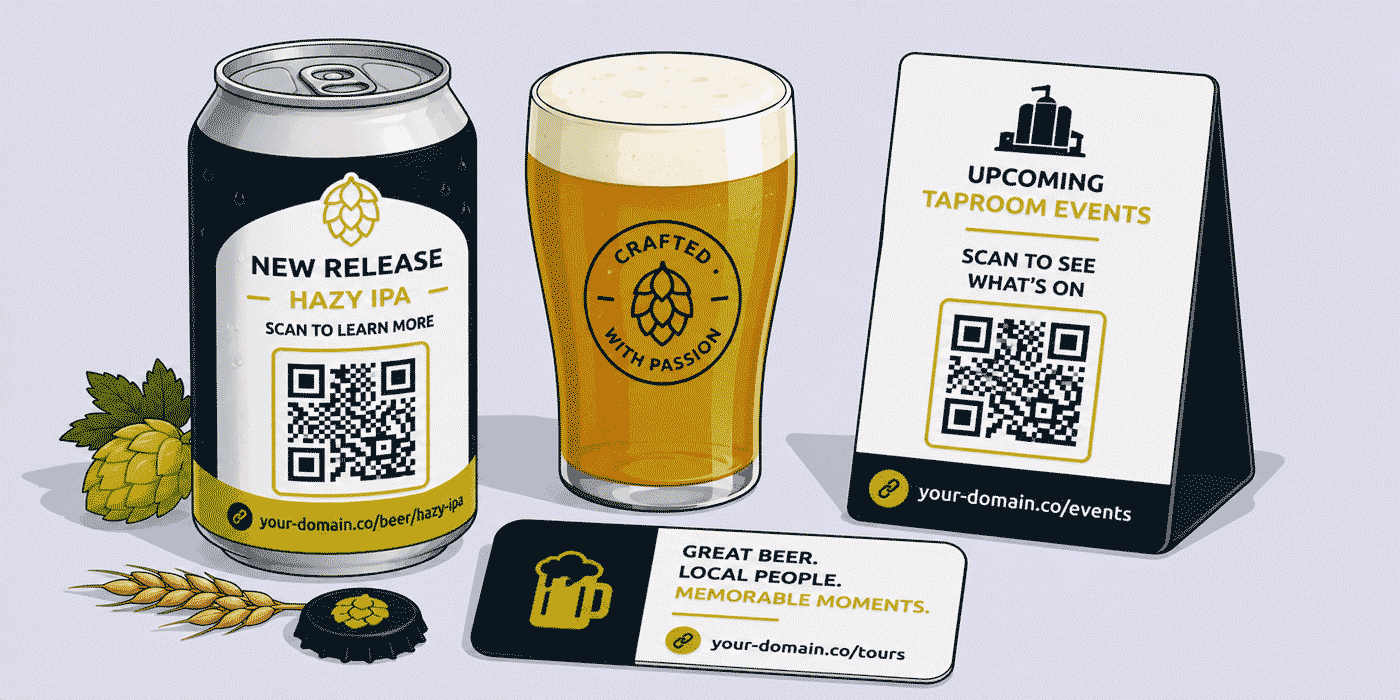
The beer can or bottle label is the most physically present marketing surface a brewery has. It travels to the point of purchase, sits in the customer's fridge, and is held in their hand when the beer is consumed. A QR Code on that label is the most direct physical-to-digital link touchpoint in the brewery's entire communication ecosystem, reaching a consumer at the moment they are most engaged with the product.
What Can Label QR Codes Should Link To
The destination behind a beer can QR Code should serve the consumer's most likely intent at the moment they are looking at the can — whether before purchase in a shop, or after purchase when they are about to drink it:
- Beer information page. Tasting notes in plain language (not just technical descriptors), serving temperature and glass suggestions, food pairing ideas, and the brewery's story behind this particular beer. This content rewards the engaged consumer and reinforces the brand relationship beyond the transaction.
- Allergen and ingredient information. For consumers with dietary requirements, the can label has limited space for detailed ingredient information. A QR Code linking to a comprehensive allergen and ingredient list is both a service to consumers and a practical compliance mechanism as food labelling requirements evolve.
- Beer club or subscription sign-up. A consumer who has picked up the beer in a supermarket or bottle shop and liked it is the highest-intent prospect for a direct subscription. A QR Code destination that invites them to "never run out of your new favourite beer" by joining the beer club converts a one-time purchase into a recurring customer relationship.
- Other beers in the range. A consumer who loves a specific beer is very likely to want to try the brewery's other styles. A QR Code destination that shows the full range with descriptions and stockist information drives cross-selling across the portfolio.
The Dynamic Can Label QR Code
A beer can label printed with a static QR Code encoding a specific URL is a liability for any brewery that changes its website platform, restructures its URL scheme, or updates its product pages. A can printed in a batch of 10,000 units will be distributed and consumed over weeks or months; the cans that remain on shelves in week eight still carry the same QR Code as those consumed in week one, and if the URL has changed in the interim, every remaining can QR Code is a dead link.
For breweries producing multiple label designs across a core range, seasonal beers, and limited releases — each requiring its own printed batch — the maintenance cost of keeping static QR Codes on labels current is prohibitive. Dynamic QR Codes generated from branded short links solve this entirely: the physical label never changes, but the destination behind the QR Code is updated whenever the website changes, without any physical label replacement.
Per-Beer Analytics
Click analytics from beer can QR Codes, aggregated and anonymized per beer, give the brewery's marketing team data that no other source can provide: which beers in the range generate the most consumer digital engagement after purchase. A brewery with a core range of six beers might find that its pale ale generates twice the QR Code scan rate of its stout — not because the pale ale is better, but because pale ale is more commonly consumed by newer craft beer drinkers who are curious about what they are drinking and scan QR Codes more frequently. This insight informs where to invest in deeper consumer education content for the beers that attract less exploration.
Pump Clips and Keg Collar QR Codes for On-Trade Accounts
A pump clip — the branded panel affixed to a cask ale handpull or, in modern keg formats, displayed beside or on the keg tap — is often the first and only physical brand touchpoint between the brewery and a pub's customers. A drinker at the bar considering which cask ale to order sees the pump clip; a drinker mid-pint who wants to know more about what they are drinking looks at the pump clip. A QR Code on a pump clip is a direct invitation for the interested drinker to learn more about the beer and the brewery.
Pump clips present the same long-life printing challenge as beer can labels. A batch of pump clips for a particular beer may be distributed to dozens of on-trade accounts and remain in use for the entire duration of the beer's distribution — weeks, months, or in the case of permanently listed core range beers, potentially years. A dynamic QR Code on a pump clip ensures that consumers at any account, at any point in the pump clip's active life, reach current and relevant information about the beer and brewery.
For breweries distributing to many on-trade accounts across a region, pump clip QR Code analytics provide a rough geographic signal about where consumer engagement with the brewery's digital content is highest, informing where to prioritize sales team visits, brewery events, or promotional activity.
New Release and Limited Edition Announcement Links
New beer releases are the highest-engagement content a craft brewery produces. A new seasonal, a limited edition collaboration, a one-off experimental batch, or the return of a popular annual beer generates genuine excitement among the brewery's fan base and wider craft beer community. Managing the link for a new release announcement well — ensuring it is live before the announcement goes out, that it serves the right content at each stage of the release lifecycle, and that it is used consistently across every channel simultaneously — is one of the most commercially important link management tasks a brewery's marketing team handles.
The Release Lifecycle Link Model
A well-managed new release short link transitions through the following stages, all through the same URL:
- Teaser (pre-announcement): destination is a "coming soon" or "sign up to be first to know" page, capturing interested customers on the brewery's email list before the release is public. Short link:
your-brewery.com/new-releaseoryour-brewery.com/beer-name. - Launch: destination is the full product page with tasting notes, serving suggestions, and purchase options (online shop, taproom, or stockist information). The same short link that was shared in the teaser now delivers the full release experience.
- Limited availability: destination can be updated to highlight stock levels or urgency messaging: "fewer than 100 cases remaining."
- Sold out: destination redirects to a "this beer has sold out — see what's coming next" page, or to the beer club sign-up to ensure the subscriber gets early access to the next limited release.
- Archive: destination becomes the beer's archive page showing its history, past releases, and any press coverage it received.
This lifecycle management converts a limited-edition release into an ongoing brand touchpoint rather than a single commercial moment. Even after a beer has sold out, the short link continues to work, serving appropriate content to anyone who encounters the link through a historical social media post or email.
Taproom Events, Tap Takeovers and Brewery Nights
A brewery's taproom is its most direct customer relationship environment, and the events that happen there — tap takeovers, meet-the-brewer sessions, food pairing evenings, music events, quiz nights, collaboration beer launches — are its most powerful community-building tools. Promoting these events through short links gives the brewery both a professional event promotion infrastructure and click analytics showing which event types and which promotion channels generate the most interest.
Event Link Structure
A consistent event link structure for a brewery with regular taproom events:
your-brewery.com/events— the permanent events calendar page, always pointing to upcoming eventsyour-brewery.com/event-name-date— per-event short links for specific events being actively promotedyour-brewery.com/taproom— the taproom information page (opening hours, address, transport links)your-brewery.com/book-tour— brewery tour booking page
The permanent events calendar link is used everywhere the brewery consistently promotes its taproom: in its social media bios, in the footer of its email newsletters, on printed taproom materials, and on any QR Code displayed in the taproom itself. The per-event links are used for specific event promotion campaigns and then retired or redirected after the event.
Click analytics per event type — comparing how much interest a tap takeover generates versus a food pairing event versus a themed brewery night — give the events team data on which formats to invest in repeating. Over a year of consistent event analytics, patterns emerge: collaboration tap takeovers generate the most social media engagement and pre-event clicks; food pairing evenings generate fewer total clicks but higher per-click ticket purchase rates, suggesting a more committed audience for the higher-ticket event format.
Online Shop, Beer Club and Subscription Links
Direct-to-consumer online sales are increasingly important for craft breweries, both as a revenue stream and as a way of building a customer database that the brewery controls, independent of the algorithms of any retail partner. A brewery with an active online shop, a beer club or mixed case subscription, and a loyal online customer base has a commercial resilience that one relying solely on on-trade and off-trade distribution cannot match.
Core Online Shop Links
A brewery's online shop needs a consistent set of short links across every channel where the shop is promoted:
your-brewery.com/shop— the main online shop entry pointyour-brewery.com/core-range— the core beer range available year-roundyour-brewery.com/new-in— the latest additions to the shop, updated regularlyyour-brewery.com/mixed-case— the mixed case option for first-time buyersyour-brewery.com/beer-club— the subscription beer club sign-up
The beer club link is particularly important as the primary recurring revenue mechanism for direct-to-consumer craft brewery sales. It appears on can labels (as a QR Code), in the taproom, in the email newsletter footer, in social media bios, and in any content specifically promoting the subscription offering. Click analytics for the beer club link show how many people are engaging with the subscription proposition from each channel, which is the most direct measure of the brewery's ability to convert one-time buyers into regular subscribers.
Brewery Tour and Taproom Booking Links
Brewery tours and taproom experiences are a significant and growing revenue stream for craft breweries, particularly those with a compelling brewery story, an interesting production environment, or a reputation that attracts beer enthusiasts and general visitors. A brewery in a repurposed industrial space, a rural farmhouse brewery with scenic surroundings, or an urban taproom known for its food programme has a tourism dimension that requires professional booking and visitor management.
A short link for brewery tour booking — your-brewery.com/book-tour or your-brewery.com/tours — gives prospective visitors a clean, professional booking path from any channel: the brewery website, social media posts, Airbnb Experiences listings, local tourism directory listings, and any press coverage featuring the brewery as a visitor destination. Because tour booking platforms change — breweries regularly move between Eventbrite, their own website booking system, and specialist tour booking platforms — a dynamic short link means the booking destination is updated without any change to all existing promotional materials.
Trade Distribution and Stockist Communications
A craft brewery's trade relationships — with pubs, bars, restaurants, off-licences, supermarkets, and specialist bottle shops that stock its beers — involve regular link-based communications. New product information sheets, trade pricelists, brewer visit schedules, and stockist finder tools all require links, and the professional quality of those links affects how the brewery is perceived by its trade buyers.
Trade Communication Links
A brewery maintaining a clean set of trade-facing short links:
your-brewery.com/trade— the trade enquiry or wholesale portal landing pageyour-brewery.com/new-product-sheet— the current new product information sheet for trade accountsyour-brewery.com/pricelist— the current wholesale pricelistyour-brewery.com/stockists— the beer finder or stockist locator for consumers looking for the brewery's beers near them
The stockist locator link is particularly valuable as a consumer-facing resource that also serves the brewery's trade development interests: a consumer who cannot find a brewery's beers in their local area and uses the stockist finder is demonstrating demand that the sales team can act on. Click analytics on the stockist finder link, showing the geographic distribution of searches (inferred from aggregated and anonymized location data in the analytics), can indicate which regions have high consumer demand but insufficient trade distribution coverage.
A Worked Example: An Independent Craft Brewery's Link Stack
Consider an independent craft brewery with a 10-barrel kit, a taproom, a core range of five beers, and approximately eight limited releases per year, using a branded domain such as your-brewery.com, connected through Cuttly's custom domain setup (an A record and a TXT record — see the custom domain setup guide).
Can label QR Codes: Each of the five core beers has its own short link: /pale-ale, /ipa, /stout, /sour, /lager. These are encoded as QR Codes on each beer's can label. When the brewery redesigns their website as part of a brand refresh, all product pages move to new URLs. Updating five short link destinations takes fifteen minutes; every can already on shelves in supermarkets, bottle shops, and consumers' fridges continues to link correctly to the updated product pages.
Limited release campaign: The brewery announces its annual Christmas Spiced Porter. Three weeks before release: /christmas-porter goes live pointing to a teaser page with an email sign-up for first-access notification. Two weeks before: 340 email sign-ups captured from the teaser link. Release day: /christmas-porter destination updates to the full product page. Within 48 hours, 890 shop visits via this link, with 140 cases sold. Post-sellout: destination updates to "sold out — join our beer club for priority access next year." Beer club sign-ups double in the week following the sellout.
Can label analytics: After six months of QR Code tracking, the IPA can generates 3x the scan rate of the stout, but the stout's scan-to-beer-club-signup conversion rate is 2x higher. The brewery concludes that stout drinkers are more committed craft beer enthusiasts who invest more time in exploring the brewery's offer. A dedicated stout club or "dark beer subscription" tier is added to the beer club, directly converting stout can scanners into subscribers.
Common Mistakes in Craft Brewery Link Management
Static QR Codes on Printed Can Labels
A brewery that generates QR Codes from direct URL encoding for can label print runs creates a permanent maintenance liability. Any change to the brewery's website structure invalidates every can QR Code from before the change. Dynamic short links eliminate this entirely and provide the per-beer analytics that static QR Codes cannot.
No Release Lifecycle Link Management
A brewery that creates a new social media post URL for each stage of a beer release, rather than managing one dynamic short link through the full lifecycle, fragments the link history across every channel and misses the opportunity to convert "sold out" readers into beer club subscribers or next-release waitlist sign-ups.
Missing Taproom Event Engagement Data
A brewery that promotes events across Instagram, email, and a taproom display without per-channel short links has no way of knowing whether Instagram, email, or foot traffic is driving the most event sign-ups. Per-channel event links cost one additional short link per channel and provide the data needed to optimize event promotion spend between digital and physical channels.
Cuttly Plan Guide for Craft Breweries
- The Free plan ($0) provides 30 short links per month, one branded custom domain, full click analytics and dynamic QR Codes, with no credit card required. Suitable for a small brewery setting up core beer product links, a taproom events link, and can or pump clip QR Codes for a limited range.
- The Starter plan ($12/month) adds 300 short links per month and 30 custom aliases per month — practical for a growing brewery managing links for a full core range plus multiple seasonal and limited releases per year, trade communications, and regular taproom events.
- The Single plan ($25/month) adds up to 5 branded domains, fully customizable QR Codes with the brewery's branding for professional can and pump clip integration, 1,000 API-created links per month for automated per-batch or per-release link generation, and a full year of analytics history for per-beer engagement comparison.
- The Team plan ($99/month) suits brewery groups with multiple brands or tap rooms, with shared link management across marketing, events, and trade teams, Campaign tag analytics for aggregated release campaign reporting, and multiple branded domains for different brewery brands within the group.
Create a free Cuttly account to set up your brewery's first beer product QR Codes, your taproom events link, and your beer club sign-up link. Registration is required for all plans, including free. No credit card is needed for the free plan.
Frequently Asked Questions
How do craft breweries use QR Codes on beer cans?
A craft brewery places a QR Code from a dynamic short link on its can labels, linking to tasting notes, allergen information, food pairing ideas, and beer club sign-up. Because the QR Code is dynamic, the destination updates when the website changes without reprinting cans. Click analytics show which beers in the range generate the most consumer digital engagement after purchase.
How do craft breweries use short links for new release announcements?
A craft brewery uses a single dynamic short link throughout a beer's release lifecycle: a teaser page before launch, the full product page at launch, a stock-urgency message during limited availability, a sold-out page with beer club sign-up, and an archive page long-term. Every historical social post and email referencing the release link serves appropriate current content at each stage.
How do craft breweries use QR Codes on pump clips and keg collars?
A craft brewery places a dynamic QR Code on pump clips and keg collars, linking pub and bar customers to the beer's product page. Because pump clips are used across many accounts over weeks or months, a dynamic QR Code ensures consumers at every account throughout the distribution life reach current, accurate information regardless of any website changes.
How do craft breweries use short links for taproom events?
A craft brewery creates per-event short links for taproom events promoted across social media, email, and taproom QR Codes. Click analytics per event type show which formats generate the most interest, and per-channel variants show which promotional channel drives the most event registrations. This data informs which events to repeat and where to focus promotional effort.
How do craft breweries use short links for beer club and subscription programmes?
A craft brewery uses a dedicated short link for beer club sign-up — on can labels as a QR Code, in the taproom, in social media bios, and in email newsletters. Click analytics show how many people engage with the subscription CTA from each channel, helping the brewery understand which touchpoints most effectively convert casual fans into regular subscribers.
- Get Started
- Create Free Account
- Plans & Pricing
- Platform Tools
- URL Shortener
- Link Analytics
- QR Code Generator
- Survey Tool
- Related Guides
- URL Shortener for Wineries
- URL Shortener for Restaurants
- URL Shortener for Food & Hospitality
- Short Links for Offline Campaigns
- URL Shortener for Subscription Boxes
- Encyclopedia
- Dynamic QR Codes
- Branded Links
- Setup Guides
- Custom Domain Setup
- Track Link Clicks
- Industry Hub
- Food, Hospitality & Lifestyle
- All Industries →
URL Shortener
Cuttly simplifies link management by offering a user-friendly URL shortener that includes branded short links. Boost your brand’s growth with short, memorable, and engaging links, while seamlessly managing and tracking your links using Cuttly's versatile platform. Generate branded short links, create customizable QR codes, build link-in-bio pages, and run interactive surveys—all in one place.
Cuttly - Consistently Rated
Among Top URL Shorteners
Cuttly isn’t just another URL shortener. Our platform is trusted and recognized by top industry players like G2 and SaaSworthy. We're proud to be consistently rated as a High Performer in URL Shortening and Link Management, ensuring that our users get reliable, innovative, and high-performing tools.C


