URL Shortener for Wineries The Complete Guide
A winery's commercial model is built on relationships that begin with a single bottle and, if everything goes right, develop into decades of loyal custom. A consumer who discovers a wine they love in a restaurant, buys it from a retailer, or tastes it for the first time at a cellar door is the beginning of a potential wine club member relationship that, over ten or twenty years, is worth thousands of pounds or dollars in direct sales. The link between that first bottle and that long-term relationship — the QR Code on the label, the cellar door booking link in a travel article, the wine club sign-up at the bottom of an event invitation — is the digital infrastructure through which that relationship is built.
This guide covers how wineries and wine estates — small independent producers, regional wine estates, established large-volume producers, and boutique destination wineries with a strong tourism dimension — use a URL shortener, branded custom domain, dynamic QR Codes and click analytics across bottle label QR Codes, wine club membership, cellar door bookings, vintage release campaigns, trade buyer communications, wine tourism, and direct-to-consumer wine sales.
What This Guide Covers
- Bottle label QR Codes — the compliance, consumer experience, and lifecycle case
- Wine club and membership sign-up links
- Cellar door and tasting room booking links
- Vintage release and allocation campaign links
- Trade buyer and retailer communications
- Wine tourism and hospitality experience links
- Direct-to-consumer online shop links
- Winemaker notes and provenance storytelling links
- Wine award and press coverage links
- A worked example: a boutique wine estate's full link infrastructure
- Common mistakes in winery link management
- A Cuttly plan guide for wineries
- Frequently asked questions
Bottle Label QR Codes: Compliance, Consumer Experience, and Lifecycle
The wine bottle label is one of the most regulated and one of the most commercially important label formats in the food and beverage industry. It carries mandatory legal information, communicates the wine's identity and provenance, and often tells a story about the estate, the vintage, and the winemaker's intent. It is also, for millions of wine drinkers, the first and most enduring physical encounter with a winery's brand. A QR Code on a wine label bridges this physical brand touchpoint with the winery's digital ecosystem — and because wine labels are printed in long runs and consumed across an extended period, managing these QR Codes dynamically is both a practical and a regulatory necessity.
The EU Wine Labelling Regulation Context
Regulation (EU) 2021/2117, which came into force for wines placed on the EU market from 8 December 2023, introduced significant new labelling requirements including the mandatory disclosure of ingredient and nutrition information. For wines with labels printed before this regulation's enforcement, a QR Code on the label was the mechanism through which winemakers could provide this information digitally without reprinting existing label stock. This regulatory pressure accelerated QR Code adoption on wine labels significantly, and for wineries operating in or exporting to the EU, the dynamic QR Code is not merely a convenience but a direct compliance mechanism.
Beyond EU regulation, the UK followed a similar trajectory post-Brexit with its own labelling updates, and the broader trend of consumers expecting detailed ingredient and allergen information on food and drink products means that every winery producing for an internationally aware consumer market benefits from a QR Code on the label pointing to current compliance information.
A dynamic short link behind the label QR Code means that as regulatory requirements evolve — as new disclosure requirements are added, as the format of the nutrition declaration is updated, or as the winery's registered allergen information changes — the label QR Code destination is updated to the current compliant information page without any label reprint. For a winery with multiple products and label batches at different points in their distribution lifecycle, this is the only practical compliance management approach.
Consumer Experience Content
Beyond compliance, the bottle label QR Code is an opportunity to deliver a richer consumer experience than the label's physical space permits. A wine bottle label carries a limited number of words; the QR Code destination can carry as much content as the winery believes adds value to the consumer's experience:
- Winemaker notes. The winemaker's personal reflection on the vintage, the growing season, the decisions made in the vineyard and cellar. This content humanises the wine and builds the winery's storytelling relationship with the consumer in a way that no label copy can replicate.
- Vintage conditions and terroir. Information about the specific year's growing season — rainfall, temperature, harvest timing — and the vineyard's soil, aspect, and location. For wine enthusiasts, this context significantly enhances the drinking experience.
- Food pairing suggestions. Specific, practical food pairing recommendations rather than generic varietal guidance. A Pinot Noir page that suggests "try this with roasted duck breast, wild mushroom risotto, or aged Manchego" provides immediate, actionable value.
- Serving guidance. Temperature, decanting time, and glass selection for the specific wine. Many consumers are uncertain about these details; a QR Code page that answers them creates a better drinking experience and reinforces the winery's expertise.
- Wine club invitation. A gentle CTA to join the wine club for early access to future vintages, discounts on direct purchases, and exclusive member events. The consumer holding a bottle of wine they are about to enjoy is the optimal moment for this invitation.
Per-Wine Analytics
Click analytics from bottle label QR Codes, aggregated and anonymized per wine, give the winery's marketing team data that is genuinely novel in the wine category: which wines in the portfolio are generating post-purchase consumer digital engagement. A flagship single-vineyard Chardonnay that generates 3x the QR Code scan rate of a volume-production Sauvignon Blanc is not surprising. But if the volume-production wine generates a higher proportion of scans that progress to the wine club sign-up, the winery has discovered that its entry-level wine is its most effective wine club acquisition vehicle — a finding worth incorporating into the club's promotional strategy.
Wine Club and Membership Sign-Up Links
The wine club is the most commercially valuable asset a direct-to-consumer winery can build. A wine club member who receives three or four mixed cases per year, at premium pricing with a members' discount, represents several hundred to several thousand pounds of annual revenue from a single customer. The customer acquisition cost for a wine club member is typically recovered within the first year of membership; the long-term value of a club member who remains a subscriber for five or ten years is substantially higher than any single retail transaction.
Every link management and marketing decision the winery makes should be evaluated partly through the lens of its contribution to wine club membership growth. The bottle label QR Code is the most direct physical-to-club pathway available; the cellar door experience is the highest-intent introduction to club membership; the vintage release email to the existing list is the highest-conversion club recruitment moment; and the wine tourism visit, which combines all three, is the richest single club acquisition opportunity.
Wine Club Short Link Placements
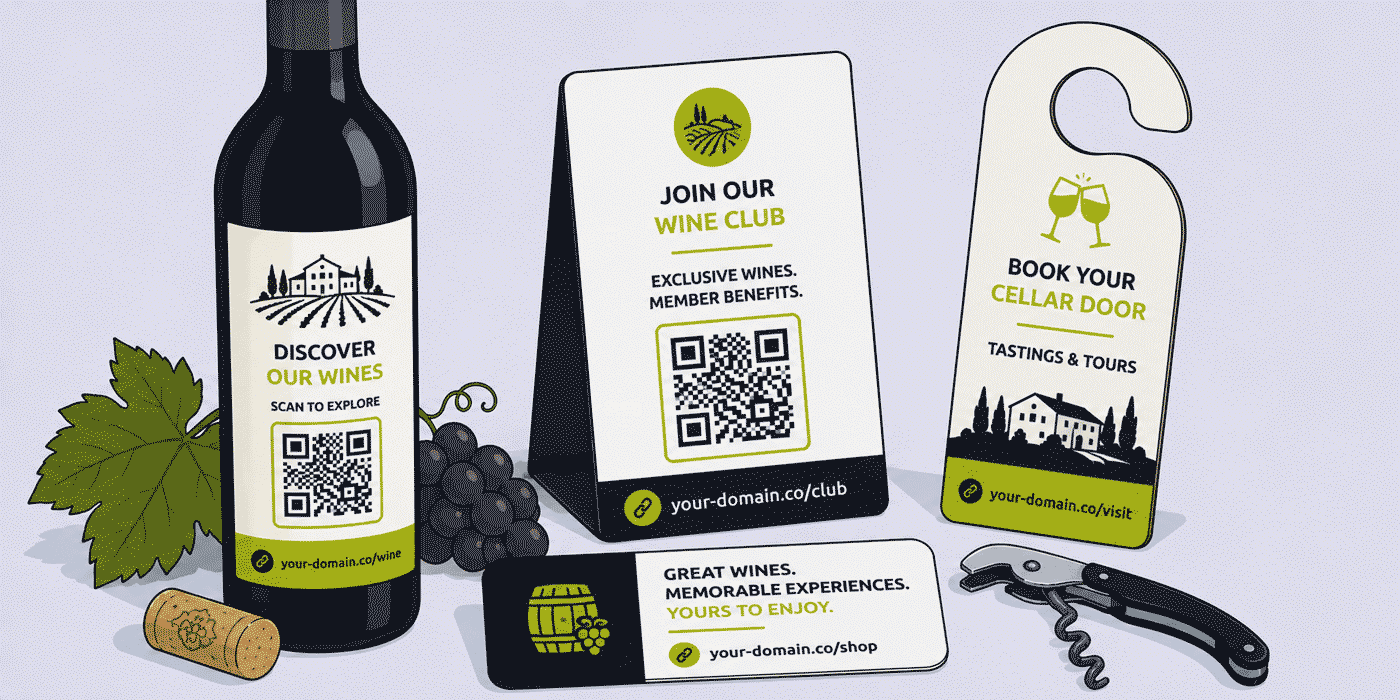
A permanent short link for the wine club sign-up — your-winery.com/wine-club or your-winery.com/join — appears in:
- Bottle label QR Code (for one or more wines in the range, rotating to the club sign-up as a destination periodically)
- Cellar door signage and table cards in the tasting room
- Every email newsletter footer
- The winery's social media bio link or Link in Bio page
- Vintage release announcement emails ("members get early access — not a member yet?")
- Post-tasting follow-up emails to cellar door visitors
Click analytics per placement give the winery insight into which touchpoints are most effective at converting interested wine buyers into club members. The post-tasting follow-up email typically generates the highest club sign-up conversion rate, because the recipient has just had an immersive brand experience that maximised their affinity with the winery. The bottle label QR Code generates lower conversion but reaches a far larger audience, including consumers who have never visited the estate. Both placements are valuable; the analytics reveal which to invest in growing.
Cellar Door and Tasting Room Booking Links
The cellar door experience is the winery's most powerful marketing tool: it converts a casual wine drinker into a committed brand advocate and, frequently, a wine club member, through the combination of the estate's physical beauty, the winemaker's hospitality, and the experience of tasting wines in the context where they were made. Getting visitors to the cellar door requires effective promotion of the experience, and the link through which that promotion drives bookings is a commercially critical element of the winery's digital infrastructure.
Cellar Door Booking Link Stability
Cellar door and tasting room booking systems are notoriously subject to change. Wineries move between general purpose booking platforms (Eventbrite, ResyOS, OpenTable), specialist wine tourism platforms (Vintrip, Winery Booking, CellarPass), their own integrated website booking systems, and direct phone-based reservation for higher-end experiences. Each platform change generates a new booking URL that invalidates every existing reference to the old one.
A permanent short link for the booking page — your-winery.com/visit or your-winery.com/book-tasting — survives every booking platform migration without any update required to the wine tourism directory listings, the travel blog features, the hotel concierge recommendations, or the social media posts that reference the booking link. For a winery whose cellar door has been featured in wine tourism guides, travel publications, and regional directories over many years, the accumulated link equity in these references is commercially significant; protecting it through dynamic link management is straightforward and free.
Tasting Experience Link Structure
For wineries with multiple tasting experience tiers — a standard cellar door tasting, a premium winemaker's tour, a food and wine pairing experience, a private event option — separate short links per experience type give visitors clear, distinct entry points to each offer and give the winery per-experience booking link analytics:
your-winery.com/tasting— standard cellar door tastingyour-winery.com/winemaker-tour— premium guided tour with the winemakeryour-winery.com/food-pairing— wine and food pairing lunchyour-winery.com/private-event— private hire and corporate events
Click analytics per experience type give the events team insight into demand distribution across the experience portfolio. An experience that generates high click interest but low booking conversion may have a pricing, description, or availability issue; one with lower click volume but very high conversion is attracting a highly motivated, specific audience who converts immediately when they find it.
Vintage Release and Allocation Campaign Links
A vintage release — particularly for a flagship wine or a highly anticipated limited production from a single vineyard — is the winery's most commercially significant annual moment. The new vintage announcement to the wine club, the allocation offer to mailing list subscribers, the trade communications to restaurant sommeliers and specialist retailers, and the press outreach to wine writers all converge around the same commercial event. Managing the links for this campaign with the same discipline as any other commercial launch is both practically valuable and professionally appropriate for a winery that takes its brand seriously.
The Vintage Release Link Lifecycle
A vintage release short link — your-winery.com/vintage-2024 or your-winery.com/estate-wine-release — manages the following lifecycle stages:
- Pre-release allocation sign-up. Wine club members and mailing list subscribers are offered early allocation priority before the wine is publicly available. The short link points to an allocation sign-up page; click analytics show how much interest the vintage is generating before release day.
- Wine club member exclusive window. The link is shared with wine club members giving them first purchase access, before the wine is offered to the general mailing list or trade. This exclusivity is a core wine club benefit and reinforces the value of membership.
- General release. The link destination transitions to the full product page on the online shop, accessible to all. Trade communications to restaurant and retail buyers use the same link.
- Limited availability. The destination is updated to acknowledge diminishing stock: "fewer than 50 cases remaining of the 2024 vintage."
- Sold through. The destination transitions to an archive page documenting the vintage, with press coverage, ratings, and winemaker notes preserved for the wine's ongoing brand heritage.
Trade Buyer and Retailer Communications
A winery's trade relationships — with Michelin-starred restaurants, specialist wine merchants, hotel groups, and independent retailers — require professional, efficient communication. New vintage information sheets, technical data sheets, updated pricing, and visit schedules from the sales team are all shared through links, and the quality of those links affects how the winery is perceived by buyers whose time and attention is competed for by hundreds of producers.
Trade Portal and Technical Sheet Links
A short link per wine for the technical data sheet — your-winery.com/tech-sheet-wine-name — provides trade buyers with a clean, professional reference for each wine in the portfolio. Technical sheets include analysis data (ABV, total acidity, residual sugar, pH), winemaking notes, vineyard source information, and packaging specifications. Because technical sheets are updated with each new vintage, a dynamic short link means the buyer's reference always points to the current vintage's data without requiring the winery's sales team to re-send updated materials.
A trade portal link — your-winery.com/trade — gives buyers a stable entry point to the winery's trade resources: current vintage information, sample request form, ordering contact, and visit booking for on-site trade tastings. This link appears in every trade email communication and in any trade directory listing.
Wine Tourism and Hospitality Experience Links
Wine tourism has grown substantially as a travel category, with wine estates increasingly positioned as destination experiences rather than purely production facilities. A winery with accommodation — vineyard cottages, a boutique hotel, or glamping facilities — with a restaurant or wine bar, with curated harvest experiences, or with a programme of exclusive member events is a hospitality business as much as a wine producer, and its links in the travel and hospitality discovery ecosystem are as commercially important as its links in the wine retail ecosystem.
Wine tourism links appear in travel publications, in regional tourism directories, on TripAdvisor and Google Business, in hotel concierge recommendation documents, in travel agent itinerary packages, and in social media content from visitors who share their experience. These references accumulate over years, generating a long tail of inbound tourism interest that a dynamic short link infrastructure protects and monetises effectively.
Tourism Experience Link Set
A wine estate with an active tourism programme maintains a set of tourism-specific short links:
your-winery.com/visit— the main visitor information and booking entry pointyour-winery.com/stay— accommodation booking if the estate offers overnight staysyour-winery.com/restaurant— estate restaurant or wine bar reservationsyour-winery.com/harvest— harvest experience booking for the autumn seasonyour-winery.com/gift— gift vouchers for cellar door experiences, wine club membership, or wine purchases
Each of these links appears in the relevant discovery context: accommodation links in booking platform profiles, restaurant links in dining directories and Google Maps, harvest experience links in seasonal tourism promotion, and gift voucher links in Christmas and Valentine's Day promotional content. All are dynamic, surviving any booking platform or website infrastructure change.
Wine Award and Press Coverage Links
Wine awards and press coverage are among the most commercially valuable promotional assets a winery can acquire. A 95-point rating from a major wine critic, a gold medal at an international competition, or a feature in a respected wine publication can significantly influence both consumer purchases and trade listings. The links that connect this coverage to the wines it refers to need to be managed as permanent brand assets.
A short link for each major award or critical acclaim — your-winery.com/awards for the general awards page, or your-winery.com/decanter-gold-2024 for a specific award — gives the winery a clean, trackable reference for its most significant accolades. These links appear in trade presentations, in social media content, in the online shop's product descriptions, and in any press materials. Click analytics show which awards and which wine show the most commercial engagement with the winery's critical recognition.
A Worked Example: A Boutique Wine Estate's Link Infrastructure
Consider a boutique wine estate in a recognised wine region producing 25,000 bottles per year across five wines, with a cellar door, a wine club with 800 members, and a growing wine tourism business, using a branded domain such as your-winery.com, connected through Cuttly's custom domain setup (an A record and a TXT record — see the custom domain setup guide).
Bottle label QR Codes: Each of the five wines has its own dynamic short link and QR Code. The flagship Pinot Noir's label QR Code links to the winemaker's vintage notes, terroir information, and a wine club invitation. After twelve months, the Pinot Noir generates 4.1x the scan rate of the estate's entry-level white — confirming the flagship wine's role as the primary brand ambassador. The Pinot Noir wine club sign-up conversion from label QR scans is 8.3%, compared with 2.1% from Instagram — making the label the most effective single wine club acquisition touchpoint despite reaching fewer total people.
Vintage release campaign: The 2024 Pinot Noir release generates a pre-release allocation sign-up from /vintage-2024. Wine club members are emailed first; 340 of 800 members request allocation (42.5% engagement rate). The general mailing list receives the release email three days later; a further 180 allocation requests arrive. Trade communications go to 45 restaurant and merchant accounts; 12 confirm orders. The total allocation of 1,200 cases is committed before the wine reaches the online shop. The winery updates the /vintage-2024 destination to a "this vintage is now fully allocated — join the wine club for priority access to the 2025 release" page.
Cellar door tourism: The winery's booking link /visit is referenced in a prominent Sunday supplement wine tourism feature. Over the following four weeks, the link generates 2,800 clicks. Of these, 340 complete the tasting booking (12.1% conversion). Post-visit emails to these 340 visitors achieve a 34% wine club sign-up rate — 116 new club members from a single press feature, representing significant long-term value from a single editorial placement. The winery's PR team uses this figure to justify an increased press and media outreach budget for the following year.
Common Mistakes in Winery Link Management
Static QR Codes on Wine Labels Without a Migration Strategy
A winery that prints static QR Codes on its bottle labels without a dynamic link strategy creates a compliance and commercial liability across its entire label inventory. Every website migration, every URL restructuring, and every new regulatory disclosure requirement means a portion of the label stock in market is pointing to outdated or dead pages. Dynamic short links eliminate this risk and provide the per-wine engagement analytics that static QR Codes cannot.
No Wine Club Touchpoint Attribution
A winery that drives wine club sign-ups through multiple touchpoints — bottle labels, cellar door, email, social media — without per-touchpoint attribution data cannot know which of these investments is generating the most club memberships. Adding per-channel short links to the wine club sign-up page costs nothing and provides the membership attribution data that turns wine club marketing from an art into a measurable practice.
Single Booking Link Across All Tasting Experience Types
A winery that uses one booking link for all its tasting experiences cannot measure which experiences are generating the most booking interest or where demand exceeds capacity. Per-experience short links provide this demand intelligence, directly informing decisions about which experiences to expand, which to retire, and how to balance the experience portfolio across available capacity.
Cuttly Plan Guide for Wineries
- The Free plan ($0) provides 30 short links per month, one branded custom domain, full click analytics and dynamic QR Codes, with no credit card required. Suitable for a small winery setting up core wine product label QR Codes, a wine club link, and a cellar door booking link.
- The Starter plan ($12/month) adds 300 short links per month and 30 custom aliases per month — practical for a growing winery managing per-wine label QR Codes, multiple tasting experience booking links, vintage release campaigns, trade communication links, and regular wine club and newsletter promotions throughout the year.
- The Single plan ($25/month) adds up to 5 branded domains, fully customizable QR Codes with the estate's brand identity for premium label integration, 1,000 API-created links per month for automated per-vintage or per-batch link generation, and a full year of analytics history for per-wine engagement and wine club acquisition comparison.
- The Team plan ($99/month) suits larger wine groups with multiple estates, multiple brands, or separate cellar door and wine tourism teams sharing link management, with Campaign tag analytics for aggregated vintage release campaign reporting and multiple branded domains for different estate brands within the group's portfolio.
Create a free Cuttly account to set up your winery's first bottle label QR Codes, your wine club sign-up link, and your cellar door booking link. Registration is required for all plans, including free. No credit card is needed for the free plan.
Frequently Asked Questions
How do wineries use QR Codes on wine bottle labels?
A winery places a QR Code from a dynamic short link on its bottle back label, linking to tasting notes, winemaker notes, vintage conditions, food pairing recommendations, allergen information, and wine club invitation. Because the QR Code is dynamic, the destination updates without reprinting labels — essential for regulatory compliance updates and website migrations. Click analytics show which wines generate the most consumer digital engagement post-purchase.
How do wineries use short links for wine club membership?
A winery uses a permanent short link — your-winery.com/wine-club — on bottle labels, cellar door signage, email newsletters, and social media bios. Click analytics per touchpoint show which channel most effectively converts casual buyers into club members. Because wine club platforms change, a dynamic link means the sign-up destination updates without reprinting or resending any materials.
How do wineries use short links for cellar door and tasting bookings?
A winery creates per-experience short links for each tasting tier — your-winery.com/tasting, your-winery.com/winemaker-tour — featured in tourism directories, travel publications, social media, and email. Because booking platforms change, a dynamic link survives every migration. Per-experience click and booking analytics reveal demand distribution across the experience portfolio, informing capacity planning and promotion prioritisation.
How do wineries use short links for vintage release campaigns?
A winery uses a single dynamic short link through a vintage release lifecycle: pre-release allocation sign-up, wine club exclusive access, general release, limited availability, and sold-through archive. Every historical communication referencing the release link continues to serve appropriate current content at each stage. Per-channel attribution variants show which distribution channel drives the most vintage engagement.
How do wine estates use short links for wine tourism?
A wine estate maintains tourism-specific short links — your-winery.com/visit, your-winery.com/stay, your-winery.com/harvest — used in travel publications, tourism directories, and social media. All are dynamic, surviving booking platform and website infrastructure changes. The long tail of tourism interest accumulated through years of press and directory references is protected and monetised effectively through stable short link infrastructure.
- Get Started
- Create Free Account
- Plans & Pricing
- Platform Tools
- URL Shortener
- Link Analytics
- QR Code Generator
- Related Guides
- URL Shortener for Craft Breweries
- URL Shortener for Restaurants
- URL Shortener for Luxury Brands
- URL Shortener for Subscription Boxes
- Short Links for Offline Campaigns
- Encyclopedia
- Dynamic QR Codes
- Branded Links
- Setup Guides
- Custom Domain Setup
- Track Link Clicks
- Industry Hub
- Food, Hospitality & Lifestyle
- All Industries →
URL Shortener
Cuttly simplifies link management by offering a user-friendly URL shortener that includes branded short links. Boost your brand’s growth with short, memorable, and engaging links, while seamlessly managing and tracking your links using Cuttly's versatile platform. Generate branded short links, create customizable QR codes, build link-in-bio pages, and run interactive surveys—all in one place.
Cuttly - Consistently Rated
Among Top URL Shorteners
Cuttly isn’t just another URL shortener. Our platform is trusted and recognized by top industry players like G2 and SaaSworthy. We're proud to be consistently rated as a High Performer in URL Shortening and Link Management, ensuring that our users get reliable, innovative, and high-performing tools.C


