URL Shortener for Credit Unions The Complete Guide
A credit union operates on a fundamentally different model from a retail bank: it is owned by its members, exists to serve its members rather than to generate profit, and competes for membership and loan business with significantly smaller marketing budgets than the commercial banks it operates alongside. This combination — the need to market effectively, the constraint of limited budgets, and the distinctive community and member-ownership positioning that genuinely differentiates a credit union from its competitors — makes every marketing tool decision more important and the value of each tool more scrutinized than in most financial institutions.
This guide covers how credit unions — employer-based credit unions, community credit unions, trade association credit unions, and multi-employer credit unions of all sizes — use a URL shortener, branded custom domain, dynamic QR Codes and click analytics across membership acquisition, loan product campaigns, community engagement, financial education, employer partner relations, and member communications. The guide also addresses the specific considerations that apply to credit union link management: the budget sensitivity, the community orientation, the member-owned identity, and the trust environment that shapes how a credit union should present its digital communications to members and prospective members. Click analytics throughout this guide are described as aggregated and anonymized.
What This Guide Covers
- Why credit unions have distinctive link management priorities compared with commercial banks
- Membership acquisition links — joining, eligibility checking, and common bond information
- Loan product campaign links — personal loans, auto loans, home equity, and member benefit products
- Community event and employer partner QR Codes
- Financial education content links — demonstrating the credit union mission
- Member communications — newsletters, benefit notifications, and service links
- Youth and school programme links
- Mobile app and digital banking onboarding for credit union members
- Per-channel acquisition attribution within a credit union budget
- Multi-branch link management and per-location attribution
- A worked example: a community credit union's link stack across a membership growth campaign
- Common mistakes in credit union link management
- A Cuttly plan guide for credit unions
- Frequently asked questions
Why Credit Unions Have Distinctive Link Management Priorities
The differences between a credit union and a commercial bank are not merely regulatory or structural; they are reflected in the character of the institution's relationship with its members and community. A credit union's marketing proposition is built on principles — member ownership, profit-sharing through better rates and lower fees, community investment, financial inclusion, and the cooperative model — that genuinely distinguish it from its commercial competitors. Its link management approach should reflect these principles: professional, accessible, community-oriented, and budget-conscious.
Budget sensitivity is one of the most significant practical constraints. Where a commercial bank might have a marketing team of dozens and a digital marketing budget running to millions, a smaller credit union might have one or two marketing staff and a budget measured in tens of thousands per year for all channels combined. Every tool needs to demonstrate clear value, and tools that require significant technical expertise to set up or ongoing management overhead are often impractical. Link management for credit unions therefore needs to be simple to implement, easy to maintain, and measurably useful without requiring technical resources that most credit unions do not have.
The community orientation of credit union marketing also shapes link strategy. Where a commercial bank's acquisition marketing might be built primarily on digital advertising and direct mail at scale, a credit union's membership growth often depends more heavily on community presence: employer partnership programmes, local event attendance, school and college outreach, local business networking, and word-of-mouth from existing members. Each of these community channels benefits from a different kind of link — one that is appropriate for a QR Code at a community event, a printed handout at a job fair, or a link in a member newsletter — and the credit union's link structure should accommodate all of them while remaining simple enough for a small team to manage.
The phishing awareness considerations that apply to banks apply equally to credit unions. A credit union that communicates with members using its own branded domain for all links — rather than generic shortener domains — maintains the professional appearance and phishing-resistant presentation that its members expect. As with banks, credit unions should consult their own compliance and information security advisors before deploying any new link management approach in member-facing channels.
Membership Acquisition Links
Membership acquisition is the foundational marketing goal for most credit unions. Growing the membership base expands the pool of assets available for lending, increases the economic scale of the cooperative, and fulfils the credit union's mission of providing financial services to a wider portion of its eligible community. Every link in the membership acquisition process — from the first encounter with a prospective member to the completion of their membership application — should be professional, branded, and tracked.
The Membership Application Link
A single, permanent, branded short link for the membership application page — your-cu.com/join — is the most important link a credit union manages. This link appears on every membership acquisition channel: the credit union's website home page, every social media profile, every printed leaflet, every employer partner communication, every community event display, and every existing member referral prompt. Its permanence means that any material ever produced with this link continues to drive prospective members to the current application process, regardless of how the credit union's website or membership system evolves over time.
Because credit union membership applications sometimes move between platforms — from a PDF form to an online form, from one digital banking platform to another, or from a paper-based process to a digital one — a dynamic short link means the destination can be updated when the application process changes. A leaflet distributed at an employer site six months ago, or a social media post made two years ago, continues to send interested prospective members to the current, correct application process.
Common Bond and Eligibility Information Links
Credit unions have a common bond requirement: eligibility for membership is typically restricted to people with a specific connection — working for a particular employer, living in a particular geographic area, belonging to a particular profession or trade association, or having a family connection to an existing member. Communicating the common bond clearly is important for prospective members who may not immediately know whether they are eligible to join.
A short link for the common bond information page — your-cu.com/eligibility or your-cu.com/who-can-join — gives prospective members a quick way to check their eligibility before beginning a membership application. For credit unions with multiple employer partners or a complex geographic common bond, this page may need to be updated regularly as new employers are added to the bond. A dynamic short link means any existing reference to the eligibility link always leads to the current, up-to-date common bond information.
Employer Partner Membership Links
For credit unions whose common bond is based on employment at specific organizations, the employer partnership relationship is a primary membership acquisition channel. An employer who promotes their credit union partnership to staff — through intranet communications, staff newsletters, new employee induction materials, and payroll deduction information — is doing much of the credit union's membership acquisition work for it.
A per-employer membership link — your-cu.com/join-employer-name — pointing to an employer-specific landing page that confirms eligibility, explains the payroll deduction process, and provides the membership application, gives the employer a branded, professional resource to share with their staff. Click analytics for each employer's link, aggregated and anonymized, show the credit union's employer relations team how much membership interest each partner organization is generating from their staff, which helps prioritize which employer relationships to develop and where to focus employer engagement activity.
Loan Product Campaign Links
Loan products are the primary revenue-generating activity of most credit unions, and loan product campaigns — for personal loans, auto loans, home equity loans, credit builder loans, and any other credit product the credit union offers — are a significant focus of marketing effort throughout the year. A well-managed loan campaign link structure gives the credit union's marketing team the attribution data they need to measure which channels are driving loan application interest, within a budget that does not permit investment in complex attribution technology.
Per-Product Loan Links
A consistent naming convention for loan product links, organized around the credit union's product range:
your-cu.com/personal-loan— personal loan product information and applicationyour-cu.com/auto-loan— auto loan or car finance productyour-cu.com/home-equity— home equity or secured lendingyour-cu.com/credit-builder— credit building loan or savings-linked loanyour-cu.com/loan-calculator— loan repayment calculator tool
These permanent product links are used across all loan marketing throughout the year. When rates change — which for credit union loan products happens in response to base rate decisions — the product page is updated and the short link destination remains current. Direct mail pieces, branch display materials, employer partner communications, and member email newsletters that reference these links all automatically direct recipients to the current product information.
Seasonal Loan Campaign Links
Credit unions often run seasonal loan campaigns: a Christmas savings and loan campaign in the autumn, a back-to-school lending promotion in late summer, a home improvement loan push in spring. Each seasonal campaign benefits from a campaign-specific short link that clearly communicates the promotional nature of the offering and that can be cleanly retired when the campaign ends, without confusing the permanent product links.
A seasonal campaign link such as your-cu.com/xmas-loan or your-cu.com/summer-saver provides a distinct, trackable campaign link that can be updated at the end of the campaign to redirect to the permanent product page, so any late-arriving recipient of the campaign communication still lands somewhere relevant rather than a dead page.
Community Event and Employer Partner QR Codes
Community presence is one of the defining characteristics of successful credit union marketing. A credit union that is visible at local employer job fairs, community festivals, school and college events, local business networking meetings, and charity fundraising events is doing more than promoting its products: it is reinforcing its identity as a community institution and building the kind of trust and familiarity that drives membership consideration over time.
Event Display QR Codes
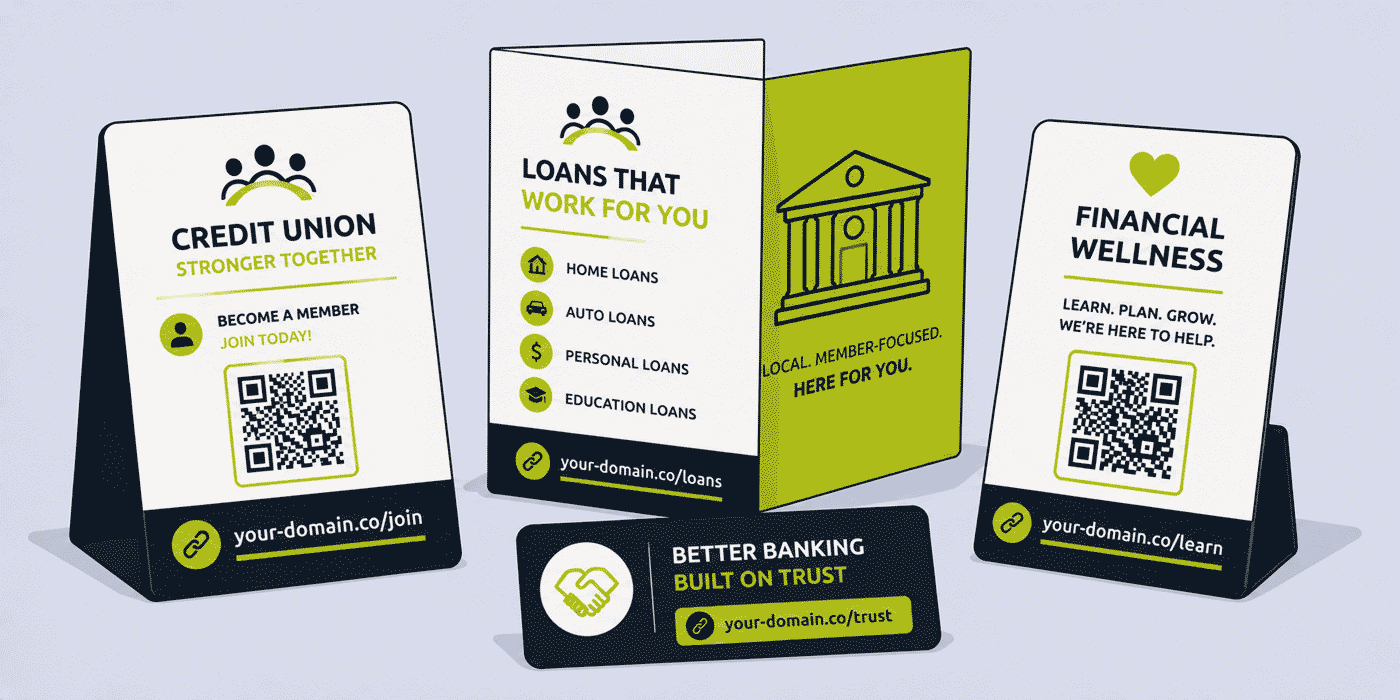
A credit union display at a community event typically includes a roll-up banner, a table display, branded promotional materials, and leaflets. Each of these is an opportunity for a QR Code that converts physical event presence into digital engagement. A QR Code on the roll-up banner linking to the membership application page, another on a table card linking to a loan calculator, and a third on the leaflet linking to a financial education guide gives event attendees three different digital paths depending on where they are in their relationship with the credit union.
Because the event display materials — particularly the roll-up banner and table display — are used repeatedly at many different events, the QR Codes on them need to serve every event on the credit union's calendar. A QR Code that links to the general membership application page is appropriate for most events; but for a school financial literacy fair, the same display is better served linking to a youth account or financial education page. Dynamic short links allow the credit union to update the display QR Code destination for each event without reprinting any display materials.
Click analytics from event QR Codes provide a measure of engagement that the credit union currently has no way of accessing from its physical event presence. Knowing that a particular employer fair generated 140 QR Code scans while a community festival generated only 32, despite similar estimated footfall at both events, tells the events team something meaningful about which event formats are generating the most active credit union interest and which are primarily general awareness activities.
Employer Partner On-Site Materials
Credit unions with employer partner agreements often provide branded materials for display at partner workplaces: posters in staff break rooms, information cards at HR reception areas, and inserts in new employee welcome packs. These materials carry QR Codes linking to the employer-specific membership page and to the payroll deduction setup guide. Because these materials may remain in place at an employer site for months or years, dynamic QR Codes are essential: any change to the credit union's membership platform, payroll deduction system, or application process can be reflected in the link destination without replacing the physical materials.
Financial Education Content Links
Financial education is central to the credit union mission. Most credit unions produce guides, calculators, webinars, and resources on topics including budgeting, saving, managing debt, understanding credit, preparing for major purchases, and planning for retirement. This content serves both a mission purpose — improving the financial wellbeing of members and the wider eligible community — and a marketing purpose: demonstrating the credit union's expertise and commitment to member welfare in a way that commercial banks typically do not replicate.
Financial Education Content Links
A branded short link for each major financial education resource — your-cu.com/budgeting-guide, your-cu.com/first-home-buyer, your-cu.com/debt-management, your-cu.com/retirement-guide — makes these resources shareable, trackable, and stable across website changes. These links are shared in member newsletters, on social media, through employer partner intranet channels, and at community education events.
Click analytics for financial education content links provide the credit union with data on which topics generate the most engagement from members and prospective members. This data is useful not only for content planning — knowing that the first home buyer guide generates three times the engagement of the retirement guide in a young-demographic employer partner population shapes which content to prioritize — but also for reporting to the credit union's board and to any regulatory or accreditation bodies that assess the credit union's community impact. Evidence of how many members and community members engaged with financial education content is a concrete measure of mission delivery.
School and Youth Programme Links
Many credit unions run youth savings accounts, school banking programmes, and financial literacy workshops for young people. These programmes are an investment in the credit union's long-term membership base as well as a mission activity, and the links associated with them need to be appropriate for a younger audience and for educational institution contexts.
A short link for youth account information — your-cu.com/youth-account or your-cu.com/kids-saver — shared with schools, parents, and youth organizations gives the credit union a consistent, professional entry point for its youth programme communications. A QR Code linked to this destination on classroom materials, school newsletter inserts, or youth event displays provides an age-appropriate digital entry point that teachers and parents can trust precisely because it carries the credit union's own domain rather than an unfamiliar third-party URL.
Member Communications and Service Links
Existing member communication — through newsletters, benefit notifications, service alerts, and account management information — involves a consistent set of links to online banking, loan payment portals, benefit programme pages, and account management tools. These links form the backbone of the member's digital relationship with the credit union and need to be stable, professional, and consistently branded across every communication channel.
Core Member Service Links
A core set of permanent member service links, included consistently across all member communications:
your-cu.com/online-banking— online banking loginyour-cu.com/make-payment— loan payment portalyour-cu.com/app— mobile app download (smart redirect by device)your-cu.com/contact— member services contact pageyour-cu.com/benefits— member benefits and discount programme
These links are used in member newsletters, in service alert emails, in the welcome pack for new members, and in any printed materials distributed to existing members. When any underlying platform changes — when the online banking platform is upgraded, when the mobile app is updated, or when the member benefits programme moves to a new provider — the short link destination is updated in the dashboard. Every historical reference to these links in past communications, archived newsletters, and retained printed materials continues to work correctly.
Member Newsletter Links
A credit union member newsletter — whether distributed digitally by email or physically by post — typically contains multiple links: to current rate information, to featured products, to financial education content, to upcoming events, and to member benefit programmes. Each of these should use a branded short link on the credit union's own domain, for the same reasons of professionalism and phishing awareness that apply to any financial institution's member communications.
Click analytics for newsletter links, aggregated and anonymized, give the communications team a picture of which newsletter content generates the most member engagement. Over multiple newsletters, comparing click-through rates across different content types — product features, financial education, event invitations, member benefits — informs what to include more prominently in future newsletters and what to feature less heavily.
Mobile App and Digital Banking Onboarding
Digital banking adoption among credit union members is an increasingly important priority: members who use the credit union's digital banking channels tend to be more engaged, to hold more products, and to have lower service costs than members who rely primarily on branch or telephone interactions. Promoting the mobile app and online banking consistently and clearly across all member communications is part of the credit union's digital transformation strategy.
A smart redirect short link for the mobile app — your-cu.com/app — that sends iOS users to the App Store and Android users to Google Play provides a single, consistent app promotion link that can appear in member newsletters, on branch posters, in employer partner communications, and in the new member welcome pack without requiring separate store-specific links in different contexts. Click analytics on this link show which communication channel is driving the most app download interest among members, which can inform where to focus digital adoption promotion.
Per-Channel Acquisition Attribution Within a Credit Union Budget
Credit union marketing budgets rarely permit investment in complex multi-channel attribution platforms. Per-channel short links offer the same attribution insight at a fraction of the cost, requiring only one additional short link per channel for any given campaign or call to action.
Per-Channel Membership Acquisition Attribution
For a membership growth campaign running across email, employer partner materials, social media, and community events simultaneously, a per-channel variant of the membership application link gives the credit union independent measurement of each channel's contribution:
your-cu.com/join-email— member email campaign and newsletteryour-cu.com/join-employer— employer partner materialsyour-cu.com/join-social— social media postsyour-cu.com/join-event— community event QR Code
All four links point to the same membership application page. Click analytics per link show which channel is generating the most membership application interest, without any additional analytics infrastructure beyond the link management platform itself. For a credit union spending a small marketing budget across these four channels, knowing which one drives the most membership enquiries is directly actionable for future budget allocation.
Multi-Branch Link Management and Per-Location Attribution
A credit union with multiple branch locations faces a link management challenge that mirrors the multi-site challenge of any other multi-location business: how to maintain brand consistency across all locations while understanding which locations are generating the most community engagement. A consistent naming convention with per-location short links addresses both needs.
Per-Location Link Structure
Each branch location gets its own short link: your-cu.com/branch-name pointing to that location's information page (address, opening hours, contact details, ATM locations, and any location-specific event calendar). Shared product and membership links — your-cu.com/join, your-cu.com/personal-loan — are used consistently across all locations, so the credit union can see total demand across the network without per-location fragmentation of the data for shared products.
Click analytics per branch location link give the credit union's management team a sense of how much digital engagement each branch's local community generates. A branch in a dense urban area with high foot traffic might generate 10x the branch page link clicks of a rural branch with lower foot traffic, but the per-head click rate might be reversed — suggesting the rural branch's community is more digitally engaged relative to its size. These relative engagement patterns inform where to invest in local digital promotion and where physical presence and community events generate more of the branch's new member activity than digital channels.
A Worked Example: A Community Credit Union's Membership Growth Campaign
Consider a community credit union with three branches, a membership of 8,000, and a geographic common bond covering a regional area, using a branded domain such as your-cu.com, connected through Cuttly's custom domain setup (an A record and a TXT record — see the custom domain setup guide).
Membership growth campaign setup: The credit union creates four channel-specific links for a three-month membership growth push: /join-email for the member referral email campaign, /join-employer for new employer partner materials at two recently signed employer partners, /join-social for the Facebook and Instagram posts, and /join-event for a QR Code on the display stand used at a regional community fair. All link to the same membership application page.
Month one results: The member referral email generates 340 clicks and 28 new membership applications. The employer partner materials generate 180 clicks and 31 applications — a significantly higher conversion rate, which the membership development officer attributes to the pre-qualified nature of employer partner enquiries (people already know they are eligible). The social media posts generate 90 clicks and 4 applications; the event QR Code generates 47 clicks and 2 applications over the two-day fair period.
Month two adjustment: The membership development officer increases the budget allocation to employer partner activity, scheduling visits to both new employer sites for an introductory webinar, and reduces the frequency of general social media promotion. The webinar invitation itself uses /join-employer as the application link, keeping the employer channel measurement consistent.
Month three outcomes: Total new memberships for the three-month campaign: 143. Per-channel attribution, available for the first time in the credit union's history: email referral 41%, employer partners 36%, social media 11%, events 5%, other/direct 7%. The board presents this per-channel breakdown in the membership growth report, using it to justify a proposal to expand the employer partner programme with three additional targeted employers in the following year.
Common Mistakes in Credit Union Link Management
No Branded Domain for Member-Facing Communications
A credit union that sends member emails containing unbranded generic shortener domain links is presenting the same appearance as a phishing message. For an institution whose entire proposition is built on member trust and community relationships, this is a particularly damaging inconsistency. A branded custom domain is the minimum professional standard for any financial institution's member-facing digital communications, and is achievable from the free plan.
No Measurement of Community Event and Employer Partner Effectiveness
Most credit unions invest time and resources in community events and employer partner relationships without any way of measuring how much membership interest these activities are generating. Per-channel QR Codes and short links provide this measurement at minimal additional cost, turning community presence activities from unquantified brand investments into measurable membership acquisition channels with comparable per-channel performance data.
Static QR Codes on Long-Lasting Display Materials
A credit union roll-up banner, an employer workplace poster, or a community noticeboard display with a static QR Code encoding a direct URL becomes a dead or misdirected link every time the credit union's website changes, its membership platform is updated, or its application process moves. These materials are typically kept and reused for years; dynamic QR Codes are the only way to ensure they continue to serve prospective members correctly throughout their entire useful life.
Cuttly Plan Guide for Credit Unions
- The Free plan ($0) provides 30 short links per month, one branded custom domain, full click analytics, dynamic QR Codes and a survey tool, with no credit card required. Sufficient for a small credit union setting up core membership, loan product, and financial education links alongside a basic community event QR Code programme.
- The Starter plan ($12/month) adds 300 short links per month and 30 custom aliases per month — practical for a growing credit union running regular membership acquisition campaigns with per-channel attribution, per-employer partner links, and an active community events calendar requiring event-specific QR Code management throughout the year.
- The Single plan ($25/month) adds up to 5 branded domains, fully customizable QR Codes with the credit union's brand identity for professional display materials, 1,000 API-created links per month, and a full year of analytics history — most relevant for multi-branch credit unions wanting branded QR Codes on all branch and event display materials, and wanting long-term campaign attribution data for board reporting.
- The Team plan ($99/month) suits larger credit union organizations with marketing, membership development, and branch teams sharing link management, multiple branded domains for different credit union brands within a larger group, and Campaign tag analytics for aggregated campaign reporting across membership growth, loan campaigns, and financial education programmes.
Create a free Cuttly account to set up your membership application link, your community event QR Code and your first loan product campaign link. Registration is required for all plans, including free. No credit card is needed for the free plan.
Frequently Asked Questions
How do credit unions use short links for membership acquisition?
A credit union creates a branded short link for its membership application page — your-cu.com/join — used across every membership acquisition channel: website, social media, employer partner materials, community events and member referral programmes. Click analytics show how many potential members engaged with the application CTA from each source, giving the membership development team per-channel attribution without separate analytics platforms for each channel.
How do credit unions use QR Codes at community events?
A credit union attending local events places QR Codes on display materials, table cards and branded handouts. Generated from dynamic short links, these QR Codes link to the membership application page, financial education resources, or loan calculators. Because the QR Code is dynamic, the destination can be updated for each different event type without reprinting any display materials, and click analytics show how many event attendees engaged with the digital CTA.
How do credit unions use short links for loan product campaigns?
A credit union creates a branded short link for each loan product — your-cu.com/auto-loan, your-cu.com/personal-loan — used in email campaigns, branch materials, employer partner communications and printed advertising. Because loan rates change regularly, a dynamic short link allows the product page destination to be updated when rates change without reprinting any materials that reference the link.
Are short links appropriate for a not-for-profit credit union's marketing budget?
Yes. The free plan provides 30 short links per month, one branded domain and full analytics at no cost, sufficient for a small credit union's core link management needs. As link management requirements grow, the Starter plan at $12 per month provides the capacity most growing credit unions require. Link management is one of the highest-ROI marketing tools available within a constrained budget, because it adds measurement to activities the credit union is already doing rather than requiring new spending.
How do credit unions use short links for financial education content?
A credit union uses branded short links for each major financial education resource — your-cu.com/budgeting-guide, your-cu.com/first-home-buyer — shared in member newsletters, on social media, and through employer partner channels. Click analytics show which content generates the most member engagement, informing content planning and providing evidence of financial education mission delivery for board and regulatory reporting.
How do credit unions manage links across multiple branch locations?
A multi-branch credit union uses per-location short links — your-cu.com/branch-name — for location-specific information alongside shared product and membership links used consistently across all locations. Click analytics per branch link show which locations are generating the most digital community engagement, informing where to prioritize local outreach and event activity.
- Get Started
- Create Free Account
- Plans & Pricing
- Platform Tools
- URL Shortener
- Link Analytics
- QR Code Generator
- Survey Tool
- Related Guides
- URL Shortener for Banks
- URL Shortener for Financial Services & Fintech
- URL Shortener for Financial Advisors
- URL Shortener for Nonprofits
- Short Links for Offline Campaigns
- Encyclopedia
- Branded Links
- Dynamic QR Codes
- Setup Guides
- Custom Domain Setup
- Track Link Clicks
- Industry Hub
- Banking & Financial Services
- All Industries →
URL Shortener
Cuttly simplifies link management by offering a user-friendly URL shortener that includes branded short links. Boost your brand’s growth with short, memorable, and engaging links, while seamlessly managing and tracking your links using Cuttly's versatile platform. Generate branded short links, create customizable QR codes, build link-in-bio pages, and run interactive surveys—all in one place.
Cuttly - Consistently Rated
Among Top URL Shorteners
Cuttly isn’t just another URL shortener. Our platform is trusted and recognized by top industry players like G2 and SaaSworthy. We're proud to be consistently rated as a High Performer in URL Shortening and Link Management, ensuring that our users get reliable, innovative, and high-performing tools.C


