URL Shortener for Ghost Kitchens The Complete Guide
A ghost kitchen — also called a dark kitchen, virtual kitchen, or cloud kitchen — operates without a physical dining room, without foot traffic, and without the organic discovery that comes from a visible presence on a high street. Its entire commercial existence is mediated through digital channels: delivery platform listings, social media content, paid advertising, and the packaging that arrives at the customer's door. Every customer interaction, from first discovery through to repeat ordering, happens through a screen. The links that connect marketing activity to ordering action are therefore not merely an operational detail but the entire commercial infrastructure through which a ghost kitchen acquires and retains its customer base.
This guide covers how ghost kitchens, virtual restaurant brands, dark kitchen operators, and multi-brand kitchen businesses use a URL shortener, branded custom domain, dynamic QR Codes and click analytics across delivery platform promotion, social media campaigns, new brand launches, packaging QR Codes, per-platform order attribution, and the critical challenge of building a direct customer relationship outside the delivery platforms that mediate almost all ghost kitchen revenue.
What This Guide Covers
- The ghost kitchen's fundamental digital dependency — and why link management is the core infrastructure
- Ordering links — per-platform attribution across Uber Eats, Deliveroo, Just Eat and direct ordering
- Packaging QR Codes — the highest-intent post-purchase touchpoint
- New brand launch link strategy
- Per-channel social media order attribution
- Multi-brand kitchen link organisation
- Building a direct customer relationship outside delivery platforms
- Loyalty programme and email list building links
- Promotional campaign and discount code links
- A worked example: a three-brand ghost kitchen's link stack
- Common mistakes in ghost kitchen link management
- A Cuttly plan guide for ghost kitchens
- Frequently asked questions
The Ghost Kitchen's Digital Dependency
Traditional restaurants acquire customers through physical presence: a good location, attractive window displays, a visible menu board, and the spontaneous decision of a person who walks past to come in. A ghost kitchen has none of these acquisition mechanisms. Its customer base is built entirely through digital discovery: being found on a delivery platform's search results, appearing in a social media feed, being mentioned in a food review, or being the subject of a promotional push that reaches a specific audience. Every one of these discovery moments ends with a link.
The delivery platform provides its own ordering flow and its own discovery algorithm, which the kitchen has limited ability to influence beyond its listing quality and rating. But the off-platform marketing a ghost kitchen does — the Instagram Reels that show the food being prepared, the TikTok videos that go viral with a satisfying unboxing of the delivery bag, the Facebook posts promoting a lunchtime deal — all depend on a link that takes the interested viewer from content to order. Managing these links well is the difference between off-platform marketing that generates measurable orders and off-platform marketing that generates views with no demonstrable commercial outcome.
Ordering Links: Per-Platform Attribution
A ghost kitchen brand is typically listed on multiple delivery platforms simultaneously: Uber Eats, Deliveroo, Just Eat in the UK; DoorDash, Uber Eats, Grubhub in the US; and equivalent platforms in other markets. Each platform has its own listing URL, its own commission structure, and its own customer base. When a ghost kitchen promotes its brand on social media, it needs a link that takes the customer to their preferred ordering option without requiring the customer to navigate each platform independently.
The Ordering Hub Page
The most effective approach for a ghost kitchen operating across multiple delivery platforms is an ordering hub page: a simple branded landing page that lists all available ordering options for the customer's location. A short link — your-brand.com/order — goes to this page. The customer arrives, sees that they can order through Uber Eats, Deliveroo, or directly if the kitchen has a direct ordering channel, and chooses their preferred platform.
This approach has three significant advantages over linking directly to a single platform's listing:
- Platform independence. If the kitchen's listing on one platform is temporarily unavailable, paused, or removed, the ordering hub continues to direct customers to remaining options. A single-platform order link that breaks when the listing is unavailable is a dead end; an ordering hub with multiple options remains functional.
- Customer preference. Different customers have strong platform preferences based on their subscription status (Deliveroo Plus, Uber One), their past experience, and their geographic location. An ordering hub lets customers self-select their preferred platform rather than being forced to a specific one.
- Direct ordering growth. If the kitchen develops a direct ordering channel — through its own website, through a dedicated ordering app, or through a third-party direct ordering platform — the ordering hub can include this option without requiring any change to the promoted ordering link. Customers who discover the direct option on the hub page generate higher-margin orders without the delivery platform's commission deduction.
Per-Platform Attribution Variants
For promotional campaigns that are specifically designed to drive orders through a particular platform — because the platform is running a joint promotion, because the kitchen has preferential commission terms with a specific platform during a campaign period, or because the campaign creative is platform-specific — per-platform attribution links provide independent click analytics per platform:
your-brand.com/order-uber— Uber Eats listing linkyour-brand.com/order-deliveroo— Deliveroo listing linkyour-brand.com/order-je— Just Eat listing linkyour-brand.com/order-direct— direct ordering channel
Click analytics per platform link, compared across multiple promotional campaigns, show the kitchen which platform its promoted audience prefers for placing orders. A kitchen that invests in Instagram advertising to drive orders and discovers that 68% of link clicks go to the Uber Eats listing can conclude that its Instagram audience skews toward Uber Eats users — information that is directly useful for negotiating promotional support from Uber Eats and for structuring future campaigns.
Packaging QR Codes: The Post-Purchase Touchpoint
The moment a delivery bag or box arrives at a customer's door is the highest-intent brand engagement moment in the ghost kitchen's customer relationship. The customer ordered food because they wanted it, they have been looking forward to its arrival, and they are at peak appetite and anticipation when they open the packaging. This is the optimal moment for every commercial action the kitchen wants a customer to take: leaving a review, ordering again, joining a loyalty programme, or following the brand on social media.
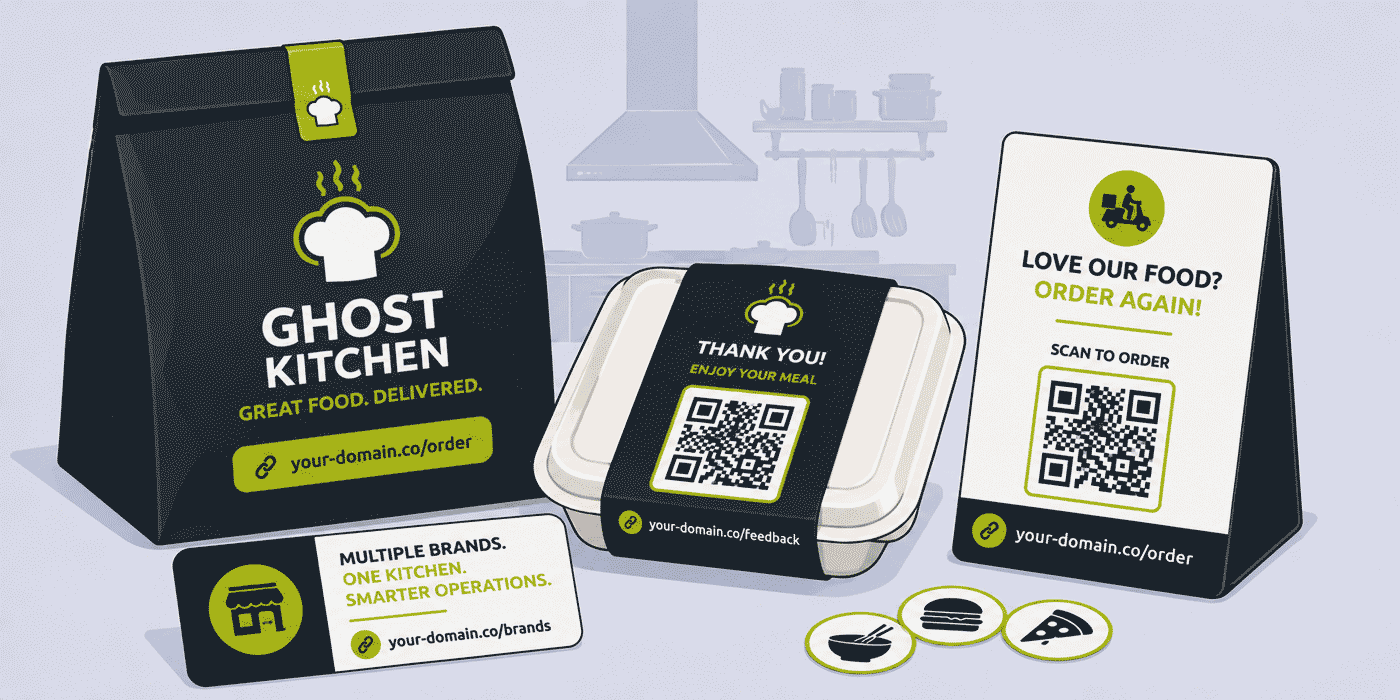
Most ghost kitchens include a printed insert in their packaging — a thank-you card, a menu leaflet, a promotional flyer. A QR Code on that insert is the link between the peak-satisfaction moment of opening the delivery and every commercial action the kitchen wants the customer to take. It is the most direct physical-to-digital link in the ghost kitchen's entire marketing toolkit, and it is the one marketing touchpoint that does not require delivery platform permission or commission.
Packaging QR Code Destination Strategy
Because the packaging QR Code is dynamic, its destination can rotate between priority commercial actions as the kitchen's needs evolve:
- New brand launch phase (first 60 days): destination is a review invitation page. "Enjoyed your meal? Your review helps others discover us." A direct link to the kitchen's Uber Eats or Google review page, with a personalised thank-you. During this phase, every order is an opportunity to generate the social proof that determines the brand's discovery position on platform.
- Established phase: destination switches to a loyalty programme sign-up or email list. "Join our VIP list for exclusive offers and early access to new menu items." The kitchen is now building a direct customer database that it owns independently of the delivery platform.
- Promotional period: destination switches to a specific offer page. "Order again this week and get a free side." Retargeting the customer who has just received their first order with an incentive to reorder within a short window maximises repeat order conversion while the brand is still fresh.
- Social growth phase: destination switches to a "follow us" page with links to the brand's Instagram, TikTok, and any other active social channels. Building a social following from the highest-intent audience — customers who have already ordered — creates a promotional channel that reduces future dependence on delivery platform algorithms.
Click analytics from the packaging QR Code show the kitchen how many customers are engaging with the post-purchase touchpoint. This is data most ghost kitchens currently have no way of measuring: whether their packaging inserts are being read, scanned, and acted on, or immediately discarded. A kitchen that discovers its packaging QR Code generates 340 scans per 1,000 orders (a 34% engagement rate) has valuable information about its packaging insert effectiveness, and can invest in improving the QR Code's visibility and the offer's attractiveness to increase this rate.
New Brand Launch Link Strategy
Ghost kitchen operators frequently launch new virtual restaurant brands as a low-capital growth strategy: the kitchen infrastructure already exists, the staff are already trained, and adding a new brand with a distinct menu, name, and visual identity requires primarily a marketing investment rather than a physical one. Managing the launch of a new virtual brand requires a specific set of short links that establish the brand's digital presence quickly and consistently across every channel simultaneously.
Launch Day Link Set
A new virtual brand launch short link set, all of which should be live and tested before the launch announcement goes out:
your-brand.com/order— the ordering hub page or primary platform listingyour-brand.com/menu— the full menu pageyour-brand.com/story— the brand's concept and story (for social media and PR)your-brand.com/order-ig,/order-tiktok,/order-fb— per-channel attribution links for the launch social campaign
Having the ordering link live before the first social media post means that every viewer who sees the launch content and clicks through immediately reaches a functional ordering page. A launch campaign that drives social media interest to a "coming soon" page or a broken link loses the most commercially valuable moment: the first-impression click from a viewer who is genuinely interested in trying the new concept.
Pre-Launch Waitlist and Hype Building
For kitchen operators who want to build anticipation before a new brand launches, a pre-launch short link — your-brand.com/waitlist — pointing to an email sign-up page ("be first to know when we launch and get an exclusive launch discount") builds an email list of genuinely interested potential customers before the brand takes its first order. Click analytics on the pre-launch waitlist link across every social media teaser post show how much genuine commercial interest the brand concept is generating before launch day.
Per-Channel Social Media Order Attribution
Ghost kitchens invest significantly in social media content as a brand discovery and order driving mechanism. Instagram food photography and Reels, TikTok cooking preparation and delivery unboxing content, Facebook local targeting ads, and influencer partnerships all contribute to the marketing mix. Understanding which channel is actually generating orders, rather than which is generating the most likes and views, is the most commercially important analytics question for a ghost kitchen's marketing team.
Attribution Link Setup for Social Campaigns
For any campaign running across multiple social channels, a per-channel ordering link set provides independent attribution:
your-brand.com/order-ig— Instagram bio link and story links during the campaignyour-brand.com/order-tiktok— TikTok bio link during the campaignyour-brand.com/order-fb— Facebook post links and ad destinationyour-brand.com/order-influencer-name— per-influencer link for any creator partnerships
All of these link to the same ordering hub or primary platform listing. Click analytics per channel show how much order intent traffic each platform drives. Combined with the delivery platform's own order volume data, the kitchen can compare not just which channel generates the most clicks but which generates the most orders per click — the most commercially meaningful campaign efficiency metric.
A TikTok video that generates 40,000 views and 820 ordering link clicks with a 9% click-to-order rate is commercially superior to a Facebook campaign that generates 3,200 link clicks with a 2.1% click-to-order rate, even though the Facebook campaign generates more raw clicks. This distinction is measurable only with both per-channel click data and platform order data available simultaneously; without the short link click layer, the kitchen would only see the delivery platform's order data, which provides no channel attribution at all.
Multi-Brand Kitchen Link Organisation
A ghost kitchen operating three or four virtual restaurant brands simultaneously — each with a distinct cuisine, name, visual identity, and target audience — needs a link management approach that keeps each brand's links clearly separated and independently trackable. A single shared link library where Brand A's links are mixed with Brand B's creates an analytics picture that is impossible to act on; per-brand link organisation is the foundation of any multi-brand ghost kitchen's digital marketing management.
Per-Brand Domain Strategy
The cleanest multi-brand link architecture uses a separate branded domain per virtual restaurant brand, with each domain managed from a single Cuttly account dashboard. Brand A's ordering links use brand-a.com/order; Brand B's ordering links use brand-b.com/order; Brand C's packaging QR Codes use brand-c.com/thanks. Each brand's analytics are completely independent, and the kitchen management team can compare per-brand digital engagement performance from a single dashboard view.
For kitchens where separate brand domains are not yet in place, a naming convention-based approach within a single domain provides a workable alternative: kitchen.com/brand-a-order, kitchen.com/brand-b-order. The prefix convention keeps each brand's links navigable and the analytics separable, though it sacrifices the brand identity benefit of a per-brand domain.
Per-Brand Performance Comparison
The most commercially useful output of per-brand link analytics for a multi-brand ghost kitchen is a direct comparison of digital engagement per brand relative to marketing investment. Brand A with three Instagram posts per week may generate more ordering link clicks than Brand B with five posts per week; the implication is that Brand A's content quality, audience relevance, or visual identity is more commercially effective per piece of content created. Per-brand click analytics make this comparison concrete and actionable rather than impressionistic.
Building a Direct Customer Relationship Outside Delivery Platforms
The structural commercial vulnerability of the ghost kitchen model is its total dependence on delivery platforms for customer relationships. The delivery platform owns the customer data: their name, their address, their order history, their payment details, and their preferences. The ghost kitchen knows only what the platform chooses to share, which is typically aggregate order data without individual customer contact information. This means the kitchen cannot contact its customers directly to announce new menu items, to promote a loyalty offer, or to re-engage customers who have not ordered for several weeks.
Building a direct customer relationship — through an email list or a loyalty programme that the kitchen controls — is therefore the most important long-term commercial investment a ghost kitchen can make. Every order that generates a packaging QR Code scan and a sign-up to the kitchen's email list or loyalty programme is a customer who can be communicated with directly, independently of what Uber Eats or Deliveroo decides to do with its algorithm, its commission structure, or its promotional support for the kitchen's brand.
The Loyalty Programme and Email Sign-Up Links
A short link for the loyalty programme or email sign-up — your-brand.com/loyalty or your-brand.com/vip — is the primary off-platform customer relationship building tool. It appears on packaging inserts as a QR Code, in the kitchen's social media bio, in any "follow up" message the kitchen is able to send through the delivery platform's own messaging systems (where permitted by the platform), and in any paid advertising that the kitchen runs outside the platform.
The incentive for a customer to sign up should be specific and immediate: "Get a free item on your next order when you join our VIP list" is more effective than a generic "sign up for news and offers." Click analytics on the loyalty sign-up link show how many customers are engaging with the off-platform relationship offer from each touchpoint, giving the kitchen a measurable velocity of direct customer base growth that is the most important indicator of its long-term commercial independence from delivery platform fee structures.
Promotional Campaign and Discount Code Links
Ghost kitchen promotions — lunchtime deals, "two for one" evenings, new menu item launch discounts, and seasonal promotions — are an important driver of incremental orders during periods of low organic demand. Managing these promotions through short links rather than relying solely on delivery platform's own promotional tools gives the kitchen control over the promotional experience and independent analytics on promotional campaign performance.
Campaign Link Management
A promotional campaign link — your-brand.com/lunch-deal or your-brand.com/free-side — pointing to the ordering page with the promotion prominently featured gives the kitchen a dedicated, trackable entry point for each promotional push. Click analytics for the campaign link show how much interest the promotion generates from each promotional channel.
When the promotion ends, the link destination is updated to the standard ordering hub rather than a "promotion expired" error, ensuring any customer who bookmarked or saved the promotional link still reaches a functional ordering page. The kitchen's promotional history — which offers generated the most engagement, which periods saw the highest click volumes relative to the campaign's reach — is visible through the analytics history across every promotional campaign link over the year.
A Worked Example: A Three-Brand Ghost Kitchen's Link Stack
Consider a ghost kitchen operating three virtual restaurant brands from a single commercial kitchen facility: a burger brand, a Thai street food brand, and a plant-based brand. Each has its own name and social media presence. The kitchen uses branded short links for each, connected through Cuttly's custom domain setup with an A record and a TXT record for each brand domain — see the custom domain setup guide.
Burger brand: Established brand with 2,800 Instagram followers. Core ordering link /order used in bio. Packaging QR Code currently pointing to /loyalty (VIP list sign-up). After three months: 1,240 packaging QR scans from approximately 3,800 orders (32.6% scan rate). VIP email list now at 380 subscribers, all verified repeat customers. The kitchen uses the email list to announce a limited new burger ahead of its Uber Eats listing going live, generating 140 direct orders on the announcement day before any platform discovery.
Thai street food brand — new launch: Brand launches with pre-launch waitlist at /waitlist. Two weeks of teaser content across Instagram and TikTok generates 890 waitlist sign-ups. Launch day: /order goes live, waitlist email sent. Per-channel analytics: TikTok drives 1,340 ordering link clicks (highest volume, driven by a "pad thai being made" Reel achieving 28,000 views), Instagram drives 620 clicks (engaged existing followers), email waitlist drives 340 clicks (highest click-to-order conversion rate at 24%, confirming waitlist subscribers as the highest-intent audience for food delivery brands).
Plant-based brand: Struggling to gain traction. Per-brand link analytics reveal the plant-based brand's Instagram posts generate 180 ordering link clicks per week compared with 820 for the burger brand despite similar content volume. The kitchen's management team uses this data to propose a content strategy review for the plant-based brand, testing different visual styles and content formats before increasing the brand's marketing budget further.
Common Mistakes in Ghost Kitchen Link Management
Linking Directly to a Single Delivery Platform
A ghost kitchen whose social media bio links directly to a single delivery platform listing, rather than to an ordering hub, loses every customer who uses a different platform. It also creates a single point of failure: if the platform listing is paused, temporarily delisted, or unavailable in a customer's area, the link is dead. An ordering hub short link that serves all available platforms eliminates both problems.
No Packaging QR Code
A ghost kitchen that does not use a packaging QR Code is missing the highest-intent post-purchase touchpoint available to it. Every order already includes a bag or box and often an insert; adding a QR Code to that insert costs almost nothing in incremental printing cost and is the only marketing touchpoint that does not require delivery platform permission or commission. The first QR Code on packaging is the single highest-return link management investment most ghost kitchens can make.
No Per-Brand Link Separation in Multi-Brand Operations
A ghost kitchen that uses the same link structure across all its virtual brands has no way to compare digital engagement performance between brands. Without per-brand analytics, marketing investment decisions about which brand to promote more heavily are based on intuition and order volume rather than digital engagement data. Per-brand link organisation costs nothing beyond setup time and provides the most actionable analytics available for multi-brand kitchen management.
Cuttly Plan Guide for Ghost Kitchens
- The Free plan ($0) provides 30 short links per month, one branded custom domain, full click analytics, dynamic QR Codes and a survey tool, with no credit card required. Suitable for a single-brand ghost kitchen setting up core ordering links, a packaging QR Code, and per-channel social media attribution for regular campaigns.
- The Starter plan ($12/month) adds 300 short links per month and 30 custom aliases per month — practical for a growing ghost kitchen with multiple virtual brands, regular promotional campaigns, new brand launches, and ongoing per-channel attribution tracking.
- The Single plan ($25/month) adds up to 5 branded domains for multi-brand kitchen operations where each virtual restaurant brand has its own domain, fully customizable QR Codes with each brand's visual identity for professional packaging integration, 1,000 API-created links per month for automated per-campaign link generation, and a full year of analytics history for brand performance comparison.
- The Team plan ($99/month) suits large ghost kitchen operators or virtual restaurant groups managing five or more brands across multiple kitchen locations, with marketing, operations, and brand teams sharing link management, Campaign tag analytics for aggregated brand portfolio reporting, and multiple branded domains across all brands in the group.
Create a free Cuttly account to set up your ghost kitchen's first ordering hub link, your packaging QR Code, and your per-channel social media attribution links. Registration is required for all plans, including free. No credit card is needed for the free plan.
Frequently Asked Questions
How do ghost kitchens use short links to drive orders across delivery platforms?
A ghost kitchen creates a branded ordering hub short link — your-brand.com/order — pointing to a page listing all available delivery platform options. Per-platform attribution variants used in specific campaigns show which platform the kitchen's promoted audience prefers to order through. An ordering hub avoids single-platform dependency and keeps every promotional reference functional even if one platform listing is temporarily unavailable.
How do ghost kitchens use QR Codes on food packaging?
A ghost kitchen places a dynamic QR Code on its packaging insert, rotating the destination between review requests, loyalty sign-up, repeat order offers, and social media follows as the brand's priority shifts. Click analytics show how many customers engage with the packaging touchpoint — data that most ghost kitchens currently have no access to — informing insert design and offer optimization.
How do ghost kitchens track which social media channel drives the most orders?
A ghost kitchen creates per-channel ordering links — /order-ig, /order-tiktok, /order-fb — for promotional campaigns. Click analytics per channel combined with delivery platform order data give the kitchen a per-channel click-to-order conversion rate. This identifies which platforms drive commercially motivated traffic versus engaged but non-purchasing audiences.
How do multi-brand ghost kitchens manage links across several virtual restaurant brands?
A multi-brand ghost kitchen uses a separate branded domain per virtual restaurant brand, each managed from a single Cuttly account. Per-brand click analytics allow direct comparison of digital engagement performance across brands, informing where to invest marketing budget, which brands need a content strategy review, and how each brand's direct customer base is growing relative to order volume.
How do ghost kitchens use short links to build a direct customer relationship outside delivery platforms?
A ghost kitchen uses a packaging QR Code and social media bio link pointing to a loyalty programme or email sign-up with an incentive. Click analytics track how quickly the direct customer database grows from each touchpoint. An email list of verified customers enables direct promotional communication completely independently of delivery platform algorithms, commission structures, or promotional support policies.
- Get Started
- Create Free Account
- Plans & Pricing
- Platform Tools
- URL Shortener
- Link Analytics
- QR Code Generator
- Survey Tool
- Related Guides
- URL Shortener for Restaurants
- URL Shortener for Craft Breweries
- URL Shortener for Food & Hospitality
- URL Shortener for Marketplace Sellers
- Short Links for Offline Campaigns
- Encyclopedia
- Dynamic QR Codes
- Branded Links
- Setup Guides
- Custom Domain Setup
- Track Link Clicks
- Industry Hub
- Food, Hospitality & Lifestyle
- All Industries →
URL Shortener
Cuttly simplifies link management by offering a user-friendly URL shortener that includes branded short links. Boost your brand’s growth with short, memorable, and engaging links, while seamlessly managing and tracking your links using Cuttly's versatile platform. Generate branded short links, create customizable QR codes, build link-in-bio pages, and run interactive surveys—all in one place.
Cuttly - Consistently Rated
Among Top URL Shorteners
Cuttly isn’t just another URL shortener. Our platform is trusted and recognized by top industry players like G2 and SaaSworthy. We're proud to be consistently rated as a High Performer in URL Shortening and Link Management, ensuring that our users get reliable, innovative, and high-performing tools.C


