URL Shortener for Mental Health Apps The Complete Guide
Mental health apps occupy a distinctive position in the digital health landscape: they serve users who may be in genuinely vulnerable states, who are making decisions about their mental wellbeing in moments of stress or crisis, and whose trust in the tools they use is foundational to the therapeutic value of those tools. This context shapes every digital communication decision a mental health app makes — including, significantly, how it manages the links through which users discover, download, and access the app and its content. A generic, unbranded short link in a mental health context does not merely look unprofessional; in the worst cases, it looks like exactly the kind of suspicious link that digital safety education warns against, at exactly the moment when a user needs to feel safe and confident about the resource they are accessing.
This guide covers how mental health apps, digital therapy platforms, mindfulness and meditation apps, wellbeing and stress management tools, peer support platforms, and crisis support apps use a URL shortener, branded custom domain, dynamic QR Codes and click analytics across user acquisition campaigns, corporate wellness partnerships, clinical environment QR Code placements, crisis resource distribution, influencer campaigns, and the full user journey from discovery to active engagement. Mental health app link management is governed by the same healthcare data privacy considerations that apply to any digital health service; platforms should review specific compliance requirements with qualified advisors for their jurisdiction and clinical context.
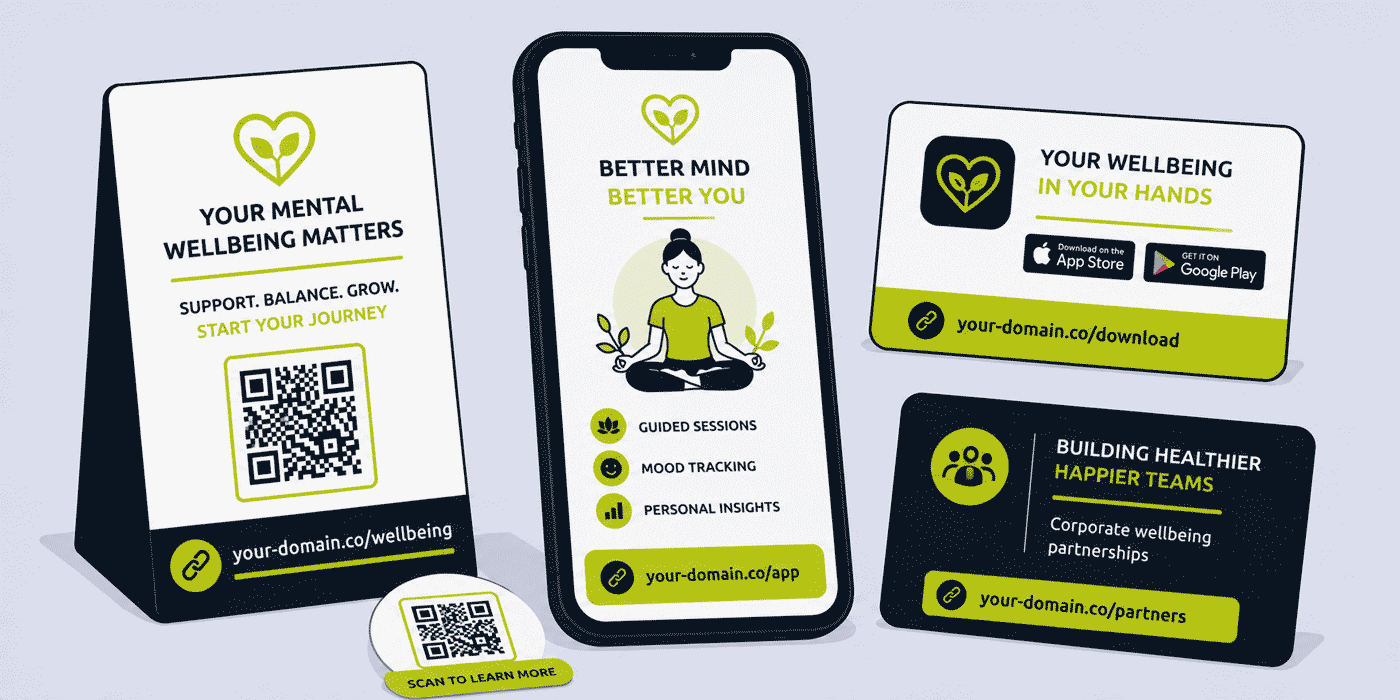
What This Guide Covers
- Why mental health app link management requires additional consideration of trust and context sensitivity
- App download and smart redirect links for mental health apps
- Per-channel user acquisition attribution
- Corporate wellness and employer benefit programme links
- QR Codes in clinical, educational and workplace settings
- Influencer and advocate campaign links
- Crisis resource and support links
- Seasonal mental health campaign links (Blue Monday, Mental Health Awareness Week, World Mental Health Day)
- User onboarding and programme access links
- Therapist and clinician referral links
- A worked example: a wellbeing app's link stack across a corporate partnership launch
- Common mistakes in mental health app link management
- A Cuttly plan guide for mental health app companies
- Frequently asked questions
Trust and Context Sensitivity in Mental Health App Links
The user of a mental health app is, by the nature of what they are using the app for, in a state of heightened emotional sensitivity. They may be experiencing anxiety, depression, stress, grief, relationship difficulty, or a mental health crisis. In this state, the signals they use to evaluate whether a digital resource is safe and trustworthy are different from the signals they use in less charged contexts. A link on a recognizable, consistently branded domain that they associate with a trusted mental health service is reassuring. A generic shortener domain link from an unfamiliar URL is potentially alarming.
This matters in practice. A mental health app that sends users to crisis resources, therapy booking pages, or onboarding flows through links on its own branded domain is presenting every link as part of a consistent, trustworthy digital environment. A mental health app that uses generic shortener domains in its user communications is introducing an inconsistency that may, in the worst cases, cause a user in crisis to hesitate before clicking a link to a resource they genuinely need.
The branded domain principle is therefore not merely a professional preference for mental health apps: it is a design standard with direct user safety implications. Every link a mental health app shares with users in any context should be on the app's own domain or on a domain the user has been clearly introduced to as belonging to the app or service.
App Download and Smart Redirect Links
The app download link is the primary user acquisition conversion point for most mental health apps, and it needs to work seamlessly across every device type from a single, consistent URL. A user who encounters the app through a social media post, a GP surgery poster, a corporate wellness programme email, or a friend's recommendation should be able to click or scan a single link and be sent directly to the correct app store for their device without any additional navigation decisions.
Smart Redirect Download Links
A smart redirect short link — your-app.com/download — configured to detect the user's device operating system and send iOS users to the App Store and Android users to Google Play provides this seamless experience from a single URL. This link can be used across every acquisition channel without modification, with per-channel variants created for attribution purposes when needed.
For mental health apps that also offer a web-based version alongside native apps, the smart redirect can include a third destination for desktop users: the web app registration page. A user on a laptop who encounters a mental health app download link is still a potential user; routing them to the web app rather than an App Store page they cannot use on a desktop maintains the acquisition flow rather than losing them at the device mismatch.
Per-Channel Download Attribution
For a mental health app running user acquisition across multiple channels simultaneously, per-channel download links provide the attribution data the growth team needs to compare channel efficiency:
your-app.com/dl-social— social media posts and advertisingyour-app.com/dl-email— email campaigns and newslettersyour-app.com/dl-corporate— corporate wellness programme materialsyour-app.com/dl-clinical— clinical setting QR Codes (GP surgeries, hospitals)your-app.com/dl-creator— influencer and advocate contentyour-app.com/dl-pr— press coverage and editorial mentions
Click analytics per channel, aggregated and anonymized, show which source drives the most download page traffic. Over multiple acquisition campaigns, the pattern of which channels bring in users who actually complete the download and become active users — compared with which bring in curious browsers who do not convert — is one of the most practically useful data sets a mental health app growth team can develop.
Corporate Wellness and Employer Benefit Programme Links
Corporate wellness partnerships have become one of the most significant distribution channels for mental health apps. Employers increasingly include mental health app access as part of their employee benefits packages, recognizing the business case for employee mental wellbeing: reduced absenteeism, lower staff turnover, higher engagement, and demonstrably improved productivity in employees who use digital mental health tools consistently.
Per-Employer Access Links
A mental health app working with employer partners creates a branded landing page for each corporate partner, accessible through a per-employer short link: your-app.com/employer-name. This landing page confirms the employee's eligibility for the benefit, explains what the app covers as part of their employer's programme, and provides a streamlined download or registration flow specific to that employer's package.
The per-employer link is shared through the employer's HR and benefits communications: the employee handbook, the benefits portal, the onboarding email, the intranet, and any wellness programme communications the employer produces. Because the link is dynamic, the destination can be updated if the employer's package changes, if the app's employer landing page is redesigned, or if the registration flow is restructured, without requiring the employer to update every instance where the link appears in their HR materials.
Click analytics for each employer's link — aggregated and anonymized — give the partnerships team data on how actively each employer's workforce is engaging with the benefit. A corporate partner with 5,000 employees where only 80 have clicked the employer access link in the first two months may need a different activation strategy — perhaps a presentation to managers, a lunch-and-learn session, or co-branded communications from the HR team — than one where 600 employees have already accessed the link. Per-employer engagement data drives these partnership activation decisions.
Mental Health First Aider and Champion Links
Many employers have trained Mental Health First Aiders (MHFAs) or Mental Wellbeing Champions whose role includes signposting colleagues to mental health resources. A short link — your-app.com/mhfa-resources or your-app.com/support-toolkit — to a resource pack specifically designed for MHFAs and champions gives these individuals a professional, easy-to-share entry point to the mental health app's resources that they can include in any colleague signposting conversation, email, or team communication.
QR Codes in Clinical, Educational and Workplace Settings
Physical settings where people are already thinking about mental health — GP surgery waiting rooms, hospital outpatient psychiatric services, university student wellbeing centres, workplace therapy rooms and quiet zones, and community mental health charity premises — are among the highest-intent environments for mental health app discovery. A person sitting in a GP waiting room who has come to discuss their anxiety, or a student in a university wellbeing centre, is in exactly the mindset where a QR Code linking to a mental health app is immediately relevant and actionable.
GP Surgery and Clinical Setting QR Codes
A mental health app that has established partnerships with GP surgeries, NHS mental health services, or community health organizations can place QR Code displays in waiting rooms and consultation areas. These QR Codes — generated from dynamic short links on the app's own branded domain — link to a landing page specifically designed for people who have been referred or self-directed to the app through a clinical context.
A clinical referral landing page differs from a general consumer acquisition landing page: it should acknowledge that the user may be in a difficult moment, provide clear information about what the app offers and what it does not (it is a wellbeing support tool, not a replacement for clinical care), give clear access to in-app crisis resources if needed, and make the download and registration process as simple as possible. The QR Code destination is therefore a specific, context-appropriate landing page rather than the generic marketing homepage.
Because clinical display materials may remain in GP surgeries and health centre waiting rooms for many months, dynamic QR Codes are essential: the landing page destination, the app version highlighted, and any specific programme being promoted can be updated without replacing the physical QR Code display.
University and Student Wellbeing QR Codes
Student mental health is a significant and growing area of concern at universities globally. A mental health app partnering with university wellbeing services places QR Codes in student health centres, student union buildings, library quiet zones, and accommodation notice boards, linked to student-specific access pages or to programmes relevant to the student experience: exam stress management, social anxiety, sleep support for irregular student schedules, and loneliness during transition periods.
Per-institution QR Codes — each with their own dynamic short link pointing to a university-specific landing page — allow the app's partnerships team to compare engagement across university partners, informing decisions about where to invest in additional partnership development and on-campus activation.
Influencer and Advocate Campaign Links
Mental health apps engage with creators and advocates differently from most consumer apps. The mental health space has developed a rich community of creators who discuss their own mental health journeys authentically on social media — talking about therapy, medication, anxiety management, mindfulness practice, and recovery. These creators have audiences that are not only large but specifically highly engaged with mental health topics, and their recommendations carry significant weight in their communities.
Per-Creator Attribution Links
For each creator partnership, the app creates a short link pointing to the download page: your-app.com/creator-name. This link appears in the creator's bio, in their video description, and in any post where they discuss the app. Click analytics show how much traffic each creator is driving to the download page, complementing any affiliate tracking the app store or partnerships platform provides.
For mental health apps specifically, the authenticity of the creator's relationship with the app matters more than in most other categories. A creator who has genuinely used the app as part of their own mental health journey and discusses it from personal experience typically drives higher-quality download traffic than one who mentions it as a paid promotion without personal context. Per-creator download link analytics that show a high click volume but low app store conversion rate may indicate that the creator's promotion style was not effectively communicating the app's value; per-creator analytics that show high click-through and high conversion indicate a creator whose audience includes high-intent potential users.
Crisis Resource and Support Links
Crisis resource links occupy a specific category in mental health app link management that has no equivalent in most other digital products: these are links that may be accessed by people in genuine psychological distress, and the speed, reliability, and trustworthiness of these links may have direct safety implications. Managing crisis resource links with particular care is not an operational concern — it is a clinical and ethical responsibility.
A permanent, branded short link for the app's crisis support resources — your-app.com/support or your-app.com/crisis — that provides immediate, unambiguous access to in-app safety tools, crisis coping resources, and links to external crisis services such as crisis lines, text-based crisis support, and emergency services, should be:
- Permanently maintained. This link should never be allowed to break, redirect to a dead page, or point to anything other than current crisis support resources. It should be monitored regularly and treated as the most operationally critical link the app manages.
- On the app's own branded domain. A user in crisis who is told to go to a specific link for immediate support needs to trust immediately that the link is what it says it is. A branded domain provides this immediate trust signal.
- Simple and memorable. In a crisis context, a link that is easy to remember and type — or easy to scan from a card given by a MHFA colleague or GP — may be accessed without prior awareness of the link. Short, descriptive, memorable slugs matter more in this context than in almost any other.
- Sharable by professionals and peers. GP surgeries, MHFAs, counselling services, and peer supporters may all want to share the crisis resource link. It should be appropriate for all of these sharing contexts.
Seasonal Mental Health Campaign Links
Mental health awareness campaigns have established seasonal moments — Blue Monday in January, Mental Health Awareness Week in May, World Mental Health Day in October, and various national campaigns specific to different countries — that represent concentrated periods of public mental health conversation and heightened interest in mental health resources. Mental health apps that participate in these campaign moments with focused digital marketing benefit from campaign-specific short links that give their seasonal campaign activities independent tracking and a clear beginning and end in the analytics data.
A campaign-specific link — your-app.com/mhaw-2026 for Mental Health Awareness Week, your-app.com/world-mental-health-day for October 10 — pointing to a campaign landing page designed for that specific awareness moment gives the marketing team independent data on how much the campaign activity drove compared with the app's baseline download traffic. Over multiple campaign cycles, comparing which awareness moments generate the most incremental traffic informs where to concentrate campaign investment in future years.
User Onboarding and Programme Access Links
A mental health app's onboarding experience is particularly important because the user is beginning a relationship with a tool that is intended to support their mental health. An onboarding experience that is smooth, welcoming, and immediately delivers value sets the foundation for consistent app engagement; an onboarding experience that is confusing or broken at any step can trigger abandonment in a population that may be more sensitive to feelings of frustration or confusion than a typical consumer app audience.
Short links for onboarding steps — used in welcome emails, push notifications, and in-app messages — provide both a professional communication standard and funnel visibility. A welcome email that includes your-app.com/start-your-journey leading to the first recommended programme, and a day-three retention email that includes your-app.com/continue leading to the next recommended session, creates a consistent, branded, trackable engagement path through the early onboarding period. Click analytics per onboarding message show the app's retention team where users are engaging and where they are dropping out of the onboarding flow.
Therapist and Clinician Referral Links
Many mental health apps include a therapist referral programme or clinical partnership that allows GPs, counsellors, psychiatrists, and other mental health professionals to refer patients to the app as a between-session support tool. The link through which a clinician refers a patient needs to be professional, unambiguous, and appropriate for inclusion in a clinical communication context.
A referral link — your-app.com/clinician-referral or a per-clinician unique link for programmes that track referral sources individually — can be included in a GP's appointment notes, a therapist's session summary, or a hospital discharge letter. Because these clinical documents may be referred back to by a patient days or weeks after the appointment, the referral link needs to remain functional and correctly directed for the full period during which the patient is likely to act on the referral.
A Worked Example: A Wellbeing App's Corporate Partnership Launch
Consider a workplace wellbeing app launching a corporate partnership with a 3,000-employee manufacturing company, using a branded domain such as your-app.com, connected through Cuttly's custom domain setup (an A record and a TXT record — see the custom domain setup guide).
Partnership setup: The app creates /employer-mfg-company pointing to the manufacturer's co-branded landing page. The page confirms employee eligibility, explains the programme included in the company's benefits package, and provides a streamlined download link. The employer's HR team includes /employer-mfg-company in the monthly internal newsletter, on the intranet benefits page, in the new employee onboarding pack, and on a poster in the factory break room (as a QR Code).
Month one: Click analytics on /employer-mfg-company show 340 clicks from the employer's communications. Of these, the intranet page generates 180 clicks, the newsletter 110, the new employee pack 32, and the break room QR Code 18. The partnerships team notes the break room QR Code generates fewer clicks than the digital channels, but the click quality (proportion who complete full registration) is higher — attributed to factory floor workers who are specifically motivated to access mental health support during or after shifts. The team recommends increasing break room QR Code placement to three additional factory locations.
Mental Health Awareness Week activation: The employer runs an internal MHAW campaign. The app's partnerships team provides co-branded campaign materials featuring /mhaw-mfg-company — a campaign-specific link pointing to the MHAW landing page with a featured anxiety management programme. Over the five campaign days, this link generates 420 clicks, a 3.1x uplift above the weekly average for the employer link. The partnerships manager presents this engagement uplift to the client HR team as evidence of the campaign's impact, informing planning for the following year's MHAW activation.
Common Mistakes in Mental Health App Link Management
Generic Shortener Domains in User Communications
A mental health app that sends users — particularly users in distress or crisis — links on generic shortener domains that are visually indistinguishable from phishing or suspicious links is creating unnecessary trust barriers at exactly the moments when trust is most needed. The branded domain requirement is a clinical consideration as much as a professional one in the mental health context.
No Per-Employer Engagement Tracking
A mental health app with multiple corporate wellness partnerships that uses the same generic download link across all employer communications cannot compare how actively different employers' workforces are engaging with the benefit. Per-employer links are the minimum structure needed to manage and optimize corporate partnerships effectively, and to demonstrate benefit utilization to HR stakeholders in partnership review conversations.
Crisis Links That Break or Redirect Incorrectly
A mental health app whose crisis resource link leads to an error page, a generic homepage, or an outdated resource page has failed at its most fundamental link management obligation. Crisis resource links should be monitored regularly, treated as the highest-priority links in the app's entire link library, and maintained on the app's own branded domain permanently. This is the one category of link where a failure has implications that go beyond user experience and into user safety.
Cuttly Plan Guide for Mental Health App Companies
- The Free plan ($0) provides 30 short links per month, one branded custom domain, full click analytics, dynamic QR Codes and a survey tool, with no credit card required. Suitable for an early-stage mental health app establishing core download, crisis resource, and first employer partner links.
- The Starter plan ($12/month) adds 300 short links per month and 30 custom aliases per month — practical for a growing mental health app managing multiple employer partner links, per-channel download attribution, seasonal campaign links, and clinical setting QR Codes.
- The Single plan ($25/month) adds up to 5 branded domains, customizable QR Codes with the app's brand design for clinical and workplace settings, 1,000 API-created links per month for automated per-employer link generation, and a full year of analytics history for partnership reporting.
- The Team plan ($99/month) suits larger mental health platforms with growth, partnerships, clinical operations, and product teams sharing link management, Campaign tag analytics for aggregated wellness campaign reporting, and multiple branded domains for different product lines or markets.
Create a free Cuttly account to set up your mental health app's download smart redirect link, your first employer partner link, and your crisis resource short link. Registration is required for all plans, including free. No credit card is needed for the free plan.
Frequently Asked Questions
How do mental health apps use short links for user acquisition?
A mental health app creates a branded smart redirect short link — your-app.com/download — that sends iOS users to the App Store and Android users to Google Play from a single URL. Per-channel variants give the growth team independent click analytics per acquisition channel. A branded domain is particularly important in mental health contexts, where users are more likely to trust a link on a recognizable domain in a vulnerable moment.
How do wellbeing apps use short links for corporate wellness partnerships?
A mental health app creates a per-employer access link — your-app.com/employer-name — pointing to an employer-branded landing page with streamlined download flow. Click analytics per employer link show how actively each employer's workforce engages with the wellness benefit, driving partnership activation decisions and providing utilization data for HR stakeholder reporting.
Are short links appropriate for mental health app communications?
A short link on the app's own branded domain is appropriate and recommended. Using the app's own domain for all user-facing links is a trust signal that matters particularly in mental health contexts where users may be in vulnerable states. Mental health apps should use branded domains (not generic shortener domains) for all user communications, and should review specific compliance requirements with qualified advisors for their regulatory context.
How do mental health platforms use QR Codes in physical spaces?
A mental health app places QR Codes in GP surgery waiting rooms, university wellbeing centres, hospital outpatient areas, and workplace wellness rooms. Generated from dynamic short links, these QR Codes link to context-appropriate landing pages. Because the QR Code is dynamic, the destination can be updated when a new programme is prioritized without replacing physical display materials.
How do mental health apps use short links for crisis resource distribution?
A mental health app maintains a permanent branded short link for crisis support — your-app.com/support — providing immediate access to in-app safety tools and links to external crisis services. This link is shared with employer MHFAs, GP surgeries, and counselling services as a resource to share with people in need. It is permanently maintained, on the app's own branded domain, and treated as the highest-priority link in the app's entire link library.
- Get Started
- Create Free Account
- Plans & Pricing
- Platform Tools
- URL Shortener
- Link Analytics
- QR Code Generator
- Survey Tool
- Related Guides
- URL Shortener for Telehealth
- URL Shortener for Healthcare & Wellness
- URL Shortener for Supplements & Wellness
- URL Shortener for Mobile Apps
- URL Shortener for Fitness Apps
- Encyclopedia
- Branded Links
- Dynamic QR Codes
- Setup Guides
- Custom Domain Setup
- Track Link Clicks
- Industry Hub
- Healthcare & Medical
- All Industries →
URL Shortener
Cuttly simplifies link management by offering a user-friendly URL shortener that includes branded short links. Boost your brand’s growth with short, memorable, and engaging links, while seamlessly managing and tracking your links using Cuttly's versatile platform. Generate branded short links, create customizable QR codes, build link-in-bio pages, and run interactive surveys—all in one place.
Cuttly - Consistently Rated
Among Top URL Shorteners
Cuttly isn’t just another URL shortener. Our platform is trusted and recognized by top industry players like G2 and SaaSworthy. We're proud to be consistently rated as a High Performer in URL Shortening and Link Management, ensuring that our users get reliable, innovative, and high-performing tools.C


