URL Shortener for Supplements and Wellness Products The Complete Guide
The supplement and wellness product market is one of the most competitive direct-to-consumer categories in existence. A market that combines high purchase frequency, strong brand loyalty once established, a complex multi-channel retail landscape spanning DTC websites, Amazon, health food retail, sports nutrition stores, and pharmacy channels, and a regulatory environment that requires scrupulous accuracy in product claims, creates a link management challenge that is simultaneously a marketing challenge, a compliance challenge, and an operational challenge. Every link in the supplement brand's ecosystem — from a QR Code on a protein powder tub to a creator's affiliate link on TikTok — needs to work correctly, present the brand professionally, and provide the attribution data the growth team needs to make channel investment decisions.
This guide covers how supplement brands and wellness product companies — sports nutrition brands, vitamins and minerals companies, nootropic and cognitive health brands, beauty supplement brands, adaptogen and herbal supplement companies, collagen and joint health brands, and general wellness product DTC businesses — use a URL shortener, branded custom domain, dynamic QR Codes and click analytics across product packaging, influencer campaigns, Amazon listing promotion, subscription conversion, content marketing, retail channel management, and the full range of DTC and marketplace channel attribution requirements. A note on compliance: supplement marketing is regulated in most jurisdictions, and all marketing content — including landing pages that short links point to — must comply with applicable advertising standards and health claim regulations. This guide addresses link management; brands are responsible for the compliance of all content their links lead to.
What This Guide Covers
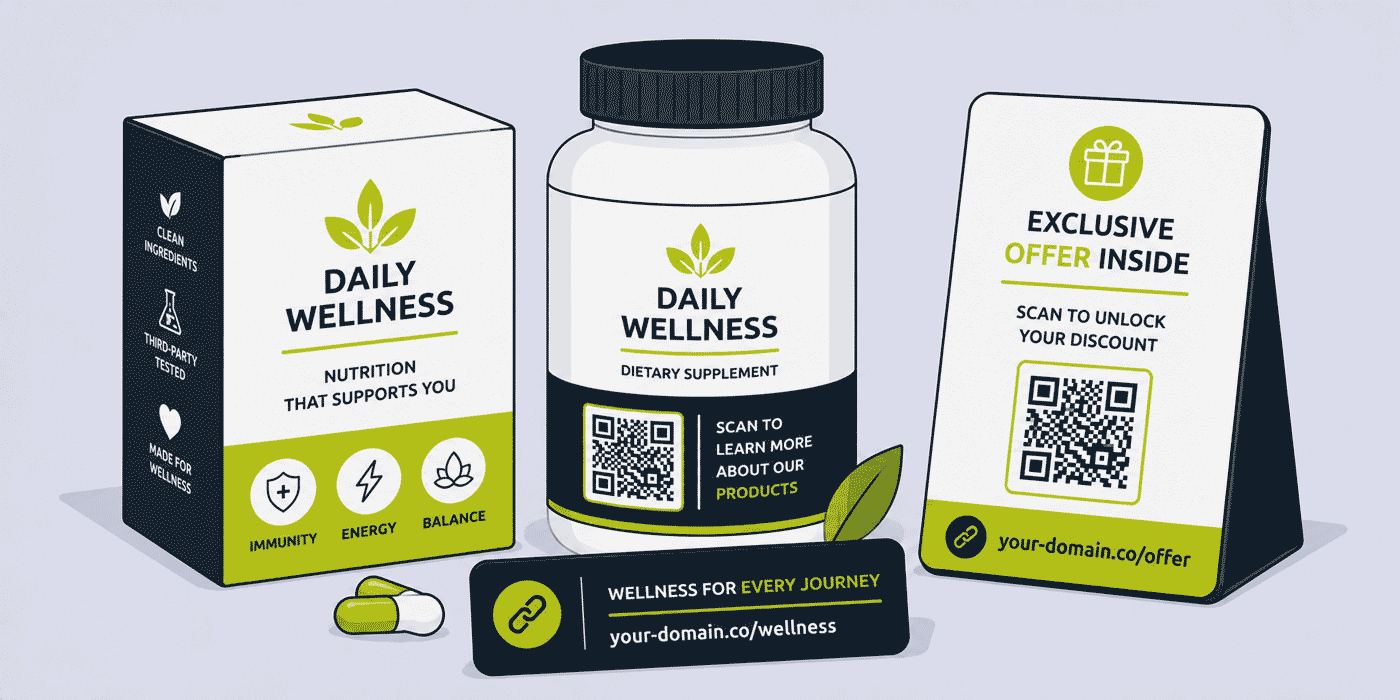
- QR Codes on supplement packaging — the central link management challenge for physical products
- Lab test and certificate of analysis links — transparency and trust building
- Influencer and creator campaign links — per-creator attribution and discount code pairing
- Amazon listing promotion links for supplement brands
- Subscription programme conversion links
- Content marketing and education links — building trust in a compliance-sensitive category
- Retail channel links — pharmacy, health food store, and gym distribution
- Email marketing and lifecycle links
- Per-channel sales attribution across DTC and marketplace
- A worked example: a sports nutrition brand's link stack across a product launch
- Common mistakes in supplement brand link management
- A Cuttly plan guide for supplement and wellness brands
- Frequently asked questions
QR Codes on Supplement Packaging
Product packaging is the most important long-lived link surface for any supplement brand with a physical product. A protein powder tub, a vitamin bottle, a collagen capsule blister pack, or a probiotic pouch is a physical object that a customer handles daily for the thirty to ninety days it takes to consume the product — and that sits visible on a kitchen counter, gym bag, or bathroom shelf throughout that period. A QR Code on that packaging is a link to the brand's digital ecosystem that the customer encounters every day, in a context of active product use and brand engagement.
What Supplement Packaging QR Codes Should Link To
The destination behind a supplement packaging QR Code depends on what the brand most needs at any given moment, and because the destination is dynamic, it can serve different purposes at different stages of the product's lifecycle or the brand's growth priorities:
- Certificate of analysis and lab test results. For supplement brands that publish third-party testing results as a quality and transparency signal — increasingly expected by informed supplement consumers — the packaging QR Code links directly to the current batch's COA. Because lab results are updated with each production batch, a dynamic short link ensures the customer always accesses the most recent results, not those from an older batch printed when the packaging was first designed.
- Full ingredient list and usage guide. Physical packaging has limited space. A QR Code linking to a comprehensive ingredient breakdown, macronutrient profile, serving suggestions, timing recommendations, and stacking guidance gives the consumer access to information that cannot fit on the label itself.
- Subscription sign-up. A customer who has purchased the product once and is enjoying it is a high-conversion target for a subscription offer. A QR Code on the packaging pointing to a subscription sign-up page captures the customer at the moment of highest product satisfaction — when they are actively using the product and are most motivated to ensure they never run out.
- Review request. Near the end of a product's use period, the packaging QR Code can redirect from the general product page to a review request. A customer in the final days of a protein tub who scans the QR Code and is directed to a review page is at peak product experience and in the optimal mindset to leave a detailed, positive review.
- Content hub. Recipe ideas, workout plans, nutritional guidance, and expert content relevant to the product category build the brand's relationship with the consumer beyond the transactional purchase, increasing loyalty and average customer lifetime value.
The Compliance Case for Dynamic QR Codes on Supplement Packaging
Supplement brands face a regulatory consideration that makes dynamic QR Codes particularly important: health claims on supplement packaging are subject to strict advertising standards in most jurisdictions. When regulatory guidance changes — when a permitted claim is updated, when a new health claim is approved or disallowed, or when a market's labelling requirements change — the content the packaging QR Code links to may need to be updated. A dynamic short link behind the QR Code allows the brand to update the linked content immediately to reflect regulatory changes, without reprinting any packaging.
This is particularly relevant for supplement brands expanding into new markets where local health claim regulations differ from the brand's home market. A product sold in the UK, US, and EU simultaneously may need different claims content for each market's regulatory environment; a dynamic short link can route users to the correct market-specific content based on their location, keeping the physical packaging consistent while serving compliant content to each market.
Lab Test and Certificate of Analysis Links
Third-party testing transparency is an increasingly significant competitive differentiator in the supplement market. As consumers become more informed about supplement quality issues — underdosing, contamination, label accuracy failures, heavy metal presence — brands that publish verifiable third-party lab results build trust that competitors without this transparency cannot replicate. The accessibility of these results — how easy they are to find, how clearly they are presented, and whether the QR Code on the product actually links to current results rather than placeholder content — is part of the trust signal.
A per-product COA link — your-brand.com/coa-product-name — maintained dynamically to always point to the most recent batch's test results is the professional standard for this increasingly mainstream supplement quality practice. As new batch results are uploaded, the link destination is updated; every consumer who scans the QR Code on their current purchase accesses results from a recent batch, not results that may be months or years old.
Influencer and Creator Campaign Links
Influencer marketing is the dominant paid acquisition channel for most DTC supplement and wellness brands. The category is a natural fit for creator content: fitness creators demonstrate pre-workout supplements in their training videos, nutritionists explain the benefits of their daily supplement stack, wellness creators integrate adaptogens into their morning routine content, and sports professionals share their recovery supplement protocols. The combination of product demonstration, personal endorsement, and targeted audience reach makes creator partnerships an extremely effective channel for supplement discovery.
Per-Creator Short Links with Discount Code Pairing
The standard structure for supplement influencer campaigns is a per-creator short link paired with a unique discount code:
- Short link:
your-brand.com/creator-namepointing to a creator-specific landing page or the product page with the discount code pre-applied - Discount code:
CREATORNAME10or similar unique code for the same creator
This dual-tracking approach provides two independent data points per creator: the short link's click analytics show how many of the creator's audience engaged with the promotion, and the discount code redemption data shows how many of those who clicked actually made a purchase. The ratio between the two — the click-to-purchase conversion rate per creator — is the most important metric for comparing the commercial efficiency of different creator relationships.
A creator with 500,000 followers whose short link generates 3,000 clicks and whose discount code generates 450 redemptions has a 15% click-to-purchase conversion rate. A creator with 100,000 followers whose link generates 800 clicks and whose code generates 200 redemptions has a 25% conversion rate. The second creator is commercially more efficient despite being smaller, because their audience is more specifically aligned with the supplement category. Per-creator short link and discount code analytics together reveal this efficiency difference; without the short link analytics, the brand would see only code redemption numbers and would not know that the first creator was sending substantially more traffic that was not converting.
Seasonal and Campaign Creator Links
Supplement brands run seasonal campaign moments: New Year's fitness resolution campaigns in January, pre-summer shred campaigns in April and May, Black Friday supplement sale promotions in November. For each campaign period, per-creator links may be updated to point to campaign-specific landing pages rather than the standard product page. Because the short link is dynamic, the creator does not need to update their bio link or video description for the campaign; the brand updates the destination behind the creator's link for the campaign period, and updates it back to the standard product page after the campaign ends.
Amazon Listing Promotion for Supplement Brands
Most supplement brands sell on Amazon alongside or instead of their own DTC website, and driving external traffic to Amazon listings is a standard growth strategy. A branded short link for each Amazon listing — your-brand.com/buy-amazon or your-brand.com/product-name-amazon — replaces the unwieldy Amazon ASIN URL in all external promotion, presenting a branded, professional link while maintaining the ability to track per-channel traffic to the listing.
Directing Packaging QR Traffic to Amazon vs DTC
For supplement brands selling through both Amazon and their own DTC website, the packaging QR Code destination choice has a commercial dimension: Amazon purchases generate lower margin but benefit from Amazon's built-in trust, discovery, and Prime delivery; DTC purchases generate higher margin and build a direct customer relationship but require more consumer trust in the brand's own checkout. A dynamic packaging QR Code link gives the brand the ability to test and optimize this routing decision, and to change it strategically as the brand's growth priorities evolve.
A brand in the early growth phase where Amazon reviews and ranking are a priority might route packaging QR traffic to Amazon; a more established brand with strong DTC infrastructure might route packaging QR traffic to the DTC site to capture higher margins and build its own email list from repeat purchasers. Because the routing is controlled through a dynamic link rather than a printed URL, this strategic decision can be changed without reprinting any packaging.
Subscription Programme Conversion Links
Subscription programmes — subscribe-and-save, monthly delivery, or membership-based supplement clubs — are a significant revenue model in the supplement category because they convert one-time buyers into predictable recurring revenue with high customer lifetime value. Driving one-time purchasers to switch to subscription is one of the highest-ROI marketing activities for most supplement brands, and the links through which this conversion is invited need to be well-managed.
Post-Purchase Subscription Conversion Links
A short link for the subscription sign-up page — your-brand.com/subscribe — is used in:
- Packaging QR Codes (as described above)
- The post-purchase email sequence (typically day 7, day 21, and day 28 of a 30-serving product)
- Influencer content specifically promoting the subscription discount
- SMS reorder reminders sent when the customer is approaching the end of their current product
- Retargeting advertising directed at customers who have purchased once but not subscribed
Click analytics on the subscription link per channel give the brand data on which acquisition channel's customers are most likely to engage with a subscription conversion offer. If email day 21 subscribers generate a significantly higher click rate on the subscription link than day 7 email subscribers, the brand may shift its subscription conversion timing. If packaging QR Code subscribers convert to subscription at a higher rate than email subscribers, the brand knows that the high-intent moment of daily product use is more effective than post-purchase email for subscription conversion.
Content Marketing and Education Links
Supplement brands that invest in educational content — ingredient efficacy guides, dosing protocols, stacking recommendations, product comparison content, nutrition and training advice, and research summaries — build a form of brand equity that advertising alone cannot create. Content-driven supplement brands that become recognized as authoritative sources of information in their niche category achieve significantly better organic discovery, higher customer trust, and lower acquisition costs than those who rely primarily on paid advertising.
Short links for content pieces — your-brand.com/creatine-guide, your-brand.com/whey-vs-casein, your-brand.com/pre-workout-timing — make content shareable, trackable, and stable across website restructurings. When a content piece is shared in a newsletter, in a social media post, in a YouTube video description, or in a reply to a customer question, a clean branded link is more professional and more likely to be clicked than the full blog post URL. Click analytics per content piece show the brand which educational topics generate the most audience engagement, informing the content calendar and the relationship between content engagement and subsequent product purchases.
Retail Channel Links
Many supplement brands sell through retail channels — health food stores, sports nutrition specialists, gyms and leisure centres, pharmacies, and supermarkets — alongside their direct and marketplace channels. Managing links in a retail context involves the same considerations as for any physical retail product: QR Codes on retail shelf displays that point to the brand's product page, ingredient information, or subscription sign-up, promotional leaflets distributed in-store that carry short links to campaign landing pages, and gym partnerships where members are directed to the brand's product through QR Codes in the gym environment.
A per-retail-channel link structure — your-brand.com/buy-instore for general in-store promotions, your-brand.com/buy-gym-name for specific gym partnerships — gives the brand click analytics from retail channels that most supplement companies currently lack entirely, because they have no way of measuring how many in-store customers actually engage with their brand's digital presence after picking up a product from a shelf.
A Worked Example: A Sports Nutrition Brand's Product Launch
Consider a sports nutrition brand launching a new pre-workout formula, using a branded domain such as your-brand.com, connected through Cuttly's custom domain setup (an A record and a TXT record — see the custom domain setup guide).
Pre-launch: The launch campaign link /preworkout-launch goes live two weeks before the product is available, pointing to a "join the waitlist" page. Influencer partners are briefed with their per-creator links: ten creators each receive a unique link (/cr-creator1 through /cr-creator10) pointing to the pre-launch page. The product packaging is printed with a QR Code using /preworkout-info — the packaging QR Code destination before launch points to a teaser page; the destination will be updated to the COA page at launch.
Launch day: /preworkout-launch destination is updated to the product purchase page. /preworkout-info (packaging QR Code) is updated to the COA and ingredient guide page. All creator links are updated to the live purchase page simultaneously. Amazon listing link /buy-amazon-preworkout is created and distributed to creator partners in the US who prefer to promote the Amazon listing.
Day 14 post-launch analysis: Creator link analytics show Creator 4 (170K followers, fitness niche) has generated 1,840 clicks and 312 discount code redemptions — a 17% conversion rate. Creator 7 (450K followers, lifestyle niche) has generated 2,100 clicks but only 89 redemptions — a 4.2% conversion rate. The brand re-negotiates Creator 7's partnership to a content-only arrangement rather than a commercial partnership, and offers Creator 4 a longer-term ambassador deal.
Month 2: The COA for the new batch is uploaded. /preworkout-info destination is updated from the COA for batch 1 to the COA for batch 2. No packaging change. Subscription conversion emails go out at day 21 of the 30-serving product with /subscribe. Click analytics on the subscription link show a 19% open-to-click rate on the day-21 email, higher than the day-7 email's 11%, confirming the timing decision to lead the subscription push at day 21.
Common Mistakes in Supplement Brand Link Management
Static QR Codes on Supplement Packaging
A supplement brand that prints a static QR Code on its packaging encoding a specific URL creates a liability with every production run. Website restructurings, DTC platform migrations, Amazon listing URL changes, and regulatory-driven content updates can all render a static QR Code dead or misdirected within the product's expected retail shelf life. A dynamic short link behind every packaging QR Code eliminates this risk entirely and gives the brand the flexibility to evolve what the packaging QR Code communicates throughout the product's commercial lifecycle.
No Per-Creator Conversion Rate Comparison
A supplement brand running influencer campaigns with many creators but measuring only discount code redemptions — without corresponding click data from per-creator short links — cannot determine which creators are sending high-quality, high-intent traffic and which are sending high volumes of curious but non-converting viewers. The click-to-redemption ratio per creator is one of the most commercially important metrics in supplement influencer marketing, and it requires per-creator short links to calculate.
No Lab Result and COA Link on Packaging
A supplement brand that publishes third-party lab results on its website but does not link to them from its product packaging is missing the most effective placement for this trust-building transparency. A consumer holding the product in their hands and considering whether to trust the brand's quality claims can resolve their uncertainty in two seconds with a packaging QR Code scan. A packaging QR Code that links to current, verifiable third-party lab results is one of the most impactful trust-building elements a supplement brand can deploy.
Cuttly Plan Guide for Supplement and Wellness Brands
- The Free plan ($0) provides 30 short links per month, one branded custom domain, full click analytics and dynamic QR Codes, with no credit card required. Suitable for a small supplement brand setting up core packaging QR Codes, a subscription link, and a first influencer campaign.
- The Starter plan ($12/month) adds 300 short links per month and 30 custom aliases per month — practical for a growing supplement brand managing multiple simultaneous influencer partnerships, per-product packaging QR Codes, per-channel sales attribution, and regular new product and campaign links throughout the year.
- The Single plan ($25/month) adds up to 5 branded domains, fully customizable QR Codes with the brand's visual identity for premium packaging integration, 1,000 API-created links per month for automated per-creator link generation in large influencer programmes, and a full year of analytics history for creator partnership ROI comparison — the most relevant tier for established supplement brands with active multi-creator influencer programmes and multiple SKUs each requiring their own packaging QR Codes.
- The Team plan ($99/month) suits larger supplement groups with marketing, product, e-commerce and DTC teams sharing link management, Campaign tag analytics for aggregated launch campaign performance reporting, multiple branded domains for different supplement brand identities, and shared workspaces across channel management teams.
Create a free Cuttly account to set up your supplement brand's first packaging QR Code, your subscription conversion link, and your first influencer campaign short link. Registration is required for all plans, including free. No credit card is needed for the free plan.
Frequently Asked Questions
How do supplement brands use QR Codes on product packaging?
A supplement brand places QR Codes from dynamic short links on product labels, tubs and bottles — linking to the certificate of analysis, full ingredient guide, subscription sign-up, or a content hub. Because the QR Code is dynamic, the destination updates when formulations change or new lab results are published without reprinting packaging. Click analytics show which products generate the most post-purchase digital engagement.
How do supplement companies use short links for influencer campaigns?
A supplement brand assigns each creator their own short link — your-brand.com/creator-name — paired with a unique discount code. Click analytics per creator link combined with code redemption data gives the brand a click-to-purchase conversion rate per creator, the most actionable metric for comparing influencer campaign ROI in the supplement and wellness category.
How do supplement brands use short links for Amazon listing promotion?
A supplement brand uses branded short links — your-brand.com/buy-amazon — for external traffic campaigns pointing to their Amazon listing rather than sharing raw ASIN URLs. The branded domain is more professional in social and email contexts, and per-channel variants provide attribution data that Amazon Brand Analytics alone cannot provide.
How do wellness product companies use short links for subscription programme promotion?
A supplement brand uses a dedicated short link — your-brand.com/subscribe — in packaging QR Codes, post-purchase email sequences, influencer content, and SMS reorder reminders. Click analytics per channel show which touchpoints drive the most subscription offer engagement, informing subscription conversion timing and channel optimization.
How do supplement brands use short links for third-party lab test results?
A supplement brand creates a short link for each product's COA — your-brand.com/coa-product-name — printed on packaging and linked from the product page. Because lab results update with each batch, a dynamic short link always points to the most current results without packaging reprints. This transparency link is one of the most effective trust-building elements in the supplement category.
- Get Started
- Create Free Account
- Plans & Pricing
- Platform Tools
- URL Shortener
- Link Analytics
- QR Code Generator
- Campaign Analytics
- Related Guides
- URL Shortener for Mental Health Apps
- URL Shortener for Healthcare & Wellness
- URL Shortener for Ecommerce
- URL Shortener for Subscription Boxes
- URL Shortener for Marketplace Sellers
- URL Shortener for Affiliate Links
- Encyclopedia
- Branded Links
- Dynamic QR Codes
- Setup Guides
- Custom Domain Setup
- Track Link Clicks
- Industry Hub
- Healthcare & Medical
- All Industries →
URL Shortener
Cuttly simplifies link management by offering a user-friendly URL shortener that includes branded short links. Boost your brand’s growth with short, memorable, and engaging links, while seamlessly managing and tracking your links using Cuttly's versatile platform. Generate branded short links, create customizable QR codes, build link-in-bio pages, and run interactive surveys—all in one place.
Cuttly - Consistently Rated
Among Top URL Shorteners
Cuttly isn’t just another URL shortener. Our platform is trusted and recognized by top industry players like G2 and SaaSworthy. We're proud to be consistently rated as a High Performer in URL Shortening and Link Management, ensuring that our users get reliable, innovative, and high-performing tools.C


