URL Shortener for Radio Stations The Complete Guide
Radio is the only major broadcast medium where the audience cannot see the link. A television viewer can read a URL on screen. A website visitor can click. A podcast listener can tap a show note. A radio listener hears words and has to remember them, type them later, or act immediately on a mobile device while the presenter moves on to the next sentence. That single constraint shapes almost every decision a radio station makes about how to use short links — and it makes spoken link design a more demanding discipline than in almost any other medium.
This guide covers how radio stations — commercial stations, public broadcasters, community radio, digital-only stations and network groups — use a URL shortener, branded domain, dynamic QR Codes and click analytics for on-air CTAs, listener competitions, sponsor reads, promotional materials, podcast extensions and station app promotion. Each of these use cases has its own design requirements, and this guide covers all of them.
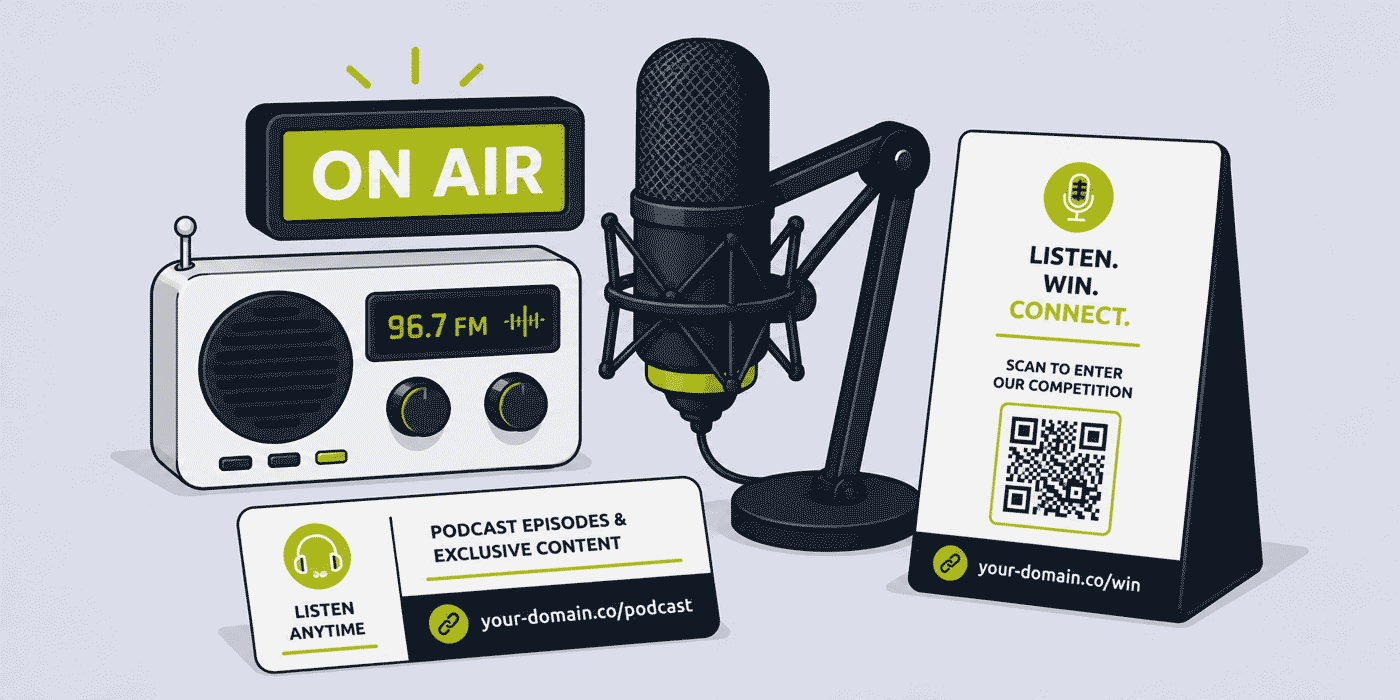
What This Guide Covers
- Why spoken short links require different design principles than links in any other medium
- On-air CTA links — the principles of spoken URL design for maximum listener recall
- Listener competition and prize links — how to structure, track and close competition campaigns
- Sponsor read links — per-sponsor attribution and post-campaign reporting
- Promotional materials — outdoor, social media, station vehicles and event presence
- Podcast extension links — how on-demand versions of radio shows use links differently
- Station app download and streaming links
- Per-show and per-daypart link tracking
- A worked example: a mid-market commercial station's complete link stack
- Common mistakes with on-air links and sponsor tracking
- A Cuttly plan guide for radio stations
- Frequently asked questions
Why Spoken Short Links Require Different Design Principles
When a link is displayed visually — on a screen, in a caption, on a poster — the reader has time to study it, note unusual spellings, and process whether a character is a zero or the letter O, whether a segment is one word or hyphenated, and whether the domain extension is .com or .co. None of this processing is available to a radio listener.
A listener who hears a link on the radio has one pass at it, in real time, while they are doing something else — driving, working, exercising, cooking. They need to either act immediately (reach for a phone, ask a smart speaker) or remember the link long enough to type it later. The more complex the link, the more likely they are to get it wrong or simply not bother.
This creates a set of design principles specific to radio that do not apply to print, visual broadcast or digital contexts:
- Short above all else. A spoken link should be sayable in one breath. If a presenter has to pause in the middle of reading a URL, the link is too long.
- Phonetically unambiguous. No characters that sound alike when spoken: avoid zero versus O, one versus I versus L, five versus file. Where there is any ambiguity, choose a different word or character.
- No hyphens if avoidable. Hyphens are invisible in speech. A listener who hears "go to your-station dot com slash win" will not know whether the slug is "win", "Win" or "W-I-N". Hyphens in the slug itself create the additional problem of the listener not knowing whether a hyphen is present.
- Descriptive enough to remember. A link that tells the listener what they will find is more memorable than a meaningless short code.
your-station.com/winis more memorable thancutt.ly/x7Qz3meven if both are short. - Consistent with what the presenter can say naturally. A link that sounds awkward when read aloud will not be read with the emphasis and clarity that drives listener action. The best on-air links are ones that presenters say naturally, repeatedly, without losing fluency.
These principles apply not just to on-air links but to any link associated with a radio station that may be read aloud — by presenters, by sponsors in ad reads, in station promos, in traffic announcements. The standard for radio link design is higher than almost any other context.
On-Air CTA Links
The on-air call to action is the most frequent and most visible use of short links for any radio station. Whether the CTA is for a listener competition, a sponsor promotion, the station app, a social media page, or a local event, the on-air CTA link is what a listener hears and is asked to act on in real time.
Station Domain vs Generic Short Link
For on-air CTAs, a branded station domain is strongly preferable to a generic short link. A link that reads your-station.com/win communicates the station name, the action and the destination in a single short phrase. A listener who hears it once and then has to type it from memory a few minutes later has a clear reference: the station's own website, followed by the relevant word.
A generic short link such as cutt.ly/aBcDeF fails almost every spoken link design test: it is not descriptive, not memorable, and the character sequence is ambiguous when heard. For on-air CTAs, a generic short link should be reserved only for situations where a branded station domain is not yet set up, and even then, a simple descriptive alias on the generic domain — cutt.ly/station-win — is significantly better than a random character sequence.
Core Station Links
Every radio station should have a small set of permanent, stable core links that presenters mention frequently and that listeners learn over time:
your-station.com/listen— the station's online streaming page or app downloadyour-station.com/app— direct to the app store listing (smart redirect by OS)your-station.com/win— the current competition entry page (destination updated per competition)your-station.com/request— the song request or shout-out pageyour-station.com/contact— the station's contact and messaging page
The power of these permanent core links is that they are dynamic — the destination behind your-station.com/win can be changed from one competition's entry page to the next without the on-air mention changing at all. Presenters always say the same link; what listeners find when they visit changes with each competition.
Listener Competition and Prize Links
Listener competitions are one of the highest-engagement features of commercial radio, and competition links are among the most frequently mentioned on-air CTAs. A well-managed competition link strategy provides the station with measurement that most radio competitions currently lack: how many unique visitors actually visited the competition entry page, which shows or dayparts drove the most entries, and how listener engagement changed over the duration of the competition.
Per-Competition vs Permanent Competition Link
There are two approaches to competition link management, each with different trade-offs. The permanent competition link — your-station.com/win always pointing to the current competition — is simpler to manage and simpler for listeners to remember, because it is the same link every time regardless of which competition is running. The trade-off is that click analytics show total competition engagement but cannot distinguish between different competitions that ran at different times using the same link.
The per-competition link — your-station.com/win-holiday for a holiday giveaway, your-station.com/win-tickets for a concert tickets competition — gives independent analytics per competition, making it possible to compare response rates across competitions and understand which prize types generate the most listener action. The trade-off is that presenters need to remember a new slug for each competition.
The most practical approach for most stations is a hybrid: use your-station.com/win as the primary on-air mention for consistency, but also create per-competition links for any competition that has its own promotional materials (posters, social media graphics, sponsor tie-in) where the separate link provides useful analytics for the station's own reporting and sponsor discussions.
Competition Close and Redirect Strategy
After a competition closes, the entry link should not lead to a dead page or a generic 404 error. Any listener who hears an old mention of the competition link — in a replay, a podcast version of the show, or an old social media post — should land somewhere relevant. Redirecting the closed competition link to the station's current competitions page, or to a "this competition has now closed" page that promotes the next competition, takes thirty seconds in the link dashboard and prevents a permanent dead link from accumulating as competitions run and close throughout the year.
Sponsor Read Links and Advertiser Attribution
Sponsor reads are the primary revenue driver for most commercial radio stations, and the ability to provide sponsors with concrete engagement data beyond reach and audience estimates is an increasingly important competitive advantage for radio advertising sales. A per-sponsor short link is the simplest way to provide this data.
Per-Sponsor Link Structure
For each sponsored segment or advertising campaign, the station creates a short link pointing to the sponsor's designated landing page: your-station.com/sponsor-name or your-station.com/sponsor-campaign-name. This link is included in the sponsor's ad read script, on any digital or social promotion associated with the campaign, and on any printed or outdoor materials the station produces in connection with the sponsorship.
Click analytics for this link — aggregated and anonymized — show how many listeners followed up on the sponsor mention, from which platforms or devices, and how click volume varied across the days and times the sponsorship ran. This data is genuinely useful to sponsors who want to compare radio's performance against their other advertising channels, and to the station's sales team who want to demonstrate the value of their audience beyond the standard audience measurement metrics.
Sponsor-Specific vs Station-Domain Links
For sponsor reads, there is a choice between using the station's own branded domain (your-station.com/sponsor-name) and creating a generic short link (cutt.ly/sponsor-name). The station domain is preferable for trust reasons — a listener who clicks a link from the station's social media or website expects to see the station's domain before being redirected to a sponsor — and for branding consistency. Some sponsors may request that a link to their own domain be used directly, in which case the station's short link simply redirects to that destination as normal.
Post-Campaign Sponsor Reporting
At the end of a sponsorship campaign, the station can share click analytics for the sponsor's short link as part of their campaign report. This adds a concrete digital engagement metric — how many listeners actually clicked through to the sponsor's page — alongside traditional radio measurement metrics such as reach, frequency and audience share. The data is aggregated and anonymized, providing engagement signal without individual listener identification.
Over multiple campaigns, the station builds a dataset of per-sponsor engagement performance that informs pricing discussions, campaign renewal negotiations, and the station's ability to demonstrate radio advertising ROI in a media environment where digital channels dominate engagement measurement conversations.
Promotional Materials: Outdoor, Social Media and Events
Radio stations exist beyond their frequencies. Station branding appears on outdoor billboards, station vehicles, promotional merchandise, event banners, social media profiles and street team materials. Each of these surfaces is an opportunity to use a trackable short link or QR Code, and each has slightly different design considerations.
Outdoor and Billboard Advertising
A station billboard promoting a morning show or a competition typically includes the station frequency and the station name, and increasingly includes a short URL or QR Code. The QR Code on a billboard is scanned by pedestrians and stationary passengers rather than drivers, so it should link to something immediately useful — the station's streaming page, the competition entry form, or a show profile page — rather than a generic homepage.
A dynamic short link behind the billboard QR Code means the destination can be updated when a competition changes, when a show roster changes, or when a seasonal campaign ends — without reprinting the billboard. For station vehicles in particular, where a QR Code may be on a van or car for several years, a dynamic link behind any vehicle QR Code is the difference between a permanently relevant touchpoint and a link that breaks the first time the station restructures its website.
Social Media Profile Links
A radio station's social media profiles — on Instagram, TikTok, Facebook, LinkedIn and X/Twitter — each allow one link in the profile or bio. A Link in Bio page at your-station.com/links turns this single bio link into a page of trackable destinations: Listen Live, App Download, Current Competition, Morning Show, Requests. Each button on the Link in Bio page is its own tracked link, so the station can see which destination listeners most want to reach from social media.
Event and Street Team Materials
At outside broadcasts, remote events, festival appearances and street team activations, station staff hand out printed materials and merchandise that may include short links or QR Codes. A QR Code on a flyer handed out at a summer festival — linking to the station's streaming page or current competition — can generate click analytics showing how many festival attendees engaged with the material after the event, which the station's events team can use to evaluate the reach of their physical presence beyond what they can observe on the day.
Podcast Extension Links
Most radio stations now produce podcast versions of their shows, whether as full re-broadcasts of live programming or as purpose-made podcast content. Podcast listeners interact with links differently from radio listeners: they are almost always using a mobile device in podcast app context, they can tap links in show notes directly, and they are listening on-demand rather than in real time. This changes the design requirements substantially.
Show Notes Links
Podcast show notes are the primary link surface for radio station podcasts. Unlike on-air spoken links, show note links can be longer and more descriptive, because the listener taps rather than types. Per-episode links — your-station.com/ep-date-sponsor — allow the station to track engagement with each episode's associated content and sponsor links independently from the live broadcast version of the same content.
For radio shows that run the same sponsor across both the live broadcast and the podcast re-broadcast, separate links for each version allows the station to compare live versus on-demand engagement for the same sponsor mention — a comparison that can be genuinely valuable in sponsor reporting, particularly as podcast advertising rates and radio advertising rates are discussed in the same conversation with advertisers who run across both.
Spoken Links in Podcast Content
Purpose-made radio station podcasts that include spoken sponsor reads follow the same design principles as on-air spoken links, with one important difference: podcast listeners can pause, rewind and immediately tap a link in show notes. A spoken link in a podcast can therefore be slightly less memorable than a pure on-air link, as long as the show notes contain the tappable equivalent. The spoken link still matters — listeners who are commuting or exercising may hear the mention before they access show notes — but the safety net of show notes makes podcast link design slightly more forgiving than live radio.
Station App and Streaming Links
A station's app download link and streaming page link are the highest-priority permanent links for most radio operations, because they directly support the station's audience development goals. Getting a listener who discovered the station through a digital channel or an event to download the station's app or bookmark the streaming page is the conversion event that turns a casual listener into a regular.
A branded short link for the app download — your-station.com/app — can use a device-detection smart redirect to send iPhone users to the App Store and Android users to Google Play from the same link. This single link can be mentioned on-air, placed in social media bios, printed on promotional materials and included in email newsletters, with all traffic tracked in one place rather than managed as two separate platform-specific links.
Per-Show and Per-Daypart Analytics
One of the most underused capabilities available to radio stations using short links is per-show audience engagement comparison. By using separate short links for the same destination across different shows — your-station.com/morning-win mentioned in the breakfast show, your-station.com/drive-win mentioned in the drive show, both pointing to the same competition entry page — the station can see which shows generate the most listener action from on-air CTAs, independent of which shows have the largest audiences by reach measurement alone.
This per-show engagement data is valuable in several contexts: scheduling decisions about where to place highest-value competition promotions, demonstrating the engagement performance of specific shows to advertisers, and comparing how different presenter styles or formats affect listener follow-through on CTAs. It is a layer of audience intelligence that audience measurement panels and streaming play counts do not provide.
A Worked Example: A Mid-Market Commercial Station
Consider a mid-market commercial radio station using a branded domain your-station.com (the station's own website domain or a dedicated short domain), connected through Cuttly's custom domain setup (an A record and a TXT record — see the custom domain setup guide).
The station's five permanent core links are /listen, /app, /win, /request, and /contact. These are stable; presenters say them so often they are second nature. The Link in Bio page at /links aggregates all five for social media profiles.
Each quarter the station runs a major competition. Rather than changing what presenters say, the team simply updates the destination behind /win to point to each new competition's entry form. For reporting purposes, they also create a parallel per-competition link — /win-q3-holiday — included in social media posts and email newsletter mentions of the competition. Comparing clicks on /win (driven by on-air mentions) with clicks on /win-q3-holiday (driven by digital channels) gives the programming and marketing teams a channel breakdown of competition entry traffic without any additional tools.
For sponsors, each campaign gets its own link: /sponsor-car-brand, /sponsor-supermarket. At the end of each campaign, the sales team includes a one-page engagement report showing total clicks, device split, and peak engagement days alongside the standard audience delivery report. Three sponsors have cited this reporting in renewal conversations as a factor in their decision to extend.
The station's morning show podcast, posted weekly, uses per-episode show notes with links structured as /ep-DATE for episode-specific resources and per-sponsor links that are distinct from the live broadcast versions. Six months of episode analytics show that podcast sponsor link click rates are running at 2.3x the equivalent on-air sponsor link click rate for the same sponsor, a finding the sales team is using in conversations about podcast advertising pricing.
Common Mistakes With Radio Station Links
Using Random-Character Generic Short Links On-Air
The most common link mistake in radio is reading a generic short link — a random-character URL from a free shortener — on-air. These links fail every spoken link design test: they are not descriptive, phonetically ambiguous, and impossible to remember. Any link that will be spoken on-air should use a branded station domain with a clear, descriptive slug. No exceptions.
Using the Same Link for All Shows and All Competitions
A single competition link used across every show and every competition conflates all listener action into one undifferentiated number. The station cannot tell which show drove the most entries, which competition type generated the most response, or whether their digital promotion or on-air mentions were responsible for traffic. The cost of fixing this is low: one additional short link per show or per competition. The value of fixing it is a dataset that directly informs programming, marketing and sales decisions.
Not Redirecting Closed Competition Links
A competition link that points to a closed entry form or a 404 page after a competition ends is a persistent dead link in every replay, podcast episode and social media post that mentioned it. Redirecting the link to the station's current competitions page after each competition closes takes under a minute and ensures that every historical reference to that link remains useful indefinitely.
Cuttly Plan Guide for Radio Stations
- The Free plan ($0) provides 30 short links per month, one branded custom domain, full click analytics, dynamic QR Codes and a Link in Bio page, with no credit card required. Sufficient for a small community or digital station setting up core permanent links and one or two competition links per month.
- The Starter plan ($12/month) adds 300 short links per month and 30 custom aliases per month — practical for a commercial station running multiple competitions, a weekly podcast with per-episode links, and several sponsor campaign links simultaneously.
- The Single plan ($25/month) adds up to 5 branded domains, customizable QR Codes with the station logo and brand colors, 1,000 API-created links per month and a full year of analytics history — relevant for stations managing multiple brands (e.g. AM and FM under the same group), producing branded QR Codes for event materials, or wanting long-term analytics history for sponsor reporting.
- The Team plan ($99/month) suits radio network groups with multiple stations sharing link management infrastructure, Campaign tag analytics for aggregated reporting across station brands, multiple branded domains per station, and shared workspaces for programming, marketing and sales teams.
Create a free Cuttly account to set up your station's core on-air links, your first competition link and your social media Link in Bio page. Registration is required for all plans, including free. No credit card is needed for the free plan.
Frequently Asked Questions
What makes a good spoken short link for radio?
A good spoken short link for radio is short enough to be said in one breath, uses only letters and numbers that are unambiguous when heard rather than seen, avoids hyphens where possible, and describes the destination clearly enough that a listener who cannot immediately access it can remember it until they are able to type it. Links like your-station.com/win or cutt.ly/contest are more effective than longer or more cryptic alternatives.
How do radio stations track which sponsors drive the most listener action?
A radio station creates a separate short link for each sponsor read — for example your-station.com/sponsor-name — pointing to that sponsor's landing page. Click analytics for each link, aggregated and anonymized, show how many listeners followed up on each sponsor mention. This gives the station's sales team concrete engagement data to share with sponsors as part of campaign reporting.
Can a radio station use the same short link across multiple shows?
A station can use the same short link across all shows for general destinations like the station website or app download page. For tracking which shows drive the most listener action, a per-show short link — your-station.com/morning-show, your-station.com/drive-time — each pointing to the same destination gives independent analytics per show.
How do radio stations use short links for listener competitions?
A short link for a listener competition — your-station.com/win or cutt.ly/competition-name — is read on-air, displayed on the station's social media and website, and printed on any associated promotional materials. Click analytics show how many listeners engaged with the competition link per day and from which platforms, helping the station understand which competitions generate the most listener response.
How do radio podcasts use short links differently from live radio?
Podcast extensions of radio shows use short links in show notes rather than purely on-air mentions, because podcast listeners can tap a link in their podcast app directly. Podcast links can be slightly longer and more descriptive than on-air spoken links, and can include per-episode sponsor links tracked independently from the live show equivalent. This lets the station compare on-air versus on-demand listener engagement for the same sponsor separately.
- Get Started
- Create Free Account
- Plans & Pricing
- Platform Tools
- URL Shortener
- Link Analytics
- QR Code Generator
- Link in Bio Builder
- Survey Tool
- Related Guides
- URL Shortener for TV Broadcasters
- URL Shortener for Streaming Services
- URL Shortener for Podcasters
- URL Shortener for Magazines
- Short Links for Offline Campaigns
- Short Links for Social Media
- Encyclopedia
- Branded Links
- Link in Bio
- Setup Guides
- Custom Domain Setup
- Track Link Clicks
- Industry Hub
- Media & Broadcasting
- All Industries →
URL Shortener
Cuttly simplifies link management by offering a user-friendly URL shortener that includes branded short links. Boost your brand’s growth with short, memorable, and engaging links, while seamlessly managing and tracking your links using Cuttly's versatile platform. Generate branded short links, create customizable QR codes, build link-in-bio pages, and run interactive surveys—all in one place.
Cuttly - Consistently Rated
Among Top URL Shorteners
Cuttly isn’t just another URL shortener. Our platform is trusted and recognized by top industry players like G2 and SaaSworthy. We're proud to be consistently rated as a High Performer in URL Shortening and Link Management, ensuring that our users get reliable, innovative, and high-performing tools.C


