URL Shortener for Magazines The Complete Guide
A magazine exists simultaneously in two worlds: the physical world of the printed page, where readers engage slowly and deeply with long-form content, and the digital world where that same content is extended, supplemented, made interactive, and connected to a community of readers who continue the conversation online. The link between these two worlds — literally and commercially — is the URL. A QR Code on a print feature that links to an extended online version, a subscription offer on a house ad page, an advertiser link that brings a print advertisement to digital life, a newsletter sign-up invitation at the back of the issue — each of these is a moment where a reader's engagement with the physical magazine can be extended into a digital relationship that generates ongoing commercial value.
This guide covers how print and digital magazines — consumer magazines, trade publications, specialist interest titles, regional and national magazines, and digital-native publications with print editions — use a URL shortener, branded custom domain, dynamic QR Codes and click analytics across print-to-digital reader journeys, subscription campaigns, advertiser link management, newsletter building, content promotion across social and email, and the full range of link management needs for a media brand operating across print and digital channels simultaneously.
What This Guide Covers
- Print-to-digital QR Codes — the magazine's physical-to-digital bridge
- Subscription campaign links — per-channel acquisition attribution
- Advertiser campaign links — demonstrating print's digital engagement contribution
- Newsletter and owned reader asset links
- Per-article and per-issue content promotion links
- Social media content link management
- Event and live journalism links for magazine brands with event programmes
- Long-life print issue link resilience
- A worked example: a consumer magazine's link infrastructure across a quarterly issue cycle
- Common mistakes in magazine link management
- A Cuttly plan guide for magazines
- Frequently asked questions
Print-to-Digital QR Codes: The Magazine's Physical-to-Digital Bridge
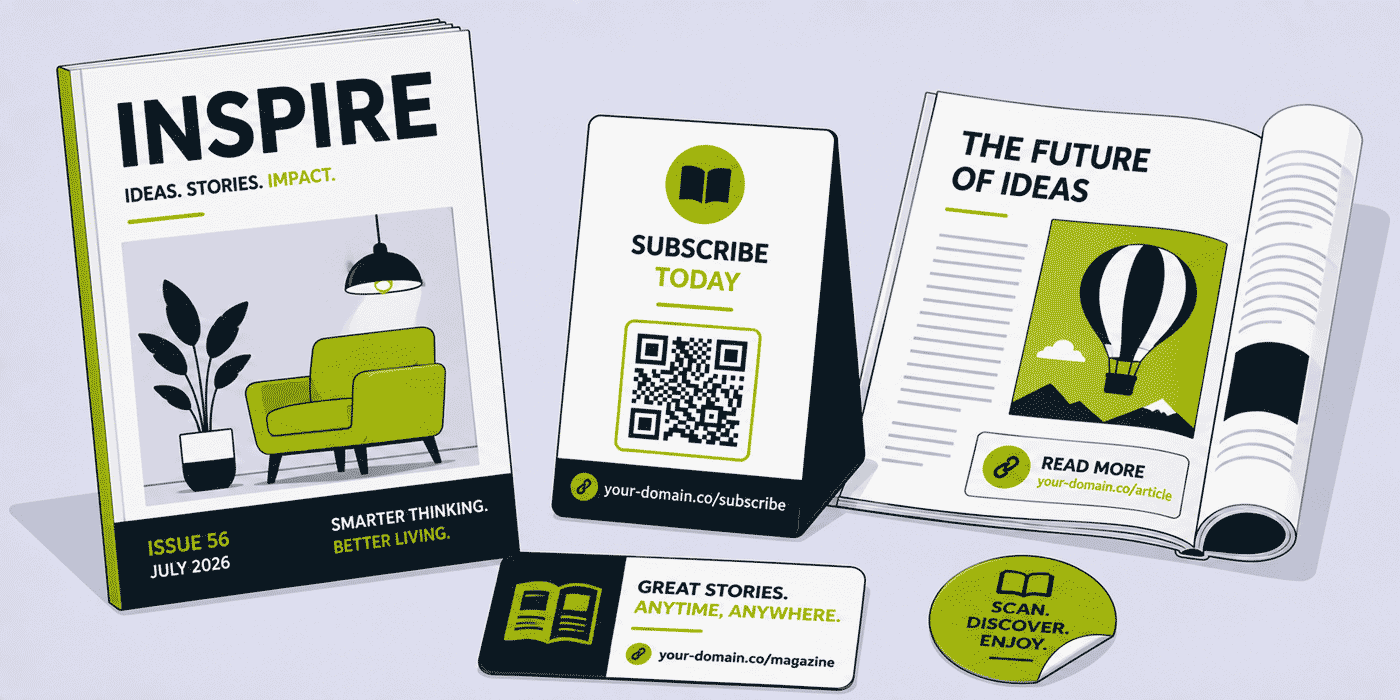
The print magazine page has a physical constraint that the digital article does not: space. A feature article in a print magazine may be 2,000 words on paper; the extended online version may run to 5,000 words with embedded video, additional photography, interactive data visualisations, and a reader comments section. A QR Code at the end of the print article — "Read the full investigation online" — bridges this constraint, extending the print reader's engagement with the editorial content into the digital environment where the full experience is available.
What Print QR Codes Should Link To
The destination behind a print QR Code should be chosen with the reader's context in mind. A reader who pauses while reading a print magazine and scans a QR Code has made an active choice to go deeper; the destination should reward that choice immediately:
- Extended article content. The full version of a feature that ran in condensed form in print. The short link —
your-magazine.com/article-title— takes the reader directly to the extended digital article, not the magazine's homepage where they must find the article again. - Video companion content. For features that are accompanied by a documentary short, an interview recording, or a how-to video that cannot exist in print, a QR Code taking the reader directly to the video is one of the highest-value print-to-digital extensions available. Short link:
your-magazine.com/video-feature-name. - Reader competition entry. Competition entry in print magazines — where a reader sends in a postcard or completes a coupon — is increasingly supplemented or replaced by online entry via QR Code. Short link:
your-magazine.com/competition-name. - Subscription offer. A house advertisement in the magazine promoting a subscription offer, with a QR Code providing an instant path to the subscription page. Short link:
your-magazine.com/subscribeoryour-magazine.com/offer-month. - Advertiser landing pages. Print advertisements that include a QR Code — either publisher-managed or advertiser-managed — linking to an advertiser's campaign landing page. Short link managed on the publisher's domain:
your-magazine.com/ad-brand-name.
The Long-Life Print Issue Challenge
A print magazine has a significantly longer effective life than most printed materials. A monthly consumer magazine may be read by the subscriber in the month of issue but then kept in a reading pile, passed to a friend, placed in a waiting room, or left at a holiday cottage for months or years afterwards. The QR Codes in that issue need to remain functional throughout this entire extended readership period, which may be several years for a well-produced specialist magazine.
Dynamic QR Codes are essential for print magazines precisely because of this long readership life. The magazine's website will be restructured. The CMS will migrate. Article URLs will change format. The subscription platform will change. The competition entry system will be replaced. Each of these changes — all of which are routine in any media business operating across a five to ten year period — would break static QR Codes from issues published before the change. Dynamic QR Codes, whose destinations can be updated to reflect the current state of the magazine's digital infrastructure, remain functional regardless of how many infrastructure changes occur between the issue's publication date and the moment a reader scans the code.
Subscription Campaign Links
Subscription revenue is the most commercially stable and financially valuable income stream for most magazines. A subscriber who commits to a twelve-month subscription is worth significantly more than a single-copy buyer, generates predictable revenue that supports editorial planning, and represents a loyal reader whose engagement with the brand extends beyond transactional newsstand purchasing. Growing subscription numbers is therefore one of the most important commercial objectives for any magazine, and the links in subscription campaigns are the primary mechanism through which this growth is pursued.
Per-Channel Subscription Attribution
A magazine acquiring new subscribers through multiple channels creates per-channel attribution links for its subscription offers:
your-magazine.com/sub-email— email campaign to non-subscriber readers and prospectsyour-magazine.com/sub-social— social media promotion of subscription offersyour-magazine.com/sub-print— house advertisement pages in print issuesyour-magazine.com/sub-podcast— podcast sponsorships or host-read mentionsyour-magazine.com/sub-affiliate— affiliate and comparison site promotions
All pointing to the same subscription offer page. Click analytics per channel give the circulation team independent subscription page traffic data per source. Over multiple subscription campaigns and multiple issues, the pattern reveals which channels send readers who convert to paid subscribers versus which generate click-through from casual readers who browse the offer but do not commit.
For a magazine that has traditionally invested heavily in print house ad subscription promotion, per-channel attribution data may reveal that email campaigns to the newsletter list convert to subscribers at three times the rate of print house ad QR Code scans — not because print is ineffective, but because the email audience is already a committed reader and the print QR Code audience may include casual browsers who are not yet committed to the magazine. This per-channel intelligence is worth significantly more than its operational cost to generate.
Offer-Specific Subscription Links
Magazines typically run different subscription offers at different times of year: a new year's welcome offer, a summer reading offer, a Christmas gift subscription campaign, and an early renewal incentive for existing subscribers approaching renewal. Each campaign benefits from its own short link pointing to a campaign-specific offer page:
your-magazine.com/christmas-gift— Christmas gift subscription campaignyour-magazine.com/new-year-offer— January new year's reading resolution offeryour-magazine.com/summer-read— summer reading promotion
When the campaign closes, the link redirects to the standard subscription offer rather than a dead campaign page. A reader who bookmarked the Christmas gift link in October to send to a friend in November reaches the current subscription offer rather than an expired campaign.
Advertiser Campaign Links
Magazine advertising is facing an ongoing challenge from the inability to measure print advertising's direct commercial impact with the same precision that digital advertising offers. A brand that places a full-page print advertisement in a magazine with a circulation of 80,000 knows approximately how many people are exposed to the advertisement, but has traditionally had no way of measuring how many actually engaged with it — visited the advertiser's website, searched for the brand, or made a purchase — as a direct result of the print placement.
A QR Code or short URL in the print advertisement that uses a branded publisher-domain short link — rather than the advertiser's own tracking URL — gives the magazine publisher a credible claim on the engagement data that demonstrates the print advertisement's digital contribution. Click analytics on the advertisement's short link, aggregated and anonymized, show how many print readers engaged with the advertiser's content. This is genuinely novel data for most print advertisers, and it represents a commercial argument for the magazine's advertising value that supplements traditional reach and readership metrics.
Publisher-Managed Advertiser Links
A magazine's commercial team provides each advertiser with a short link on the magazine's branded domain — your-magazine.com/ad-brand-name — for inclusion in their print advertisement. This link points to the advertiser's chosen campaign landing page. The magazine's analytics show the advertiser how many readers engaged with their advertisement digitally; the advertiser's own analytics show what those visitors did on their website.
This data is commercially valuable to the advertiser because it shows the print advertisement's digital contribution to website traffic, a metric that is increasingly important to brand marketers who need to demonstrate cross-channel ROI to their CFOs. It is also commercially valuable to the magazine because it provides empirical evidence of print advertising's engagement value — a genuinely important contribution to the magazine's commercial proposition in an advertising market that has shifted significantly toward digital performance metrics.
Newsletter and Owned Reader Asset Links
A magazine's email newsletter list is its most commercially resilient owned asset. Social media algorithms change; search engine ranking fluctuates; newsstand distribution costs increase. None of these changes affects a magazine's ability to send its newsletter to an engaged subscriber who has opted in to receive it. Building and maintaining a large, engaged newsletter audience is therefore one of the most important long-term strategic investments any magazine can make.
A permanent short link for the newsletter sign-up — your-magazine.com/newsletter — features across every reader touchpoint:
- A dedicated page in each print issue: "Get our weekly digital newsletter — sign up at your-magazine.com/newsletter"
- A QR Code in the print issue's inside back cover or table of contents
- Every social media bio and regularly in social media posts
- Every email footer sent to single-copy digital readers
- Any podcast sponsorship or editorial mention on other media platforms
Click analytics on the newsletter sign-up link per placement context show the editorial and commercial teams which touchpoints are most effective at growing the newsletter audience. If the print QR Code consistently generates more newsletter sign-ups per month than the social media bio link, the magazine knows that its print audience is a more committed reader base than its social media follower base — information that is directly relevant to editorial strategy and to the commercial case for maintaining print publication.
Per-Article and Per-Issue Content Promotion
A magazine produces a significant volume of editorial content each issue, and much of that content has genuine discoverability and commercial value beyond the pages of the magazine itself. A feature investigation that took two months to research, a cover interview with a significant public figure, a deep-dive into a topic of genuine public interest — each of these has an audience beyond the magazine's existing subscribers, and reaching that audience through digital promotion expands both the magazine's readership and its brand authority.
Per-Article Short Links
A short link per significant article — your-magazine.com/article-title — used in all social media promotion of that piece, in email newsletters that feature it, in any press or media coverage of the article's findings, and in the print issue itself as a reference to the extended digital version, gives each piece a consistent, shareable reference that is stable across any website migration or URL structure change.
The most common reason article promotion links fail is URL structure changes during CMS migrations. A magazine that has been building its content archive for ten years and has migrated its CMS twice in that period has almost certainly broken some or many of its historically promoted article links. A short link for each article, updated when the URL changes, ensures every historically promoted piece continues to be accessible regardless of backend infrastructure changes.
Per-Issue Links
A short link for each issue's digital edition or issue preview — your-magazine.com/issue-month-year — used in new issue announcement communications gives the circulation team a consistent, trackable reference for each issue's launch promotion. Click analytics per issue link show the team which issues generated the most pre-purchase preview engagement and which promotional channels drove the most issue interest. Over multiple issues, the pattern reveals which cover stories, cover designs, and promotional approaches generate the most reader engagement from each channel.
A Worked Example: A Consumer Magazine's Quarterly Issue Link Infrastructure
Consider a consumer lifestyle magazine published quarterly in print and updated weekly digitally, with 45,000 print circulation, 92,000 digital edition subscribers, and a newsletter list of 180,000, using a branded domain such as your-magazine.com, connected through Cuttly's custom domain setup (an A record and a TXT record — see the custom domain setup guide).
New issue launch (quarterly): Each quarterly issue has its own short link set: /issue-summer-2026 (issue overview page), /sub-summer-offer (subscription campaign for the issue), and per-article links for the six most significant editorial pieces. The summer issue's cover investigation — a major piece on sustainable fashion — generates 34,000 clicks on its article short link over six weeks, 72% of which come from social media sharing and press coverage of the investigation's findings. The piece is the magazine's most-clicked editorial content of the year.
Print QR Code programme: The summer issue carries eight QR Codes: three for extended article content, one for a reader competition, two for advertiser landing pages, one for the newsletter sign-up, and one for the subscription offer. After three months in circulation (the issue remains available in waiting rooms, on newsagents' shelves, and in readers' homes): the extended article QR Codes generate an aggregate 8,400 scans, the competition QR Code generates 2,100 entries (compared with 340 postal entries in the previous year's equivalent competition — confirming the shift in reader behaviour), and the subscription QR Code generates 180 new subscribers. These 180 subscribers, acquired at essentially zero additional marketing cost beyond the QR Code design, represent significant subscription revenue over their expected subscription lifetime.
Advertiser link case study: A luxury skincare brand places a full-page print advertisement in the summer issue with a short link — /ad-skincare-brand — in the advertisement creative. Over twelve weeks: 1,840 clicks from print readers to the advertiser's campaign landing page. The advertiser's post-campaign report, which previously showed only digital channel attribution, now includes the magazine's print engagement data as a separately measured channel. The print contribution justifies a larger advertising commitment for the following year's programme.
Common Mistakes in Magazine Link Management
Static QR Codes in Print Issues
A magazine that uses static QR Codes in its print issues — encoding destination URLs directly — creates a link maintenance problem that compounds with every website change, every CMS migration, and every URL restructuring. Given that print issues remain in circulation for months to years after publication, a static QR Code that worked on publication day may be pointing to a dead or misdirected URL within six months. Dynamic QR Codes in all print issues are the only professionally appropriate approach for a publication that takes its reader experience seriously across the full life of each printed issue.
No Print Advertising Engagement Data
A magazine that sells print advertising without providing advertisers with any digital engagement measurement from their print placements is missing a commercial argument that is increasingly important in advertising conversations. Adding a publisher-managed short link to every print advertisement costs negligible operational effort and provides the advertiser with genuine cross-channel engagement data. This data strengthens the commercial case for print advertising at a time when print advertising investment is under pressure from purely digital alternatives.
No Per-Channel Subscription Attribution
A magazine that acquires subscribers through multiple channels without per-channel attribution links cannot measure which acquisition channels deliver the best cost-per-subscriber. Given that subscription marketing budgets are always constrained, the difference between a channel that delivers subscribers at £8 per acquisition and one that delivers them at £28 per acquisition is commercially significant. Per-channel short links for subscription campaigns provide this data with minimal additional operational investment.
Cuttly Plan Guide for Magazines
- The Free plan ($0) provides 30 short links per month, one branded custom domain, full click analytics and dynamic QR Codes, with no credit card required. Suitable for a small independent magazine setting up core subscription, newsletter, and per-issue QR Code links.
- The Starter plan ($12/month) adds 300 short links per month and 30 custom aliases per month — practical for an active magazine managing per-article content links, per-issue QR Code sets, per-channel subscription attribution, advertiser campaign links, and newsletter growth links throughout the publishing cycle.
- The Single plan ($25/month) adds up to 5 branded domains for magazine groups with multiple titles, fully customizable QR Codes for professional print issue integration, 1,000 API-created links per month for automated per-article link generation, and a full year of analytics history for issue-by-issue and article-by-article content performance comparison.
- The Team plan ($99/month) suits larger magazine publishers with editorial, commercial, circulation, and digital teams sharing link management, Campaign tag analytics for aggregated content and subscription campaign reporting, and multiple branded domains for different magazine titles within a publisher's portfolio.
Create a free Cuttly account to set up your magazine's subscription campaign links, your print issue QR Codes, and your newsletter sign-up link. Registration is required for all plans, including free. No credit card is needed for the free plan.
Frequently Asked Questions
How do magazines use QR Codes in print issues?
A magazine places QR Codes from dynamic short links in print editions linking to extended article content, video companions, competition entries, subscription offers, and advertiser landing pages. Because print issues remain in circulation for months to years, dynamic QR Codes ensure every link remains functional regardless of how many website or platform changes occur after publication. Click analytics from print QR Codes provide engagement data that print-only measurement cannot deliver.
How do magazines use short links for subscription campaigns?
A magazine creates per-channel subscription attribution links — email, social, print, podcast, affiliate — all pointing to the same subscription offer page. Click analytics combined with conversion data reveal which channels deliver the lowest cost per new subscriber. Dynamic links ensure every historical promotion continues to reach the current offer page through any subscription platform migration.
How do magazines use short links for advertiser campaigns?
A magazine provides advertisers with publisher-managed short links — your-magazine.com/ad-brand-name — for inclusion in print advertisements. Click analytics on these links demonstrate the print advertisement's digital reader engagement contribution, providing cross-channel ROI evidence that strengthens the commercial case for print advertising investment in an increasingly digital advertising market.
How do magazines use short links for newsletter growth?
A magazine features a permanent newsletter sign-up short link across all reader touchpoints: print issues, social media bios, email footers, and podcast mentions. Because the newsletter is the magazine's most algorithm-resilient owned asset, consistent newsletter sign-up link visibility across channels is a strategic priority. Click analytics per placement context show which touchpoints most effectively convert casual readers into committed newsletter subscribers.
How do magazines use short links for per-article and per-issue content promotion?
A magazine creates a short link per significant article and per issue — stable across any CMS migration — used in social media, email newsletters, and press coverage of the magazine's editorial work. Per-article click analytics show the editorial team which content topics generate the most reader engagement from each promotion channel, informing future editorial planning with audience engagement data rather than intuition alone.
- Get Started
- Create Free Account
- Plans & Pricing
- Platform Tools
- URL Shortener
- Link Analytics
- QR Code Generator
- Survey Tool
- Related Guides
- URL Shortener for Podcasting Networks
- URL Shortener for TV Broadcasters
- URL Shortener for Radio Stations
- URL Shortener for Book Authors
- URL Shortener for Literary Publishers
- Encyclopedia
- Dynamic QR Codes
- Branded Links
- Setup Guides
- Custom Domain Setup
- Track Link Clicks
- Industry Hub
- Media & Broadcasting
- All Industries →
URL Shortener
Cuttly simplifies link management by offering a user-friendly URL shortener that includes branded short links. Boost your brand’s growth with short, memorable, and engaging links, while seamlessly managing and tracking your links using Cuttly's versatile platform. Generate branded short links, create customizable QR codes, build link-in-bio pages, and run interactive surveys—all in one place.
Cuttly - Consistently Rated
Among Top URL Shorteners
Cuttly isn’t just another URL shortener. Our platform is trusted and recognized by top industry players like G2 and SaaSworthy. We're proud to be consistently rated as a High Performer in URL Shortening and Link Management, ensuring that our users get reliable, innovative, and high-performing tools.C


