URL Shortener for Food Trucks: The Complete Guide
Food trucks are one of the most social-media-native businesses in existence. The business model runs on visibility: people need to know where you are today, what you are serving, and why they should queue at your window rather than walking past. Instagram and TikTok are the primary discovery channels for most food trucks — the visual format suits the product, the content is naturally shareable, and the algorithm rewards consistent posting in a way that benefits small operations willing to invest time rather than money. But social media reach without a reliable mechanism to convert that reach into actual customer visits is awareness without ROI. This guide covers how food truck owners use branded short links, QR Codes, and link analytics to bridge the gap between social media visibility and the queue of people standing in front of their window.
What This Guide Covers
- The food truck marketing challenge: mobile, social-first, location-dependent
- The menu QR Code: the highest-value physical link
- Location schedule links: sharing where you are without changing the URL
- Instagram and TikTok: Link in Bio for social-first food trucks
- Vehicle wrap QR Code: your most permanent marketing surface
- Event and festival promotion
- Corporate and private catering enquiries
- Google Reviews: the food truck's most powerful trust signal
- Loyalty and repeat customer engagement
- Measuring which channels bring customers to the window
- Packaging and serving surface QR Codes
- Which Cuttly plan is right for a food truck
The Food Truck Marketing Challenge
A food truck's marketing challenge is structurally different from a fixed-location restaurant. A restaurant has a permanent address — customers can find it, review it on Google Maps, bookmark it, and come back reliably. A food truck moves. Its value proposition is partly that mobility — being at the right location at the right time for the right audience — but that same mobility creates a communication problem: how do customers know where you are today?
The answer is almost always Instagram. Most food trucks build their customer communication model around Instagram (or TikTok for trucks targeting younger audiences) — posting their location schedule, today's menu, and any last-minute changes. Followers get location updates in their feed or stories. But the conversion gap remains: the post says "we're at X location today" but the follower has to navigate from Instagram to a maps app or a website to find the exact spot, or the post includes a URL they have to type out. The friction between awareness ("I see they're near me today") and action ("I'm going to go") is where food trucks lose customers who intended to visit but didn't get around to it.
Branded short links close parts of this gap. A single, stable branded URL — go.truckname.com/location — shared in every post and in every physical material routes to the current location pin or schedule. That URL never changes; the destination behind it does. A customer who has saved the URL in their phone or bookmarked it from a previous visit can check it any time without needing to find the latest post.
The Menu QR Code: The Highest-Value Physical Link
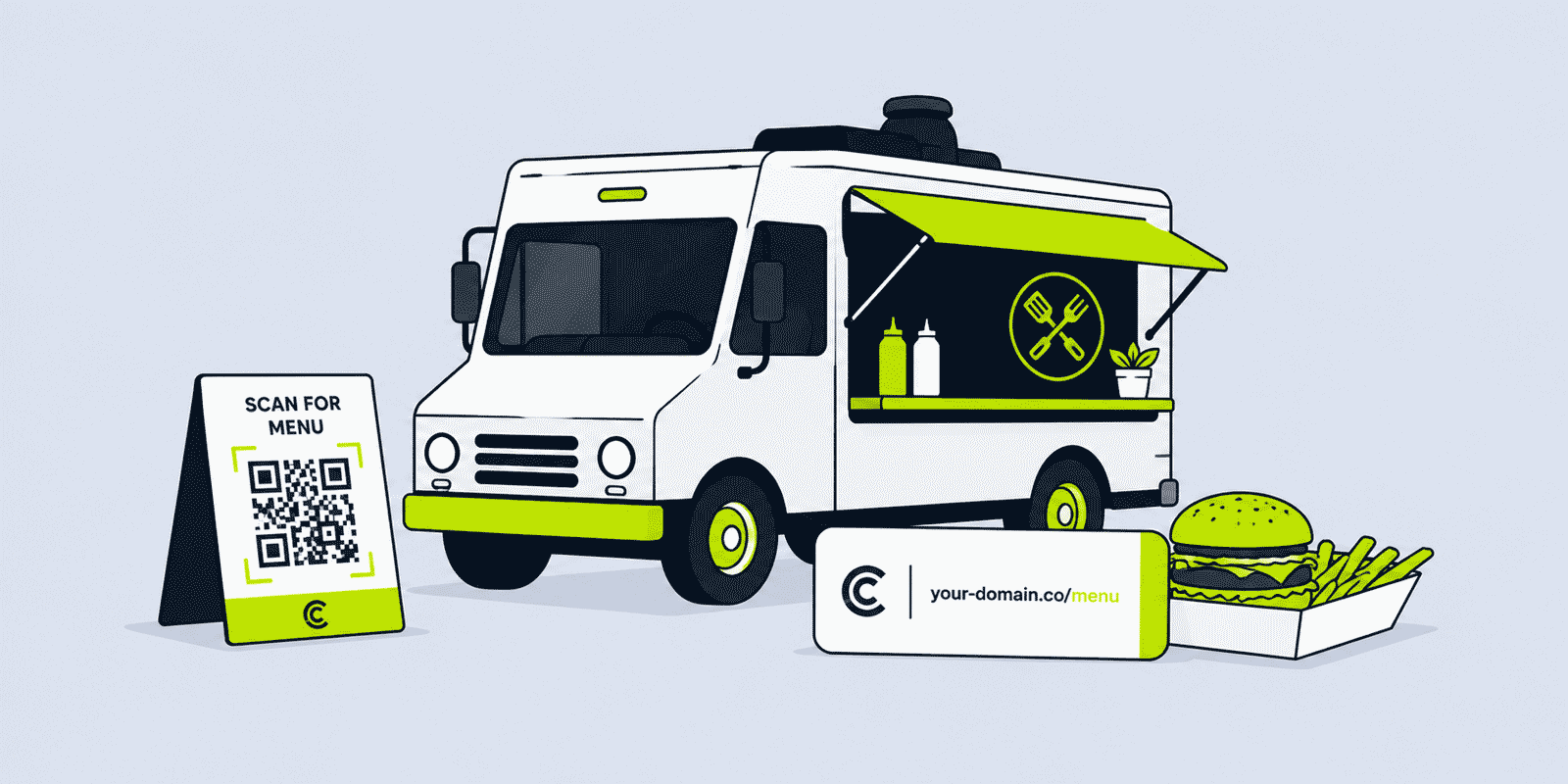
The QR Code on the menu board or the serving window is the most-scanned QR Code a food truck can have — because it is placed exactly at the point of customer interest. A customer standing in front of a food truck deciding what to order, who scans a QR Code and gets the current digital menu with photos, descriptions, allergen information, and prices, has a better ordering experience than one squinting at a chalk board in the sun.
The critical requirement: this QR Code must be dynamic. Food truck menus change constantly — seasonal specials, sold-out items, price adjustments, event-specific menus. A static QR Code encoding the menu URL means that every time the menu changes, the URL potentially changes, and the QR Code becomes outdated. A dynamic QR Code from Cuttly — pointing to go.truckname.com/menu — allows the destination to be updated instantly when the menu changes. The QR Code on the window never changes; only the page it routes to does.
For trucks that use a digital menu platform (Square, Toast, or a simple Google Doc or PDF updated regularly), one Cuttly short link to the current menu URL serves the entire QR Code infrastructure. Update the menu page, and every printed QR Code — on the window, on packaging, on business cards, on flyers — routes to the updated version automatically.
Analytics on the menu QR Code show how many customers scanned at each service location and at what times. A busy lunch location that generates 80 scans versus a weekend market that generates 15 tells the truck owner something useful about relative customer engagement with the digital menu at each pitch type.
Location Schedule Links: Sharing Where You Are
A stable branded short link to the truck's location schedule or "where to find us" page is one of the most practical tools for managing the food truck's mobility as a communication challenge. The link is permanent. The destination — a Google Maps pin, a schedule page on the website, an Instagram Highlights archive, or a simple page on the truck's website — is updated as the schedule changes.
go.truckname.com/location appears in: the Instagram bio (via Link in Bio), the TikTok bio, every social post that mentions today's location, the vehicle wrap as a printed URL, and the business card. Every customer who receives any of these touchpoints has access to the current location via the same stable URL.
When the schedule changes — a cancelled spot, an additional market date, a one-off festival appearance — the Cuttly short link destination is updated to the revised schedule page. Every customer who has saved or shared the location link accesses the current schedule.
For food trucks that manage a customer WhatsApp group or community — customers who want location alerts — the location short link is the standard reference in every group message. Consistent use of the same branded URL makes it easy for customers to bookmark and check independently without depending on group messages.
Instagram and TikTok: Link in Bio for Social-First Food Trucks
Instagram allows one clickable link in the profile bio — a significant constraint for a food truck that wants to give followers access to: today's location, the current menu, the event schedule, the catering enquiry form, the Google Review page, and the truck's loyalty programme. A Link in Bio page behind one branded URL addresses this comprehensively.
A Cuttly Link in Bio page at cutt.bio/truckname or go.truckname.com/links (from the Single plan, on the truck's branded domain) aggregates: today's location or schedule (first button, most prominent — this is what most followers want), the current menu, the catering and event booking enquiry, the Google Review page, and any current promotion or loyalty programme. The button order and content updates as the season and the priority changes.
Analytics on the Link in Bio page show which buttons followers click most. If the location button consistently generates 60%+ of all button clicks, followers are primarily using the bio link to find the truck — confirming that location visibility is the primary need and the Link in Bio is serving it correctly. If the catering enquiry button generates unexpectedly high clicks, there is latent catering demand from the social audience that warrants more prominent promotion.
TikTok's bio link works the same way. A food truck with a TikTok following using the same Link in Bio URL in both Instagram and TikTok bios can compare per-platform traffic to the Link in Bio page using referrer analytics — showing which platform's audience is more action-oriented (clicking through to location and menu) versus passive (watching videos but not following up).
Vehicle Wrap QR Code: Your Most Permanent Marketing Surface
A vehicle wrap is among the most expensive single marketing investments a food truck owner makes — a high-quality full or partial wrap runs into thousands. Once applied, it is there for years. Any URL or QR Code on the wrap must remain valid and functional for the wrap's entire lifespan.
A static QR Code on a vehicle wrap encoding a raw menu URL or website URL is a long-term liability. If the website URL ever changes, or if the menu page is restructured, or if the truck owner ever wants to change what the QR Code links to — a career transition from a food truck to a catering company, a website rebuild, a platform change — the QR Code on every panel of the wrap is now incorrect. The only fix is a partial rewrap or a cover sticker — both expensive.
A dynamic Cuttly QR Code on the vehicle wrap encodes the short link. The short link is permanent. The destination it routes to can change as many times as needed over the wrap's lifespan — at no cost, in seconds, from the Cuttly dashboard. The QR Code on the wrap remains correct forever, regardless of what changes behind it.
The QR Code on a vehicle wrap should be large enough to scan from a distance — pedestrians passing the parked truck, spectators at an event, customers approaching the service window. Minimum 5 cm × 5 cm for a stationary service context; 8 cm+ for high-visibility side panels that may be seen from further away. Download in SVG for the wrap designer to place at the correct size without any quality loss.
Analytics on the vehicle wrap QR Code reveal how many people scan while the truck is at service — a passive measure of customer interest from the physical vehicle's presence alone, separate from any social media-driven traffic.
Event and Festival Promotion
Food festivals, street food markets, music events, corporate events, and community fairs are primary trading opportunities for food trucks. Pre-event promotion — letting followers know you will be at a specific event, when, and what you will be serving — drives event-day traffic from the social following.
Cuttly's Action Pages (Single plan+) are ideal for event-specific promotion: event name, date and location, today's menu or event-specific special menu, what to expect at the truck, and a "Save the date" or "Get directions" CTA button. Accessible via a branded short link, shareable in Instagram stories, TikTok posts, and WhatsApp groups. The Action Page countdown timer adds urgency to limited-time event appearances.
For food trucks that appear at recurring events — a weekly market, a monthly street food night, a seasonal festival — create a unique short link per event type. Analytics show which events generate the most pre-event social engagement (link clicks in the days before the event) versus which events generate mostly walk-in traffic with no pre-event digital engagement. This informs whether pre-event social promotion for specific events is worth the effort.
Corporate and Private Catering Enquiries
Corporate catering — office lunches, company away days, product launches, staff events — is a significant revenue opportunity for established food trucks. The catering enquiry is typically initiated when a decision-maker sees the truck at a public event, follows the truck's Instagram, or receives a recommendation from a colleague who has experienced the truck previously.
A branded short link to the catering enquiry form — go.truckname.com/catering — should appear: on the Instagram and TikTok bio via Link in Bio (second most prominent button after the location link, for trucks actively pursuing corporate catering), at the bottom of the digital menu page, on the business card distributed at events and markets, and in any direct Instagram DM follow-up after a positive service interaction.
A dedicated catering enquiry Action Page — with the truck's story, capacity and service style, what event types the truck caters for, reference to previous events, and a detailed enquiry form CTA — provides a more compelling and complete pitch than a simple Google Form. Analytics on the catering enquiry link show how many people are actively exploring the catering option from each touchpoint — a signal of demand that may warrant more proactive catering sales activity.
Google Reviews: The Food Truck's Most Powerful Trust Signal
Google Reviews for food trucks serve two purposes: they validate the truck's quality to potential new customers who search for it, and they improve the truck's visibility in "food trucks near me" and "street food near me" Google search results. A food truck with 200 reviews and a 4.8 rating is substantially more visible and credible than one with 15 reviews, regardless of the underlying quality gap.
The highest-conversion moment to request a review is immediately after a positive service interaction — when the customer is still holding their food, satisfied with the experience, and feeling positively disposed toward the truck. A branded short link to the Google Review page — go.truckname.com/review — on a small card given at the window, on the packaging insert, or on a QR Code sticker on the packaging itself provides the path from "I enjoyed this" to "I left a five-star review" in one tap.
Analytics on the review link show how many customers are clicking through to the review page versus how many are submitting reviews (tracked in Google Business Profile). A high click-through with low completion rate may indicate the review form is asking too many questions, or the page is loading slowly on mobile.
Loyalty and Repeat Customer Engagement
Food truck loyalty works differently from restaurant loyalty — customers are not always in the same location to use a physical stamp card. A digital loyalty mechanism — a loyalty app, a points-based system via Square Loyalty, or even a simple repeat-visit offer distributed via WhatsApp — works better for the food truck's mobile model.
A branded short link to the loyalty programme signup — go.truckname.com/loyalty — on the menu QR Code page, on the packaging, and on the Link in Bio page provides consistent access to the loyalty mechanism regardless of where the customer encounters the truck. Analytics track how many customers are clicking through to loyalty signup from each touchpoint — indicating which physical or digital context generates the most loyalty engagement.
A customer WhatsApp group — opt-in, for customers who want location updates and exclusive offers — is one of the most effective retention tools for food trucks. The group is populated primarily by the truck's most loyal customers. Links shared in the group (daily location updates, special menu announcements, event invitations) are tracked short links that show how many members engage with each communication.
Measuring Which Channels Bring Customers to the Window
This is the question that most food truck owners cannot currently answer: of all the marketing activity — Instagram posts, TikTok videos, event posters, vehicle wrap QR Code, packaging reviews, word of mouth — which actually brings people to the window?
The measurement mechanism: create a separate branded short link for each channel, all routing to the same location or menu page. One for the Instagram bio, one for the TikTok bio, one for each event poster QR Code, one for the vehicle wrap, one for packaging inserts, one for the WhatsApp group. Monthly analytics comparison shows click volume per channel — which platform's audience is most action-oriented, which physical placements generate measurable scans, which channels generate more engagement in pre-service hours versus post-service.
Over a full season of data, the patterns become clear. If the Instagram bio link generates 3x the clicks of the TikTok bio link, Instagram is the more action-oriented audience. If the vehicle wrap QR Code generates consistent scans at specific locations but not others, the vehicle placement at those locations has higher customer engagement. If the WhatsApp group location link generates the most clicks on Thursday evenings, that is when the most engaged customers are planning their Friday visits.
This data does not need to be sophisticated to be useful. A simple monthly review of which five links generated the most clicks last month tells the truck owner where to invest attention and content effort next month.
Which Cuttly Plan Is Right for a Food Truck
The Free plan ($0) provides 30 links/month, 1 branded domain, basic QR Code generation, UTM builder, and 30 days of analytics. No credit card required. Adequate for a sole operator with a small set of core links — menu, location, review — and minimal active campaign management. 30 links/month is sufficient for the core operational links without seasonal campaign activity.
The Single plan ($25/month) is the right plan for most established food trucks with active marketing. 5,000 links/month covers extensive use. 1 year of analytics history supports season-over-season comparison of event performance and channel attribution. Full QR customization with SVG export for vehicle wrap and packaging — brand colors, truck logo in the QR Code center. Link in Bio on the truck's branded domain for Instagram and TikTok. Action Pages for event and festival promotion. Cuttly Surveys for post-service feedback.
The Team plan ($99/month) is appropriate for food truck operators who run multiple trucks, franchise-style food truck networks, or operators who integrate link creation with catering management systems via the Team API.
Start with Cuttly's free plan — no credit card required, 1 branded domain included. Create your menu QR Code, set up your location link, and build your Instagram Link in Bio in under 20 minutes before the next service. Registration required; free plan available immediately.
Frequently Asked Questions
Why do food trucks need a URL shortener?
Food trucks need stable, branded short links because the business is mobile — menus and locations change constantly. Dynamic short links allow destinations to update without reprinting vehicle wraps, packaging, or event materials. Analytics show which channels (Instagram, TikTok, vehicle wrap, event posters) are actually bringing customers to the window.
What should a food truck use a short link for?
Menu QR Code on service window and vehicle wrap (dynamic — updated when menu changes), location schedule link (shared in all channels), Instagram and TikTok Link in Bio, event and festival promotion Action Pages, corporate catering enquiry form, Google Review link on packaging, loyalty programme signup, and separate tracked links per channel to measure what drives customers.
How can a food truck use a QR Code?
On the service window/menu board (linking to current menu), on the vehicle wrap (permanent — updates without reprinting), on table cards at static pitches, on packaging linking to Google Review or loyalty programme, on event posters and flyers, and on business cards linking to the Link in Bio page. All should be dynamic QR Codes from Cuttly.
How can a food truck measure which marketing activities bring customers to the window?
Create separate branded short links per channel — Instagram bio, TikTok bio, vehicle wrap QR, event poster QR, WhatsApp group link — all routing to the same menu or location page. Monthly Cuttly analytics comparison shows click volume per channel, revealing which platform and physical placements generate the most measurable customer engagement.
- Tools
- URL Shortener Tool →
- Link in Bio Builder →
- QR Code Generator →
- Link Analytics →
- Related Industry Guides
- URL Shortener for Restaurants →
- URL Shortener for Coffee Shops →
- URL Shortener for Food Delivery →
- URL Shortener for Hospitality →
- URL Shortener for Small Business →
- Related Guides
- QR Codes on Packaging →
- What Is a Dynamic QR Code? →
- Link in Bio Without Linktree →
- Link Tracking 101 →
- Verticals Hub
- URL Shortener for Every Industry →
- Start Here
- Create Free Account
- Plans & Pricing
URL Shortener
Cuttly simplifies link management by offering a user-friendly URL shortener that includes branded short links. Boost your brand’s growth with short, memorable, and engaging links, while seamlessly managing and tracking your links using Cuttly's versatile platform. Generate branded short links, create customizable QR codes, build link-in-bio pages, and run interactive surveys—all in one place.
Cuttly - Consistently Rated
Among Top URL Shorteners
Cuttly isn’t just another URL shortener. Our platform is trusted and recognized by top industry players like G2 and SaaSworthy. We're proud to be consistently rated as a High Performer in URL Shortening and Link Management, ensuring that our users get reliable, innovative, and high-performing tools.


