URL Shortener for Medical Devices and Medtech The Complete Guide
Medical device manufacturers and medtech companies operate at the intersection of clinical credibility, regulatory compliance, and commercial effectiveness. Every communication they make — with healthcare professionals, procurement committees, hospital systems, international distributors, patients, regulators, and clinical researchers — must simultaneously demonstrate scientific rigour, meet labelling and promotional regulations, and be accessible and professional enough to support the commercial relationships that fund continued innovation. The links in those communications are not merely operational details; they are entry points to clinical evidence, regulatory documentation, product information, and professional relationships that have direct implications for patient care.
This guide covers how medical device manufacturers and medtech companies — from Class I consumer wellness devices through to Class III implantable technologies, across diagnostic imaging, surgical robotics, patient monitoring, digital health platforms, and the full spectrum of medtech — use a URL shortener, branded custom domain, dynamic QR Codes and click analytics to manage device label documentation links, healthcare professional campaigns, conference presence, distributor networks, and clinical evidence distribution. Regulatory compliance — MDR in Europe, FDA regulations in the US, and equivalent frameworks globally — governs the content of all medical device communications; this guide addresses link management mechanics, and companies should obtain appropriate regulatory affairs review of any new communications approach.
What This Guide Covers
- Device label QR Codes — the regulatory and operational case for dynamic links
- Instructions for use (IFU) and clinical documentation links
- Product registration and post-market surveillance links
- Healthcare professional campaign links — per-specialty and per-indication
- Conference and medical trade show link strategy
- Distributor and international channel partner links
- Clinical evidence and publication links
- Training and clinical education links for HCP users
- Patient-facing product information links
- A worked example: a medtech company's link stack across a conference campaign
- Common mistakes in medical device link management
- A Cuttly plan guide for medical device companies
- Frequently asked questions
Device Label QR Codes: The Regulatory and Operational Case for Dynamic Links
The medical device label is one of the most regulated surfaces in any industry. Under MDR in Europe, FDA UDI requirements in the United States, and equivalent frameworks globally, device labels must carry specific mandatory information in specific formats, and any changes to labelling must undergo regulatory review and approval before implementation. This regulatory constraint makes the physical device label among the most expensive and least flexible printed materials in any manufacturing context to update.
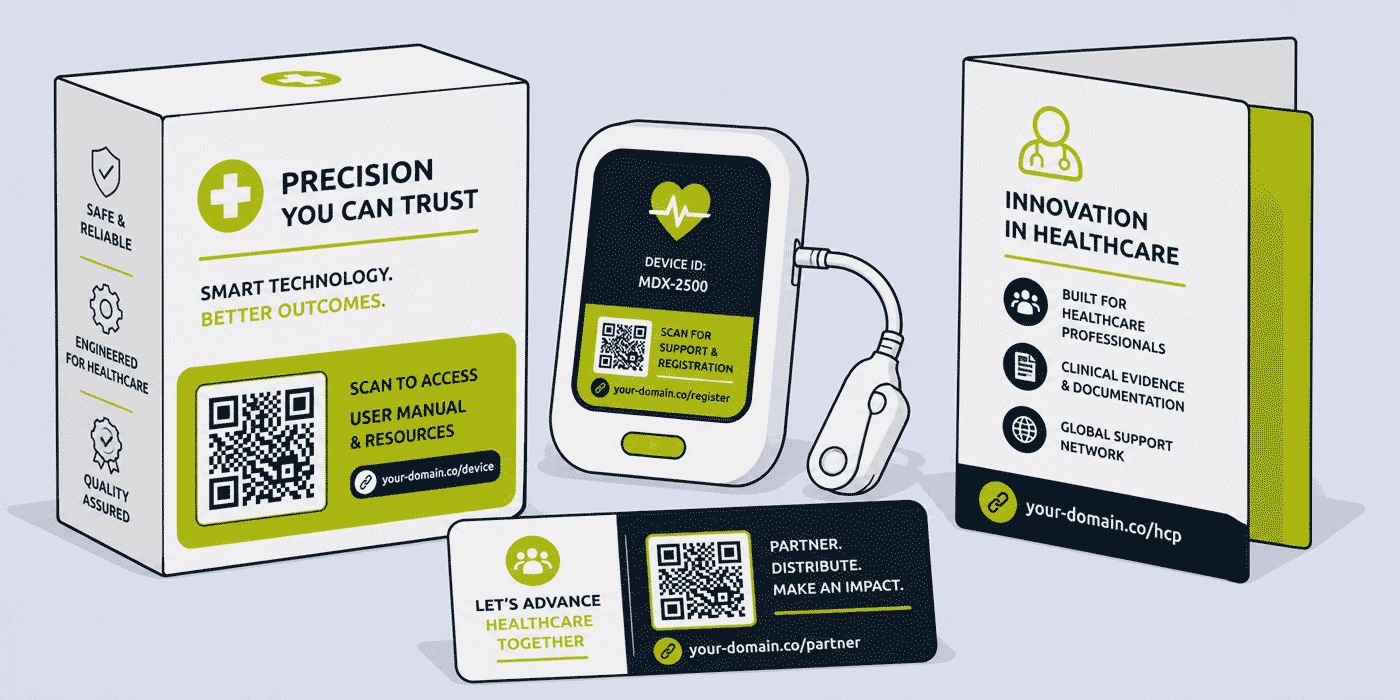
Against this backdrop, a QR Code on a device label that encodes a dynamic short link rather than a destination URL directly provides enormous operational flexibility. The physical label — with all its regulatory-approved content — does not change. The digital content behind the QR Code's short link can be updated immediately when clinical documentation is revised, when a safety notice is issued, when a new regulatory approval is granted for an additional indication, or when product information is updated following post-market surveillance findings. The link evolves; the label stays constant.
For devices with long field lifespans — active implants, diagnostic imaging systems, surgical equipment, patient monitoring infrastructure — this distinction is not merely convenient but essential. An active implantable device that was labelled in 2022 may still be in a patient in 2040. A QR Code on that device's documentation, if it was printed with a static URL, will reflect the state of the manufacturer's digital infrastructure in 2022; if it was generated from a dynamic short link, it can serve whatever documentation and information the manufacturer considers most relevant in 2040.
What Device Label QR Codes Should Link To
The specific destination for a device label QR Code depends on the device class, the intended user (clinician, patient, maintenance technician), and the regulatory environment. Common and well-established QR Code destinations for medical device labels include:
- Instructions for use (IFU) and electronic IFU (eIFU). EU MDR (2017/745) explicitly permits or requires electronic IFUs for many device classes under specific conditions, and QR Codes are the primary mechanism through which eIFUs are accessed. A dynamic short link behind the eIFU QR Code ensures that clinicians and patients always access the current, regulatory-approved version of the IFU, even if the document's hosting URL changes during the device's commercial lifetime.
- Product registration and warranty activation. A QR Code linking to the manufacturer's product registration portal lets end users register the device immediately at the point of unboxing, without requiring them to navigate to a website independently.
- Safety and maintenance documentation. For capital equipment and reusable devices, maintenance schedules, cleaning and disinfection procedures, and calibration requirements accessible through a device-label QR Code give biomedical engineering teams immediate access to current technical documentation in the field.
- Post-market surveillance and adverse event reporting. A QR Code linking to the manufacturer's adverse event or vigilance reporting form gives clinical users a direct path to report safety observations, supporting the manufacturer's post-market surveillance obligations.
Instructions for Use and Clinical Documentation Links
The instructions for use is the most legally and clinically significant document associated with any medical device. Its accuracy, accessibility, and currency directly affect patient safety, and regulatory requirements for IFU accessibility are specific and enforceable. Electronic IFU programmes, now mandatory or highly encouraged in the EU under MDR for many device classes, create a direct link between the device and its current IFU through a scannable identifier — the QR Code — that must remain functional throughout the device's lifetime.
A per-device or per-product family short link for the IFU — your-medtech.com/ifu-device-model — managed dynamically ensures that the link on the device label always resolves to the current, regulatory-approved version of the IFU. When a new IFU version is approved following a device modification or a post-market update, the short link destination is updated to the new version. Every existing device in the field, every reference to the IFU link in clinical training materials, and every device label carries a link that now leads to the current document.
This approach is consistent with the principle in EU MDR Article 10(11) and the associated MDCG guidance on eIFUs, which require that the eIFU is kept up to date and that the means of access ensures the correct and current version is always available. A dynamic short link is technically and practically aligned with these requirements.
Product Registration and Post-Market Surveillance Links
Medical device manufacturers have extensive post-market surveillance obligations under both EU MDR and FDA regulations, including proactive collection of field performance data, systematic analysis of user feedback, and structured adverse event reporting. Managing the links through which clinicians and patients contribute to these surveillance processes is an underappreciated but commercially and clinically important link management function.
Product Registration Links
A short link for the product registration portal — your-medtech.com/register-device or a per-device model registration link — on the packaging and in the in-box documentation gives customers an immediate registration path. Because product registration portals change platforms over time — manufacturers regularly update their customer relationship and registration systems as they scale — a short link ensures that every reference to the registration portal in historical packaging, in training materials, and in distributor onboarding documentation continues to resolve correctly after a platform migration.
Adverse Event and Vigilance Reporting Links
A direct short link to the manufacturer's adverse event reporting form — your-medtech.com/report-event — lowers the barrier to clinical users reporting safety observations. Most clinicians know they should report adverse events but many do not do so because the reporting mechanism is not immediately accessible at the point where the observation occurs. A QR Code on the device's documentation folder or a short link in the clinical training materials that goes directly to the reporting form removes the navigation friction that currently reduces voluntary adverse event reporting rates for many device categories.
Healthcare Professional Campaign Links
Medtech companies' commercial success depends on clinical adoption: healthcare professionals who understand the clinical evidence for a device, who are trained to use it correctly, who see its value in their clinical practice, and who advocate for its procurement through their hospital's or healthcare system's purchasing process. Marketing and medical affairs programmes directed at healthcare professionals are the primary commercial mechanism for building this clinical adoption, and the links in those programmes determine how accessible and how measurable those efforts are.
Per-Specialty Campaign Links
A medtech company with a device applicable across multiple clinical specialties — a wound management system used in both wound care and surgery, a monitoring device used in critical care and general wards, a diagnostic tool used in cardiology, respiratory medicine, and emergency medicine — creates per-specialty landing pages and per-specialty short links:
your-medtech.com/cardiology— cardiology-specific clinical evidence, case studies, and programme informationyour-medtech.com/critical-care— critical care applications and evidence baseyour-medtech.com/wound-care— wound management clinical pathway informationyour-medtech.com/emergency— emergency medicine applications and training
Each specialty link points to a landing page crafted for the clinical context of that specialty: the clinical challenges they face, the evidence base relevant to their patients, the workflow integration considerations specific to their setting. Click analytics per specialty link, aggregated and anonymized, show the medical affairs team which specialties are most actively engaging with the company's clinical content, informing where to allocate medical education resources and clinical liaison time.
Clinical Evidence Links
Clinical evidence — published peer-reviewed studies, randomised controlled trial results, health economic analyses, and real-world evidence publications — is the primary currency of medical device marketing in the HCP audience. A short link per major clinical publication or evidence summary — your-medtech.com/rct-2024, your-medtech.com/meta-analysis — makes clinical evidence shareable, trackable, and stable across the years during which a publication remains clinically relevant.
When a medical affairs representative shares a clinical study link with a physician, a short link on the company's own domain is more credible than a raw PubMed URL or a link to a PDF on an unfamiliar document hosting service. The branded domain signals that the company is directing the physician to their own curated clinical evidence page, which typically includes context, a summary of the study's implications, and links to related evidence — rather than just the raw paper.
Conference and Medical Trade Show Link Strategy
Medical conferences — ESC, AHA, AAOS, ESMO, and hundreds of specialty conferences globally — are where medical devices are launched, where clinical evidence is presented, where relationships between industry and clinical communities are built, and where procurement decisions are influenced. A medtech company's conference presence is typically one of its highest-cost and highest-stakes marketing investments.
Conference Booth QR Codes
A medtech company's conference booth carries multiple QR Codes: on the booth display panels (for general product information), on demonstration unit stations (linking to the specific device being demonstrated's IFU and clinical evidence), on printed brochures and conference handouts (linking to a conference-specific landing page with post-conference follow-up content), and on product sample or demo kit packaging (linking to the full product documentation set).
Each QR Code is generated from a dynamic short link. After the conference, the landing page destinations can be updated from conference-specific content to post-conference follow-up content — a white paper relevant to the clinical discussions at the conference, a webinar registration for a post-conference clinical education session, or a clinical trial recruitment link if the company is running an ongoing study in the specialty the conference serves. The printed materials remain valid; the digital content evolves.
Per-Product and Per-Indication Conference Analytics
For medtech companies presenting multiple products at a conference, separate short links per product or per indication allow the commercial and medical affairs teams to compare which products generated the most HCP engagement at each conference. Over multiple conferences in the same specialty, this per-product engagement data builds into a picture of which products are most resonant with the clinical community at each conference type, informing both product launch prioritization and conference selection decisions.
Distributor and International Channel Partner Links
Medical device distribution is complex and geographically variable. In most markets outside the manufacturer's home country, devices are distributed through local or regional distributors who hold the local regulatory approvals, manage local clinical relationships, and handle local logistics. These distributor relationships involve intensive information sharing: product training materials, local regulatory submission packages, market-specific IFU translations, pricing documentation, and technical support resources.
Per-Distributor Resource Links
A per-distributor short link for the manufacturer's distributor resource portal — your-medtech.com/dist-region-name — provides each distributor with a stable, professional access point to the materials they need. When the distributor portal platform changes, the short link destination is updated; every historical communication the manufacturer has sent to the distributor continues to work. Click analytics per distributor link show the manufacturer's international commercial team which distributors are actively engaging with provided materials, helping identify where additional training, support, or commercial development investment is needed.
Regulatory Submission Package Links
International market expansion requires distributors to file local regulatory submissions using technical documentation packages provided by the manufacturer. These packages — containing technical files, clinical evaluation reports, performance data, and declaration of conformity documents — are shared with distributors through a short link pointing to a secure document sharing area. When submission packages are updated — when new evidence is added, when manufacturing site information changes, or when the CE mark scope is extended — the short link destination is updated to the current package version, ensuring every distributor references the most current submission-ready documentation.
Training and Clinical Education Links
Training and clinical education are essential components of medical device commercial success: a device that clinicians cannot use correctly will not demonstrate the clinical outcomes that drive procurement decisions, generate adverse events that create regulatory problems, and generate negative word-of-mouth among clinical communities. Medtech companies invest substantially in clinical training, and the links through which training materials are accessed need to be reliable, organised, and accessible to clinical users across diverse settings.
Per-Device Training Links
A short link per device for its training resources — your-medtech.com/training-device-model — points to a training hub containing video walkthroughs, simulation guides, competency assessment tools, and troubleshooting resources. This link is included in the device's documentation, given to clinical educators during product launches, and distributed to biomedical engineering teams and clinical governance teams responsible for ensuring staff competency on new devices.
When training materials are updated — which happens when device modifications are made, when IFUs are revised, when new clinical techniques are validated, or when simulator updates become available — the training hub destination is updated and every historical reference to the training link automatically points to the current materials. A hospital that bookmarked the training link when the device was first installed continues to reach current training content years later.
Patient-Facing Product Information Links
For medical devices that are used directly by patients — continuous glucose monitors, implantable hearing aids, CPAP machines, home diagnostic devices, insulin pumps, personal emergency response systems — patient-facing documentation links serve a distinct audience with distinct needs: accessibility, plain language, and reassurance. A patient scanning a QR Code on their device should reach content that is clearly written for non-clinical users, that provides immediate answers to common questions, and that gives clear direction on when and how to contact the manufacturer or a clinical professional if they have concerns.
A dedicated patient information short link — your-medtech.com/patient-guide-device-model — on the device and in its packaging reaches this audience directly. Because patient-facing materials are updated when device modifications occur, when safety communications are issued, or when new usage guidance is available, a dynamic short link ensures patients always access current information regardless of when their device was supplied.
A Worked Example: A Medtech Company's Conference Campaign
Consider a medtech company launching a new cardiac monitoring system at the European Society of Cardiology Annual Congress, using a branded domain such as your-medtech.com, connected through Cuttly's custom domain setup (an A record and a TXT record — see the custom domain setup guide). The company's regulatory affairs team has confirmed that the link management approach is consistent with the company's MDR compliance framework.
Pre-congress setup: The company creates a congress-specific landing page at /esc-2026 featuring the launch clinical data, the device overview, a demo booking form, and a post-congress webinar registration link. Booth display QR Codes use /esc-2026 as their primary destination. Individual product demonstration station QR Codes use /monitor-device-clinical pointing to the cardiology-specific clinical evidence page. The IFU for the new device uses /ifu-monitor-v1.
During the congress: Three days of booth activity generate 847 scans of the /esc-2026 QR Code and 312 scans of the clinical evidence QR Code. The demo station generates 156 direct IFU accesses. The medical affairs team notes that a higher proportion of IFU accesses occur on day two and three of the congress, after the device's clinical data is presented in a hotline session on day one, suggesting that the presentation drives increased due diligence activity from attending physicians.
Post-congress: The /esc-2026 destination is updated from the congress landing page to the post-congress webinar registration, then to the webinar on-demand recording after the webinar has aired. All congress-distributed materials continue to carry a functional QR Code for six months after the event. The IFU link /ifu-monitor-v1 is updated to /ifu-monitor-v2 destination when the first post-launch IFU revision is approved. All devices already in the field continue to carry the same QR Code but now resolve to the updated IFU.
Common Mistakes in Medical Device Link Management
Encoding Destination URLs Directly in Device Label QR Codes
A medical device manufacturer that generates QR Codes for device labels from direct destination URLs creates a permanent documentation maintenance liability. Every IFU revision, every platform migration, every regulatory submission update that changes a document's URL requires either a label reprint (expensive, regulatory-process-dependent) or an invalid QR Code on the device label (unacceptable in a clinical context). Dynamic short links are the only operationally and regulatory-practice-appropriate solution for device label QR Codes.
No Per-Specialty HCP Campaign Attribution
A medtech company running HCP campaigns across multiple specialties without per-specialty link attribution cannot compare the commercial efficiency of its medical education investment across specialties. If cardiologists are three times more likely to engage with clinical content than emergency medicine physicians for the same device, this information should inform how clinical education budgets are allocated. Per-specialty short links provide this attribution at the cost of one additional link per specialty.
Unstable Distributor Resource Links
A medical device manufacturer that shares raw document hosting platform URLs with its distributor network creates a link stability problem that manifests at the worst possible moments: when a distributor is preparing a regulatory submission, when a field engineer needs a maintenance document for a device in a hospital, or when a distributor's sales team needs current clinical evidence for a procurement meeting. Short links for all distributor-facing resources ensure stability regardless of the manufacturer's document infrastructure changes.
Cuttly Plan Guide for Medical Device Companies
- The Free plan ($0) provides 30 short links per month, one branded custom domain, full click analytics and dynamic QR Codes, with no credit card required. Suitable for a small medtech startup setting up core device label, IFU, and registration links for a first device.
- The Starter plan ($12/month) adds 300 short links per month and 30 custom aliases per month — practical for a growing medtech company managing per-device IFU links, specialty campaign links, conference QR Codes, and distributor resource links across a developing product portfolio.
- The Single plan ($25/month) adds up to 5 branded domains, customizable QR Codes with the company's brand identity for professional conference and device materials, 1,000 API-created links per month for automated per-device or per-lot QR Code generation, and a full year of analytics history — most relevant for established medtech companies with multiple device lines, active international distributor networks, and regular conference presence.
- The Team plan ($99/month) suits larger medtech organizations with regulatory affairs, medical affairs, commercial, and marketing teams sharing link management, multiple branded domains for different device brands or regional operations, Campaign tag analytics for aggregated conference and specialty campaign reporting, and shared workspaces across globally distributed teams.
Create a free Cuttly account to set up your medical device's first IFU link, your product registration QR Code and your first HCP campaign landing page link. Registration is required for all plans, including free. No credit card is needed for the free plan.
Frequently Asked Questions
How do medical device companies use QR Codes on device labels?
A medical device manufacturer places QR Codes from dynamic short links on device labels, linking to the IFU, regulatory approvals, product registration portal, and safety documentation. Because the QR Code is dynamic, the destination updates when documentation is revised without reprinting device labels. For devices with long field lifespans, dynamic QR Codes are the only practical way to maintain current documentation access across the device's entire service life.
How do medtech companies use short links for healthcare professional campaigns?
A medtech company creates per-specialty branded short links — your-medtech.com/cardiology, your-medtech.com/critical-care — pointing to specialty-specific clinical evidence and product information pages. Click analytics per specialty link show which clinical areas are most engaged with the company's digital content, informing medical education investment and sales team prioritization.
Are short links appropriate for regulated medical device communications?
A short link redirects to whatever destination the medical device company chooses and does not process clinical data. Medical device companies should ensure all linked content complies with applicable device labelling and promotional regulations (MDR, FDA, equivalent frameworks), obtain appropriate regulatory affairs review of their digital communications approach, and use their own branded domain rather than generic shortener domains for all professional communications.
How do medical device companies use short links at medical conferences?
A medical device company places QR Codes on booth displays, demonstration units, and printed conference materials — each from dynamic short links. Post-conference, the landing page destinations update from conference-specific content to post-conference follow-up without replacing printed materials. Per-product QR Code analytics show which clinical areas generated the most HCP engagement at each event.
How do medtech companies use short links for distributor networks?
A medical device company creates per-distributor short links — your-medtech.com/dist-region-name — for training resources, product documentation, regulatory submission packages, and technical support portals. Click analytics per distributor link show which distributors are actively engaging with provided materials, helping identify where additional support or training investment is needed.
- Get Started
- Create Free Account
- Plans & Pricing
- Platform Tools
- URL Shortener
- Link Analytics
- QR Code Generator
- Related Guides
- URL Shortener for Hospitals
- URL Shortener for Telehealth
- URL Shortener for Pharmacies
- URL Shortener for Manufacturers
- URL Shortener for PDF Sharing
- Setup Guides
- Custom Domain Setup
- API Documentation
- Industry Hub
- Healthcare & Medical
- All Industries →
URL Shortener
Cuttly simplifies link management by offering a user-friendly URL shortener that includes branded short links. Boost your brand’s growth with short, memorable, and engaging links, while seamlessly managing and tracking your links using Cuttly's versatile platform. Generate branded short links, create customizable QR codes, build link-in-bio pages, and run interactive surveys—all in one place.
Cuttly - Consistently Rated
Among Top URL Shorteners
Cuttly isn’t just another URL shortener. Our platform is trusted and recognized by top industry players like G2 and SaaSworthy. We're proud to be consistently rated as a High Performer in URL Shortening and Link Management, ensuring that our users get reliable, innovative, and high-performing tools.C


