URL Shortener for Hospitals The Complete Guide
A hospital communicates across a greater range of audiences, channels, and urgency levels than almost any other organisation. Patients receiving appointment letters need clear, accessible links to preparation guides and parking information. Staff across hundreds of departments need reliable access to policy updates, mandatory training, and occupational health resources. The public needs accurate information about services, visiting hours, and how to access care. Charitable foundations need to reach donors and volunteers. And the entire communications infrastructure needs to remain functional and accurate as clinical guidance evolves, digital systems migrate, and organisational structures change.
This guide covers how hospitals, NHS trusts, and independent hospital groups use a URL shortener, branded custom domain, dynamic QR Codes and click analytics across patient information, appointment communications, digital wayfinding, staff communications, public health campaigns, charitable foundation fundraising, and the full range of link management needs for a large, complex clinical organisation. This guide addresses link management mechanics only. All patient-facing clinical content, information governance, and public communications should be developed and approved through the hospital's appropriate clinical, legal, information governance, and communications governance processes, and in compliance with applicable NHS, CQC, and relevant regulatory standards.
What This Guide Covers
- Patient information links — appointment letters, pre-procedure guides, discharge information
- Digital wayfinding QR Codes — department navigation on large clinical sites
- Outpatient and appointment communication links
- Staff communications links — policy, training, occupational health
- Public health campaign links and per-channel attribution
- Charitable foundation and fundraising links
- Volunteer and community engagement links
- Research and clinical trial information links
- Media and press office communications
- A worked example: a large NHS trust's link infrastructure
- Common mistakes in hospital link management
- A Cuttly plan guide for hospitals
- Frequently asked questions
Patient Information Links
Patient information is among the most carefully managed content in any hospital trust. Pre-operative preparation guides, post-procedure care instructions, medication information, consent documentation explanations, and service access information all need to be accurate, current, and written to accessibility standards. The links through which patients access this information — in appointment letters, in discharge summaries, in clinic waiting area QR Codes, and in any digital communication — need to be equally well managed.
Appointment Letter Links
The outpatient appointment letter is the most widely distributed printed patient communication in most hospitals. Every patient receiving a clinic appointment receives a letter that may include links to:
- The department's patient information page explaining what to expect at the appointment
- A pre-appointment preparation guide (relevant for procedures requiring fasting, medication adjustments, or specific preparation)
- Parking, transport, and wayfinding information for the relevant site
- An appointment confirmation or rescheduling portal
- A patient questionnaire or pre-assessment form to complete before attending
A branded short link for each of these resources — trust.nhs.uk/pre-op, trust.nhs.uk/parking, trust.nhs.uk/confirm-appointment — in the appointment letter provides a clean, trustworthy URL that patients can type on any device. Because appointment letters are printed in batches and may be sent weeks or months before the appointment, the patient may refer back to the letter on the day of attendance — months after the letter was generated. A dynamic short link ensures that the parking information, the pre-appointment guide, and the confirmation portal referenced in the letter continue to reach accurate, current information on the day it is actually needed.
The hospital's own branded domain on the short link is also a trust signal that matters in healthcare communications: a patient who receives a letter containing a link on the trust's own domain (trust.nhs.uk/link) has immediate visual confirmation that the link is from the organisation they expect. A raw shortener domain URL in a healthcare letter is a potential phishing concern for security-aware patients.
Discharge and Post-Procedure Information Links
Discharge documentation — the information given to patients when they leave a ward or clinic — includes instructions, warnings, and guidance that patients need to understand and follow after leaving the hospital. Wound care instructions, medication schedules, symptom awareness guides, and follow-up appointment information are all time-sensitive and clinically important. A QR Code on the discharge letter, linking to the relevant digital resource — trust.nhs.uk/wound-care, trust.nhs.uk/post-op-care — provides a digital supplement to the printed information that patients can access on their phone at home when they need it.
Because clinical guidance is updated regularly, a dynamic short link for post-procedure information ensures patients who were discharged months earlier and return to a bookmarked resource link find current guidance rather than outdated information. This accuracy maintenance is operationally simple with a dynamic link and impossible to manage at scale without one.
Digital Wayfinding QR Codes
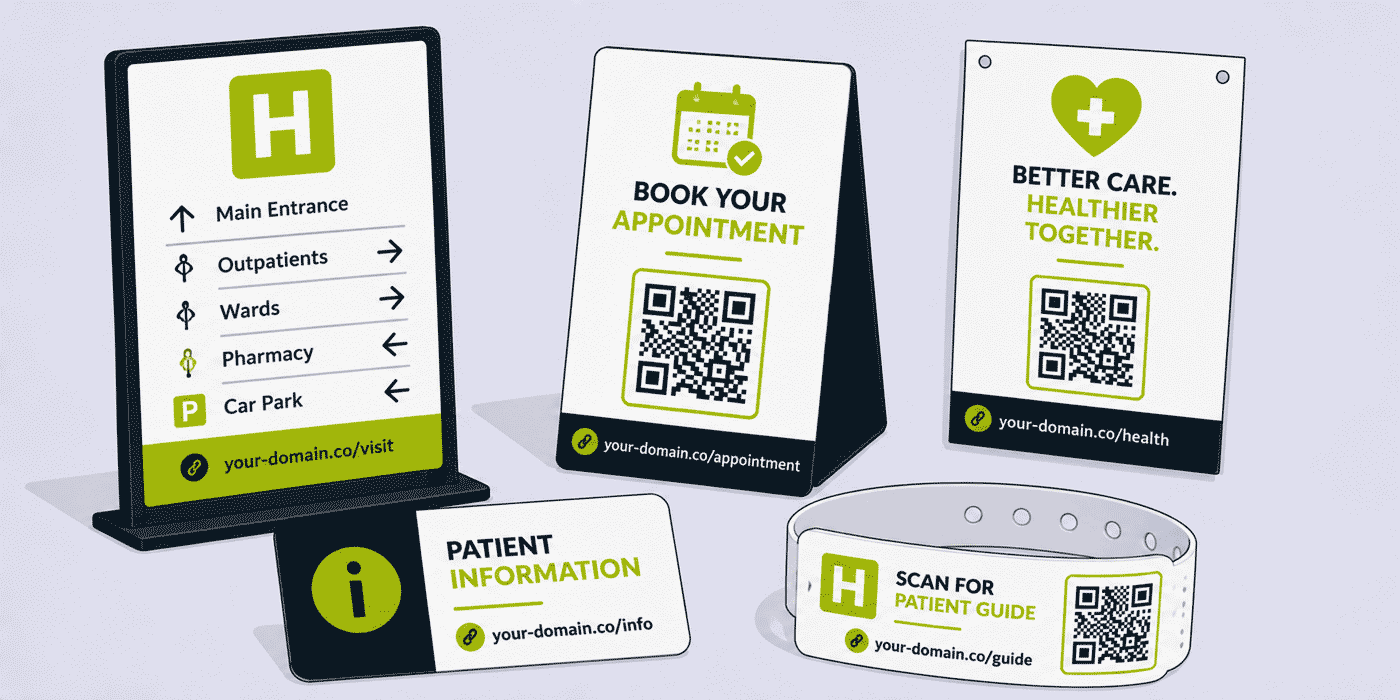
Large hospital sites — multi-building acute trusts, teaching hospitals, specialist referral centres — present a significant navigation challenge for patients, visitors, and staff who are unfamiliar with the layout. Physical signage is expensive to update and is often insufficient for the complexity of a large clinical environment. Digital wayfinding, delivered through QR Codes at key navigation points, supplements physical signage with the full depth of information that cannot be printed on a corridor sign.
QR Code Placement Strategy
Strategic QR Code placement at navigation decision points across the hospital site:
- Main entrance and reception. A QR Code linking to the hospital's full site map and department finder —
trust.nhs.uk/find-us— helps newly arriving patients and visitors orient themselves before approaching reception, reducing queue pressure at busy arrival periods. - Lift lobbies and corridor junctions. QR Codes at floor-by-floor decision points linking to floor-specific department maps —
trust.nhs.uk/floor-3— give patients navigating independently a reference point without requiring interaction with busy clinical staff. - Outpatient clinic waiting areas. QR Codes in waiting areas linking to clinic-specific patient information, appointment confirmation, and any pre-assessment questionnaires that can be completed while waiting —
trust.nhs.uk/clinic-name. Using waiting time productively by enabling pre-assessment completion before the consultation improves clinic efficiency. - Car parks and transport information. QR Codes at car park entry and payment machines linking to parking information, patient transport eligibility, and public transport options —
trust.nhs.uk/parking.
All wayfinding QR Codes are generated from dynamic short links. Hospital sites change: departments move, facilities are refurbished, new buildings open, and temporary arrangements are made during construction phases. A dynamic QR Code at a lift lobby pointing to department locations can be updated when departments move without any physical QR Code replacement. Given that QR Code displays on hospital walls may remain in place for five to ten years, dynamic links are not merely convenient but operationally essential for maintaining accurate wayfinding information.
Outpatient and Appointment Communication Links
The administrative management of outpatient appointments — confirmation, rescheduling, cancellation, pre-assessment, and post-appointment follow-up — has been significantly digitalised across most NHS trusts over the past decade. Patient portals, online appointment management systems, electronic pre-assessment questionnaires, and digital discharge summaries have replaced or supplemented many paper-based processes. The links through which patients access these digital systems need to be consistently communicated and persistently functional.
A permanent short link for the patient portal — trust.nhs.uk/my-appointments — used in every appointment-related communication (confirmation letters, reminder texts, discharge letters, and any communication that references the patient's appointment management) provides a consistent, single reference that survives every patient portal platform migration. NHS trusts have migrated through multiple patient portal systems over the past decade; a dynamic short link means patients who were told about the portal years ago find the current system through any historical reference.
Staff Communications Links
Hospital trusts employ thousands of staff across clinical, administrative, operational, and support functions, communicating with them through intranets, email, noticeboards, and line management structures. The links in staff communications — to policy documents, to mandatory training modules, to staff survey forms, to HR and occupational health resources — need to be reliable, accessible, and resilient to the frequent platform changes that large organisations undergo.
Mandatory Training Links
Mandatory training compliance is a significant operational challenge for hospital trusts: ensuring that thousands of staff complete the required training modules within specified timeframes requires repeated, accessible communication of the training portal link. A permanent short link for the mandatory training portal — trust.nhs.uk/training — in every communications channel used to remind staff about training compliance (email, intranet, posters in staff rooms and break areas) reduces the "I couldn't find the link" barrier to completion.
Because NHS trusts have migrated through multiple e-learning platforms over the years — from paper-based records to the ESR system to bespoke e-learning platforms to third-party systems — a dynamic short link for mandatory training means every staff communication that references the training portal continues to reach the current system, regardless of which platform migration has occurred since the communication was first issued.
Policy and Governance Document Links
Clinical policies, infection control guidance, safeguarding procedures, information governance policies, and operational protocols are updated regularly and need to be accessible to all relevant staff at all times. A short link for key policy categories — trust.nhs.uk/policies, trust.nhs.uk/infection-control, trust.nhs.uk/safeguarding — in staff communications ensures that staff access current documents rather than relying on saved copies of older versions. Because policy documents are regularly updated, the dynamic destination behind each policy link ensures any staff member who follows the link from an old email, an intranet post, or a printed briefing note reaches the current, approved version.
Public Health Campaign Links
Hospital trusts play a significant role in public health communication, running campaigns on cancer screening uptake, vaccination programmes, healthy lifestyle programmes, mental health awareness, and emergency department appropriate use. These campaigns reach the public through social media, GP surgery waiting rooms, local pharmacy poster campaigns, community event presence, and media advertising. Managing campaign links well — ensuring consistent, attributable, and durable references across every campaign channel — is part of running an effective public health programme.
Per-Channel Campaign Attribution
A trust running a bowel cancer screening awareness campaign across social media, GP surgery waiting area posters, community pharmacy leaflets, and local newspaper advertising creates per-channel attribution links to measure which channels are generating the most campaign engagement:
trust.nhs.uk/screening-social— social media campaign poststrust.nhs.uk/screening-gp— GP surgery waiting room poster QR Codestrust.nhs.uk/screening-pharmacy— pharmacy leaflet QR Codestrust.nhs.uk/screening-press— local newspaper advertising
Click analytics per channel, aggregated and anonymized, show the trust's public health and communications teams which channels are generating the most screening information page engagement. Over multiple campaigns, per-channel attribution builds an evidence base for public health campaign investment decisions — which channels reach which demographic groups most effectively, which are most cost-efficient per engagement, and which GP surgery or pharmacy locations are generating the highest QR Code scan rates. This data supports the trust's population health management function and informs future campaign design.
All public health campaign content must be clinically reviewed and approved through the trust's governance processes before publication, and all claims about screening, vaccination, and health interventions must reflect current NICE guidance and NHS policy. The link management mechanics described here apply to the distribution infrastructure for approved campaign content; they do not substitute for the clinical and communications governance that produces that content.
Charitable Foundation and Fundraising Links
Most NHS trust hospitals operate an associated charitable foundation or a hospital charity that raises funds for equipment, research, patient comfort (such as ward amenities, specialist rehabilitation equipment, or children's wards environments), and staff wellbeing programmes. These charities operate separately from NHS core funding and rely on public donations, legacy gifts, and corporate partnerships to achieve their fundraising objectives.
A branded short link for the charitable foundation's donation page — trust-charity.org/donate or using a dedicated charity domain — appears in patient thank-you communications (where patients who have had a positive care experience are invited to support the charity), in internal staff communications encouraging charitable giving, in public fundraising campaigns, and in any legacy and major donor communications. Because charitable giving platforms change as the market evolves, a dynamic short link ensures every historical donation reference continues to reach the current giving page.
Charitable fundraising communications from hospital foundations must comply with the Charities Act, Fundraising Regulator guidance, the Code of Fundraising Practice, and the trust's own policies on charitable fundraising. Patient data used in charitable fundraising communications must comply with UK GDPR and the trust's information governance framework. These governance requirements apply to the communications themselves; the link management mechanics described here apply to the technical infrastructure that delivers those communications.
Volunteer and Community Engagement Links
Hospital volunteers — who provide a wide range of support to patients, visitors, and staff across wards, clinics, and administrative functions — are recruited through public communications, community engagement, and relationships with voluntary organisations. A short link for the volunteer sign-up or information page — trust.nhs.uk/volunteer — used in community communications, in local press features about the volunteering programme, in social media posts, and in any materials distributed at community events, gives interested potential volunteers a consistent, accessible path to the current volunteer recruitment process.
Because hospital volunteer programmes are managed through systems that change over time, a dynamic short link for the volunteer sign-up page ensures the reference in any past community communication remains functional through every system migration. Click analytics on the volunteer sign-up link, aggregated and anonymized, show the volunteering team which community channels are most effective at generating interest from potential volunteers.
Research and Clinical Trial Information Links
Teaching hospitals and specialist centres conduct significant research activity, including clinical trials for which patient participation is sought. Information about available trials, eligibility criteria, and how to express interest is distributed through clinical consultations, patient information materials, and public communications. Short links for research information pages — trust.nhs.uk/research, trust.nhs.uk/trials — provide patients and the public with a consistent, findable reference to the trust's research activity.
All clinical trial information distributed to patients must comply with the Research Ethics Committee approval conditions for the relevant study, the applicable Good Clinical Practice guidelines, and the Medicines and Healthcare products Regulatory Agency requirements. The link management mechanics described here apply to the distribution of research information pages that have been appropriately reviewed and approved; they do not affect the governance requirements for the underlying research communications themselves.
A Worked Example: A Large NHS Trust's Link Infrastructure
Consider a large acute NHS trust with two main hospital sites, 7,800 staff, 380,000 outpatient appointments per year, and an active public health communications programme, using branded short links on the trust's own domain, connected through Cuttly's custom domain setup (an A record and a TXT record — see the custom domain setup guide).
Patient portal migration: The trust migrates from its legacy patient portal to a new integrated care record portal. Previously, appointment letters contained the old portal URL printed directly in the letter text — a URL that is now defunct. All future appointment letters carry trust.nhs.uk/my-appointments as the portal reference. The short link destination is updated on migration day. Letters already sent carry a defunct direct URL, but the communications team issues a catch-up message to patients who were sent letters in the prior three months directing them to the new link. Going forward, the dynamic short link means no future migration will create this problem.
Bowel cancer screening campaign: A six-week campaign across social media, GP surgery QR Code displays (42 practices in the catchment area), community pharmacy leaflets, and local newspaper advertising. After six weeks: GP surgery QR Code displays generate 3,400 aggregate scans from 42 practices (an average of 81 scans per practice), social media generates 2,800 clicks, pharmacy leaflets generate 1,240 clicks, and newspaper advertising generates 480 clicks. The public health team identifies three GP practices generating disproportionately high QR Code engagement (over 200 scans each) and investigates — discovering these practices have particularly prominent display positions and have actively directed patients to the QR Code during consultations. The team works with all 42 practices to replicate these activation behaviours in the next campaign.
Staff mandatory training: The trust introduces trust.nhs.uk/training in all mandatory training reminder communications. After 90 days, the proportion of staff clicking through to the training portal from reminder emails increases by 28% compared with the previous system where training portal URLs were pasted directly into email bodies. The information governance team attributes the improvement to both the link's cleaner appearance (reducing staff concerns about clicking suspicious-looking URLs) and its memorable format (staff can type it from memory when prompted at their workstation).
Common Mistakes in Hospital Link Management
Printing Static URLs in Appointment Letters
A hospital that prints raw department website URLs directly in appointment letters creates a broken link problem at every website restructuring. Given that NHS trust websites are redesigned and restructured periodically, and that appointment letter templates are not always updated promptly when URLs change, patients who refer back to old appointment letters — sometimes months later — may find broken links. Branded dynamic short links in appointment letters protect the patient communication quality through every website change.
Static QR Codes in Physical Wayfinding Displays
A hospital that installs static QR Codes in physical wayfinding displays creates a maintenance liability at every website restructuring, department move, or visiting guidance change. Given that hospital physical displays may remain unchanged for five to ten years, static QR Codes are almost certain to point to outdated or broken destinations within that period. Dynamic QR Codes in all physical hospital displays are the only operationally sustainable approach to digital wayfinding integration.
No Per-Channel Attribution for Public Health Campaigns
A hospital trust that runs public health campaigns across multiple channels without per-channel attribution cannot measure which channels are most effective at reaching the target population groups. Given that public health campaign budgets are limited and that different channels reach different demographic groups very differently, per-channel attribution data is a genuine public health resource: it directs future campaign investment toward the channels that most effectively reach the groups with the greatest health need for the specific intervention being promoted.
Cuttly Plan Guide for Hospitals
- The Free plan ($0) provides 30 short links per month, one branded custom domain, full click analytics and dynamic QR Codes, with no credit card required. Suitable for a smaller independent hospital or a single clinical service setting up core patient information, wayfinding and appointment communication links.
- The Starter plan ($12/month) adds 300 short links per month and 30 custom aliases per month — practical for a growing hospital or medium-size NHS trust managing patient information links, wayfinding QR Codes, staff communication links, and public health campaign links across multiple departments.
- The Single plan ($25/month) adds up to 5 branded domains for trust groups managing multiple hospital sites under different domains, customizable QR Codes for professional patient-facing and wayfinding displays, 1,000 API-created links per month for automated per-department or per-campaign link generation, and a full year of analytics history for campaign performance comparison.
- The Team plan ($99/month) suits large NHS trusts with communications, public health, digital, patient experience, and charitable foundation teams sharing link management across multiple sites and campaign programmes, with Campaign tag analytics and multiple branded domains for different trust entities.
Create a free Cuttly account to set up your hospital's first patient information links, your digital wayfinding QR Codes, and your public health campaign attribution links. Registration is required for all plans, including free. No credit card is needed for the free plan.
Frequently Asked Questions
How do hospitals use short links for patient information?
A hospital creates branded short links for patient information pages — pre-operative guides, post-procedure care, visiting information — used in appointment letters, discharge documents, and waiting area QR Codes. Because patient information is updated regularly as clinical guidance evolves, dynamic links ensure every existing reference always reaches current, accurate information. All patient-facing clinical content must be developed and approved through appropriate clinical and information governance processes.
How do hospitals use QR Codes for wayfinding and department navigation?
A hospital places dynamic QR Codes at entrances, lift lobbies, and waiting areas, linking to digital wayfinding maps and department information pages. Because hospital physical displays remain in place for years, dynamic QR Codes ensure wayfinding destinations stay current through every website restructuring, department move, or operational change — without any physical signage replacement.
How do hospitals use short links for staff communications?
A hospital trust uses permanent short links for mandatory training portals, policy documents, and HR resources in all staff communications. Because NHS systems migrate regularly, dynamic links ensure staff can always reach current resources from any historical communication. Memorable branded staff links also reduce the "I couldn't find the link" barrier to compliance with mandatory training and policy requirements.
How do hospital trusts use short links for public health campaigns?
A hospital trust creates per-channel campaign short links for public health programmes across social media, GP surgery QR Codes, pharmacy leaflets, and media advertising. Click analytics per channel give the public health team visibility of which channels reach the target population most effectively, informing future campaign investment. All campaign content requires appropriate clinical and governance approval before distribution.
How do hospitals use short links for charitable foundation and fundraising communications?
A hospital's charitable foundation uses a branded short link for its donation page, featured in patient thank-you communications, staff giving campaigns, and public fundraising. Because giving platforms change, a dynamic link ensures all historical fundraising references remain functional. Charitable communications must comply with Charity Commission requirements, Fundraising Regulator guidance, and the trust's information governance policies.
- Get Started
- Create Free Account
- Plans & Pricing
- Platform Tools
- URL Shortener
- Link Analytics
- QR Code Generator
- Survey Tool
- Related Guides
- URL Shortener for Hospices
- URL Shortener for Telehealth
- URL Shortener for Senior Care
- URL Shortener for Mental Health Apps
- URL Shortener for Medical Devices
- Encyclopedia
- Dynamic QR Codes
- Branded Links
- Setup Guides
- Custom Domain Setup
- Track Link Clicks
- Industry Hub
- Healthcare & Medical
- All Industries →
URL Shortener
Cuttly simplifies link management by offering a user-friendly URL shortener that includes branded short links. Boost your brand’s growth with short, memorable, and engaging links, while seamlessly managing and tracking your links using Cuttly's versatile platform. Generate branded short links, create customizable QR codes, build link-in-bio pages, and run interactive surveys—all in one place.
Cuttly - Consistently Rated
Among Top URL Shorteners
Cuttly isn’t just another URL shortener. Our platform is trusted and recognized by top industry players like G2 and SaaSworthy. We're proud to be consistently rated as a High Performer in URL Shortening and Link Management, ensuring that our users get reliable, innovative, and high-performing tools.C


