URL Shortener for Hospices The Complete Guide
A hospice occupies a unique position in the healthcare landscape: it is simultaneously a clinical care provider, a charitable organisation, a community resource, and a place where some of the most significant human experiences take place. The communications it manages span the full range of organisational needs — clinical information for patients and families, fundraising appeals to supporters, volunteer recruitment across the community, professional referral information for healthcare colleagues, and bereavement support resources for those who have been bereaved. Each of these communication contexts requires a different tone, a different degree of care, and a different sensitivity to the people being reached. The links that connect each communication to its destination need to be as reliable and professionally managed as the care the hospice provides.
This guide covers how hospices and palliative care organisations use a URL shortener, branded custom domain, dynamic QR Codes and click analytics across family and patient information, fundraising campaigns, volunteer recruitment, bereavement support, professional referral communications, charity retail links, community education, and the full range of link management needs for a palliative care organisation that communicates with exceptional care and precision. This guide addresses link management mechanics. All patient and family-facing clinical content, information governance, fundraising communications, and professional referral information should be developed and approved through the hospice's appropriate clinical, governance, and communications processes, and in compliance with CQC requirements, Charity Commission obligations, and applicable regulatory standards.
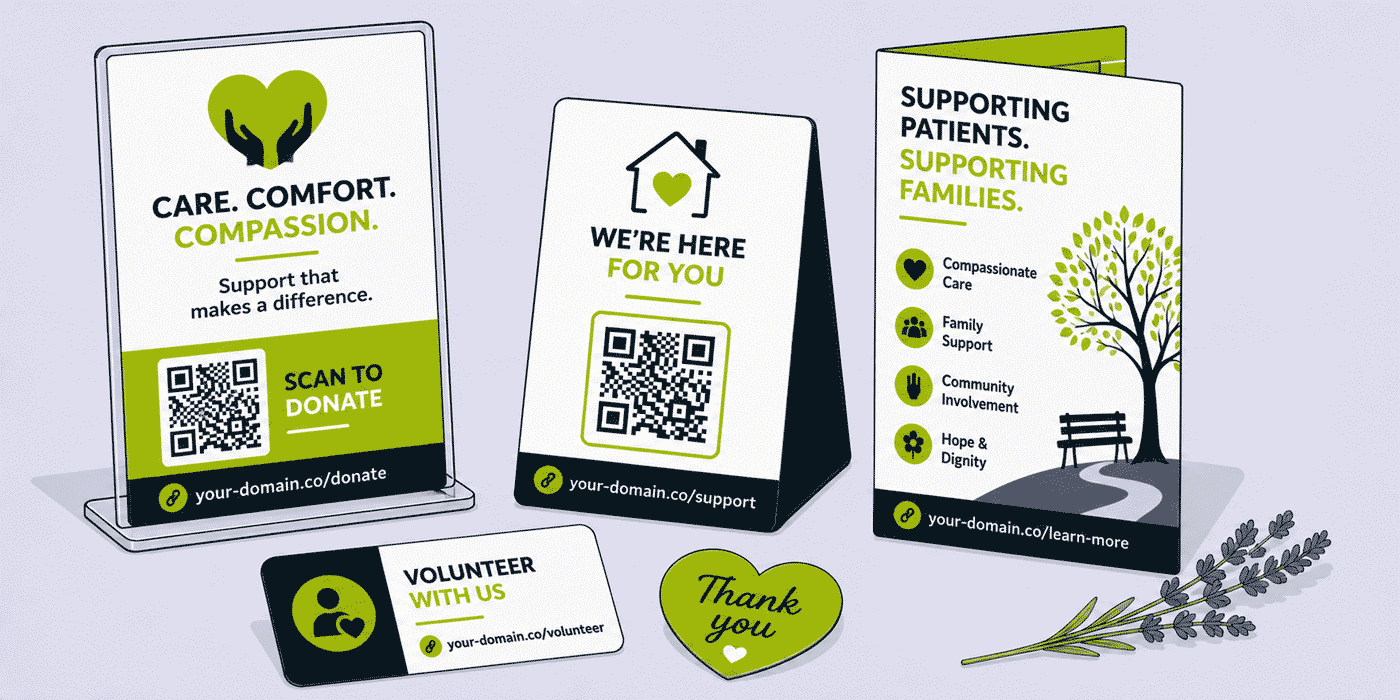
What This Guide Covers
- Family and patient information links — the most sensitive communication context in the guide
- Bereavement support resource links — permanence and accuracy as a duty of care
- Fundraising campaign links — the commercial lifeline of a charitable hospice
- Volunteer recruitment links across clinical, community, and retail roles
- Professional referral pathway communications
- Charity retail shop and online shop links
- Community education and public awareness links
- Legacy giving and planned donation links
- A worked example: a community hospice's full link infrastructure
- Common mistakes in hospice link management
- A Cuttly plan guide for hospices
- Frequently asked questions
Family and Patient Information Links
The information that families and patients receive during a hospice care journey is among the most important written communication any organisation produces. A family arriving at a hospice for the first time — often following a long and difficult illness journey, often in a state of considerable distress and uncertainty — needs clear, accurate, accessible information about what hospice care involves, what to expect, how to access practical support, and what the hospice can and cannot provide. The links through which this information is delivered need to match the care taken in producing the information itself.
Family Welcome Pack Links
Most hospices provide a printed welcome pack to families at the start of a patient's care. This pack typically includes practical information about visiting times, parking, facilities, meals, and the hospice's pastoral and spiritual care offer, alongside clinical information about the care process, comfort measures, and what the family might observe. A QR Code in the welcome pack — or a short URL — linking to the digital version of the family information guide gives families who want to refer to the full information resource on their phone or tablet an accessible path to do so.
A short link for the family information resource — hospice.org.uk/family-guide — must be managed with particular care. It will be accessed by families in extremely difficult emotional circumstances, often on mobile devices, often in the hospice itself or at home during difficult moments. This means the link needs to:
- Always be functional — a broken link to a family information resource causes distress and erodes trust
- Always lead to current, reviewed information — outdated clinical information in a palliative care context is a patient safety concern
- Be on the hospice's own branded domain — a trustworthy, recognisable URL from the organisation the family is relying on
- Be accessible on all devices — short links optimised for mobile access rather than long desktop-oriented URLs
Because hospice family information resources are reviewed and updated periodically as the hospice's service model evolves and as palliative care clinical guidance develops, a dynamic short link ensures that welcome packs given to families at any point in the past continue to reference the current, most accurate family information when accessed later.
Bereavement Support Resource Links
Bereavement support is among the most important services many hospices provide, both to families who have been supported through a patient's care and to the wider community. Bereavement counselling, peer support groups, memorial events, practical guidance on navigating the administrative processes following a death, and signposting to specialist support services are all part of a hospice's bereavement offer. The links through which bereaved families access this support occupy a special category in the hospice's link management infrastructure: they are accessed in some of the most difficult moments of a person's life and must be maintained with absolute reliability.
A permanent short link for the bereavement support page — hospice.org.uk/bereavement — is given to families in the written communication they receive after a patient's death, referenced by clinical staff in bereavement follow-up calls, included in the hospice's online resources, and mentioned in any community communication about the hospice's bereavement offer. This link should be treated with the same governance priority as any other safety-critical resource link: it should be checked regularly, its destination should always reflect current service provision, and any change to the bereavement support offer should be reflected in the link's destination promptly.
The dynamic nature of this link is particularly important because bereavement support services change: group schedules change seasonally, waiting times for counselling change as demand and capacity fluctuate, and the external services the hospice signposts to (such as national bereavement charities and local mental health services) change their own contact details and access routes. A dynamic short link pointing to a regularly maintained bereavement support page ensures that families who were given this link months or years after their bereavement find current, accurate, and accessible support information when they need it.
Fundraising Campaign Links
Most independent hospices in the UK are charitable organisations that receive partial NHS funding but depend significantly on charitable fundraising for their operating budgets. The proportion of funding from charitable sources varies by hospice but is typically between 30% and 70% of total operating costs. This means that effective fundraising is not a supplementary activity but an operational necessity: the hospice's ability to provide care depends directly on its fundraising performance.
Managing fundraising links well — ensuring that donation pages are always accessible, that campaign-specific links are correctly attributed across channels, and that the giving platform references in any historical communication remain functional — is therefore a matter of organisational significance that goes beyond communications convenience.
Permanent Donation Link
A permanent short link for the hospice's primary donation page — hospice.org.uk/donate — features in every supporter communication: the annual fundraising appeal, the monthly donor newsletter, the hospice's social media, the website, the charity retail shop receipts, and any community event presence. Because giving platforms change as the fundraising technology landscape evolves, a dynamic short link ensures this permanent reference always reaches the current, active giving page regardless of how many platform migrations the hospice's fundraising team has undertaken.
Campaign-Specific Fundraising Links
Hospices run multiple fundraising campaigns throughout the year — a memory walk, a light-up a life remembrance event, a Christmas appeal, a spring raffle, a corporate challenge events programme. Each campaign benefits from a dedicated short link:
hospice.org.uk/memory-walk— the annual sponsored memory walk registration and sponsorship pagehospice.org.uk/light-up-a-life— the Christmas remembrance light dedication appealhospice.org.uk/spring-appeal— the direct mail spring fundraising appealhospice.org.uk/corporate— corporate partnership and challenge events programme
Per-channel attribution variants for major campaigns — /memory-walk-email, /memory-walk-social, /memory-walk-poster — give the fundraising team visibility of which channels are generating the most registration and sponsorship page traffic. Because hospice fundraising campaigns are typically run with small teams and limited marketing budgets, evidence of which channels generate the most cost-effective supporter engagement is directly actionable in resource allocation decisions.
The Light Up a Life campaign — common across many hospices — is a remembrance appeal where families and supporters dedicate a light on a Christmas tree in memory of someone they have lost. This campaign sits at the intersection of charitable fundraising and deeply personal grief: it is both a fundraising mechanism and a bereavement support offering. The link for this campaign should reflect the dual purpose: hospice.org.uk/light-up-a-life leading to a page that communicates both the remembrance meaning and the fundraising invitation with appropriate sensitivity and warmth.
Volunteer Recruitment Links
Hospices typically rely on large numbers of volunteers across a wide range of roles: clinical support volunteers who assist with patient care activities under clinical supervision, complementary therapy volunteers, pastoral and spiritual care volunteers, family liaison volunteers, administrative volunteers, fundraising and events volunteers, retail volunteers in the hospice's charity shops, and community education volunteers. Recruiting, managing, and retaining this volunteer workforce is a significant operational requirement that begins with accessible, well-managed recruitment communications.
A permanent short link for volunteer information — hospice.org.uk/volunteer — features in:
- Community communications: local press features, community notice boards, parish magazines, community centre posters
- Social media posts highlighting volunteer opportunities and volunteer stories
- Any corporate partnership communications where employee volunteering opportunities are offered
- University and college communications targeting students seeking volunteering experience relevant to healthcare, social care, and charity sector careers
- Faith community contacts, where volunteering with the local hospice is often seen as a natural extension of community values
Click analytics on the volunteer recruitment link across different channels — aggregated and anonymized — show the volunteer coordinator which community contexts are most effective at generating volunteer interest. A local university partnership that consistently generates volunteer link engagement may justify a more structured volunteer placement programme; a community engagement channel that generates very low engagement despite regular posting may need a different approach.
Professional Referral Pathway Communications
Most hospice admissions arrive through professional referrals from GPs, district nursing teams, hospital palliative care teams, oncology departments, and community health and social care professionals. Ensuring that the healthcare professionals who might refer appropriate patients are aware of the hospice's services, understand the referral criteria, and can access the referral process easily is a key element of the hospice's operational effectiveness.
A short link for the professional referral page — hospice.org.uk/referrals or hospice.org.uk/refer-a-patient — used in communications to local GPs and practice managers, in any materials distributed at integrated care board meetings or palliative care network events, and in the hospice's NHS referral portal communications, gives healthcare professionals a consistent reference to the current referral process. Because referral systems change — from paper referral forms to electronic referral systems to NHS e-Referral Service integration — a dynamic short link ensures the referral reference in any past communication continues to reach the current process.
Charity Retail and Online Shop Links
Many hospices operate a network of charity retail shops and an online donation shop that are significant fundraising revenue streams. These shops accept donated goods, clothing, books, and household items, and sell them to generate charitable income. A short link for the hospice's online shop — hospice.org.uk/shop — and for the donation of goods — hospice.org.uk/donate-goods — features in the hospice's community communications, in social media posts about the retail programme, and in any materials distributed in the community that promote the charity retail operation.
Because charity retail platforms, online auction tools, and donation booking systems change over time, dynamic short links for the retail and goods donation references ensure every community communication that mentions the hospice's retail programme continues to direct the reader to the current, active platform.
Legacy Giving and Planned Donation Links
Legacy giving — leaving a gift to the hospice in a will — is the single most financially significant form of charitable giving for most hospices, typically accounting for a substantial proportion of the hospice's total income in any year where legacy gifts are received. Communicating the legacy giving opportunity appropriately — with sensitivity, without pressure, and with the genuine personal significance of end-of-life philanthropy understood and respected — is one of the most important and most delicate areas of hospice fundraising.
A short link for the legacy information page — hospice.org.uk/legacy or hospice.org.uk/in-your-will — used in the hospice's supporter newsletter, in printed legacy information brochures given to long-term supporters and to families who have expressed an interest in legacy giving, and in any communication from the hospice's fundraising team to legacy prospects, needs to carry the same weight and credibility as the communication itself. A branded link on the hospice's own domain is the only appropriate format for a communication that asks a supporter to consider a gift that may represent the most personally significant charitable decision of their lifetime.
Because legacy information resources are updated as legislation changes, as the hospice's gift acceptance policy evolves, and as estate planning advice changes, a dynamic short link for the legacy page ensures that legacy prospects who were given this reference months or years earlier always find current, accurate information when they return to it.
Community Education and Public Awareness Links
Many hospices have a significant public education and community engagement mission: providing information about palliative care, about dying and death, about how to talk to children about death, about advance care planning, and about the full range of support that hospices and palliative care services offer. This public education work challenges the widespread misconception that hospices are places people go only in the very final days of life, and builds community understanding of palliative care that supports both appropriate referral and community fundraising.
Short links for community education resources — hospice.org.uk/what-is-palliative-care, hospice.org.uk/advance-care-planning, hospice.org.uk/talking-about-dying — used in community communications, in social media content addressing end-of-life topics, in any media coverage of the hospice's education work, and in materials distributed at community events and healthcare professional networks, provide consistent, findable references to the hospice's public education resources.
A Worked Example: A Community Hospice's Link Infrastructure
Consider a community hospice with a 16-bed inpatient unit, a hospice-at-home service serving 180 patients per year, eight charity retail shops, and a fundraising income of approximately £3.2 million per year from a combination of NHS funding and charitable sources, using a branded domain such as hospice.org.uk, connected through Cuttly's custom domain setup (an A record and a TXT record — see the custom domain setup guide).
Memory Walk fundraising campaign: The hospice's largest annual fundraising event, a sponsored memory walk in September, is promoted through email to 14,000 supporters, social media, GP surgery and pharmacy waiting area posters, and local press coverage. Per-channel short links: /memory-walk-email, /memory-walk-social, /memory-walk-poster, /memory-walk-press. After four weeks of promotion: email generates 2,840 registration page clicks (highest volume — established supporter database), posters in GP and pharmacy settings generate 1,240 clicks (strong community reach for a relatively low distribution effort), social media generates 980 clicks, press coverage generates 340 clicks. The fundraising team increases poster distribution to more GP surgeries for the following year's campaign, targeting practices in areas with lower registration rates.
Bereavement support link maintenance: The hospice establishes a quarterly governance review of the bereavement support short link destination, checking that all bereavement support resources referenced on the destination page are current, that all third-party support service links are functional, and that waiting times and availability information is accurate. This review is built into the clinical governance calendar alongside clinical case reviews and quality audits. The link — /bereavement — is tested from multiple devices each quarter and the result recorded.
Legacy programme: The /legacy link is introduced into the hospice's annual supporter newsletter (sent to 6,800 households) for the first time, with a one-page feature on the importance of legacy gifts to the hospice's future. In the six months following the newsletter, the legacy information page receives 840 visits from the newsletter link — significantly more than the legacy page had received in total in the preceding year from organic web traffic. Three legacy pledge conversations result from outbound calls to supporters who clicked the legacy link and had previously indicated an interest in legacy giving.
Common Mistakes in Hospice Link Management
No Governance Protocol for Bereavement and Support Resource Links
A hospice that treats its bereavement support link as a standard operational link — created, left to function, and only updated when something breaks — is failing in its duty of care to bereaved families. Bereavement and support resource links should be subject to a formal governance review process that verifies both the technical functionality of the link and the accuracy and currency of the information it leads to. This is a clinical governance matter, not merely a communications operations matter.
Family Information Welcome Pack Links That Break at Website Migrations
A hospice that prints raw website URLs in its family welcome packs creates a communication quality problem at every website migration. Families who refer to a welcome pack given to them months earlier — sometimes in very difficult circumstances — and find a broken link lose confidence in the hospice's operational care standards at a moment when that confidence is particularly important. Dynamic short links in all printed family information materials protect communication quality through every digital infrastructure change.
Donation Platform Migration Without Link Update
A hospice that changes its charitable giving platform without updating its permanent donation short link breaks every existing fundraising reference simultaneously: the donate button on the website, every past email, every social media post, every printed appeal letter still in supporters' homes. A dynamic short link for the donation page updated on migration day protects the entire accumulated supporter communication investment through every platform change.
Cuttly Plan Guide for Hospices
- The Free plan ($0) provides 30 short links per month, one branded custom domain, full click analytics, dynamic QR Codes and a survey tool, with no credit card required. Sufficient for most hospices establishing core family information, bereavement support, donation, and volunteer recruitment links. The free plan covers the needs of the majority of hospices without any financial commitment.
- The Starter plan ($12/month) adds 300 short links per month and 30 custom aliases per month — practical for a hospice with an active fundraising events calendar, per-channel campaign attribution, charity retail links, professional referral communications, and community education links throughout the year.
- The Single plan ($25/month) adds up to 5 branded domains for hospice groups or networks managing multiple hospice sites, fully customizable QR Codes for professional family information and wayfinding displays, and a full year of analytics history for fundraising campaign and community engagement performance comparison.
- The Team plan ($99/month) suits larger hospice organisations, hospice networks, or national palliative care charities with fundraising, clinical communications, retail, and volunteer teams sharing link management across multiple sites and programmes.
Create a free Cuttly account to set up your hospice's family information links, your donation short link, your bereavement support resource link, and your volunteer sign-up link. Registration is required for all plans, including free. No credit card is needed for the free plan.
Frequently Asked Questions
How do hospices use short links for family and carer information?
A hospice creates branded short links for family information resources — welcome guides, what to expect, visiting information — distributed in printed welcome packs and referenced in family communications. Because family information is regularly updated as clinical guidance and service provision evolves, dynamic links ensure every reference reaches current, accurate information. These links should be subject to regular accuracy review as a governance priority.
How do hospices use short links for fundraising campaigns?
A hospice creates a permanent donation short link and per-campaign links for major fundraising events — memory walks, light-up-a-life appeals, spring and Christmas fundraising. Per-channel attribution gives the fundraising team visibility of which channels generate the most supporter engagement. Dynamic links survive every giving platform migration, protecting the entire accumulated fundraising communication investment.
How do hospices use short links for volunteer recruitment?
A hospice maintains a permanent volunteer information short link used in community communications, social media, and corporate partnership materials. Click analytics show which channels generate the most volunteer interest, informing community engagement investment. Clear, accessible volunteer links from trusted hospice domains reduce the barrier for community members considering volunteering for the first time.
How do hospices use short links for bereavement support resources?
A hospice maintains a permanent bereavement support short link — hospice.org.uk/bereavement — subject to formal quarterly governance review of both technical functionality and content accuracy. Bereavement links must be always functional and always current. A broken bereavement support link is a failure of care. Dynamic links survive every platform change; the governance review ensures the destination content itself remains accurate and helpful.
How do hospices use short links for referral pathway communications?
A hospice uses a permanent professional referral short link — hospice.org.uk/referrals — in communications to GPs, district nurses, and hospital palliative care teams. Because referral systems change, a dynamic link ensures every existing professional communication continues to reach the current referral process. Accessible, clearly signposted referral links support appropriate and timely patient referrals to hospice services.
- Get Started
- Create Free Account
- Plans & Pricing
- Platform Tools
- URL Shortener
- Link Analytics
- QR Code Generator
- Survey Tool
- Related Guides
- URL Shortener for Hospitals
- URL Shortener for Senior Care
- URL Shortener for Telehealth
- URL Shortener for Charity Events
- URL Shortener for Churches
- Encyclopedia
- Dynamic QR Codes
- Branded Links
- Setup Guides
- Custom Domain Setup
- Track Link Clicks
- Industry Hub
- Healthcare & Medical
- All Industries →
URL Shortener
Cuttly simplifies link management by offering a user-friendly URL shortener that includes branded short links. Boost your brand’s growth with short, memorable, and engaging links, while seamlessly managing and tracking your links using Cuttly's versatile platform. Generate branded short links, create customizable QR codes, build link-in-bio pages, and run interactive surveys—all in one place.
Cuttly - Consistently Rated
Among Top URL Shorteners
Cuttly isn’t just another URL shortener. Our platform is trusted and recognized by top industry players like G2 and SaaSworthy. We're proud to be consistently rated as a High Performer in URL Shortening and Link Management, ensuring that our users get reliable, innovative, and high-performing tools.C


