URL Shortener for Music Venues The Complete Guide
A music venue's commercial model is built on one deceptively simple equation: fill the room, as often as possible, with people who are happy to be there and will come back. Everything the venue does — its programming decisions, its marketing, its bar operation, its technical production, its relationship with artists, and its community presence — serves this equation. The links through which tickets are sold, through which audiences are informed about upcoming shows, through which artists collaborate on promotion, and through which the venue builds an ongoing relationship with its community are the digital infrastructure that either supports or undermines this model at every point of contact.
This guide covers how music venues — grassroots club venues, mid-size concert halls, arenas, outdoor amphitheatres, pub music rooms, and any space that hosts live music as a primary or significant commercial activity — use a URL shortener, branded custom domain, dynamic QR Codes and click analytics across ticket sales, presale and mailing list management, show-by-show promotion, artist collaboration links, in-venue QR Code programmes, membership schemes, and the audience relationship management that keeps people coming back to the next show.
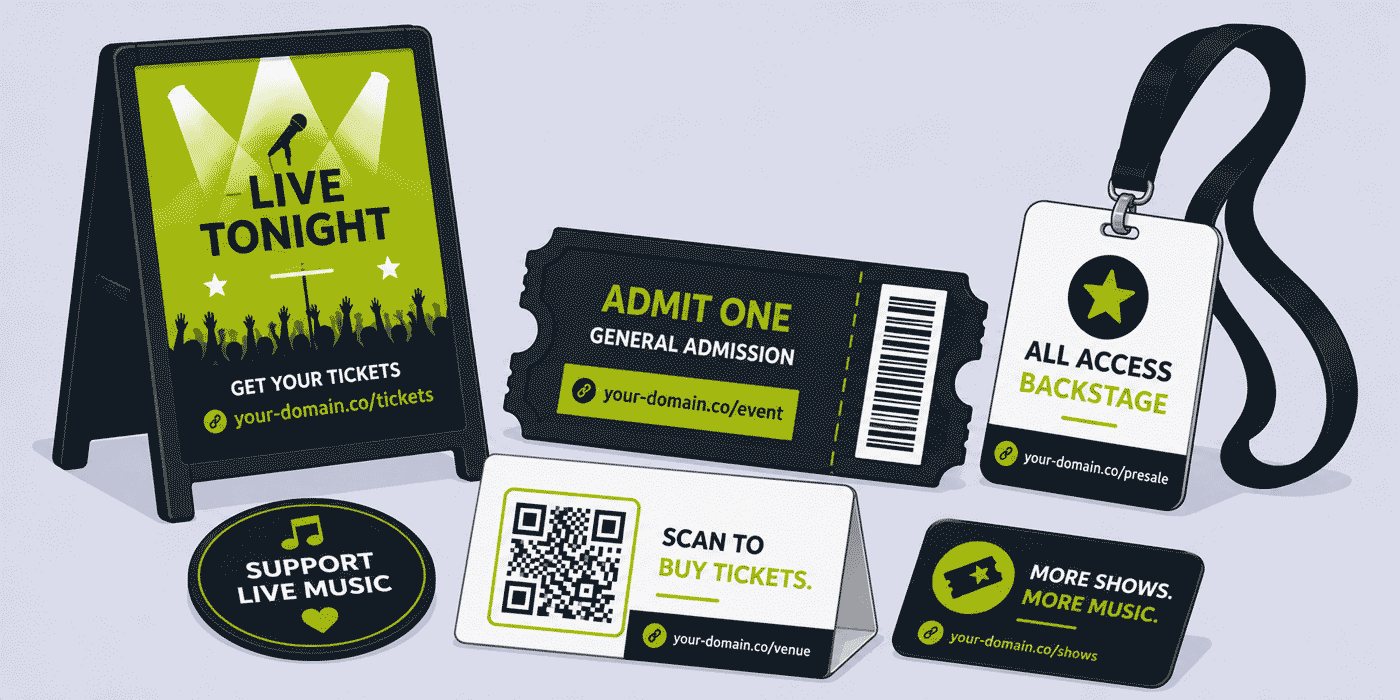
What This Guide Covers
- Per-show ticket links — professional, stable, and attributable across every promotional channel
- Mailing list and presale sign-up links — the venue's most valuable owned asset
- Per-channel show promotion attribution
- Artist promotion collaboration links
- In-venue QR Codes — converting the live experience into ongoing audience relationships
- Membership and loyalty scheme links
- Programming announcement and season links
- Merchandise links
- Press and media links for show listings and features
- A worked example: an independent mid-size venue's show promotion link stack
- Common mistakes in music venue link management
- A Cuttly plan guide for music venues
- Frequently asked questions
Per-Show Ticket Links
The ticket page link for a specific show is the most commercially significant link in any music venue's communications. Every promotional activity — every social media post, every email newsletter mention, every artist Instagram story, every listings website entry, every press mention, every poster or flyer — ultimately serves a single commercial purpose: driving someone to click this link and buy a ticket. Managing it well is not optional.
The Ticketing Platform Migration Problem
Music venues change their ticketing platforms more frequently than audiences or artists realise. The ticketing technology landscape for venues — DICE, Skiddle, Eventbrite, Ticketweb, Ticketmaster, Tixel, and numerous others — is competitive and evolving, and venues regularly renegotiate or change their ticketing partner as fee structures, features, and relationships evolve. Each migration typically changes the URL format for all show ticket pages.
For an active venue promoting two to four shows per week, the ticket page URL appears across hundreds of social media posts, dozens of email newsletters, multiple press listings, and various poster and flyer designs each year. When the ticketing platform changes, all of these historical references point to the old platform's URL structure, which no longer works. A dynamic short link for each show's ticket page — your-venue.com/show-artist-date — updated when the platform changes, ensures every existing reference continues to reach the current ticket page.
Show Ticket Link Naming Convention
A consistent naming convention for show ticket links makes the venue's link library navigable and makes the links themselves informative to the audience:
your-venue.com/tickets-artist-name— clear, memorable, mentionable in a social captionyour-venue.com/jan25-artist— date-prefixed, useful for a venue with multiple shows close togetheryour-venue.com/show-ref— internal reference-based, for venues with a high volume of shows per week
The first format — artist name in the slug — is most appropriate for headline shows where the artist's name is the primary draw. A social media caption that ends with "tickets at your-venue.com/tickets-radiohead" is clean, informative, and typeable from memory if someone hears it mentioned. A raw ticketing platform URL that wraps across two lines in a caption and includes a string of alphanumeric event identifiers is none of these things.
Show Announcement and On-Sale Management
For shows with a presale period before general on-sale, the short link's dynamic nature enables a two-stage announcement structure that manages information release professionally:
- Announcement day: The short link destination is a "show announced — add to presale list" page that captures interested buyers for the presale communication rather than allowing general sale immediately. This page generates mailing list sign-ups from people who are specifically interested in this show.
- Presale day: The short link destination updates to the ticket page, and an email goes to presale sign-ups giving them early access. The social media posts and other materials from announcement day now all resolve directly to the ticket page.
- General on-sale: No change to the short link — it continues to point to the ticket page for all channels.
- Sold out: The short link destination updates to a "this show is sold out — see more upcoming events" page that redirects sold-out interest toward other available tickets rather than a dead end.
Mailing List and Presale Sign-Up Links
A music venue's mailing list is its most commercially valuable owned asset. An email subscriber who has opted in to receive show announcements is demonstrating a level of engagement with the venue that no social media follower count can match: they have actively requested to be told about upcoming shows, they are likely to open the email, and they are highly predisposed to purchase tickets when a show they want to see is announced.
The commercial case for investing in mailing list growth is strong: an email to 12,000 subscribers announcing a presale for a popular artist typically generates more first-hour ticket sales than all social media and paid advertising channels combined. A venue that has been growing its list consistently for several years has a significant and compounding commercial advantage over one that relies primarily on social media reach.
Mailing List Short Link
A permanent, prominently featured short link for the mailing list sign-up — your-venue.com/list or your-venue.com/join — goes in:
- The venue's Instagram, TikTok, Facebook, and Twitter/X bios
- Every show announcement social post: "Tickets on sale Friday — sign up at your-venue.com/list to get presale access"
- In-venue QR Codes at the bar, at the merchandise stand, and near the entrance
- Every email footer: "Know a music lover? Tell them to sign up at your-venue.com/list"
- The venue's Google My Business profile
Click analytics on the mailing list sign-up link show the venue's marketing team which channels and which content contexts are most effective at driving list growth. A show announcement post that includes the mailing list CTA consistently generates more sign-ups when the presale benefit is clearly communicated ("sign up for presale access — before tickets go on general sale") than when the benefit is vague ("sign up for news and updates"). Per-post analytics reveal which framing is most effective.
Per-Channel Show Promotion Attribution
A venue promoting a show across its email list, Instagram, Facebook, TikTok, the artist's social channels, local press listings, and any paid advertising benefits from per-channel attribution to understand which promotional efforts are generating the most ticket page traffic. Without this data, the marketing team cannot compare the return on promotional investment across channels or make evidence-based decisions about where to concentrate effort for future shows.
Per-Channel Attribution Structure
For each show, a per-channel ticket link set:
your-venue.com/show-email— newsletter to mailing list subscribersyour-venue.com/show-instagram— Instagram posts and Storiesyour-venue.com/show-facebook— Facebook event and postsyour-venue.com/show-artist— provided to the artist for their own promotionyour-venue.com/show-press— press listings and editorial features
Click analytics per channel, aggregated and anonymized, give the venue's marketing team a data-driven picture of show promotion efficiency. Over multiple shows of comparable size and genre, the pattern shows which channels are consistently most effective at driving ticket page traffic — and when combined with the ticketing platform's own sales data, which channels send the most purchase-motivated audiences.
For a grassroots venue with limited marketing resources, this data is particularly valuable: it allows the team to concentrate their most limited resource — time — in the channels that demonstrably convert to ticket sales, rather than spreading effort uniformly across every platform.
Artist Promotion Collaboration Links
Every artist who performs at a venue has their own fanbase, and that fanbase represents a potential audience for the show that the venue cannot reach through its own channels alone. When an artist promotes their upcoming show at the venue through their own Instagram, their newsletter, or their social media, they are reaching fans who may not follow the venue at all. For a venue building its audience, this artist-generated promotion is commercially significant.
Artist-Specific Promotion Links
Providing each performing artist with a dedicated short link for their show's ticket page — your-venue.com/show-artist-promo — that the artist shares in their own promotional posts serves two commercial purposes simultaneously:
- Attribution. Click analytics on the artist promotion link show the venue how much ticket traffic the artist's own promotional activity is generating, completely separately from the venue's own marketing. An artist who generates 800 ticket page clicks through their own Instagram promotion is demonstrably contributing to the show's commercial success in a way that the venue can now quantify.
- Audience development. People who click the ticket page through an artist's promotion and purchase tickets are arriving via an introduction to the venue through the artist, not through the venue's own marketing. The venue benefits by converting these new visitors into mailing list subscribers and returning audience members, capturing the artist's fanbase attention and expanding its own community.
The attribution data from artist promotion links is also useful in programming conversations: an artist whose promotion generates high ticket traffic justifies a stronger commercial offer on their return to the venue; one whose promotion generates minimal independent traffic is relying more heavily on the venue's own marketing to fill the room, which should be reflected in the deal structure.
In-Venue QR Codes
A music venue has the most valuable possible audience for its own promotional QR Codes: people who are already there, are actively enjoying a live music experience, and are by definition interested in attending live music events. A person at a show who discovers that the venue has an excellent upcoming events calendar and a mailing list that gives them presale access is precisely the person who should be on that list. In-venue QR Codes convert the live experience into an ongoing relationship.
Bar and Merchandise QR Codes
QR Codes placed where audience members spend time during a show — at the bar, at the merchandise stand, near the entrance, in the toilets — need to be immediately relevant to the context:
- Bar area:
your-venue.com/list— "Join our mailing list for presale access to shows like this one." A person enjoying a drink and feeling positively toward the venue and the music is in the optimal state for a mailing list sign-up invitation. - Merchandise stand:
your-venue.com/upcoming— the venue's upcoming events calendar. A fan who has come to see one artist and is enjoying the experience naturally wants to know what else the venue has coming up. - Entrance area:
your-venue.com/follow— a link to all the venue's social media profiles, for people who want to follow the venue across platforms after a positive first experience.
All in-venue QR Codes are generated from dynamic short links. The bar QR Code displayed tonight will still be on the same physical display in two years; the mailing list platform, the events calendar system, and the social media landscape may all have changed by then. Dynamic QR Codes ensure every in-venue display continues to serve its current, correct destination throughout its physical lifespan.
Membership and Loyalty Scheme Links
An increasing number of music venues — particularly independent venues that cannot compete with corporate-backed operators on marketing budget — are developing membership schemes that offer regular attendees early ticket access, discounts, priority bar service, and community benefits in exchange for an annual fee. These schemes convert casual attendees into committed venue supporters with a predictable recurring revenue dimension.
A short link for the membership sign-up — your-venue.com/membership or your-venue.com/friends — features prominently in the venue's email communications, in social media posts about the membership benefits, and in in-venue QR Codes. Because membership scheme platforms change, a dynamic short link ensures the membership sign-up reference in any historical communication continues to reach the current sign-up page.
Click analytics on the membership link, per communication channel, show the venue which touchpoints are most effective at converting regular attendees into paid members. If the most effective membership sign-up channel is the in-venue QR Code (from people who are physically experiencing the venue's quality and feel most motivated at that moment), the venue can invest in better QR Code placement and messaging to increase membership conversion from the in-venue audience.
Programming Announcement and Season Links
Larger venues that programme seasons of events — an autumn and winter programme, a summer festival series, an annual residency by a particular artist or genre — benefit from season-level short links that give the full programming announcement a single, consistent reference across all announcement channels.
A season announcement short link — your-venue.com/autumn-programme or your-venue.com/2026-2027 — used in the press release, in the email newsletter announcement, in social media posts, and in any print advertising for the season, provides a clean reference to the full programme. As tickets go on sale for individual shows within the season, the season page is updated to reflect availability, and the season short link always leads to the current, accurate season overview rather than stale information.
A Worked Example: An Independent Mid-Size Venue's Show Promotion
Consider an independent music venue with a 600-capacity main room, a 200-capacity second stage, and a programme of 180 shows per year across both spaces, using a branded domain such as your-venue.com, connected through Cuttly's custom domain setup (an A record and a TXT record — see the custom domain setup guide).
Show announcement — headline artist with 18,000 Instagram followers: Ticket link /tickets-artist-name with per-channel attribution: /artist-email, /artist-instagram, /artist-facebook, /artist-artist-promo (provided to the artist for their social media). Announcement day analytics: artist's own promo link generates 1,240 clicks in the first 4 hours (the artist's Instagram audience is clearly engaged and ticket-buying), venue email generates 840 clicks (12,000 list members, 7% click rate), venue Instagram generates 310 clicks. The artist's own promotion drives more first-day ticket traffic than the venue's entire email list — a finding that significantly raises the artist's perceived commercial value to the venue.
Ticketing platform migration: Midway through the year, the venue moves from Skiddle to DICE. All 94 upcoming show ticket links need to have their destinations updated — a process that takes the venue's marketing coordinator 40 minutes using the link management dashboard. Every historical social media post, every email archive, every press listing, and every poster with a QR Code for any of the 94 shows continues to work correctly without any further intervention.
In-venue mailing list programme: The venue installs branded QR Code displays at all four bar positions and at the merchandise stand, all linking to /list. After three months: average of 34 new mailing list sign-ups per show night from in-venue QR Code scans, generating approximately 6,100 new subscribers over the quarter. The mailing list grows from 10,400 to 16,500 subscribers in three months, and the following quarter's presale email to the larger list generates 23% more first-day ticket sales than the previous quarter's equivalent.
Common Mistakes in Music Venue Link Management
Ticketing Platform URLs Directly in Social Media and Email
A venue that shares raw ticketing platform URLs in its show announcement social posts and emails creates a broken link problem at every platform migration, and a presentation problem at every show announcement. Long ticketing platform URLs — often containing event codes and tracking parameters — look unmemorable and unprofessional in a social caption. Branded short links for every show ticket page are the professional standard for any venue that values its audience's experience of its communications.
No Per-Channel Ticket Attribution
A venue that uses a single ticket link across email, social media, and artist promotion cannot compare which channels are most effective at driving ticket sales. Given that artist-generated promotion frequently outperforms venue marketing for shows by artists with large engaged fanbases, the absence of per-channel attribution means the venue does not know how much of its promotional work is being done by the artist — commercial intelligence that should inform deal structures and programming decisions.
No In-Venue Mailing List QR Code Programme
A venue whose bar areas, merchandise stand, and entrance contain no mailing list sign-up QR Codes is missing the highest-intent mailing list acquisition audience available to it: people who are already at the venue, enjoying a show, and are by definition interested in live music. The incremental cost of a well-placed QR Code display is minimal; the compounding commercial value of the mailing list subscribers it generates over years of operation is significant.
Cuttly Plan Guide for Music Venues
- The Free plan ($0) provides 30 short links per month, one branded custom domain, full click analytics and dynamic QR Codes, with no credit card required. Suitable for a small venue or pub music room setting up core show ticket links and a mailing list sign-up link.
- The Starter plan ($12/month) adds 300 short links per month and 30 custom aliases per month — practical for an active independent venue programming 8 to 15 shows per month, managing per-show per-channel attribution, artist promotion links, in-venue QR Codes, and membership scheme links throughout the year.
- The Single plan ($25/month) adds up to 5 branded domains for venue groups or music organisations managing multiple spaces, customizable QR Codes for professional in-venue displays, 1,000 API-created links per month for automated per-show link generation, and a full year of analytics history for show-by-show channel performance comparison.
- The Team plan ($99/month) suits larger venues or venue chains with programming, marketing, and bar and events teams sharing link management, Campaign tag analytics for aggregated show and season portfolio reporting, and multiple branded domains for different venue brands within a group.
Create a free Cuttly account to set up your venue's first show ticket link, your mailing list sign-up link, and your in-venue QR Codes. Registration is required for all plans, including free. No credit card is needed for the free plan.
Frequently Asked Questions
How do music venues use short links for ticket sales?
A music venue creates a branded short link per show — your-venue.com/tickets-artist-name — used consistently across every promotional channel. Because ticketing platforms change, a dynamic link ensures every existing promotional reference continues to reach the current ticket page. The show lifecycle is managed through the same short link: announcement, presale, general sale, and sold-out redirects all handled by updating the destination.
How do music venues use short links for mailing list and presale sign-ups?
A venue maintains a permanent short link — your-venue.com/list — in every bio, every social post, every email footer, and every in-venue QR Code. The mailing list is the venue's most commercially valuable owned asset; a presale email to subscribers consistently outperforms general on-sale channels in first-hour ticket sales. Click analytics show which content contexts drive the most sign-up link engagement.
How do music venues use QR Codes inside the venue?
A music venue places dynamic QR Codes at the bar, merchandise stand, and entrance, linking to the mailing list sign-up, upcoming events calendar, and social media profiles. People enjoying a show are the highest-intent mailing list acquisition audience available. Because in-venue displays remain for years, dynamic QR Codes ensure destinations stay current through every platform change without physical replacement.
How do music venues track which promotional channel sells the most tickets?
A venue creates per-channel ticket links — email, Instagram, Facebook, artist promo — all pointing to the same ticket page. Click analytics per channel combined with sales data reveal not only which channels drive the most traffic but which send the most purchase-motivated audiences. Artist-generated promotion frequently outperforms venue marketing for shows by artists with large fanbases, a finding that should influence programming deals and artist relationship management.
How do music venues use short links for artist promotion and collaboration?
A venue gives each performing artist a dedicated promotion link — your-venue.com/show-artist-promo — for the artist to share with their own fanbase. Click analytics on the artist promotion link quantify exactly how much ticket traffic the artist's own promotion generates, separately from the venue's marketing. This attribution data directly informs programming decisions, deal structures, and the commercial value of an artist's fanbase engagement to the venue's business.
- Get Started
- Create Free Account
- Plans & Pricing
- Platform Tools
- URL Shortener
- Link Analytics
- QR Code Generator
- Survey Tool
- Related Guides
- URL Shortener for Comedy Clubs
- URL Shortener for Stadiums & Arenas
- URL Shortener for Sports Events
- URL Shortener for Restaurants
- URL Shortener for Trade Shows
- Encyclopedia
- Dynamic QR Codes
- Branded Links
- Setup Guides
- Custom Domain Setup
- Track Link Clicks
- Industry Hub
- Food, Hospitality & Lifestyle
- All Industries →
URL Shortener
Cuttly simplifies link management by offering a user-friendly URL shortener that includes branded short links. Boost your brand’s growth with short, memorable, and engaging links, while seamlessly managing and tracking your links using Cuttly's versatile platform. Generate branded short links, create customizable QR codes, build link-in-bio pages, and run interactive surveys—all in one place.
Cuttly - Consistently Rated
Among Top URL Shorteners
Cuttly isn’t just another URL shortener. Our platform is trusted and recognized by top industry players like G2 and SaaSworthy. We're proud to be consistently rated as a High Performer in URL Shortening and Link Management, ensuring that our users get reliable, innovative, and high-performing tools.C


