URL Shortener for Sports Coaches and Athletic Trainers: The Complete Guide
The sports coaching profession has undergone a significant transformation in how coaches build and communicate their expertise. A generation ago, a coach's reputation was built almost entirely through word of mouth within the sport — a good result with a team, a recommendation from a respected figure, a CV that circulated through the right networks. Today, the most effective coaches also have a professional digital presence: a website that articulates their coaching philosophy, social media profiles that share their expertise publicly, a LinkedIn profile that positions them within the sports science and performance community, and — increasingly — digital content and resources that demonstrate their approach before a club or athlete makes first contact. Every link in this digital ecosystem is a signal. A URL shortener with a coach's own branded domain makes every link in every communication consistent, professional, and trackable — from the first pitch to a club's board of directors to the training plan sent to an athlete on the morning of a competition.
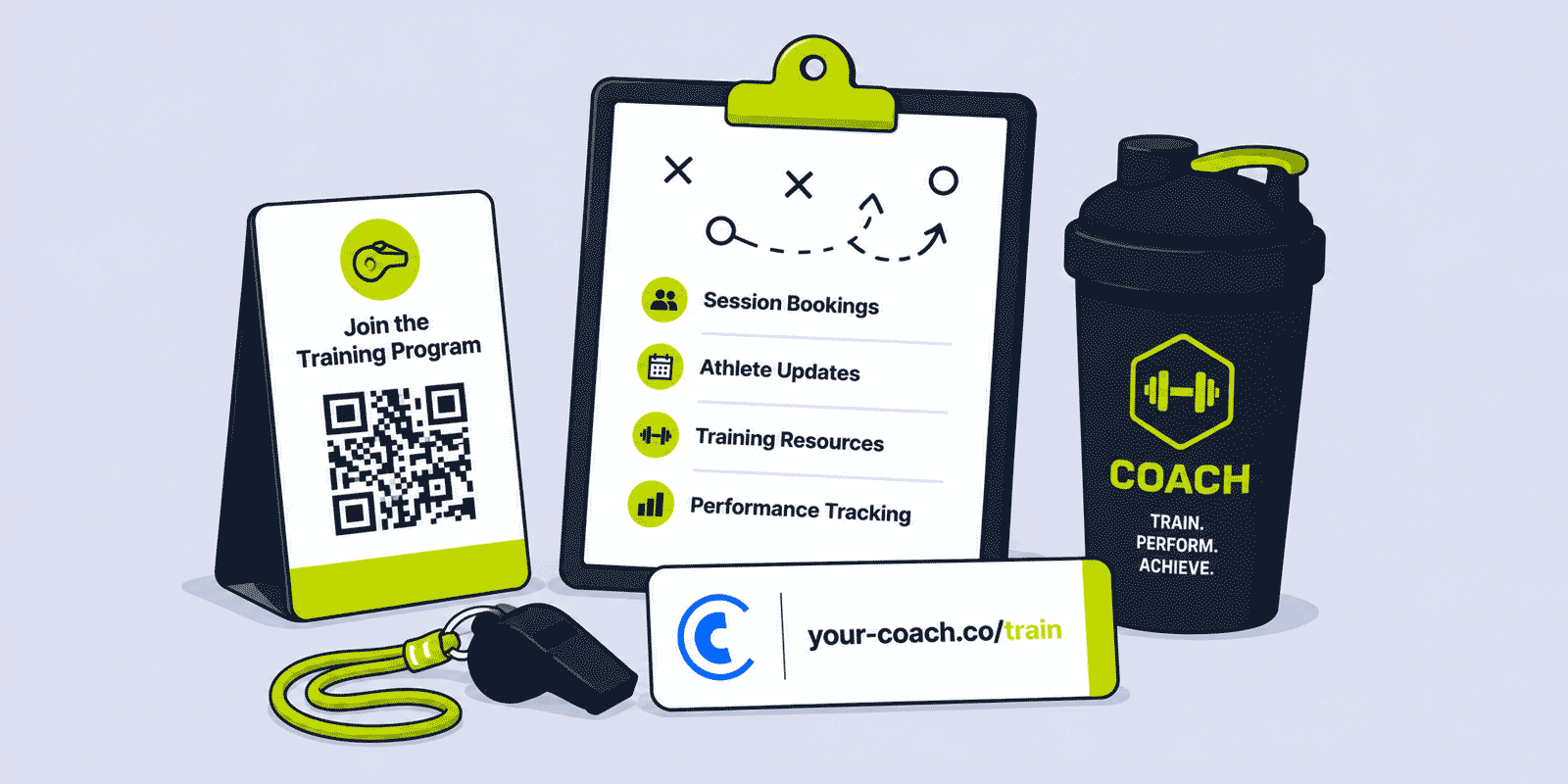
What This Guide Covers
- Why professional credibility is the central challenge in high-level coaching
- The coaching inquiry and contract pitch: highest-value link destinations
- Training plans and program documentation: sharing athlete resources
- Video analysis and technique review links
- QR Codes on printed session plans and training materials
- Club and academy contract acquisition: tracking which channels work
- Online coaching programs and remote athlete management
- Coaching clinics, camps, and masterclasses: event promotion and registration
- LinkedIn: the most important social platform for high-level coaches
- Instagram and TikTok: building public coaching authority
- Athlete performance data and monitoring resources
- CPD and professional development portfolio
- Strength and conditioning: gym and facility-based coaching contexts
- Periodization documentation and annual planning resources
- Youth sport and academy pathway coaching
- Link in Bio for coaching social profiles
- Which Cuttly plan is right for a sports coach
Why Professional Credibility Is the Central Challenge in High-Level Coaching
Sports coaching is a profession with a significant credibility hierarchy. At the elite level, credentials include coaching qualifications (Level 3/4 coaching awards, UKSCA, NSCA-CSCS, NCSA credentials, UEFA coaching licenses, or sport-specific national governing body qualifications), experience at relevant levels of competition, and a documented track record of athlete development and performance outcomes. At the amateur and youth development level, the hierarchy is similar but the audiences are different — parents and club officials rather than performance directors and national governing bodies.
In both contexts, the challenge is the same: how does a coach communicate their expertise, methodology, and track record to a club, academy, athlete, or parent who does not yet know them? The answer, increasingly, is through a professional digital presence — and through the quality of the materials and communications the coach produces. A coach whose digital presence is polished, whose training documentation is professionally presented, and whose communications use consistent branded links is signaling the same level of professionalism as their coaching methodology.
This is especially true for coaches seeking to move up the coaching hierarchy — from grassroots to academy, from regional to national, from club coaching to specialist performance roles. At each level, the competition intensifies and the scrutiny of professional presentation increases. A coach who presents their methodology through a well-designed website with clean, branded short links to their documented frameworks and case studies is presenting more professionally than a competitor who emails raw Google Drive URLs or sends a PDF from a generic platform domain.
The practical argument: branded short links in every piece of coaching communication — go.coachname.com/programme, links.coachingbrand.com/analysis — reflect the same attention to professional detail that characterizes excellent coaching practice.
The Coaching Inquiry and Contract Pitch: Highest-Value Links
For an independent sports coach or athletic trainer, the primary conversion goals are: a new private athlete signed up for a program, a club or academy retained as a client, a performance role secured, or a coaching clinic booking confirmed. Each of these outcomes begins with some form of initial contact — a website inquiry, a LinkedIn message, a referral from a colleague, or a cold approach to a club's coaching staff.
The short link to the coaching inquiry form or the "work with me" page is the most important link the coach manages from an acquisition perspective. It should appear on: the coach's website in the most prominent position, the email signature in every professional communication, the LinkedIn profile, every social media bio (via Link in Bio), and any professional presentation or speaking materials.
Create separate tracked short links per acquisition channel — all routing to the same inquiry page. One for the LinkedIn profile, one for the email signature, one for the Instagram bio, one for the conference exhibition stand display card, one for the referral from a fellow coach or sports scientist. Monthly analytics review shows which channels are generating the most active coaching inquiry interest. A sports science conference that generates 15 inquiry link clicks in the week following the event is more productive than one that generates 2 — data that informs conference attendance decisions.
For club and academy contract pitches — a formal presentation to a club's board or performance committee — a short link to the coach's pitch documentation, methodology overview, or case study portfolio can be included in the pitch itself: a QR Code on the final slide of a presentation, or a short link in the follow-up email after the meeting. Analytics show whether the club's decision-makers clicked through to review the documentation — a signal that active consideration is ongoing even if formal communication has slowed.
Training Plans and Program Documentation
Sports coaches produce significant volumes of documentation: periodized training programs, individual athlete plans, session-by-session drill sequences, recovery protocols, nutrition guidance, competition preparation plans, and end-of-season reviews. This documentation is the primary tangible output of coaching expertise — the written expression of the coach's methodology, translated into an athlete's specific program.
Sharing this documentation professionally matters both operationally and for reputation. A training program sent as a clean branded short link — go.coachname.com/athlete-plan-q3 or links.coachingbrand.com/session-12 — presents the coach's work with the same professionalism as the work itself. The athlete or club receives a link on the coach's domain, not a raw Google Drive URL or a Dropbox link that may expire or change.
The dynamic nature of Cuttly short links is operationally important here. Training programs evolve — a plan that was appropriate at the start of a macrocycle may need modification following a competition result, an injury, or a change in competitive priorities. If the coach updates the plan document and uploads a new version (to Google Drive, a PDF hosting service, or a coaching software platform), updating the Cuttly short link destination takes seconds. The athlete or club's bookmarked link continues to work, now routing to the current version of the plan.
For coaches who produce a library of documented methodologies, exercise reference guides, or coaching frameworks — resources they share with athletes, clubs, and other coaches — a stable short link per resource creates a citable reference: go.coachname.com/periodization-framework can be referenced in coaching presentations, articles, and CPD materials as a stable URL that will always route to the current version of the document.
Video Analysis and Technique Review Links
Video analysis has become a standard coaching tool across most sports — reviewing technique footage, match analysis, opponent scouting, and training session documentation are all increasingly video-based. Sharing this video analysis with athletes effectively requires links that are: clean and recognizable (athletes trust clicking links on the coach's branded domain), stable (a video analysis link sent after a training session should still work three months later), and trackable (the coach should know whether the athlete actually watched the analysis).
A branded short link to a specific video analysis session — go.coachname.com/analysis-sprint-mechanics or go.coachname.com/game-review-may — is shared with the athlete via WhatsApp, email, or the coaching platform's messaging tool. Analytics show whether the athlete viewed the analysis (link click). An athlete who consistently does not click analysis links is either not engaging with the review process or receiving the links through a channel they are not monitoring — both signals worth addressing in the coaching relationship.
For coaches who host video on Vimeo, YouTube (unlisted), or a dedicated sports analysis platform (Sportscode, Hudl, Dartfish), branded short links wrap the platform URL and present consistently within the coach's brand rather than showing the hosting platform's domain. When the hosting platform changes — as many coaching software providers reorganize their URL structures — the short link destination is updated and all previously shared links continue to work.
QR Codes on Printed Session Plans and Training Materials
Printed training materials — session plans, drill diagrams, exercise reference cards, competition preparation sheets — remain in use at many coaching levels despite the prevalence of digital tools. A QR Code on a printed session plan that links to a video demonstration of each exercise, an audio cue recording, or a digital version of the extended drill notes creates a blended resource that combines the convenience of printed materials with the richness of digital content.
A strength and conditioning coach who gives athletes a printed weekly workout card with a QR Code linking to video demonstrations of each exercise eliminates the "how does this exercise look?" question in the weight room. An athletics coach who distributes a printed sprint mechanics reference card with a QR Code linking to slow-motion video examples of correct and incorrect technique gives athletes a self-correction reference they can use independently.
All QR Codes on printed coaching materials must be dynamic — generated from Cuttly short links. Coaching materials are often reprinted infrequently and remain in use for extended periods. If the video demonstration link changes (a new platform, a better video, an updated exercise description), the QR Code destination is updated in Cuttly and every existing printed card routes to the new content. Download QR Codes in SVG format from Cuttly for professional print production — scalable to any size without quality loss, as described in the QR Code best practices guide.
Club and Academy Contract Acquisition: Tracking Which Channels Work
Independent sports coaches and performance professionals typically pursue club and academy contracts through multiple channels simultaneously: cold outreach via email and LinkedIn, warm referrals from colleagues and mentors, presentation at coaching conventions and sports science conferences, CPD course facilitator positions, publication of coaching content and case studies, and competitive applications to advertised posts. Each of these channels requires effort and, in some cases, direct cost (conference registration, travel, CPD course fees).
Without tracked links, the productivity of each channel is invisible. With a unique short link per channel — each routing to the same coaching profile or portfolio page — the data becomes measurable. The LinkedIn profile link, the conference presentation follow-up email link, the CPD course resource pack QR Code, and the referral card link each generate independent analytics. Over a contract acquisition cycle (typically 3 to 12 months for club-level positions), the data shows which channels are generating meaningful engagement with the coach's profile and methodology documentation versus which are generating reach without measurable interest.
A coach who consistently generates 12 to 15 profile page visits per month from LinkedIn activity but 1 to 2 from conference attendance data may conclude that LinkedIn content marketing is a more productive acquisition channel for their specific context than conference networking — and reallocate effort accordingly. This is not a generic insight; it is specific to that coach's context, audience, and competitive positioning. Only tracked links per channel reveal it.
Online Coaching Programs and Remote Athlete Management
Remote and online coaching has grown substantially across all sports — technology for video communication, movement analysis, athlete monitoring, and program delivery now makes geographically distributed coaching relationships practical and effective. For coaches who work with remote athletes, the entire coaching relationship is mediated digitally: program delivery, technique review, communication, check-ins, and progress assessment all happen online.
In this context, the quality of the digital links in every interaction is even more important than in face-to-face coaching — there is no physical environment to provide parallel trust signals. A remote athlete's entire experience of their coach's professionalism is through digital communications. Branded short links in every message, on every resource shared, and in every program document are part of the digital environment the coach creates.
An online coaching program has its own short link infrastructure: a program sales page link, an intake questionnaire link for new athletes, a check-in form link for weekly monitoring, a video session room link, a resource library link, and a progress review access link. Each of these should be a branded short link on the coach's domain — go.coachname.com/programme-strength, go.coachname.com/weekly-check-in, go.coachname.com/session-room — creating a consistent, professional digital environment throughout the athlete's program journey.
For coaches selling online programs directly — a self-paced strength program, a competition preparation course, a sprint mechanics module — Cuttly's Action Pages (Single plan+) provide a lightweight sales landing page: program title, description, what the athlete gets, results from previous athletes, price, and a "Buy Now" CTA. A branded short link to the Action Page is shareable in Instagram Stories, LinkedIn posts, email campaigns, and WhatsApp. Analytics track page visits and button click-through rate — revealing which channels drive the most program purchase intent.
Coaching Clinics, Camps, and Masterclasses
Coaching clinics, training camps, position-specific masterclasses, and intensive development weekends are high-value products for both participants and coaches. They require effective promotion to fill places and attract the right participants, and they provide a high-quality demonstration of the coach's methodology that often converts clinic participants into ongoing clients.
Each clinic or camp event should have its own unique tracked short link for promotion — go.coachname.com/sprint-clinic-july, go.coachname.com/goalkeeping-camp-aug. Promote across: email to existing athletes and coaching contacts, LinkedIn post, Instagram Story (with link sticker), sports-specific Facebook groups, direct message to relevant connections, club and academy notice boards (QR Code on a poster), and the national governing body's coaching network if applicable.
Create separate short links per promotional channel for each event. Post-event analytics show which channel filled the most places — data that informs how to promote the next clinic. A LinkedIn post that generates 25 registrations from a following of 800 coaches is performing at a 3.1% conversion rate — excellent for organic social. An Instagram Story that generates 2 registrations from a following of 2,000 athletes is performing at 0.1% — potentially indicating that the Instagram audience is less commercially oriented than the LinkedIn audience, or that the clinic's positioning needs adjustment for the Instagram context.
Cuttly's Action Pages (Single plan+) serve well for clinic promotion: event details, coach credentials (brief, relevant, credibility-building), what participants work on during the session, who the clinic is designed for, maximum group size, price, and a booking CTA with a countdown timer to the booking deadline. The Action Page is the clinic's dedicated sales page — created in minutes without requiring a full website build, accessible via branded short link, and tracked via Cuttly's analytics throughout the promotional window.
LinkedIn: The Most Important Platform for High-Level Coaches
LinkedIn is the primary professional network for sports coaches seeking club and academy contracts, performance roles, and collaborations with sports science professionals. A coach's LinkedIn presence reaches: talent directors and heads of academy at professional clubs; sports scientists and strength and conditioning leads at national institutes; player agents who coordinate specialist coaches for individual athletes; NGB coaching development staff who commission CPD providers; and fellow coaches who provide referrals.
LinkedIn content that demonstrates coaching methodology — a post analyzing a tactical pattern, an article on athlete monitoring practices, a case study (anonymized appropriately) of a program intervention and its outcome — builds authority with exactly the decision-making audience that coaches need to reach. Each such post should include a branded short link to the relevant section of the coach's website or portfolio: go.coachname.com/methodology, go.coachname.com/case-study-strength-programme, go.coachname.com/ams-monitoring-guide.
Analytics per LinkedIn-distributed link reveal which type of content generates the most engaged traffic to the coaching portfolio — tactical analysis, strength and conditioning methodology, athlete monitoring, competition preparation, or youth development. The content type that consistently generates the most portfolio page visits from LinkedIn is the one that resonates most with the professional audience the coach is trying to reach. This insight should guide the content calendar: create more of what generates measurable professional audience engagement.
The LinkedIn profile itself includes one website URL — this should be a branded short link to the coach's primary call to action (the inquiry or "work with me" page), not the homepage. Or, from the Single plan, a Link in Bio page at go.coachname.com/links that aggregates the coach's website, methodology document, most compelling case study, current availability for new contracts, and preferred contact method.
Instagram and TikTok: Building Public Coaching Authority
Instagram and TikTok are relevant for coaches building a public profile — either as a route to attracting private athletes who follow sports content, as a platform for establishing thought leadership that creates conference and CPD facilitation opportunities, or as a content business in its own right (a coaching influencer who monetizes through online programs and sponsorships).
A Link in Bio page on the coach's branded domain aggregates all key destinations: coaching inquiry or program booking (first button, most prominent), most popular free resource (a downloadable training guide, a sample periodization template, a sprint mechanics checklist), online program shop, YouTube channel for extended coaching content, and LinkedIn profile for professional connections. Analytics on the Link in Bio page show which destinations Instagram and TikTok audiences engage with most — useful data for understanding whether the social media audience has commercial intent (clicking to the coaching program) or educational intent (downloading the free resource).
TikTok has proven highly effective for coaches in visually engaging disciplines — sprinting technique, weightlifting, gymnastics, racket sports technique, swimming stroke mechanics — where brief, high-quality video content demonstrates expertise immediately. A TikTok coach with 50,000 followers who consistently links from their bio to a coaching inquiry page can generate a sustainable pipeline of private athlete inquiries purely from organic content reach. Each social platform's bio link should use a separate tracked short link for analytics — comparing Instagram-driven coaching inquiries to TikTok-driven ones reveals which platform's audience has more commercial intent.
Athlete Performance Monitoring and Data Sharing
Performance monitoring — tracking training load, physical testing results, wellness questionnaires, GPS data, heart rate metrics, and competition performance over time — is central to evidence-based coaching practice. The data is typically housed in athlete monitoring software (Smartabase, Kinduct, TeamBuildr, TrainingPeaks, or similar platforms) that generates URLs for athlete-facing dashboards and reports.
When sharing performance data with athletes, clubs, or parents of youth athletes, branded short links replace the raw platform URLs: go.coachname.com/athlete-report-q2 or links.coachingbrand.com/wellness-dashboard. The athlete receives a link on the coach's domain — reinforcing that the data and the coaching program are being managed by their coach, not a third-party platform. If the coaching software is changed (a common occurrence as the market evolves), the short link destination is updated and the athlete's bookmarked link continues to work.
For coaches who compile periodic performance reports — quarterly athlete progress reviews, pre- and post-season testing comparisons, competitive season load analyses — a unique short link per report allows the coach to track whether the athlete (and in youth coaching, the athlete's parents and club officials) have accessed the report. A performance review that was sent but never opened is worth following up on; analytics on the report link reveal this without requiring the athlete to confirm receipt.
CPD and Professional Development Portfolio
Sports coaching is a profession that requires ongoing CPD — coaching licenses and qualifications require formal CPD hours, and professional credibility in the performance sector requires staying current with sports science research, coaching methodology development, and technological advances in athlete monitoring and preparation.
A CPD portfolio — documentation of qualifications, courses completed, conferences attended, publications, and professional development activities — is increasingly shared digitally, particularly when pitching for club contracts or national academy positions. A branded short link to the CPD portfolio document — go.coachname.com/cpd-portfolio — is cleaner and more professional in a covering letter or LinkedIn profile than a raw Google Drive URL or a lengthy PDF attachment.
For coaches who are CPD facilitators or deliver coaching education themselves — running courses for lower-level coaches, presenting at NGB coaching development events, writing for coaching publications — links to published articles, course materials, and recorded webinars are part of the professional digital footprint. Branded short links to each piece of CPD content create a consistent, professional reference library: go.coachname.com/article-ams-framework, go.coachname.com/webinar-sprint-development.
Youth Sport and Academy Pathway Coaching
Coaches working in youth sport and academy pathways have a distinct communication challenge: their primary professional relationships are with clubs, academies, and national governing bodies, but their day-to-day communications involve young athletes (under 18) and their parents. This dual-audience context creates specific requirements for how resources and links are shared.
For parent communications in youth coaching: the same principles that apply to any other service provider communicating with parents apply here — branded short links on a recognizable domain, clear identification of the coach or organization sending the communication, and consistent professional presentation. Parents of youth athletes are making decisions about their child's participation, development, and welfare; the professional quality of the coach's communications contributes to their confidence in the coaching environment.
Practical use cases: a parent welcome pack for a youth coaching program with a QR Code linking to the program overview and code of conduct; a session-by-session resource link sent to parents after training with the exercise demonstrated in the session (valuable for parents who want to understand what their child is working on); a short link to the competition schedule and travel information for tournament weekends; and a parent feedback survey at the end of each program block.
Cuttly's native survey builder (all plans including free) provides a practical mechanism for parent feedback in youth coaching — a 4-to-5 question survey at the end of each program block or season, distributed via a branded short link in the program completion communication. Parent feedback data, combined with athlete performance outcome data, gives the coach evidence-based insights into both the technical and experiential dimensions of the program's effectiveness.
Which Cuttly Plan Is Right for a Sports Coach
The Free plan ($0) provides 30 links/month, 1 branded domain, basic QR Code generation, UTM builder, Cuttly Surveys, and 30 days of analytics. No credit card required. Appropriate for a coach with minimal active link management — a coaching inquiry link, a LinkedIn profile link, and a session resource link. 30 links/month is limiting for active marketing and athlete resource sharing, but adequate for testing the platform before upgrading.
The Single plan ($25/month) is the right plan for most independent sports coaches and athletic trainers. 5,000 links/month easily covers all athlete communications, marketing activities, and resource sharing. Up to 5 branded domains allows separate brands for different coaching specialisms or program products. 1 year of analytics history supports year-over-year comparison of which channels generate the most coaching contracts — season-over-season data that reveals sustainable acquisition patterns. Full QR customization with SVG export for professional printed coaching documentation. Link in Bio on a branded domain for LinkedIn, Instagram, and TikTok. Action Pages for clinic, camp, and program launch promotion. Password-protected links for sensitive athlete performance documentation. Surveys for program feedback and athlete wellness check-ins.
The Team plan ($99/month) is appropriate for: coaching businesses with multiple coaches or staff, strength and conditioning departments within sports clubs or academies, or coaching companies running multiple programs simultaneously that benefit from shared workspace, Cuttly Campaigns for aggregated program analytics, and the Team API for integration with athlete management software.
Start with Cuttly's free plan — no credit card required, 1 branded domain included. Create your coaching inquiry short link, generate your business card QR Code, and build a Link in Bio for your LinkedIn and Instagram profiles in under 20 minutes. Registration required; free plan available immediately.
Periodization Documentation and Annual Planning Resources
Periodization — the systematic planning of training across time to peak performance at target competitions — is the conceptual foundation of evidence-based sports coaching. A coach's periodization model, annual training plan (ATP), and mesocycle documentation represent the intellectual core of their coaching methodology. Sharing these documents professionally, and ensuring athletes and clubs can access the most current version, requires the same dynamic link infrastructure as any other evolving document.
An annual training plan sent to a professional athlete or a club's performance director at the start of a competitive season benefits from being distributed as a branded short link — go.coachname.com/atp-2026. This link remains bookmarked by the athlete and accessible throughout the season. When the plan is revised following mid-season review — a common occurrence in elite coaching as competitive schedules shift or performance data prompts recalibration — the Cuttly short link destination is updated to the revised plan. No new communication needed; the existing link routes to the current version.
For coaches who publish elements of their periodization methodology publicly — sharing annual planning templates, mesocycle structures, or training load management frameworks as free resources to build professional reputation — a stable, citable short link to each resource is part of a professional content strategy. A periodization framework document that is cited in coaching articles, CPD presentations, and LinkedIn posts with a consistent short link URL builds measurable reach: every time the link is shared in a new context, analytics record an additional referral source. Over time, this data shows which professional communities and platforms are most actively engaging with the coach's intellectual contribution to the field.
Cuttly's link analytics for a publicly shared periodization resource show: total access over time (is the document being found and read?), referrer sources (which publications, LinkedIn posts, or websites are linking to it?), and geographic distribution (which countries or regions are accessing the resource?). For a coach building an international profile — seeking contracts or consultancy with clubs outside their home market — geographic analytics showing consistent engagement from target markets is meaningful evidence of international interest in their methodology.
Strength and Conditioning: Gym and Facility-Based Contexts
Strength and conditioning (S&C) coaches work in facility-based environments — weight rooms, performance centers, track and field facilities, and sports complexes — that create specific physical marketing and communication contexts. Posters and display materials in these environments, laminated cards at exercise stations, and QR Codes on equipment reference panels all present opportunities for branded short links.
An S&C coach who manages a facility can place QR Code displays at each exercise station that link to: a video demonstration of the exercise, the mobility drill sequence for that movement pattern, or the relevant section of the athlete's individual program. An athlete arriving at the squat rack who is uncertain about the session's protocol can scan the rack QR Code and immediately access the relevant program section without having to search through a PDF or ask the coach.
For S&C coaches who manage facility programming across multiple sports within a single setting — a university athletic facility, a performance center shared by multiple sports academies, or an institute of sport — branded short links per sport or per program phase keep the link library organized and analytically separable. The athletics program links, the rugby program links, and the swimming program links are tagged differently in Cuttly, enabling per-sport analytics comparison even when the links route to content on the same hosting platform.
Facility communication displays — notice boards, digital screens in the weight room, cards in the recovery area — benefit from QR Codes that update seasonally. A recovery protocol display in pre-season is different from one in-season. A QR Code that routes to the current protocol document — updated in Cuttly as the protocol evolves — keeps facility communications current without requiring replacement of the physical display. This is the same dynamic link principle that applies to any printed material: the physical object stays; the content behind it evolves.
Building a Coaching Professional Brand That Generates Inbound Opportunities
The most sustainable position for an independent sports coach or athletic trainer is one where coaching opportunities come to them — clubs and athletes approach the coach because of their documented expertise and professional reputation, rather than the coach constantly pursuing opportunities outward. This inbound position is built through consistent public contribution: publishing coaching insights, sharing methodology documentation, participating in professional communities, and demonstrating analytical depth that is visible to the professional audience.
The link tracking data from this inbound strategy is genuinely useful for understanding which professional contributions are generating the most reach and engagement. A coach who publishes regularly on LinkedIn, shares methodology documents via branded short links, and speaks at coaching conferences accumulates analytics data over time that shows: which LinkedIn articles generate the most portfolio visits, which conference follow-up emails generate the most inquiry link clicks, and which free resource downloads attract the most professional traffic from relevant organizations.
This data is not just operationally useful for the coach's own strategy — it is also communicable in coaching contract pitches. A coach who can say "my published methodology guide has been accessed by coaching professionals at clubs in six countries, with 40% of access coming from performance directors and heads of academy at professional clubs" is presenting evidence-based reach data that goes beyond the usual testimonial-and-qualification pitch. Cuttly's analytics — geographic distribution, referrer sources, professional context inferred from access patterns — provide the data that makes this kind of evidence-based professional pitch possible.
Frequently Asked Questions
Why do sports coaches need a URL shortener?
To present professionally in athlete and club communications with branded links on their own domain, to track which channels and activities generate the most coaching contracts and inquiries, and to share training programs, video analysis, and performance data as clean, trackable links rather than raw platform URLs.
How can a sports coach use QR Codes?
On printed session plans (linking to exercise video demonstrations), on professional profile cards distributed at coaching conferences, on competition preparation guides, in pitch presentations to clubs and academies, at coaching clinics and taster sessions, and on business cards and promotional materials. All dynamic — destination updatable without reprinting.
What should a sports coach use a short link for?
Coaching inquiry or program booking page, tracked links per acquisition channel, training plan and program documentation, video analysis links, online program sales, coaching clinic and camp registration, LinkedIn and social media profiles via Link in Bio, athlete performance reports, and parent feedback surveys in youth coaching contexts.
Which Cuttly plan is right for a sports coach?
Most independent coaches start with Single ($25/month): 5,000 links/month, 5 branded domains, 1 year analytics history, full QR customization with SVG, Link in Bio on branded domain, Action Pages for clinic promotion, password-protected athlete performance links, and surveys. Free plan (30 links, 1 domain) is adequate for minimal use. Coaching teams and S&C departments need Team ($99/month).
- Tools
- URL Shortener →
- Link in Bio Builder →
- QR Code Generator →
- Link Analytics →
- Related Industry Guides
- URL Shortener for Sports & Fitness →
- URL Shortener for Personal Trainers →
- URL Shortener for Gyms →
- URL Shortener for Sports Clubs →
- URL Shortener for Coaches →
- URL Shortener for Small Business →
- Related Guides
- What Is a Branded Short Link? →
- QR Code Best Practices 2026 →
- Link Tracking 101 →
- Link in Bio Without Linktree →
- Verticals Hub
- URL Shortener for Every Industry →
- Start Here
- Create Free Account
- Plans & Pricing
URL Shortener
Cuttly simplifies link management by offering a user-friendly URL shortener that includes branded short links. Boost your brand’s growth with short, memorable, and engaging links, while seamlessly managing and tracking your links using Cuttly's versatile platform. Generate branded short links, create customizable QR codes, build link-in-bio pages, and run interactive surveys—all in one place.
Cuttly - Consistently Rated
Among Top URL Shorteners
Cuttly isn’t just another URL shortener. Our platform is trusted and recognized by top industry players like G2 and SaaSworthy. We're proud to be consistently rated as a High Performer in URL Shortening and Link Management, ensuring that our users get reliable, innovative, and high-performing tools.


