How Long Should a Short Link Be? The Data Behind Optimal Slug Length
A short link has two parts: the domain and the slug (alias). The domain length is fixed by which domain you use — cutt.ly is 7 characters; a branded domain like go.yourbrand.com is longer but carries trust value that justifies the additional characters. The slug is within your control: aBcDeF (6 random characters), summer-sale (11 descriptive characters), s (1 character), 2026-annual-conference-registration (36 characters). Which of these is optimal? The answer depends on what the link needs to do — a link in a tweet has different requirements from a link on a billboard, a link on a business card, or a link in an API-generated product catalogue. This guide examines the available evidence and practical experience behind slug length decisions across every major use case: digital channels, print, spoken communication, memorability, typability, and CTR. Alongside existing research on slug psychology and CTR, we build a practical, channel-specific framework for slug length decisions.
What This Guide Covers
- The two dimensions of slug length: brevity and meaning
- Auto-generated slugs: when random short strings are appropriate
- The character count range that most use cases fall within
- Descriptive vs random slugs: CTR implications
- Channel-specific optimal length: digital vs print vs voice
- Print and offline: typability requirements
- SMS and messaging: character economy matters
- Email: link length and display concerns
- Social media: different constraints per platform
- QR Codes: slug length and QR Code complexity
- API-generated links: programmatic slug design
- Memorability: word-based slugs vs alphanumeric codes
- The domain length factor: total URL length calculation
- Naming convention: consistent slug structure for link portfolios
- Practical recommendations per use case
The Two Dimensions of Slug Length: Brevity and Meaning
Slug design involves two competing dimensions: brevity (how short the slug is) and meaning (how much information the slug conveys about the link's destination or purpose). These two dimensions are in tension — a slug that is maximally brief (a) conveys no meaning; a slug that is maximally meaningful (summer-2026-annual-fundraising-campaign-donation-page) is not brief.
The optimal slug length is not a fixed number — it is the point on the brevity-meaning continuum that best serves the specific use case. Different use cases have different optimal points:
- API-generated per-product links for a large e-commerce catalogue: maximum brevity (short alphanumeric alias derived from SKU), no human-readability required because no human types these links
- Print materials that appear on billboards or packaging: meaningful descriptor, typeable by a consumer who reads the URL, maximum 15 to 20 characters
- Campaign links shared in email and social media: descriptive enough to communicate intent, brief enough to look clean in a message, typically 8 to 15 characters
- Spoken in a radio or podcast advertisement: phonetically simple, memorable, 2 to 3 short words maximum
- Internal team resource links: descriptive enough to identify the content, no brevity requirement beyond not being unwieldy
The framework throughout this guide: identify the primary use case for a link, apply the appropriate brevity-meaning balance for that case, and use a consistent slug structure (naming convention) across all links in the same category.
Auto-Generated Slugs: When Random Short Strings Are Appropriate
Cuttly generates a random 6-character alphanumeric alias (e.g. aBcDeF) when no custom alias is specified. These auto-generated slugs are: short (6 characters), unique within the namespace, and immediately available without any configuration. When are they the right choice?
High-volume API-generated links: an e-commerce platform creating a short link for each of 10,000 product SKUs does not need human-readable slugs if the links will only appear in programmatically generated communications (automated emails, product feeds, API responses). The link is created by a system, delivered by a system, and clicked by a user who never types it manually. Random short slug is appropriate.
Temporary or single-use links: a short link created for a one-time use (a link shared in a specific Slack message, a temporary access link for a specific person, a short link for a presentation that will never be distributed beyond that session) does not need a meaningful alias — it will not be reused, referenced again, or typed from memory. Random alias is appropriate.
When the branded domain itself provides sufficient context: a link like go.yourshop.com/aBcDeF is branded by the domain even if the slug is random. The domain communicates the sender; the slug communicates nothing specific. This is acceptable when the recipient's trust is established by the domain, the link is only clicked once (in an email or message), and the destination is confirmed by context (e.g., a receipt for the order just placed). But it is suboptimal for any link that appears in contexts where the slug is visible and can reinforce or undermine trust.
Random slugs are inappropriate for: links in public marketing materials (where a descriptive slug conveys intent), links that may be shared person-to-person (where the recipient inspects the link before clicking), print links that must be typed by the recipient, any link where the slug is visible and contributes to the click decision.
The Character Count Range for Most Use Cases
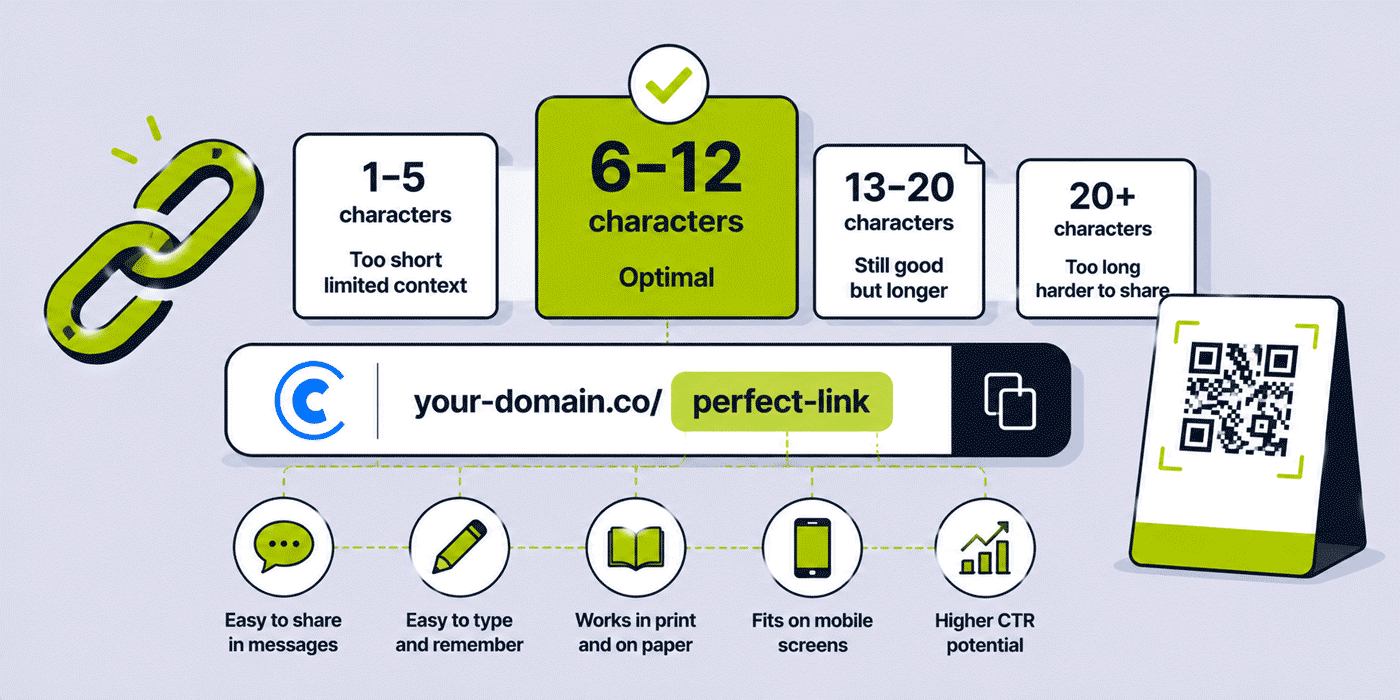
Based on analysis of high-performing branded short links across marketing, B2B communications, nonprofit appeals, and consumer retail, the effective slug length range for most intentionally designed links is 4 to 20 characters, with different sub-ranges optimal for different contexts.
Slug Length Reference Table
| Length (chars) | Example | Best for | Avoid for |
|---|---|---|---|
| 1–3 | go, buy | Root/vanity, one-time campaigns, broadcast ads | Most general use (too limited namespace) |
| 4–6 | sale, event | Single-word CTAs, broadcast media, maximum brevity | Complex campaigns needing channel distinction |
| 7–12 | summer26, donate-now | Campaign links, email CTAs, social bio links | Print at large sizes where word wrapping could occur |
| 13–20 | spring-campaign-2026 | Named campaigns, per-channel tracking, internal docs | SMS (character economy), broadcast spoken URL |
| 21–35 | summer-launch-email-newsletter | Operational/internal links, API campaign management | Any user-facing context — too long to read quickly |
| 36+ | 2026-q3-summer-product-launch-email | Internal reference only | Any public or user-facing use |
The 7–12 character range is the practical sweet spot for most campaign and marketing links. Long enough to be descriptive (incorporating a campaign name or channel identifier), short enough to look clean in email, social posts, and digital display. Beyond 20 characters, a slug begins to undermine the "short" value proposition — a 30-character slug on a 15-character branded domain produces a 46-character total URL that is no shorter than many original URLs.
Descriptive vs Random Slugs: CTR Evidence
The slug psychology research documents a consistent finding: descriptive slugs outperform random slugs in click-through rate for branded communications. The mechanism is trust — a recipient who can see that the link goes to go.brand.com/summer-sale rather than go.brand.com/x7Qz9m has more confidence about where the link leads. That confidence reduces hesitation, and reduced hesitation increases clicks.
The effect is largest in contexts where the slug is visible and the recipient has a moment to inspect it: email (where hovering shows the full URL in a desktop client), messaging platforms (where links preview before clicking), and print (where the URL is visible as text). The effect is smallest in contexts where the link is activated without inspection: QR Codes (the user scans without seeing the URL), API-generated automated flows, and deep links that open apps directly.
Quantifying the CTR effect of slug descriptiveness precisely is difficult because it interacts with other variables (domain trust, message content, sender reputation). Studies of email marketing campaigns comparing identical messages with descriptive versus random slugs on branded domains typically show 5% to 15% higher CTR for descriptive slugs. The effect is larger for cold or unfamiliar audiences and smaller for warm, loyal audiences who already trust the sender regardless of slug.
Important nuance: the CTR benefit of a descriptive slug only realises if the description is accurate. A slug like go.brand.com/exclusive-offer that leads to a generic homepage rather than an exclusive offer creates a trust violation — the link is perceived as deceptive. The descriptive slug must accurately reflect the destination. Accurate descriptions build trust; inaccurate ones erode it.
Channel-Specific Optimal Slug Length
Digital Channels: Email, Social, Messaging
In email, the link's slug is visible to recipients who hover over it in desktop clients, or can see it in the plain text version. The optimal slug length for email campaign links is 8 to 15 characters — long enough to be descriptive (identifying the campaign and ideally the channel), short enough to look professional and not overwhelming. Email subject lines and preview text have character limits; link URLs in email body text do not, but excessively long URLs in visible text reduce visual cleanliness.
For social media posts — Twitter/X, LinkedIn, Facebook — the platform typically shortens any URL to a display version regardless of actual length. However, in contexts where the URL is visible (Instagram bio, TikTok bio, captions that show the URL), slug length is user-visible and readability matters. Bio links on Instagram and TikTok should use short, clear slugs: 4 to 10 characters is ideal.
For messaging apps (WhatsApp, Telegram, iMessage, Signal), links often show a preview card that renders the destination page title and image — in these contexts, the slug itself matters less to the recipient because they are previewing the destination. However, the slug is still visible in the text of the message before the preview loads. A clean, descriptive slug maintains professional appearance even in messaging contexts.
SMS: Character Economy Matters
SMS has a hard character limit of 160 characters for a single segment message (in GSM-7 encoding). Longer messages are delivered as multi-part messages, each segment incurring a separate cost with SMS providers. Short link length directly affects SMS character economy.
The math: a branded domain URL of go.yourbrand.com/slug uses: 19 characters for the domain + the slug length + 1 for the slash. With a 6-character slug: 26 characters. With a 15-character slug: 35 characters. In a 160-character SMS message where the URL must be short enough to leave room for the message content, the difference between a 6-character and 15-character slug is meaningful.
For SMS-specific short links, aim for 4 to 8 character slugs. A service reminder SMS: "Your MOT is due soon. Book online: go.garagename.com/mot-book — ABC Garage" — the 8-character slug keeps the URL to 27 total characters, leaving 133 characters for the message content within the single-SMS threshold.
Print and Offline: Typability Requirements
Print links that must be typed by a recipient — URLs on leaflets, posters, business cards, packaging, vehicle wraps — have the strictest slug requirements of any use case. The recipient reads the URL, retains it in working memory, switches to a device, and types it. Every additional character increases the probability of a typing error and the cognitive load of remembering the string.
Research on working memory and digit/word sequence retention (Miller's Law and subsequent work) indicates that humans can reliably retain approximately 7 items (±2) in working memory — the "magic number seven." For short link typability, this suggests that a slug of 7 or fewer meaningful units (characters or words) is in the reliable range for type-from-memory without error. Random alphanumeric strings are harder to retain than meaningful words — x7Qz9m (6 characters but 6 random items) is harder to remember than donate (6 characters, 1 meaningful word).
For print links: word-based slugs (hyphenated short words) are more typeable than alphanumeric codes. go.charity.org/give is more typeable than go.charity.org/dN3m9p despite being the same total length. For print contexts, prefer dictionary words and short compound words over alphanumeric codes regardless of length.
Maximum practical slug length for print typability: 15 characters (a two-word hyphenated phrase like summer-sale is 11 characters; a three-word phrase like book-your-place is 15 characters — both reliably typeable). Beyond 20 characters, print typability becomes significantly impaired for general audiences.
Spoken in Broadcast Media: Voice URL Constraints
URLs in radio, podcast, and television advertising must be speakable, hearable, and memorable from a single hearing. These constraints are the most restrictive of any channel. The spoken URL must: be pronounceable without ambiguity (no characters that sound like multiple letters), be memorable from a 15 to 30 second ad, and be typeable from memory on a phone while the listener is in a car or engaged in another activity.
For broadcast spoken URLs: maximum 2 to 3 short words, all dictionary words, no hyphens needed when speaking (the domain and words are spoken as separate elements). Examples: "Visit yourshop-dot-com slash sale." "Text or go to go-dot-brand-dot-com slash summer." The slug should be a single memorable word for maximum effectiveness: /sale, /book, /apply, /win.
The domain length matters enormously for broadcast: a long branded subdomain like go.yourbrand.com has 15 spoken syllables ("go dot your brand dot com") before the slug is even reached. For broadcast specifically, a dedicated short domain of 2 to 3 syllables is optimal: brand.link/sale (4 spoken syllables + 1 for slug) versus go.yourbrand.com/sale (8 syllables).
QR Codes: Slug Length and QR Complexity
QR Codes encode the full URL string — including the domain and the slug. Longer URLs encode into more complex QR Codes with more dots in the pattern. More complex QR Codes require larger physical sizes to scan reliably. For small-format print applications (business card QR Codes, packaging label QR Codes), URL length meaningfully affects minimum viable QR Code size.
Quantifying the effect: a URL of 20 characters at error correction level H encodes into a Version 3 QR Code (29×29 modules). A URL of 50 characters at the same error correction level encodes into a Version 5 QR Code (37×37 modules) — approximately 62% larger in terms of module count, requiring 62% larger physical dimensions to maintain the same module size and therefore scanning reliability.
For small-format print (business cards printed at standard size, product labels), keeping the total URL under 25 to 30 characters produces a QR Code that can be reliably printed and scanned at sizes as small as 2 cm × 2 cm. URLs over 50 characters require QR Codes of 3 cm × 3 cm or larger at the same error correction level.
Since the recipient does not type or read the URL in a QR Code context — they just scan — the human-readability argument for descriptive slugs is weaker for QR-only links. However, the URL length argument for QR Code quality is strong: keep QR-targeted slugs short (4 to 10 characters) to maintain manageable QR Code complexity and smaller physical print size requirements.
API-Generated Links: Programmatic Slug Design
When short links are created programmatically via API — for product catalogues, CRM integrations, automated campaign generation — slug design is a code-level decision that affects the entire link portfolio's organisation and searchability.
The recommended approach for API-generated slugs: derive the slug from the entity's stable identifier, truncated or formatted to a standard length. For product links: the product SKU, truncated to 12 characters (prd-SKU00123). For CRM deal links: the deal ID (deal-123456). For article links: the article slug truncated to 20 characters (summer-sale-guide from summer-sale-complete-guide-2026).
This approach produces slugs that are: identifiable (the entity type is clear from the prefix), searchable in the dashboard (search "prd-" to find all product links), and idempotent (the same entity always generates the same slug — preventing duplicate link creation as documented in the API developer guide).
For API-generated links that will appear in user-facing communications (emails, push notifications, SMS), human-readability matters and the slug should be derived from meaningful entity metadata (product name, campaign name) rather than raw database IDs. For internal API links that are processed by systems only, brevity and uniqueness are the only requirements.
Memorability: Word-Based Slugs vs Alphanumeric Codes
Memorability is distinct from typability: a link is memorable if it can be recalled from memory hours or days after seeing it. This matters primarily for broadcast advertising, event presentations, and any context where the recipient will encounter the URL once and then need to act on it later.
Words are significantly more memorable than alphanumeric codes of equivalent character count. The reason: words have semantic meaning that creates a memory anchor. The brain encodes donate as a concept, not as a 6-character sequence. It encodes x7Qz9m as a meaningless sequence — harder to retain and recall accurately.
The memorability hierarchy (most to least memorable per character): common single word > two-word hyphenated compound > short alphanumeric with dictionary word component (win2026) > pure alphanumeric random string (x7Qz9m).
For any slug that needs to be memorised from a single exposure (broadcast, event, presentation), prioritise a common single word or a two-word phrase even if it is longer in characters than the auto-generated random alternative. The recipient will not remember x7Qz9m 10 minutes after a radio ad, but they may remember summer-sale.
The Domain Length Factor: Total URL Length
Slug length should be considered in the context of the total URL length — domain + slug. The brevity goal is the total URL, not the slug alone. A 6-character slug on a 15-character branded domain produces a 22-character total URL. A 6-character slug on a 4-character platform domain produces a 12-character total URL. The same slug produces very different total URL lengths depending on the domain.
Total URL length targets by use case:
- SMS (under 160-char constraint): total URL under 30 characters strongly preferred
- Print typability: total URL under 25 characters ideal, maximum 35 characters
- Broadcast spoken: total URL under 20 characters — 2-syllable domain + 1 word slug
- QR Code (small format): total URL under 30 characters for minimum viable size
- Email and digital: no hard maximum, but under 50 characters maintains visual cleanliness
- Internal/operational: no maximum — clarity and searchability take priority
The implication for branded domain choice: if SMS, print, or broadcast use cases are important to the organisation, the domain used for those channels should be as short as possible. A dedicated short domain of 8 to 12 characters leaves the most character budget for a meaningful slug within total URL constraints. This is one of the practical arguments for registering a dedicated short domain rather than using a long branded subdomain for high-constraint channels.
Naming Convention: Consistent Slug Structure
Individual slug length decisions are improved by a consistent naming convention that establishes standard slug structures for each link type. Without a convention, different team members create slugs with different lengths, different separator characters, and different information structures — making the link library unsearchable and analytics comparisons unreliable.
Recommended naming convention elements:
- All lowercase:
summer-salenotSummer-Sale - Hyphens as word separators:
spring-launch-2026notspringlaunch2026orspring_launch_2026 - Campaign-channel format for tracked links:
summer26-email,summer26-instagram - Short but complete campaign identifier:
summer26notsummer(ambiguous across years) and notsummer-2026-campaign(unnecessarily verbose) - Avoid dates in evergreen links: a booking page linked as
book-june2026appears outdated by July; usebookfor any link intended for long-term use
The convention produces a slug length distribution that naturally falls in the optimal range for each use case — campaign tracking slugs in the 7-15 character range, evergreen service links in the 4-8 character range, and internal operational links in any length that clearly identifies the content.
Practical Recommendations by Use Case
Email campaign CTA link: 8 to 15 characters, descriptive, campaign-channel format. spring26-email (13 chars). Slug visible in hover, descriptiveness supports click confidence.
Direct mail / leaflet (typeable): maximum 15 characters, dictionary words only, ideally a single recognisable word or two-word phrase. donate, book-now, get-started. Human must type this from the printed page.
Business card (QR Code only): 4 to 8 characters for minimal QR Code complexity. jane, portfolio, enquiry. Slug not typed; QR Code size is the constraint.
Vehicle wrap or billboard QR Code: same as business card — brevity for QR Code quality and appropriate size at vehicle or billboard scale.
Radio/podcast broadcast: 1 to 4 characters, single dictionary word, phonetically unambiguous. join, win, shop, give.
SMS campaign link: 4 to 8 characters, total URL under 30 characters. Check total character economy for the full message.
Social media bio link (Instagram/TikTok): 4 to 10 characters, recognisable. links, bio, shop. A Link in Bio page behind the bio link, aggregating all destinations, removes the need for per-campaign bio link updates.
API-generated product links: entity-derived, typically 8 to 15 characters. prd-SKU00123 for a product, deal-45678 for a CRM deal. Prioritise identifiability and idempotency over brevity.
Google Business Profile: 4 to 10 characters, clear destination identifier. book, menu, reviews, location.
Slug Design Across a Campaign's Full Link Set
In practice, slug design decisions are not made for individual links in isolation — they are made for sets of related links that share a campaign, a product, or a purpose. A summer campaign that deploys 8 links (email, Instagram bio, Instagram Stories, Facebook, TikTok, SMS, direct mail QR Code, event flyer QR Code) needs 8 slugs that are individually distinct, collectively identifiable as the same campaign, and each optimised for its specific channel's constraints.
The campaign slug set design framework:
- Establish the campaign root: a 5 to 8 character identifier for the campaign:
sum26(summer 2026),xmas26(Christmas 2026),spring(spring campaign). Shorter is better — this is the repeated prefix in every channel slug. - Append the channel suffix from the standard list:
sum26-email(10 chars),sum26-ig(8 chars),sum26-sms(8 chars),sum26-flyer(10 chars). - Validate each slug against its channel's constraint: check the SMS slug's total URL length (domain + slug + characters in message), check the flyer QR Code's total URL length for QR Code complexity.
- For QR Code channels, calculate QR Code version: use the total URL length to estimate the QR Code version required at error correction H. If the required version exceeds what is printable at the planned QR Code size, shorten the campaign root or use a shorter domain.
This systematic approach ensures slug consistency across the full campaign link set, makes analytics filtering reliable (search sum26 to see all summer campaign links), and catches constraint violations before any link is deployed — preventing the post-deployment discovery that the SMS link is 5 characters too long for a single-segment message.
The Character Budget: Calculating What You Have
The "character budget" concept makes the slug length decision concrete: given the constraints of a specific channel and use case, how many characters are available for the slug?
SMS character budget calculation:
- Total SMS segment: 160 characters (single segment, GSM-7)
- Domain length: 20 characters (e.g.
https://go.brand.com/) - Message template (fixed text): 100 characters (estimated for a complete service reminder message)
- Remaining for slug: 160 - 20 - 100 = 40 characters. The slug can be up to 40 characters without pushing the message to a second SMS segment.
In this example, 40 characters for the slug is generous — almost no marketing use case requires a 40-character slug. But if the domain were 35 characters (https://go.yourlongerbrandname.com/) and the message template 110 characters, the slug budget drops to 15 characters — and slug design decisions begin to bite.
Print typability budget: research on working memory retention and typing error rates at various string lengths suggests a practical limit of 10 to 15 meaningful characters (word-based) before error rates increase significantly for general audiences typing from a printed source. With a 20-character domain, the total typeable URL should not exceed 35 to 40 characters — leaving 15 to 20 characters for the slug.
QR Code size budget (small-format print): with a minimum print size of 2.5 cm × 2.5 cm for reliable scanning, error correction level H, and a total URL of 20 characters (Version 2, 25×25 modules) versus 35 characters (Version 4, 33×33 modules) versus 60 characters (Version 6, 41×41 modules) — each additional 10 to 15 characters in the URL adds approximately one QR Code version, increasing the required print area by approximately 5 to 8 modules per dimension. For business card QR Codes (2.5 cm available), 20-character total URL is preferable; for A5 leaflet QR Codes (3+ cm available), 35 to 40 character total URL is workable.
When Slug Length Limits Make Sense: Link Expiry and Rotation
Two Cuttly features interact with slug length in ways worth understanding: link expiration and link rotation (A/B testing).
Link expiration and slug reuse: a slug that expires can be reused for a new destination. A Christmas campaign slug (christmas) that expires on January 15 can be reassigned to next year's Christmas campaign without any conflict in the URL namespace. This means high-value short slugs — common words with high memorability — can be reused across campaign cycles rather than accumulating year-specific variants (christmas2024, christmas2025, christmas2026). The tradeoff: expired and reused slugs lose historical analytics continuity. For campaigns where year-over-year analytics comparison is valuable, year-specific slugs are preferable. For one-shot campaigns where historical continuity is irrelevant, short reusable slugs are more efficient.
Link rotation (A/B test) and slug design: Cuttly's link rotation feature (A/B test, available from the Single plan) sets alternative destination URLs for a single short link — the same slug routes different visitors to different destinations based on the configured split. The slug design implication: when running an A/B test on a short link, the slug should reflect the campaign without implying a specific destination variant, since the slug is shared across both (or all) destinations. summer-cta-test is a better slug for an A/B test than summer-sale-page-v1, which implies specificity to a variant. The slug names the campaign; the rotation configuration determines the destination.
The Relationship Between Slug Length and Trust Signalling
Beyond CTR, slug length has a secondary trust signalling function that varies by context. Specifically: very short slugs (1 to 3 characters) can appear dismissive or automated — not designed with care for the recipient. Very long slugs (30+ characters) can appear unstructured, as if the link was hastily created without a naming convention. Medium-length descriptive slugs (8 to 15 characters) in a consistent naming format signal professional intentionality — someone considered what this link should be called and followed a consistent system.
This trust signal is subtle but accumulates over repeated exposure. A brand that consistently distributes short links with clean, consistent, 8 to 12-character descriptive slugs on a recognisable branded domain is building a digital communications identity. A recipient who has seen go.brand.com/summer26-email, go.brand.com/autumn26-email, and go.brand.com/winter26-email across multiple campaigns recognises the pattern instantly — and that pattern recognition is itself a trust signal. The link looks like what the sender always sends.
This accumulated trust from consistent slug structure is why naming conventions matter: they produce not just a manageable internal link library but an externally consistent digital identity. The recipient's recognition of the pattern is the marketing benefit of the internal discipline. Inconsistent slugs — a mix of random strings, dated variants, and ad-hoc descriptions — produce no such recognition and accumulate no trust benefit regardless of the individual slug quality.
The practical conclusion: design slugs as part of a system, not as individual decisions. A naming convention that produces consistent, channel-appropriate, descriptive slugs in the 7 to 15-character range for campaign links — applied consistently across every link in every campaign — produces both operational benefits (searchable, filterable link library, reliable campaign analytics aggregation) and external trust benefits (recognisable, consistent digital communications identity). Both benefits scale with consistency and compound over time. Neither benefit is achievable through individual good-slug decisions without the systematic structure that a naming convention provides.
International and Non-ASCII Slug Considerations
For organisations distributing short links to international audiences — or for organisations based in non-English-speaking markets — slug design has an additional dimension: whether to use ASCII characters (English alphabet, digits, hyphens) or localised characters from the relevant alphabet.
ASCII slugs are universally compatible: they display correctly in all URL bars, email clients, SMS applications, and print typesetting without encoding issues. Non-ASCII slugs (using characters like ñ, ü, é, or non-Latin scripts) must be percent-encoded in the actual URL, which can expand the effective URL length significantly — a 5-character slug using accented characters may encode to 15+ characters in the URL's wire format, affecting QR Code complexity and SMS character budgets.
For display purposes, modern browsers show the decoded (human-readable) form of IDN and percent-encoded URLs in the address bar — a user sees go.brand.com/лето (Cyrillic for "summer") rather than the percent-encoded form. But the underlying URL is percent-encoded; the character budget implications must be calculated on the encoded length, not the display length.
Practical recommendation for international use: use ASCII equivalents or transliterations for slugs where possible (the display is universally compatible and the character budget is predictable), and reserve localised slugs for contexts where the localised spelling provides a significant brand or recognition benefit that justifies the encoding overhead.
Frequently Asked Questions
What is the ideal length for a short link?
For most digital channels: 4 to 8 characters produces maximum brevity; 8 to 15 characters balances brevity with campaign identification. For print typability: up to 15 meaningful characters (word-based slugs). For QR Codes: under 30 total URL characters. For broadcast/spoken: 1 to 4 character single word. For API-generated links: entity-derived, 8 to 15 characters preferred.
Does slug length affect click-through rate?
Slug descriptiveness affects CTR (5–15% higher for descriptive vs random slugs in branded email communications), but raw length matters less than meaning. A 15-character descriptive slug typically outperforms a 6-character random one. The slug must accurately reflect the destination — inaccurate descriptive slugs erode trust.
How short can a short link slug be?
In Cuttly, custom aliases have a minimum of 3 characters. Single-character slugs are possible on branded domains with full alias namespace control. Practically, slugs under 3 characters are rarely worthwhile — the marginal brevity gain is minimal and the loss of descriptive capacity is significant.
- Tools
- URL Shortener →
- Link Analytics →
- Related Guides
- Slug Psychology & CTR →
- What Is a Branded Short Link? →
- How to Create a Branded Short Link →
- QR Code Best Practices 2026 →
- 47 URL Shortener Best Practices →
- URL Shortener API Guide →
- A/B Test Links Guide →
- Short Link Best Practices (Agencies) →
- Encyclopedia
- Branded Links
- Start Here
- Create Free Account
- Plans & Pricing
URL Shortener
Cuttly simplifies link management by offering a user-friendly URL shortener that includes branded short links. Boost your brand’s growth with short, memorable, and engaging links, while seamlessly managing and tracking your links using Cuttly's versatile platform. Generate branded short links, create customizable QR codes, build link-in-bio pages, and run interactive surveys—all in one place.
Cuttly - Consistently Rated
Among Top URL Shorteners
Cuttly isn’t just another URL shortener. Our platform is trusted and recognized by top industry players like G2 and SaaSworthy. We're proud to be consistently rated as a High Performer in URL Shortening and Link Management, ensuring that our users get reliable, innovative, and high-performing tools.


