URL Shortener for AI Companies The Complete Guide
AI companies operate in one of the fastest-moving and most attention-contested spaces in the technology industry. A model release, a research paper, a product launch, or a capabilities demonstration that generates significant community interest on a Monday can be displaced from the conversation by a competitor announcement by Wednesday. In this environment, the speed and professionalism with which an AI company distributes its announcements — including the quality and clarity of the links through which people access those announcements — affects how much of the available attention window the company captures.
This guide covers how AI companies — foundation model developers, AI application startups, machine learning infrastructure providers, AI research labs, and enterprise AI solution providers — use a URL shortener, branded custom domain and click analytics across product launches, research paper distribution, API sign-up campaigns, developer community engagement, conference presence, investor communications, and the full range of channels through which an AI company builds and maintains its presence in a rapidly evolving market.
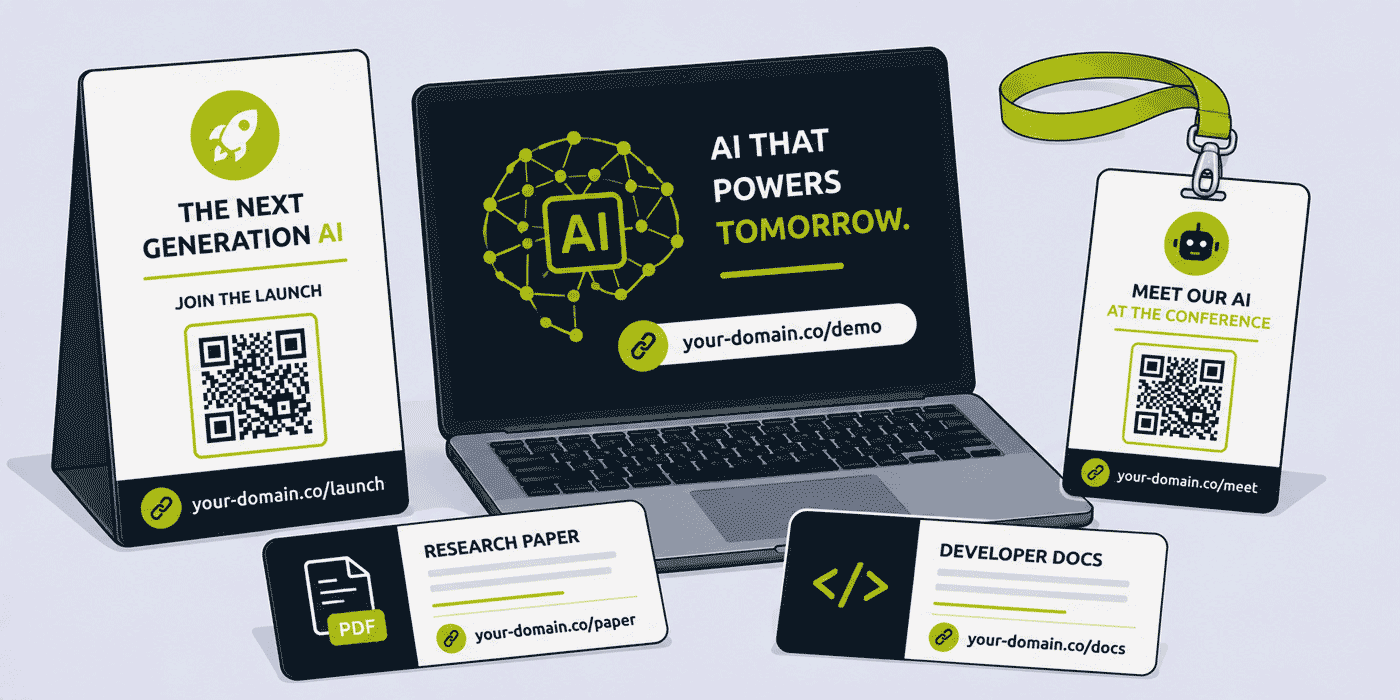
What This Guide Covers
- Product launch and model release links — maximizing the attention window
- Research paper and technical blog distribution links
- API sign-up and developer onboarding links
- Developer community engagement — GitHub, Colab, documentation links
- Conference, hackathon and demo links
- Investor and press communication links
- Waitlist and early access programme links
- Per-channel growth attribution for AI SaaS products
- Partner and integration ecosystem links
- Content and thought leadership distribution links
- A worked example: an AI startup's link stack across a model launch
- Common mistakes in AI company link management
- A Cuttly plan guide for AI companies
- Frequently asked questions
Product Launch and Model Release Links
An AI product launch or model release is a concentrated attention event. The community interest generated by a significant capability announcement peaks within hours of the first post on X/Twitter, Hacker News, or LinkedIn, and then decays rapidly as the next announcement captures the conversation. Managing the links associated with a launch is therefore a time-sensitive operation: every link needs to be ready before the announcement goes live, and every link needs to work perfectly from the first second the announcement is public.
Pre-Launch Link Preparation
An AI company should prepare the full launch link set before any announcement is made, with destinations configured and tested in advance:
your-ai.com/launch— the primary launch announcement page or product pageyour-ai.com/demo— the interactive demo or live capability demonstrationyour-ai.com/api— the API documentation and sign-up pageyour-ai.com/paper— the technical paper or research report accompanying the launchyour-ai.com/blog-launch— the company blog post announcing the launch
Having these links ready before the announcement means that the founding team's tweet thread, the company LinkedIn post, the Hacker News Show HN post, the Discord announcement, and the tech newsletter mention can all go live simultaneously with clean, professional, on-brand links rather than the long, auto-generated URLs that most product launch pages produce.
Per-Channel Launch Attribution
For AI companies that have built distribution across multiple channels — a strong Twitter/X following, a developer community on Discord, a tech newsletter subscriber base, and a LinkedIn presence — per-channel launch links provide the attribution data to understand where the launch audience actually comes from:
your-ai.com/launch-twitter— Twitter/X announcement postsyour-ai.com/launch-hn— Hacker News Show HN postyour-ai.com/launch-linkedin— LinkedIn company and founder postsyour-ai.com/launch-newsletter— email newsletter to subscribersyour-ai.com/launch-discord— community Discord announcement
The relative click volumes across these channels in the first 24 hours of the launch give the growth team the most real-time channel attribution data available, independent of each platform's own analytics. Over multiple launches, the pattern of which channels consistently deliver the most launch-day traffic builds into an evidence base for where to invest in growing distribution before the next major announcement.
Research Paper and Technical Blog Distribution Links
For AI research companies and labs, research publications are a primary marketing and credibility-building asset. A significant paper on a new architecture, a benchmark result, a safety finding, or a capability advancement generates community attention, press coverage, and commercial credibility that paid advertising cannot replicate. The distribution of research publications therefore deserves the same link management attention as a product launch.
Paper Distribution Links
A branded short link for each major paper or technical report — your-ai.com/paper-name or your-ai.com/arxiv-2026-01 — is used in the paper announcement thread, in the academic email list distribution, in the company newsletter feature, and in any partner or collaborator who shares the finding. Because papers are hosted on arXiv, on the company's own website, and sometimes on multiple platforms simultaneously, a dynamic short link can point to the best available version of the paper at any given time — the arXiv preprint initially, the peer-reviewed published version once available, and an accessible explainer blog post for the non-technical audience simultaneously through a choice page.
Click analytics for paper distribution links give the research team and communications team visibility into how much interest each publication generates and from which channels. A paper that generates significantly more clicks from the practitioner community (Twitter, Reddit ML communities) than from the academic community (email lists, Semantic Scholar) may indicate a finding with high commercial application relevance; a paper generating more academic than practitioner engagement suggests a more fundamental research contribution. This audience mix data informs how the company positions subsequent publications for different audiences.
API Sign-Up and Developer Onboarding Links
For AI companies that monetize through API access, the API sign-up conversion is the primary commercial metric. A developer who discovers the API through a tutorial, a comparison article, a Hacker News comment, or a conference demo needs a friction-free path to the sign-up page and to the first working API call. Every additional step or navigation decision between discovery and first call reduces conversion.
API Sign-Up Attribution Links
The API sign-up page link is the most commercially important link an AI API company manages, and per-channel attribution for this link provides the growth team with direct insight into where developer discovery is happening:
your-ai.com/api-docs— developer who navigated from documentationyour-ai.com/api-hn— Hacker News discoveryyour-ai.com/api-tutorial— third-party tutorial or comparison articleyour-ai.com/api-conference— conference demo or workshop CTAyour-ai.com/api-partner— integration partner referral
All pointing to the same API sign-up page. Click analytics per channel combined with the sign-up platform's own conversion data gives the growth team a per-channel click-to-sign-up rate. A developer who finds the API through a tutorial is typically more conversion-ready than one who encounters it through a general tech news article, and this difference in conversion rate is measurable only with per-source attribution data.
Documentation and Quickstart Links
Developer documentation is a product in itself for API-first AI companies, and the accessibility and quality of the documentation directly affects developer adoption rates. Short links for key documentation entry points — your-ai.com/quickstart, your-ai.com/docs, your-ai.com/api-reference — are used in developer communications, in support responses, in community forum answers, and in any educational content about the API. Because documentation structures change as APIs evolve, dynamic short links for documentation entry points ensure that any historical reference to the quickstart guide or API reference continues to reach the current version.
Developer Community Engagement Links
Developer community engagement is a primary growth channel for many AI companies, particularly those with API products and open-source components. The developer community's trust is built through technical credibility demonstrated in code, documentation, and working examples. Links to working demonstrations, usable code samples, and well-organized technical resources carry significant weight in the developer audience.
Demo Notebook and Sample Links
A branded short link for each major code sample, Colab notebook, or interactive demo — your-ai.com/demo-colab, your-ai.com/sample-classification, your-ai.com/playground — is used in tutorial content, community forum answers, and social media posts featuring the working example. These links are cleaner than raw GitHub or Colab URLs, remain valid if the notebook is moved to a different hosting location, and provide click analytics showing which technical resources generate the most developer engagement.
For AI companies releasing open-source models on HuggingFace, the HuggingFace model page URL is straightforward but long, and a branded short link — your-ai.com/hf-model-name — provides a more professional and memorable reference for the model in social media posts, paper citations, and community discussions.
Conference, Hackathon and Demo Links
AI conferences — NeurIPS, ICML, ICLR, AI Summit, and countless specialist events — are where the AI community's attention converges, where research findings are presented, and where commercial relationships between AI companies and enterprise buyers, investors, and partners are initiated. A well-managed conference presence includes QR Codes and short links at every physical and digital touchpoint.
Conference Booth and Session Links
An AI company with a conference booth or a paper presentation creates a conference-specific short link for the event: your-ai.com/neurips-2026 pointing to a landing page featuring the company's presentation, the paper being presented, a live demo access link, and a meeting booking page for enterprise conversations. This single link is displayed on the booth display, on the presentation slide, on printed booth materials, and mentioned in any pre-conference social media announcing the company's attendance.
After the conference, the destination is updated to a post-conference summary page — a blog post recapping what was shared, links to the paper and demo, and an invitation to continue the conversation. Conference attendees who bookmarked or saved the booth QR Code continue to be served relevant content after the event rather than reaching a dead conference landing page.
AI Hackathon and Challenge Links
Many AI companies sponsor or run hackathons and model evaluation challenges as a developer acquisition and community building strategy. A short link for the hackathon registration — your-ai.com/hackathon or your-ai.com/challenge-2026 — is used in all hackathon promotion across social media, developer communities, university partnerships, and email outreach. Click analytics for the hackathon link across different promotion channels show the team which channels generate the most active developer community engagement.
Investor and Press Communication Links
AI companies raising funding and managing press relationships face link management situations with significant commercial stakes. An investor who receives a deck link or a product demo link from an AI startup is making their first practical assessment of the company's operational competence alongside their substantive evaluation of the technology and business model. A broken link, a generic shortener domain, or a link that leads to a poorly organized page creates a negative first impression at a moment when every detail matters.
Investor Deck and Data Room Links
A branded short link for the investor presentation — your-ai.com/investor-deck or your-ai.com/raise-2026 — in investor outreach emails presents a professional, controlled access point that reflects the company's own brand rather than an unfamiliar document-sharing platform URL. Because pitch decks are updated frequently during an active fundraise — as metrics are updated, as term sheet conversations evolve — a dynamic short link means the investor always accesses the current version of the deck without requiring a re-send.
Click analytics on investor deck links — aggregated and anonymized — give the founding team a picture of which investors have actively engaged with the materials before a meeting, informing where to focus preparation energy. An investor who has accessed the deck three times in the week before a meeting is more likely to have specific questions than one who has not yet opened it; the meeting preparation can be calibrated accordingly.
Press Kit and Technical Evaluation Links
Press contacts evaluating a new AI company or product need access to a media kit containing the company's background, the product's capabilities, benchmark results, executive headshots, and product screenshots. A branded short link for the press kit — your-ai.com/press or your-ai.com/media-kit — provides a professional, stable access point that remains valid as the press kit is updated. Click analytics show which press contacts are actively accessing materials before coverage is published.
Waitlist and Early Access Programme Links
Waitlists and early access programmes are standard user acquisition tools for AI companies in pre-launch or controlled rollout phases. A waitlist link that goes viral in the AI community can generate thousands of sign-ups in hours if the product generates genuine excitement. Managing this link well — ensuring it is branded, stable, and has per-channel attribution when the waitlist is promoted across multiple channels — is an early growth management priority.
A permanent waitlist link — your-ai.com/waitlist or your-ai.com/early-access — is used in all pre-launch communications. When the waitlist converts to open access, the link destination is updated to the sign-up or product page; every existing reference to the waitlist link automatically becomes a live product link without any change to previously published posts, articles, or community threads.
A Worked Example: An AI Startup's Model Launch Link Stack
Consider an AI startup launching a new multimodal reasoning model, using a branded domain such as your-ai.com, connected through Cuttly's custom domain setup (an A record and a TXT record — see the custom domain setup guide).
48 hours before launch: The team prepares five core launch links: /model-name (product page), /model-paper (arXiv preprint), /model-demo (interactive demo), /api (API sign-up), /model-colab (Colab notebook with usage examples). Per-channel variants are created for the three primary announcement channels: /model-twitter, /model-hn, /model-newsletter.
Launch morning: All links go live simultaneously. The founding team's Twitter thread uses /model-twitter; the Hacker News Show HN post uses /model-hn; the 8am newsletter send uses /model-newsletter. Within 6 hours: HN generates 2,100 clicks (highest volume, strong developer intent), Twitter generates 4,800 clicks (highest volume overall but lower per-click intent), newsletter generates 340 clicks with the highest click-to-API-sign-up conversion rate at 31%.
Investor outreach: Fifteen target investors receive outreach emails with /investor-deck. After 72 hours, 9 investors have clicked the deck link. The founder's assistant schedules prep calls before each meeting for investors who have accessed the deck twice or more, indicating active evaluation.
Post-launch: The arXiv preprint is accepted to a conference three months later. /model-paper destination is updated from the arXiv preprint to the published proceedings version. Every community post, tweet, and blog article that referenced the preprint link automatically now points to the peer-reviewed version.
Common Mistakes in AI Company Link Management
No Pre-Launch Link Preparation
An AI company that scrambles to create shareable links at the moment a launch is announced misses the first hours of the attention window — often the highest-traffic period for any AI announcement. Having branded, tested launch links ready before the first post is published captures the full attention spike rather than losing early traffic to broken or unready links.
Raw GitHub and Colab URLs in Community Posts
A developer community post or tutorial that uses raw GitHub, Colab, or HuggingFace URLs loses the tracking and stability benefits of branded short links. A branded short link in a tutorial or community post is more professional, provides analytics showing how many developers engaged with the resource, and remains valid if the resource is moved to a different platform or path.
No Investor Deck Link Analytics
An AI startup sharing a pitch deck without tracking which investors have accessed it is missing one of the clearest pre-meeting signals available about investor engagement level. Click analytics on investor deck links give the founding team information that directly improves meeting preparation and follow-up prioritization during an active fundraise.
Cuttly Plan Guide for AI Companies
- The Free plan ($0) provides 30 short links per month, one branded custom domain, full click analytics and dynamic QR Codes, with no credit card required. Suitable for an early-stage AI startup or research lab setting up core launch, paper, and API sign-up links.
- The Starter plan ($12/month) adds 300 short links per month and 30 custom aliases per month — practical for a growing AI company managing multiple product and paper launches per year, per-channel attribution, developer community resource links, and conference presence.
- The Single plan ($25/month) adds up to 5 branded domains for different product lines or research labs within a group, 1,000 API-created links per month for automated per-release link generation, and a full year of analytics history for cross-launch channel performance comparison.
- The Team plan ($99/month) suits larger AI companies with research, product, growth, and communications teams sharing link management, Campaign tag analytics for aggregated launch and paper campaign reporting, multiple branded domains for different product brands, and shared workspaces for globally distributed teams.
Create a free Cuttly account to set up your AI company's launch link, your API sign-up attribution links, and your press and investor kit links. Registration is required for all plans, including free. No credit card is needed for the free plan.
Frequently Asked Questions
How do AI companies use short links for product launches?
An AI company prepares branded short links for each launch asset before the announcement goes live — product page, demo, paper, API sign-up. Per-channel variants allow comparison of which distribution channel drives the most traffic during the launch window. All links are tested and ready before the first announcement post is published.
How do AI research companies use short links for paper distribution?
A branded short link per major paper — your-ai.com/paper-name — is used in the announcement thread, academic email lists, newsletter features, and community posts. Click analytics show how much interest each publication generates across different channels, revealing whether a finding resonates more with practitioners or academic audiences.
How do AI companies track which channel drives the most API sign-ups?
Per-channel API sign-up links — your-ai.com/api-hn, your-ai.com/api-docs, your-ai.com/api-tutorial — all pointing to the same sign-up page. Click analytics combined with sign-up conversion data give a per-channel click-to-developer conversion rate, revealing which discovery channels attract the most motivated developers.
How do AI startups use short links for developer community engagement?
Branded short links for Colab notebooks, GitHub repos, and documentation entry points — your-ai.com/demo-colab, your-ai.com/quickstart — are more professional than raw platform URLs, remain valid if resources are moved, and provide analytics showing which technical resources generate the most developer engagement.
How do AI companies use short links for investor and press communications?
A branded short link for the investor deck — your-ai.com/investor-deck — presents a professional access point in investor outreach and updates to the current deck version dynamically. Click analytics show which investors have actively engaged with materials before a meeting, informing preparation priorities during an active fundraise.
- Get Started
- Create Free Account
- Plans & Pricing
- Platform Tools
- URL Shortener
- Link Analytics
- QR Code Generator
- Campaign Analytics
- Related Guides
- URL Shortener for SaaS Companies
- URL Shortener for IT Companies
- URL Shortener for Mobile Apps
- URL Shortener for Developers
- URL Shortener for PR Agencies
- Setup Guides
- Custom Domain Setup
- API Documentation
- Industry Hub
- Marketing, Sales & SaaS Teams
- All Industries →
URL Shortener
Cuttly simplifies link management by offering a user-friendly URL shortener that includes branded short links. Boost your brand’s growth with short, memorable, and engaging links, while seamlessly managing and tracking your links using Cuttly's versatile platform. Generate branded short links, create customizable QR codes, build link-in-bio pages, and run interactive surveys—all in one place.
Cuttly - Consistently Rated
Among Top URL Shorteners
Cuttly isn’t just another URL shortener. Our platform is trusted and recognized by top industry players like G2 and SaaSworthy. We're proud to be consistently rated as a High Performer in URL Shortening and Link Management, ensuring that our users get reliable, innovative, and high-performing tools.C


